The best of Tom Lubbock, one of Britain's most intelligent, outspoken and revelatory art critics, is collected here for the first time.
There are electrifying insights - using Hitchcock's Suspicion to explore the lighting effects in a Zurbarán still life, imagining three short films to tease out the meanings of El Greco's Boy Lighting a Candle - and cool judgements - how Vuillard's genius is confined to a single decade, when he worked at home, why Ingres is really 'an exciting wierdo'.
Ranging with passionate perspicacity over eight hundred years of Western art, whether it's Giotto's raging vices, Guston's 'slobbish, squidgy' pinks, Géricault's pile of truncated limbs or Gwen John's Girl in a Blue Dress, Tom Lubbock writes with immediacy and authority about the fifty works which most gripped his imagination.
When I was a college student, I took an art history class. Before the first class began, I was excited about it. Unfortunately, it turned out to be a bust - at least for me. The way it was set up was, memorize certain artists and dates, and recognize certain works and know what you're supposed to see in them. Anything else you might see was a no go. I was turned off by that format. It seemed like a memorization game, and a game I had no interest in playing. Over he years, I've tended to find my own way in the world of art (and in music and literature). The downside of that is that there are large gaps (historical and otherwise) in my knowledge of art, which I regret. Usually, though, when there's a downside, there's also an upside. The upside here is that I've discovered worlds of pleasure and enjoyment that I might never have experienced if I had pursued art in a more academic way.
Which brings me to Tom Lubbock's book, Great Works. The format of the book is that fifty paintings are displayed, with an accompanying two page text by Mr. Lubbock after each work. (I should mention that the texts are taken from newspaper columns that Mr. Lubbock wrote over a period of years. I should also mention that the newspaper, the Independent is (or was when Mr. Lubbock's columns were written) unlike any newspaper I know in the U.S. I don't know of any U.S. newspaper that would publish anything like Tom Lubbock's columns.) Mr. Lubbock makes connections that I would never think of - connecting a still life by Juan Sanchez-Cotan with a great story about Tallulah Bankhead; pointing out the way in which Pietro Longhi makes use (or non-use, in this case) of perspective to create social and emotional effects in a painting; commenting that Hopper's Early Sunday Morning "is a view without a viewer" - I can't imagine a more telling comment.
If by some miracle, Tom Lubbock had taught that art history class I took (he'd have been too young to have done so), or if his book had been used as a text (it hadn't been written yet), my path through the worlds of art might have been a very different one. The good news for me is that Great Works has helped to teach me to see paintings in very different ways than I had done so before. For that reason alone, Great Works has a place of honor on my bookshelves.
I have to give a tip of the cap and many thanks to my Goodreads friend Tony, whose review tipped me off to Great Works and led me to buy a copy. Here's his review: https://www.goodreads.com/review/show...
This book is about 50 paintings by 50 artists, each accompanied by personal reflections by Lubbock, a critic who died just this year. The 'reflections' all consider the paintings but in the context of events, styles or histories.
So the odd Painter's Table by Philip Guston, something I would never hang in my dining room, is considered first by examining Pinkstinks, the slogan of a campaign in 2009 opposing the use of the color 'pink' for girls.
How does Daumier paint motion into the human body? Take your clothes off. Yes, all of them. And stand in front of a mirror. Contort yourself. Have someone try, just try, to trace you.
Which "little patch of yellow wall" in Vermeer's View of Delft was Proust talking about in Vol. 5 of Remembrance of Things Past? How is Zurbaran like Alfred Hitchcock? How did Tallulah Bankhead upstage a rival actress without even being on stage? And what does that have to do with the quince, cabbage, melon and cucumber in Sanchez-Cotan's painting of the same name? Masaccio's Adam had his penis exposed for 300 years, then had it covered by leaves for almost 300 more. It's back out in the open now and Lubbock, having looked at it a lot, tells us what it means.
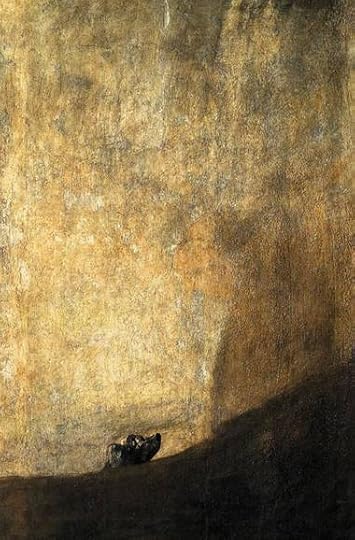
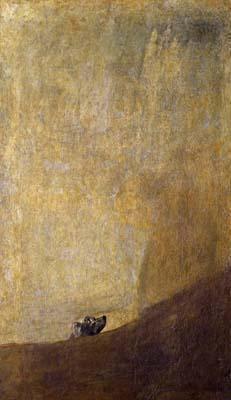
Here is my favorite painting in the bunch, The Dog by Goya:
I was unaware of this piece. But I found it really moving. And I disagree with Lubbock's analysis of meaning. (Am I allowed to do that?). Lubbock notes that there appears to be another shadowy 'figure' above and to the right of the dog. And then he tells us to disregard it. Really? How could we, now? Why would we? I mean, Goya didn't put it there for nothing. But Lubbock is right that the 'figure' appears differently depending on which reproduction you view:
In the reproduction in the book, the 'figure' is barely detectable and maybe appears to be two figures, scraggly like Picasso's Don Quixote, making me think of two soldiers, worn down by war, or a mother and child maybe, walking away, hopeless.
In any event, the painting seemed dystopian to me. Full of sadness. Maybe at the individual, personal level, the dog pining over the one who meant so much and is now gone. But maybe for me at a more historical or allegorical level, as if humanity itself is gone, or could be.
It made me think once again of Saramago's dog Constant in Seeing and listening to Niels-Henning Orsted Pedersen's Those That Were and the feeling I've always had whenever someone I've loved has gone away.
Lubbock is worth reading. His insights have expanded my appreciation. “When we were at school,” Hopper remembered, “we debated debated what a room looked like when there was no one to see it….”
“Early Sunday Morning has the look of a scene that isn’t being looked at. It’s without any particular focus. The eye just scans along it; and nothing in it suggests a human eye observing, noticing, taking and interest. The pole and the hydrant, thing that might stand out as creature-like – a man and a dog, almost – refuse to become protagonists. They are merely two inanimate interrupting fixtures that catch and break the light….There is no point at which the picture gets excited. Nor is it assertively blank, in a surreal or alienated way. It is simply, calmly there. With you or without you, the silent street goes on.”
I have that picture on my wall and often think about what might happen next in that scene.
"Any painting surface is more alive than any face”, Malevich said. The Square is a living royal infant."
•The Hunter, Catalan Landscape 1923-4, Joan Miro
Miró wrote of making a line or a point, just by itself, into something you can feel'. Here outlines and hairlines and stick-lines get muddled up and lose their identities. The feeling of the world becomes unstable. Bodies shift, disintegrate, go solid and threadbare and totally unsubstantial. It's a picture you can sense between your fingers, and you get an uncomfortable metamorphosis of balloon-skins, cheese-wires, bristles, blades and thin air. Mir-world may be a light, jolly, playful place, but - like Struwwelpeter - it has a cruel turn.
•View of Delft 1660, Vermeer
“At last he came to the Vermeer, which he remembered as more striking, more different from anything else he knew, but in which, thanks to the critic's article, he noticed for the first time some small figures in blue, that the sand was pink, and, finally, the precious substance of the tiny patch of yellow wall. His dizziness increased; he fixed his gaze, like a child upon a yellow butterfly that it wants to catch, on the precious little patch of wall. 'That's how I ought to have written, he said. My last books are too dry, I ought to have gone over them with a few layers of colour, made my language precious in itself, like this little patch of yellow wall...He repeated to himself: Little patch of yellow wall, with a sloping roof, little patch of yellow wall.” -À La Recherche du temps perdu, Vol 5
•The Child in the Meadow, detail from Morning 1809, Philipp Otto Runge
In his (Runge) short life he initiated a number of artistic projects that took off in the later nineteenth and twentieth centuries. He explored the growing forms of plants lin semi-abstract silhouettes) and the physics and symbolism of colours (devising the colour-sphere). In The Times of Day he envisaged the 'total work of art', a visual-verbal-musical-installation-experience. ( 🎶Scriabin might be good music pairing ? 😁)
• Sand Dune 1983, Francis Bacon
“To me Art's subject is the human clay, / And landscape but a background to a torso...” - W.H. Auden ( Lubbock describes the painting as being “ in a calm hysteria” - I think it’s a perfect description)
•The Dying Seneca 1612-13, Peter Paul Rubens
What's troubling in the painting is the way it conveys a complete distance between the self, the publicly performing self, and the physically dying body. The philosopher's sturdy body, which dominates the picture, is a mere organism or mechanism - not him, not anything to which he is especially attached.—the body of a disembodied mind.
• Combing the Hair 1896-1900, Edgar Degas
Proust said: 'It is in moments of illness that we are compelled to recognise that we live not alone but chained to a creature of a different kingdom, whole worlds apart, who has no knowledge of us and by whom it is impossible to make ourselves understood: our body. It is not only in moments of illness. It is everyday, several times a day, when we comb our hair, when we dry our backs, when we wipe our bottoms. hope no children are reading this, but those are the facts of life.
• The Expulsion from Paradise (detail) c.1425, Masaccio
Jean-Paul Sartre noted with compunction that the penis is not a fine, prehensile organ, rippling with muscles. Its behaviour is biological and autonomous But others have found Augustine's idea of arousal at will an even more horrible thought: ‘acrobatic prostitution', William Empson called it. …But if Masaccio is following Augustine, then the penis in this picture is a penis that has just acquired a life of its own. Its behaviour is no longer under the command of its owner. It is twitching into autonomous activity.
• Study of Truncated Limbs 1818-19, Théodore Géricault 🎨
In his philosophical study on laughter, Le Rire, Henri Bergson said that the definition of comedy was the triumph of dead matter over living spirit. A man falls over in the street. A person is a slave to their bodily needs. A character is fixed in a repetitive psychological pattern. These are basic comic situations. We laugh whenever human behaviour is rigid, compulsive, automatic. We laugh every time a person gives the impression of being a thing." In his book The Act of Creation, Arthur Koestler was having none of this. He retorted: If we laugh each time a person gives the impression of being a thing, there would be nothing more funny than a corpse.' A good knockdown answer. But it's not quite the last word. For the fact is, corpses are funny. … Study of Truncated Limbs brings out the full troubling ambiguity of the corpse. It plays life against death, person against thing, loving gesture against rigor mortis, caressing touch against ruined flesh and open wounds. The most gentle human situation, and the most brutal, are brought together. Sustaining it all there's a kind of pun, in the deceptive similarity between the sleep of satisfied desire and the inertia of death.
•Lucretia 1664, Rembrandt van Rijn
This is an image of someone whose life has moved outside human reach and understanding. She does't act out a moment of decision or crisis. The action of the figure has a slow drift, a slow sideways sway to it. Imagine the right hand held no knife, and was held up empty like the left hand is. It wouldn't be a suicide picture. It would be a picture of someone dancing - alone, gently, dreamily, with herself. Lucretia, or the Last Waltz.
• 1025 Colours 1973, Gerhard Richter
One should never underestimate the power of meaninglessness. Late-twentieth-century art certainly didn't. The painted void, the wholly meaningless, utterly indifferent picture, became a quest. One common solution was extremely minimal: the monochrome', the single coloured canvas. Another, still more powerful, was a bit more maximal. It involved a multitude of colours. … So this wholly indifferent composition performs like a great classical masterpiece. It achieves, without trying at all, the classical virtues of balance, plenitude, variety, unity-in-multiplicity, inexhaustible richness. Though constructed on the model of a colour chart, it comes to feel like a real painting.
• The Ruins of the Old Kreuzkirche in Dresden 1765, Bernardo Bellotto Saw his works in Warsaw :) The discussion of painterly and musical mess and disorder. Learned about a composer previously unknown to me: Harrison Birtwistle 🎶Music pairing : Carl Nielsen's Fifth Symphony ( which is mentioned in the essay)
• Still Life with Quince, Cabbage, Melon and Cucumber c. 1600, Juan Sánchez-Cotán The precariousness and drama in still life- the vulnerability of the stillness , transcendent order vs display of contingency Pascal: “If you put the world's greatest philosopher on a plank wider than he needs, but with a precipice beneath, however strongly his reason may convince him of his safety, his imagination will prevail.”
• The Beheading of St John the Baptist 1455-60, Giovanni di Paolo Aestheticized violence! ( there were paint stains on the page of the essay of this library book, somehow made me smile )
• The Dog, 1820-23 Francisco de Goya 🎨 One of Goya’s “ Black Paintings” The inherent drama of the extreme proportions A picture of survival in the face of hopeless doom.
•Place du Théâtre Française 1898, Camille Pissarro overhead view —an absurdist vision of humans milling about like micro-organisms on a specimen slide. Lubbock considers this a political image ( Pissarro’s Anarchist convictions)
• Madonna with Saints 1505, Giovanni Bellini Lubbock describes a trance-like hallucinatory experience viewing the painting in Venice. I am familiar with that kind of experience/ state, as I have experienced it many times myself- with both visual arts and music. Like Lubbock, I don’t consider it a mystical or religious experience either. I consider it an aesthetic experience. However I do like the fact that he has included William James’ description of four characteristics of a mystical state in the essay: “In The Varieties of Religious Experience, William James gives four characteristics of a mystical state. It is transient. It is passive. It is ineffable, defying adequate expression. It is noetic' - it seems to bring a kind of knowledge, it’s an illumination, a revelation, full of significance and importance, even if this can't be articulated.”
• Early Sunday Morning 1930, Edward Hopper 'To see a landscape as it is when I am not there'- Simone Weil (Her theory of art : ‘All great painting gives the following impression: that God is in contact with its point of view regarding the world, with the perspective of it, without either the painter or the person admiring the picture being there to disturb the tête-a-tête. Whence comes the silence of all great painting. ‘ I am not religious but I can understand it as simply an emptying and annihilation of “self” as Lubbock suggests. ) Hopper’s works often depicts a world that seems undisturbed by a human viewer, it simply exists.
• Madame Paul-Sigisbert Moitessier, Standing 1851, Jean Auguste Dominique Ingres
•Inconstancy, Anger, Despair from Vices 1303-6, Giotto di Bondone
• The Bed 1893, Henri de Toulouse-Lautrec ————————————————————— From artists previously unknown to me:
•Portrait of a Young Boy holding a Child's Drawing c. 1515 , Giovanni Francesco Caroto
•Event on the Downs 1934, Paul Nash
Somethings are never funny, or so Henri Bergson maintained in Le Rire, his philosophical study of laughter. The natural world, for example, is inherently non-funny. “The comic does not exist outside the pale of what is strictly human. A landscape may be beautiful, charming and sublime, or insignificant and ugly; it will never be laughable.” It's a generalisation that invites contradiction. But the obvious counter-examples confirm Bergson's basic idea. A landscape garden could be laughable, but precisely because of the human input. A landscape painting could be laughable too, inadvertently or deliberately, for the same reason. Even a plain old bit of unmodified nature could be laughable, when in imagination we humanise it.
• Concrete Cabin ( West Side ) 1993, Peter Doig 🎨
He ( Doig) paints with sophistication but intuitively, without irony or tricks. He has called his pictures 'abstractions of memories. They are often landscapes, sometimes with figures - a solitary house, a river in a forest, a snowscape - and always derived from photographs or film stills. The scenes suggest fixation, sights that have somehow got stuck in the mind, a trauma, a moment of Rosebud' ecstasy, a memory frozen - and then treated, by being overlaid, obscured, disintegrated, illuminated with intense decoration, networks of branches, blizzards of snow, strange meltings and of snow, strange meltings and corrosions of the paint.
• Painter’s Table 1973, Philip Guston
•Holly Leaf on Red Background 1928, Fernand Léger
• Silence 1799-1801, Henry Fuseli
• Girl in a Blue Dress 1914, Gwen John 🎨
Gwen John, a Morandi of the solitary female figure, once Rodin’s model and lover. Lubbock argues that it is often thought that one becomes immortalized by a portrait, however, in his view, the model is also flattened , withdrawn from life, fading into the painting’s surface - they become nobody.
•Jupiter and Juno on Mount Ida c. 1800, James Barry
• The presentation 1740, Pietro Longhi
• Hoop- La 1965, Jeremy Moon
This entire review has been hidden because of spoilers.
This is a book that lives up to its cover. Its short essays originally appeared in the Independent and they are models of insight & concision. Each painting gets a full page (the reproductions are excellent), and the accompanying essay another two or three – i.e., brief enough so you can't get bored. Almost without exception they are are eye-opening. Lubbock's a master of setting perspective and providing context. The one on Daumier begins "Here's an exercise for you. Take off your clothes." then illuminates the ambiguities of contour. The writing is direct, even earthy, without trying to be trendy. There's no Artforum jargon or straining for sublimity. In fact, the essays are curious throughout about how comedy shows up in fine art.
Each essay concludes with a capsule biography of the artist and some of these are gems. Gerhard Richter "is a technical wizard, with a genius for self-effacement – and so his work acquires the mystery and authority of something that has appeared from nowhere." The small clay working models of Degas "are the greatest sculptures of the nineteenth century." As for Miro after 1940, "the trademark style is set, and endlessly, pointlessly repeated for decades." Gwen John "joined the Catholic Church and painted a series of portraits of a long-dead nun."
Equally unpredictable are the choices themselves. While Lubbock chooses the Proustian "View of Delft" for Vermeer, we get Pollock's "Stenographic Figure" (cartoon lines of energy, instead of the drips) and Paul Nash's "Event on the Downs" instead of his more famous war paintings. Albrecht Altdorfer's battle painting "Alexander's Victory" recalls John Keegan's The Face of Battle but it reminded me of the infinity of CGI warriors in Peter Jackson's "Lord of the Rings."
It took me a couple slow months to make my way through the book. Each painting appeared as a minor revelation and I had no urge to hurry. Lubbock died last year; I'm sorry I've only now discovered his work.
I won this book from the Goodreads Giveaway program. It was incredible!
The book is a collection of Lubbock's art critique column from his series on Western Art. He covers everything from the pre-Renissance to painters who are still working. It's a unique look at the art. I really enjoyed Lubbock's interesting view and commentaries on the paintings chosen for this book. Always coming at the pieces from a unique point of view, these short critiques where funny, interesting and thought provoking. I especially enjoyed the piece about duck hunting and the bed. I would highly recommend this book to anyone who has ever walked into an art gallery, stared at a piece of art for a long time and though, huh, wonder what they were trying to say with this. While Lubbock's answer may not be the authoritarian answer, he does a wonderful job of thinking about pieces, drawing in examples from a host of other sources, movies, philosophy, literature, and making you think about what exactly the artist was trying to convey with their piece.
This was something different from my usual reading fare. A book to dip into, which I did over a number of weeks when our library books couldn't be returned. Some of the paintings in the book were familiar to me; many were not. Lubbock analyses each work and talks about what makes it distinctive. This provided visual and intellectual pleasure.
Varied selection of artists were chosen and this is interesting. However, the selection of representative works could have been better. For example, the Hopper is not one of his leading works.
"Great Works" is a book to revisit indefinitely, a bookshelf staple for any art lover.
The first page of nearly all of Lubbock's evocative essays has you doing a double-take, wondering if the designer mis-matched the painting and text. The opening is always somehow out of left-field - be it a drawing exercise, an interview with Hitchcock, self-immolation or the word "lobster" written six times over. No matter how much you doubt the essay will help comprehend the painting next to it, by the end of each exploration you end up feeling like you truly "get it".
This is what sets "Great Works" apart from much of art criticism. Lubbock's writing seems barely bothered with the medium, the material or the method, straight up disinterested in showing off knowledge. Instead he revels in guiding you to a unique perspective that is without exception deeply human. Indiscriminate of era or movement, the essays make even the most distant painting relatable - not through an all-encompassing analysis, but by peeking at it through an emotional keyhole.
"Great Works" is exactly what it claims to be - even if you have to remind yourself, that it's the paintings the title's referring to.
This is a book about complexity and specificity in painting. Lubbock makes idiosyncratic choices and always highlights a new aspect, but he works within the standard forms of art criticism, is always illuminating and never repeats himself. He often employs an engaging tactic of first discussing an interesting subject, apparently unconnected with the work at hand, then brings the two together. The book and reproductions are on the small side but large enough to get the point across. It is nicely printed with an elegant and beautiful typeface.
I love this kind of book, in which the author points out all the things I'm too unobservant to see in a painting. I just wish he had picked better paintings.
I received this book from Good Reads. It is a lovely book with beautiful artwork.. What makes it special is the descriptions of what the autour sees or feels about each work of art. As a result you see a totally different view of each..Wonderful book for a cofee table or to spark some intresting discussions