In a mostly abandoned city, Ben lives in a musty basement room, terrified of the "woolvs" that dwell in the shadows outside, with only an upstairs neighbor, Mrs. Radinski, to help him cope with his fears.
Margaret Wild is one of Australia's most highly respected picture-book creators whose award-winning children's books are loved by children all over the world. Margaret has published over seventy picture books for young children and she has been the recipient of the Nan Chauncy Award and the Lady Cutler Award for her contributions to Australian children's literature.
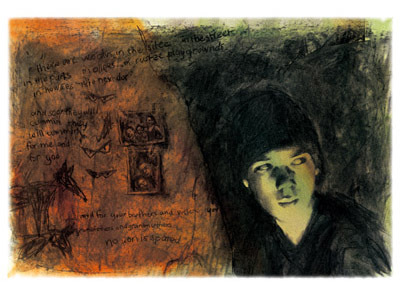
when i was volunteering at the library, i was about to shelve this book, but something about the cover intrigued me, and made me flip through it idly. and that's when i came across a familiar face!! the rest of the book looked pretty cool, so i ordered it into my store and bought myself a copy, and now i can hang out with miriam anytime i want!! i may have missed out on the goodreads.com san francisco gathering, but nothing can stop me from having my own, sad imaginary party here at home:
THIS IS A PICTURE OF ME AND THE BOOK CONTAINING MIRIAM'S AVATAR, AS THOUGH WE ARE BEST FRIENDS HANGING OUT IN MY APARTMENT.
this book is totally haunting. it is not a typical cut-and-dried children's book; there is no moral, there is no happy ending. i'm not even sure if there is a story here. this is more like a fragment of a larger, unwritten piece that spooks you a little and gives you skull-echoes, and a desire to look over your shoulder. the whole thing is more of a tone-story, with ambiguous happenings and contradicting viewpoints. is it a true apocalypse story?? is the narrator mad?? some things point towards one interpretation, some to t'other. for a picture book with relatively few words, it could potentially lead to hours of discussion.
and once i realized it was the same woman who had given the world Fox, it all clicked. the madness!! this woman is awesome! and i know our dear miriam has read a bunch of her other books, and this inspires me to get to the bottom of what makes her (margaret wild) tick, and why she creates such fantastically dark and disorienting children's books. WHAT IS SHE PLANNING??
i love this book. it makes my brain itch. watch out for woolvs.
Ben, the protagonist of this post-apocalyptic picture book, hides from the shadowy wolves in a basement room, burning furniture for warmth and begging the old lady upstairs for water.
There is some suggestion, based on Missus Radinski's claims that there are no wolves and Ben should go back to school or get a hobby, that perhaps the little boy is suffering from some mental illness rather than the collapse of civilization. On the other hand, she doesn't seem to see a problem in him living alone in a basement. And eventually she disappears. Is she the one living in a fantasy world? The red skies and broken black buildings certainly look like the products of a real catastrophe. Unless they are in Ben's head and we're seeing from his point of view...?
I think I incline towards seeing the devastation as real rather than imaginary because the book reminded me of Russell Hoban's post-apocalyptic novel, Riddley Walker. This has an urban setting rather than a rural one, but I can easily see this as in a continuum with Hoban's work, as if this was the immediate fall-out (Ben recalls blues skies and his family) while Riddley Walker occurs centuries later. In Ben's scrawled narrative we see the decline in spelling and grammar, the made-up vocabulary of a boy who heard words that he didn't understand precisely. In both books the altered language seems very natural.
The art is dark and effective, mirroring and sometimes interacting with the text.
I may be a little obsessed with Margaret Wild books here lately. I picked up another one the other day due to it's interesting title which is misspelled along with an eerie looking cover. After starting the story I realized that many of the words are misspelled in the book which really adds to the darkness.
The story takes place in a post-apocalyptic world and a boy named Ben is stuck in a house with barely any food or water. He's scared of the outside world and believes that there are Woolvs waiting outside to get him.
"And soon they will Kum.
They will Kum for me and for yoo
and for yor bruthers and sisters.
yor muthers and fathers. yor arnts and unkils.
yor grandfathers and grandmuthers.
No won is spared."
He lives in an apartment building with an elderly woman named Mrs. Radinski and once saved by her, he now must return the favor and conquer his fears by leaving the building in which he resides to locate her.
The misspelled and sketched words along with the black and watercolor illustrations add to the dismalness of the story.
Once again, Margaret Wild never ceases to amaze me with her powerful writing. The message this book sends is to be brave and overcome your fears. Never be afraid and take control of your life. This book is best suited for older children 6 grade and up. It's content is too difficult for younger readers.
This was an extremely unique book! I read it to my class and they enjoyed it. However, it was hard to read because so many of the words are spelled incorrectly (on purpose).
This beautiful book could be seen as a lushly dark post-apocalyptic threnody for adult fans of experimental graphic novels. Or it could be a kid's book. The text itself is rendered expressionistically with bold scrawl alternating with thin scratches while what it says is in semi-modernist verse with phonetic spellings that intensify their subjective urgency:
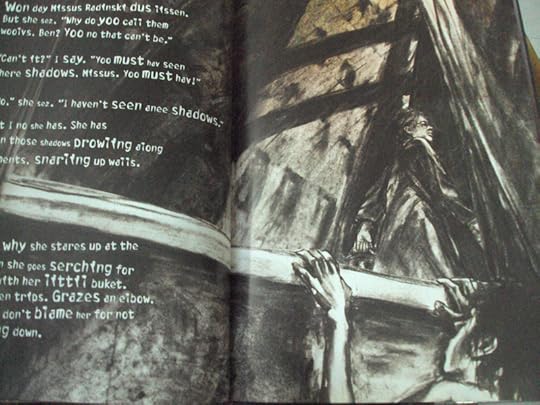
"No." she sez. "I haven't seen anee shadows." But I no she has. She has seen those shadows prowling along pavments, snarling up walls.
Or it could be like a kid wrote it. Either way the illustrations, which occupy the entirety of nearly every page with the text printed over them, are charcoal and ink (it looks like anyway but hell as far as I know it coulda all been done on a computer) in combinations of lines jagged and smeary, but sometimes giving way to large fields of non-representational texture such as water-buckled or aged paper.
As for the story I won't say much but that the climax surprised me by striking a moving note which actually did move me a bit, surprising because I rarely feel that with books and because it was done with so little. I'm not a cold person but fiction hardly ever gives me a real inner ping/pang of feeling, not because I'm a tough guy or, again, a cold person, but I guess I'm a cold reader. Bald attempts to move me usually just move my eyeballs in a circular motion but this book is corn free.
My friend Miriam's GR avatar is from this book, which is why I read it. It's a good example of the art's moody and enigmatic style. I'm so glad I found it and can't wait to read it to my nephews. The meter of the text is expert, perfect for sharing aloud (and doing voices!).
This is one of the weirdest books I’ve ever read. It’s children’s (children’s?!) picture book. It seems to be a horror book. I think it’s about external horrors, but I kept thinking of agoraphobia and other mental illnesses, and of growing up in a less than ideal situation, and not knowing what was going on is part of its technique, I think.
Anyway, it was chilling. It would have terrified me had I read this while a child or teen, especially the years when I was living alone, especially the relatively short period when I was in some actual danger. Danger permeates everything about this book and Ben’s narration.
Because of the misspellings and dark content (it’s dark no matter how it’s interpreted) I wouldn’t recommend this for anyone under nine and only those who don’t get easily frightened by books’ contents.
The art is eerily effective in helping make this book as scary and puzzling as it is. The art is superb as far as it matching the book’s text. Wow!
In a way I hated this book, but it’s so unique and I had such a visceral reaction while reading that I have to say I really liked it. Contemplating what Ben is really facing is compelling. And, it’s unlike any other books, especially any short picture books, I’ve ever read.
Completely weird!!! And very hard to rate! I have no desire to reread it, but I’d like to discuss it with other readers.
Well! This brilliantly disturbing picture-book is something a little different! Dystopian fiction for the school set? Yes. Or, perhaps no. An award-winning Australian import - it was given an Aurealis Award (Australia's science-fiction, fantasy and horror prize) in 2007, and chosen as a CBC (Children's Book Council) Honour Book - Woolvs in the Sitee is the story of Ben, a terrified young boy living in what appears to be a post-apocalyptic world. Hiding in his basement room, emerging every once in a while to seek water, and companionship with his neighbor, the kind "Missus" Radinski, Ben worries about the hateful "woolvs" that haunt the "sitee," and longs to see a blue sky again, rather than the bleak gray and black skies that hang over the mostly abandoned city outside. When Missus Radinski disappears, however, Ben must put aside his fear and go in search of his only friend and companion...
Who, or what, are these woolvs? This is never made entirely clear in Margaret Wild's eerie story, and that ambiguity gives the narrative an immense power, as fear is so often accentuated when it is vague, and the unknown danger can feel far more threatening than the specific one. If this truly is a post-apocalyptic dystopia, than the woolvs might be some sort of horrific creatures, or perhaps bands of roving humans, transformed into marauding gangs by whatever disaster overtook their society. On the other hand, if - as has been suggested by some reviewers - this is a story of mental illness, with the bleak world around Ben reflecting his illness, or being a depiction of the world as viewed through the distorted lens of his illness, then perhaps the woolvs are his own personal demons - the emblems of his disease. Although I lean toward the former, I think either interpretation works pretty well.
I am going to have to re-read this. Until I read other reviews, I thought the book was "Wolves in the Settee" So I thought the boy writing it was schizophrenic and thought wolves were living in his furniture. It's a totally different story when you think the whole thing is taking place in the dark and twisted imagination of a mentally disturbed person.
I'm so embarassed. I had no idea that Sitee was "City" and now it makes MUCH more sense.
Short graphic novel set in a post-apocalyptic world which has been taken over by woolvs. A young man tells about his fears and how he survives. His only friend is his upstairs neighbor who doesn't believe him about the woolvs until she runs afoul of them and disappears. The colors are dark and the spelling is creative in this story.
The talented team of Margaret Wild and Anne Spudvilas has produced a remarkable picture book that beautifully balances those ubiquitous reviewers’ words, “compelling” and “challenging.” Woolvs in the Sitee, 2007 winner of the Aurealis Award and a CBC Honour Book, is so original and unusual that the publishers have posted a special teaching guide on the book’s website page. But don’t be deterred by classification-slipping noises; Woolvs offers rich rewards for the visually and metaphorically literate young reader.
Wild’s wild spelling is the first clue that something’s amiss in the world of the first-person narrator, Ben, and from the dramatic red and black cover onwards, Spudvilas’ charcoal and colored ink artwork invigorates and propels the story forward in a kind of counterpoint to the text. The colors, calligraphy and dramatic perspectives, along with brilliantly distinctive spelling and inventive vocabulary, suggest that Wild and Spudvilas could hold their own in any midnight graffiti crew. It’s not clear what exactly is wrong in Ben’s dystopian world; readers can project holocaust or schizophrenia equally well, but whatever the source, Ben is paralyzed by fear, huddled in a basement room, his only contact with the outside world a neighbor who checks in periodically. “Missus Radinski’s veree kind, but she won’t lissen abowt the woolvs... She thinks I’m torking abouwt those luvlee wyld creechis…”
Missus Radinski rescues a terrified Ben when, excited by a newly-painted blue wall glimpsed from his room, he once ventures outside, expecting sunshine and safety. Later, she doesn’t appear for three days, doesn’t even answer Ben’s knocks at her door, and he finds the courage to go looking for her. “My hart is jakhammering, but I will no longer let the woolvs forse me to scrootch. I will no longer let them stop me from making the streets my rivers and the parks my vallees.” Ben looks up at readers, Spudvilas’ rough brushstrokes capturing his vulnerability and resolve as he departs, and invites us, “Joyn me.”
Only for well-established writers and illustrators like Wild and Spudvilas do publishers risk such nervy work. For the emerging adolescent who is realizing that life is not just what it appears to be, Woolvs in the Sitee will be embraced as a book that respectfully articulates the dark passages in one boy’s journey of emerging selfhood.
Written by one of Australia's leading picture book writers, Margaret Wild, Woolvs in the Sitee is a dystopian picture book about a boy named Ben who shares his story of living in a dark, frightening world where his only help comes from a neighbor, Mrs. Radinski. The book is written from Ben's point of view, with words written out phonetically, and he shares his immense fear of wolves and his dream of seeing a real blue summer sky. The text is formatted in a frantic manner, and the pictures are almost scribbled on the page--like it's a page out of Ben's diary and he's writing quickly to get his thoughts on paper before someone or something finds him.
While this book was nothing like I've ever read before and its visuals were unique, I didn't find that I could connect with Ben or his story. If a teacher were to use this, I would recommend middle school students or older. The tone of the piece from the colors, scribbled pictures, and language, might be difficult or frightening for younger students.
A very strange book! It seems to take place in an apocalyptic world, possibly an environmental catastrophe (his longing for blue sky), in a sparsely populated city. Given his poor spelling, one can judge that civilization broke down a number of years ago, before he had had enough schooling to learn how to spell properly. The nature of the "woolvs" is never made clear, though the boy's fear of them is palpable. The illustrations, largely in black, gray, and red, added to the sense of doom and fear. This story would make a good jumping-off point for discussion or for a creative writing prequel (how did he get to this point?).
The illustrations are raw and interesting; the cover is striking. The spelling is a challenge: on one hand, I appreciated the way it portrayed the world the boy lived in; yet, on the other hand, I can't stand intentional misspelling like that. Overall, a cool read. But I don't think it'll appeal to its target audience. It's in picture book format, but the subject matter makes it apppropriate for 6th grade and up. But I don't know how many teens will be drawn to the book, given the format that is suited for a younger audience. Very puzzling.
This is one of the most beautiful and eerie and haunting books that I've ever read. Misspelled as though a child has written this, Woolvs in the Sitee depicts either a traumatic dystopia or perhaps a heterotopic world through a paranoid lens. Either way, the ambiguity is utterly amazing, and I think that this book is one that absolutely elevates the notion of what children's literature is as an art form. With dark, jerky illustrations, this becomes a well-rounded book that plays on fears, belief, strength, and denial. Though I typically give age ranges on my book reviews (a problematic aspect, perhaps?), I can certainly say that I believe this is great for all ages. Some may disagree on account of the content, but it's ultimately an engaging and creative book that does its best to encapsulate the mind of a young boy in a world unlike our own.
Oh my. Dark. Twisted. LOVE IT. Actually, I hated it. But I hated it so much that I love it. What an interesting, thought provoking book. So much potential for discussion. And the spelling!
This was a tough one. I get that it was meant to be disturbing, but there were so many missing elements that I was annoyed instead of disturbed. If this were lengthened into a short story, cutting the visuals and giving more context - I think that would have worked better. Or turning it into a real graphic novel spanning a few volumes - that would have served this story better. Instead it feels like someone dumped me into the middle of a story, shoehorned the thing into a short children's book format, and shouted 'Are you scared? Like, so totally scared?!'. It just didn't work for me. It's like Wolves in the Walls by Neil Gaiman (I love a few of Neil's novels, and Sandman, but I hate WitW) got drunk, and then mugged in a back alley and left for dead. That doesn't make sense? Yeah, that's about right for this book then. I see potential, but the execution was terrible.
'Woolvs in the Sitee' is not a children's picture book but rather a graphic short story, more suitable for older teens. The story and the ideas underlying it make it a challenging book.
From the beginning, the reader knows that something is wrong. The rough wolf image and the strong, graffiti-like writing act like a warning. The central character, Ben, has withdrawn from the world; he is alienated and full of fears. He is terrified of the 'woolvs' but determined to find his neighbour. To do so, he needs to be strong and find the courage to overcome his fear of going out.
This would be a great book to study at school even though the subject matter is dark. So many teens nowadays struggle with fear and depression. This book addresses fear and has a positive message.
Wow. This was profound. The art moody and atmospheric, and the irregular spelling adds to unreliability of the narrator, which further develops the dread and uncertainty of it all. On my first read I can't quite tell if it is a supernatural fiction about some mysterious evil or a metaphor for something more real like mental illness or war. Either way, it is exceptionally put together and worth further consideration. Really creepy and definitely something that could spark some conversation with the right kids, but probably not the best book for a lot of little kids. This was a random find in my local library.
Strange, haunting work about a child who appears to live alone in a crumbling apartment complex, save for one neighbor, an older woman who looks after him as best she can, until the day she cannot.
Is this a story about a dystopia? the aftermath of a nuclear war? severe mental illness? In today's world, we may surmise the child and neighbor are hiding from ICE agents. We simply do not know what is going on, and the child's words are ones based upon fairy-tale villains--"woolvs." This is a darkly memorable book that will linger with the reader.
Visually unique and stylistically engaging, Woolvs in the Sitee defies easy categorization as it paints a picture of one boy's experience with fear, abandonment, and resilience in a world he does not recognize.
I’m not sure what I think about this book, but it’s intriguing. I would’ve loved to have it when I taught high school ELA. It would’ve been a great discussion starter and/or writing prompt: What are your wolves? How can/do you cope?
As I was browsing the Teen Graphic Novel section (the only place graphic novels aren’t dispersed into the stacks) Margaret Wild & Anne Spudvilas’ picture book caught my eye. Woolvs in the Sittee‘s cover is intriguingly creepy; and my mind went immediately to Dave McKean. The jacket copy drew me in deeper, though afterward I found it forgivably misleading for the most part.
What is actually going on in Woolvs in the Sitee is not transparent. In a way, the paranoia of the protagonist Ben could have sketched the hostile environment, imagined these Woolvs that “spare no won.” Ben’s only neighbor Mussus Radinski thinks he should get out more, go to school. But as Ben observes, even Radinski “stares up at the sky wen she goes serching for water with her littil buket. She offen trips. Grazes an elbow. a nee. I don’t blame her for not looking down.” Maybe it is Missus Ridinski who is “scrooching down” into her delusions.
After Ben is lured outside and into a harrowing moment, there is little doubt on anyone’s part that the Woolvs are real; though who they are is another matter. And what they’ve done, still another.
The situation is creepy, and the font, the phonetic spelling by the narrator Ben, the charcoal (slashing in the background, fluid and real with the characters), the colors used and how applied, the perspectives in the composition of each illustration… Wild and Spudvilas truly capture the atmospheric and set the reader on an edge.
“Spudvilas’s rough charcoal sketches of deserted streets and vacant interiors slash the full-bleed spreads, and watercolor washes of sour yellow, blood red and toxic green imply apocalypse.”~Publisher’s Weekly.
It is unclear what created the situation, or how it is resolved. Woolvs only tells the story of one lone boy hiding, keeping occasional company with his older, maternal neighbor, who is eventually forced to confront his situation in a new way after she disappears. Will he continue to remain “scrooched up in won room in a mustte basement, hevy kertins akross the window?” Or will he go out and reclaim the “streets as his rivers and the parks as his vallees?” And ultimately, will he go it alone?–which is an unanticipated ending, an ending in which you realize just how far the narrator and his creators wish to draw the Reader into their world. The “yoo” Ben is addressing is a device the writer is taking seriously. This world Ben lives in isn’t just happening to him. The Woolvs may in fact kum for yoo, as he warns, for yoo and “yor bruthers and sisters, yor muthers and fathers, yor arnts and unkils, yor grandfathers and grandmuthers. No won is spared.”
Whether the story will find success with the Reader is left to the Reader. The ending was strange and somewhat abrupt, certainly more open-ended than I expected. Publisher’s Weekly observes: Woolves in the Sitee ”reads more as a prequel to a thriller than as a tale in its own right.” Is this where the “challenging” part of the jacket copy’s assertion comes in? What does the unsettling aspects of the story provoke–to include ending it as it does?
I can say it is well-rendered, and it’s a nice creepy little read. And it may be a delicious little writing prompt; may be you decide to “joyn” Ben; may be you’ve a beginning of your own.
Woah. Intense. First of all, this is not a picture book for little kids. At least, not for them to read on their own. This could cause some serious nightmares, or at least some serious questions about how safe they are in the world.
The story is set in an unknown 20th or 21st century city. A teen boy, Ben, won't leave his home, because he knows the woolvs are waiting for him. The entire story is told with fine grammar, but atrocious spelling, but the spelling makes sense. If you are trapped inside your home during your developmental years, out of contact with most of humanity, niceties like "spelling" are probably nto high on your priorities.
Ben's neighbor, Mrs. Radinski, makes occasional forays for water, but even she is wary of the outside. And then she disappears. The book ends on a not necessarily uplifting note, but a foreward-moving one. Ben leaves his home to find Mrs. Ridinski. Will he? Or will he be caught by the woolvs?
I've seen speculation that the sitee is actually in Nazi Germany, and there's certainly some evidence to support that, but it's never made so overt that this could only be about the Nazis. It could just as well be set in the bombing of Afghanistan, or in some future post-apocalyptic world. Wit how vague things are, I think this could be a great book to use in a high school English lit class, to teach students how to make an argument about a text.
Avoid this for general storytimes, for sure. This book is meant for a more introspective session. Be ready to talk things through, and certainly don't ever try this as a bedtime story for your kid.




 come to my blog!