Jump to ratings and reviews
Rate this book

By His Bootstraps

Rate this book
"By His Bootstraps" is a science fiction novella by American writer Robert A. Heinlein. It plays with some of the inherent paradoxes that would be caused by time travel.

The story was published in the October 1941 issue of Astounding Science Fiction under the pen name Anson MacDonald; the same issue has "Common Sense" under Heinlein's name. "By His Bootstraps" was reprinted in Heinlein's 1959 collection The Menace From Earth, and in several subsequent anthologies.

39 pages

First published October 1, 1941

13 people are currently reading
1261 people want to read

About the author

Robert A. Heinlein

1,053 books10.5k followers
Robert Anson Heinlein was an American science fiction author, aeronautical engineer, and naval officer. Sometimes called the "dean of science fiction writers", he was among the first to emphasize scientific accuracy in his fiction, and was thus a pioneer of the subgenre of hard science fiction. His published works, both fiction and non-fiction, express admiration for competence and emphasize the value of critical thinking. His plots often posed provocative situations which challenged conventional social mores. His work continues to have an influence on the science-fiction genre, and on modern culture more generally.
Heinlein became one of the first American science-fiction writers to break into mainstream magazines such as The Saturday Evening Post in the late 1940s. He was one of the best-selling science-fiction novelists for many decades, and he, Isaac Asimov, and Arthur C. Clarke are often considered the "Big Three" of English-language science fiction authors. Notable Heinlein works include Stranger in a Strange Land, Starship Troopers (which helped mold the space marine and mecha archetypes) and The Moon Is a Harsh Mistress. His work sometimes had controversial aspects, such as plural marriage in The Moon Is a Harsh Mistress, militarism in Starship Troopers and technologically competent women characters who were formidable, yet often stereotypically feminine—such as Friday.
Heinlein used his science fiction as a way to explore provocative social and political ideas and to speculate how progress in science and engineering might shape the future of politics, race, religion, and sex. Within the framework of his science-fiction stories, Heinlein repeatedly addressed certain social themes: the importance of individual liberty and self-reliance, the nature of sexual relationships, the obligation individuals owe to their societies, the influence of organized religion on culture and government, and the tendency of society to repress nonconformist thought. He also speculated on the influence of space travel on human cultural practices.
Heinlein was named the first Science Fiction Writers Grand Master in 1974. Four of his novels won Hugo Awards. In addition, fifty years after publication, seven of his works were awarded "Retro Hugos"—awards given retrospectively for works that were published before the Hugo Awards came into existence. In his fiction, Heinlein coined terms that have become part of the English language, including grok, waldo and speculative fiction, as well as popularizing existing terms like "TANSTAAFL", "pay it forward", and "space marine". He also anticipated mechanical computer-aided design with "Drafting Dan" and described a modern version of a waterbed in his novel Beyond This Horizon.
Also wrote under Pen names: Anson McDonald, Lyle Monroe, Caleb Saunders, John Riverside and Simon York.

Ratings & Reviews

What do you think?
Rate this book

Friends & Following

Create a free account to discover what your friends think of this book!

Community Reviews

5 stars
451 (33%)
4 stars
540 (40%)
3 stars
266 (19%)
2 stars
63 (4%)
1 star
22 (1%)
Displaying 1 - 30 of 106 reviews
Profile Image for Lyn.
2,009 reviews17.6k followers
August 8, 2016
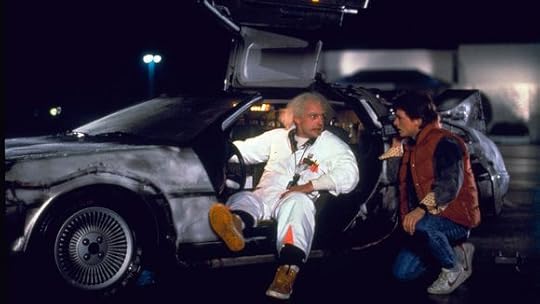
Marty and Dr. Brown are working under the hood of a DeLorean talking about time travel and Robert A. Heinlein.

Marty: So what made you first think about time travel, Doc?

Brown: Science Fiction, my boy! Science Fiction, the very finest literature!

Marty: Isn’t that kind of , you know, looked down upon?

Brown: What?? By who? Marty, science fiction is what makes everything tick, it’s the fuel, the impetus. It’s the spark, I tell, you, like electricity!

Marty: Well, like what?

Brown: HG Wells – The Time Machine! And Edgar Rice Burroughs, and Jules Verne – Alistair Reynolds!

Marty: Who?

Brown: Er, ah, no one, uh – and what about Robert A. Heinlein! Now there is a writer. The Rolling Stones, Between Planets, and my favorite, a short story, “By His Bootstraps” – ah that was a good one.

Marty: What’s it about?

Brown: Why time travel, of course. It explores the paradox of finding yourself in another time – uh, ah, or something like that, forget it, hand me that wrench, Marty.

Marty: Paradox’s huh? That sounds cool, like what, like if you go back or forward in time and see yourself, maybe warn yourself about –

Brown: Forget it, Marty, like you said, uh, um, just silly kid stuff, time travel, blah!

Marty: But Doc! I’m back in time, you brought me back here, what about the paradox? What if I see myself in another time?

Brown: Well, like I said, Heinlein explores how a time traveler can see himself in another time, maybe even interact with himself –

Marty: Doc, I can’t find the wrench, hey what’s this, looks Arabic or Farsi or something – What about all that talk about screwing up future events? The space-time continuum?

Brown: Ah! Give me that! Well, I figured, what the hell?

description
Profile Image for Jeff Yoak.
834 reviews54 followers
July 13, 2021
By His Bootstraps is atypical for a Heinlein story, particularly in terms of having a weak and undesirable main character. I think this was a byproduct of a very unusual plot challenge.

While Heinlein used time travel in other places, it was always of a distant sort. If you are both willing to move 2000 years through time and declare yourself unsure of potential paradoxes, time traveling isn't that big a burden. You just get an interesting setting. This was Heinlein's one use of close time travel, so close that at one point three versions of a person aged within days of each other end up in a fist fight. This imposes a much greater challenge in that Heinlein follows the character through a continuity of consciousness through all frames, creates a vivid character, and has all of the behavior plausible in all frames, including the inevitable puckish desire to change what happened last time. (I think some of the characters faults and his being a little dim were probably required to make it work.)

It does work on many, many levels. Heinlein is so impressed with himself that he takes the last 15 minute or so, in the audio version, to explain things that you probably missed (I had) that are resolved cleverly. This sounds like a major fault but seasons Heinlein fans, if they haven't seen it before, at least aren't too surprised. Like always, such excess by the author is easy to ignore.

All in all, a great story making the best use of a common speculative fiction device that I've seen anywhere. It feels very unlike a Heinlein story and at the same time I have a hard time imagining anyone else writing it.

2016: I finally read this one with Alex. He loves time travel stories, he says. I didn't have the heart to tell him this is not only one of the best that I've seen, but that good ones are pretty darned few.
Profile Image for Dennis.
663 reviews330 followers
June 19, 2021
***By His Bootstraps by Robert A. Heinlein***

Very cool time travel story, first published in 1941 under the pseudonym Anson MacDonald.

Another story that got merged into a magazine entry. I can't quite remember if I read this somewhere online or as part of an anthology. Can't find a link now. So probably the latter. I think I'll re-read this one if I can find it again.

2017 rating: 4 stars
Profile Image for Dipika Desaboyina.
19 reviews27 followers
July 8, 2016
A random stumbling upon the wiki of Causal Loops led me into reading By His Bootstraps. In hindsight I must speculate if it was truly random after all. The thoughts of my future self could have devised a way to prompt me into reading this book because it is imperative for the causation of some thought process that I haven't yet actualized. Perhaps the portals of time travel aren't mechanistic as they are portrayed in the media and fiction. Perhaps they exist only as folds in memory which is circular and not linear as assumed by popular belief. However, I only come upon two marginally reasonable thoughts at the end of the hour it took me to read this book - it takes very little to make a conspiracy theorist out of an idle idiot like myself and this book is a fantastic little mind-trip.
Profile Image for Andreea Daia.
Author 3 books57 followers
June 1, 2012
In spite of its several lacks, I mostly enjoyed By His Bootstraps, particularly because it condenses my personal theory about the quintessence of time. ツ

Robert A. Heinlein imagines an applied example of "immovable history" (my home-brewed term), which postulates that an actor is not able to change any events (past and future) of his/her life: s/he can only fulfill the history. The fantasy genre (and not only!) makes great use of the concept in the form of prophecies, while science-fiction mostly uses the concept of time-travel to embody it.

What is notable about Heinlein's essay is that he touches on the aspect that makes most people shy away from this doctrine: the free-will. These people argue that if whatever is to happen will happen, then individuals are not responsible for their actions... In this regard Mr. Heinlein points out that, the actors in the middle of events are in no way constrained in their choices, and hence they always maintain their free-will.
"You are telling me that I did something because I was going to do something.”
“Well, didn’t you? You were there.”
“No, I didn’t—no... well, maybe I did, but it didn’t feel like it.”
“Why should you expect it to? It was something totally new to your experience.”
I have my personal theory on this, but this is neither the time nor the place for it. As about the faults of the story, some of them gave me the nails-on-a-chalkboard nausea.

1) There is a manifest chauvinistic feel in the narrative: a woman's "right attitude" is serving food to her man on her knees... No further comment. ☹
2) Probably even worse than the misogyny is the author's opinion that the lack of what he calls "will-to-power" is a negative aspect of society. Maybe it's just me, but shouldn't we all aspire to a world in which no one has power over another human being, not the other way around? ☹☹
3) Regarding the story itself, the entire plot would not have been possible if Wilson had not shown distinct signs of obtuseness. Some of the situations can be explained by intoxication, but the rest... And he is supposed to be a math student which doesn't bode well for the future of this science. ツ

So blaming the above issues (#1 and #2) on the social norms of a past culture, I will go ahead and highly recommend this story to science-fiction lovers and/or those interested in the theories of the spacetime continuum.
Profile Image for Elsits.
122 reviews34 followers
April 19, 2023
El bucle infinito.
Buen relato de Heinlein sobre viajes en el tiempo y paradojas temporales que hace reflexionar acerca de la propia identidad y el libre albedrío.
Profile Image for Tim.
639 reviews27 followers
February 23, 2020
“I’m just BESIDE myself!”

“I’ve got myself comin’ and goin’.”

“Now, I almost had a heart attack,
Lookin’ in my rear-view mirror;
I saw myself the next car back,
Lookin’ in the rear-view mirror,
‘Bout to have a heart attack.”
-from “(Damn this) Traffic Jam,” by James Taylor

The person who recommended this long short story (along with Heinlein’s “All You Zombies” [review coming]) said it was gonna “blow your mind.” Well, he was quite correct. The story centers around a graduate student in mathematics, Bob Wilson, trying to complete a thesis on the nature of time travel from a mathematical point of view. All of a sudden, behind him in his room, is a large circle through which a vaguely-familiar figure with a cut lip and a black eye steps, telling him that the circle is a “Time Gate,” with the explanation that “time flows along side by side on each side of the Gate, but some thousands of years apart.” The stranger doesn’t know just how the Time Gate works, but for the time it’s open, Wilson can step into it and go into the future. The stranger, who calls himself “Joe,” tells Wilson that needs to go through himself, that there’s an old guy on the other side who needs his help.
Soon another man, again of vague familiarity but even older, emerges from the Time Gate and tries to stop Wilson and Joe from going through. A fight ensues and Wilson gets punched in the face, stumbles through the Gate and meets up with the aforementioned older man, who tells Bob that he is some 30,000 years in the future, in what he calls the” Hall of the High Gate in the High Palace of Norkal.” The older man calls himself “Diktor,” and says he wants to send Bob back on an errand to obtain some things ‘which will be to our mutual advantage.” He explains that an alien culture called the ‘High Ones” had come to Earth and obliterated all human culture and then left, basically leaving humans referred to as “the Forsaken Ones”) subservient and subject to rule by anyone of higher intelligence. He warns Bob to be prepared for certain paradoxes upon his return, and when he does he sees someone vaguely familiar sitting at his desk.
The above takes up about a fourth of the story. The rest involves looking at the same events through different eyes and how the events have a way of coming around and, at length, making sense. Along the way we find Bob’s hat, experience a couple of strange phone calls, the actual Time gate mechanism and a notebook (“Who wrote the notebook?”), as well as some dated sexism and a description of the Forsaken Ones reminiscent of the Eloi from “The Time Machine.”
The circularity of time and its manifestations, especially as told from several points of view, is a dizzying experience; indeed, I had to read it through twice to comprehend many of the details. Think of it as sort of reading the script for “Bill and Ted’s Excellent Adventure,” but from a more abstract, less playful (well, maybe existentially playful) vantage point. Very entertaining, albeit requiring some work. Five stars.
Profile Image for Ale..
61 reviews57 followers
December 29, 2017
More like 3.5

PD: Es gracioso como llegué a este libro solo porque el Doctor me dijo que gogleara algo. What can I say? I'm weak.
Profile Image for Alex Memus.
458 reviews43 followers
January 22, 2021
Красивая история, в честь которой даже назвали целый парадокс и которую даже упомянули в статье по философии.

Хорошо:
* Научная точность и то, как Хайнлайн следит за деталями, чтобы все было логично
* Рассуждения про свободу воли

Плохо:
* Оголтелый сексизм
* Ну и просто текст по ст��лю 100% pulp fiction. Прям продирался местами.

Я прочитал эту книгу для обсуждения на подкасте про научную фантастику «Худо Не Было». Послушать можно тут: https://share.transistor.fm/s/6854c70f
Profile Image for Rick Davis.
870 reviews143 followers
May 31, 2016
I had previously been vaguely aware of this story as a sci-fi time travel classic that I needed to read. However I was actually prompted to track it down last fall when the Doctor told me to Google the Boostrap Paradox.

https://youtu.be/u4SEDzynMiQ
Profile Image for Mª Carmen.
858 reviews
July 6, 2022
3,5/5⭐
En este relato Heinlein sigue ahondando en el tema de las paradojas de los viajes en el tiempo. Al haberlo leído después de Todos vosotros zombies (que es magistral), por comparación ha salido perdiendo. Aún así, recomendable.
Profile Image for muthuvel.
256 reviews144 followers
December 16, 2016
How to confuse someone with the elemental time travel story?

This short story has its own closed über confused loops with some holes left by the author unanswered however backed by some epistemological notions. Read it if you want to experience such a possible life in the world of science fiction. Concepts of Free will, Retro causality, futuristic utopian visions and many more.

"If God created the world, who created God?
Who wrote the notebook? Who started the chain?" It's all bugging me.
Profile Image for Artem Gavrishev.
63 reviews4 followers
May 20, 2020
Очередной анекдот. С первых страниц понятно абсолютно все. Путешествия во времени в целом уже утомили.
Profile Image for Adam Smith.
Author 2 books38 followers
September 22, 2015
When a mysterious stranger appears in his room and tells him to step through a strange doorway, Bob Wilson finds himself thrust into the distant future where a man presents him with a proposal to rule the world. Now Bob has to deal with the mess of time loops and temporal entanglement.

Oh, sweet delicious time travelly goodness. This story is awesome. Watching Bob fumble his way through encounters with himself and stable time loops that ask "where did any of this begin?" is well worth the time. This is one of the best examples of stable time loops and predestination that I have ever read.

A must-read for those with a love of time travel.
Profile Image for Susan.
1,447 reviews33 followers
August 24, 2016
It was interesting to read this because it's vintage Heinlein, originally published in 1941. But it's hard to judge it on its own terms since so much more thoughtful work on time travel has been done since. The description says the story "plays with some of the inherent paradoxes" of time travel; and "play" with them is about all it does: there seems no attempt to make any of it make sense, or even to make what happens seem plausible.
Profile Image for Onemore Fakefbpage.
1 review
Read
June 13, 2013
This Astounding Science Fiction is one of my prized possessions. It is a great little insight into the war years, the story rocks and I just had to own something special to remind me of all the enjoyment Robert Heinlein has given me.

FOR THE RECORD - it is published in Astounding Science Fiction 1941 under the alias Anson Macdonald. It was reprinted later under Robert Heinlein I believe.

My copy is not in good condition & has little real value..............except to me.
Profile Image for Juan.
26 reviews
October 14, 2015
I don't know how I end up reading this book, though I really enjoyed it. This is the second short story I read from Heinlein, being the first one "All you zombies".... hmmm, interesting no? I liked the way in which Heinlein deepens into time-travel and paradoxes.
If you have read both books, you'll know what I was thinking. If not, I encourage you to first read "By his bootstraps", then "All you zombies".
Profile Image for Max.
29 reviews4 followers
August 20, 2016
I must admit I was a little confused at first and could not decide whether I liked it or not, but after a while I got into the flow of the story and then it started to captivate me. I love the idea of time travel in this short story and I believe the use of language is pretty typical for the time it was written. I did really like it in the end but I can also imagine that it is not going to be a story for everyone.
Profile Image for Stephen Gutowski.
5 reviews46 followers
April 14, 2014
A wonderful short story for the sci-fi-minded. A pleasantly unique examination of the paradox of time travel that's sewn together in a most imaginative way.

An intriguing and quick read that I'd recommend to anybody who doesn't mind a narrative that may leave you a bit dizzy.
Profile Image for Nooilforpacifists.
990 reviews64 followers
September 16, 2016
The best example of the "Impossibility" approach to fictional time travel (along with Heinlein's short story "All You Zombies," which has a similar plot). See my review of "Dark Matter" for the three literary theories of time travel.
Profile Image for Jim  Davis.
415 reviews27 followers
November 24, 2024
Probably the best time travel/temporal paradox short story written until Heinlein went one better in "All You Zombies" in 1959. If it doesn't make you think about the nature of time then you must have skimmed through it and need to read it over again.
Profile Image for Laurence.
1,165 reviews43 followers
January 17, 2022
Like in many time travel movies, one must return from the future to start the paradox that brings the that particular future into being.

Apparently this is now known as the bootstrap paradox. Kudos Heinlein.
18 reviews2 followers
September 15, 2016
So mind-boggling that it was amazing. I've read it twice and am still comprehending what went down.
Profile Image for Χρηστος Αθανασόπουλος.
59 reviews4 followers
December 17, 2018
(Σποιλερς;;)
Η ιστορία όταν ξεκινάει για τα καλά και το ένα γεγονός ξεδιπλώνεται μετά το άλλο φαίνεται κάπως περίπλοκη και μπερδεμένη. Παίζει με χρονικές λούπες και σε κάνει να σκέφτεσαι τι προκάλεσε τι ή τι θα επηρεάσει τι; Στην ουσία όμως η δομή της ιστορίας είναι αρκετά απλή. Είναι ένας τεράστιος κύκλος που επαναλαμβάνεται συνεχώς και μόλις ο χαρακτήρας που γνωρίσαμε στην αρχή φτάνει στο τέλος, ο κύκλος ξαναξεκινά απο την αρχή.
Η ιδέα λοιπόν είναι αρκετά απλή αλλά η πλοκή είναι τόσο σφιχτά δεμμένη που κάνει τις σελίδες να παιρνούν πανεύκολα και τα γεγονότα να ρέουν πολύ φυσι��ά. Κάνει την ανάγνωση ευχάριστη και σε αρκετά σημεία συναρπαστική.
Τα μόνα θέματα που έχω με αυτήν την ιστορία είναι πως 1)Αναφέρει το πρόβλημα της ελεύθερης βούλησης στο οποίο ο χαρακτήρας βρίσκεται, δηλαδή είναι αναγκασμένος να επαναλάβει ξανά και ξανά τα ίδια γεγονότα άρα πως ακριβώς είναι ελεύθερος να επιλέξει; Ο χαρακτήρας όμως μέσα στην ιστορία ακόμη κι όταν καταλαβαίνει πως βρίσκεται μέσα σε αυτήν την ασταμάτητη επανάληψη πολύ σπάνια σκέφτεται την αδυναμία του να κάνει διαφορετικά. Μου φαίνεται κάπως μη ρεαλιστικό γιατί αν κάποιος ήξερε τι θα κάνει πριν το κάνει κι ύστερα το έκανε, θα το είχε συνεχώς στο μυαλό του πιστεύω και θα του ήταν κάπως τρομακτικό. Δεν φαίνεται να ισχύει όμως και πολύ με τον πρωταγωνιστή.
2)Απο ένα σημείο και μετά είναι ξεκάθαρο πως βρίσκεται σε μία λούπα. Ο πρωταγωνιστής όμως για δικούς του λόγους νομίζει πως με κάποια συγκεκριμένη του πράξη ξέφυγε απο αυτήν. Αυτό όμως ποτέ δεν γίνεται πειστικό για τον αναγνώστη κι έτσι είναι λίγο παράξενα αδιάφορο το να περιμένω να ανακαλύψει κάτι ο πρωταγωνιστής το οποίο γνωρίζω εγώ ήδη. Δεν προκειταί στο ελάχιστο για έκπληξη όταν στο τέλος ανακαλύπτει πως δεν ξέφυγε απο την λούπα.
Ο πρωταγωνιστής μου άρεσε σαν χαρακτήρας ήταν ενδιαφέρον αν και όχι τρομερά βαθής και αυτός ο συνδυασμός αλήτη-φιλόσοφου όπως λέει και ο συγγραφέας με κράτησε στην ιστορία.
Είχε σίγουρα τα θέματά της απο την άποψη του κατά πόσο κατάφερνε ο συγγραφέας να σε κάνει να συμβιβαστείς με τις δικαιολογίες που σου έβαζε έτσι ώστε όλο αυτό να δουλεύει και να βγάζει νόημα (πχ α δεν αναγνωρισα τον εαυτό μου για αυτόν τον λόγο, νόμιζα ξέφυγα απο την λούπα για τον τάδε λόγο κλπ) αλλά είναι τόσο καλογραμμένο, σφτιχτό και ρέει τόσο καλά που δεν μπορώ να μην το βαθμολογήσω με 4.
Displaying 1 - 30 of 106 reviews

Can't find what you're looking for?

Get help and learn more about the design.