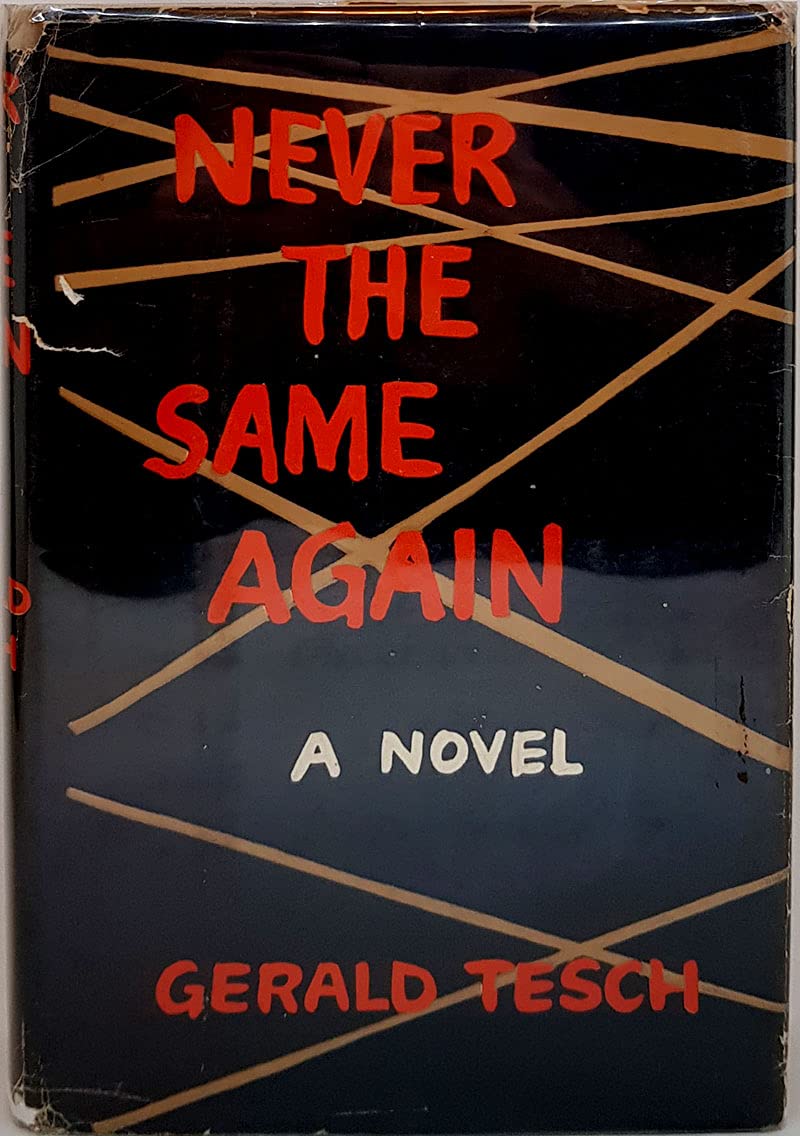
G. P. Putnam's Sons [Published 1956]. Hard cover, 318 pp. First Edition. [Excerpt from jacket flap] In this first novel which breathes the spirit of adolescence in all its frustrations and uncertain joys, Geraid Tesch has created an unforgettable picture of innocence betrayed. Such realism in setting down on paper the thoughts and language and reactions of a boy of thirteen has seldom been found in an American novel. Johnny's family, his tortured friend Roy, the determined and evil boys' club leader, the judge, and the others involved in Johnny's case are all depicted with astonishing perception and maturity. This book reveals a fresh and important new talent. Parish was an exceptionally bright boy at thirteen. True, his mother was divorced and his family life in a small midwestern town was far from ideal, but he had done well in school and his aunts and the neighbors liked him. Then came the summer when Roy Davies, who ran a gas station, befriended him and gave him a job. They were pals from the first and Roy got on all right with Johnny's mother Barbara. Evenings at the movies, fishing trips, week ends at the Lake, a thousand small jokes and bits of comradeship came to bind them together. What Roy came to feel for Johnny was perhaps too intense, carried the small-boy adoration of the companionable older man too far. Yet it was the head of the boys' club, not Roy, who made the trouble in the fall when Johnny went back to school and to activities with those of his own age. A scandal of major proportions developed, tragic for Johnny and no less so for Roy.
Because information on this novel and author are hard to come by the following review is on the long side but I have broken it up into sections
1. From the flyleaf on the jacket of the 1956 hardback edition from G.P. Putnam & Sons:
"In this first novel which breathes the spirit of adolescence in all its frustrations and uncertain joys, Gerald Tesch has created an unforgettable picture of innocence betrayed. Such realism in setting down on paper the thoughts and language and reactions of a boy of thirteen has seldom been found in an American novel. Johnny's family, his tortured friend Roy, the determined and evil boys' club leader, the judge and the others involved in Johnny's 'case' are depicted with astonishing perception and maturity. This book reveals a fresh and important new talent.
"Johnny Parish was an exceptionally bright boy at thirteen. True, his mother was divorced and his family life in a small midwestern (sic) town was far from ideal, but he has done well in school and his aunts and neighbors liked him.
Then came the summer when Roy Davies, who ran a gas station, befriended him and gave him a job. They were pals from the first and Roy got on all right with Johnny's mother Barbara. Evenings at the movies, fishing trips, weekends at the Lake, a thousand small jokes and bits of comradeship came to bind them together.
" What Roy came to feel for Johnny was perhaps too intense, carried the small-boy adoration of the companionable older man to far. Yet it was the head of the boys' club, not Roy, who made the trouble in the fall when Johnny went back to school and to activities with those of his own age. A scandal of major proportions developed, tragic for Johnny and no less for Roy.
"The Author: Gerald Tesch is twenty-three years old and his formal education extended only through the sixth grade (the equivalent of primary school in the UK - Liam). He worked on his novel at the famous Lowney Handy colony for writers, from which James Jones also emerged."
2. How I discovered this novel:
I found the book in a list of 'gay' interest items from a USA second hand book dealer and I was intrigued because although a paperback it didn't seem to be a typical 'camp/gay' product of the times (the 1950s/60s). It was clearly a 'lierary' not a 'pulp' novel and I was intrigued by the possibility it was a forgotten classic like John Cromwell's 'In A Grain of Sand'. Tesch wrote the novel while attending the prestigious Lowney Handy Colony for writers (of which more later) which James Jones attended. Apparently this is Tesch's first and only published book. Tesch was pseudonym and his real name was Gerry Tschappat.
For those like me, who don't know, James Jones was the author of 'From Here to Eternity' and many other novels, though I've never read him, I have seen the film of the 'From Here to Eternity'.
3. My Review:
This is not a lost or forgotten early 'gay' novel, even less is it a man-boy-love novel (though there are elements of that genre I will discuss), because Lowney Turner Handy who ran/taught the authors at the Lowney Handy Colony was vehemently homophobic and opposed to homosexual writers often derogatory remarks about artists such as Walt Whitman, Marcel Proust, and Hart Crane but her scorn also included D. H. Lawrence, T. S. Eliot, Wallace Stevens, Franz Kafka, and Dylan Thomas (none of whom were homosexual), among others which she banned her 'students' from reading and even going so far as to tear up books and physically assault students. Since in 'Never the Same Again' the Roy Davies regularly masturbates Johnny Parish and has Johnny masturbate him you might wonder how homosexuality is dealt with (please see my footnote *1).
It is dealt with by largely ignoring it and stressing young Johnny's intense heterosexual desire for women and Roy's more muted but definite interest in women. Indeed why Roy should do what he does with Johnny is not really explained or explored and we are left confused at the end of the novel as to whether this is something Roy does regularly or was this a first occasion? It is one of the great weaknesses of the novel that what makes Roy 'tick' is totally unexplored. Everything is seen via Johnny and Johnny is presented perfectly happy and unfazed by Roy's sexual interest (it is also unclear in the end if their sexual acts were confined to masturbating each other or went further) and is presented as having only heterosexual lusts and fantasies. The unexplored lacuna of the Johnny?Roy relationship leaves the novel unsatisfactory and puzzling.
But I must be clear the novel isn't about the sex Johnny/Roy have or don't have. It reads more as an examination of all the post WWII obsessions about what was happening to 'young people' the effect of divorce, women working, absent fathers etc. In many ways it is exploring the same issues behind the film 'Rebel Without a Cause' the, supposed, moral decay of American youth and poor parental role models but through the eyes of a much younger protagonist. The problem is that novels dealing with popular issues of concern to newspaper pundits don't usually hold up. You have to be a Turgenev to write a masterpiece on the clash between generations (see his 'Fathers & Sons). Too much of this novel reads as if it is responding to 'issues' of the day rather than the author presenting something that has grown out of his own experiences. There is a reason why novels like this are forgotten but 'Catcher in the Rye' is still read.
The mention of Catcher in the Rye' brings me to another issue - the colloquialisms used by Johnny and to a much lesser extent Roy and the other adults. The use of specific teenage slang, or the slang of any group is not a problem even after it passes out of fashion. The problem is that the way Johnny speaks reminds me of old Disney films or TV shows like 'Leave it to Beaver' or 'The Andy Griffith Show' - language that has been created as a sanitised substitute for the way real teenagers speak.
The sad thing is that reading the novel I can see that if he could have explored the issues of Johnny's relationship with Roy and in particular the way it was ended (which brought to mind George Whitemor's 'Nebraska'). Although being at the Lowney writers colony probably ensured the publication of this novel I can't help thing that Ms Lowney's prejudices proscribed the way Tesch dealt, or more accurately evaded issues at the heart of the novel. One of the strongest themes touched on but not developed is the devastating emotional effect that the relationship with Roy had on Johnny.
I have probably devoted enough to this novel - I hope what I have expressed explains my three star rating - it is not recommendation - only acknowledgement that there are qualities in this novel that deserve recognition - although in total I regard as a failure. *1 I am not suggesting that masturbating a 13 year old has anything to do being gay or homosexual but within the popular cultural purview at the time novel was published, 1956, that distinction didn't exist.