

What do you think?

Avenues by Train.
When seven-year-old Jedza witnesses a tragic incident involving a train and the death of his close boyhood friend in his hometown Miner’s Drift, he is convinced that his life is haunted. Now in his mid-20s, Jedza is a down-and-out electrician, moving to Harare in the hopes that he will escape the darkness and superstitions of the small town. But living in the shadowy restless atmosphere of the Avenues with its mysterious pools of water rising under musasa trees, he is tormented by the disappearance of his sister and their early encounters with ancestral spirits, the shapeshifting power of the njuzu and a vengeful ngozi. To move forward, he must stop running away and confront the trauma of his past. An eclectic, experimental novel, AVENUES BY TRAIN is a brash and confident debut by an exciting new voice.
304 pages, Hardcover
First published January 1, 2023
About the author
Farai Mudzingwa
2 books13 followersFarai Mudzingwa's fiction has been published by Kwani?, Writivism, Weaver Press, Enkare Review, Short Story Day Africa, and Kalahari Review.
His non-fiction appears in Contemporary&, The New Humanitarian, Chimurenga Chronic, The Johannesburg Review of Books, Africa Is A Country, The Africa Report, This Is Africa, Mail & Guardian, TRT World and New Frame.
He is Miles Morland Foundation Writing Scholarship shortlisted (2019).
His non-fiction appears in Contemporary&, The New Humanitarian, Chimurenga Chronic, The Johannesburg Review of Books, Africa Is A Country, The Africa Report, This Is Africa, Mail & Guardian, TRT World and New Frame.
He is Miles Morland Foundation Writing Scholarship shortlisted (2019).
Ratings & Reviews
Friends & Following
Create a free account to discover what your friends think of this book!
Community Reviews
Displaying 1 - 21 of 21 reviews

August 21, 2023
Shortlisted for the 2024 Republic of Consciouness Prize, UK & Ireland
“Before these white men came and started making us build all these houses here, this area was home to vaDziva, guardians of water, the only ones who knew how to navigate the wetlands without falling into the deep pools of water. They had musasa trees here and there, where they performed rituals required to appease the water beings present in the area, who in turn protected the downstream villages from being flooded. They also allowed the surrounding villages to access water during the dry season and in times of drought.”
I start to open my mouth and she cuts me off, “Do not run, my child, listen to me while I bite your ears.”
...
“A hundred years are one day to those who came before us, those underground. They never forget and they do not forgive easily.”
Avenues by Train is the debut novel by Farai Mudzingwa and published by Cassava Republic Press:
The novel is set in Zimbabwe primarily in the 2016-18 period, and largely told from the perspective of Jedza (aka Gerry), born in the late 1970s in the (I think fictional) town of Miner's Drift. But it opens with two flashbacks:
- to 1974, when a young girl Theresa disappears as a group of schoolgirls cross a river. Natsai, later Jedza's older sister, saw that the girl was taken by the njuzu, the water spirits, herself only just escaping the same fate as the njuzu grasp at her ankle, leaving her with a permanent scar and limp.
- to 1984, where 7 year old Jedza and his two best friends are racing on their new bikes, and one of Jedza's friends is killed by a train on a level crossing, leaving Jedza haunted with guilt, as he was accidentally responsible.
Natsai later moves to Harare as a trainee journalist, and we learn something of her story which exposes her to the corruption and political violence that mars the country, as well as to the city's attractions, but she later disappears.
Harare city is this living and breathing thing. It has a pulse, beating to its own rhythm, offbeat and setting its own time. The people on the street, vending and shouting for commuters, dance to the tune. The faceless councillors in the city hall break the rhythm, they drum colonial marches in a city that is pumping out a new vibrant beat.
Later, in 2016, Jedza, who has been making, or failing to make, a living first as an electrician and later jerry-rigging electricity supplies, moves to Harare as well, at first in the poorer Chenga Ose district, but later moves to the Avenues suburb, where Natsai was last seen:
Each generation keeps moving forward, across the railway tracks, then further north and ideally, north of Samora Machel Avenue. Chenga Ose is an abstract concept to anyone now living in the Avenues. Some generic location south of Samora Machel Avenue, that represents things inferior and less affluent.
For them, it is where other people live. The bodies riding to work in the stuffy and packed commuter minibuses; the armpits with the odour; the anonymous faces peering into TV cameras behind reporters on the evening news; the swollen bellies affected by typhoid and cholera outbreaks; the multitude of faces and hands at political rallies; the legs running from teargas and riot police; gaping mouths that speak English with a bad accent; indiscriminate bodies that stand too close behind you in supermarket queues; the aching feet queuing for hours outside banks; those torsos bent over checking second-hand clothes from imported bales; the massed shoulders hunched together on sidewalks downtown; eager pavement barbers imploring, “Shall we cut?”. Too numerous to deserve attention, so many scrabbling to make a living. Fruit and vegetable vendors taking over the pavements in the centre of town; the youths making a career out of installing WhatsApp on phones; those brash bodies driving cheap Toyota Altezzas; those learners that somehow slipped into private schools when the economy lost shape; the hustlers that landed in new money and almost became our neighbours; the thirsty, desperate mouths sucking for relief on the opening of a beer bottle or a Broncleer bottle and now, a glass pipe.
The statements, the assumptions, are casual and Chenga Ose is cast well: a pastoral name derived from an old saying, Chenga ose manhanga, hapana risina mhodzi , there is value in all things.
The main story has Jdeza attempting to make a living in The Avenues, as well as rekindling a relationship with a schoolfriend. But he also increasingly senses his sister's spirit, and there are mysterious pools of water which appear in the city, and which perhaps hark back to what his sister experienced over 40 years previously.
The novel contains a number of intertwined themes - the legacy of colonialism, including ecological damage; economic and political corruption; a portrayal of sex work; the impact of PTSD on those involved in the independence conflict; and Christianity vs. the traditional Shona spiritualism amongst others. The different themes and narrative styles (1st, 2nd and 3rd persons are used) give the text a musical quality, and music is also integral to the novel. Post me reading, the author has, prompted by Gumble’s Yard Instagram review, created a playlist which I wish I had had to hand while reading: here on Spotify
The author explains in an afterword how musical composition is key to his own style:
There's a lot packed in, but Mudzingwa keeps the story flowing with some judicious and light-hearted use of footnotes, as he also explains:
And the novel ends with an extended set piece, a Bira ceremony:
Me, Grandmother, my spirit runs away from playing mbira,
I turn away from them,
Because when I play them, they are heard there, way over there,
They draw attention to me
Elders are seated along the curving wall, their heads slightly bowed as they lean over and whisper to one another. They have assistants on either side of them and Profe sits in the shadow of Mbuya Dziva, the great water ancestor’s svikiro. The mbira players are seated across the banya with their legs straightened out in front of them, instruments steady on their thighs. Between Mbuya Dziva and the gwenyambira stands the musasa tree around which the banya is built, barely visible in the smoky firelight but musasa presence and the tingling scent of fresh bark fills the room. Bodies are filing in: I brush up against other dancers and sway as part of the small dancing circle in front of the mbira players. One of the young women serving musumo earlier writhes on the floor as the mbira keys draw out something ancient lodged deep within her.
She dances,
Come see,
In her watery den,
Now she glides,
She dances, There she dives!
The woman on the floor gyrates and swivels around and around the tree. The gwenyambira lean into their resonators and then strum on. The playing rises to a crescendo and the path trailing the woman becomes soaked in water seeping through from below ground. Kutsinhira, the response, on one end; kushaura, the call, on the other; the mbira notes lock in.
Impressive and recommended.
“Before these white men came and started making us build all these houses here, this area was home to vaDziva, guardians of water, the only ones who knew how to navigate the wetlands without falling into the deep pools of water. They had musasa trees here and there, where they performed rituals required to appease the water beings present in the area, who in turn protected the downstream villages from being flooded. They also allowed the surrounding villages to access water during the dry season and in times of drought.”
I start to open my mouth and she cuts me off, “Do not run, my child, listen to me while I bite your ears.”
...
“A hundred years are one day to those who came before us, those underground. They never forget and they do not forgive easily.”
Avenues by Train is the debut novel by Farai Mudzingwa and published by Cassava Republic Press:
Cassava Republic Press was founded in Abuja, Nigeria, 2006 with the aim of bringing high quality fiction and non-fiction for adults and children alike to a global audience. We have offices in Abuja and London.
Our mission is to change the way we all think about African writing. We think that contemporary African prose should be rooted in African experience in all its diversity, whether set in filthy-yet-sexy megacities such as Lagos or Kinshasa, in little-known communities outside of Bahia, in the recent past or indeed the near future.
We also think the time has come to build a new body of African writing that links writers and readers from Benin to Bahia. It’s therefore the right time to ask challenging questions of African writing – where have we come from, where are we now, where are we going?
The novel is set in Zimbabwe primarily in the 2016-18 period, and largely told from the perspective of Jedza (aka Gerry), born in the late 1970s in the (I think fictional) town of Miner's Drift. But it opens with two flashbacks:
- to 1974, when a young girl Theresa disappears as a group of schoolgirls cross a river. Natsai, later Jedza's older sister, saw that the girl was taken by the njuzu, the water spirits, herself only just escaping the same fate as the njuzu grasp at her ankle, leaving her with a permanent scar and limp.
- to 1984, where 7 year old Jedza and his two best friends are racing on their new bikes, and one of Jedza's friends is killed by a train on a level crossing, leaving Jedza haunted with guilt, as he was accidentally responsible.
Natsai later moves to Harare as a trainee journalist, and we learn something of her story which exposes her to the corruption and political violence that mars the country, as well as to the city's attractions, but she later disappears.
Harare city is this living and breathing thing. It has a pulse, beating to its own rhythm, offbeat and setting its own time. The people on the street, vending and shouting for commuters, dance to the tune. The faceless councillors in the city hall break the rhythm, they drum colonial marches in a city that is pumping out a new vibrant beat.
Later, in 2016, Jedza, who has been making, or failing to make, a living first as an electrician and later jerry-rigging electricity supplies, moves to Harare as well, at first in the poorer Chenga Ose district, but later moves to the Avenues suburb, where Natsai was last seen:
Each generation keeps moving forward, across the railway tracks, then further north and ideally, north of Samora Machel Avenue. Chenga Ose is an abstract concept to anyone now living in the Avenues. Some generic location south of Samora Machel Avenue, that represents things inferior and less affluent.
For them, it is where other people live. The bodies riding to work in the stuffy and packed commuter minibuses; the armpits with the odour; the anonymous faces peering into TV cameras behind reporters on the evening news; the swollen bellies affected by typhoid and cholera outbreaks; the multitude of faces and hands at political rallies; the legs running from teargas and riot police; gaping mouths that speak English with a bad accent; indiscriminate bodies that stand too close behind you in supermarket queues; the aching feet queuing for hours outside banks; those torsos bent over checking second-hand clothes from imported bales; the massed shoulders hunched together on sidewalks downtown; eager pavement barbers imploring, “Shall we cut?”. Too numerous to deserve attention, so many scrabbling to make a living. Fruit and vegetable vendors taking over the pavements in the centre of town; the youths making a career out of installing WhatsApp on phones; those brash bodies driving cheap Toyota Altezzas; those learners that somehow slipped into private schools when the economy lost shape; the hustlers that landed in new money and almost became our neighbours; the thirsty, desperate mouths sucking for relief on the opening of a beer bottle or a Broncleer bottle and now, a glass pipe.
The statements, the assumptions, are casual and Chenga Ose is cast well: a pastoral name derived from an old saying, Chenga ose manhanga, hapana risina mhodzi , there is value in all things.
The main story has Jdeza attempting to make a living in The Avenues, as well as rekindling a relationship with a schoolfriend. But he also increasingly senses his sister's spirit, and there are mysterious pools of water which appear in the city, and which perhaps hark back to what his sister experienced over 40 years previously.
The novel contains a number of intertwined themes - the legacy of colonialism, including ecological damage; economic and political corruption; a portrayal of sex work; the impact of PTSD on those involved in the independence conflict; and Christianity vs. the traditional Shona spiritualism amongst others. The different themes and narrative styles (1st, 2nd and 3rd persons are used) give the text a musical quality, and music is also integral to the novel. Post me reading, the author has, prompted by Gumble’s Yard Instagram review, created a playlist which I wish I had had to hand while reading: here on Spotify
The author explains in an afterword how musical composition is key to his own style:
Music as an artform is quite possibly the main inspiration for my writing. Mbira music in particular. There is the cyclical structure to mbira music which involves the interlacing of multiple melodies emanating from the same repeated chord structures. The result is similar to a mosaic of melodies from which each person extracts and hears those melodies which speak to their disposition. In a literary sense, I try to write themes, subtext, extended metaphors and other literary devices, in a manner that allows the reader to perceive multiple narratives and themes, with varying prominence dependent on the reader themselves. Ultimately, music leaves you with emotion. You may not remember the lyrics or the chord progressions; you may recall only parts of the chorus or the melody, but what sits with you and never leaves, is how you felt. I aim to leave that effect on the reader.
There's a lot packed in, but Mudzingwa keeps the story flowing with some judicious and light-hearted use of footnotes, as he also explains:
The footnotes are my way of nudging the reader and whispering in their ear. As they read, I tap their shoulder with some juicy titbits; and add some “inside info”. I want the reader to know that all these other wild events are happening above, below and around what is on the page. I want us both to step away from the page, only for a moment, to shake our heads at the madness informing what is on the page.
And the novel ends with an extended set piece, a Bira ceremony:
Me, Grandmother, my spirit runs away from playing mbira,
I turn away from them,
Because when I play them, they are heard there, way over there,
They draw attention to me
Elders are seated along the curving wall, their heads slightly bowed as they lean over and whisper to one another. They have assistants on either side of them and Profe sits in the shadow of Mbuya Dziva, the great water ancestor’s svikiro. The mbira players are seated across the banya with their legs straightened out in front of them, instruments steady on their thighs. Between Mbuya Dziva and the gwenyambira stands the musasa tree around which the banya is built, barely visible in the smoky firelight but musasa presence and the tingling scent of fresh bark fills the room. Bodies are filing in: I brush up against other dancers and sway as part of the small dancing circle in front of the mbira players. One of the young women serving musumo earlier writhes on the floor as the mbira keys draw out something ancient lodged deep within her.
She dances,
Come see,
In her watery den,
Now she glides,
She dances, There she dives!
The woman on the floor gyrates and swivels around and around the tree. The gwenyambira lean into their resonators and then strum on. The playing rises to a crescendo and the path trailing the woman becomes soaked in water seeping through from below ground. Kutsinhira, the response, on one end; kushaura, the call, on the other; the mbira notes lock in.
Impressive and recommended.

Read
April 28, 2026Farai Mudzingwa erzählt aus der unmittelbaren Gegenwart der 2010er Jahre rückblickend ins Jahr 1984 über Jedza/Gerry und seine ältere Schwester Natsai, die 1990 wegen einer Stelle bei der „Tribune“ aus dem fiktiven Bergarbeiter-Örtchen Miner’s Drift nach Harare/Simbabwe geht. Weil Natsai 10 Jahre zuvor als Kind Augenzeugin wird, wie ein Wassergeist nach dem Mädchen Theresa greift und damit ihre Karriere als Heilerin bewirkt, wird der Icherzähler „Wortakrobat“ Jedza sich dauerhaft fragen, ob der Griff des Wassergeists auch ihn beeinflusst hat und er indirekt am tragischen Unfalltod seines Kindheitsfreunds Dalitso schuld sein kann.
Obwohl sie sehr abergläubisch ist, lehnt Jedzas Mutter Hexenglauben ab, hängt aber beharrlich der Einstellung an, dass Mädchen für die Ehe bestimmt sind. Über den Großvater von Jedzas engem Freund Jai erzählt man sich, dass er einst zu Fuß als Flüchtling aus Malawi ins Land kam. Als Erwachsener arbeitet Jedzai als angelernter Gelegenheits-Elektriker. Sein schlechter Gesundheitszustand lässt eine unheilbare Krankheit vermuten. Der Glaube an Magie zeigt sich u. a. darin, dass nur euphemistische Bezeichnungen von Krankheiten zugelassen werden.
Als dritter Person folgen wir in Harare der Prostituierten Penny, die in einem System der „Taxis“ in die Stadt gebracht wurde und im System der Zwangsprostitution arbeitet. Als Jedza als Erwachsener in seinen Heimatort zurückkehrt, realisiert er, dass dort in illegalen Stollen geschürft wird und die Arbeiter den geringen Ertrag mit ihrem Leben bezahlen. Durch Natsais Arbeit bei der Zeitung und Pennys Schicksal erhalten wir Einblick in ein Land, das durch Enteignung weißer Landbesitzer in eine verheerende Wirtschaftskrise gestürzt wurde.
Fazit
In Zeitsprüngen vor und zurück, durch mehrere Icherzähler und mit dem Stilmittel, hochironische Kommentare in Fußnoten zu verbergen, gibt Farai Mudzingwa Einblick in die wirtschaftlichen Probleme Simbabwes bis in die Gegenwart. Ein episodenhafter, sprunghafter Roman, der Vorkenntnisse erfordert und die Bereitschaft, die Bedeutung der Fußnoten wie Geheimbotschaften selbst zu entschlüsseln. Bei europäischen Lesern setzt „Die Avenues“ voraus, sich in eine Gesellschaft zu versetzen, die bestimmt ist von Aberglauben, Arbeitslosigkeit und einer Aidsrate bei Menschen über 15 Jahren von über 10%.
---
historischer Hintergrund: Unabhängigkeit 1980, Landreform, die eine Wirtschaftskrise verursacht, 2017 Sturz Mugabes durch Militärputsch
3 1/2 Sterne
Obwohl sie sehr abergläubisch ist, lehnt Jedzas Mutter Hexenglauben ab, hängt aber beharrlich der Einstellung an, dass Mädchen für die Ehe bestimmt sind. Über den Großvater von Jedzas engem Freund Jai erzählt man sich, dass er einst zu Fuß als Flüchtling aus Malawi ins Land kam. Als Erwachsener arbeitet Jedzai als angelernter Gelegenheits-Elektriker. Sein schlechter Gesundheitszustand lässt eine unheilbare Krankheit vermuten. Der Glaube an Magie zeigt sich u. a. darin, dass nur euphemistische Bezeichnungen von Krankheiten zugelassen werden.
Als dritter Person folgen wir in Harare der Prostituierten Penny, die in einem System der „Taxis“ in die Stadt gebracht wurde und im System der Zwangsprostitution arbeitet. Als Jedza als Erwachsener in seinen Heimatort zurückkehrt, realisiert er, dass dort in illegalen Stollen geschürft wird und die Arbeiter den geringen Ertrag mit ihrem Leben bezahlen. Durch Natsais Arbeit bei der Zeitung und Pennys Schicksal erhalten wir Einblick in ein Land, das durch Enteignung weißer Landbesitzer in eine verheerende Wirtschaftskrise gestürzt wurde.
Fazit
In Zeitsprüngen vor und zurück, durch mehrere Icherzähler und mit dem Stilmittel, hochironische Kommentare in Fußnoten zu verbergen, gibt Farai Mudzingwa Einblick in die wirtschaftlichen Probleme Simbabwes bis in die Gegenwart. Ein episodenhafter, sprunghafter Roman, der Vorkenntnisse erfordert und die Bereitschaft, die Bedeutung der Fußnoten wie Geheimbotschaften selbst zu entschlüsseln. Bei europäischen Lesern setzt „Die Avenues“ voraus, sich in eine Gesellschaft zu versetzen, die bestimmt ist von Aberglauben, Arbeitslosigkeit und einer Aidsrate bei Menschen über 15 Jahren von über 10%.
---
historischer Hintergrund: Unabhängigkeit 1980, Landreform, die eine Wirtschaftskrise verursacht, 2017 Sturz Mugabes durch Militärputsch
3 1/2 Sterne

Read
March 9, 2024My eyes keep glazing over the text and that's not a good sign. I need something that'll grab my attention and that's not happening here. It's me I'm sure, but I'm leaving the novel for some other time.

April 27, 2026
Mudzingwa’s debut novel is set in present day Zimbabwe, but with flashbacks to precolonial and colonial times. It is an expansive novel which follows the country’s history through its protagonist, Jedza, his childhood friends Takunda and Dalitso, and his sister Natsai.
I have read a lot of literature from around the world, but this is my first novel from Zimbabwe.
The structure isn’t easy to follow, as the story is not told chronologically, but rather oscillates between present day and the past. As a positive, it leans into aspects of Zimbabwean folklore, though working out what is reality at times is also not easy.
It’s a novel with some outstanding passages, and marks Mudzingwa as an upcoming writer to watch out for.
I have read a lot of literature from around the world, but this is my first novel from Zimbabwe.
The structure isn’t easy to follow, as the story is not told chronologically, but rather oscillates between present day and the past. As a positive, it leans into aspects of Zimbabwean folklore, though working out what is reality at times is also not easy.
It’s a novel with some outstanding passages, and marks Mudzingwa as an upcoming writer to watch out for.
June 2, 2024
Beautifully written, a very special writer who I hope writes a mammoth novel one day as I am sure it would be very special. Thanks Farai

September 23, 2023
In Farai Mudzingwa’s stunning new novel, Jedza moves through two worlds in parallel—the physical and the spiritual, and also the small world of Miner’s Drift and, later, the larger world of Harare. It’s a bildungsroman: we meet Jedza as a lovable and irrepressible boy in Miner’s Drift, up to small boy things with his little crew (and, very memorably, a little running away from home with his dog, Spider). When the unthinkable happens, Jedza is forever marked and haunted by forces far beyond his knowledge or ability to deal with.
These hauntings follow him to Harare, where he tries to piece together the life of a Zimbabwean adult—with some success, but feeling that true happiness and freedom evade him. He’s caught up in the twilight zone of Harare’s precarity—less so for him, in some ways, than for those his life is intertwined with. Mudzingwa portrays this beautifully: Harare’s shadow life in the Avenues—the sex workers, the guys high on drugs and selling airtime at the street corners, the maize sellers, the old woman selling cigarettes and sweets at the corner—and life south of Samora in Chenga Ose, with its malaise, broken sewers, and hand-to-mouth existence. In all of this, above everything, it’s community that holds lives together.
Underneath, though, that second world—the one of hauntings—never leaves Jedza. His sister, Natsai, also moved to Harare’s Avenues some years ago, before disappearing mysteriously—although she is not truly gone. In the novel, Shona cosmology (with touches of more generic “African” beliefs) is the brilliant, sparkling web of existence, that you can just see through the corner of your eye if you turn your head quickly. Jedza comes to believe he cannot find peace without confronting what haunts him, and gradually becomes aware of how he might find answers. In the climactic scene, he attends a bira on the edge of town where he comes face-to-face with the truth of his identity and with the long line connecting him to the ancient past, bringing him hope for freedom.
Mudzingwa proves himself a true svikiro (spirit medium), channelling the voice of a people, the Shona, through their son Jedza. This voice is plaintive, in mourning for all that has been lost through colonialism, in the loss of a connection to its children and the land. You’ve heard it: it haunts us in the music of Zimbabwe, and in the struggles of its people. That pain comes through in Mudzingwa’s exceptional novel, leaving the reader feeling haunted too.
Thank you to Cassava Republic Press and NetGalley for access to an ARC of Avenues by Train.
These hauntings follow him to Harare, where he tries to piece together the life of a Zimbabwean adult—with some success, but feeling that true happiness and freedom evade him. He’s caught up in the twilight zone of Harare’s precarity—less so for him, in some ways, than for those his life is intertwined with. Mudzingwa portrays this beautifully: Harare’s shadow life in the Avenues—the sex workers, the guys high on drugs and selling airtime at the street corners, the maize sellers, the old woman selling cigarettes and sweets at the corner—and life south of Samora in Chenga Ose, with its malaise, broken sewers, and hand-to-mouth existence. In all of this, above everything, it’s community that holds lives together.
Underneath, though, that second world—the one of hauntings—never leaves Jedza. His sister, Natsai, also moved to Harare’s Avenues some years ago, before disappearing mysteriously—although she is not truly gone. In the novel, Shona cosmology (with touches of more generic “African” beliefs) is the brilliant, sparkling web of existence, that you can just see through the corner of your eye if you turn your head quickly. Jedza comes to believe he cannot find peace without confronting what haunts him, and gradually becomes aware of how he might find answers. In the climactic scene, he attends a bira on the edge of town where he comes face-to-face with the truth of his identity and with the long line connecting him to the ancient past, bringing him hope for freedom.
Mudzingwa proves himself a true svikiro (spirit medium), channelling the voice of a people, the Shona, through their son Jedza. This voice is plaintive, in mourning for all that has been lost through colonialism, in the loss of a connection to its children and the land. You’ve heard it: it haunts us in the music of Zimbabwe, and in the struggles of its people. That pain comes through in Mudzingwa’s exceptional novel, leaving the reader feeling haunted too.
Thank you to Cassava Republic Press and NetGalley for access to an ARC of Avenues by Train.

January 19, 2024
Shortlisted for the 2024 Republic of Consciousness Prize
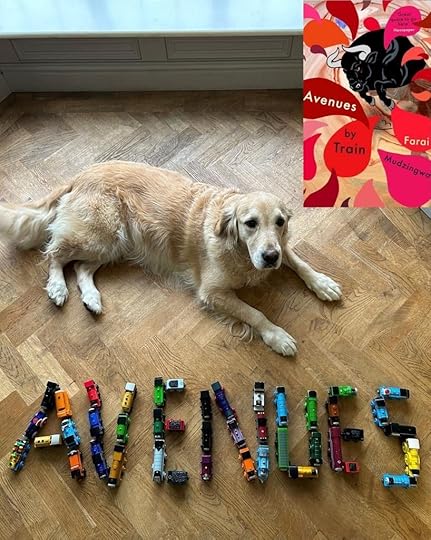
The Harare based author of this book - Faria Mudzingwa – is a published writer of short story fiction and long-form journalism, but this is his debut novel, published in 2023 by Cassava Republic Press: an African book publishing company established in Nigeria in 2006 with a stated mission "to change the way we all think about African writing. (...) to build a new body of African writing that links writers across different times and spaces." - and which then launched a UK office in London in 2016.
It broadly tells the story of Jedza (known to most people as Gerry) over a period from 1984-1988 (when he is a child, living in the fictional Zimbabwean town of Miner’s Drift – on the border with Mozambique, and a backwater now the mines which gave it its name have closed) through to a period in 2016-18 as he moves to Harare in his late twenties.
But through Jedza it tells two wider stories: one of modern Zimbabwe in all its post-colonial corruption and economic turmoil (a story excellently supplemented by more than 40 satirical and pointed footnotes); but the other of a much longer history of the country, its people and its spirits (particularly Shona religion) suppressed by colonialism.
The author has said of this: “The main inspiration is my interest in the ‘lost’ ways of our people. The ancestral spirituality, creative expression, social practices and epistemologies that were sidelined and at times outlawed by the colonizers. I wanted to explore how cultures with disrupted spirituality and culture reconcile with modernity. There is a historical context to who we are at present as a people which is erased but necessary for our grounding today.“
Two formative experiences play out for much of the novel – given Jedza his own historical context to how he presents himself as an adult.
The first is from three years before he is born: his sister Natsai and a group of friends cross a stream where water spirits (Njuzu) try to take them. One of their number disappears underwater and only reappears after a ritual sacrificial offering by her family (who learn what they need to do from a bira (an all night communion with ancestral spirits for guidance). Natsai is touched by the spirits but escapes – but thereafter (and despite the dismissal of her fears as pure superstition by her Catholic family) she is marked both physically (on her ankle where she was touched) and mentally/spiritually by her encounter. Years later when she as an adult moves to Harare for a career as a journalist – she disappears without trace. When, even later, Jedza moves to Harare it is partly to seek out his sister.
The second is from when he is seven – and he is playing with friends near a railway track and trying to beat a crossing gate on their bikes, when one of his friends falls into the path of a speeding train with a distracted driver. The lengthy and early chapter which interleaves: the initially care free bike ride of the seven year old boys; the trying day of the train driver and the journey of his train; the voices of the ancient hills reflecting on the landscape destruction which was wrought by the railway line being built as part of the colonisation of the country; and the route taken by Jedza’s grandfather along the railway line when he migrated from Malawi to Rhodesia (and what was then Salisbury) – is an absolute highlight of the novel showcasing both the author’s ability to weave different voices and his strong sense of rhythm in his writing. For Jedza though the incident leaves him believing that he too is in some ways marked or cursed in the same way as his sister – and his move to Harare is also part of seeking a greater understanding of what this means.
In Harare (as in his hometown) Jedza supports himself by unofficial electrical jobs – typically jerry rigging houses to have free electricity.
He starts in the wasteland of Chenga Ose in the outskirts of the City, south of the train lines, where he is disturbed by spirits which seem to attack a young boy next door and finds he cannot escape his past (including the memories of a teacher who suffered from PTSD from the liberation wars)
He then moves to the edge of a vibrant, mixed inner City suburb of The Avenues into a flat owned by a schoolboy crush and early girlfriend from when was around eleven – Loveless (who he first saw wearing a green ribbon and whose brother Never beat him senseless in a fight). In Harare he and Loveless become occasional lovers (intimidated by her he has to resort to dodgy potions to perform for her); although Loveless is a mistress to a senior official in a government ministry as well as, he comes to realise over time, a madam for a number of street girls.
Jedza (like the author) is a music lover and much of the his life as well as the writing is set to the rhythm of music and/or inspired by or closely following music lyrics.
I did find this quote very useful (in an author interview) and I felt it was a very good fit for the novel.
And (thanks to an exchange with the author on Instagram) he sent me this Spotify playlist
https://open.spotify.com/playlist/7sC...
This is a novel which frequently showcases its author’s versatility.
Other highlights include:
The sections tracing Natsai’s time in Harare – a move that gets her increasingly tangled up with a dissident writer, a victim of the Gukurahundi massacres, the shadow-state and a washed-up English cultural attache – until she is drawn back to the ancestral waters and the spirits that have marked her since childhood;
A chapter of miscellaneous historical excerpts set in 1892, including a series of preambles to a spoof contract between the “South Anglo Company”, the “South Anglican Republic” and on behalf of “Queen Vexatious” which includes:
Jedza’s minibus journey from Chenga Ose to The Avenues – which alternates a second person voice with a plural first person chorus – with the next chapter then alternating first and second voices to tell of his early days in The Avenues and the group of rastaz, hustlers, street walkers he gets to know and who begin to form his community;
A section when Jedza runs through the streets of Harare – again musicality and rhythm is to the fore here.
Jedza also though, like his sister (although it takes him sometime to realise this), is drawn to the more ancient streams and ancestral spirits which lie underneath and close to the surface of the City.
And another bravura section interleaves:
Jedza’s current day realisation that he needs to finally needs to come to terms with the haunting he feels both from his sister’s ghost-life water-bound appearances in his dreams and from the railway incident when he was a child;
With the narrative of Penny – originally a younger school mate of his but now a drug addicted street prostitute working for one of Loveless’s street-madams (Sisi Stella – a recurring character in Jedza’s time in Harare) and who finds herself draw like Natsai by the njuzu.
An increasingly key part of the novel are Shona and other ancestral religious practices culminating in Jedza himself taking part in a bira in the penultimate chapter. I must admit that this religious aspect (crucial as it is to the author’s stated intentions) and particularly the all-night spiritual/ancestral vigil were rather lost on me – I felt that some footnotes (perhaps less satirical than the political ones) would have greatly aided here.
However the final chapter – even when it involves Jedza’s own sacrifice to the njuzu was far more comprehensible to me and gave an excellent conclusion to what is really a very strong and, for me, highly recommended novel.
The Harare based author of this book - Faria Mudzingwa – is a published writer of short story fiction and long-form journalism, but this is his debut novel, published in 2023 by Cassava Republic Press: an African book publishing company established in Nigeria in 2006 with a stated mission "to change the way we all think about African writing. (...) to build a new body of African writing that links writers across different times and spaces." - and which then launched a UK office in London in 2016.
It broadly tells the story of Jedza (known to most people as Gerry) over a period from 1984-1988 (when he is a child, living in the fictional Zimbabwean town of Miner’s Drift – on the border with Mozambique, and a backwater now the mines which gave it its name have closed) through to a period in 2016-18 as he moves to Harare in his late twenties.
But through Jedza it tells two wider stories: one of modern Zimbabwe in all its post-colonial corruption and economic turmoil (a story excellently supplemented by more than 40 satirical and pointed footnotes); but the other of a much longer history of the country, its people and its spirits (particularly Shona religion) suppressed by colonialism.
The author has said of this: “The main inspiration is my interest in the ‘lost’ ways of our people. The ancestral spirituality, creative expression, social practices and epistemologies that were sidelined and at times outlawed by the colonizers. I wanted to explore how cultures with disrupted spirituality and culture reconcile with modernity. There is a historical context to who we are at present as a people which is erased but necessary for our grounding today.“
Two formative experiences play out for much of the novel – given Jedza his own historical context to how he presents himself as an adult.
The first is from three years before he is born: his sister Natsai and a group of friends cross a stream where water spirits (Njuzu) try to take them. One of their number disappears underwater and only reappears after a ritual sacrificial offering by her family (who learn what they need to do from a bira (an all night communion with ancestral spirits for guidance). Natsai is touched by the spirits but escapes – but thereafter (and despite the dismissal of her fears as pure superstition by her Catholic family) she is marked both physically (on her ankle where she was touched) and mentally/spiritually by her encounter. Years later when she as an adult moves to Harare for a career as a journalist – she disappears without trace. When, even later, Jedza moves to Harare it is partly to seek out his sister.
The second is from when he is seven – and he is playing with friends near a railway track and trying to beat a crossing gate on their bikes, when one of his friends falls into the path of a speeding train with a distracted driver. The lengthy and early chapter which interleaves: the initially care free bike ride of the seven year old boys; the trying day of the train driver and the journey of his train; the voices of the ancient hills reflecting on the landscape destruction which was wrought by the railway line being built as part of the colonisation of the country; and the route taken by Jedza’s grandfather along the railway line when he migrated from Malawi to Rhodesia (and what was then Salisbury) – is an absolute highlight of the novel showcasing both the author’s ability to weave different voices and his strong sense of rhythm in his writing. For Jedza though the incident leaves him believing that he too is in some ways marked or cursed in the same way as his sister – and his move to Harare is also part of seeking a greater understanding of what this means.
In Harare (as in his hometown) Jedza supports himself by unofficial electrical jobs – typically jerry rigging houses to have free electricity.
He starts in the wasteland of Chenga Ose in the outskirts of the City, south of the train lines, where he is disturbed by spirits which seem to attack a young boy next door and finds he cannot escape his past (including the memories of a teacher who suffered from PTSD from the liberation wars)
The past won’t let me be. All this solitary time to process my thoughts, the hours spent drinking alone and, pertinently, the encounters with Shalom the kid from next door, all of it drags me back to the fight with Never, the green ribbon, Mr. Gumbo’s marching songs and further back, the mystery of the train incident and the friends I never saw again. I can’t tell which train rumblings are on the railway line running through Chenga Ose and which are echoes thundering in from my past.
He then moves to the edge of a vibrant, mixed inner City suburb of The Avenues into a flat owned by a schoolboy crush and early girlfriend from when was around eleven – Loveless (who he first saw wearing a green ribbon and whose brother Never beat him senseless in a fight). In Harare he and Loveless become occasional lovers (intimidated by her he has to resort to dodgy potions to perform for her); although Loveless is a mistress to a senior official in a government ministry as well as, he comes to realise over time, a madam for a number of street girls.
Jedza (like the author) is a music lover and much of the his life as well as the writing is set to the rhythm of music and/or inspired by or closely following music lyrics.
I did find this quote very useful (in an author interview) and I felt it was a very good fit for the novel.
There is the cyclical structure to mbira music which involves the interlacing of multiple melodies emanating from the same repeated chord structures. The result is similar to a mosaic of melodies from which each person extracts and hears those melodies which speak to their disposition. In a literary sense, I try to write themes, subtext, extended metaphors and other literary devices, in a manner that
allows the reader to perceive multiple narratives and themes, with varying prominence dependent on the reader themselves.
And (thanks to an exchange with the author on Instagram) he sent me this Spotify playlist
https://open.spotify.com/playlist/7sC...
This is a novel which frequently showcases its author’s versatility.
Other highlights include:
The sections tracing Natsai’s time in Harare – a move that gets her increasingly tangled up with a dissident writer, a victim of the Gukurahundi massacres, the shadow-state and a washed-up English cultural attache – until she is drawn back to the ancestral waters and the spirits that have marked her since childhood;
A chapter of miscellaneous historical excerpts set in 1892, including a series of preambles to a spoof contract between the “South Anglo Company”, the “South Anglican Republic” and on behalf of “Queen Vexatious” which includes:
Whereas the British way of life is the very precept upon which civilization shall be built in the primitive margins of the globe.
Whereas, not in a thousand years, is it in the best interests of the childlike native races, just emerging from barbarism, for them to be left in a permanent state of independence.
Whereas it is known that wherever gold is, or wherever it is reported to be, there it is impossible for native races to exclude white men, and, therefore, the wisest and safest course for them to adopt, and that which will give least trouble to themselves, is to agree with one approved body of nite men, and arrange where white people are to dig;
Jedza’s minibus journey from Chenga Ose to The Avenues – which alternates a second person voice with a plural first person chorus – with the next chapter then alternating first and second voices to tell of his early days in The Avenues and the group of rastaz, hustlers, street walkers he gets to know and who begin to form his community;
A section when Jedza runs through the streets of Harare – again musicality and rhythm is to the fore here.
Jedza also though, like his sister (although it takes him sometime to realise this), is drawn to the more ancient streams and ancestral spirits which lie underneath and close to the surface of the City.
"This side of the city is built on the bed of a winding river, itself part of many underground streams and pools spread beneath these streets where we spend our days." She watches my face closely as I ponder her words. "You see the water rising to the surface here and there, around here, do you not?"
I nod.
"Before these white men came and started making us build all these houses here, this area was home to vaDziva, guardians of water, the only ones who knew how to navigate the wetlands without falling into the deep pools of water ..
I hold my tongue. A low high-pitched sound rises from within me. What she is saying would have sounded crazy to me only a few months ago. I might have brushed it off as drunken ramblings but her words resonate with the visions I have experienced since coming to this part of town.
And another bravura section interleaves:
Jedza’s current day realisation that he needs to finally needs to come to terms with the haunting he feels both from his sister’s ghost-life water-bound appearances in his dreams and from the railway incident when he was a child;
With the narrative of Penny – originally a younger school mate of his but now a drug addicted street prostitute working for one of Loveless’s street-madams (Sisi Stella – a recurring character in Jedza’s time in Harare) and who finds herself draw like Natsai by the njuzu.
An increasingly key part of the novel are Shona and other ancestral religious practices culminating in Jedza himself taking part in a bira in the penultimate chapter. I must admit that this religious aspect (crucial as it is to the author’s stated intentions) and particularly the all-night spiritual/ancestral vigil were rather lost on me – I felt that some footnotes (perhaps less satirical than the political ones) would have greatly aided here.
However the final chapter – even when it involves Jedza’s own sacrifice to the njuzu was far more comprehensible to me and gave an excellent conclusion to what is really a very strong and, for me, highly recommended novel.
September 10, 2023
On the surface, a magical realist story set in Zimbabwe, following young Gerry as he moves from his small town to the capital Harare, running away from memories of childhood trauma. As Gerry struggles to run away from himself, his past and his role in it gradually catch up with him, as he oscillates between the secular world of Zimbabwean economy, and the world of local spirits.
On another level, the book is a thoughtful and nuanced critique of the Zimbabwean regime, at least as complex and thought provoking (albeit perhaps less allegorical) as Wizard of the Crow. In some ways, albeit a different genre, it reminds me of Age of Vice, because both books choose to point a finger at the failings of the respective governments via small and arguably quotidian moments in the lives of their protagonists. In Avenues by Train, the author also helpfully intercedes with carefully placed footnotes, which elucidate and provide colour on the points he is trying to make in the text (for those who, perhaps, are less familiar with the world of Zimbabwe).
The book is incredibly thoughtfully written, and all the characters are all vivid and emotive. The circumstances they find themselves in are gut-wrenching, and despite the moral opacity it is hard to criticise even someone like Loveness.
The writing is distinctly non-Western, and it shows in the style, the thin line between fact and the world of the spirits, and the types of relationships between our protagonists. The pacing is unrelenting, and the intersection between personal, political, and psychological intrigue is sophisticate and enticing.
Recommend to anyone interested in Africa, and anyone interested in new and creative voices coming from the continent.
My thanks to Netgalley and the publisher for providing me with an early copy of this novel in return for an honest review.
On another level, the book is a thoughtful and nuanced critique of the Zimbabwean regime, at least as complex and thought provoking (albeit perhaps less allegorical) as Wizard of the Crow. In some ways, albeit a different genre, it reminds me of Age of Vice, because both books choose to point a finger at the failings of the respective governments via small and arguably quotidian moments in the lives of their protagonists. In Avenues by Train, the author also helpfully intercedes with carefully placed footnotes, which elucidate and provide colour on the points he is trying to make in the text (for those who, perhaps, are less familiar with the world of Zimbabwe).
The book is incredibly thoughtfully written, and all the characters are all vivid and emotive. The circumstances they find themselves in are gut-wrenching, and despite the moral opacity it is hard to criticise even someone like Loveness.
The writing is distinctly non-Western, and it shows in the style, the thin line between fact and the world of the spirits, and the types of relationships between our protagonists. The pacing is unrelenting, and the intersection between personal, political, and psychological intrigue is sophisticate and enticing.
Recommend to anyone interested in Africa, and anyone interested in new and creative voices coming from the continent.
My thanks to Netgalley and the publisher for providing me with an early copy of this novel in return for an honest review.

Read
December 9, 2023Thank you to Netgalley and the publisher for providing me with an eARC of this novel, however, all thoughts and opinions in this review are my own.
I have to admit that I don't think that I'm really the "correct reader" for this book. However, I'm really happy that I picked it up and decided to stick with it. The author wove together an interesting narrative that mixed non-fiction, magical realism, and literary fiction. Add a dash of government critique and it made for a really unique read. Jedza and Natsai were two different and distinctive narrators, but I have to admit to sort of plowing through Jedza's chapters and flying through Natsai's. I was much more interested in what was going on in her chapters.
That being said, I enjoyed the sort of mystery aspect to Natsai's disappearance, the glimpses into Shona spirituality, and the author's footnotes. The footnotes added so much to the experience, but also information, which was really important to me as someone not very familiar with either Zimbabwe, it's history and culture, or literary traditions. I sort of wish that other authors would consider this. I know that footnotes may be a make or break aspect for some readers, but they work really well here and serve a purpose.
Overall, I would recommend this for readers interested in reading a book to become slightly more familiar with Zimbabwe, sibling narratives, magical realism, train town people, and readers looking to step outside their own lives and culture. I think, if it doesn't already exist, the author needs to create a Spotify playlist for this book because there are so many references to music and artists throughout this and it would be a lot of fun to have. I look forward to seeing what is next for Farai Mudzingwa.
I have to admit that I don't think that I'm really the "correct reader" for this book. However, I'm really happy that I picked it up and decided to stick with it. The author wove together an interesting narrative that mixed non-fiction, magical realism, and literary fiction. Add a dash of government critique and it made for a really unique read. Jedza and Natsai were two different and distinctive narrators, but I have to admit to sort of plowing through Jedza's chapters and flying through Natsai's. I was much more interested in what was going on in her chapters.
That being said, I enjoyed the sort of mystery aspect to Natsai's disappearance, the glimpses into Shona spirituality, and the author's footnotes. The footnotes added so much to the experience, but also information, which was really important to me as someone not very familiar with either Zimbabwe, it's history and culture, or literary traditions. I sort of wish that other authors would consider this. I know that footnotes may be a make or break aspect for some readers, but they work really well here and serve a purpose.
Overall, I would recommend this for readers interested in reading a book to become slightly more familiar with Zimbabwe, sibling narratives, magical realism, train town people, and readers looking to step outside their own lives and culture. I think, if it doesn't already exist, the author needs to create a Spotify playlist for this book because there are so many references to music and artists throughout this and it would be a lot of fun to have. I look forward to seeing what is next for Farai Mudzingwa.

April 15, 2026
Mitten rein ins Chaos, kein sanftes Ankommen, sondern direkt Kopf voraus in eine Welt, die gleichzeitig fremd und erschreckend nah wirkt. Miner’s Drift fühlt sich an wie dieser eine Ort aus der Kindheit, der harmlos beginnt und dann plötzlich kippt. Und genau da packt einen die Geschichte schon.
Jedza ist keiner, den man sofort durchschaut. Eher so ein Typ, bei dem man merkt, dass da was brodelt. Schuld, Angst, dieser nagende Gedanke verflucht zu sein. Das sitzt tief. Und während man noch denkt, okay, das wird jetzt eine klassische Coming of Age Nummer, zieht einem das Buch in Harare komplett den Boden weg.
Diese Stadt lebt. Und zwar laut, dreckig und gnadenlos ehrlich. Korruption, Aberglaube, Hoffnungsschimmer zwischen all dem Wahnsinn. Die Avenues wirken wie ein schillernder Rausch, irgendwo zwischen Party und Absturz. Man merkt beim Lesen richtig, wie alles an einem zerrt.
Was hängen bleibt, ist dieses Gefühl von Rastlosigkeit. Figuren, die kämpfen, stolpern, wieder aufstehen. Kein Held, kein perfekter Weg, sondern einfach Leben pur. Und genau das macht es so stark.
Klar, manchmal verliert sich die Geschichte ein bisschen in ihrem eigenen Tempo. Aber ganz ehrlich, das gehört fast dazu. Weil sich auch das echte Leben nicht immer sauber erzählen lässt.
Am Ende sitzt man da, leicht erschöpft, aber irgendwie auch beeindruckt. So ein Buch, das nicht geschniegelt sein will, sondern lieber echt ist.
Jedza ist keiner, den man sofort durchschaut. Eher so ein Typ, bei dem man merkt, dass da was brodelt. Schuld, Angst, dieser nagende Gedanke verflucht zu sein. Das sitzt tief. Und während man noch denkt, okay, das wird jetzt eine klassische Coming of Age Nummer, zieht einem das Buch in Harare komplett den Boden weg.
Diese Stadt lebt. Und zwar laut, dreckig und gnadenlos ehrlich. Korruption, Aberglaube, Hoffnungsschimmer zwischen all dem Wahnsinn. Die Avenues wirken wie ein schillernder Rausch, irgendwo zwischen Party und Absturz. Man merkt beim Lesen richtig, wie alles an einem zerrt.
Was hängen bleibt, ist dieses Gefühl von Rastlosigkeit. Figuren, die kämpfen, stolpern, wieder aufstehen. Kein Held, kein perfekter Weg, sondern einfach Leben pur. Und genau das macht es so stark.
Klar, manchmal verliert sich die Geschichte ein bisschen in ihrem eigenen Tempo. Aber ganz ehrlich, das gehört fast dazu. Weil sich auch das echte Leben nicht immer sauber erzählen lässt.
Am Ende sitzt man da, leicht erschöpft, aber irgendwie auch beeindruckt. So ein Buch, das nicht geschniegelt sein will, sondern lieber echt ist.
September 5, 2023
This novel tells the story of two children as they grow up in present day Zimbabwe . One of the children witnesses, a horrific death of one of his friends in a train crash the author looks at how this is affected him as he grows up
I found it hard to get into this book initially there’s a lot of prayers and magical reality that didn’t make sense to me.at first
When we are introduced to the child, characters of the story, the novel becomes instantly more real and believable and I started to enjoy the story more.
The elements of the book that I felt was less strong were the magical reality elements where the author uses ancient African legend myth and religion .
I was unsure about the footnotes , they’re interesting, but are written in a different voice than the rest of the novel almost as if the author themselves were commenting on their own writing.
The story flits between time periods and also the narrator varies frequently.I found myself getting a bit confused who I was reading about from time to time.
The author has an easily read prose style, which was a pleasure to read
I read an early copy of the novel on NetGalley, UK the book is published in the UK on the 26th of September 2023 by Cassava Republic
This review will appear on NetGalley, UK good reads and my bookblog bionicsarahsbooks.wordpress.com. After publication, it will also appear on Amazon, UK.
I found it hard to get into this book initially there’s a lot of prayers and magical reality that didn’t make sense to me.at first
When we are introduced to the child, characters of the story, the novel becomes instantly more real and believable and I started to enjoy the story more.
The elements of the book that I felt was less strong were the magical reality elements where the author uses ancient African legend myth and religion .
I was unsure about the footnotes , they’re interesting, but are written in a different voice than the rest of the novel almost as if the author themselves were commenting on their own writing.
The story flits between time periods and also the narrator varies frequently.I found myself getting a bit confused who I was reading about from time to time.
The author has an easily read prose style, which was a pleasure to read
I read an early copy of the novel on NetGalley, UK the book is published in the UK on the 26th of September 2023 by Cassava Republic
This review will appear on NetGalley, UK good reads and my bookblog bionicsarahsbooks.wordpress.com. After publication, it will also appear on Amazon, UK.

October 25, 2023
I am not familiar with a lot of Zimbabwean history, but this seems to have taken a lot of non fiction things and threaded itself beautifully in this interesting book. A mix of magical realism, fantasy and literary fiction.
The book sucks you in to the surroundings of our alternating narrators.
It has beautiful prose. The pacing is slow, and sometimes the story is a bit surreal. The book has a heavy, melancholy mood to it. One of the few books I have read where I couldn’t guess what was coming next.
Monogamy doesn’t seem to be very important, and the book revolves around lot around base physical urges and supplying the option to please men. There are sex workers in this book as well as alcohol and drug abuse.
I highly recommend this. I also loved all the footnotes by the author, sharing historic moment that influenced a scene. It felt like reading the book with the author.
The book sucks you in to the surroundings of our alternating narrators.
It has beautiful prose. The pacing is slow, and sometimes the story is a bit surreal. The book has a heavy, melancholy mood to it. One of the few books I have read where I couldn’t guess what was coming next.
Monogamy doesn’t seem to be very important, and the book revolves around lot around base physical urges and supplying the option to please men. There are sex workers in this book as well as alcohol and drug abuse.
I highly recommend this. I also loved all the footnotes by the author, sharing historic moment that influenced a scene. It felt like reading the book with the author.
August 22, 2024
This book irritated me from the start. If you can get past the first 60+ pages that are narrated in an unconvincing child's voice, then it definitely improves after that. I found the footnotes added nothing but a disruption to the story, I stopped reading them after a while. The added 'old chap' 'oopsie daisy' and 'dearie me' every time the English man was talking was irritating, and it felt pointless, adding him to the story because it went nowhere with him. I can see the story had potential, and I'm sure plenty of other people will rave about it, but I just found it disjointed, and the magical element didn't work for me and in the end nothing was resolved.

August 21, 2023
For a girl that grew up in railway towns, this took me back in time and I LOVED it. In so many ways it was like I was chatting with an old friend about our lives experiences. The water creatures, the childhood crushes, and just the general mischief and naïveté of our youth as kids. I miss that and I realize now that it was good times.
This entire review has been hidden because of spoilers.

September 23, 2023
I enjoyed how Farai explored African tradition, Zimbabwean to be exact and showed how it played a major role in Jedza’s life. I have been looking for books that explore folklores and “myths” about Zimbabwe and this book was great. I enjoyed the tit bits that imitated real life events and how it was portrayed in a that was captivating.
Highly recommend his work.
Highly recommend his work.
December 30, 2025
The author's notes were my favourite part of Avenues by Train. They reminded me that no government or people have a monopoly on mediocrity and rubbish audacity. They made me laugh, they made me sad. They are a very important part of the story IMO.
Thanks to NetGalley and the publishers for the ARC.
The book comes out in September this year.
Thanks to NetGalley and the publishers for the ARC.
The book comes out in September this year.
February 11, 2024
I enjoyed journeying with Jedza and Natsai, learning so much about spiritualism and the misworkings of the nation in which the book is set. I wish there was more, I still have so many questions! I definitely recommend!

June 1, 2024
I LOVED this book!

June 27, 2025
Beautifully written , the narrator , so nostalgic in the way he speaks. Absolutely enjoyed this book
August 16, 2024
3.5☆
I struggled with the first 46 pages, as I don't enjoy cutsey/funny child voices with a problem-filled backdrop in books.
Lucky for me, things changed after that.
I enjoyed the tone, atmosphere and language in this book. Things are getting more and more unsettling with recurring nightmares, vanishing young women and appearances of ghosts.
I found chapter 7 (~page 100), a look back on the start of colonialization and into Shona spirituality, to be perfect in setting the scene for the rest of the book.
Very informative and engrossing.
I love that this work comes with its own Zim soundtrack- I listened to the tunes while reading.
I struggled with the first 46 pages, as I don't enjoy cutsey/funny child voices with a problem-filled backdrop in books.
Lucky for me, things changed after that.
I enjoyed the tone, atmosphere and language in this book. Things are getting more and more unsettling with recurring nightmares, vanishing young women and appearances of ghosts.
I found chapter 7 (~page 100), a look back on the start of colonialization and into Shona spirituality, to be perfect in setting the scene for the rest of the book.
Very informative and engrossing.
I love that this work comes with its own Zim soundtrack- I listened to the tunes while reading.

July 6, 2024
(3.5)
“Avenues by Train” allows me to check off Zimbabwe from my list of countries read. I didn’t find myself drawn to the characters, and I often got lost when chapters would jump back and forth in time.
“Avenues by Train” allows me to check off Zimbabwe from my list of countries read. I didn’t find myself drawn to the characters, and I often got lost when chapters would jump back and forth in time.
Displaying 1 - 21 of 21 reviews