“The riots and gun battles that shook Tehran during the third week of August 1953 were part of a drama in which nearly no one actually understood his or her true part. Rioters who rampaged through the streets did not know that they were being paid by the CIA. Soldiers who joined the uprising had no idea that they were defending Western control of their own country’s oil. Newspapers around the world unwittingly parroted doctored press release that Iranians were rising up to depose a hated government.”
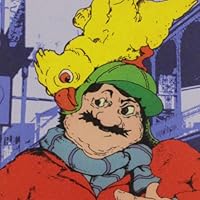
From the moment you open this book and turn the first couple of pages, you realise that you are in for a real treat. Really nice quality paper, the art work is sharp and powerful and the colouring is sumptuous with no detail spared. There is an excellent foreword and afterword provided by Stephen Kinzer whose book this is largely based on.
“Britain discovered an ocean of oil under Iran. And so, they carefully rigged the political system to virtually hand this treasure to themselves, as fast as they could pump it out of the ground and haul it away.” The British struck oil in 1908, in what was then Persia and then formed The Anglo-Persian Oil Company. The APOC (changed in 1935 to AIOC, when Persia became Iran) paid pence on the pound for as much oil as they could haul away. Shah Reza Khan started to do side deals, even getting involved with the Nazis. London decided to get rid of him and used this opportunity to bleed Iran’s oil reserves to help with the war effort. The Brits needed a replacement for Khan and in 1941 they installed their ideal candidate, his son, Mohammed Reza Pahlavi.
An anti-royalist/pro-democracy parliamentarian by the name of Mohammed Mossadegh drew up a long list of 25 grievances’ that he had with the deeply asymmetrical agreement that Iran had with the Brits. The Brits refused to address any of their concerns and instead offered a mere 11 cent increase per barrel, whilst they made hundreds of millions from Iran’s oil. The Shah’s poor attempt at vote rigging, resulted in new elections being called. Razmara was installed by the Brits, after he was killed, Mossadegh filled the shoes of power and then nationalised the oil in 1951.
The Brits reacted by freezing Iran’s bank accounts, pushing sanctions and rigged an ironclad international embargo. Enter Winston Churchill he got the navy to steal back the oil, even going as far as arresting the crew aboard the Italian tanker coming out of Iran, to send a message out to the rest of the world. The Brits also infiltrated the government by paying off various people to create maximum unrest and subversion; this resulted in Mossadegh kicking them out of the country.
The US refused to back Churchill and his warmongering, until Eisenhower became president in 1953. He brought in the notorious Dulles brothers. John Foster Dulles was the highest paid corporate lawyer in the USA. “His firm represented Rockefeller oil empire, the world’s largest banking empires and just about every major trans-national in the US.” He was also a devout Calvinist. Allen Dulles was a professional spy, helping to write the law that created the CIA. Eisenhower made him the director. The brothers shared a passionate faith in corporate power and a global network of covert agents. Allen managed to stoke fear of communism within congress so that they would greatly enhance his war chest. He then embarked on a huge recruitment campaign, raiding the Ivy League for fresh blood. Within three years the CIA went from 300 men to 2800.
Although there was a lot of money and men floating around the CIA there was very little for them to do all day, “We had signed up to be heroes and they made us typists, churning out reports on reports on reports-just busywork, with no end in sight. We wandered the halls looking for a reason to exist beyond the next cup of coffee. An internal report revealed rampant anger, frustration, suicide and substance abuse.” The situation in Iran would suddenly prove to be just what the new government and the CIA needed, and they soon launched Operation Ajax.
The US’s attitude radically shifted from one that supported Iran to the country posing, “A direct threat to American freedom.” Which is just another misleading banality, which really means, hindering America’s business interest, usually oil, as was the case here. The CIA soon went deep into subversive overdrive. It was a three-way brawl between “The faker communists, the hired royalists and the paid cops.”. Chaos that would needlessly kill hundreds of Iranians.
“Operation Ajax did not simply end Mossadegh’s political career, it also ended Iran’s fragile experiment with democracy, The Shah returned and built a highly repressive state. Iran became one of the most heavily militarised and most corrupt countries in the world. Uprooted from its foundations, the country ultimately fell under the rule of bitterly anti-Western clerics. At the time, Operation Ajax seemed a triumphant success for American foreign policy. History, however, has delivered another verdict.” In the end the AIOC reformed in 1954 and is now known as BP. Churchill ended up only receiving 20% of the oil ownership, far less than the 50% he was offered by Iran.
So this is an exceptional piece of work, which expertly combines lavish colouring and detailed art work with some genuinely shocking 20th century political history, taking a relatively hidden subject and presenting it in a clear and unambiguous way. This is truly essential reading.