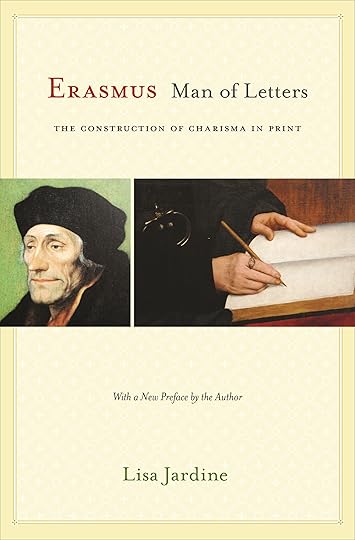
The name Erasmus of Rotterdam conjures up a golden age of scholarly integrity. However, as Lisa Jardine portrays him, Erasmus self-consciously created his own reputation as the central figure of the European intellectual world.
Lisa Anne Bronowski (Jardine) was a British historian of the early modern period. From 1990 to 2011 she was Centenary Professor of Renaissance Studies and Director of the Centre for Editing Lives and Letters at Queen Mary, University of London. Since 2008 she was Chair of the Human Fertilisation and Embryology Authority (HFEA)] She was a Member of Council of the Royal Institution, but resigned from that post in September 2009. On 1 September 2012, She relocated with her research centre and its staff to University College London (UCL) to become the first director of its Centre for Interdisciplinary Research in the Humanities.
Jardine argues that Erasmus' fame was not based on intellectual merit but on skillful self-promotion and networking.
There is a genre of biography that focuses on claiming that great figures weren't really great, and I'm afraid it usually comes across as sour grapes.
Readers who are well-versed in this subfield will recognize many of the "assumptions" Jardine attributes to extant scholarship as strawmen of her own creation -- rather amusing as this is one of the tricks she attributes to her subject. For instance, she claims to argue against an entrenched perception of Erasmus as a "lone wolf" scholar, operating outside the support of existing institutions. On the contrary, everything prior I'd read on Erasmus emphasized the importance of scholarly networks and communication across political borders.
The book does include a valuable reminder of the necessity of understanding Erasmus in his specific cultural context rather than merely reading modern editions of his works, but this caveat applies pretty universally to any intellectual figure one could think of.
There is an excellent review of this book by Laurel Carrington in the Renaissance Quarterly, Spring 95.
To be fair to the author, this is not a conventional biography of Erasmus - it is a rather narrowly-scoped scholarly work setting forth his program of self-promotion through the printed medium, especially in the genre of "familiar" letters. With that said, unless you bring a healthy passion for the thrills of Northern Renaissance Humanism to the table and love getting deep (DEEP) into the weeds of textual criticism, it is unlikely that you will find much of interest in this book.
No debería admitirse la publicación de un libro con un título que te hace pensar en una suerte de biografía documentada, y que al hacerte con él te encuentres con un análisis erudito sobre aspectos sumamente concretos y de escaso interés para el profano acerca de una personalidad como la de Erasmo. No sé si hablar de deshonestidad, pero sí de algo muy próxima a la publicidad engañosa. Si deseas conocer estudios apasionantes sobre Erasmo, opta por el clásico de Huizinga e incluso por el apasionado de Zweig.
The review on the back cover confirms what I felt throughout the book. It was written for literary and cultural historians. Since I am an amateur historian I struggled mightily with this book. Even so there is a lot of fascinating detail that sheds light on the world of Erasmus and the scholars that were part of his sphere.