In England, Henry Fuseli was known as the “Wild Swiss”, but he was nevertheless seen as a very British artist, famous for his illustrations of the works of William Shakespeare and John Milton.
Fuseli now explores the work of this romantic artist from the perspective of his Swiss countrymen. This lavishly illustrated collection examines Fuseli’s most famous paintings, populated by elemental spirits, goblins, and other deliciously strange creatures, as well as the artist’s early sketches, his monumental historical paintings, and his rarely seen erotic drawings.
Accompanying critical essays trace Fuseli’s own evolution—from his forced exile at twenty-five after publishing a volatile pamphlet against the local Zürich government, to his later activities as a member of the British Royal Academy of Arts.
The most comprehensive volume ever published on this master of the fantastic, Fuseli will serve as the perfect complement to exhibitions at the Kunsthaus Zürich in Switzerland and the Tate Gallery of Britain in 2006.
Amazingly, this is about the only big, full-length illustrated book on Fuseli in English. Produced for a 2006 exhibition at the Kunsthaus Zurich (in conjunction with Tate Britain), it is frustratingly hard to track down today, but includes some fascinating art-historical essays on Fuseli's aesthetic principles, on the role of fairies and spirits in his work, on the influence of the Nibelungenlied, and on the importance of London's theatres for his painting.
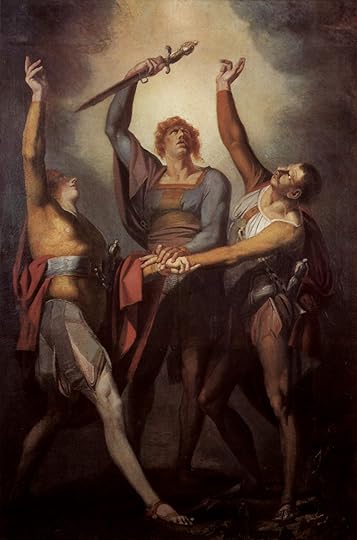
The Oath on the Rütli, 1779–81
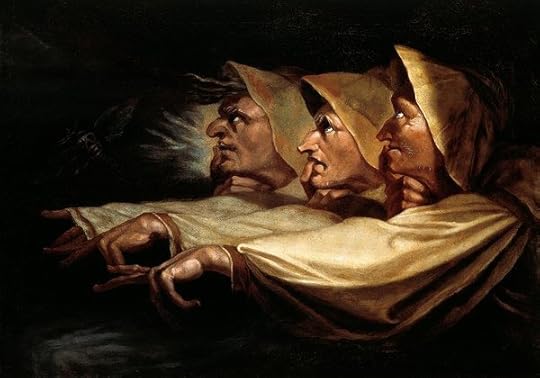
Fuseli hated portrait-painting and anything naturalistic – for him, art should be about great mythic feats of imagination, either taken from dramatic moments in history, or, preferably, from great literature. Most of his best works illustrate Shakespeare or Milton (he knew both of them almost word for word), or, later, the Nibelungenlied.
The Three Witches, 1783
Almost all of his work was produced in London, and much of it remains there, split roughly between the Tate and the V&A; but quite a lot has now been reacquired by Swiss galleries, especially the Kunsthaus Zurich which is where I discovered him. It was an embarrassingly long time before I realised that he was the artist behind The Nightmare, which is about the only painting he's still known for nowadays, and which has left Europe altogether to take up residence at a gallery in Detroit.
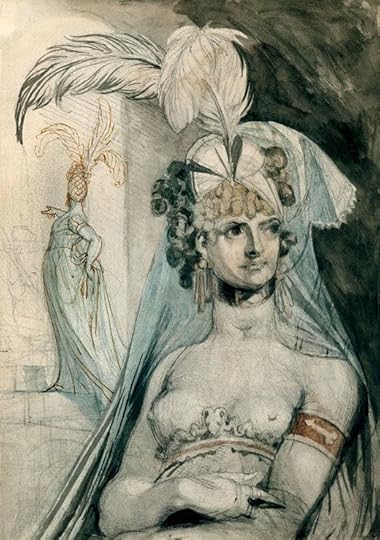
Zurich holds a huge collection of Fuseli's graphical works – sketches in chalk and charcoal with colour washes – and many of these are quite hard to see in the wild, so it's nice to have them well covered in here. Fuseli's lifelong obsession with women's hairstyles and clothing is much in evidence.
Courtesan with plume and veil, 1800–10
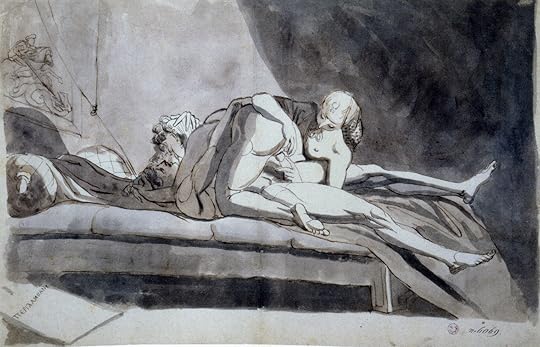
There are also reproductions of some of his erotic drawings, many of which were produced late in life at the request (and for the personal use) of the Prince Regent.
Symplegma of a man and a woman with the aid of a maidservant, 1770–78
The essays are all translated (nicely) from German, and the book includes a helpful chronology of his life as well as a solid bibliography. It's a good visual introduction to a fabulous – I would say somewhat neglected - artist, whose work paved the way for the Romantics.
Insbesondere die geheimnisvollen, von Geistern und Gnomen wimmelten Bilder sind faszinierend. Mehr zu den Hintergründen erfährt man im Kapitel zu Geistwesen der englisch-schottischen Sagen und Literatur (Milton, Shakespeare) sowie im Kapitel zu den Wurzeln des Gothic. Dabei spielten wohl die Gordon Riots keine unwesentliche Rolle, was mir bislang unbekannt war.