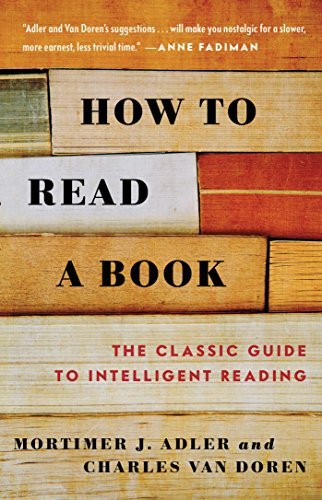
With half a million copies in print, How to Read a Book is the best and most successful guide to reading comprehension for the general reader, completely rewritten and updated with new material.
This popular author worked with thought of Aristotle and Saint Thomas Aquinas. He lived for the longest stretches in cities of New York, Chicago, San Francisco, and San Mateo. He worked for Columbia University, the University of Chicago, Encyclopædia Britannica, and own institute for philosophical research.
Born to Jewish immigrants, he dropped out school at 14 years of age in 1917 to a copy boy for the New York Sun with the ultimate aspiration to a journalist. Adler quickly returned to school to take writing classes at night and discovered the works of Aristotle, Thomas Aquinas, John Locke, John Stuart Mill, and other men, whom he came to call heroes. He went to study at Columbia University and contributed to the student literary magazine, The Morningside, (a poem "Choice" in 1922 when Charles A. Wagner was editor-in-chief and Whittaker Chambers an associate editor). Though he failed to pass the required swimming test for a bachelor's degree (a matter that was rectified when Columbia gave him an honorary degree in 1983), he stayed at the university and eventually received an instructorship and finally a doctorate in psychology. While at Columbia University, Adler wrote his first book: Dialectic, published in 1927.
In 1930 Robert Hutchins, the newly appointed president of the University of Chicago, whom Adler had befriended some years earlier, arranged for Chicago’s law school to hire him as a professor of the philosophy of law; the philosophers at Chicago (who included James H. Tufts, E.A. Burtt, and George H. Mead) had "entertained grave doubts as to Mr. Adler's competence in the field [of philosophy]" and resisted Adler's appointment to the University's Department of Philosophy. Adler was the first "non-lawyer" to join the law school faculty. Adler also taught philosophy to business executives at the Aspen Institute.
Adler and Hutchins went on to found the Great Books of the Western World program and the Great Books Foundation. Adler founded and served as director of the Institute for Philosophical Research in 1952. He also served on the Board of Editors of Encyclopædia Britannica since its inception in 1949, and succeeded Hutchins as its chairman from 1974. As the director of editorial planning for the fifteenth edition of Britannica from 1965, he was instrumental in the major reorganization of knowledge embodied in that edition. He introduced the Paideia Proposal which resulted in his founding the Paideia Program, a grade-school curriculum centered around guided reading and discussion of difficult works (as judged for each grade). With Max Weismann, he founded The Center for the Study of The Great Ideas.
Adler long strove to bring philosophy to the masses, and some of his works (such as How to Read a Book) became popular bestsellers. He was also an advocate of economic democracy and wrote an influential preface to Louis Kelso's The Capitalist Manifesto. Adler was often aided in his thinking and writing by Arthur Rubin, an old friend from his Columbia undergraduate days. In his own words:
Unlike many of my contemporaries, I never write books for my fellow professors to read. I have no interest in the academic audience at all. I'm interested in Joe Doakes. A general audience can read any book I write—and they do.
Didn't really enjoy this one, probably because it was mainnly about nonfiction reading. I did get some useful things out of it, though, and the overall idea I got was this: read a book to gain understanding, not just knowledge. I would probably get more out of this book if I read it again when I was older. But for now, after reading it in school for four years, I'm happy to be done!!
This taught me a lot of new tricks, how to get everything out of texts. Especially philosophy essays. If you think you know how to read, read this book. You will see what I mean. I would also suggest for students this is an excellent book to learn analytical reading.
Everyone has to read hard books as well. Not only reading for pleasure but reading also for expanding horizons and gaining knowledge, nor information or facts but actual knowledge on different subjects you're reading about. That's hard work, exactly the same as going to the gym but for your mind.
A fundamental aspect of modern society is the ability, or at the very least access, to become literate. Reading, in all of its variations, takes a significant portion of education and follows us throughout the journey of our lives. However, an unfortunate part of the education system, speaking on behalf of my experience with the American education system, is that the ability to read deeply is not universally taught nor are the steps to do so effectively widely known.
“How to Read a Book” by Mortimer J. Adler seeks to rectify these problems by offering the reader an instructional guide on not only how to read a book, but how to truly understand the book you are reading and the ideas of the author who wrote it. Adler breaks reading into four levels: Elementary Reading (the first and rudimentary level), Inspectional Reading (the level characterized by its emphasis on the time spent on reading a book), Analytical Reading (the complete and thorough reading of a book) and Syntopical Reading (the level focused on the systematic reading a list of related books on a given subject). Adler spends a good majority of his book focusing on analytical reading and how it helps answer the four main questions you must ask every book: What is the book about as a whole? What is being said in detail and how? Is the book true, in whole or in part? And what of it? In order to answer these sets of questions, you must apply his 15 rules of analytical reading that are broken down into three stages.
In an era of our time that is experiencing an increase in general anti-intellectualism, demagoguery, and a decline in media literacy, Adler’s book seems more important now than ever to seriously consider implementing in your own personal journey. Adler lays out the foundations for anyone wanting to expand the scope of their ability to not only read books in a more thoughtful and engaging way, but to also improve on their ability to engage with the ideas of the book with their own perspective. A core set of maxims in the final stage of analytical reading that Adler presents is that after truly understanding a book, the reader must decide whether they agree, disagree, or suspend their judgement of the author’s positions by presenting good and provable reasons for their own conclusion. Those maxims are one of the plethora of reasons as to why this book is valuable to anyone willing to develop their own critical thinking skills and to the general public at large.
The heart of any society that truly wishes to promote freedom, equity, equality and democracy is within its education system. A populace that is able to think deeply and critically about the world around them and their place within it is a net benefit for the human experience. Books are at the core of understanding and further developing that experience. If you wish to develop your skills as a reader and as a thinker, there are few other books I could recommend than this to guide you.
This entire review has been hidden because of spoilers.
I found this book while browsing the shelves at Barnes & Noble and was intrigued by the title. As an avid reader I thought I knew how to read a book and it seems like a pretty simple task so why write a whole book about it? Well, after reading the book I can say that there's more to reading a book than you think! The authors make a good argument for reading a book deeply, rather than just reading the words. This is a book worth reading and keeping around to reference as I read different kinds of books to get more out of them!
I read this book for school and am grateful for reading it. This is not something I would normally choose to read, but it is full of insights and helpful tips to read better across any genre from novels to history to science to philosophy. I would recommend to anyone serious about reading or pursuing graduate school. It will be worth the read even if you simply skim through to find the major "rules" for reading.
This book has changed not only the way I read, but also the way I handle conversations and disagreements. I highly recommend it for anyone who reads, but especially those who want to read more challenging books. Books that are worth your time.
Everyone should read this book, especially if you're ready to read "complicated" books.
This book made me grow and challenge how I read. I feel more confident in tackling complex books with the skills described and exemplified in the text.
A practical guide to active reading that teaches you how to understand, analyze, and compare books through four levels of reading and structured questioning.
Probably a better book than I give it credit for, but needs a second read at least for me. I just got anxious to move to something else about 3/4 of the way through.
How to Read a Book is an outstanding book. All that reading a book involves amazes me. I learned a lot from the book and enjoyed listening to it on Audible.