

What do you think?

Catherine the Great: Portrait of a Woman
Goodreads Choice Award
Nominee for Readers' Favorite History & Biography (2011)The Pulitzer Prize–winning author of Peter the Great, Nicholas and Alexandra, and The Romanovs returns with another masterpiece of narrative biography, the extraordinary story of an obscure young German princess who traveled to Russia at fourteen and rose to become one of the most remarkable, powerful, and captivating women in history.
Born into a minor noble family, Catherine transformed herself into Empress of Russia by sheer determination. Possessing a brilliant mind and an insatiable curiosity as a young woman, she devoured the works of Enlightenment philosophers and, when she reached the throne, attempted to use their principles to guide her rule of the vast and backward Russian empire. She knew or corresponded with the preeminent historical figures of her time: Voltaire, Diderot, Frederick the Great, Empress Maria Theresa of Austria, Marie Antoinette, and, surprisingly, the American naval hero, John Paul Jones.
Reaching the throne fired by Enlightenment philosophy and determined to become the embodiment of the “benevolent despot” idealized by Montesquieu, she found herself always contending with the deeply ingrained realities of Russian life, including serfdom. She persevered, and for thirty-four years the government, foreign policy, cultural development, and welfare of the Russian people were in her hands. She dealt with domestic rebellion, foreign wars, and the tidal wave of political change and violence churned up by the French Revolution that swept across Europe. Her reputation depended entirely on the perspective of the speaker. She was praised by Voltaire as the equal of the greatest of classical philosophers; she was condemned by her enemies, mostly foreign, as “the Messalina of the north.”
Catherine’s family, friends, ministers, generals, lovers, and enemies—all are here, vividly described. These included her ambitious, perpetually scheming mother; her weak, bullying husband, Peter (who left her lying untouched beside him for nine years after their marriage); her unhappy son and heir, Paul; her beloved grandchildren; and her “favorites”—the parade of young men from whom she sought companionship and the recapture of youth as well as sex. Here, too, is the giant figure of Gregory Potemkin, her most significant lover and possible husband, with whom she shared a passionate correspondence of love and separation, followed by seventeen years of unparalleled mutual achievement.
The story is superbly told. All the special qualities that Robert K. Massie brought to Nicholas and Alexandra and Peter the Great are present here: historical accuracy, depth of understanding, felicity of style, mastery of detail, ability to shatter myth, and a rare genius for finding and expressing the human drama in extraordinary lives.
History offers few stories richer in drama than that of Catherine the Great. In this book, this eternally fascinating woman is returned to life.
From the Hardcover edition.
Born into a minor noble family, Catherine transformed herself into Empress of Russia by sheer determination. Possessing a brilliant mind and an insatiable curiosity as a young woman, she devoured the works of Enlightenment philosophers and, when she reached the throne, attempted to use their principles to guide her rule of the vast and backward Russian empire. She knew or corresponded with the preeminent historical figures of her time: Voltaire, Diderot, Frederick the Great, Empress Maria Theresa of Austria, Marie Antoinette, and, surprisingly, the American naval hero, John Paul Jones.
Reaching the throne fired by Enlightenment philosophy and determined to become the embodiment of the “benevolent despot” idealized by Montesquieu, she found herself always contending with the deeply ingrained realities of Russian life, including serfdom. She persevered, and for thirty-four years the government, foreign policy, cultural development, and welfare of the Russian people were in her hands. She dealt with domestic rebellion, foreign wars, and the tidal wave of political change and violence churned up by the French Revolution that swept across Europe. Her reputation depended entirely on the perspective of the speaker. She was praised by Voltaire as the equal of the greatest of classical philosophers; she was condemned by her enemies, mostly foreign, as “the Messalina of the north.”
Catherine’s family, friends, ministers, generals, lovers, and enemies—all are here, vividly described. These included her ambitious, perpetually scheming mother; her weak, bullying husband, Peter (who left her lying untouched beside him for nine years after their marriage); her unhappy son and heir, Paul; her beloved grandchildren; and her “favorites”—the parade of young men from whom she sought companionship and the recapture of youth as well as sex. Here, too, is the giant figure of Gregory Potemkin, her most significant lover and possible husband, with whom she shared a passionate correspondence of love and separation, followed by seventeen years of unparalleled mutual achievement.
The story is superbly told. All the special qualities that Robert K. Massie brought to Nicholas and Alexandra and Peter the Great are present here: historical accuracy, depth of understanding, felicity of style, mastery of detail, ability to shatter myth, and a rare genius for finding and expressing the human drama in extraordinary lives.
History offers few stories richer in drama than that of Catherine the Great. In this book, this eternally fascinating woman is returned to life.
From the Hardcover edition.
Audio
First published November 8, 2011
About the author
Robert K. Massie
49 books1,665 followersRobert Kinloch Massie was an American historian, writer, winner of a Pulitzer Prize, and a Rhodes Scholar.
Born in Versailles, Kentucky, Massie spent much of his youth there and in Nashville, Tennessee. He studied American history at Yale University and modern European history at Oxford University on his Rhodes Scholarship. Massie went to work as a journalist for Newsweek from 1959 to 1964 and then took a position at the Saturday Evening Post.
After he and his family left America for France, Massie wrote and published his breakthrough book, Nicholas and Alexandra, a biography of the last Tsar of Russia, Nicholas II, his wife, Alexandra of Hesse, and their family and cultural/political milieu. Massie's interest in the Tsar's family was triggered by the birth of his son, the Rev. Robert Kinloch Massie, who suffers from hemophilia, a hereditary disease that also afflicted the last Tsar's son, Alexei. In 1971, the book was the basis of an Academy Award–winning film of the same title. In 1995, in his book The Romanovs: The Final Chapter, Massie updated Nicholas and Alexandra with much newly discovered information.
In 1975, Robert Massie and his then-wife Suzanne chronicled their experiences as the parents of a hemophiliac child and the significant differences between the American and French healthcare systems in their jointly written book, Journey.
Massie won the 1981 Pulitzer Prize for Biography for Peter the Great: His Life and World. This book inspired a 1986 NBC mini-series that won three Emmy Awards, starring Maximilian Schell, Laurence Olivier and Vanessa Redgrave.
Born in Versailles, Kentucky, Massie spent much of his youth there and in Nashville, Tennessee. He studied American history at Yale University and modern European history at Oxford University on his Rhodes Scholarship. Massie went to work as a journalist for Newsweek from 1959 to 1964 and then took a position at the Saturday Evening Post.
After he and his family left America for France, Massie wrote and published his breakthrough book, Nicholas and Alexandra, a biography of the last Tsar of Russia, Nicholas II, his wife, Alexandra of Hesse, and their family and cultural/political milieu. Massie's interest in the Tsar's family was triggered by the birth of his son, the Rev. Robert Kinloch Massie, who suffers from hemophilia, a hereditary disease that also afflicted the last Tsar's son, Alexei. In 1971, the book was the basis of an Academy Award–winning film of the same title. In 1995, in his book The Romanovs: The Final Chapter, Massie updated Nicholas and Alexandra with much newly discovered information.
In 1975, Robert Massie and his then-wife Suzanne chronicled their experiences as the parents of a hemophiliac child and the significant differences between the American and French healthcare systems in their jointly written book, Journey.
Massie won the 1981 Pulitzer Prize for Biography for Peter the Great: His Life and World. This book inspired a 1986 NBC mini-series that won three Emmy Awards, starring Maximilian Schell, Laurence Olivier and Vanessa Redgrave.
Ratings & Reviews
Friends & Following
Create a free account to discover what your friends think of this book!
Community Reviews
Displaying 1 - 30 of 4,756 reviews

January 11, 2012
“By early evening, Catherine was in a commanding position in the capital. She was sure of the Guards, the Senate, the Holy Synod, and the crowds in the street. Calm prevailed in the city and no blood had been shed. But, as she knew, if she was mistress of St. Petersburg, acclaimed by the regiments there and by the political leaders and the leaders of the church, Peter was unaware of this. He still believed he was emperor. Possibly he still possessed the allegiance of the army in Germany and the fleet at Kronstadt. The Holstein soldiers at Oranienbaum would certainly support their master…The key to success was Peter himself; he remained free and had neither abdicated nor been deposed. If he made his way to the Russian army in Germany, calling on the king of Prussia to support him, a civil war was inevitable. Accordingly, he must be found, seized, and forced to accept what had happened. After this tumultuous, triumphant day, Catherine was exhausted, but, sustained by excitement and ambition, she decided to finish what she had begun. A strong force of the Guards pledged to her must march to Oranienbaum to arrest Peter III. Here, Catherine made another dramatic decision: she would lead this march herself…”
- Robert K. Massie, Catherine the Great: Portrait of a Woman
Firstly, to answer your most pressing question regarding Catherine the Great, the Empress of Russia from 1762 to 1796: No, she did not die having sex with a horse.
Moreover, if you have an abiding interest in the origins of this rumor, Robert K. Massie’s Catherine the Great will not satiate your deviant interest. Massie refuses to engage the slander – born during her own lifetime – at any level, or even to acknowledge its existence.
Thus, there is not one sentence of horse sex in nearly 600 pages of text.
Of other sexual encounters, though, there are many.
The story of Catherine the Great is filled with sex. There are enough romantic entanglements, sordid liaisons, and passionate affairs to fuel several television seasons on premium cable. There are also dozens of the betrayals, murders, coups, plots and palace secrets that underlie so much of Russia’s imperial history. Massie gives life to them all in a book that balances the literal hugeness of Russia – a stage 1/8 the size of Earth – with an intimate, warts-and-all portrayal of her leaders.
Born Sophia Augusta Fredericka, a minor German princess, Catherine eventually traveled to Russia to be the wife of Peter III, the future tsar. Her early years in Russia were extremely difficult. She had a volatile relationship with the reigning Russian monarch, Empress Elizabeth, a relationship that actually looks much better in relation to her husband, Peter III, an immature boy of few gifts who treated Catherine horribly.
(Massie supports the theory that Peter’s mood, as well as Catherine’s and Peter’s inability to consummate the marriage, stemmed from Peter’s phimosis, a condition marked by a painful tightening of the foreskin. Some think Louis XVI had the same condition).
In 1762, Empress Elizabeth died and Peter ascended the throne, where he performed as poorly as expected. Just six months into his rein, an alienated Imperial Guard revolted and proclaimed Catherine the Empress. Seizing the moment, Catherine had her husband arrested; Peter III was killed by Alexei Orlov just eight days later, while imprisoned. (Massie finds no evidence that Catherine was involved in ordering Peter’s death).
Catherine reigned until 1796 in a manner best described as the personification of Montesquieu’s “benevolent despot.” She liked to compare herself to Peter the Great, and she worked to further modernize/Europeanize Russia. She was a patron of the arts and literature; she believed in the value of education; she paid service to enlightenment values and even carried on a lengthy correspondence with Voltaire. During her 34 year reign, she dealt with wars, rebellions, and the fallout of the French Revolution.
Despite her dalliances with liberalism, though, she was deeply pragmatic. She made some changes to Russia’s serf laws, but left serfdom – a pretty way of saying slavery – firmly in place.
Massie tells this sweeping story from the ground, through the eyes of those who lived it. This is first and foremost a story about people. The narrative belies the Tolstoyan view of history as an impersonal force. Instead, it focuses on how history is shaped and shifted by ordinary folks with recognizably human abilities and failings, ambitions and desires.
I am a huge fan of Massie’s books, and I have always appreciated this about him. For this same reason, he his disliked by academics and “serious” students of Russia. After all, Massie is a writer, not a researcher. He relies on secondary sources and translations in crafting his books. He does not write scholarly works.
For the most part, I think the criticism is generated by Massie’s success. He has amassed an enviable career without ever having to worry about tenure, which certainly must aggravate his critics. But that is not to say that Massie is beyond reproach. Certainly, his lack of facility with primary sources (he uses 4 different translations of Catherine’s Memoirs) gives me pause.
More importantly, I question Massie’s objectivity in dealing with his subjects. He tends to be less a biographer than a booster. This is a failing in all of his books (and a common issue with biographies in general). In Peter the Great, Massie delights in telling of Peter capering about Europe incognito, but glosses over the Tsar’s order to torture his own son. Similarly, in Nicholas and Alexandra, Massie provides an overly-sympathetic portrait of Nicholas as an inherently decent man in over his depth, rather than the anti-Semitic blunderer he actually was.
Here, too, Catherine is given the benefit of every doubt. If Massie is required to make a historical judgment call, you can be certain that it will inure to Catherine’s advantage.
These concerns, however, are a bit esoteric, and are overwhelmed by the sheer joy of being in the hands of an absurdly good storyteller. Quite simply, Massie is on a very short list of authors who have that rare gift of giving life to history. You finish this book with a sense not only of what these famous people have done, but what these famous people were like.
Massie’s writing style is engaging and graceful, if not elegant. Like Robert Caro, he does not simply focus on his subject, but gives ample time to all the people in his subject’s life. As such, Catherine the Great treats the reader to fascinating mini-biographies of Johanna, Catherine’s scheming, petty, small-minded mother; Empress Elizabeth, the mother-in-law from hell; and Gregory Potemkin, the greatest of all Catherine’s lovers, who for many years was the most powerful man – and therefore the second most powerful person – in Russia.
The result of Massie’s focus on intertwining personalities is a sense of history unfolding as it happens, rather than a discrete event that happened long ago. The larger perspective tends to get lost, but that’s okay. If I have to choose between a more formal and rigid survey of Catherine’s reign or a detailed recounting of the soap operatic machinations of Catherine’s court, I’m choosing the latter.
As I said before, this is a book of sex and violence (but no horse sex or horse violence). It provides all the prurient joys of the trashiest novel, yet comes cloaked in the respectability of a weighty tome by a respected author. I don’t know about you, but this is a win-win for me. I’m always on the lookout for a way to satisfy both my lowbrow instincts and my highbrow pretensions. Robert K. Massie’s Catherine the Great does both.
- Robert K. Massie, Catherine the Great: Portrait of a Woman
Firstly, to answer your most pressing question regarding Catherine the Great, the Empress of Russia from 1762 to 1796: No, she did not die having sex with a horse.
Moreover, if you have an abiding interest in the origins of this rumor, Robert K. Massie’s Catherine the Great will not satiate your deviant interest. Massie refuses to engage the slander – born during her own lifetime – at any level, or even to acknowledge its existence.
Thus, there is not one sentence of horse sex in nearly 600 pages of text.
Of other sexual encounters, though, there are many.
The story of Catherine the Great is filled with sex. There are enough romantic entanglements, sordid liaisons, and passionate affairs to fuel several television seasons on premium cable. There are also dozens of the betrayals, murders, coups, plots and palace secrets that underlie so much of Russia’s imperial history. Massie gives life to them all in a book that balances the literal hugeness of Russia – a stage 1/8 the size of Earth – with an intimate, warts-and-all portrayal of her leaders.
Born Sophia Augusta Fredericka, a minor German princess, Catherine eventually traveled to Russia to be the wife of Peter III, the future tsar. Her early years in Russia were extremely difficult. She had a volatile relationship with the reigning Russian monarch, Empress Elizabeth, a relationship that actually looks much better in relation to her husband, Peter III, an immature boy of few gifts who treated Catherine horribly.
(Massie supports the theory that Peter’s mood, as well as Catherine’s and Peter’s inability to consummate the marriage, stemmed from Peter’s phimosis, a condition marked by a painful tightening of the foreskin. Some think Louis XVI had the same condition).
In 1762, Empress Elizabeth died and Peter ascended the throne, where he performed as poorly as expected. Just six months into his rein, an alienated Imperial Guard revolted and proclaimed Catherine the Empress. Seizing the moment, Catherine had her husband arrested; Peter III was killed by Alexei Orlov just eight days later, while imprisoned. (Massie finds no evidence that Catherine was involved in ordering Peter’s death).
Catherine reigned until 1796 in a manner best described as the personification of Montesquieu’s “benevolent despot.” She liked to compare herself to Peter the Great, and she worked to further modernize/Europeanize Russia. She was a patron of the arts and literature; she believed in the value of education; she paid service to enlightenment values and even carried on a lengthy correspondence with Voltaire. During her 34 year reign, she dealt with wars, rebellions, and the fallout of the French Revolution.
Despite her dalliances with liberalism, though, she was deeply pragmatic. She made some changes to Russia’s serf laws, but left serfdom – a pretty way of saying slavery – firmly in place.
Massie tells this sweeping story from the ground, through the eyes of those who lived it. This is first and foremost a story about people. The narrative belies the Tolstoyan view of history as an impersonal force. Instead, it focuses on how history is shaped and shifted by ordinary folks with recognizably human abilities and failings, ambitions and desires.
I am a huge fan of Massie’s books, and I have always appreciated this about him. For this same reason, he his disliked by academics and “serious” students of Russia. After all, Massie is a writer, not a researcher. He relies on secondary sources and translations in crafting his books. He does not write scholarly works.
For the most part, I think the criticism is generated by Massie’s success. He has amassed an enviable career without ever having to worry about tenure, which certainly must aggravate his critics. But that is not to say that Massie is beyond reproach. Certainly, his lack of facility with primary sources (he uses 4 different translations of Catherine’s Memoirs) gives me pause.
More importantly, I question Massie’s objectivity in dealing with his subjects. He tends to be less a biographer than a booster. This is a failing in all of his books (and a common issue with biographies in general). In Peter the Great, Massie delights in telling of Peter capering about Europe incognito, but glosses over the Tsar’s order to torture his own son. Similarly, in Nicholas and Alexandra, Massie provides an overly-sympathetic portrait of Nicholas as an inherently decent man in over his depth, rather than the anti-Semitic blunderer he actually was.
Here, too, Catherine is given the benefit of every doubt. If Massie is required to make a historical judgment call, you can be certain that it will inure to Catherine’s advantage.
These concerns, however, are a bit esoteric, and are overwhelmed by the sheer joy of being in the hands of an absurdly good storyteller. Quite simply, Massie is on a very short list of authors who have that rare gift of giving life to history. You finish this book with a sense not only of what these famous people have done, but what these famous people were like.
Massie’s writing style is engaging and graceful, if not elegant. Like Robert Caro, he does not simply focus on his subject, but gives ample time to all the people in his subject’s life. As such, Catherine the Great treats the reader to fascinating mini-biographies of Johanna, Catherine’s scheming, petty, small-minded mother; Empress Elizabeth, the mother-in-law from hell; and Gregory Potemkin, the greatest of all Catherine’s lovers, who for many years was the most powerful man – and therefore the second most powerful person – in Russia.
The result of Massie’s focus on intertwining personalities is a sense of history unfolding as it happens, rather than a discrete event that happened long ago. The larger perspective tends to get lost, but that’s okay. If I have to choose between a more formal and rigid survey of Catherine’s reign or a detailed recounting of the soap operatic machinations of Catherine’s court, I’m choosing the latter.
As I said before, this is a book of sex and violence (but no horse sex or horse violence). It provides all the prurient joys of the trashiest novel, yet comes cloaked in the respectability of a weighty tome by a respected author. I don’t know about you, but this is a win-win for me. I’m always on the lookout for a way to satisfy both my lowbrow instincts and my highbrow pretensions. Robert K. Massie’s Catherine the Great does both.

November 19, 2011
FROM THE MEMOIRS OF CATHERINE THE GREAT
First things first: that wasn’t my real name. The Empress Elizabeth, who was Peter the Great’s daughter (now, that is a man who truly deserves “the Great” after his name!), changed my name to Ekaterina when she converted me into the Russian Orthodox religion. As for that superfluous title that follows my new name, it was prematurely bestowed on me by the Legislative Commission that I convened to give Russia a more enlightened legal code (more on this later). I brought them together to study laws, and they were busy discussing my virtues instead. Imagine that! I still blush with embarrassment whenever I recall the incident, although I cannot say that I’m thoroughly displeased with it.
My real name is Sophie Friederike Auguste von Anhalt-Zerbst-Dornburg. Yes --- I was a German import. Many Romanov royals, including my future husband Tsar Peter III, are actually Germans, specifically Prussians. This caused some awkwardness later when we went to war against Prussia in my reign --- but that was still far in the future. Papa was the ruler of the Anhalt-Zerbst principality. Some people would call him a minor aristocrat, but he was still a prince, nein? Mama was formerly a princess of the house of Holstein-Gottorp (yes, that’s where those lovely cows come from), whose late brother was affianced to the young Empress Elizabeth. He died of smallpox before the wedding, but Elizabeth never forgot him, and when it was time to look for a spouse for the Tsarevich, she naturally turned toward his family.
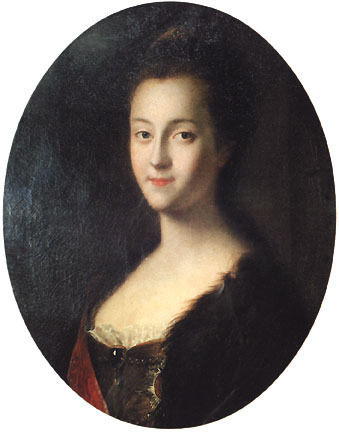
I was all of 14 years old when Elizabeth summoned Mama and me to Russia to marry Peter III. I was just a tiny slip of a girl then! The entirety of my trousseau consisted of three old dresses, a dozen chemises, a few pair of stockings and a few handkerchiefs. You see, Mama had spent all of the money that the empress sent for me on her own wardrobe. That’s Mama for you. Soon after my wedding, Elizabeth unceremoniously sent her back home for being a meddlesome mother-in-law and a clumsy Prussian secret agent. I never saw her again for the rest of my life.

That’s my husband. As you can see, he’s not much of a catch, but he’s still Peter the Great’s only surviving grandson, and that’s who I married --- the future Tsar of all the Russias. Peter was a sickly man-child who would rather play with his toy soldiers on our marital bed than with me. He was not allowed to play with them during the day, so they were hidden under the bed. As soon as we were both in bed, Madame Krause, our nanny/supervisor, would come in and brought out the toy soldiers. I couldn’t even move in the bed --- they were so many of them! Peter played with them until well after midnight, and every time someone knocked at the door to check on us, we had to scramble to hide the toys under the blanket. It was farcical: a newly married couple constantly on guard lest they be caught playing with toys. But the Empress Elizabeth was not amused when, years into our marriage, we had not produced the heir that she was expecting from us.
The fact is that my husband never touched me for the first nine years of our marriage. There was a lot of speculation as to the reason why. He openly told me that he was in love with another woman --- one of my ladies in waiting --- but it seemed that the relationship was similarly unconsummated. Others speculated that he was just simply too physically and mentally immature to father a child. Some of our learned doctors even diagnosed him with phimosis (http://en.wikipedia.org/wiki/Phimosis). Sergei Saltykov, the first of my twelve lovers (oh, how handsome he was!), convinced him to have an operation to correct the condition. You see, once Sergei was involved with me, he became anxious of his own safety. What if I got pregnant? But if Peter had been known to be able to consummate our marriage, who could say that Sergei was responsible? It turned out that my paramour was unnecessarily worried: the empress herself had instructed her minions to provide me with a more reliable male for the purposes of begetting an heir --- and Sergei was one of those considered! Anyway, I soon fell pregnant, resulting in Paul, the long-awaited Romanov heir.
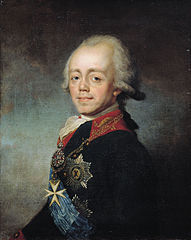
Many people claimed to see a marked resemblance between my son and my husband, not just in looks, but also in their shared hobby of playing soldier. But whenever I wanted to needle my son, I always said that Sergei Saltykov was his father. We never got on well, Paul and I, perhaps because I rarely saw him during his childhood. The Empress Elizabeth whisked him away right after he was born, smothered him with frustrated maternal love and casted me aside. When my first grandson was born, I contemplated bypassing Paul altogether and make him Tsar Alexander I, but it was not to happen.
After the empress passed way, Peter briefly got to be Tsar, before he was forcibly deposed by the army, who made me empress instead. Peter idolized Frederick II, the Prussian king who was at war with us, and wanted to make peace with him. The patriotic Russian people hated this radical change in foreign policy and casted their lot with me instead. My then boyfriend, Grigory Orlov (that’s him below, by the way --- isn’t he dashing?), and his brother made sure that Peter was mysteriously dispatched soon after, and I got to gloriously rally the Russian people on horseback wearing the uniform of a colonel of the Preobrazhensky Regiment.

Boyfriend#3

The reign of Catherine II officially begins!
I believed in the strong Russian motherland and added many territories, 520,000 km2 in all, to Peter the Great’s empire. When he was only able to gain a toehold in the south, I completed his conquest by defeating the ailing Turks (and gaining a warm water port, so crucial for Russia, in the process). The former Ottoman territories around the Black Sea, the Ukraine, and Crimea (which the love of my life, Grigory Potemkin, administered as my Viceroy) became Russian possessions. I also partitioned Poland, after putting my second lover, Stanislaus Poniatowski, on the throne of that country (poor sweetie, he actually didn’t want to be king, imagine that!).

Boyfriend#2
On the home front, I tried my best to drag Russia into the modern age. Eighteen years of boredom and loneliness as an unhappily married woman gave me the opportunity to read many books. I imbibed the best ideas of the Aufklarung through the writings of M. Montesquieu (whose ideas I pillaged for the Nakaz, the new legal code that I envisioned for Russia), Mr. John Locke (what is more important than our children’s education, especially our girls?) and Signore Beccaria (torture is barbaric!). I corresponded with the best minds in France, including M. Voltaire (he called me “The Star of the North” --- such a sweet man!) and M. Diderot, whose work on his Encyclopedie I supported, and whose library I purchased --- on the condition that he got to keep it during his lifetime as I thought that it would be so cruel to separate a scholar from his books. M. Diderot actually visited me in St. Petersburg to express his gratitude, the poor sickly man. Unfortunately, many of these progressive ideas proved to be far too advanced for the country, and I had to reassert my absolute powers as the autocrat of all the Russias to prevent the total collapse of the social order, particularly during the savage Pugachev rebellion. That rough Cossack pretended to be my long dead husband --- what insolence!
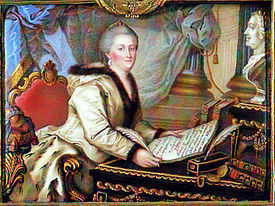
The Benevolent Despot in action
Finally, I must say for myself that as a sovereign I wanted nothing other than what was good for my country, and that I had employed all the powers on my disposal to bring happiness, liberty and prosperity for my subjects. I am aware, however, that I have a number of detractors, who do not hesitate to concoct lies and outright fabrications to sully my good name. They alleged, for example, that the so-called “Potemkin Villages” deceived me during my visit to the Crimea in 1787. My darling Grigory (below --- mwah, mwah!) might have put some fresh paint on some of the settlements that we passed through, but he did not construct whole made-up villages for my benefit. And even if he did, do you think that they could have fooled me, and my whole entourage, which included courtiers, foreign diplomats and even Emperor Joseph II?

Boyfriend#5
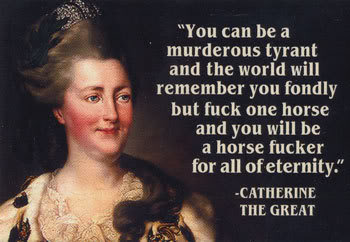
And as for that unspeakable, much more egregious fabrication--- let us just say that some men were troubled by the fact that there was an accomplished, powerful woman on the throne and would stop at nothing to slander her. Besides, I had had twelve handsome young men at my beck and call --- what would I need a horse for?
First things first: that wasn’t my real name. The Empress Elizabeth, who was Peter the Great’s daughter (now, that is a man who truly deserves “the Great” after his name!), changed my name to Ekaterina when she converted me into the Russian Orthodox religion. As for that superfluous title that follows my new name, it was prematurely bestowed on me by the Legislative Commission that I convened to give Russia a more enlightened legal code (more on this later). I brought them together to study laws, and they were busy discussing my virtues instead. Imagine that! I still blush with embarrassment whenever I recall the incident, although I cannot say that I’m thoroughly displeased with it.
My real name is Sophie Friederike Auguste von Anhalt-Zerbst-Dornburg. Yes --- I was a German import. Many Romanov royals, including my future husband Tsar Peter III, are actually Germans, specifically Prussians. This caused some awkwardness later when we went to war against Prussia in my reign --- but that was still far in the future. Papa was the ruler of the Anhalt-Zerbst principality. Some people would call him a minor aristocrat, but he was still a prince, nein? Mama was formerly a princess of the house of Holstein-Gottorp (yes, that’s where those lovely cows come from), whose late brother was affianced to the young Empress Elizabeth. He died of smallpox before the wedding, but Elizabeth never forgot him, and when it was time to look for a spouse for the Tsarevich, she naturally turned toward his family.
I was all of 14 years old when Elizabeth summoned Mama and me to Russia to marry Peter III. I was just a tiny slip of a girl then! The entirety of my trousseau consisted of three old dresses, a dozen chemises, a few pair of stockings and a few handkerchiefs. You see, Mama had spent all of the money that the empress sent for me on her own wardrobe. That’s Mama for you. Soon after my wedding, Elizabeth unceremoniously sent her back home for being a meddlesome mother-in-law and a clumsy Prussian secret agent. I never saw her again for the rest of my life.
That’s my husband. As you can see, he’s not much of a catch, but he’s still Peter the Great’s only surviving grandson, and that’s who I married --- the future Tsar of all the Russias. Peter was a sickly man-child who would rather play with his toy soldiers on our marital bed than with me. He was not allowed to play with them during the day, so they were hidden under the bed. As soon as we were both in bed, Madame Krause, our nanny/supervisor, would come in and brought out the toy soldiers. I couldn’t even move in the bed --- they were so many of them! Peter played with them until well after midnight, and every time someone knocked at the door to check on us, we had to scramble to hide the toys under the blanket. It was farcical: a newly married couple constantly on guard lest they be caught playing with toys. But the Empress Elizabeth was not amused when, years into our marriage, we had not produced the heir that she was expecting from us.
The fact is that my husband never touched me for the first nine years of our marriage. There was a lot of speculation as to the reason why. He openly told me that he was in love with another woman --- one of my ladies in waiting --- but it seemed that the relationship was similarly unconsummated. Others speculated that he was just simply too physically and mentally immature to father a child. Some of our learned doctors even diagnosed him with phimosis (http://en.wikipedia.org/wiki/Phimosis). Sergei Saltykov, the first of my twelve lovers (oh, how handsome he was!), convinced him to have an operation to correct the condition. You see, once Sergei was involved with me, he became anxious of his own safety. What if I got pregnant? But if Peter had been known to be able to consummate our marriage, who could say that Sergei was responsible? It turned out that my paramour was unnecessarily worried: the empress herself had instructed her minions to provide me with a more reliable male for the purposes of begetting an heir --- and Sergei was one of those considered! Anyway, I soon fell pregnant, resulting in Paul, the long-awaited Romanov heir.
Many people claimed to see a marked resemblance between my son and my husband, not just in looks, but also in their shared hobby of playing soldier. But whenever I wanted to needle my son, I always said that Sergei Saltykov was his father. We never got on well, Paul and I, perhaps because I rarely saw him during his childhood. The Empress Elizabeth whisked him away right after he was born, smothered him with frustrated maternal love and casted me aside. When my first grandson was born, I contemplated bypassing Paul altogether and make him Tsar Alexander I, but it was not to happen.
After the empress passed way, Peter briefly got to be Tsar, before he was forcibly deposed by the army, who made me empress instead. Peter idolized Frederick II, the Prussian king who was at war with us, and wanted to make peace with him. The patriotic Russian people hated this radical change in foreign policy and casted their lot with me instead. My then boyfriend, Grigory Orlov (that’s him below, by the way --- isn’t he dashing?), and his brother made sure that Peter was mysteriously dispatched soon after, and I got to gloriously rally the Russian people on horseback wearing the uniform of a colonel of the Preobrazhensky Regiment.
Boyfriend#3
The reign of Catherine II officially begins!
I believed in the strong Russian motherland and added many territories, 520,000 km2 in all, to Peter the Great’s empire. When he was only able to gain a toehold in the south, I completed his conquest by defeating the ailing Turks (and gaining a warm water port, so crucial for Russia, in the process). The former Ottoman territories around the Black Sea, the Ukraine, and Crimea (which the love of my life, Grigory Potemkin, administered as my Viceroy) became Russian possessions. I also partitioned Poland, after putting my second lover, Stanislaus Poniatowski, on the throne of that country (poor sweetie, he actually didn’t want to be king, imagine that!).
Boyfriend#2
On the home front, I tried my best to drag Russia into the modern age. Eighteen years of boredom and loneliness as an unhappily married woman gave me the opportunity to read many books. I imbibed the best ideas of the Aufklarung through the writings of M. Montesquieu (whose ideas I pillaged for the Nakaz, the new legal code that I envisioned for Russia), Mr. John Locke (what is more important than our children’s education, especially our girls?) and Signore Beccaria (torture is barbaric!). I corresponded with the best minds in France, including M. Voltaire (he called me “The Star of the North” --- such a sweet man!) and M. Diderot, whose work on his Encyclopedie I supported, and whose library I purchased --- on the condition that he got to keep it during his lifetime as I thought that it would be so cruel to separate a scholar from his books. M. Diderot actually visited me in St. Petersburg to express his gratitude, the poor sickly man. Unfortunately, many of these progressive ideas proved to be far too advanced for the country, and I had to reassert my absolute powers as the autocrat of all the Russias to prevent the total collapse of the social order, particularly during the savage Pugachev rebellion. That rough Cossack pretended to be my long dead husband --- what insolence!
The Benevolent Despot in action
Finally, I must say for myself that as a sovereign I wanted nothing other than what was good for my country, and that I had employed all the powers on my disposal to bring happiness, liberty and prosperity for my subjects. I am aware, however, that I have a number of detractors, who do not hesitate to concoct lies and outright fabrications to sully my good name. They alleged, for example, that the so-called “Potemkin Villages” deceived me during my visit to the Crimea in 1787. My darling Grigory (below --- mwah, mwah!) might have put some fresh paint on some of the settlements that we passed through, but he did not construct whole made-up villages for my benefit. And even if he did, do you think that they could have fooled me, and my whole entourage, which included courtiers, foreign diplomats and even Emperor Joseph II?
Boyfriend#5
And as for that unspeakable, much more egregious fabrication--- let us just say that some men were troubled by the fact that there was an accomplished, powerful woman on the throne and would stop at nothing to slander her. Besides, I had had twelve handsome young men at my beck and call --- what would I need a horse for?

September 6, 2011
Like probably every woman of note in history, open about and unashamed of her sexuality, Catherine the Great is primarily remembered as a power- and man-hungry, salacious, perverted woman. Try googling her name and see how high on the list of the results is the ever-pressing question - Did she really sleep with a horse? Does anyone care about her accomplishments in politics, art and science? Not really. But her sexual exploits? Oh, YES!
That's why I appreciate Robert K. Massie's Catherine the Great: Portrait of a Woman so much. It is an honest, frank, compassionate account of this superbly intelligent and deeply dedicated to her adoptive country woman's life.
As expected from a biography of a monarch, this work is pretty heavy on historical details. I won't lie, I skimmed over a good quarter of the book, not desiring to read much about domestic and foreign policies, wars, legislation and reforms.
Thankfully, the details of Catherine's personal life had me glued to the pages of this hefty work. She was brought to Russia at the age of 14, married to a man unable to rid her of her virginity for years (just like Marie Antoinette) and thus encouraged to take a lover and get pregnant by him to finally produce an heir to the Russian throne (which made me think - how many kings, emperors and princes who were assumed to belong to various royal dynasties had actual blood/DNA claim to them? not many methinks), deposed her own husband and usurped the power. And, of course, all those lovers - oh my, 12 in total throughout her life, by Massie's count. Ironically, her husband was not one of the 12.
It is easy to sensationalize these facts of Catherine's life and use them to condemn her. But the reality is, most of what she did was motivated by Catherine's desire to serve Russia, be that by producing a very necessary heir when her husband was unable to do so due to psychological or physical issues, or by removing the same incapable husband from the throne. As for the lovers, as a woman of high intellect and high power, Catherine was never able to find a man emotionally, politically and intellectually equal to her. Thus can be explained her "harem" of young favorites she settled for in the later years of her life, to quench her loneliness mostly.
I finished this biography feeling a lot of respect for Catherine, a progressive, smart, responsible woman. But I felt sad on her behalf too. She might have succeeded as a monarch, but her personal desires of being a mother and having a dedicated life partner were never completely fulfilled.
That's why I appreciate Robert K. Massie's Catherine the Great: Portrait of a Woman so much. It is an honest, frank, compassionate account of this superbly intelligent and deeply dedicated to her adoptive country woman's life.
As expected from a biography of a monarch, this work is pretty heavy on historical details. I won't lie, I skimmed over a good quarter of the book, not desiring to read much about domestic and foreign policies, wars, legislation and reforms.
Thankfully, the details of Catherine's personal life had me glued to the pages of this hefty work. She was brought to Russia at the age of 14, married to a man unable to rid her of her virginity for years (just like Marie Antoinette) and thus encouraged to take a lover and get pregnant by him to finally produce an heir to the Russian throne (which made me think - how many kings, emperors and princes who were assumed to belong to various royal dynasties had actual blood/DNA claim to them? not many methinks), deposed her own husband and usurped the power. And, of course, all those lovers - oh my, 12 in total throughout her life, by Massie's count. Ironically, her husband was not one of the 12.
It is easy to sensationalize these facts of Catherine's life and use them to condemn her. But the reality is, most of what she did was motivated by Catherine's desire to serve Russia, be that by producing a very necessary heir when her husband was unable to do so due to psychological or physical issues, or by removing the same incapable husband from the throne. As for the lovers, as a woman of high intellect and high power, Catherine was never able to find a man emotionally, politically and intellectually equal to her. Thus can be explained her "harem" of young favorites she settled for in the later years of her life, to quench her loneliness mostly.
I finished this biography feeling a lot of respect for Catherine, a progressive, smart, responsible woman. But I felt sad on her behalf too. She might have succeeded as a monarch, but her personal desires of being a mother and having a dedicated life partner were never completely fulfilled.

June 18, 2013
Catherine the Great: Portrait of a Woman by Robert K Massie is the extraordinary story of an obscure young German princess who travelled to Russia at the tender age of fourteen and rose to become one of
the most powerful, and captivating women in history.
I had previously read Massie's Nicholas and Alexandra which was wonderful and I was really interested in reading about Catherine the Great.
Massie did extensive research on this book. It is Catherine’s detailed and excellent memoirs and letters from which Massie quotes liberally which make it possible for him to write such a wonderful detailed portrait of this Woman and her time in history. Mr. Massie writes elegantly and knows how to get the readers attention and I found myself totally invested in this story and its characters.
I loved reading this book and really learned so much. I spent a lot of time googing places and palaces in Russia that I was totally side-tracked for much of the novel. I did finish the book feeling some compassion for Catherine and her life at court, but I was stunned at the opulence and behaviour of those within the Russian court.
Lovers of history will not be disappointed with this extensively researched and easy to read story that flows from beginning to end.
the most powerful, and captivating women in history.
I had previously read Massie's Nicholas and Alexandra which was wonderful and I was really interested in reading about Catherine the Great.
Massie did extensive research on this book. It is Catherine’s detailed and excellent memoirs and letters from which Massie quotes liberally which make it possible for him to write such a wonderful detailed portrait of this Woman and her time in history. Mr. Massie writes elegantly and knows how to get the readers attention and I found myself totally invested in this story and its characters.
I loved reading this book and really learned so much. I spent a lot of time googing places and palaces in Russia that I was totally side-tracked for much of the novel. I did finish the book feeling some compassion for Catherine and her life at court, but I was stunned at the opulence and behaviour of those within the Russian court.
Lovers of history will not be disappointed with this extensively researched and easy to read story that flows from beginning to end.

December 14, 2021
How this woman ever achieved a semblance of normalcy and clear sightedness is a testament to the resiliency of the human brain. Disliked by her mother, used as a marriage pawn, manipulated by the Russian crown, isolated in the palace with her immature and odd betrothed, she overcame these obstacles to rule a powerful and respected Russian Empire for 34 years.
Fueled by a quick mind, a love of reading, and a commitment to Enlightenment theory, she successfully fought wars, challenged the Justice system, and improved education, medical care, and the arts. She built a Navy, guided her people through a pandemic, snuffed an insurrection, and expanded the Empire. She lamented over her inability to free the serfs, she strongly believed in autocratic rule, and her never ending search for a suitable lifelong partner was unfulfilled.
This well written account uses Catherine’s personal journals and letters as well as correspondence from other leaders of the time. Not only is this a look into Catherine the Great’s life, but the influence of the shifting events in Europe and America during her reign are clearly presented.
Highly recommended if you’re into this kind of stuff.
Fueled by a quick mind, a love of reading, and a commitment to Enlightenment theory, she successfully fought wars, challenged the Justice system, and improved education, medical care, and the arts. She built a Navy, guided her people through a pandemic, snuffed an insurrection, and expanded the Empire. She lamented over her inability to free the serfs, she strongly believed in autocratic rule, and her never ending search for a suitable lifelong partner was unfulfilled.
This well written account uses Catherine’s personal journals and letters as well as correspondence from other leaders of the time. Not only is this a look into Catherine the Great’s life, but the influence of the shifting events in Europe and America during her reign are clearly presented.
Highly recommended if you’re into this kind of stuff.

April 6, 2017
My ongoing exploration of biographies has pushed into yet another realm; women of power. What better way to begin than with a woman who held much power in her time and about whom I know very little? Bring on Catherine the Great of Russia! Robert K. Massie does a sensational job of pulling out a strong and well-rounded story of this most interesting Empress of Russia. She faced hurdles and impediments throughout her life, but always found a way to succeed. While Massie offers the reader numerous parts to the biography, for the purposes of review, the reader can see her upbringing, marriage, and eventual reign as three key areas worthy of discussion below, all of which interconnect to make her the woman remembered by many in history. Massie's effective arguments and thorough research are a treat for the curious reader, even if little is known about this woman before beginning the journey.
Born into a somewhat noble (though by no means powerful) family, Sophia Augusta Fredericka of Anhalt-Zerbst was the first-born and yet shunned by her parents. In an era when male heirs were prized, Sophia was forced to live in the shadow of her younger brother, whose health was precarious at the best of times. Sophia was deemed plain and on the verge of ugly by her mother, something that Massie does not refute strongly in his narrative. As was the norm in the era, she would have to be married off in order to bring some wealth and prominence to her family, as Anhalt-Zerbst was by no means significant. Answering a call from Empress Elizabeth in Russia, Sophia and her mother traveled to court. There, negotiations began to join Sophia to the Grand Duke Peter, himself a teenager. While at court, Sophia tried her best to fit in and studied Russian, as well as commencing a conversion from the Lutheran Church to Orthodoxy, the state religion of Russia and long practiced by the Romanovs. While this would surely dilute her ancestral roots, Sophia was willing to do all she could to earn favour with the Empress and Grand Duke. After her conversion, Sophia became Catherine and her future as Empress Consort began.
Marrying Peter, a man whom she did not love or even particularly care about, was the least of her worries. Catherine's husband had little interest in bringing forth is own heir, as Massie explores, choosing instead to have little Prussian toy soldiers brought to the bed after he and Catherine retired (I cannot refrain from saying that it brings a whole new meaning to 'toys in the bedroom'). Catherine suffered both physical and emotional pains at this flagrant insult to her person, a matrimonial virginity that lasted upwards of nine years. Such rejection took its toll, as well as a number of miscarriages after Peter did consummate the marriage. Both the Grand Duke and Duchess turned elsewhere for their physical needs, with Catherine having at least three men in her life who proved to be significant lovers. Massie goes so far as to stress the depth of these affairs by presenting the reader with the fact that Catherine eventually had children with all three. When Catherine finally bore Peter an heir, they named him Paul and the little one received all the protection due someone in the line of succession. An interesting fact in Russia, the Throne was not passed along by a firm family tree (the tradition of primogeniture). The reigning sovereign was able to choose their successor, as Peter the Great had established when he negated past rules of succession. Elizabeth had chosen her nephew, though she did deeply admire Catherine as well. When Elizabeth died, Peter ascended to the Throne, though he was little known and even less liked by the people. Massie describes Peter III as being belligerent and highly pompous, poor traits for an emperor. He would not engage in conversations and sought to overturn all the major decisions within the state that had been established by Elizabeth. Catherine saw this and knew that she could not remain subservient to a man who treated her so poorly. Massie lays the groundwork for the proverbial last straw when Peter tried to shame his wife at a public banquet. Thereafter, Catherine took matters into her own hands.
Catherine's formal ascension to the Russian Throne proved interesting and is in line with her hold on power for the length of her reign. Catherine, still stinging from the rebuke in front of so many, organized a coup that overthrew Peter III and saw her take his place. Massie offers a strong narrative for the reader to understand the nuances of this and how Catherine was able to sway the support of the military to her favour before assuming power. Peter III was banished and lost his fight to regain his position, leaving Catherine to begin her lengthy reign. Peter III had only reigned a few months, which made the coup all the more surprising to the outside world. Catherine wasted no time in solidifying her strength both within Russia and on an international scale. Moves to secularise the Church and make priests bureaucrats of the state proved to be a means of lessening the control (and deflating competition) over the population, without banishing religion entirely. Some speculate this was Catherine seeking to give Protestantism a new strength in the country, though this is not entirely supported. She revisited the idea of serfs and the nobility, in an era when slavery remained rampant around the world (especially in the soon to be created United States), though these were not subjugated people of a different culture or ethnicity. On a grander scale, Massie speaks of Catherine's desire to continue ruling as an autocrat, but still have the input of the people who so loved her. Catherine formed a loose advisory board, where representatives could meet and debate various issues of importance to Russia. However, when representatives got caught up in the minutiae, nothing was forthcoming and the collective dissolved with little to show for itself. (It was at this gathering that Catherine was given the title 'The Great', which might indicate that they did something that pleased the Empress!) Surely concerned with her subjects, Massie explores how Catherine handled many health crises within Russia, from smallpox to the plague and many other situations in between. She was by no means wanting to ignore those under her, but did remain isolated so as not to catch what was in the air. On the international front, Catherine returned to her roots and solidified an alliance with Prussia and its monarchy, as Massie seems to insinuate that Anhalt-Zerbst falls under or close to the Prussian lands. Europe was still teetering between a number of alliances, which could turn a single fallen domino into a full-blown war. Russia kept things peaceable and forged ahead with Prussia, turning to small Poland and carving out chunks to strengthen their respective empires. Catherine remained ruler in all but name of Poland, choosing its kings and keeping a close eye on the situation there. While she kept Russian land interests in mind and the military strong, Catherine made sure her people did not forget other Romanov rulers who had helped make Mother Russia strong, erecting monuments and statues of those who came before her. The waning years of Catherine's reign seemed to be a time to remember others and prepare for the end of her own life. It had surely been a full and remarkable reign, which Massie asserts was by no means bland.
As I entered this biography, I could not have told you much about Catherine or what she did for Russia. Massie helps with his attention to detail and significant research on both the region and its ruler. While I remain flummoxed by the number of names, geographic regions, military campaigns, and even historical alliances, Massie uses a detailed narrative to navigate through all this and help me see Catherine's place. That this Empress was a significant figure in Russian history is not lost on me, nor is that she was the last female ruler of the country (after her son, Paul, reinstated primogeniture). Much like some of the other strong females I hope to discover in my biography journey, Catherine leaves an indelible mark on history. Massie is also a biographer to which I will surely return, as his interest in Russia is one that will prove very telling in these trying political times.
Kudos, Mr. Massie for bringing Sophia Augusta Fredericka of Anhalt-Zerbst to life for me. You have a wonderful way with words and prove that European history is full of intricate details that can be compared effectively to the modern political scene. This book solidifies that Catherine surely earned her moniker, while the current autocratic ruler of the country is anything but formidable.
Like/hate the review? An ever-growing collection of others appears at:
http://pecheyponderings.wordpress.com
Born into a somewhat noble (though by no means powerful) family, Sophia Augusta Fredericka of Anhalt-Zerbst was the first-born and yet shunned by her parents. In an era when male heirs were prized, Sophia was forced to live in the shadow of her younger brother, whose health was precarious at the best of times. Sophia was deemed plain and on the verge of ugly by her mother, something that Massie does not refute strongly in his narrative. As was the norm in the era, she would have to be married off in order to bring some wealth and prominence to her family, as Anhalt-Zerbst was by no means significant. Answering a call from Empress Elizabeth in Russia, Sophia and her mother traveled to court. There, negotiations began to join Sophia to the Grand Duke Peter, himself a teenager. While at court, Sophia tried her best to fit in and studied Russian, as well as commencing a conversion from the Lutheran Church to Orthodoxy, the state religion of Russia and long practiced by the Romanovs. While this would surely dilute her ancestral roots, Sophia was willing to do all she could to earn favour with the Empress and Grand Duke. After her conversion, Sophia became Catherine and her future as Empress Consort began.
Marrying Peter, a man whom she did not love or even particularly care about, was the least of her worries. Catherine's husband had little interest in bringing forth is own heir, as Massie explores, choosing instead to have little Prussian toy soldiers brought to the bed after he and Catherine retired (I cannot refrain from saying that it brings a whole new meaning to 'toys in the bedroom'). Catherine suffered both physical and emotional pains at this flagrant insult to her person, a matrimonial virginity that lasted upwards of nine years. Such rejection took its toll, as well as a number of miscarriages after Peter did consummate the marriage. Both the Grand Duke and Duchess turned elsewhere for their physical needs, with Catherine having at least three men in her life who proved to be significant lovers. Massie goes so far as to stress the depth of these affairs by presenting the reader with the fact that Catherine eventually had children with all three. When Catherine finally bore Peter an heir, they named him Paul and the little one received all the protection due someone in the line of succession. An interesting fact in Russia, the Throne was not passed along by a firm family tree (the tradition of primogeniture). The reigning sovereign was able to choose their successor, as Peter the Great had established when he negated past rules of succession. Elizabeth had chosen her nephew, though she did deeply admire Catherine as well. When Elizabeth died, Peter ascended to the Throne, though he was little known and even less liked by the people. Massie describes Peter III as being belligerent and highly pompous, poor traits for an emperor. He would not engage in conversations and sought to overturn all the major decisions within the state that had been established by Elizabeth. Catherine saw this and knew that she could not remain subservient to a man who treated her so poorly. Massie lays the groundwork for the proverbial last straw when Peter tried to shame his wife at a public banquet. Thereafter, Catherine took matters into her own hands.
Catherine's formal ascension to the Russian Throne proved interesting and is in line with her hold on power for the length of her reign. Catherine, still stinging from the rebuke in front of so many, organized a coup that overthrew Peter III and saw her take his place. Massie offers a strong narrative for the reader to understand the nuances of this and how Catherine was able to sway the support of the military to her favour before assuming power. Peter III was banished and lost his fight to regain his position, leaving Catherine to begin her lengthy reign. Peter III had only reigned a few months, which made the coup all the more surprising to the outside world. Catherine wasted no time in solidifying her strength both within Russia and on an international scale. Moves to secularise the Church and make priests bureaucrats of the state proved to be a means of lessening the control (and deflating competition) over the population, without banishing religion entirely. Some speculate this was Catherine seeking to give Protestantism a new strength in the country, though this is not entirely supported. She revisited the idea of serfs and the nobility, in an era when slavery remained rampant around the world (especially in the soon to be created United States), though these were not subjugated people of a different culture or ethnicity. On a grander scale, Massie speaks of Catherine's desire to continue ruling as an autocrat, but still have the input of the people who so loved her. Catherine formed a loose advisory board, where representatives could meet and debate various issues of importance to Russia. However, when representatives got caught up in the minutiae, nothing was forthcoming and the collective dissolved with little to show for itself. (It was at this gathering that Catherine was given the title 'The Great', which might indicate that they did something that pleased the Empress!) Surely concerned with her subjects, Massie explores how Catherine handled many health crises within Russia, from smallpox to the plague and many other situations in between. She was by no means wanting to ignore those under her, but did remain isolated so as not to catch what was in the air. On the international front, Catherine returned to her roots and solidified an alliance with Prussia and its monarchy, as Massie seems to insinuate that Anhalt-Zerbst falls under or close to the Prussian lands. Europe was still teetering between a number of alliances, which could turn a single fallen domino into a full-blown war. Russia kept things peaceable and forged ahead with Prussia, turning to small Poland and carving out chunks to strengthen their respective empires. Catherine remained ruler in all but name of Poland, choosing its kings and keeping a close eye on the situation there. While she kept Russian land interests in mind and the military strong, Catherine made sure her people did not forget other Romanov rulers who had helped make Mother Russia strong, erecting monuments and statues of those who came before her. The waning years of Catherine's reign seemed to be a time to remember others and prepare for the end of her own life. It had surely been a full and remarkable reign, which Massie asserts was by no means bland.
As I entered this biography, I could not have told you much about Catherine or what she did for Russia. Massie helps with his attention to detail and significant research on both the region and its ruler. While I remain flummoxed by the number of names, geographic regions, military campaigns, and even historical alliances, Massie uses a detailed narrative to navigate through all this and help me see Catherine's place. That this Empress was a significant figure in Russian history is not lost on me, nor is that she was the last female ruler of the country (after her son, Paul, reinstated primogeniture). Much like some of the other strong females I hope to discover in my biography journey, Catherine leaves an indelible mark on history. Massie is also a biographer to which I will surely return, as his interest in Russia is one that will prove very telling in these trying political times.
Kudos, Mr. Massie for bringing Sophia Augusta Fredericka of Anhalt-Zerbst to life for me. You have a wonderful way with words and prove that European history is full of intricate details that can be compared effectively to the modern political scene. This book solidifies that Catherine surely earned her moniker, while the current autocratic ruler of the country is anything but formidable.
Like/hate the review? An ever-growing collection of others appears at:
http://pecheyponderings.wordpress.com

April 24, 2022
47th book of 2022
"She sat on the throne of Peter the Great and ruled an empire, the largest on earth. Her signature, inscribed on a decree, was law and, if she chose, could mean life or death for any one of her twenty million subjects. She was intelligent, well-read, and a shrewd judge of character. During her coup, she had shown determination and courage; once on the throne, she displayed an open mind, willingness to forgive, and a political morality founded on rationality and practical efficiency..." Cathrine the Great Robert K. Massie
This was my first biography of Cathrine the Great, so I cannot speak to how it compares to others on the same subject. However, what I can say is that what I have read within these 576 pages will long linger in my mind. I did not fully know what to expect when I first began reading Cathrine the Great. What I was swept into was a thoroughly researched, beautifully presented, and accessible biography of a woman who would forever leave her mark on the world.
Delving into all aspects of Cathrine's life, Massie doesn’t hold back, giving the reader every detail and the result is something truly magical. I was enthralled the entire time, never growing tired or bored with any one of the remarkable figures presented throughout this biography. Five stars.
"She sat on the throne of Peter the Great and ruled an empire, the largest on earth. Her signature, inscribed on a decree, was law and, if she chose, could mean life or death for any one of her twenty million subjects. She was intelligent, well-read, and a shrewd judge of character. During her coup, she had shown determination and courage; once on the throne, she displayed an open mind, willingness to forgive, and a political morality founded on rationality and practical efficiency..." Cathrine the Great Robert K. Massie
This was my first biography of Cathrine the Great, so I cannot speak to how it compares to others on the same subject. However, what I can say is that what I have read within these 576 pages will long linger in my mind. I did not fully know what to expect when I first began reading Cathrine the Great. What I was swept into was a thoroughly researched, beautifully presented, and accessible biography of a woman who would forever leave her mark on the world.
Delving into all aspects of Cathrine's life, Massie doesn’t hold back, giving the reader every detail and the result is something truly magical. I was enthralled the entire time, never growing tired or bored with any one of the remarkable figures presented throughout this biography. Five stars.

February 26, 2011
This one was clearly a win for me as a biography of Catherine the Great. Massie's writing is clear, brisk and kept the story moving throughout. What I really enjoyed was how he took the time and trouble to show how Catherine carried forward the reforms begun by Peter the Great, and was a monarch who overcame a great deal of adversity to overcome the obstacles of not being Russian, being a woman, and a usurper to boot -- most biographies focus on her time before becoming empress and/or her lovers -- while Massie does look closely at several of them, he also wisely discards the more wild rumours and looks at what Catherine actually did. While I did receive an ARC of this, I still intend to buy a copy of the finished edition. This one gets five stars from me, and a hearty recommendation for anyone interested in Tsarist history.
For the longer review, please go here:
http://www.mylot.com/post/2913151/rev...
For the longer review, please go here:
http://www.mylot.com/post/2913151/rev...

February 24, 2017
This book is hard to place on a scale. At times, it’s a 5 and other times it’s a 2 or even a 1. After some debating in my head I’m going to give it a 3.5, but it’s not enough to round it up to a 4.
This book started off as a 5 and I loved it. The story of Catherine (then Sophia) growing up, being picked as the bride for the heir to the Russian Empire, and her years spent in Russia was great. Massie interspaced entries from her own memoirs into these years and it really added a great personal flavor to the history. Granted I didn’t know that story going into this book but it’s a very interesting look at a girl getting out from under her family and turning into a strong woman.
Then Catherine becomes Empress and the book takes a huge nose-dive. Just when I thought it was going to really get interesting. Instead of continuing the solid chronological narrative, the author suddenly decides to tackle broad topics related to Catherine’s reign – her legal code book, her various lovers, Poland, philosophy, art etc. All important things to her rule but it’s a very jarring switch. Plus he bounces around in the timeline until I have no real sense of when these things are happening. The crème de la crème occurs when suddenly there’s a chapter on the French revolution and the death penalty.

The author eventually jumps back towards a chronological narrative but he never recovers the strength of the beginning. There’s still a lot of year jumping so that it feels like you learn about something only to go back in time and build the years up to it. Not the smoothest read for sure and while I was more interesting in the historical events, I never felt like I got a solid look at Catherine’s full reign as Empress.
Before you know it, Catherine is an old woman. Like I really had a holy shit moment of why is her health failing suddenly?! What do you mean she’s in her 60s and her grandson is like 17 and people think she wants him to be heir?! HE WAS JUST BORN?! Then she’s gone and that’s the book. I really could have used a legacy chapter here or even a little bit of what happened next to the family.
Honestly I think Massie tried to tackle too much in one book. It’s understandable given her amazing life and the interesting journey she took to the Russian throne. It was definitely a 5 star read for me. I wish he would have sorted out her life as Empress and folded broad issue topics into the narrative as they occurred as a second book. I can recommend the first part of this book. If you want to learn about Catherine pre-Empress, it is definitely an intriguing story. Just don’t expect to be too excited about her life as Empress.
This book started off as a 5 and I loved it. The story of Catherine (then Sophia) growing up, being picked as the bride for the heir to the Russian Empire, and her years spent in Russia was great. Massie interspaced entries from her own memoirs into these years and it really added a great personal flavor to the history. Granted I didn’t know that story going into this book but it’s a very interesting look at a girl getting out from under her family and turning into a strong woman.
Then Catherine becomes Empress and the book takes a huge nose-dive. Just when I thought it was going to really get interesting. Instead of continuing the solid chronological narrative, the author suddenly decides to tackle broad topics related to Catherine’s reign – her legal code book, her various lovers, Poland, philosophy, art etc. All important things to her rule but it’s a very jarring switch. Plus he bounces around in the timeline until I have no real sense of when these things are happening. The crème de la crème occurs when suddenly there’s a chapter on the French revolution and the death penalty.
The author eventually jumps back towards a chronological narrative but he never recovers the strength of the beginning. There’s still a lot of year jumping so that it feels like you learn about something only to go back in time and build the years up to it. Not the smoothest read for sure and while I was more interesting in the historical events, I never felt like I got a solid look at Catherine’s full reign as Empress.
Before you know it, Catherine is an old woman. Like I really had a holy shit moment of why is her health failing suddenly?! What do you mean she’s in her 60s and her grandson is like 17 and people think she wants him to be heir?! HE WAS JUST BORN?! Then she’s gone and that’s the book. I really could have used a legacy chapter here or even a little bit of what happened next to the family.
Honestly I think Massie tried to tackle too much in one book. It’s understandable given her amazing life and the interesting journey she took to the Russian throne. It was definitely a 5 star read for me. I wish he would have sorted out her life as Empress and folded broad issue topics into the narrative as they occurred as a second book. I can recommend the first part of this book. If you want to learn about Catherine pre-Empress, it is definitely an intriguing story. Just don’t expect to be too excited about her life as Empress.

February 9, 2024
Now what am I to read when I cannot fall asleep at night? I started this biography on 23 June 2017, so it's been entertaining me for a while. Yes it was interesting and I learned far more than I intended, Robert Massie puts in far more detail than any normal person would be interested in. The book rambled and weaved its way through the second half of 18th century Europe and Russia. And it was important and often interesting times, with Catherine at the forefront of much of the goings on at the time.
The details of her 'favourites' is of course of note, as according to Massie, at least 12 prior to and during her long reign. Favourites were of course her various lovers, usually for less than a couple of years, but being married as a German minor princess at 16 to the future Tsar of Russia, Peter III, their marriage was never consummated. These men were not hidden away, but part of her court and rewarded with money, titles and properties, yet other than Potemkin, never sharing in any running of her empire.
During Catherine's reign, some of the lands conquered and subjugated to Russia included present day Ukraine, Belarus, Lithuania, Crimea and many other areas in the news today. She ruled as an 'enlightened despot' as she did embrace the arts and European philosophies, including corresponding with Voltaire, as well as being one of the earliest monarchs to embrace vaccines, being inoculated against small pox soon after a vaccine became available. She tried to upgrade the Russian legal system with moderate success, but the nobles still had too much power, although she subjugated the Orthodox Church under her power.
But she was an absolute ruler in the end, one can see Putin's desire to continue in her footsteps, with his policies and in believing Ukraine is part of Russia as part of his dreams.
Interesting most of the time, but of course far too much detail, far too long and far too much extraneous information for me, but also worth the time and read. 3.5 stars.
The details of her 'favourites' is of course of note, as according to Massie, at least 12 prior to and during her long reign. Favourites were of course her various lovers, usually for less than a couple of years, but being married as a German minor princess at 16 to the future Tsar of Russia, Peter III, their marriage was never consummated. These men were not hidden away, but part of her court and rewarded with money, titles and properties, yet other than Potemkin, never sharing in any running of her empire.
During Catherine's reign, some of the lands conquered and subjugated to Russia included present day Ukraine, Belarus, Lithuania, Crimea and many other areas in the news today. She ruled as an 'enlightened despot' as she did embrace the arts and European philosophies, including corresponding with Voltaire, as well as being one of the earliest monarchs to embrace vaccines, being inoculated against small pox soon after a vaccine became available. She tried to upgrade the Russian legal system with moderate success, but the nobles still had too much power, although she subjugated the Orthodox Church under her power.
But she was an absolute ruler in the end, one can see Putin's desire to continue in her footsteps, with his policies and in believing Ukraine is part of Russia as part of his dreams.
Interesting most of the time, but of course far too much detail, far too long and far too much extraneous information for me, but also worth the time and read. 3.5 stars.

February 27, 2011
I am impressed. Catherine the Great lived from 1729-1796. She was 14 when she first came to Russia, This book covers this entire time period meticulously. I understand how her childhood experiences came to shape her as an adult. I understand her need for love and why she came to have twelve lovers. At the same time she was motivated to seek power. She played a huge role in European history. All of this history is detailed in the book. You meet her as a person and as a leader. Everything one could possibly wish to know about her life is in this book........except gossip that is unsubstantiated.
Do yourself a favor - read the book! You will learn a lot and enjoy yourself most of the time. I think every time you reread the book you would enjoy it more. The parts most difficult for me were those where my knowledge is lacking.
**************************
Through 45%: The NYT Sunday Book Review has an article on the book this week. Here is the link: http://www.nytimes.com/2011/11/20/boo... I must warn you that there are spoilers. One reason alone to read this book is to laugh at crazy Peter. I mean this guy is so juvenile; it is mind boggling. In to his 20s he plays with toy soldiers in his/their bed. He even has real people marching up and down his room. Marching drills, tight uniforms, whips........ Is he real? Unfortunately - yes!
********************************
At 35%, the beginning of Part IV: I believe this book will appeal to a different group of people than those who appreciated Nicholas and Alexandra. Catherine the Great is a strong, politically minded person. The book does not focus upon a child with hemophilia. Although you do learn details of Catherine's childhood, and it certainly is essential to know these details to understand who she became as an adult, politics must be the central theme of this book.
Empress Elizabeth is reaching the end of her life. Catherine, who has never been allowed contact with her children, is now considering her next step toward power. It is power that she seeks.
Panin, believing that Peter was unfit to rule and should somehow be removed, wished Paul (Catherine's first child) to be placed on the throne as a boy emperor with Catherine as regent. Catherine pretended to agree with Panin; "I had rather be the mother than the wife of the emperor," she told him. In reality, she had no desire to be subordinated to her own child; her ambition was to occupy the throne herself. (35%)
If you are not interested in a woman seeking power and a place on the political stage, perhaps one should look elsewhere. I am curious to know how many stars I will finally give this book on completion.
********************************
I have now read 30% of the book. I am somewhere in Part III. The difficult job of keeping track of who is who is not a problem any more. For me, I get most enjoyment from the book when I am left undisturbed. What I want to mention here is that perhaps you think that the life of the nobility is a piece of cake. Forget that. There is no way you will envy their lives. I do not want to tell you why I say this, because that would be a spoiler. I will give you one example though. Moscow in the 1750s was a city constructed primarily of wooden houses. Sometimes the fancy houses were painted to look like stone. Even the nobility lived in houses of wood. Houses that were cold and infested with vermin. Even the palaces burned. Yes, I think it was in 1753 that the palace where Elizabeth and Peter and Catherine were residing burned. Then they moved to the governess' and governor's house, the house of their arch-enemies, the Choglokovas Only these two were no longer arch-enemies at this point. The description of their residence, that one would assume would be of high quality, is utterly deplorable! During the fire, what is most interesting to observe is what valuables are "lost/saved" by each. Elizabeth lost the most - thousands and thousands of dresses. Peter, he was embarrassed when a cabinet was hauled out of his room and it opened with liquor and wine bottles spilling out over the mud. And Catherine? Her pile of books by Voltaire and other such authors - they were saved. The articles most important to each says volumes! The author provides direct quotes from existing diaries.
Catherine's birthing experience and the way her child is kept from her are heart wrenching, even considering usual customs of the time. Contact between mother and child was made impossible. Elizabeth had brought Peter and Catherine to Russia. It took years for an heir to be "produced"! After that, Catherine and Peter had little significance to Elizabeth. They role was finished, as far as Elizabeth was concerned.
I find the book fascinating. Massie's choice of the specific details to include are balanced, descriptive and engaging.
**************************************
I have begun part two and am at 15%: At first I liked Empress Elizabeth, but now I despise her. Sophia, now called Catherine after her official conversion to the Orthodox faith, has married Grand Duke Peter Ulrich. Neither she nor her husband were told anything about sex. This is rather ironic given all the hullabaloo and planning behind the wedding! Rather essential bits were skipped! What is shocking is Elizabeth's volatile personality. Fortunately, Catherine is intelligent and is learning quickly. She is only seventeen and completely on her own. In a sense she has always been on her own with so one tor rely on since her birth. Lives are destroyed on the whims of Empress Elizabeth.
Let me take this opportunity to give you an excerpt concerning Empress Elizabeth:
...Elizabeth, whose concerns and fears were personal: she feared for the security of her person, her throne, and the future of her branch of the dynasty. In her plans, of course, Catherine, Peter, and their future child were of supreme importance. For this reason over the years ahead, Elizabeth's attitudes toward both the young husband and the young wife oscillated dramatically between affection, concern, disappointment, impatience, frustration and rage.
Not only in appearance but also in character, Elizabeth was her parents' child. She was the daughter of Russia's greatest tsar and his peasant wife, who became Empress Catherine I. Elizabeth was tall, like her father, and she resembled him in her energy, ardent temper, and sudden impulsive behavior. Like her mother, she was quickly moved to sympathy and to lavish spontaneous generosity. But her gratitude, like her other qualities, lacked moderation and permanence. (15%)
I appreciate how the author summarizes the descriptive incidents previously depicted. The reader is first part of the whirlwind events and then stands back and looks at what these events say about the individuals.
I do not think I have properly shown you Elizabeth's character/ Listen to this:
To maintain her dazzling preeminence at court, Elizabeth made certain that no other woman present could shine as brightly. Sometimes, this required draconian coercive measures. During the winter of 1747, the empress decreed that all of her ladies-in-waiting must shave their heads and wear black wigs until their hair grew in again. The women wept but obeyed. Catherine assumed that her own turn would come, but to her surprise, she was spared: Elizabeth explained that Catherine's hair was just growing back after an illness. Soon, the reason for the general pruning became known: after a previous festive occasion, Elizabeth and her maids had been unable to brush a heavy powder out of her hair, which became gray, coagulated, and gummy. The only remedy was to have her head shaved. And because she refused to be the only bald woman at court, bushels of hair were cropped.
What do you think of her now? I have seen tender moments too.
**********************************
I have read 12% of the book. I am somewhere in chapter 11. I have noted that several say that although they enjoy the book, they put it aside and read other lighter books occasionally. I take the opposite approach. I came to a point where the future husband of Sophia, who will later come to be called Catherine, died....... What! I obviously had something confused. The truth is that if you bother to try and understand the different family members and how they are all related, you do need to pay attention. If I had chosen to put the book aside for a while, I would have had to start over from the beginning. My head leaks. Instead I backtracked to the beginning of the chapter and determined that I would sit and pay close attention for at least one hour. No breaks, nothing, just reading. And this did the trick. That was a different Peter, who died! I would not recommend reading this book on a noisy metro, or in a noisy room while the kids are looking at TV. No, read it when you can pay attention, at least in those parts where the complicated family relations are discussed. You run into such sections and then you do need to pay attention. Other sections are not at all as difficult.
Or maybe you don't have to pay close attention. What I most enjoy in this book so far is the way the author describes the people in a nuanced manner. Take Empress Elizabeth. She was the daughter of Peter the Great. She did not seek power. She was vivacious and fun loving and had several affairs. But no kids. However there comes a point where either the regent Anna Leopoldovna is going to stick her in a nunnery or she had to fight for the reign. She had no intention of sitting in a nunnery. When she fights to become Empress you are rooting for her. As all people, she had kind, wonderful characteristics and others qualities less admirable. You see all the different sides of her personality. It is the author's ability to show us who the characters really are that I most enjoy. So maybe you can just forget the difficult sections that are hard to follow. That is another approach.
You will come to understand Elizabeth and Sophia and her future husband Grand Duke Peter Ulrich. It is important to know of what happened to them in their childhood. They both had very difficult family situations. Wait till you hear of how Sophia's mother, Johanna, treats her daughter. When they leave on a secret trip, in the winter to travel to St. Petersburg absolutely no clothes are bought for Sophia. Johanna spent the money on clothes for herself! Sophia was off to meet her future betrothed with the fewest of garments imaginable. This is just one indication of the horrible mother/ daughter relationship. And Peter, put under the supervision of Brümmer. You will be shocked. Peter is not particularly handsome or stable, but you will understand why. He was practically starved to death as punishment for slight misdemeanors. Both Sophia and Peter are starving for kindness. I will not say more, but their lives are very interesting. I have only come to the point where they are betrothed. Peter is still sexually immature, so marriage must be delayed. But the clock is ticking for Elizabeth. There are scenes that will make you laugh - men dressed as women and women as men and dancers falling over each other! All so that Elizabeth can display her shapely legs. Well, read the book and you will understand.
So I like the book. Either you see that you are left in peace to understand the sections that are a bit complicated, or you don't worry too much and just enjoy that which is easily engaging. Your choice depends on your own personality. But don't skip the book! So far, I think it is fascinating.
*************************************
BEFORE READING: This WILL be available in Kindle format on November 8, 2011!!!!!! YAY! Does fussing help? I have also requested his Peter the Great book on Kindle......
Do yourself a favor - read the book! You will learn a lot and enjoy yourself most of the time. I think every time you reread the book you would enjoy it more. The parts most difficult for me were those where my knowledge is lacking.
**************************
Through 45%: The NYT Sunday Book Review has an article on the book this week. Here is the link: http://www.nytimes.com/2011/11/20/boo... I must warn you that there are spoilers. One reason alone to read this book is to laugh at crazy Peter. I mean this guy is so juvenile; it is mind boggling. In to his 20s he plays with toy soldiers in his/their bed. He even has real people marching up and down his room. Marching drills, tight uniforms, whips........ Is he real? Unfortunately - yes!
********************************
At 35%, the beginning of Part IV: I believe this book will appeal to a different group of people than those who appreciated Nicholas and Alexandra. Catherine the Great is a strong, politically minded person. The book does not focus upon a child with hemophilia. Although you do learn details of Catherine's childhood, and it certainly is essential to know these details to understand who she became as an adult, politics must be the central theme of this book.
Empress Elizabeth is reaching the end of her life. Catherine, who has never been allowed contact with her children, is now considering her next step toward power. It is power that she seeks.
Panin, believing that Peter was unfit to rule and should somehow be removed, wished Paul (Catherine's first child) to be placed on the throne as a boy emperor with Catherine as regent. Catherine pretended to agree with Panin; "I had rather be the mother than the wife of the emperor," she told him. In reality, she had no desire to be subordinated to her own child; her ambition was to occupy the throne herself. (35%)
If you are not interested in a woman seeking power and a place on the political stage, perhaps one should look elsewhere. I am curious to know how many stars I will finally give this book on completion.
********************************
I have now read 30% of the book. I am somewhere in Part III. The difficult job of keeping track of who is who is not a problem any more. For me, I get most enjoyment from the book when I am left undisturbed. What I want to mention here is that perhaps you think that the life of the nobility is a piece of cake. Forget that. There is no way you will envy their lives. I do not want to tell you why I say this, because that would be a spoiler. I will give you one example though. Moscow in the 1750s was a city constructed primarily of wooden houses. Sometimes the fancy houses were painted to look like stone. Even the nobility lived in houses of wood. Houses that were cold and infested with vermin. Even the palaces burned. Yes, I think it was in 1753 that the palace where Elizabeth and Peter and Catherine were residing burned. Then they moved to the governess' and governor's house, the house of their arch-enemies, the Choglokovas Only these two were no longer arch-enemies at this point. The description of their residence, that one would assume would be of high quality, is utterly deplorable! During the fire, what is most interesting to observe is what valuables are "lost/saved" by each. Elizabeth lost the most - thousands and thousands of dresses. Peter, he was embarrassed when a cabinet was hauled out of his room and it opened with liquor and wine bottles spilling out over the mud. And Catherine? Her pile of books by Voltaire and other such authors - they were saved. The articles most important to each says volumes! The author provides direct quotes from existing diaries.
Catherine's birthing experience and the way her child is kept from her are heart wrenching, even considering usual customs of the time. Contact between mother and child was made impossible. Elizabeth had brought Peter and Catherine to Russia. It took years for an heir to be "produced"! After that, Catherine and Peter had little significance to Elizabeth. They role was finished, as far as Elizabeth was concerned.
I find the book fascinating. Massie's choice of the specific details to include are balanced, descriptive and engaging.
**************************************
I have begun part two and am at 15%: At first I liked Empress Elizabeth, but now I despise her. Sophia, now called Catherine after her official conversion to the Orthodox faith, has married Grand Duke Peter Ulrich. Neither she nor her husband were told anything about sex. This is rather ironic given all the hullabaloo and planning behind the wedding! Rather essential bits were skipped! What is shocking is Elizabeth's volatile personality. Fortunately, Catherine is intelligent and is learning quickly. She is only seventeen and completely on her own. In a sense she has always been on her own with so one tor rely on since her birth. Lives are destroyed on the whims of Empress Elizabeth.
Let me take this opportunity to give you an excerpt concerning Empress Elizabeth:
...Elizabeth, whose concerns and fears were personal: she feared for the security of her person, her throne, and the future of her branch of the dynasty. In her plans, of course, Catherine, Peter, and their future child were of supreme importance. For this reason over the years ahead, Elizabeth's attitudes toward both the young husband and the young wife oscillated dramatically between affection, concern, disappointment, impatience, frustration and rage.
Not only in appearance but also in character, Elizabeth was her parents' child. She was the daughter of Russia's greatest tsar and his peasant wife, who became Empress Catherine I. Elizabeth was tall, like her father, and she resembled him in her energy, ardent temper, and sudden impulsive behavior. Like her mother, she was quickly moved to sympathy and to lavish spontaneous generosity. But her gratitude, like her other qualities, lacked moderation and permanence. (15%)
I appreciate how the author summarizes the descriptive incidents previously depicted. The reader is first part of the whirlwind events and then stands back and looks at what these events say about the individuals.
I do not think I have properly shown you Elizabeth's character/ Listen to this:
To maintain her dazzling preeminence at court, Elizabeth made certain that no other woman present could shine as brightly. Sometimes, this required draconian coercive measures. During the winter of 1747, the empress decreed that all of her ladies-in-waiting must shave their heads and wear black wigs until their hair grew in again. The women wept but obeyed. Catherine assumed that her own turn would come, but to her surprise, she was spared: Elizabeth explained that Catherine's hair was just growing back after an illness. Soon, the reason for the general pruning became known: after a previous festive occasion, Elizabeth and her maids had been unable to brush a heavy powder out of her hair, which became gray, coagulated, and gummy. The only remedy was to have her head shaved. And because she refused to be the only bald woman at court, bushels of hair were cropped.
What do you think of her now? I have seen tender moments too.
**********************************
I have read 12% of the book. I am somewhere in chapter 11. I have noted that several say that although they enjoy the book, they put it aside and read other lighter books occasionally. I take the opposite approach. I came to a point where the future husband of Sophia, who will later come to be called Catherine, died....... What! I obviously had something confused. The truth is that if you bother to try and understand the different family members and how they are all related, you do need to pay attention. If I had chosen to put the book aside for a while, I would have had to start over from the beginning. My head leaks. Instead I backtracked to the beginning of the chapter and determined that I would sit and pay close attention for at least one hour. No breaks, nothing, just reading. And this did the trick. That was a different Peter, who died! I would not recommend reading this book on a noisy metro, or in a noisy room while the kids are looking at TV. No, read it when you can pay attention, at least in those parts where the complicated family relations are discussed. You run into such sections and then you do need to pay attention. Other sections are not at all as difficult.
Or maybe you don't have to pay close attention. What I most enjoy in this book so far is the way the author describes the people in a nuanced manner. Take Empress Elizabeth. She was the daughter of Peter the Great. She did not seek power. She was vivacious and fun loving and had several affairs. But no kids. However there comes a point where either the regent Anna Leopoldovna is going to stick her in a nunnery or she had to fight for the reign. She had no intention of sitting in a nunnery. When she fights to become Empress you are rooting for her. As all people, she had kind, wonderful characteristics and others qualities less admirable. You see all the different sides of her personality. It is the author's ability to show us who the characters really are that I most enjoy. So maybe you can just forget the difficult sections that are hard to follow. That is another approach.
You will come to understand Elizabeth and Sophia and her future husband Grand Duke Peter Ulrich. It is important to know of what happened to them in their childhood. They both had very difficult family situations. Wait till you hear of how Sophia's mother, Johanna, treats her daughter. When they leave on a secret trip, in the winter to travel to St. Petersburg absolutely no clothes are bought for Sophia. Johanna spent the money on clothes for herself! Sophia was off to meet her future betrothed with the fewest of garments imaginable. This is just one indication of the horrible mother/ daughter relationship. And Peter, put under the supervision of Brümmer. You will be shocked. Peter is not particularly handsome or stable, but you will understand why. He was practically starved to death as punishment for slight misdemeanors. Both Sophia and Peter are starving for kindness. I will not say more, but their lives are very interesting. I have only come to the point where they are betrothed. Peter is still sexually immature, so marriage must be delayed. But the clock is ticking for Elizabeth. There are scenes that will make you laugh - men dressed as women and women as men and dancers falling over each other! All so that Elizabeth can display her shapely legs. Well, read the book and you will understand.
So I like the book. Either you see that you are left in peace to understand the sections that are a bit complicated, or you don't worry too much and just enjoy that which is easily engaging. Your choice depends on your own personality. But don't skip the book! So far, I think it is fascinating.
*************************************
BEFORE READING: This WILL be available in Kindle format on November 8, 2011!!!!!! YAY! Does fussing help? I have also requested his Peter the Great book on Kindle......

September 11, 2012
"She sat on the throne of Peter the Great and ruled an empire, the largest on earth. Her signature, inscribed on a decree, was law and, if she chose, could mean life or death for any one of her twenty million subjects. She was intelligent, well-read, and a shrewd judge of character. During the coup, she had shown determination and courage; once on the throne, she displayed an open mind, willingness to forgive, and a political morality founded on rationality and practical efficiency. She softened imperial presence with a sense of humor and a quick tongue; indeed, with Catherine more than any other monarch of her day, there was always a wide latitude for humor. There was also a line not to be crossed, even by close friends."
I knew almost nothing about Catherine the Great before reading this book. Now that I've finished it, all I say is damn, this lady was impressive.
It would have been easy for this book to be a never-ending litany of reasons Catherine's life sucked, but even as Massie details all the tragic aspects of Catherine's life, we never get the sense that we should feel too sad, because her personal strength and character shine through clearly, no matter what hell she happens to be going through at the time. And she went through a lot of shit in her lifetime. Catherine was fourteen when she was brought to Russia to marry the nephew of the Empress Elizabeth, who was unmarried and, despite numerous affairs throughout her reign, didn't have a child of her own to be her heir. So she brought Peter of Holstein to Russia at the age of fourteen to make him her heir instead, and Catherine was shipped over (that's the most accurate way to describe it) in a hurry so they could get married and Elizabeth could officially make Peter her successor. Due mostly to the fact that he'd been uprooted from his home and controlled by sadistic tutors for most of his life, Peter was an unpleasant little shit, and he and Catherine disliked each other. It didn't help either that they didn't have sex for nine years after their marriage (shades of Marie Antoinette), or that Elizabeth was intensely protective of Peter and had Catherine spied on every waking minute, even going so far as to dismiss any servants that Catherine got too friendly with. When Catherine finally had her first child (the father was almost certainly not her husband), Elizabeth had the child taken to her own rooms the second it was born. Catherine didn't see her newborn son for an entire week after giving birth to him, and after that she was barely allowed to see him.
So it's understandable that as soon as Elizabeth died and Peter got the throne, Catherine put up with that for about five minutes, and then it was coup d'etat o'clock. (or, more accurately, her friends in the military were like, "Hey Catherine, if you feel like overthrowing your lame husband we'll totally back you up" and she was like, "Might as well. Fetch my Usurping Gown.")
Once Catherine becomes empress, everything gets awesome. Massie's book may portray her in an overly-glowing light, but as far as I can tell, Catherine was an ideal ruler. She worked from six am to ten pm, often went days without sleeping or eating, and genuinely wanted the best for her people. She spent months organizing and revising a codex of laws, expanded the empire, improved hospitals and medical practices in the country, and tried to abolish serfdom (all while maintaining affairs with a succession of handsome and charming men, all of whom were in their mid-twenties even when Catherine was in her fifties. Get it, girl). She made permanent improvements to Russia and its people, and it's easy to forget that she technically stole her throne, and wasn't even born Russian. She was a complex, utterly-competent woman who managed to take a terrible situation and make it awesome, and then become one of the greatest women in history.
Comparisons to Elizabeth I are inevitable, and thankfully Massie avoids them almost entirely. This book could have easily dissolved into "here's why Catherine was similar to Elizabeth and other famous female rulers, and here's why they were different, etc", and I was very glad that Massie didn't take the book in that direction. Other historical figures come and go here (such as Louis XVI, Voltaire, and even the founder of the US Navy John Paul Jones), but, minus one over-long detour into the French Revolution, Catherine always remains the center of the book's focus. As she should be. She's certainly earned it.
I knew almost nothing about Catherine the Great before reading this book. Now that I've finished it, all I say is damn, this lady was impressive.
It would have been easy for this book to be a never-ending litany of reasons Catherine's life sucked, but even as Massie details all the tragic aspects of Catherine's life, we never get the sense that we should feel too sad, because her personal strength and character shine through clearly, no matter what hell she happens to be going through at the time. And she went through a lot of shit in her lifetime. Catherine was fourteen when she was brought to Russia to marry the nephew of the Empress Elizabeth, who was unmarried and, despite numerous affairs throughout her reign, didn't have a child of her own to be her heir. So she brought Peter of Holstein to Russia at the age of fourteen to make him her heir instead, and Catherine was shipped over (that's the most accurate way to describe it) in a hurry so they could get married and Elizabeth could officially make Peter her successor. Due mostly to the fact that he'd been uprooted from his home and controlled by sadistic tutors for most of his life, Peter was an unpleasant little shit, and he and Catherine disliked each other. It didn't help either that they didn't have sex for nine years after their marriage (shades of Marie Antoinette), or that Elizabeth was intensely protective of Peter and had Catherine spied on every waking minute, even going so far as to dismiss any servants that Catherine got too friendly with. When Catherine finally had her first child (the father was almost certainly not her husband), Elizabeth had the child taken to her own rooms the second it was born. Catherine didn't see her newborn son for an entire week after giving birth to him, and after that she was barely allowed to see him.
So it's understandable that as soon as Elizabeth died and Peter got the throne, Catherine put up with that for about five minutes, and then it was coup d'etat o'clock. (or, more accurately, her friends in the military were like, "Hey Catherine, if you feel like overthrowing your lame husband we'll totally back you up" and she was like, "Might as well. Fetch my Usurping Gown.")
Once Catherine becomes empress, everything gets awesome. Massie's book may portray her in an overly-glowing light, but as far as I can tell, Catherine was an ideal ruler. She worked from six am to ten pm, often went days without sleeping or eating, and genuinely wanted the best for her people. She spent months organizing and revising a codex of laws, expanded the empire, improved hospitals and medical practices in the country, and tried to abolish serfdom (all while maintaining affairs with a succession of handsome and charming men, all of whom were in their mid-twenties even when Catherine was in her fifties. Get it, girl). She made permanent improvements to Russia and its people, and it's easy to forget that she technically stole her throne, and wasn't even born Russian. She was a complex, utterly-competent woman who managed to take a terrible situation and make it awesome, and then become one of the greatest women in history.
Comparisons to Elizabeth I are inevitable, and thankfully Massie avoids them almost entirely. This book could have easily dissolved into "here's why Catherine was similar to Elizabeth and other famous female rulers, and here's why they were different, etc", and I was very glad that Massie didn't take the book in that direction. Other historical figures come and go here (such as Louis XVI, Voltaire, and even the founder of the US Navy John Paul Jones), but, minus one over-long detour into the French Revolution, Catherine always remains the center of the book's focus. As she should be. She's certainly earned it.

December 1, 2023
I really enjoyed this book. It has a breezy feel to it that was fun to read and didn’t feel at all like a normal history book. This might have been at the cost of some rigor and detail. For instance, the book would tell stories about who said what in a particular conversation, without getting bogged down in discussions of what exactly the evidence is, or how to resolve any conflicting accounts.
When Catherine (or Sophia, as she was known at the time) was 15 years old it was decided that she will move from her home in Prussia to Moscow to marry Prince Peter, the heir to Empress Elizabeth. The book grabbed me with this story. Catherine wanted the marriage to happen; not because she was in love with Peter, but because her and her family’s prospects depended upon it. She showed herself to have tremendous diplomatic skills, keeping both the volatile, judgmental Empress and the childish, disturbed Peter happy. She made allies in Court. She educated herself to understand the Russian language, world politics, and the workings of the Court.
When Empress Elizabeth died and Peter became the ruler, he quickly showed to everyone that he was not fit to rule. Because Catherine was so well liked and respected, a coup happened and Catherine became ruler. It is interesting that Russia accepted an Empress that had no blood ties to any Russian nobility, and in fact wasn’t even Russian.
It’s also interesting that Catherine’s son was not from Peter and that it was an open secret that this was the case. There was a tolerance of affairs at the time if people were discreet. The stories of Catherine’s lovers throughout her life was fascinating. (You can see why HBO made a show out of Catherine the Great, though I was disappointed. It’s really just about juicy romances and sex, done with little semblance to what actually happened. There was a lot of other interesting stuff they could have covered that was actually true!)
Catherine moved Russia in a more liberal and enlightened direction. She was a lover of the arts and corresponded with Enlightenment writers like Voltaire, holding her own intellectually. She wasn’t revolutionary, though she did express support early on for freeing the serfs. She quickly backed off on this when she learned she would face a fierce fight. But overall, Russia could have done a lot worse than Catherine (and did do a lot worse than her, for instance in the 6 month reign of her husband). She was a very shrewd politician, and her reign was a period of increased stability and prosperity, with a less-than-average amount of warring.
I would strongly recommend this if you want an accessible and fun to read introduction to the topic.
When Catherine (or Sophia, as she was known at the time) was 15 years old it was decided that she will move from her home in Prussia to Moscow to marry Prince Peter, the heir to Empress Elizabeth. The book grabbed me with this story. Catherine wanted the marriage to happen; not because she was in love with Peter, but because her and her family’s prospects depended upon it. She showed herself to have tremendous diplomatic skills, keeping both the volatile, judgmental Empress and the childish, disturbed Peter happy. She made allies in Court. She educated herself to understand the Russian language, world politics, and the workings of the Court.
When Empress Elizabeth died and Peter became the ruler, he quickly showed to everyone that he was not fit to rule. Because Catherine was so well liked and respected, a coup happened and Catherine became ruler. It is interesting that Russia accepted an Empress that had no blood ties to any Russian nobility, and in fact wasn’t even Russian.
It’s also interesting that Catherine’s son was not from Peter and that it was an open secret that this was the case. There was a tolerance of affairs at the time if people were discreet. The stories of Catherine’s lovers throughout her life was fascinating. (You can see why HBO made a show out of Catherine the Great, though I was disappointed. It’s really just about juicy romances and sex, done with little semblance to what actually happened. There was a lot of other interesting stuff they could have covered that was actually true!)
Catherine moved Russia in a more liberal and enlightened direction. She was a lover of the arts and corresponded with Enlightenment writers like Voltaire, holding her own intellectually. She wasn’t revolutionary, though she did express support early on for freeing the serfs. She quickly backed off on this when she learned she would face a fierce fight. But overall, Russia could have done a lot worse than Catherine (and did do a lot worse than her, for instance in the 6 month reign of her husband). She was a very shrewd politician, and her reign was a period of increased stability and prosperity, with a less-than-average amount of warring.
I would strongly recommend this if you want an accessible and fun to read introduction to the topic.

March 6, 2020
The late and revered historian Robert K. Massie has provided biographies on a phenomenal list of historical subjects, bringing some of Russia’s greatest leaders to the forefront of history—and he spares no expense with his intimate biography of Catherine the Great. He elegantly portrays a courtly woman with much more depth, power, and cunning than what is usually provided upon with the generic and typical musings on her romantic liaisons and exploits. Born in the shadow of royalty and with a bloodline connecting her to such famous leaders as Peter the Great and the Empress Elizabeth, Sophie—not yet under the noble title of Catherine—must learn her place as a Prussian princess.
Massie chronicles all the adventures and aspects of Princess Sophie’s adolescence and eventual rise to power—from her manners, education, and courtships of some of the most eligible and kingly bachelors around—until she finally journeys to the steps of St. Petersburg in Russia. It’s here that the reigning Empress Elizabeth gives away her quirky and lackadaisical nephew, Peter III, to Catherine, where their rocky and undevoted marriage is filled with drama, intrigue, and scandal—with Catherine eventually coming into power in what some would call an all-out usurpation. Massie uses Catherine’s letters and other sources to dutifully describe her triumphs for the country of Russia and her own standing, and it is quite amazing to comprehend the amount of enlightened thinkers, soldiers, and gentility that she came into contact with—including Frederick the Great, Diderot, Grimm, John Paul Jones, and Voltaire:
This “New Ferney” would become the repository of Voltaire’s library, purchased by Catherine from Mme Denis for 135,000 pounds. The books went to Russia, but the architectural project was abandoned, and the library of over six thousand volumes, annotated by Voltaire page by page in the margins, was placed in a hall of the Hermitage in St. Petersburg. In the center of this space, the place of honor, was an exact copy of Houdon’s remarkable statue of Voltaire seated. It is there today.
The reader may find the most intriguing facts and information involving those that revolve around Catherine and her relationship with Potemkin, who acts both as a trusted confidant, lover, and a man whose duty is to himself above all else. In her later years, it is he who is pulling strings and giving input on monumental decisions—going so far as to neglect the dashing naval commander, John Paul Jones. Indeed, he makes the famous sailor bide his time with two other candidates who want sole command of the Russian fleet, and shows no favoritism for the more reputable and popular American. Overall, there is an unquestionable amount of valuable information to be gained in Massie’s depiction of Catherine the Great, with a flow that is easy to follow and valuable source material found throughout. Maps are provided, as well as more than twenty five unique illustrations.
Massie chronicles all the adventures and aspects of Princess Sophie’s adolescence and eventual rise to power—from her manners, education, and courtships of some of the most eligible and kingly bachelors around—until she finally journeys to the steps of St. Petersburg in Russia. It’s here that the reigning Empress Elizabeth gives away her quirky and lackadaisical nephew, Peter III, to Catherine, where their rocky and undevoted marriage is filled with drama, intrigue, and scandal—with Catherine eventually coming into power in what some would call an all-out usurpation. Massie uses Catherine’s letters and other sources to dutifully describe her triumphs for the country of Russia and her own standing, and it is quite amazing to comprehend the amount of enlightened thinkers, soldiers, and gentility that she came into contact with—including Frederick the Great, Diderot, Grimm, John Paul Jones, and Voltaire:
This “New Ferney” would become the repository of Voltaire’s library, purchased by Catherine from Mme Denis for 135,000 pounds. The books went to Russia, but the architectural project was abandoned, and the library of over six thousand volumes, annotated by Voltaire page by page in the margins, was placed in a hall of the Hermitage in St. Petersburg. In the center of this space, the place of honor, was an exact copy of Houdon’s remarkable statue of Voltaire seated. It is there today.
The reader may find the most intriguing facts and information involving those that revolve around Catherine and her relationship with Potemkin, who acts both as a trusted confidant, lover, and a man whose duty is to himself above all else. In her later years, it is he who is pulling strings and giving input on monumental decisions—going so far as to neglect the dashing naval commander, John Paul Jones. Indeed, he makes the famous sailor bide his time with two other candidates who want sole command of the Russian fleet, and shows no favoritism for the more reputable and popular American. Overall, there is an unquestionable amount of valuable information to be gained in Massie’s depiction of Catherine the Great, with a flow that is easy to follow and valuable source material found throughout. Maps are provided, as well as more than twenty five unique illustrations.

March 6, 2022
Started this book because I realized what a creative job my teacher did for us on Russian history in middle school, as I watched The Great on Hulu.
Thoroughly enjoyed this biography of Catherine. And I say to Putin that if he really wants to make Russia great again, he should be more like Catherine.
Thoroughly enjoyed this biography of Catherine. And I say to Putin that if he really wants to make Russia great again, he should be more like Catherine.
July 11, 2017
Whew. What a densely loaded book about a fascinating woman. If you have an interest in Catherine the Great, this is most definitely a biography to add to your repertoire. When the audiobook has 19 "chapters" which are just over an hour in length... you know you are getting your book's worth of material. My interest is still piqued in Russian history and this woman.
I also appreciated the time devoted to her predecessor Elizabeth, her sort of technically uncoronated predecessor Peter, as well as the Enlightenment philosophers of the time period. The time spent explaining the concept of "serfs", how Russians considered wealth, and the eventual emancipation of the serfs was fascinating. Very closely coinciding with our own Emancipation Proclamation.
I am still fairly ignorant to Russian history but I know this book combated that ignorance. Highly recommend.
I also appreciated the time devoted to her predecessor Elizabeth, her sort of technically uncoronated predecessor Peter, as well as the Enlightenment philosophers of the time period. The time spent explaining the concept of "serfs", how Russians considered wealth, and the eventual emancipation of the serfs was fascinating. Very closely coinciding with our own Emancipation Proclamation.
I am still fairly ignorant to Russian history but I know this book combated that ignorance. Highly recommend.

February 15, 2014
This engaging and well-researched historical tome about one of Russia’s greatest rulers merits 4 full stars. Apart from painting a memorable and respectable portrait of the dramatic life of Catherine the Great, the book also accounts succinctly for the labyrinth of European/Eurasian politics at play in the 18th century, and depicts Russia’s participation in the Seven Years’ War, its carving up of Poland, its two major Wars with Turkey and its putting down the Pugachev Rebellion.
As a child German princess, Catherine II was inspired by her Huguenot Frenchwoman tutor to develop a “permanent love of the French language, with all its possibilities for logic, subtlety, wit and liveliness in writing and conversation”. As a Russian grand duchess and later Empress, she came under the influence of great French philosophers and writers like Bayle, Voltaire, Diderot and Montesquieu, and became the life-long friend of Friedrich Melchior Grimm. Hence her guiding rules for governance were fundamentally based on Enlightenment principles, although she always kept up the appearance of being a devout Orthodox Christian since her conversion from Lutheranism at the time of her marriage to Peter III at the age of fifteen.
Despite her sincere attempt to end centuries-old serfdom in Russia, stiff opposition from the deeply entrenched landed nobility, especially those who had a hand in putting her on the throne, meant that her hands were tied. But her summoning the Legislative Commission in 1767 to debate on social issues raised in her carefully crafted “Nakaz” (a political treatise) showed that she was truly willing to listen to opinions of her subjects about social reforms.
Her personal life was marked by frustration and misery in the first nine years of her marriage. Then after the death of Empress Elizabeth, a twist of fate catapulted her to the zenithal position. Delight, love and career pursuits, success and material opulence decorated her mid-life. After the death of the love of her life, her trusted partner and best friend – Gregory Potemkin – in 1791, she never quite recovered from her grief.
It is interesting to note that the term “Potemkin village”, with its sarcastic undertone which is meant to mock something that’s sham or fraudulent, is actually unjustly attributed to Gregory Potemkin and ungrounded in truth in its common usage. As Massie points out, when Potemkin showed Catherine his great achievements in the form of newly built ports, villages and naval bases in the Crimean peninsula, there were other eyewitnesses – the ambassadors from England and France – who were just as amazed as Catherine on seeing the spectacular new buildings and infrastructure, which couldn’t have been cardboard displays.

August 17, 2019
باز هم روسیه و تاریخ شگفت انگیز و مسحور کننده آن
این بار ماجرا و داستان چند سالی بعد از فوت پطر کبیر آغاز می شود ، جایی که دختر پطر ، امپراطریس الیزابت دنبال همسری برای نوه پطر و خواهر زاده خود می گردد و مورد نمونه خود را در پروس و از خانواده ای با شناسنامه ولی نه چندان سرشناس می یابد .دختری به نام سوفیا که از پروس به روسیه می آید و امپراطریس روسیه می شود و این کشور درجه دوم را به قدرت اول اروپا تبدیل می کند . سوفیا با نوه پطر ازدواج می کند و و تا زمان فوت خاله همسر خود و ملکه روسیه صبر می کند و سپس بر علیه همسر خود که مردی سفیه و نسبتا عقب افتاده بود کودتا کرده و قدرت را بدست می آورد . سپس با پشتکاری عجیب به اصلاح امور و قویتر کردن ارتش می پردازد و البته زندگی عاشقانه را هم فراموش نمی کند و کتاب به صورت مفصل ماجراهای عشقی کاترین کبیر را با مردان متعدد شرح می دهد ( نزدیک به 100 صفحه !) . ملکه کاترین به فکر اصلاح امور اسفناک رعیت های روسیه بود ومانیفیستی برای آنان منتشر کرد که با اعتراض اشراف روبرو شد ، البته باید توجه کرد که این مانیفست قبل از انقلاب کبیر فرانسه و قبل از آزادی بردگان توسط آبراهام لینکلن بود و این کار تقریبا در آن زمان نا ممکن بود ، سپس شورش داخلی عظیمی به رهبری پوگاچف شروع شد که عملا دیگر اصلاح وضعیت رعیت ها را ناممکن کرد ، و سپس این ایده به فراموشی سپرده شد تا دو قرن بعد که با انقلاب کمونیستی این بار نوبت به دیکتاتوری پرولتاریا برسد . بیشتر اقدامات کاترین ، نظامی بود و بیشتر شامل تسخیر متصرفات امپراطوری عثمانی و گسترش دادن پهنه امپراطوری روسیه و اضافه کردن نفوس به جمعیت آن بود . و بدیهی ایست که اقدامات رفاهی مانند ساختن موزه هرمیتاژ ، یا بیمارستان و مدرسه و دانشگاه مربوط به طبقه اشراف بود و وضعیت دهقانان و کشاورزان و طبقه محروم روسیه بسیار اسفناک بود ، به مانند سالیان قبل و مانند سالیان بعد .
کاترین کبیر ، آن گونه که در کتاب شرح داده می شود دیکتاتوری روشنفکر بود که در عین حال که با فلاسفه ای مانند ولتر نامه نگاری می کرد ، اعتقاد راسخ به حکومت مطلقه داشت .کاترین کبیر شاید به دلیل اصالت آلمانی دارای ذهنی منظم و برنامه ریزی شده بود آن خوی خشن وسخت پطر کبیر را هم نداشت . نویسنده کتاب اعتقاد دارد که اقدامات کاترین در ساختن دانشگاه ، تئاتر ، تالارهای موسیقی باعث به وجود آمدن انبوهی از نویسندگان و موسیقی دانان و شاعر ها شد که به غنای ادبیات روسیه افزود .
این بار ماجرا و داستان چند سالی بعد از فوت پطر کبیر آغاز می شود ، جایی که دختر پطر ، امپراطریس الیزابت دنبال همسری برای نوه پطر و خواهر زاده خود می گردد و مورد نمونه خود را در پروس و از خانواده ای با شناسنامه ولی نه چندان سرشناس می یابد .دختری به نام سوفیا که از پروس به روسیه می آید و امپراطریس روسیه می شود و این کشور درجه دوم را به قدرت اول اروپا تبدیل می کند . سوفیا با نوه پطر ازدواج می کند و و تا زمان فوت خاله همسر خود و ملکه روسیه صبر می کند و سپس بر علیه همسر خود که مردی سفیه و نسبتا عقب افتاده بود کودتا کرده و قدرت را بدست می آورد . سپس با پشتکاری عجیب به اصلاح امور و قویتر کردن ارتش می پردازد و البته زندگی عاشقانه را هم فراموش نمی کند و کتاب به صورت مفصل ماجراهای عشقی کاترین کبیر را با مردان متعدد شرح می دهد ( نزدیک به 100 صفحه !) . ملکه کاترین به فکر اصلاح امور اسفناک رعیت های روسیه بود ومانیفیستی برای آنان منتشر کرد که با اعتراض اشراف روبرو شد ، البته باید توجه کرد که این مانیفست قبل از انقلاب کبیر فرانسه و قبل از آزادی بردگان توسط آبراهام لینکلن بود و این کار تقریبا در آن زمان نا ممکن بود ، سپس شورش داخلی عظیمی به رهبری پوگاچف شروع شد که عملا دیگر اصلاح وضعیت رعیت ها را ناممکن کرد ، و سپس این ایده به فراموشی سپرده شد تا دو قرن بعد که با انقلاب کمونیستی این بار نوبت به دیکتاتوری پرولتاریا برسد . بیشتر اقدامات کاترین ، نظامی بود و بیشتر شامل تسخیر متصرفات امپراطوری عثمانی و گسترش دادن پهنه امپراطوری روسیه و اضافه کردن نفوس به جمعیت آن بود . و بدیهی ایست که اقدامات رفاهی مانند ساختن موزه هرمیتاژ ، یا بیمارستان و مدرسه و دانشگاه مربوط به طبقه اشراف بود و وضعیت دهقانان و کشاورزان و طبقه محروم روسیه بسیار اسفناک بود ، به مانند سالیان قبل و مانند سالیان بعد .
کاترین کبیر ، آن گونه که در کتاب شرح داده می شود دیکتاتوری روشنفکر بود که در عین حال که با فلاسفه ای مانند ولتر نامه نگاری می کرد ، اعتقاد راسخ به حکومت مطلقه داشت .کاترین کبیر شاید به دلیل اصالت آلمانی دارای ذهنی منظم و برنامه ریزی شده بود آن خوی خشن وسخت پطر کبیر را هم نداشت . نویسنده کتاب اعتقاد دارد که اقدامات کاترین در ساختن دانشگاه ، تئاتر ، تالارهای موسیقی باعث به وجود آمدن انبوهی از نویسندگان و موسیقی دانان و شاعر ها شد که به غنای ادبیات روسیه افزود .

February 1, 2022
‘’It is inconceivable with what address she mingles the ease of behavior with the dignity of her rank, with what facility she familirizes herself with the meanest subjects, without losing a point of her authority and with what astonishing magic she inspires at once both respect and affection’’
Robert Zaretsky, Catherine and Diderot, 2019
“This princess seems to combine every kind of ambition in her person. Everything that may add luster to her reign, will have some attraction for her.”
George Vernadsky, A Source Book For Russian History Vol. 2, 1972
Catherine the Great: Portrait of a Woman is the second book in the Romanovs series by Robert K. Massie. It is a work that decisively delivers on its promise of giving the reader a portrait of an empress who had a significant impact on Russian history as well as 18th century European history. Young Catherine, a Lutheran German educated in the French language, perhaps was an unlikely candidate to rule over The Orthodaox Russian Empire. Born in what is now Szczecin, Poland, Cathrine II (or Sophie of Anhalt-Zerbst prior to her Orthodox baptism) was a contemporary of George Washington worlds away. She was the head of a nation at a time when, through either conquest or negotiations, the Russian Empire was expanding rapidly.

When writing a historical biography on a figure of Catherines’ significance, it’s easy to get lost in the accomplishment and not give failures their fair due. Many books are guilty of this. However, I thought Massie discusses Catherine's reign in a sensible and fair manner. Catherine was a great patron of the arts, founded many cities, tried to embed many of the enlightenment ideals into Russia’s laws and culture, and built the foundations on which the modernization of education in Russia could thrive. However, the book also shades light on some of the things she fell short of. Catherine was an ardent advocate of European enlightenment. She had had a lifetime of correspondences with Voltaire, Denis Diderot and Friedrich Melchior Grimm (Baron Von). Despite her efforts though, she wasn’t able to abolish the institution of serfdom during her reign (her great grandson Alexander II would abolish it in 1861). The Massacre of Praga during The Kościuszko Uprising, where 20,000 Poles were slaughtered, was also a very dark chapter of her rule.
I particularly enjoyed the chapter on Pugachev's Rebellion (1773-1775). Pugachev’s Rebellion was a violent internal Russian upheaval led by A Don Cossack by the name of Yemelyan Pugachev. It shook the entire Russian empire at a time when it was at war with Turkey. This chapter on The Pugachev rebellion (also wonderfully depicted by Alexander Pushkin’s 1836 novel The Captain's Daughter) was detailed, vivid and informative. Other strengths of the book were Massie’s ability to give the reader a mental image of St. Petersburg; His discussion on how the French Revolution made Cathrine doubt the practicality of The Enlightenment ideals in 18th century Russia; and descriptions of the Crimean journey she undertook with Grigory Potemkin who was her loyal statesman and long time lover. I was so glad that Massie didn’t pay much credit to some of the conspiracies of promiscuity that surround the very mention of Catherine’s name (There’s even a wikipedia page dedicated to some of her alleged escapades).
All told, reading this book was a wonderful experience. It is, in my opinion, the most authoritative work on Catherine The Greats’ life and times.
Final Notes
As part of my plans to read a historical book followed by a related work of historical fiction, I’ve read The Winter Palace: A Novel Of Catherine The Great. It was a pretty good novel that mostly focuses on the earlier years of Cathrine, before she became the Empress of Russia.
In addition, I've watched the HBO mini series ‘’Catherine the Great’’ (2018), starring Helen Mirren as Cathrine II, which was good. But for a much more in-depth immersion, I’d recommend the Russian series ‘’Ekaterina’’ (2014).

February 7, 2014
Experience the coming of age of Russia in the Age of the Enlightenment through the eyes of Catherine the Great as her world opens up to us in Massie’s engaging biography. As the title says this is the portrait of a woman, one in constant need of a man’s attention. But Catherine is also an empress and she is singularly strong and forceful leading Russia to prominence while entertaining the new radical ideas that were just beginning to change the world.
Catherine is well known for her ardent love life. Supplying Catherine with suitable “favorites” became a court function. When her current lover, Alexander Mamonov, asked the powerful Gregory Potemkin (one of Catherine’s former lovers) to release him from his relationship with Catherine, he was told, “It is your duty to return to your post. Don’t be a fool and ruin your career.”
Catherine’s husband, Peter III, was not one of her lovers. Thus, birth records notwithstanding, her progeny and all future Tsars were not truly Romanovs. Rather their blood came from the German princess and her handsome, ruthless Russian lover, Sergei Saltykov. So much for Ancestry.com. Massie delves into Catherine’s serial affairs but those looking for salacious detail will be disappointed. Her role as an “enlightened despot” held more interest for me.
While Catherine is self-absorbed demanding constant attention and flattery, she also is a fan of Montesquieu, a lifelong correspondent with Voltaire and supporter of Diderot and purchaser of his library. However, Catherine the reformer struggles to apply these Enlightenment philosophers’ new ideas to her Russian empire. She introduces some domestic improvements in healthcare and education, but she is unable to cut through the country’s highly stratified social fabric with major reforms. Sadly in the end her idealism completely unravels in the face of the horrors of the French Revolution and she reverts to stereotypical monarchial repression.
Even before the French revolution Catherine had retreated from her reform agenda. The Pugachev rebellion hardened Catherine and brought out her underlying classist beliefs. Ignoble and ruthless, Pugachev rallied the downtrodden. He found fertile grounds on the Russian frontier which like America’s was comprised of native peoples and those living on the margins of society. Pugachev’s brutal rebellion was extinguished with equal brutality.
Catherine considered all of America to be like the Russian frontier. As Catherine wrote to Voltaire, “this freakish event is inhabited by all the good for nothings of whom Russia has thought fit to rid herself over the past forty years, rather in the same spirit that the American colonies have been populated.” Fortunately when King George III asked for 20,000 Russian troops to help him put down the American rebellion, Catherine, facing a war with Turkey, turned him down. George III did hire 17,000 Hessian mercenaries to fight against Washington, but it seems strange to think of bands of Russian Cossacks raping and pillaging across the colonies.
While only modestly successful as a reformer Catherine is very successful building upon Peter the Great’s legacy with military victories and territorial gains. Peter defeated the Swedes to give the landlocked Russian nation access to the Baltic Sea and create St. Petersburg. Catherine defeated the Turks to extend the Russian empire to the Black Sea and with the astute leadership of her assistant Gregory Potemkin firmly establish Russia’s presence there. Thus Catherine solidifies Russia as a major European power.
Massie superbly weaves together the personal, the political and the societal aspects of Catherine’s life and reign. His book is exceptional combining all these elements to illustrate the endless sequence of great people shaping events and events in turn shaping great people. As with Massie’s other books, the reader truly feels a part of the story. You are right there to see it all. CATHERINE THE GREAT: PORTRAIT OF A WOMAN is highly recommended for those who want to witness the challenges and successes of one of history’s most powerful and impactful women and for those who want to witness the halting painful beginnings of the modern Western World.
Catherine is well known for her ardent love life. Supplying Catherine with suitable “favorites” became a court function. When her current lover, Alexander Mamonov, asked the powerful Gregory Potemkin (one of Catherine’s former lovers) to release him from his relationship with Catherine, he was told, “It is your duty to return to your post. Don’t be a fool and ruin your career.”
Catherine’s husband, Peter III, was not one of her lovers. Thus, birth records notwithstanding, her progeny and all future Tsars were not truly Romanovs. Rather their blood came from the German princess and her handsome, ruthless Russian lover, Sergei Saltykov. So much for Ancestry.com. Massie delves into Catherine’s serial affairs but those looking for salacious detail will be disappointed. Her role as an “enlightened despot” held more interest for me.
While Catherine is self-absorbed demanding constant attention and flattery, she also is a fan of Montesquieu, a lifelong correspondent with Voltaire and supporter of Diderot and purchaser of his library. However, Catherine the reformer struggles to apply these Enlightenment philosophers’ new ideas to her Russian empire. She introduces some domestic improvements in healthcare and education, but she is unable to cut through the country’s highly stratified social fabric with major reforms. Sadly in the end her idealism completely unravels in the face of the horrors of the French Revolution and she reverts to stereotypical monarchial repression.
Even before the French revolution Catherine had retreated from her reform agenda. The Pugachev rebellion hardened Catherine and brought out her underlying classist beliefs. Ignoble and ruthless, Pugachev rallied the downtrodden. He found fertile grounds on the Russian frontier which like America’s was comprised of native peoples and those living on the margins of society. Pugachev’s brutal rebellion was extinguished with equal brutality.
Catherine considered all of America to be like the Russian frontier. As Catherine wrote to Voltaire, “this freakish event is inhabited by all the good for nothings of whom Russia has thought fit to rid herself over the past forty years, rather in the same spirit that the American colonies have been populated.” Fortunately when King George III asked for 20,000 Russian troops to help him put down the American rebellion, Catherine, facing a war with Turkey, turned him down. George III did hire 17,000 Hessian mercenaries to fight against Washington, but it seems strange to think of bands of Russian Cossacks raping and pillaging across the colonies.
While only modestly successful as a reformer Catherine is very successful building upon Peter the Great’s legacy with military victories and territorial gains. Peter defeated the Swedes to give the landlocked Russian nation access to the Baltic Sea and create St. Petersburg. Catherine defeated the Turks to extend the Russian empire to the Black Sea and with the astute leadership of her assistant Gregory Potemkin firmly establish Russia’s presence there. Thus Catherine solidifies Russia as a major European power.
Massie superbly weaves together the personal, the political and the societal aspects of Catherine’s life and reign. His book is exceptional combining all these elements to illustrate the endless sequence of great people shaping events and events in turn shaping great people. As with Massie’s other books, the reader truly feels a part of the story. You are right there to see it all. CATHERINE THE GREAT: PORTRAIT OF A WOMAN is highly recommended for those who want to witness the challenges and successes of one of history’s most powerful and impactful women and for those who want to witness the halting painful beginnings of the modern Western World.

October 19, 2022
A Great Woman. A Great Monarch
Catherine II of Russia is one of the greats in history, a smart impressive woman who overcame a dominant mother, controlling mother in law and imbecile for a husband. Robert K. Massie tells the ultimate story of an outsider who came to dominate the period she lived in and has become one of the most important people in Russia’s history.
Catherine the Great: Portrait of a Woman was well written, coherent and face paced. It followed Catherine rather than deviating to others too much, such as Peter III her husband or her lovers Grigory Orlov or Prince Potemkin two of her most famous lovers. So much happens in her story, it is truest fascinating and surely will be which has inspired many stories over the years.
Peter the Great made Russia a great power and she expanded it. In placing her well meaning, ex-lover Stanislaw August Poniatowski on the throne of Poland she kept it weak and then eventually partitioned it, giving Russia 96,000 square kilometre of new territory. She also took hold of the coast of the Black Sea, seizing Crimea and establishing the important towns of Odessa (where controversially her statue still stands today) and Sevastopol. She believed in enlightened autocracy and truly built a great system.
Her main failure was her son, Paul who was taken away from at birth to be raised by the Empress Elizabeth, a jealous but able woman. He would reject her Russian outlook much as Peter III rejected Elizabeth’s and would sow the seeds for Russia’s downfall in 1917. She also weirdly repeated the mistake of Elizabeth by having soul influence over the heir, this time Alexander, which again caused division between her and Paul.
As I have said above, the story is told on a great way by a literary master. Really enjoyed it and even managed to learn more than I already knew. Can’t recommend enough!
Catherine II of Russia is one of the greats in history, a smart impressive woman who overcame a dominant mother, controlling mother in law and imbecile for a husband. Robert K. Massie tells the ultimate story of an outsider who came to dominate the period she lived in and has become one of the most important people in Russia’s history.
Catherine the Great: Portrait of a Woman was well written, coherent and face paced. It followed Catherine rather than deviating to others too much, such as Peter III her husband or her lovers Grigory Orlov or Prince Potemkin two of her most famous lovers. So much happens in her story, it is truest fascinating and surely will be which has inspired many stories over the years.
Peter the Great made Russia a great power and she expanded it. In placing her well meaning, ex-lover Stanislaw August Poniatowski on the throne of Poland she kept it weak and then eventually partitioned it, giving Russia 96,000 square kilometre of new territory. She also took hold of the coast of the Black Sea, seizing Crimea and establishing the important towns of Odessa (where controversially her statue still stands today) and Sevastopol. She believed in enlightened autocracy and truly built a great system.
Her main failure was her son, Paul who was taken away from at birth to be raised by the Empress Elizabeth, a jealous but able woman. He would reject her Russian outlook much as Peter III rejected Elizabeth’s and would sow the seeds for Russia’s downfall in 1917. She also weirdly repeated the mistake of Elizabeth by having soul influence over the heir, this time Alexander, which again caused division between her and Paul.
As I have said above, the story is told on a great way by a literary master. Really enjoyed it and even managed to learn more than I already knew. Can’t recommend enough!

February 1, 2012
‘She sat on the throne of Peter the Great and ruled an empire, the largest on earth.’
Sophia Augusta Fredericka of Anhalt-Zerbst was born into a minor German noble family on 21 April 1729. Sophia was brought to Russia as a teenager, converted to Orthodoxy, renamed Catherine, and married off by the Empress Elizabeth Petrovna to her nephew and heir Peter. As Catherine II, she was Empress of Russia from 28 June 1762 until her death on 6 November 1796. She came to power following a coup d'état and the assassination of her husband, Peter III, and her reign is often considered the Golden Age of the Russian Empire. This was a period when the Russian Empire was expanding rapidly through both conquest and diplomacy. In the south, the Crimean Khanate was crushed following Russian victories over the Ottoman Empire, and Russia colonised territory along the coasts of the Azov and Black Seas. In the west, the Polish-Lithuanian Commonwealth was eventually partitioned between Austria, Prussia and Russia with Russia gaining the largest share.
Catherine often relied on her noble favourites, most notably Grigory Orlov (whose brother Alexei Grigoryevich Orlov's victory at Chesme Bay in June 1770 gave Russia a foothold in the Black Sea) and Grigory Potemkin (governor of Russia's new southern provinces and responsible for the annexation of the Crimea).
Catherine presided over the age of the Russian enlightenment, founding the Smolny Institute in 1764 (the first state-financed higher education institution for women in Europe), corresponded with Denis Diderot and Voltaire, and ruled as an enlightened despot.
`She was a majestic figure in the age of monarchy; the only woman to equal her on a European throne was Elizabeth I of England. In the history of Russia, she and Peter the Great tower in ability and achievement over the other 14 tsars and empresses of the three hundred year Romanov dynasty.'
The history of this period makes for fascinating reading: 18th century geopolitics were complex and Mr Massie presents detailed information clearly. Catherine herself is presented sympathetically by Mr Massie: a child neglected by her mother; a wife ignored by her husband; a highly intelligent woman who had platonic relationships with thinkers like Diderot and Voltaire, and physical relationships with a number of different noble favourites some of whom fathered her children.
This is both a detailed biography of Catherine the Great and a detailed history of Europe's 18th century, and while it wasn't always easy to read I found it absorbing. At times, I found myself admiring Catherine and sympathizing with her. At other times I found her actions at deplorable. She could be both courageous, and insensitive. She was definitely, though, fascinating. The woman who `became the greatest collector and patron of art in the history of Europe' was interested in public health, was inoculated against smallpox and was also an insensitive mother.
Jennifer Cameron-Smith
Sophia Augusta Fredericka of Anhalt-Zerbst was born into a minor German noble family on 21 April 1729. Sophia was brought to Russia as a teenager, converted to Orthodoxy, renamed Catherine, and married off by the Empress Elizabeth Petrovna to her nephew and heir Peter. As Catherine II, she was Empress of Russia from 28 June 1762 until her death on 6 November 1796. She came to power following a coup d'état and the assassination of her husband, Peter III, and her reign is often considered the Golden Age of the Russian Empire. This was a period when the Russian Empire was expanding rapidly through both conquest and diplomacy. In the south, the Crimean Khanate was crushed following Russian victories over the Ottoman Empire, and Russia colonised territory along the coasts of the Azov and Black Seas. In the west, the Polish-Lithuanian Commonwealth was eventually partitioned between Austria, Prussia and Russia with Russia gaining the largest share.
Catherine often relied on her noble favourites, most notably Grigory Orlov (whose brother Alexei Grigoryevich Orlov's victory at Chesme Bay in June 1770 gave Russia a foothold in the Black Sea) and Grigory Potemkin (governor of Russia's new southern provinces and responsible for the annexation of the Crimea).
Catherine presided over the age of the Russian enlightenment, founding the Smolny Institute in 1764 (the first state-financed higher education institution for women in Europe), corresponded with Denis Diderot and Voltaire, and ruled as an enlightened despot.
`She was a majestic figure in the age of monarchy; the only woman to equal her on a European throne was Elizabeth I of England. In the history of Russia, she and Peter the Great tower in ability and achievement over the other 14 tsars and empresses of the three hundred year Romanov dynasty.'
The history of this period makes for fascinating reading: 18th century geopolitics were complex and Mr Massie presents detailed information clearly. Catherine herself is presented sympathetically by Mr Massie: a child neglected by her mother; a wife ignored by her husband; a highly intelligent woman who had platonic relationships with thinkers like Diderot and Voltaire, and physical relationships with a number of different noble favourites some of whom fathered her children.
This is both a detailed biography of Catherine the Great and a detailed history of Europe's 18th century, and while it wasn't always easy to read I found it absorbing. At times, I found myself admiring Catherine and sympathizing with her. At other times I found her actions at deplorable. She could be both courageous, and insensitive. She was definitely, though, fascinating. The woman who `became the greatest collector and patron of art in the history of Europe' was interested in public health, was inoculated against smallpox and was also an insensitive mother.
Jennifer Cameron-Smith

January 20, 2019
This was such an enjoyable read and I felt that I learned so much. I barely knew anything about Catherine the Great and Russian history before reading this. She was born to a minor noble German family. She married Peter, the only living grandson of Peter the Great, when she was fourteen.

The story takes off from there. She was an incredible ruler and truly wanted what was best for Russia and its peoples. She improved hospitals and revised a code of laws. Her hours were intense – working from six in the morning until the late hours of the night.

Robert Massie truly has a gift for making figures in history come alive. His writing is engaging and his research is superb. Since I’m not interested in too many military and political details, those parts of the book did get a bit overly detailed at times, more towards the middle. I loved all the rest, however, am so happy that I read this, and I look forward to reading more by Massie. This book is an enjoyable read for anyone who loves history.
Finally, I was shocked to learn that the guillotine remained a form of execution in France until 1977!
My favorite quotes:
“She softened imperial presence with a sense of humor and a quick tongue; indeed, with Catherine more than any other monarch of her day, there was always a wide latitude for humor.”
“Books were her refuge. Having set herself to learn the Russian language, she read every Russian book she could find. But French was the language she preferred, and she read French books indiscriminately, picking up whatever her ladies-in-waiting happened to be reading. She always kept a book in her room and carried another in her pocket.”
“Supper was served, but Catherine never ate, and at ten she withdrew. When there was no official court reception, she entertained privately in the Hermitage. The company listened to a concert, watched a French or Russian play, or simply played games, performed charades, or played whist. During these gatherings, her long-standing rules remained in force: formality was banned; it was forbidden to rise when the empress stood; everyone talked freely; bad tempers were not tolerated; laughter was required.”
“I have had to endure much, and have only been able to endure it because I have always laughed whenever I had the chance.”
How she wished her grandchildren to be brought up:
"they are to be honest and courageous, be courteous to servants and elders", "grow their own gardens", "sufficient walks/exercise daily, bath every day".

The story takes off from there. She was an incredible ruler and truly wanted what was best for Russia and its peoples. She improved hospitals and revised a code of laws. Her hours were intense – working from six in the morning until the late hours of the night.
Robert Massie truly has a gift for making figures in history come alive. His writing is engaging and his research is superb. Since I’m not interested in too many military and political details, those parts of the book did get a bit overly detailed at times, more towards the middle. I loved all the rest, however, am so happy that I read this, and I look forward to reading more by Massie. This book is an enjoyable read for anyone who loves history.
Finally, I was shocked to learn that the guillotine remained a form of execution in France until 1977!
My favorite quotes:
“She softened imperial presence with a sense of humor and a quick tongue; indeed, with Catherine more than any other monarch of her day, there was always a wide latitude for humor.”
“Books were her refuge. Having set herself to learn the Russian language, she read every Russian book she could find. But French was the language she preferred, and she read French books indiscriminately, picking up whatever her ladies-in-waiting happened to be reading. She always kept a book in her room and carried another in her pocket.”
“Supper was served, but Catherine never ate, and at ten she withdrew. When there was no official court reception, she entertained privately in the Hermitage. The company listened to a concert, watched a French or Russian play, or simply played games, performed charades, or played whist. During these gatherings, her long-standing rules remained in force: formality was banned; it was forbidden to rise when the empress stood; everyone talked freely; bad tempers were not tolerated; laughter was required.”
“I have had to endure much, and have only been able to endure it because I have always laughed whenever I had the chance.”
How she wished her grandchildren to be brought up:
"they are to be honest and courageous, be courteous to servants and elders", "grow their own gardens", "sufficient walks/exercise daily, bath every day".

December 4, 2011
Maybe this book is very excellent at what it wanted to be, but I wanted it to be something different. I wanted a history book.
1) In trying to be accessible, the prose comes off as simplistic at times.
2) A quibble is the repetition of statements from only a few chapters prior. Those statements do help set the scene for the current action, but are sometimes overdone and unnecessary if the reader had been paying any attention at all to what was just recently covered.
3) At one point in the book towards the back, Massie gets into personal musings about the death penalty that have zero bearing on the topic (in my view), and 4) tries to squash in a wide variety of topics that could better have been covered as we went along through the narrative. In short, the back eighth seems to contain a collection of afterthoughts.
5) My final complaint is the amount of text spent upon the emotional trivia of love affairs, the clothing worn, the "rich and famous" approach that pops up throughout the text. In places I think I am reading about the sumptuous gowns worn by the Kardashians and how drunk they all got one night. Massie cheapens his subject a bit too much for my taste in places.
On the upside...
1) He did paint a portrait of Catherine with humanity and dimension.
2) The portrayal of Potemkin and his achievements was quite interesting, along with the exceptional tour that was put on to view it all.
3) Some, though not heavy, coverage was given to the foreign policy issues of the day. I wish badly that this area had been given much more complete treatment.
Overall, I am a bit disappointed that a book by a well-known writer must be written to this mediocre standard. Maybe that says more about us than it does about him.
1) In trying to be accessible, the prose comes off as simplistic at times.
2) A quibble is the repetition of statements from only a few chapters prior. Those statements do help set the scene for the current action, but are sometimes overdone and unnecessary if the reader had been paying any attention at all to what was just recently covered.
3) At one point in the book towards the back, Massie gets into personal musings about the death penalty that have zero bearing on the topic (in my view), and 4) tries to squash in a wide variety of topics that could better have been covered as we went along through the narrative. In short, the back eighth seems to contain a collection of afterthoughts.
5) My final complaint is the amount of text spent upon the emotional trivia of love affairs, the clothing worn, the "rich and famous" approach that pops up throughout the text. In places I think I am reading about the sumptuous gowns worn by the Kardashians and how drunk they all got one night. Massie cheapens his subject a bit too much for my taste in places.
On the upside...
1) He did paint a portrait of Catherine with humanity and dimension.
2) The portrayal of Potemkin and his achievements was quite interesting, along with the exceptional tour that was put on to view it all.
3) Some, though not heavy, coverage was given to the foreign policy issues of the day. I wish badly that this area had been given much more complete treatment.
Overall, I am a bit disappointed that a book by a well-known writer must be written to this mediocre standard. Maybe that says more about us than it does about him.

July 4, 2017
Robert K. Massie does a convincing effort to tell us Catherine the great, or the tale of how a small German princess became one of the greatest monarch during the Enlightenment era.
Born to a low noble German family, Catherine's life got turned upside down when she was betrothed to Paul I, the adopted son of Empress Elizabeth of Russia. However, the betrothal and subsequent marriage was not a happy one, and due to the eccentric behaviour of Paul I she was quickly able to seize the throne in 1762.
Where Peter the Great was to make Russia one of the great European powers, Catherine managed to introduce the Enlightenment ideals, where she emphasized human intelligence as power, and set out to create a culture based on reading, pondering and criticism.
She named herself an "enlightened autocrat" and is known for spreading Western ideas to Russia. However, although on the surface being considered as benevolent, in many cases she upheld noble privilege, increased serfdom and continued autocratic rule.
It is this contradiction, that Massie delivers in great deal in his book.
Born to a low noble German family, Catherine's life got turned upside down when she was betrothed to Paul I, the adopted son of Empress Elizabeth of Russia. However, the betrothal and subsequent marriage was not a happy one, and due to the eccentric behaviour of Paul I she was quickly able to seize the throne in 1762.
Where Peter the Great was to make Russia one of the great European powers, Catherine managed to introduce the Enlightenment ideals, where she emphasized human intelligence as power, and set out to create a culture based on reading, pondering and criticism.
She named herself an "enlightened autocrat" and is known for spreading Western ideas to Russia. However, although on the surface being considered as benevolent, in many cases she upheld noble privilege, increased serfdom and continued autocratic rule.
It is this contradiction, that Massie delivers in great deal in his book.

March 27, 2013
I wish Robert Massie had written this book before my trip to Russia in 2008. One thing I was looking forward to seeing on that trip was Catherine’s Palace and The Amber Room. Of course, I also visited The Hermitage and between these settings, I did get to see some the incredible art collection that Catherine amassed during her reign. Ah, but there is so much more to this woman.
Robert K. Massie certainly delivers on the subtitle of his book: The Portrait of a Woman particularly in the opening chapters where he gives us background on her journey from Germany to Russia as Empress Elizabeth seeks a wife for Peter III and an heir to the throne. The politics of country and church, the wars between this country and that, are not always easy for me to follow but Massie’s narrative non-fiction make for a comfortable read. I learned just enough to give me a basic understanding of this time in history.
This was a book group choice and I started the discussion by asking if there was anything that surprised each reader about Catherine, if there was something they didn’t know before reading the book. It seemed a given that most of us had not known of Catherine’s many lovers, but other accomplishments were not as well known; her relationships with the Russian Orthodox Church, her agility as a horsewoman, her keen mind and ability to write, and her understanding of what it took to be a leader. I hadn’t realized that she was the first person in Russia to be inoculated for small pox, insisting that it be she rather than one of her court or subjects. I was greatly impressed by this. Her vision to see medicine move forward by supporting doctors and hospitals, her humanity to unwed mothers, and her devotion to the arts were also high on her list of achievements. We all were amazed that Catherine, German, not in line for the crown, a woman, with the turmoil of the times, managed to rule for over 30 years and as a whole was well liked.
We wondered at how it must have been to leave your country, never see your father again, be refused the right to correspond with your family, have your first child virtually pulled out of your arms, habitat the same bed for nine years with a man (boy) who wouldn’t even touch you, have superior intelligence to your husband, balance all the lovers, have few women friends, and still manage to stay on top.
I think if I had it to do over again, I’d read Massie’s Pulitzer Prize winning Peter the Great first as I’d like to understand how Peter’s style of running his country meshed with Catherine’s philosophies. A compelling read!
Robert K. Massie certainly delivers on the subtitle of his book: The Portrait of a Woman particularly in the opening chapters where he gives us background on her journey from Germany to Russia as Empress Elizabeth seeks a wife for Peter III and an heir to the throne. The politics of country and church, the wars between this country and that, are not always easy for me to follow but Massie’s narrative non-fiction make for a comfortable read. I learned just enough to give me a basic understanding of this time in history.
This was a book group choice and I started the discussion by asking if there was anything that surprised each reader about Catherine, if there was something they didn’t know before reading the book. It seemed a given that most of us had not known of Catherine’s many lovers, but other accomplishments were not as well known; her relationships with the Russian Orthodox Church, her agility as a horsewoman, her keen mind and ability to write, and her understanding of what it took to be a leader. I hadn’t realized that she was the first person in Russia to be inoculated for small pox, insisting that it be she rather than one of her court or subjects. I was greatly impressed by this. Her vision to see medicine move forward by supporting doctors and hospitals, her humanity to unwed mothers, and her devotion to the arts were also high on her list of achievements. We all were amazed that Catherine, German, not in line for the crown, a woman, with the turmoil of the times, managed to rule for over 30 years and as a whole was well liked.
We wondered at how it must have been to leave your country, never see your father again, be refused the right to correspond with your family, have your first child virtually pulled out of your arms, habitat the same bed for nine years with a man (boy) who wouldn’t even touch you, have superior intelligence to your husband, balance all the lovers, have few women friends, and still manage to stay on top.
I think if I had it to do over again, I’d read Massie’s Pulitzer Prize winning Peter the Great first as I’d like to understand how Peter’s style of running his country meshed with Catherine’s philosophies. A compelling read!

September 21, 2011
Sophia, daughter of humble Prince Augustus of Anhalt-Zerbst, Prussia, spends an lonely childhood, unloved by a scheming mother, recommended by Frederick the Great and subsequently summoned to Russia by Empress Elizabeth, married to the heir Peter III (also a German) who would not consummate the marriage for 9 years, produces an heir to the throne (just who is the father?), then relegated to the background, eventually forces her unbalanced husband to abdicate while she assumes the throne of Russia, tries to add on to Peter the Great’s work by bringing enlightenment to the backward nation, has 12 different “favorites” and possibly married one (Potemkin), fights wars, adds great swathes of territory to the west and south to the Russian Empire, became one of the great art collectors of the time and was more Russian than many natural born Russians. Whew, that’s the story. Basically she ruled like a girl…a very accomplished, brilliant and amazing one. I’m happy to give this one 5 Stars.
In most cases, I don’t give 2 cents for any “royal” or “noble”, an accident of birth that grates on my “murican” sense that all are created equal with equal opportunity to rise. But sometimes a royal stands out and Catherine stands atop a small group of notable nobles. This book gives a detailed account of her life before Russia and after she is brought to St Petersburg. My one complaint is that the book is so intensely focused on Catherine and the Russian court. You do not get the European big picture with Frederick the Great and the Seven Years War, Maria Theresa of Austria and all the major events. After Catherine takes the throne, you get a better picture of her internal and external struggles.
Catherine started out as quite the enlightened monarch but later, especially after the Pugachev Revolt, she pulls back to harsher autocratic rule. Yet she resists cruelty when other of her station have no problem with harsh treatment or torture. Her relationship with men in her life forms a major thread throughout. She was always looking for love and also for a companion who could be her equal intellectually. Potemkin seems to be the only one to meet that need…and yet they can’t live together. Mainly because of his being a jerk. Yet he is a fascinating character and Catherine relies on him heavily.
Overall, a fascinating look at a towering figure. The book moves along quickly and you won’t be bored if you have any interest in Russian history. Also pertinent to today as you will see how important the Ukraine is to the Russian story. Much of the Ukraine and former Poland becomes Russian in her reign. I would also recommend you read these books about the same period to get a better feel for the wider world Catherine the Great faced:
 The Great Upheaval: America and the Birth of the Modern World, 1788-1800
 Frederick the Great: The Magnificent Enigma
In most cases, I don’t give 2 cents for any “royal” or “noble”, an accident of birth that grates on my “murican” sense that all are created equal with equal opportunity to rise. But sometimes a royal stands out and Catherine stands atop a small group of notable nobles. This book gives a detailed account of her life before Russia and after she is brought to St Petersburg. My one complaint is that the book is so intensely focused on Catherine and the Russian court. You do not get the European big picture with Frederick the Great and the Seven Years War, Maria Theresa of Austria and all the major events. After Catherine takes the throne, you get a better picture of her internal and external struggles.
Catherine started out as quite the enlightened monarch but later, especially after the Pugachev Revolt, she pulls back to harsher autocratic rule. Yet she resists cruelty when other of her station have no problem with harsh treatment or torture. Her relationship with men in her life forms a major thread throughout. She was always looking for love and also for a companion who could be her equal intellectually. Potemkin seems to be the only one to meet that need…and yet they can’t live together. Mainly because of his being a jerk. Yet he is a fascinating character and Catherine relies on him heavily.
Overall, a fascinating look at a towering figure. The book moves along quickly and you won’t be bored if you have any interest in Russian history. Also pertinent to today as you will see how important the Ukraine is to the Russian story. Much of the Ukraine and former Poland becomes Russian in her reign. I would also recommend you read these books about the same period to get a better feel for the wider world Catherine the Great faced:
The Great Upheaval: America and the Birth of the Modern World, 1788-1800
Frederick the Great: The Magnificent Enigma
January 20, 2015
This is a beautiful and very readable biography of one of the most fascinating and influential women in history. The author did not limit his book to Catherine’s story nor to her family and the Russian imperial line but included many important figures from the Russian political world and the wider European courts and culture (for example wonderful cameos of Voltaire and Diderot). In this way, Massie successfully provides a 360 degree view of historical period in which Catherine lived and an enjoyable introduction to the main players and events in 18th century European history.
Without losing his focus on Catherine’s biography (with perhaps the exception of the description of French revolution in which Catherine declined to directly intervene and where the author indulged in a detailed description the use of the guillotine), Massie describes very well the Russian internal situation and its social structure, her relationship with the Orthodox Church, the caste system and the plight of the serfs were particularly interesting to me.
Highly recommended, this book deserves a full 5 shining stars rating (The book has even maps!)
Memo to self, Massie mentions an interesting story between a Russian aristocrat and his serf celebrity, read The Pearl: A True Tale of Forbidden Love in Catherine the Great's Russia.
Fav. Quotes:
My natural pride made the idea of being miserable intolerable to me. I used to say to myself that happiness and misery depend on ourselves. If you feel unhappy, rise above it and act so that your happiness may be independent of all outside events.
“Monsieur Diderot,” she finally said to him, I have listened with the greatest pleasure to all the inspirations of your brilliant mind. But all your grand principles, which I understand very well, would do splendidly in books and very badly in practice. In your plans for reform, you are forgetting the difference between our two positions: you work only on paper which accepts anything, is smooth and flexible and offers no obstacles either to your imagination or your pen, while I, poor empress, work on human skin, which is far more sensitive and touchy.
She was the heavily burdened ruler of a great empire as well as a proud and passionate woman, and she had neither time nor inclination to explain or quibble. She was lonely and she needed a partner, someone with whom to share not power but conversation, laughter, and human warmth. Therein lay one of the problems confronting her: the love of power and the power to attract love were not easy to reconcile.
Without losing his focus on Catherine’s biography (with perhaps the exception of the description of French revolution in which Catherine declined to directly intervene and where the author indulged in a detailed description the use of the guillotine), Massie describes very well the Russian internal situation and its social structure, her relationship with the Orthodox Church, the caste system and the plight of the serfs were particularly interesting to me.
Highly recommended, this book deserves a full 5 shining stars rating (The book has even maps!)
Memo to self, Massie mentions an interesting story between a Russian aristocrat and his serf celebrity, read The Pearl: A True Tale of Forbidden Love in Catherine the Great's Russia.
Fav. Quotes:
My natural pride made the idea of being miserable intolerable to me. I used to say to myself that happiness and misery depend on ourselves. If you feel unhappy, rise above it and act so that your happiness may be independent of all outside events.
“Monsieur Diderot,” she finally said to him, I have listened with the greatest pleasure to all the inspirations of your brilliant mind. But all your grand principles, which I understand very well, would do splendidly in books and very badly in practice. In your plans for reform, you are forgetting the difference between our two positions: you work only on paper which accepts anything, is smooth and flexible and offers no obstacles either to your imagination or your pen, while I, poor empress, work on human skin, which is far more sensitive and touchy.
She was the heavily burdened ruler of a great empire as well as a proud and passionate woman, and she had neither time nor inclination to explain or quibble. She was lonely and she needed a partner, someone with whom to share not power but conversation, laughter, and human warmth. Therein lay one of the problems confronting her: the love of power and the power to attract love were not easy to reconcile.

July 24, 2014
Historical Fictionistas Group Read starting 1Feb15!
Started reading this in February, got roughly 30 pages in and put it down... Found the audio through my library and I'm SO GLAD I did, otherwise I might never have finished this. Not because it's boring, but because the research is simply EXHAUSTIVE. If you're interested in Russian history, I highly recommend this book. It's my first Massie book but I have two more waiting at home (thankfully shorter than this one). He presents history from all angles-- you get to see Catherine through her own memoirs and the writings of others around her throughout her life. Every page makes clear how much research went into this book, and if this is so well-written I can only imagine how incredible his Pulitzer-winning book on Peter the Great is.
Before this book, the majority of what I knew of Russian history included Nicholas II's family (I've been obsessed with them since I first saw Anastasia as a child), the Bolsheviks, serfdom, and names like Peter the Great, Catherine the Great, and Ivan the Terrible. Just because I knew their names didn't mean I necessarily knew anything about them. Having finished this, I can happily say that I know much more about Catherine's life and reign than I did after my European History class in high school. Again, I remember her name cropping up but I don't recall learning a whole lot aside from the whole serf thing.
It seemed to peter out (haha) toward the end a bit, probably because I have little interest in government and zoned out here and there because I was just ready to be DONE, but overall this was a fascinating book. As mentioned in my updates, I had no idea Catherine was so connected with people like Voltaire and Diderot, nor was I familiar with the circumstances that led to her reign. It was so refreshing to learn as I listened, and reminded me how much I like biographies. Kudos, Mr Massie. Portrait of a Woman, indeed.
Started reading this in February, got roughly 30 pages in and put it down... Found the audio through my library and I'm SO GLAD I did, otherwise I might never have finished this. Not because it's boring, but because the research is simply EXHAUSTIVE. If you're interested in Russian history, I highly recommend this book. It's my first Massie book but I have two more waiting at home (thankfully shorter than this one). He presents history from all angles-- you get to see Catherine through her own memoirs and the writings of others around her throughout her life. Every page makes clear how much research went into this book, and if this is so well-written I can only imagine how incredible his Pulitzer-winning book on Peter the Great is.
Before this book, the majority of what I knew of Russian history included Nicholas II's family (I've been obsessed with them since I first saw Anastasia as a child), the Bolsheviks, serfdom, and names like Peter the Great, Catherine the Great, and Ivan the Terrible. Just because I knew their names didn't mean I necessarily knew anything about them. Having finished this, I can happily say that I know much more about Catherine's life and reign than I did after my European History class in high school. Again, I remember her name cropping up but I don't recall learning a whole lot aside from the whole serf thing.
It seemed to peter out (haha) toward the end a bit, probably because I have little interest in government and zoned out here and there because I was just ready to be DONE, but overall this was a fascinating book. As mentioned in my updates, I had no idea Catherine was so connected with people like Voltaire and Diderot, nor was I familiar with the circumstances that led to her reign. It was so refreshing to learn as I listened, and reminded me how much I like biographies. Kudos, Mr Massie. Portrait of a Woman, indeed.

September 1, 2011
his the biography of Catherine the Great written by Robert K. Massie.
In reality, her birthday’s name was Sophie Friederike Auguste von Anhalt-Zerbst-Dornburg.
Her father, Christian August, Prince of Anhalt-Zerbst was a German prince of the House of Ascania. He was a ruler of the Principality of Anhalt-Dornburg.

Her mother, Joanna Elisabeth of Holstein-Gottorp was a princess of the House of Holstein-Gottorp and later the Princess of Anhalt-Zerbst.

By being born in Stettin - a small principality called Anhalt-Zebst, she started out as a German princess.
Since Sophia was not the favorite child of her parents, she saw marriage as a way to escape from her faith.
The Russian came up in Sophia’s life one he mother accepted an invitation to St. Petersburg from the Empress Elizabeth who was looking for a suitable wife for her heir, Grand Duke Peter, later called as Petter II.

Catherine was persecuted by Empress Elizabeth for several years since she wanted an heir for the Russian throne quite soon. On the other hand, Catherine’s marriage’s was not an easy task since her husband suffered from phimosis.
Catherine became Catherine II after a Coup d’etat and the assassination of her husband at the end of the Seven Years’ War.

By consequence, Catherine had several lovers along her life, such as: Sergei Saltykov , the supposed Paul’s father; Stanislaus Poniatowski; Grigory Grigoryevich Orlov; Alexander Vasilchikov; Grigory Potemkin and others.
Catherine reign was called Russia’s golden age. The Manifesto on Freedom of the Nobility freed the Russian nobility from compulsory military service.
Under Voltaire’s influence, she was in charge of the Russian Enlightenment: she founded the Hermitage Museum as well as the National Library of Russia.
She lived in the magnificent and beautiful Tsarskoye Selo was the summer residence of the Russian Tsars.

When Catherine died, her successor and son Paul I became the Emperor of Russia between 1796 and 1801.
Catherine was buried at Peter and Paul Cathedral for 34 years.
A movie was made based on Catherine’s life: Catherine the Great (1996) with Catherine Zeta-Jones, Paul McGann, Ian Richardson.

Russian Channel One is preparing a lavishly epic historical series CATHERINE THE GREAT with Yulia Snigir playing the legendary Russian tzarina.

In reality, her birthday’s name was Sophie Friederike Auguste von Anhalt-Zerbst-Dornburg.
Her father, Christian August, Prince of Anhalt-Zerbst was a German prince of the House of Ascania. He was a ruler of the Principality of Anhalt-Dornburg.
Her mother, Joanna Elisabeth of Holstein-Gottorp was a princess of the House of Holstein-Gottorp and later the Princess of Anhalt-Zerbst.
By being born in Stettin - a small principality called Anhalt-Zebst, she started out as a German princess.
Since Sophia was not the favorite child of her parents, she saw marriage as a way to escape from her faith.
The Russian came up in Sophia’s life one he mother accepted an invitation to St. Petersburg from the Empress Elizabeth who was looking for a suitable wife for her heir, Grand Duke Peter, later called as Petter II.
Catherine was persecuted by Empress Elizabeth for several years since she wanted an heir for the Russian throne quite soon. On the other hand, Catherine’s marriage’s was not an easy task since her husband suffered from phimosis.
Catherine became Catherine II after a Coup d’etat and the assassination of her husband at the end of the Seven Years’ War.
By consequence, Catherine had several lovers along her life, such as: Sergei Saltykov , the supposed Paul’s father; Stanislaus Poniatowski; Grigory Grigoryevich Orlov; Alexander Vasilchikov; Grigory Potemkin and others.
Catherine reign was called Russia’s golden age. The Manifesto on Freedom of the Nobility freed the Russian nobility from compulsory military service.
Under Voltaire’s influence, she was in charge of the Russian Enlightenment: she founded the Hermitage Museum as well as the National Library of Russia.
She lived in the magnificent and beautiful Tsarskoye Selo was the summer residence of the Russian Tsars.
When Catherine died, her successor and son Paul I became the Emperor of Russia between 1796 and 1801.
Catherine was buried at Peter and Paul Cathedral for 34 years.
A movie was made based on Catherine’s life: Catherine the Great (1996) with Catherine Zeta-Jones, Paul McGann, Ian Richardson.
Russian Channel One is preparing a lavishly epic historical series CATHERINE THE GREAT with Yulia Snigir playing the legendary Russian tzarina.
Displaying 1 - 30 of 4,756 reviews