

What do you think?

History of Rome #1
Rubicon: The Triumph and Tragedy of the Roman Republic by Tom Holland
In 49 B.C., the seven hundred fifth year since the founding of Rome, Julius Caesar crossed a small border river called the Rubicon and plunged Rome into cataclysmic civil war. Tom Holland’s enthralling account tells the story of Caesar’s generation, witness to the twilight of the Republic and its bloody transformation into an empire. From Cicero, Spartacus, and Brutus, to Cleopatra, Virgil, and Augustus, here are some of the most legendary figures in history brought thrillingly to life. Combining verve and freshness with scrupulous scholarship, Rubicon is not only an engrossing history of this pivotal era but a uniquely resonant portrait of a great civilization in all its extremes of self-sacrifice and rivalry, decadence and catastrophe, intrigue, war, and world-shaking ambition.
Paperback
First published January 1, 2003
About the author
Tom Holland
97 books4,108 followersTom Holland is an English historian and author. He has written many books, both fiction and non-fiction, on many subjects from vampires to history.
Librarian Note: There is more than one author in the Goodreads database with this name.
Holland was born near Oxford and brought up in the village of Broadchalke near Salisbury, England. He obtained a double first in English and Latin at Queens' College, Cambridge, and afterwards studied shortly for a PhD at Oxford, taking Lord Byron as his subject, before interrupting the post graduate studies and moving to London.
He has adapted Herodotus, Homer, Thucydides and Virgil for BBC Radio 4. His novels, including Attis and Deliver Us From Evil, mostly have a supernatural and horror element as well as being set in the past. He is also the author of three highly praised works of history, Rubicon, Persian Fire and Millennium.
He is on the committee of the Society of Authors and the Classical Association.
Librarian Note: There is more than one author in the Goodreads database with this name.
Holland was born near Oxford and brought up in the village of Broadchalke near Salisbury, England. He obtained a double first in English and Latin at Queens' College, Cambridge, and afterwards studied shortly for a PhD at Oxford, taking Lord Byron as his subject, before interrupting the post graduate studies and moving to London.
He has adapted Herodotus, Homer, Thucydides and Virgil for BBC Radio 4. His novels, including Attis and Deliver Us From Evil, mostly have a supernatural and horror element as well as being set in the past. He is also the author of three highly praised works of history, Rubicon, Persian Fire and Millennium.
He is on the committee of the Society of Authors and the Classical Association.
Ratings & Reviews
Friends & Following
Create a free account to discover what your friends think of this book!
Community Reviews
Displaying 1 - 30 of 2,019 reviews

January 5, 2014
”Rather than gesture his men onward, Gaius Julius Caesar instead gazed into the turbid waters of the Rubicon, and said nothing. And his mind moved upon silence.
The Romans had a word for such a moment Discrimen, they called it--an instant of perilous and excruciating tension, when the achievements of an entire lifetime might hang in the balance. The career of Caesar, like that of any Roman who aspired to greatness, had been a succession of such crisis points. Time and again he had hazarded his future--and time and again he had emerged triumphant. This, to the Romans, was the very mark of a man.”

Julius Caesar
In 49 BC when Julius Caesar made the fateful decision to cross the Rubicon with his soldiers, and march on Rome this was the beginning of the end of the Roman Republic. This is considered the watershed moment of Roman history,
but really the trouble all starts with Sulla.
Just a few decades before Caesar’s march on Rome Sulla and Marius were embroiled in a battle for power.Everything culminates when Sulla wins the right to go East and fight Mithridates. Every patrician worth his salt prays to the gods for someone like Mithridates to come along to advance their careers. Marius, with political astuteness, manages to find enough senators to overturn Sulla’s appointment. Things quickly get out of hand. Sulla marched on Rome and demands his appointment back. There are riots, stonings, and general unrest among the Roman population. Sulla is granted his appointment again.

Sulla
While Sulla is gone Marius is in charge of Rome, and promptly musters enough votes to exile Sulla. Now the trouble is if you are a senator existing under these circumstances with two very powerful men vying for your loyalty what do you do? If you back the wrong horse it isn’t just about your career. Potentially your life, your possessions, and the lives of your family are all on the line if your guy fails to keep power.
While Marius is back home trying his best to destroy Sulla. Sulla is in the East kicking Mithridates rear end all over Asia. Just a quick word about Mithridates. This guy, when he comes to power, has his brother and sister killed, and his mother murdered as well. He gives himself doses of poison to build up his resistance for any future attempted assassinations. Even with his army in shambles he somehow escapes displaying that feral survival skill that will save him time and time again.

Mithridates had a role to play in Roman politics.
Of course Sulla is well aware of what has been going on back in Rome. He comes home triumphant, and promptly marches on Rome a second time. This time the senate declares him dictator, in an attempt in my opinion to give him what he wants, and hopefully spare their lives as well.
It doesn’t work.
Sulla, flushed with self-importance, and frankly pissed off sends out lists of enemies of the state i.e. people who opposed Sulla. This is where those who backed the wrong horse lose everything. Julius Caesar, a young lad and heir of the prestigious Julian family, finds himself on the run, hiding in the countryside, and avoiding, sometimes bribing, bounty hunters who were trying to collect the price on his head. It was to leave a lasting impression on Julius.
Sulla in 81 BC steps down as dictator and returns Rome to the republican model they had been following in the past. Julius Caesar mocked Sulla for doing so. I’m sure from a properly safe distance away.

During this period Romans were cuisine crazy and even more fish crazy. One of the richest among them, Lucullus split a mountain in two to bring salt water to his pond, so that he could raise the salt water creatures that he wanted to have readily available for his dining pleasure.
By 60 BC Julius Caesar, Pompey the Great, and Crassus had formed what Tom Holland called a Triumvirate. Instead of fighting each other for ultimate power they decided to just carve up the empire between them, sharing power, and making it almost impossible for Cato the Younger and Cicero who opposed this powerful trio to have any chance in eroding their control. In 53 BC nature does what Cicero and Cato can not...Crassus dies.
Julius Caesar meanwhile is invading Britain on the pretext that they had offered help to Rome’s enemies. He soon has to abandon his plans of conquest to put down a revolt in Gaul. Vercingetorix manages to unite the tribes of Gaul under one banner, and wins a couple of battles against Caesar. At the Battle of Alesia, Caesar is pinched between two Gaul forces, and manages to defeat both sides. He also captures Vercingetorix. The leader of the Gauls is thrown in chains and brought back to Rome to be publicly beheaded for the enjoyment of the Roman citizens. Vercingetorix is the cherry or rather the noggin to top off a very elaborate triumphal parade.

Vercingetorix, defeated, but immortalized.
All of Rome was following the exploits of Caesar, equivalent, as Holland says to the time of the moon landings when almost the entire United States population was glued to TVs and radios to hear Neil Armstrong utter those famous words. Even Cicero, sworn enemy of Caesar, was gleefully following the events in Britain and Gaul as they unfolded. The idea, even a glimmer of a thought, that Caesar would lose is preposterous.
”A Roman could no more conceive of the Republic’s collapse than he could imagine himself an Egyptian or a Gaul. Fearful of the gods’ anger he may have been, but not to the point of dreading the impossible.”

Pompey the Great. I smile every time I see his smirk which adorns most of his sculptures.
Pompey realizes that Caesar has become much more powerful and much more popular than even his own grand self. He aligns himself with the senate in an attempt to balance out this shifting of power with Caesar . They order Caesar to disband his army.
Yeah right.
A sub-story, that is absolutely fascinating, involves the more thuggish elements behind the scenes. Clodius (Claudius) and his sister Clodia (Claudia) are patricians who changed their names to more plebeian pronunciations to better identify with those that would become their main base of support. They were charming, beautiful, charismatic people who were both sexually attractive to men and women. Rumor has it, malicious maybe, that they were more attracted to each other than other people. The rumor grew to the point that Clodius is actually accused of incest. He is acquitted for lack of evidence, but his ability to spread cash among the jury probably didn’t hurt his cause either. He was a supporter of Crassus. His arch rival Milo, was a Pompey supporter, so along the lines of the enemy of my enemy is my friend he became more closely aligned with Caesar after Crassus died.
This is a different kind of politics with Clodius and Milo having bands of thugs who fought epic gang style battle through the streets of Rome. He famously burns down the forum. It is easy to dismiss Clodius, as much of history has, as a man more interested in violence than in truly championing reform, but if we can set aside his flamboyant brutality he did support and sponsor legislation that was very progressive. Historians are in the process of reevaluating his possibly maligned image. Clodia was just as political and just as dangerous as her brother.
”Her eyes, dark and glittering, had the ox-like appearance that invariably made Roman men go weak at the knees.”
When a humorist called her Lady Copper-Bit referring to the low-rent hookers who stood on street corners. He ”soon had the smile wiped off his face. Publicly beaten and gang-raped, it was he who had been used like a whore.”
They were a sibling duo not to be messed with.
Just ask Cicero.
Cicero testified in yet another trial where Clodius stands accused. When all the dust settles Cicero is in exile, and his house has been bought by Clodius and razed to the ground.
Caesar crosses the Rubicon and 460 years of Rome being a republic come to an end. Pompey raises an army that has no real chance against the battlefield hardened warriors that make up the Caesar legions. Pompey escapes to Egypt only to be murdered on the shore at the order of Ptolmey XIII, Cleopatra’s brother.
”A Roman renegade drew his sword and ran him through the back. More blades were drawn. The blows rained down. And Pompey, drawing his toga over this face with both hands, endured them all, nor, did he say or do anything unworthy, only gave a faint groan. And so perished Pompey the Great.”
There is certainly something poignant about the death of Pompey. It has always bothered me that Ptolmey had Pompey’s head spiked and displayed as if he were a criminal or had been defeated in battle, when really he had been murdered most cowardly. To Caesar’s credit when he saw the head of Pompey displayed in such a manner he wept.
Caesar's remaining opposition are unable to offer any resistance to his rise to power. Cato was asked nicely to commit suicide, and he did so. Cicero was politically marginalized, and eventually murdered on the orders of Marc Anthony the following year after Caesar's assassination.

Cicero, the great orator. I don’t know why, but I’ve just never warmed to him.
”Trapped by his executioners at last, Cicero leaned out from his litter and bared his throat to the sword. This was the gesture of a gladiator, and one he had always admired. Defeated in the greatest and deadliest of games, he unflinchingly accepted his fate. He died as he would surely have wished bravely, a martyr to freedom and to freedom of speech.”
Caesar lived happily ever after.
Well not exactly.
On March 15th 44 BC he is set upon by a group of senators and stabbed to death. Beware the Ides of March. There were so many men involved in the assassination that many of them were stabbed by fellow conspirators trying to plunge their knives into Caesar’s body. Brutus, son of Caesar’s mistress, was one of the main conspirators. Interesting enough knifing someone in the back runs in the Brutus family. One of his ancestors assassinated the last king of Rome.
I’ve only skimmed the surface of what this book covers. Tom Holland’s breezy, novelistic style presents the information in such a palatable form that I feel this is a good introductory book to someone who wants to learn more about the beginning and ending of the Rome Republic. For those, like myself, who need a brush up on the period it serves that purpose as well.
An interesting piece of trivia about Tom Holland is that I first encountered him as a novelist of...well...
Vampire books.
They are not listed in this book. I would guess that now that he has turned his pen to serious non-fiction books he considers that chapter in his life, writing of the undead, closed. I actually rather enjoyed his horror books. For those Byron fans, Lord Of The Dead takes the melancholy poet and turns him into a rather interesting blood sucking fiend.
If you wish to see more of my most recent book and movie reviews, visit http://www.jeffreykeeten.com
I also have a Facebook blogger page at:https://www.facebook.com/JeffreyKeeten
The Romans had a word for such a moment Discrimen, they called it--an instant of perilous and excruciating tension, when the achievements of an entire lifetime might hang in the balance. The career of Caesar, like that of any Roman who aspired to greatness, had been a succession of such crisis points. Time and again he had hazarded his future--and time and again he had emerged triumphant. This, to the Romans, was the very mark of a man.”

Julius Caesar
In 49 BC when Julius Caesar made the fateful decision to cross the Rubicon with his soldiers, and march on Rome this was the beginning of the end of the Roman Republic. This is considered the watershed moment of Roman history,
but really the trouble all starts with Sulla.
Just a few decades before Caesar’s march on Rome Sulla and Marius were embroiled in a battle for power.Everything culminates when Sulla wins the right to go East and fight Mithridates. Every patrician worth his salt prays to the gods for someone like Mithridates to come along to advance their careers. Marius, with political astuteness, manages to find enough senators to overturn Sulla’s appointment. Things quickly get out of hand. Sulla marched on Rome and demands his appointment back. There are riots, stonings, and general unrest among the Roman population. Sulla is granted his appointment again.

Sulla
While Sulla is gone Marius is in charge of Rome, and promptly musters enough votes to exile Sulla. Now the trouble is if you are a senator existing under these circumstances with two very powerful men vying for your loyalty what do you do? If you back the wrong horse it isn’t just about your career. Potentially your life, your possessions, and the lives of your family are all on the line if your guy fails to keep power.
While Marius is back home trying his best to destroy Sulla. Sulla is in the East kicking Mithridates rear end all over Asia. Just a quick word about Mithridates. This guy, when he comes to power, has his brother and sister killed, and his mother murdered as well. He gives himself doses of poison to build up his resistance for any future attempted assassinations. Even with his army in shambles he somehow escapes displaying that feral survival skill that will save him time and time again.

Mithridates had a role to play in Roman politics.
Of course Sulla is well aware of what has been going on back in Rome. He comes home triumphant, and promptly marches on Rome a second time. This time the senate declares him dictator, in an attempt in my opinion to give him what he wants, and hopefully spare their lives as well.
It doesn’t work.
Sulla, flushed with self-importance, and frankly pissed off sends out lists of enemies of the state i.e. people who opposed Sulla. This is where those who backed the wrong horse lose everything. Julius Caesar, a young lad and heir of the prestigious Julian family, finds himself on the run, hiding in the countryside, and avoiding, sometimes bribing, bounty hunters who were trying to collect the price on his head. It was to leave a lasting impression on Julius.
Sulla in 81 BC steps down as dictator and returns Rome to the republican model they had been following in the past. Julius Caesar mocked Sulla for doing so. I’m sure from a properly safe distance away.

During this period Romans were cuisine crazy and even more fish crazy. One of the richest among them, Lucullus split a mountain in two to bring salt water to his pond, so that he could raise the salt water creatures that he wanted to have readily available for his dining pleasure.
By 60 BC Julius Caesar, Pompey the Great, and Crassus had formed what Tom Holland called a Triumvirate. Instead of fighting each other for ultimate power they decided to just carve up the empire between them, sharing power, and making it almost impossible for Cato the Younger and Cicero who opposed this powerful trio to have any chance in eroding their control. In 53 BC nature does what Cicero and Cato can not...Crassus dies.
Julius Caesar meanwhile is invading Britain on the pretext that they had offered help to Rome’s enemies. He soon has to abandon his plans of conquest to put down a revolt in Gaul. Vercingetorix manages to unite the tribes of Gaul under one banner, and wins a couple of battles against Caesar. At the Battle of Alesia, Caesar is pinched between two Gaul forces, and manages to defeat both sides. He also captures Vercingetorix. The leader of the Gauls is thrown in chains and brought back to Rome to be publicly beheaded for the enjoyment of the Roman citizens. Vercingetorix is the cherry or rather the noggin to top off a very elaborate triumphal parade.

Vercingetorix, defeated, but immortalized.
All of Rome was following the exploits of Caesar, equivalent, as Holland says to the time of the moon landings when almost the entire United States population was glued to TVs and radios to hear Neil Armstrong utter those famous words. Even Cicero, sworn enemy of Caesar, was gleefully following the events in Britain and Gaul as they unfolded. The idea, even a glimmer of a thought, that Caesar would lose is preposterous.
”A Roman could no more conceive of the Republic’s collapse than he could imagine himself an Egyptian or a Gaul. Fearful of the gods’ anger he may have been, but not to the point of dreading the impossible.”

Pompey the Great. I smile every time I see his smirk which adorns most of his sculptures.
Pompey realizes that Caesar has become much more powerful and much more popular than even his own grand self. He aligns himself with the senate in an attempt to balance out this shifting of power with Caesar . They order Caesar to disband his army.
Yeah right.
A sub-story, that is absolutely fascinating, involves the more thuggish elements behind the scenes. Clodius (Claudius) and his sister Clodia (Claudia) are patricians who changed their names to more plebeian pronunciations to better identify with those that would become their main base of support. They were charming, beautiful, charismatic people who were both sexually attractive to men and women. Rumor has it, malicious maybe, that they were more attracted to each other than other people. The rumor grew to the point that Clodius is actually accused of incest. He is acquitted for lack of evidence, but his ability to spread cash among the jury probably didn’t hurt his cause either. He was a supporter of Crassus. His arch rival Milo, was a Pompey supporter, so along the lines of the enemy of my enemy is my friend he became more closely aligned with Caesar after Crassus died.
This is a different kind of politics with Clodius and Milo having bands of thugs who fought epic gang style battle through the streets of Rome. He famously burns down the forum. It is easy to dismiss Clodius, as much of history has, as a man more interested in violence than in truly championing reform, but if we can set aside his flamboyant brutality he did support and sponsor legislation that was very progressive. Historians are in the process of reevaluating his possibly maligned image. Clodia was just as political and just as dangerous as her brother.
”Her eyes, dark and glittering, had the ox-like appearance that invariably made Roman men go weak at the knees.”
When a humorist called her Lady Copper-Bit referring to the low-rent hookers who stood on street corners. He ”soon had the smile wiped off his face. Publicly beaten and gang-raped, it was he who had been used like a whore.”
They were a sibling duo not to be messed with.
Just ask Cicero.
Cicero testified in yet another trial where Clodius stands accused. When all the dust settles Cicero is in exile, and his house has been bought by Clodius and razed to the ground.
Caesar crosses the Rubicon and 460 years of Rome being a republic come to an end. Pompey raises an army that has no real chance against the battlefield hardened warriors that make up the Caesar legions. Pompey escapes to Egypt only to be murdered on the shore at the order of Ptolmey XIII, Cleopatra’s brother.
”A Roman renegade drew his sword and ran him through the back. More blades were drawn. The blows rained down. And Pompey, drawing his toga over this face with both hands, endured them all, nor, did he say or do anything unworthy, only gave a faint groan. And so perished Pompey the Great.”
There is certainly something poignant about the death of Pompey. It has always bothered me that Ptolmey had Pompey’s head spiked and displayed as if he were a criminal or had been defeated in battle, when really he had been murdered most cowardly. To Caesar’s credit when he saw the head of Pompey displayed in such a manner he wept.
Caesar's remaining opposition are unable to offer any resistance to his rise to power. Cato was asked nicely to commit suicide, and he did so. Cicero was politically marginalized, and eventually murdered on the orders of Marc Anthony the following year after Caesar's assassination.

Cicero, the great orator. I don’t know why, but I’ve just never warmed to him.
”Trapped by his executioners at last, Cicero leaned out from his litter and bared his throat to the sword. This was the gesture of a gladiator, and one he had always admired. Defeated in the greatest and deadliest of games, he unflinchingly accepted his fate. He died as he would surely have wished bravely, a martyr to freedom and to freedom of speech.”
Caesar lived happily ever after.
Well not exactly.
On March 15th 44 BC he is set upon by a group of senators and stabbed to death. Beware the Ides of March. There were so many men involved in the assassination that many of them were stabbed by fellow conspirators trying to plunge their knives into Caesar’s body. Brutus, son of Caesar’s mistress, was one of the main conspirators. Interesting enough knifing someone in the back runs in the Brutus family. One of his ancestors assassinated the last king of Rome.
I’ve only skimmed the surface of what this book covers. Tom Holland’s breezy, novelistic style presents the information in such a palatable form that I feel this is a good introductory book to someone who wants to learn more about the beginning and ending of the Rome Republic. For those, like myself, who need a brush up on the period it serves that purpose as well.
An interesting piece of trivia about Tom Holland is that I first encountered him as a novelist of...well...
Vampire books.
They are not listed in this book. I would guess that now that he has turned his pen to serious non-fiction books he considers that chapter in his life, writing of the undead, closed. I actually rather enjoyed his horror books. For those Byron fans, Lord Of The Dead takes the melancholy poet and turns him into a rather interesting blood sucking fiend.
If you wish to see more of my most recent book and movie reviews, visit http://www.jeffreykeeten.com
I also have a Facebook blogger page at:https://www.facebook.com/JeffreyKeeten

February 5, 2011
The Good
: Holland has an impressive understanding of Ancient Rome and the institutions of the Republic. What's more, this understanding was apparently acquired under the influence of a passionate enthusiasm for all things related to the Mistress of the Mediterranean; and this, combined with his novelist's skills and grasp of language, allows him to whip through the centuries without ever getting hung-up upon minutiae or buried beneath the weight of the various personalities who boldly and energetically bestrode the foredeck of the Republic.
This truly is popular history at its best, a breakneck ride through the tumultuous doings of the Roman Republic in the last century before the birth of Christ that still exert their enthralling spell upon a whole host of modern readers. After a rapid introduction to the birth of the Republic in the sixth century BC and a tour through the Latin and Samnite Wars, the Punic Wars, the absorption of distant provinces, and Rome's makeup - cultural, religous, geographical, and, most importantly, political - Holland then tears it up vigorously in placing the Marian and Sullan factions - and their namesake leaders - within the civic foundations and adjuncts of the Eternal City. The Sullan conservative aristocracy always on guard to preserve their cherished Republican constitution; the Marian demagogues who sought to manipulate the plebian hordes to expand their authority and overcome the institutional bulwarks that prevented the augmentation of their personal power - this forms the dominate theme as we meet Catulus, Lucullus, Cato, Cicero, Pompey, Crassus, Clodius, Catiline, Caesar. The story especially takes off when Caesar, Pompey, and Crassus - the unlikeliest of allies - form the first Triumvirate; then Gaul is smashed, Crassus slain, Caesar set against the Republic defended by Pompey; Caesar victorius but always in danger; Caesar slain and Antony, Octavian, and Lepidus at the head of the Second Triumvirate; proscription, great battles, down to two between Octavian and Antony. Then, after the great smashup at Actium, Octavian reborn as Augustus, the Princeps, the political genius who, under the guise of restoring the august Republic, buried it utterly beneath the gilded chains of a rigorous and absolute monarchy.
Sure, it's not a scholarly work, but it is a damn good read, with no time to catch your breath before being whisked into another clash of wills and personalities, with the civic mobs always swaying in the winds and spoiling for a good fight. Holland does an excellent job at bringing sometimes alien and perplexing customs to light, and is especially adept at placing the actions undertaken by the various actors within the political traditions of the Republic - at how Rome paradoxically encouraged a boundless ambition and hunger for fame within its children whilst simultaneously ensuring that ambition and fame would always be clipped, channeled, or eclipsed in the end - that Rome would always benefit whether its offspring was rising or falling - and thus making them explicable to mindsets tuned to the modern age.
The Bad : The enormity of the time frame and events that Holland needed to portray certainly limited him in his expositional choices, and thus it was almost inevitable that he would be reduced to the need to tell the tale through the Big Men - and a handful of women in the background - who dominated the course of events. Nonetheless, this does mean that much gets lost in the process, and certain key episodes are whipped through so quickly that many of the details crucial to a true understanding of how things played out are either skipped entirely or condensed to a scattering of words that fail to adequately convey their import. Admittedly, this is a relatively minor complaint, because Holland's choices of what to omit, for the most part, are quite judicious and still impart a visceral understanding of what has taken place and why it mattered.
A more serious flaw is the tone and manner in which Holland pens his history. The story of the fall of the Republic - that institutional framework compiled by a practical and hard-working amalgamation of Tiber hill clans in the midst of an unimportant mountainous peninsula - which, as it teetered on the precipice, had risen to dominate the entire Mediterranean, should be a tale tragic in its unfolding, full of grim pathos and heroic striving. Unfortunately, Holland comes at his material with an irony and sarcasm that drips off of virtually every page, and no matter the character or the historic event being described, the whole is distilled to the raging greed, hypocrisy, pettiness, hatred, revenge, lust, and burning desire for power that underlay everything as an ulterior motive. While the manner in which the proconsuls, in alliance with business interests, ruthlessly exploited the provinces is endlessly reiterated, Holland never mentions the law and order, general peace, good roads and expanded markets, etc. that improved the standard of living for many of the Republic's provincials and client subjects. Although base actions tinged much during this period, it becomes wearisome to see every single thing painted with its unflattering and mocking hues.
That Holland chose this route to portray his subject is, of course, his prerogative; but he is so generally dismissive and harsh towards the Republic that, by the end, the reader can only wonder why its downfall should be presented as a bad thing. If it was, in many ways, a dysfunctional and cynical undertaking in which all roads pointed towards dictatorship, a mercurial snake pit endemically poised to be seized by the strong arm of the despot it repeatedly reared and nurtured within its own walls, then why lament the fact that Augustus removed all of the remaining republican trappings, the naked authority exposed to be covered with his own concealing fig leafs? In Holland's hands, it's not a tragedy, it's a comedy, starring the grossest collection of misanthropic misfits ever assembled upon a single stage. The vast benefits of modern scholarship and hindsight certainly allow the author to drip his bemused irony and thinly-veiled scorn all over his work - but, IMO, it detracts from the very message that, presumably, he has been trying to get across: that the Republic, despite it many imperfections, was a noble and relatively free experiment in a form of representative government. That it fell because it was not designed for the incredibly extensive cultures and realms it came to be required to rule is tragic but true - yet this important point gets lost within the arch patina that Holland applied to his textual brio.
The Ugly : One of the drawbacks of Holland's witty and bracing style is the abundant insertion of modernisms into the text, which can be jarring in their cheesiness and insouciance: thus Clodia has gangster-chic and porn-caliber; Sulla's legions are described as being stormtroopers; the aristocratic frenzy to snatch up properties in the Bay of Naples is all about location, location, location; Cicero dips into his Rolodex; the Greek petty realms are oppressed by the arm of Big Business, etc. For every corny groaner Holland floats, he provides another that is genuinely amusing - but the effect over time does tend to distractingly remove the reader from the setting of the glorious Republic and remind him that the ancient Roman authors, for all the archaicness of their style, were thankfully absent the need to try and impress their readership by being hip.
The Bottom Line : The book has its flaws, but they pale next to its galloping readability and informative flow. If your wish is for a well-written popular history of the dramatic final years of the Republic, you'll scarce find one better than Rubicon.
This truly is popular history at its best, a breakneck ride through the tumultuous doings of the Roman Republic in the last century before the birth of Christ that still exert their enthralling spell upon a whole host of modern readers. After a rapid introduction to the birth of the Republic in the sixth century BC and a tour through the Latin and Samnite Wars, the Punic Wars, the absorption of distant provinces, and Rome's makeup - cultural, religous, geographical, and, most importantly, political - Holland then tears it up vigorously in placing the Marian and Sullan factions - and their namesake leaders - within the civic foundations and adjuncts of the Eternal City. The Sullan conservative aristocracy always on guard to preserve their cherished Republican constitution; the Marian demagogues who sought to manipulate the plebian hordes to expand their authority and overcome the institutional bulwarks that prevented the augmentation of their personal power - this forms the dominate theme as we meet Catulus, Lucullus, Cato, Cicero, Pompey, Crassus, Clodius, Catiline, Caesar. The story especially takes off when Caesar, Pompey, and Crassus - the unlikeliest of allies - form the first Triumvirate; then Gaul is smashed, Crassus slain, Caesar set against the Republic defended by Pompey; Caesar victorius but always in danger; Caesar slain and Antony, Octavian, and Lepidus at the head of the Second Triumvirate; proscription, great battles, down to two between Octavian and Antony. Then, after the great smashup at Actium, Octavian reborn as Augustus, the Princeps, the political genius who, under the guise of restoring the august Republic, buried it utterly beneath the gilded chains of a rigorous and absolute monarchy.
Sure, it's not a scholarly work, but it is a damn good read, with no time to catch your breath before being whisked into another clash of wills and personalities, with the civic mobs always swaying in the winds and spoiling for a good fight. Holland does an excellent job at bringing sometimes alien and perplexing customs to light, and is especially adept at placing the actions undertaken by the various actors within the political traditions of the Republic - at how Rome paradoxically encouraged a boundless ambition and hunger for fame within its children whilst simultaneously ensuring that ambition and fame would always be clipped, channeled, or eclipsed in the end - that Rome would always benefit whether its offspring was rising or falling - and thus making them explicable to mindsets tuned to the modern age.
The Bad : The enormity of the time frame and events that Holland needed to portray certainly limited him in his expositional choices, and thus it was almost inevitable that he would be reduced to the need to tell the tale through the Big Men - and a handful of women in the background - who dominated the course of events. Nonetheless, this does mean that much gets lost in the process, and certain key episodes are whipped through so quickly that many of the details crucial to a true understanding of how things played out are either skipped entirely or condensed to a scattering of words that fail to adequately convey their import. Admittedly, this is a relatively minor complaint, because Holland's choices of what to omit, for the most part, are quite judicious and still impart a visceral understanding of what has taken place and why it mattered.
A more serious flaw is the tone and manner in which Holland pens his history. The story of the fall of the Republic - that institutional framework compiled by a practical and hard-working amalgamation of Tiber hill clans in the midst of an unimportant mountainous peninsula - which, as it teetered on the precipice, had risen to dominate the entire Mediterranean, should be a tale tragic in its unfolding, full of grim pathos and heroic striving. Unfortunately, Holland comes at his material with an irony and sarcasm that drips off of virtually every page, and no matter the character or the historic event being described, the whole is distilled to the raging greed, hypocrisy, pettiness, hatred, revenge, lust, and burning desire for power that underlay everything as an ulterior motive. While the manner in which the proconsuls, in alliance with business interests, ruthlessly exploited the provinces is endlessly reiterated, Holland never mentions the law and order, general peace, good roads and expanded markets, etc. that improved the standard of living for many of the Republic's provincials and client subjects. Although base actions tinged much during this period, it becomes wearisome to see every single thing painted with its unflattering and mocking hues.
That Holland chose this route to portray his subject is, of course, his prerogative; but he is so generally dismissive and harsh towards the Republic that, by the end, the reader can only wonder why its downfall should be presented as a bad thing. If it was, in many ways, a dysfunctional and cynical undertaking in which all roads pointed towards dictatorship, a mercurial snake pit endemically poised to be seized by the strong arm of the despot it repeatedly reared and nurtured within its own walls, then why lament the fact that Augustus removed all of the remaining republican trappings, the naked authority exposed to be covered with his own concealing fig leafs? In Holland's hands, it's not a tragedy, it's a comedy, starring the grossest collection of misanthropic misfits ever assembled upon a single stage. The vast benefits of modern scholarship and hindsight certainly allow the author to drip his bemused irony and thinly-veiled scorn all over his work - but, IMO, it detracts from the very message that, presumably, he has been trying to get across: that the Republic, despite it many imperfections, was a noble and relatively free experiment in a form of representative government. That it fell because it was not designed for the incredibly extensive cultures and realms it came to be required to rule is tragic but true - yet this important point gets lost within the arch patina that Holland applied to his textual brio.
The Ugly : One of the drawbacks of Holland's witty and bracing style is the abundant insertion of modernisms into the text, which can be jarring in their cheesiness and insouciance: thus Clodia has gangster-chic and porn-caliber; Sulla's legions are described as being stormtroopers; the aristocratic frenzy to snatch up properties in the Bay of Naples is all about location, location, location; Cicero dips into his Rolodex; the Greek petty realms are oppressed by the arm of Big Business, etc. For every corny groaner Holland floats, he provides another that is genuinely amusing - but the effect over time does tend to distractingly remove the reader from the setting of the glorious Republic and remind him that the ancient Roman authors, for all the archaicness of their style, were thankfully absent the need to try and impress their readership by being hip.
The Bottom Line : The book has its flaws, but they pale next to its galloping readability and informative flow. If your wish is for a well-written popular history of the dramatic final years of the Republic, you'll scarce find one better than Rubicon.

April 20, 2012
I know this books wasn't really meant to be read by someone with a classics background, but would it have killed Holland to write a popularized history with a bit more recent historical research in it? I will commend him - and nearly give him a 3 for - presenting the republican romans as the superstitious and religiously conscious lot they were, but that is pretty much (ok, and the raunchy details they would have left out) where this book diverges from something that could have been written in the 50s.
For example, the patron-client model (essentially institutionalized mafia social dynamics) explains a lot about why the different personalities acted the way they did in the waning years of the republic and is widely accepted and understood amongst historians of antiquity, but Holland barely goes into it. And it could have made the romans so much easier to understand! Instead, he went the familiar route, modernizing roman sensibilities and institutions - even starting the book with a brief comparison to the modern US. This is, of course, nonsense. The people living in antiquity had a world-view and understanding of their place in the universe and society VERY different from ours. The job of the popular historian is not to make them appear as modern people in the old, tired vein of 18th-19th century historeography, but make us understand them even as they confuse us in their decicions and archaeic worldview. In Millenium, he makes this very same error on the other side of the scale.
I guess it is a good thing that he gets people into history, he is a very good writer. But those points just grind my perception of this book down.
For example, the patron-client model (essentially institutionalized mafia social dynamics) explains a lot about why the different personalities acted the way they did in the waning years of the republic and is widely accepted and understood amongst historians of antiquity, but Holland barely goes into it. And it could have made the romans so much easier to understand! Instead, he went the familiar route, modernizing roman sensibilities and institutions - even starting the book with a brief comparison to the modern US. This is, of course, nonsense. The people living in antiquity had a world-view and understanding of their place in the universe and society VERY different from ours. The job of the popular historian is not to make them appear as modern people in the old, tired vein of 18th-19th century historeography, but make us understand them even as they confuse us in their decicions and archaeic worldview. In Millenium, he makes this very same error on the other side of the scale.
I guess it is a good thing that he gets people into history, he is a very good writer. But those points just grind my perception of this book down.

June 3, 2023
My favorite part was when Caesar acted all serious about crossing the Rubicon but really dgaf, marched all over his friends and enemies on the way to Rome, then booty-called Cleopatra in Egypt, when he got there was all like "Oh no, you people killed my frenemy/son-in-law Pompey. Anyways.." and then went on a Nile River booze cruise with Cleopatra, knocked her up, and then said, "Babe, I gotta go", went wildin' in Spain, came back to Rome and got stabbed by 60 of his close friends all at once. This man stomped the earth.

December 11, 2025
Un ensayo interesante y bien documentado sobre el auge y la caída de la República romana.
Mis impresiones.
Lo primero que quiero destacar es que, aunque se trate de un ensayo, el libro está escrito con una prosa sencilla y fluida. Es riguroso, pero ameno.
Se divide en varias partes. La primera "La República paradójica" es de carácter introductorio. En ella, Holland nos pone de manifiesto las fortalezas y debilidades del orden republicano, así como sus contradicciones internas, que, a la postre, fueron la causa que propició su caída.
Tras ese capítulo se centra en las circunstancias y en los actores. Desde los Gracos hasta Augusto, personajes y acontecimientos de sobra conocidos figuran en sus páginas. Cicerón, Catón el joven, Clodio, Catilina y por supuesto Mario y Sila y el primer triunvirato, Pompeyo, César y Craso. El autor describe lo ocurrido en cada caso, así como sus causas y consecuencias. Lo hace desde una visión global y con una total imparcialidad hacia los actores, sean estos cuales sean.
Para los aficionados al curso de las batallas, Holland nombra lugares y hechos, pero no se detiene en narrar con detalle su desarrollo. Tampoco se echa de menos, no en este libro.
La descripción de lugares y ambientes es muy buena. El urbanismo caótico de la ciudad de Roma, la diferencia entre colinas y barrios, el Foro, los templos, el Senado, etc. Igualmente buenas las descripciones de la peninsular itálica y del oriente de entonces. El libro contiene mapas que ayudan al lector a situarse en época y lugar. El primero de ellos muestra el mundo romano en el año 140 a. C.
La documentación es rigurosa y se nota. Contiene además ilustraciones de esculturas, frisos, etc, que han llegado hasta nuestros días.
El ensayo concluye con un Augusto ya asentado en el poder. Después de este libro escribió otros dos, "Dinastía" sobre los emperadores de la familia Julio Claudia y "Pax Romana", desde la caída de Nerón hasta la muerte de Adriano. Ya los tengo en casa y los leeré en breve.
En conclusión. Un ensayo sobre las causas que condujeron a la República romana a su final, que aporta una visión global e imparcial sobre el tema. Recomendable.
Mis impresiones.
Lo primero que quiero destacar es que, aunque se trate de un ensayo, el libro está escrito con una prosa sencilla y fluida. Es riguroso, pero ameno.
Se divide en varias partes. La primera "La República paradójica" es de carácter introductorio. En ella, Holland nos pone de manifiesto las fortalezas y debilidades del orden republicano, así como sus contradicciones internas, que, a la postre, fueron la causa que propició su caída.
Tras ese capítulo se centra en las circunstancias y en los actores. Desde los Gracos hasta Augusto, personajes y acontecimientos de sobra conocidos figuran en sus páginas. Cicerón, Catón el joven, Clodio, Catilina y por supuesto Mario y Sila y el primer triunvirato, Pompeyo, César y Craso. El autor describe lo ocurrido en cada caso, así como sus causas y consecuencias. Lo hace desde una visión global y con una total imparcialidad hacia los actores, sean estos cuales sean.
Para los aficionados al curso de las batallas, Holland nombra lugares y hechos, pero no se detiene en narrar con detalle su desarrollo. Tampoco se echa de menos, no en este libro.
La descripción de lugares y ambientes es muy buena. El urbanismo caótico de la ciudad de Roma, la diferencia entre colinas y barrios, el Foro, los templos, el Senado, etc. Igualmente buenas las descripciones de la peninsular itálica y del oriente de entonces. El libro contiene mapas que ayudan al lector a situarse en época y lugar. El primero de ellos muestra el mundo romano en el año 140 a. C.
La documentación es rigurosa y se nota. Contiene además ilustraciones de esculturas, frisos, etc, que han llegado hasta nuestros días.
El ensayo concluye con un Augusto ya asentado en el poder. Después de este libro escribió otros dos, "Dinastía" sobre los emperadores de la familia Julio Claudia y "Pax Romana", desde la caída de Nerón hasta la muerte de Adriano. Ya los tengo en casa y los leeré en breve.
En conclusión. Un ensayo sobre las causas que condujeron a la República romana a su final, que aporta una visión global e imparcial sobre el tema. Recomendable.

January 8, 2023
This is probably the most accessible and entertaining contemporary book written on the decline and final turbulent years of the Roman Republic. In particular it highlights the struggle between the incredible and larger than life Sulla and Marius and later on, the rise and fall of the three figures of the famed triumvirate - Crassus, Pompey, and Julius Caesar. More than anything, this books shows us the nature of power in Ancient Rome and the correct - and incorrect - assumptions these great men made about gaining and maintaining power. Crassus made the mistake of thinking wealth and shady backroom dealings alone would grant him unlimited power and glory. Pompey, the incorrect assumption that the external trappings of power - endless parades, awards, triumphs, and accolades - would be enough to gain and retain power. Caesar, of the three, was the most correct in that he harnessed propaganda to pull on the heartstrings of the masses to hold on to political power. An insight that his heir, Octavian, took to even greater heights.
Overall an excellent book and one anyone interested in this time period would be well rewarded reading.
Overall an excellent book and one anyone interested in this time period would be well rewarded reading.

July 16, 2015
It is rare that you come across a history book which is suitable for both readers who know a fair amount about the subject and also for those who know virtually nothing, but this is one of those very unusual books. To be fair, most people know something about the Roman Empire, but this book fleshes out historical characters that may be just ‘names’ and puts them in context.
The book begins with Julius Caesar about to take the supreme gamble of ‘Crossing the Rubicon,’ and then backtracks to show the reader why that was such an immense step to take. There is much about the establishment of the Republic, as far back as 509 BC, before explaining the importance of the Republic to Romans. As Cicero once stated, “The fruit of too much liberty is slavery,” and so, as the book unfolds, we hear of how the almost religious sense of community felt by Roman citizens and of politics and power in the history of Rome.
This book is full of famous names and events. Civil wars, assassinations, ancient patrician families, prestige and politics abound. As the book progresses we read of Sulla, Marius, Pompey and Crassus. Much of the bulk of the book tells the story of Julius Caesar – the young man of nineteen who was forced to flee Rome and who then stood on the threshold of history on the Rubicon. Cleopatra, Antony and Octavian all exist here, in a readable and understandable form. In fact, the author cleverly uses modern titles and sub-titles to help us understand the context of events – so you read, “The Winner Takes it All,” “Luck Be a Lady,” or “Blitzkrieg,” and know exactly where the author is expertly leading us..
“Rubicon,” covers a vast time period and a huge cast of characters. We travel from the establishment of the Republic in 509 BC to the death of Augustus in 14 AD and, as such, sometimes there is a lack of depth. However, as an introductory read, it would be hard to beat this. When Octavian faced Antony and won, it was clear how the Citizens of Rome were grateful for peace and a restored Republic. Understanding the Roman people – and the importance of re-branding – Octavian became Augustus and held power for forty years. I look forward to “Dynasty,” Tom Holland’s sequel to “Rubicon,” and his history of Rome’s first imperial dynasty. If it is anything near as readable, and enjoyable, as this, then it will be a great read.
The book begins with Julius Caesar about to take the supreme gamble of ‘Crossing the Rubicon,’ and then backtracks to show the reader why that was such an immense step to take. There is much about the establishment of the Republic, as far back as 509 BC, before explaining the importance of the Republic to Romans. As Cicero once stated, “The fruit of too much liberty is slavery,” and so, as the book unfolds, we hear of how the almost religious sense of community felt by Roman citizens and of politics and power in the history of Rome.
This book is full of famous names and events. Civil wars, assassinations, ancient patrician families, prestige and politics abound. As the book progresses we read of Sulla, Marius, Pompey and Crassus. Much of the bulk of the book tells the story of Julius Caesar – the young man of nineteen who was forced to flee Rome and who then stood on the threshold of history on the Rubicon. Cleopatra, Antony and Octavian all exist here, in a readable and understandable form. In fact, the author cleverly uses modern titles and sub-titles to help us understand the context of events – so you read, “The Winner Takes it All,” “Luck Be a Lady,” or “Blitzkrieg,” and know exactly where the author is expertly leading us..
“Rubicon,” covers a vast time period and a huge cast of characters. We travel from the establishment of the Republic in 509 BC to the death of Augustus in 14 AD and, as such, sometimes there is a lack of depth. However, as an introductory read, it would be hard to beat this. When Octavian faced Antony and won, it was clear how the Citizens of Rome were grateful for peace and a restored Republic. Understanding the Roman people – and the importance of re-branding – Octavian became Augustus and held power for forty years. I look forward to “Dynasty,” Tom Holland’s sequel to “Rubicon,” and his history of Rome’s first imperial dynasty. If it is anything near as readable, and enjoyable, as this, then it will be a great read.

February 23, 2013
Armed with the HBO series derived knowledge of ancient Rome, I always used to think myself an expert on the era. With a flippant, relaxed and easy telling of the story Holland has just made me even more comfortable in my entertainment-based version of the history of Rome. It is such a simple story, is it not? The whole city has the same sort of people and the direction of the Republic was like one unwavering arrow and everyone stays true to their characters. Narrative history is squarely in vogue as Holland asserts and we are all the better informed for these assertive linear narrations of history.

November 6, 2022
This was eminently readable, avoided the confusion that many similar books wander into and finally clarified what crossing the Rubicon meant. Being an inhabitant of the UK where we have strived to recreate Rome with the backstabbing, the revolving doors of leadership, allegiances made and broken and an unending line of ambitious individuals vying to take power while proclaiming they are only in it for the good of the state.
Sadly for us, we have no Caesar, Pompey, Mark Antony (although party boy Boris may be the closest), Cicero or Cato. Instead, we have a man in need of a pair of trousers that fit, a man who has never found his way to the barbers, a woman who was elected on her piss-poor impression of a former leader and a man who must have dirt of such magnitude that he keeps being promoted despite being the natural heir to Frank Spencer. Only Kwasi Kwarteng has any resonance with the Roman Republic and that is only in respect of his sleeping with the entire female contingent of parliament.
This book goes to show that whatever safe-guards are in place, whatever the mores of the time power is always desired for self-gain and glory. Integrity is a rare trait and loyalty to person or ideals is fleeting. Still at least the Romans knew how to behave with dignity when their time was up. Cato eviscerated himself while Cicero bared his neck in the style of the Colosseum gladiators. Ours go sending out a spokesperson to deny they are hiding under a desk and proclaiming that a piece of cake and a bottle of Peroni a party doth not make. On a semi-serious note, where is our Cato? The voice of reason and the conscience of the state to hold its representatives to account. We have none except for a media that is focussed on the headline grabbing fripperies rather than the affronteries to office that the government is committing. We have reached the same point where the gains of the individual take precedence over the nation and we all know that never ends well.
Empires rise and fall but, to quote Buzz Lightyear, some fall with style.
Sadly for us, we have no Caesar, Pompey, Mark Antony (although party boy Boris may be the closest), Cicero or Cato. Instead, we have a man in need of a pair of trousers that fit, a man who has never found his way to the barbers, a woman who was elected on her piss-poor impression of a former leader and a man who must have dirt of such magnitude that he keeps being promoted despite being the natural heir to Frank Spencer. Only Kwasi Kwarteng has any resonance with the Roman Republic and that is only in respect of his sleeping with the entire female contingent of parliament.
This book goes to show that whatever safe-guards are in place, whatever the mores of the time power is always desired for self-gain and glory. Integrity is a rare trait and loyalty to person or ideals is fleeting. Still at least the Romans knew how to behave with dignity when their time was up. Cato eviscerated himself while Cicero bared his neck in the style of the Colosseum gladiators. Ours go sending out a spokesperson to deny they are hiding under a desk and proclaiming that a piece of cake and a bottle of Peroni a party doth not make. On a semi-serious note, where is our Cato? The voice of reason and the conscience of the state to hold its representatives to account. We have none except for a media that is focussed on the headline grabbing fripperies rather than the affronteries to office that the government is committing. We have reached the same point where the gains of the individual take precedence over the nation and we all know that never ends well.
Empires rise and fall but, to quote Buzz Lightyear, some fall with style.

March 8, 2014
With Rubicon: The Last Years of the Roman Republic, Tom Holland has taken the ancient sources and fashioned an absorbing narrative of the waning years of Republican Rome. Holland transformed his source material, which often seems dry and obtuse to modern readers, into an exceedingly readable tale -- even though he is guilty of occasionally lapsing into glibness. Holland earned a strong Four Stars from me as well as an interest in reading his other works.

November 6, 2025
When Tom Holland writes of history, his characters are alive. You see them not as facts to be memorized or chronologies to be sketched but as the real people they were. He can “is” the “was” so well because, with the skill of a novelist, he puts you there, in the past like it’s playing out before your eyes.
Read and enjoy.
Read and enjoy.

August 18, 2019
An enjoyable account of the last years of the Roman Republic from Sulla to Augustus. I would recommend this over SPQR.

January 13, 2017
Read for the third time - starting on a flight to Rome ahead of a Lazio based stay and in preparation for reading the rest of what is, as of August 2023, now a trilogy. As on the first two readings a superb piece of narrative history and one of my favourite ever non fiction books.
Brilliantly constructed summary of the fall of the Republic – mainly concentrating on the period from the actions of Sulla up to the death of Octavius (although with some coverage of earlier tensions such as the Gracchus brothers).
As a narrative almost novelistic style history book it is better read by someone already familiar with the history – where it acts as an extremely readable summary and also one which implicitly rather than explicitly draws out its key themes around the reason for the Republic’s collapse in face of the inate conservatism and stability of the Republic for many years.
A book for the new reader which very much inspires further reading – and even in Robert Harris case the writing of his Cicero trilogy.
Brilliantly constructed summary of the fall of the Republic – mainly concentrating on the period from the actions of Sulla up to the death of Octavius (although with some coverage of earlier tensions such as the Gracchus brothers).
As a narrative almost novelistic style history book it is better read by someone already familiar with the history – where it acts as an extremely readable summary and also one which implicitly rather than explicitly draws out its key themes around the reason for the Republic’s collapse in face of the inate conservatism and stability of the Republic for many years.
A book for the new reader which very much inspires further reading – and even in Robert Harris case the writing of his Cicero trilogy.

January 7, 2025
Loved every minute. Excellent writing. Witty and beautiful without ostentation. Sad and profound and world-significant stories brought carefully and vividly to life.

February 7, 2013
Breezy and brisk, Tom Holland tells the story of the early Roman Republic and the counterintuitive yet inevitable transition to a monarchy in a style that is very easy to read. The Roman Republic was founded upon an abhorrence of kings, making the presumption that Rome was destined to be ruled by emperors somewhat hard to swallow. Holland, however, makes the case for Roman personal ambition and competetiveness as major motivators for kingship, and also highlights a variety of additional interesting oxymorons built into Roman dogma.
The speed with which the reader is whooshed through the narrative makes one worry how thorough a history can be without being stodgy and meticulous. Carthage, the Punic Wars, and Hannibal receive perhaps two pages. One gets the impression as they read this book that they are zipping through an art museum on a roller coaster.
Gladly, the details Holland chooses are chosen very well, which makes his accelerated style very functional. They are concise and illuminating and well crafted, and they make it possible to describe the Carthaginian wars effectively.
The Roman attitude is the primary theme, with all its perks and pitfalls. For example, Romans regarded their city with pride and arrogance, yet Holland (and others) compare it unfavorably to other cities of its day in terms of layout, consistency, and architectural beauty. The anathema of long-term despotic rule does have its advantages, as Holland indicates, allowing long-term architectural projects and metropolitan organization, compared to 1-year consular rule that prevented extensive plans of action, resulting in a Rome that was, in short, a haphazard dump in which it was easy to get lost. Romans likewise cherished the illusion of public opinion swaying the direction of their city and nation, when in truth the ruling class held sway more and more as years passed, as the Republic gradually metamorphosed into a plutocracy.
Because this period of Roman history has been covered to great extent, it's difficult to question the veracity of historical fact Holland presents--he offers up seven pages of source material in defense of his writings. Holland has degrees in English and Latin, not history, and may take a bit of creative license with the figures in his book, but he doesn't spend much time on anyone without a significant amount of contemporary writing done about them, and it's easy to infer what sort of men Julius and Augustus Caesar, Pompey, Sulla, Cicero, and others were through their actions, and because they constantly wrote about themselves or had someone else do it for them (though they may have elaborated somewhat upon their histories--it's plausible that Julius Caesar was not, in fact, a god). While the opinions and feelings he projects upon the characters may or may not be true, the circumstances certainly were, and Holland uses his Roman Thesis to calculate them appropriately.
In the end, Holland covers ground similar to that which Plutarch covers with the latter, Roman portion of his Lives, but with more energy and a great deal of circumspection about the nature of Roman society, with the aforementioned disdain for an inevitable monarchy at the forefront, and how successive personalities laid the path for Emperors.
I liked this book a great deal.
The speed with which the reader is whooshed through the narrative makes one worry how thorough a history can be without being stodgy and meticulous. Carthage, the Punic Wars, and Hannibal receive perhaps two pages. One gets the impression as they read this book that they are zipping through an art museum on a roller coaster.
Gladly, the details Holland chooses are chosen very well, which makes his accelerated style very functional. They are concise and illuminating and well crafted, and they make it possible to describe the Carthaginian wars effectively.
The Roman attitude is the primary theme, with all its perks and pitfalls. For example, Romans regarded their city with pride and arrogance, yet Holland (and others) compare it unfavorably to other cities of its day in terms of layout, consistency, and architectural beauty. The anathema of long-term despotic rule does have its advantages, as Holland indicates, allowing long-term architectural projects and metropolitan organization, compared to 1-year consular rule that prevented extensive plans of action, resulting in a Rome that was, in short, a haphazard dump in which it was easy to get lost. Romans likewise cherished the illusion of public opinion swaying the direction of their city and nation, when in truth the ruling class held sway more and more as years passed, as the Republic gradually metamorphosed into a plutocracy.
Because this period of Roman history has been covered to great extent, it's difficult to question the veracity of historical fact Holland presents--he offers up seven pages of source material in defense of his writings. Holland has degrees in English and Latin, not history, and may take a bit of creative license with the figures in his book, but he doesn't spend much time on anyone without a significant amount of contemporary writing done about them, and it's easy to infer what sort of men Julius and Augustus Caesar, Pompey, Sulla, Cicero, and others were through their actions, and because they constantly wrote about themselves or had someone else do it for them (though they may have elaborated somewhat upon their histories--it's plausible that Julius Caesar was not, in fact, a god). While the opinions and feelings he projects upon the characters may or may not be true, the circumstances certainly were, and Holland uses his Roman Thesis to calculate them appropriately.
In the end, Holland covers ground similar to that which Plutarch covers with the latter, Roman portion of his Lives, but with more energy and a great deal of circumspection about the nature of Roman society, with the aforementioned disdain for an inevitable monarchy at the forefront, and how successive personalities laid the path for Emperors.
I liked this book a great deal.

July 14, 2013
Because I’ve been bogged down with reading Ulysses for the last month, I decided that I would read something engaging and entertaining alongside it. And so Rubicon proved to be. Tom Holland’s narration of the fall of the republic is a deft bit of popular nonfiction: educational but not pedantic, eloquent but not pompous. Holland manages to condense an enormous amount of history into a novel-sized book. He paints thumbnail sketches of the principle actors (Cicero, Caesar, Pompey), and also gives a kind of ethnography of Roman culture.
But, of course, it’s not a perfect book. For one, Holland’s tone is curiously inconsistent. Most of the time, he emulates the grandiloquence of Gibbon; but it seems he couldn’t resist sneaking in some contemporary references and more modern turns of phrase. The final result is that of a scrawny young man trying on an older man’s massive cloak. This is certainly not to say that he’s a bad writer. To the contrary, Holland’s prose is quite good; it is just tinctured with the inconstancy of youth.
One also wonders how much apocryphal information Holland ends up relating. He does have a sort of disclaimer in the preface, saying that he fills in the gaps of our knowledge with educated guesses. Of course, this is what all writers of narrative history must do. But, being a popular writer and not a historian, I suspect that Holland’s interpretations were chosen more for vivacity than veracity. That comes with the territory of popular book-writing, however, so I don’t blame him in the least.
(Speaking of which, here’s a little thought I’ve been turning around: why are so few popularly read history books written by academic historians nowadays? Or were they ever? And if not, why?)
Even with its faults and flaws, this is a book well worth reading. You will learn; you will laugh; you will grieve; you will gasp. And then, if you’re like me, you will go on obnoxious rants to your friends about how the United States is just a second Rome.
But, of course, it’s not a perfect book. For one, Holland’s tone is curiously inconsistent. Most of the time, he emulates the grandiloquence of Gibbon; but it seems he couldn’t resist sneaking in some contemporary references and more modern turns of phrase. The final result is that of a scrawny young man trying on an older man’s massive cloak. This is certainly not to say that he’s a bad writer. To the contrary, Holland’s prose is quite good; it is just tinctured with the inconstancy of youth.
One also wonders how much apocryphal information Holland ends up relating. He does have a sort of disclaimer in the preface, saying that he fills in the gaps of our knowledge with educated guesses. Of course, this is what all writers of narrative history must do. But, being a popular writer and not a historian, I suspect that Holland’s interpretations were chosen more for vivacity than veracity. That comes with the territory of popular book-writing, however, so I don’t blame him in the least.
(Speaking of which, here’s a little thought I’ve been turning around: why are so few popularly read history books written by academic historians nowadays? Or were they ever? And if not, why?)
Even with its faults and flaws, this is a book well worth reading. You will learn; you will laugh; you will grieve; you will gasp. And then, if you’re like me, you will go on obnoxious rants to your friends about how the United States is just a second Rome.

August 23, 2012


Rubicon - Triumph Tragedy Roman Republic - Tom Holland
Read by Steven Crossley | 13 cds | 15.7 hrs | unabridged |
Clipper Audio | 2005
42 mp3
0101 _ Clipper Audio _ Rubicon, Last Years of the Roman Republic _ Tom Holland
0102 _ Preface _ 49 BC _ Narrated by Steven Crossley
0103 _ Preface _ The Die is Cast
0108 _ Ch 01 _ The Paradoxical Republic _ Ancestral Voices
0115 _ Ch 01 _ The Paradoxical Republic _ The Capital of the World
0201 _ Ch 01 _ The Paradoxical Republic _ Blood in the Labyrinth
0207 _ Ch 02 _ The Sibyl's Curse _ Sacker of Cities
0210 _ Ch 02 _ The Sibyl's Curse _ Choking on Gold
0217 _ Ch 02 _ The Sibyl's Curse _ A Trumpet in the Sky
0304 _ Ch 03 _ Luck Be a Lady _ The Rivals
0307 _ Ch 03 _ Luck Be a Lady _ Thinking the Unthinkable
0314 _ Ch 03 _ Luck Be a Lady _ Missing the Joke
0319 _ Ch 04 _ Return of the Native _ Sulla Redux
0402 _ Ch 04 _ Return of the Native _ Sulla Felix
0409 _ Ch 04 _ Return of the Native _ Sulla Dictator
0415 _ Ch 05 _ Fame is the Spur _ A Patrician's Progress
0503 _ Ch 05 _ Fame is the Spur _ Round and Round the Racetrack
0512 _ Ch 05 _ Fame is the Spur _ The Bull and the Boy
0517 _ Ch 05 _ Fame is the Spur _ The Shadow of the Gladiator
0605 _ Ch 06 _ A Banquet of Carrion _ The Proconsul and the Kings
0613 _ Ch 06 _ A Banquet of Carrion _ The War Against Terror
0618 _ Ch 06 _ A Banquet of Carrion _ The New Alexander
0703 _ Ch 07 _ The Debt to Pleasure _ Shadows in the Fishpond
0707 _ Ch 07 _ The Debt to Pleasure _ Party People
0713 _ Ch 07 _ The Debt to Pleasure _ Caelius's Conspiracy
0801 _ Ch 07 _ The Debt to Pleasure _ Scandal
0806 _ Ch 08 _ Triumvirate _ Cato's Gambit
0814 _ Ch 08 _ Triumvirate _ Clodius Raises the Stakes
0820 _ Ch 08 _ Triumvirate _ Caesar's Winning Streak
0905 _ Ch 08 _ Triumvirate _ Pompey Throws Again
0912 _ Ch 09 _ The Wings of Icarus _ Crassus Loses his Head
0920 _ Ch 09 _ The Wings of Icarus _ Ad Astra
1006 _ Ch 09 _ The Wings of Icarus _ Weeping for Elephants
1015 _ Ch 09 _ The Wings of Icarus _ Mutually Assured Destruction
1104 _ Ch 10 _ World War _ Blitzkrieg

It has some laugh outloud moments - take the incident where a certain chappie is in his tent dying of plague then BAM CLAP KAPOW ZING lightening strikes and moves the outcome forward a tad. And I never tire of the tales of Publius Claudius Pulcher.

4* Persian Fire: The First World Empire and the Battle for the West
4* Rubicon: The Last Years of the Roman Republic
January 4, 2015
In the few days since I finished this book the initial vague feelings of disatisfaction have coalesced into a malignant lump of unfufilled ambition for the book. The opening chapter promises so much that the rest of book falls resoundingly flat.
In 49 BC, Ceasar crossed the rubicon with his army and thereby ended a proto democracy with dictatorial rule by deified monarchs as the prevalent form of government for the next millenia and more. Which is an essentially fascinating question why would such a regime switch occur, how are previously robust institutions eroded, and do citizens choose security over free will. Throughout the book various hypotheses are wafted up in the air such as a system built on fostering ambition amongst its citizens was inevitably going to goad one them into achieving the ultimate goal of absolute power, Rome`s democracy could not survive the need to administer an ever increasing empire especially with the tempting despots as role models, was there just a degree of entropy in the system or again the natural consequences of greed. In the end any more substantial discussion or indeed opinion is subsumed into a straight narrative of one ambitous Roman after another Sulla, Marius, Pompey, Crassus and finally Ceasar flinging themselves into the fray and coming to a variety of spinal tap drummer bad ends. Its ends with Octavian coming out of nowhere and taking the whole show over. Its all interesting and well written but I cannot help feeling that the inititial ambition is deftly sidetepped for the temptations of biographical titliation. I wnated so much more.
In 49 BC, Ceasar crossed the rubicon with his army and thereby ended a proto democracy with dictatorial rule by deified monarchs as the prevalent form of government for the next millenia and more. Which is an essentially fascinating question why would such a regime switch occur, how are previously robust institutions eroded, and do citizens choose security over free will. Throughout the book various hypotheses are wafted up in the air such as a system built on fostering ambition amongst its citizens was inevitably going to goad one them into achieving the ultimate goal of absolute power, Rome`s democracy could not survive the need to administer an ever increasing empire especially with the tempting despots as role models, was there just a degree of entropy in the system or again the natural consequences of greed. In the end any more substantial discussion or indeed opinion is subsumed into a straight narrative of one ambitous Roman after another Sulla, Marius, Pompey, Crassus and finally Ceasar flinging themselves into the fray and coming to a variety of spinal tap drummer bad ends. Its ends with Octavian coming out of nowhere and taking the whole show over. Its all interesting and well written but I cannot help feeling that the inititial ambition is deftly sidetepped for the temptations of biographical titliation. I wnated so much more.
May 11, 2025
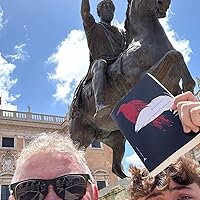
I reread this book while in Italy and walking the ancient Roman sites. So much better the second time around 5 stars. I really appreciated all pre- republic history. Really amazing to be reading about Remus and Romulus as you are exploring the ruins of their hut ! Or learning about Caesar while walking the spot where he was assassinated!
4.5 Stars
As a devoted fan of ancient Roman history and a great admirer of Tom Holland’s elegant prose, I thoroughly enjoyed Rubicon. Though I mistakenly read the trilogy out of order—having already devoured Pax and Dynasty—it didn’t detract from the pleasure of this earlier volume. In fact, it offered me a unique vantage point to appreciate Holland’s development as a narrative historian.
Rubicon charts Rome’s dramatic transformation from monarchy through republic to the reign of Caesar's adopted heir. The depth of research is evident throughout, yet the storytelling never loses momentum. Holland skillfully balances scholarly detail with vivid character portraits and compelling scenes, bringing the ancient world alive without sacrificing nuance.
Having now completed all three books, I can say that Rubicon stands strong not only as a foundational piece of the trilogy but as an exceptional work in its own right. It's a gripping, enlightening journey through one of history’s most fascinating periods.
I do have one bone to pick with Rubicon- Let's give Cleopatra her due! She wooed two of the most powerful men in the world and changed the course of history!!! More then just a femme fatale, I feel she gets short shrift in the book. I will have to check out the Goldsworthy book next!
4.5 Stars
As a devoted fan of ancient Roman history and a great admirer of Tom Holland’s elegant prose, I thoroughly enjoyed Rubicon. Though I mistakenly read the trilogy out of order—having already devoured Pax and Dynasty—it didn’t detract from the pleasure of this earlier volume. In fact, it offered me a unique vantage point to appreciate Holland’s development as a narrative historian.
Rubicon charts Rome’s dramatic transformation from monarchy through republic to the reign of Caesar's adopted heir. The depth of research is evident throughout, yet the storytelling never loses momentum. Holland skillfully balances scholarly detail with vivid character portraits and compelling scenes, bringing the ancient world alive without sacrificing nuance.
Having now completed all three books, I can say that Rubicon stands strong not only as a foundational piece of the trilogy but as an exceptional work in its own right. It's a gripping, enlightening journey through one of history’s most fascinating periods.
I do have one bone to pick with Rubicon- Let's give Cleopatra her due! She wooed two of the most powerful men in the world and changed the course of history!!! More then just a femme fatale, I feel she gets short shrift in the book. I will have to check out the Goldsworthy book next!

January 17, 2015
Roman history is well documented and this book does a great job of retelling their superb history. Marius the retired Military hero is appointed commander to fight Rome’s enemy Mithridates. This angered his former deputy Sulla who had campaigned for that job. Sulla then challenged Marius for the job which caused a civil war in Rome. Unfortunately Marius died before he could campaign. Without his leadership Sulla’s forces defeated the remainder of Marius’s soldiers. Then he marched on Rome and became its dictator.
Sulla established peace with Mithridates, in the kingdom of Pontus, but made a list of proscriptions and exterminated most of his enemies. He is not regarded as a great Roman Ruler due to his extreme violence and his unpopular and peculiar relaxation activities. And he was the first Military leader to march on Rome itself in Rome’s history. He does one remarkable thing, however,he retired and relinquished his power then returned to his odd behavioral ways. The republic was afterward reestablished.
The author points out the mindset of the Roman people. Ambition was their number one goal. They viewed sex as a weakness. They were xenophobic. Winning was everything and the path to glory was winning wars.
Pompey rode this subscription to its highest level. He ran a spectacular string of successes in Spain and took credit for ending Spartacus’s slave revolt. When the Senate decided to try to stop the Pirate harassment of Roman citizens, which had grown substantially over the decade, they called on Pompey. He miraculously wiped out the Pirates in just 3 months. He was then sent to take care of Roman’s greatest enemy Mithridates. He easily defeated him and continued into Syria and Judea making them Roman satellites. No Roman general had accomplished so much. In all, 243 countries came under Rome rule due to Pompey. He was given the title “Great” because of these accomplishments.
However, there were two other men seeking similar glory in the midst. The first was Crassus, Rome’s wealthiest man. The other was Julius Caesar. Caesar won a high office due to his great charisma and paying for votes. From this position he was able to secure a part in a triumvirate along with Pompey and Crassus which ruled Rome. While serving as part of the triumvirate he was appointed as governor of Gaul. This is where he met his first test of his military greatness by soundly defeating a united Gallic force. He then moved through Germany and built a bridge to cross into England and occupy Britain by defeating a Celtic Army. It was the first time in history that a foreign enemy invaded Great Britain.
Back in Rome, the Senate feared Caesar’s accomplishment’s called him back to face charges of illegal military actions. Caesar calculated that the Senate was out to get him, gathered his troupes and assembled them at the Rubicon. The Senate sensed Caesar’s intentions called on Pompey the Great for Rome’s defense. As Caesar troupes moved at an accelerated pace Pompey left Rome to assemble troupes to battle and end Caesar’s ambitions. Caesar finally met Pompey at Pharsalus where his army routed Pompey’s. Pompey fled to Egypt but rather than the great hero receiving safety, he is murdered. Caesar entered Egypt finding Egypt in the midst of a political power struggle. Cleopatra, in exile, was snuggled in a blanket then rolled out in front of Caesar. She seduced Caesar. Caesar next took a long deserved vacation, after he reestablished Cleopatra as Egypt’s ruler, by taking a boat ride down the Nile River.
The Romans were not happy about Caesar’s love affair with Cleopatra. He returned, with Cleopatra, to a shattered and crumbled Rome. The Senate gave him a 10 year period of dictatorship recognizing his brilliance. Caesar, forgave his enemies, provided land to his troops, granted citizenship to disenfranchised citizens and commissioned rebuilding of Rome’s great architecture.
However, the Ides of March 44 BC the great Julius Caesar was stabbed 23 times by among 60 enemies including men named Casca and Brutus.
Afterwards Rome capitulated into another civil war. Caesar’s Lieutenant Mark Anthony crushed the murderers. But Caesar’s heir made claims to succeed his great Uncle Julius Caesar. Octavian and Antony agree to joint rule for a while. As Antony relished in power his relationship with Octavian strained until they finally went to war. Octavian won a fairly easy war therefore becoming Rome’s undisputed ruler. In Rome he was entitled as Augustus. Augustus ruled for 40 years of peace and prosperity and a happy Rome strived.

April 23, 2026
Few things are more unsettling than realizing an empire can begin falling apart while still looking powerful from the outside.
Rubicon: The Last Years of the Roman Republic by Tom Holland explores the political collapse of the Roman Republic, covering figures like Julius Caesar, Cicero, Pompey, Crassus, and others whose rivalries reshaped Roman history. Rather than presenting events as distant historical facts, the book traces how ambition, public unrest, corruption, and personal grudges steadily pushed Rome toward instability and eventual dictatorship.
What made this especially engaging was how alive the historical figures felt. These aren’t presented as untouchable legends; they come across as deeply flawed people making reckless, strategic, or self-serving choices in real time. I found myself getting unexpectedly invested in Senate debates and political alliances, which is not something I usually say about Roman history.
Tom Holland has a way of explaining complicated political events without making them feel dry or overly academic. The narrative flows almost like a drama, though occasionally it becomes dense with names and historical detail, especially in sections covering shifting alliances and military campaigns. I had to slow down more than once just to keep track of who was maneuvering against whom.
The themes around power, public image, and political instability feel surprisingly modern at times, which adds another layer to the reading experience. Even when the pacing dips, the larger sense of inevitability keeps the story moving.
I’m giving this 4 out of 5 stars.
It’s thoughtful, detailed, and highly readable for a history book, though it works best for readers willing to stay patient with the political complexity and constant historical figures.
Rubicon: The Last Years of the Roman Republic by Tom Holland explores the political collapse of the Roman Republic, covering figures like Julius Caesar, Cicero, Pompey, Crassus, and others whose rivalries reshaped Roman history. Rather than presenting events as distant historical facts, the book traces how ambition, public unrest, corruption, and personal grudges steadily pushed Rome toward instability and eventual dictatorship.
What made this especially engaging was how alive the historical figures felt. These aren’t presented as untouchable legends; they come across as deeply flawed people making reckless, strategic, or self-serving choices in real time. I found myself getting unexpectedly invested in Senate debates and political alliances, which is not something I usually say about Roman history.
Tom Holland has a way of explaining complicated political events without making them feel dry or overly academic. The narrative flows almost like a drama, though occasionally it becomes dense with names and historical detail, especially in sections covering shifting alliances and military campaigns. I had to slow down more than once just to keep track of who was maneuvering against whom.
The themes around power, public image, and political instability feel surprisingly modern at times, which adds another layer to the reading experience. Even when the pacing dips, the larger sense of inevitability keeps the story moving.
I’m giving this 4 out of 5 stars.
It’s thoughtful, detailed, and highly readable for a history book, though it works best for readers willing to stay patient with the political complexity and constant historical figures.

May 20, 2012
Really enjoyed this book. Holland's brisk writing style really brought the time period to vivid life. What impressed me beyond how much he brought it to life is how easy he presents the morass and tangle of the Roman politics and politicians during this period. Highly recommended, I think even someone with just rudimentary knowledge of the time period would find this accessible and educating.

August 5, 2023
This book outlines the collapse of the Roman Republic into the tyranny of one man. It begins with a brief overview of Rome's mythical founding in 753 BC; its rejection of monarchy in 509 BC; its imperial expansion up until 146 BC; and the adoption of murderous violence against popular elected figures. Rome's imperial expansion and embracement of political violence underpinned a state of perpetual civil war from 88 BC when Sulla first marched on Rome, until Octavian became Princeps of Rome in 31 BC. This period also witnessed Italian and slave revolts, Cicero defeating Cataline's conspiracy against the Republic, and Caesar's rise and fall.
Although Holland simplifies this convoluted era of Roman history, the book feels rushed in some sections. Holland also proposes the thesis that Rome's descent into civil war and tyranny was primarily due to the cultural values ingrained in elite Roman men—glory at any cost. However, Holland does little to expound on this further, merely presenting it 'as is'. The book consequently does not appropriately analyse other potential causes put forth by other scholars—i.e., economic issues, the expansion of citizenship, or corruption. The reader may consequently be left with a skewed understanding of the reasons behind the collapse of the Roman Republic.
Like his other work, "Persian Fire," Holland adopts a narrative historical style and frequently employs vernacular language. Perhaps due to this prose, the book has been commercially popular since its first publication two decades ago. Nevertheless, I find fault with this style for two reasons. First, it somewhat trivialises the extreme brutality of this period in Roman history, where millions died; and second, it lacks scholarly rigour by not thoroughly analysing the sources, which inherently contain biases and historical inaccuracies. As a result, this book is a reasonable starting point for novices to this period of history, but not as an academic source.
Although Holland simplifies this convoluted era of Roman history, the book feels rushed in some sections. Holland also proposes the thesis that Rome's descent into civil war and tyranny was primarily due to the cultural values ingrained in elite Roman men—glory at any cost. However, Holland does little to expound on this further, merely presenting it 'as is'. The book consequently does not appropriately analyse other potential causes put forth by other scholars—i.e., economic issues, the expansion of citizenship, or corruption. The reader may consequently be left with a skewed understanding of the reasons behind the collapse of the Roman Republic.
Like his other work, "Persian Fire," Holland adopts a narrative historical style and frequently employs vernacular language. Perhaps due to this prose, the book has been commercially popular since its first publication two decades ago. Nevertheless, I find fault with this style for two reasons. First, it somewhat trivialises the extreme brutality of this period in Roman history, where millions died; and second, it lacks scholarly rigour by not thoroughly analysing the sources, which inherently contain biases and historical inaccuracies. As a result, this book is a reasonable starting point for novices to this period of history, but not as an academic source.

November 15, 2018
Reviewed for The Bibliophibian.
With a title like Rubicon, if you know about the significance of that small river, you might expect the book to be mostly about Julius Caesar (if you didn’t notice the subtitle, which differs slightly between editions but always mentions the Republic). It isn’t: in fact, at times early on you might not be quite sure what Caesar has to do with it and what’s even happening to him at the time. Which is fine: there’s plenty going on that you don’t need the big name to make Roman history interesting, but I do think it makes the title a little bit misleading. It’s not really all about that decisive moment of Caesar’s: it’s more broadly about the Republic, and the sense I got was that even if Caesar hadn’t taken the action he did, the end of the Republic would still have come.
Holland’s writing is mostly breezy and easy to follow: sometimes he gets a little too flippant or broad in his translations for my liking (I wouldn’t put it past Romans to call someone a “cocktease”, definitely, but I’ve seen that line translated rather less explosively, too), and sometimes the sheer number of events and names starts to tangle a little. He’s covering quite a lot here, really putting the moment of crossing the Rubicon into context, and it can feel both a little jam-packed and a little dry as he crams everything in.
For the most part a good read, though a fairly traditional account of the doings of men in classical history. (Give me more about Clodia and her influence!)
With a title like Rubicon, if you know about the significance of that small river, you might expect the book to be mostly about Julius Caesar (if you didn’t notice the subtitle, which differs slightly between editions but always mentions the Republic). It isn’t: in fact, at times early on you might not be quite sure what Caesar has to do with it and what’s even happening to him at the time. Which is fine: there’s plenty going on that you don’t need the big name to make Roman history interesting, but I do think it makes the title a little bit misleading. It’s not really all about that decisive moment of Caesar’s: it’s more broadly about the Republic, and the sense I got was that even if Caesar hadn’t taken the action he did, the end of the Republic would still have come.
Holland’s writing is mostly breezy and easy to follow: sometimes he gets a little too flippant or broad in his translations for my liking (I wouldn’t put it past Romans to call someone a “cocktease”, definitely, but I’ve seen that line translated rather less explosively, too), and sometimes the sheer number of events and names starts to tangle a little. He’s covering quite a lot here, really putting the moment of crossing the Rubicon into context, and it can feel both a little jam-packed and a little dry as he crams everything in.
For the most part a good read, though a fairly traditional account of the doings of men in classical history. (Give me more about Clodia and her influence!)

June 4, 2023
Really entertaining read that satisfied my secret kink for learning a little something along the way.
I thought I knew the broad strokes of the end of the Roman republic and beginning of empire but like most things it was more complicated and drawn out than expected.
The book covers roughly 200 years from the first man to seize power over Rome, Sulla. He was elected to the dictatorship which was basically like being granted emergency powers by the consuls. It continues to gaius Julius ceaser who wasn’t actually an emperor himself and definitely not wary enough of the idea of march. His somewhat adopted son Augustus finally took the title.
If I knew nothing about Ancient Rome and was presented this as fiction I’d say the world building was amazing, it really gave me a sense of life in the city for rulers and average citizens.
The idea that personal station and titles weren’t inherited, no matter who you were you had to achieve your own glory through military conquest or practicing law.
The amount of backstabbing, political corruption, mob violence and toga raising sexcapades is staggering.
Well written book, Tom holland has a couple of other titles that look interesting too. All this writing and he still finds time to be a friendly neighbourhood spider-man.
I thought I knew the broad strokes of the end of the Roman republic and beginning of empire but like most things it was more complicated and drawn out than expected.
The book covers roughly 200 years from the first man to seize power over Rome, Sulla. He was elected to the dictatorship which was basically like being granted emergency powers by the consuls. It continues to gaius Julius ceaser who wasn’t actually an emperor himself and definitely not wary enough of the idea of march. His somewhat adopted son Augustus finally took the title.
If I knew nothing about Ancient Rome and was presented this as fiction I’d say the world building was amazing, it really gave me a sense of life in the city for rulers and average citizens.
The idea that personal station and titles weren’t inherited, no matter who you were you had to achieve your own glory through military conquest or practicing law.
The amount of backstabbing, political corruption, mob violence and toga raising sexcapades is staggering.
Well written book, Tom holland has a couple of other titles that look interesting too. All this writing and he still finds time to be a friendly neighbourhood spider-man.
June 13, 2010
I'm surprised by the great reviews this book receives on GoodReads and on Amazon. I found the writing to be extremely choppy and full of unsupported generalizations about what Romans desired, detested, dreamed about, etc. This is not good history- no matter how many primary documents the author reviewed, there is simply no way for a modern author to get into the heads of the ancients. This is a world in which Greek towns welcomed home their sailors with phallic processions, in which women paraded through the streets with large, penis-shaped dummies on sticks. We simply cannot wrap our heads around the true motivations of people so long gone.
I found the author's "great man" approach to history also quite frustrating. According to him, Roman history can be summed up in the biographies of a handful of men like Sulla, Octavian, etc. He offers some discussion of important women, as well, but virtually ignores "the masses" and the slaves of the period, simplifying history into a history of the elites.
Very disappointing.
I found the author's "great man" approach to history also quite frustrating. According to him, Roman history can be summed up in the biographies of a handful of men like Sulla, Octavian, etc. He offers some discussion of important women, as well, but virtually ignores "the masses" and the slaves of the period, simplifying history into a history of the elites.
Very disappointing.

December 19, 2023
Rubicon is an excellent history book, I enjoyed the way it was written and I really enjoyed the subject matter. The later days of the Roman Republic is a time period that is among my favorites in history, such interesting stories, so many powers are at work, so many captivating characters. Sulla, Marius, Crassus, Cicero, Cato, Pompey, and of course Julius Caesar!
Tom Holland is a very good storyteller. He cautiously maps out the route from the Roman Republic to that famous moment when Julius Caesar crosses the Rubicon and what happens after that, the end of the Republic and the start of the Roman Empire. Very captivating and entertaining at the same time.
Tom Holland is a very good storyteller. He cautiously maps out the route from the Roman Republic to that famous moment when Julius Caesar crosses the Rubicon and what happens after that, the end of the Republic and the start of the Roman Empire. Very captivating and entertaining at the same time.
January 31, 2024
I enjoyed this book but I am not in any position to comment on Tom Holland as a competent historian of the period (I hated his history of Christianity to such an extent that it stopped me from reading this book for at least two years) but it is readable and for those new to Roman history it is probably not a bad place to start. Clearly any book whose opening paragraph has lines like these:
"Rather than gesture his men onward, Gaius Julius Caesar instead gazed into the turbid waters of the Rubicon, and said nothing. And his mind moved upon silence.
"The Romans had a word for such a moment Discrimen, they called it--an instant of perilous and excruciating tension, when the achievements of an entire lifetime might hang in the balance. The career of Caesar, like that of any Roman who aspired to greatness, had been a succession of such crisis points. Time and again he had hazarded his future--and time and again he had emerged triumphant. This, to the Romans, was the very mark of a man.”
is bound to raise the hackles of anyone who likes to separate history from fiction writing but this egregious slip does not reflect the rest of the book - though obviously this is popular not academic history but then I don't see anything wrong with popular history when it largely sticks to what is known and is not trying force modern relevance/parallels indiscriminately on material it doesn't fit (see for example almost all the works of Neil Fergusson for how not to write history). Holland does indulge some slight attempts to find modern relevance in the story of the fall of the Roman Republic and the rise of the Caesar's and Imperial Rome but fortunately he doesn't overplay it and confines such speculations to the introduction.
For me this was good popular history, I enjoyed it immensely, but wouldn't dream of taking it as a definitive account.
"Rather than gesture his men onward, Gaius Julius Caesar instead gazed into the turbid waters of the Rubicon, and said nothing. And his mind moved upon silence.
"The Romans had a word for such a moment Discrimen, they called it--an instant of perilous and excruciating tension, when the achievements of an entire lifetime might hang in the balance. The career of Caesar, like that of any Roman who aspired to greatness, had been a succession of such crisis points. Time and again he had hazarded his future--and time and again he had emerged triumphant. This, to the Romans, was the very mark of a man.”
is bound to raise the hackles of anyone who likes to separate history from fiction writing but this egregious slip does not reflect the rest of the book - though obviously this is popular not academic history but then I don't see anything wrong with popular history when it largely sticks to what is known and is not trying force modern relevance/parallels indiscriminately on material it doesn't fit (see for example almost all the works of Neil Fergusson for how not to write history). Holland does indulge some slight attempts to find modern relevance in the story of the fall of the Roman Republic and the rise of the Caesar's and Imperial Rome but fortunately he doesn't overplay it and confines such speculations to the introduction.
For me this was good popular history, I enjoyed it immensely, but wouldn't dream of taking it as a definitive account.

February 18, 2018
Contar por enésima vez la historia de la República, desde su formación hasta la irrupción de Augusto, puede parecer algo manido. Aníbal y Cartago, Mitrídates, Mario y Sila, la revuelta de Espartaco, Catilina, el primer triunvirato... los hechos son más o menos conocidos. La gracia del enfoque de Holland está en cómo alumbra su relato bajo el espíritu del buen romano. Cómo el mantenimiento de la libertad y la búsqueda de las glorias personal y de la República pudieron estar detrás de todas y cada una de las decisiones que la convirtieron en la potencia hegemónica en el Mediterráneo... y la terminaron devorando desde dentro. El uso de un lenguaje un tanto informal le imprime garra, algo que sin duda atraerá a los más reacios a acercarse al ensayo histórico.

March 19, 2013
-Además de citar y enumerar, interpretar y explicar (con datos en la mano, eso sí) son dos ejercicios que en Historia se agradecen, aunque no estemos de acuerdo con las conclusiones.-
Género. Historia.
Lo que nos cuenta. Con pequeños vistazos hacia atrás y hacia delante, repaso de la sociedad, cultura, economía, guerra y sobre todo la política (en concreto, la lucha por el poder) de Roma hasta tiempos de Augusto, pero centrándose realmente en los últimos 70 años de la República tal y como la conocían los romanos.
¿Quiere saber más del libro, sin spoilers? Visite:
http://librosdeolethros.blogspot.com/...
Género. Historia.
Lo que nos cuenta. Con pequeños vistazos hacia atrás y hacia delante, repaso de la sociedad, cultura, economía, guerra y sobre todo la política (en concreto, la lucha por el poder) de Roma hasta tiempos de Augusto, pero centrándose realmente en los últimos 70 años de la República tal y como la conocían los romanos.
¿Quiere saber más del libro, sin spoilers? Visite:
http://librosdeolethros.blogspot.com/...
Displaying 1 - 30 of 2,019 reviews