Doom on the water! In an epic spanning from New York to Louisiana to California to Maryland to the Atlantic Ocean, the Avengers are forced into Dr. Doom's latest scheme by the Atlantean Attuma, who wants Earth's Mightiest Heroes to keep Doom from conquering the world - so he can conquer it, instead!
COLLECTING : Avengers 150-156, Annual 6; Super -Villain Team - Up 9
Steve Englehart went to Wesleyan University in Middletown, Connecticut. After a stint in the Army, he moved to New York and began to write for Marvel Comics. That led to long runs on Captain America, The Hulk, The Avengers, Dr. Strange, and a dozen other titles. Midway through that period he moved to California (where he remains), and met and married his wife Terry.
He was finally hired away from Marvel by DC Comics, to be their lead writer and revamp their core characters (Superman, Batman, Wonder Woman, Flash, and Green Lantern). He did, but he also wrote a solo Batman series (immediately dubbed the "definitive" version) that later became Warner Brothers' first Batman film (the good one).
After that he left comics for a time, traveled in Europe for a year, wrote a novel (The Point Man™), and came back to design video games for Atari (E.T., Garfield). But he still liked comics, so he created Coyote™, which within its first year was rated one of America's ten best series. Other projects he owned (Scorpio Rose™, The Djinn™) were mixed with company series (Green Lantern [with Joe Staton], Silver Surfer, Fantastic Four). Meanwhile, he continued his game design for Activision, Electronic Arts, Sega, and Brøderbund.
And once he and Terry had their two sons, Alex and Eric, he naturally told them stories. Rustle's Christmas Adventure was first devised for them. He went on to add a run of mid-grade books to his bibliography, including the DNAgers™ adventure series, and Countdown to Flight, a biography of the Wright brothers selected by NASA as the basis for their school curriculum on the invention of the airplane.
In 1992 Steve was asked to co-create a comics pantheon called the Ultraverse. One of his contributions, The Night Man, became not only a successful comics series, but also a television show. That led to more Hollywood work, including animated series such as Street Fighter, GI Joe, and Team Atlantis for Disney.
Not best Avengers story arc ever; Doctor Doom's storyline is just in the second half of the volume and the Super Villains Team Up issue is far better written than all the other stories making you wanna read more of that title; celebrating issue #150 is almost just a collection of reprints; Tyrak the Treacherous'plot sucked so much that Jim Shooter fixed Gerry Conway's storyline in the last issue (Why the f@%% you capture the Avengers and send them against Namor if you are so strong that you alone can so easily defeat them???).
The Good:
Avengers #151 is one of the first Avengers comics I've read when I was a kid and the story and the roster there formed are still a fan favourite of mine; George Perez, "Big" John Buscema and "King" Jack Kirby (covers only, but they are over the top!) artworks in the same volume... What you wanna more??? And with Wonder Man's return from death, Vision starts becoming a far better character and his love story with Scarlet Witch more interesting.
Not greatest Avengers volume at all, but still a real good one.
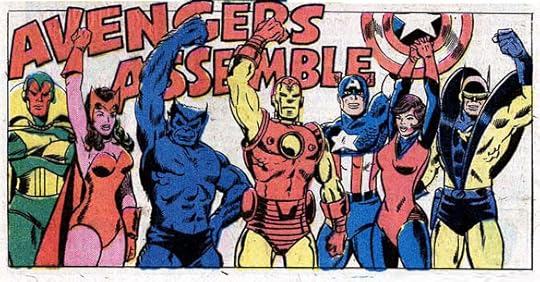
The flashback-laden introductory two-parter transitioned the title to writer Gerry Conway and established a line-up that would be the title’s core for most of the next five years: Iron Man, Captain America, Scarlet Witch, Vision, Beat, Wasp and Yellowjacket. That announcement was punctuated by the delivery of the long-dead Wonder Man, now a seeming zombie, onto the team’s front lawn. Sojourns to the Louisiana bayou to confront voodoo priest Black Talon and a California Army base, where they dealt with Living Laser, Nuklo and a rogue military unit, ensued. Wonder Man came back to his senses along the way and Golden Age hero the Whizzer, then believed to be the Witch’s father, made a return. Atlantis warlord Attuma attacked the Avengers and drew them into a conflict with Doctor Doom and the Sub-Mariner that also crossed over into Super-Villain Team Up.
Wonder Man’s return was the most momentous part of this arc. It sent Vision (whose android brain was based on Wonder Man’s brain patterns) into an existential crisis from which he wouldn’t emerge fully for years. Vision and the Witch experienced some marital ups and downs. Wonder Man struggled to re-adjust to being among the living. And Beast experienced his own identity issues, trying to reconcile his new appearance with his old place in the world. John and Sal Buscema spelled George Perez for some of these issues, but the key addition was inker Pablo Marcos. After some heavier hands had held back Perez’s earlier issues, Marcos proved to be a fantastic partner, bringing out the full dynamism in Perez’s work. Avengers: The Private War of Dr. Doom might not be the place to start for fans exploring the Avengers back catalogue, but it’s a great stretch of issues that’s worth reading once you’ve tackled the major arcs.
The first few issues are random Avengers stories and the actual 'war' featuring Doom is just the last issue taken out of context. Skip this and just read the Supervillain Team Up with Doom and Namor that has the entire storyline of Doom and Namor's team up along with his war. Superior stories there and is far more cohesive as a collected trade.
This was an at-the-time huge crossover that spanned across The Avengers, the Avengers Annual, and Super Villain Team-Up. It seems rather quaint by today's mega-epic, 50+ issue crossovers that plague the industry.
The gist, with minimal spoilers- Attuma, in an attempt to usurp control of the world, enslaves The Avengers with the assistance of Tyrak the Terrible. Using slave collars that blocked their powers to escape but not their powers to fight, they are sent to attack Prince Namor, the Sub-Mariner. They unknowingly and unwittingly end up attacking Dr. Doom. The Vision convinces Doom that defeating Attuma is in his best interests, and the Avengers and Dr. Doom end up working side by side fighting Attuma, Tyrak, and the Atlanteans.
Steve Englehart's Magneto as the Scarlet Witch's father subplot gets dropped when he leaves (or was booted from) the title, and Gerry Conway ends up making the Whizzer her father. This ret-con was later ret-conned (see the Avengers: Knights of Wundagore TPB), and has been ret-conned a few more times if I'm not mistaken. There is a free flowing spirit in these Bronze Age comics, where mistakes can happen but the energy and spontaneity are enough to make it all worthwhile. Everything is spit shined to perfection nowadays, with all of the juice and life sucked right out of it.
This book is loads of fun, but it is uneven in places due to the constantly shifting creative teams. There are a few points where the plot almost gets lost, but everything is tied up neatly by the end of the book. George Perez's artwork is great. It's amazing how quickly he progressed in such a short time. John Buscema does a fill in issue without missing a beat. He's one of the best. Perez handles the bulk of the issues collected in this book. Despite it's flaws, this book is a better read than anything written by the loathsome Brian Michael Bendis. Modern Avengers fans who have never read any of the classics would do well to pick this book up so that they can see how it is really done.
Marvel needs to revamp the way they list creator credits in these collected editions, particularly when attributing cover artist credits. While Jack Kirby is credited under artists and in the issue where his artwork appeared, the uninitiated might not realize that Kirby also supplied the artwork for the bulk of the covers of the issues collected in this book. One might also argue that the uninitiated might not care, but for the sake of budding OCD completists everywhere let's assume that they do.
The late, lamented Marvel Premiere Classic line of hardcovers were a sort of junior Masterworks line, with decent restoration, nice paper, and sewn binding at a much lower MSRP.
This book begins with one of those issues that crops up fairly regularly in Avengers comics: the shuffling of the team members. Some stay, some leave, some old favourites return and some new members join. This issue isn't the finest example of that though, as half of it is a reprint of issue #16. Still, it goes a long way to show to much the art style has changed from the Silver Age to the Bronze Age of comics. Otherwise, it's absolutely a filler issue and a bit pointless really.
As for the rest of the book, it has two big draws: the return of Wonder Man and the Avengers' second encounter with Dr. Doom. On one hand, I enjoy seeing Wonder Man back from the dead, and I look forward to his enjoyable friendship with the Beast in the issues to come, but on the other hand, I have always seen Dr. Doom as a Fantastic Four Villain, not an Avengers one. Throw Sub-Mariner and Attuma into the mix as well and it makes for a pretty convoluted and underwhelming story.
I'm having trouble rating this three stars, because to me it isn't up to par with the other stories of recent years, but it's still miles better than the majority of Silver Age stories. I really wish Goodreads allowed half-star ratings or something, because it's right between three and four for me. Oh well.
I guess I can put it up to four because of the art. George Perez, John & Sal Buscema do create some astounding art. They are among my favourite Avengers artists.
This book didn't quite live up to the title mainly because Doctor Doom ultimately played a lessor role in this story. I had not realized that this book sort of crossed over with a compilation of Super-Villain Team-Up comics that I had read before that involved Doctor Doom working with Namor. This volume helped to fill in the blanks and provide more context as to what happened as the core adventure was tied to the Avengers.
But man, this story had very odd beats starting with another Avengers roster change followed by the surprise resurrection of Wonder Man. We didn't quite get a full answer as to what happened there, but things give way to (1) the Vision being all dramatic and (2), a surprise discovery of another Atlantis-related plot involving (who else) Attuma. We had to get through all those beats to discover how Doctor Doom would get involved in all this and in the end...it wasn't even that.
Ignoring the title, it's still an interesting part of Avengers history despite the quirkiness of some of the plot developments.
Merece la pena por el dibujo de un joven George Pérez, que aunque aún no estaba en su mejor momento mejoraba con mucho los números de Don Heck, al guión Conway no está demasiado inspirado, de hecho lo mejor del tomo son los números 150 y 151 de vengadores, en los que la presentación de la nueva formación de los vengadores y el regreso del hombre maravilla sirve como excusa para hacer un repaso a la historia del supergrupo y los distintos miembros que fueron pasando por él desde sus inicios.
Para completistas principalmente, puede resultar útil como punto de partida para aquellos que se quieran introducir en estas épocas, la historia que da nombre al tomo en realidad es lo menos destacable.
Really? Over half the book was NOT about the Avengers battle with Dr. Doom. Attuma had more in this book than Doom - which is a shame. Perhaps if they had titled the book something else because only one story out of the many included here bore that title. Left me feeling a little bummed. Artwork was good for the overall series [Sal Buscema was great as usual], writing was more than just a tad melodramatic for my tastes but then Marvel always did tend to go that way. Worth a read.
Els darrers números, on hi ha l'arc argumental en sí, estan molt bé. El conjunt perd bastant perquè hi han inclòs dos números al principi que consten només d'una reunió per decidir qui segueix sent Avenger i qui no (amb mig número de refregit inclòs). També s'inclouen números d'altres col·leccions que són necessaris per seguir el fil argumental, però que també contenen altres fils argumentals.
This volume collects issues #150–156, Annual #6, and Super-Villain Team-Up #9, and follows directly after The Serpent Crown, which is the first Avengers collection featuring the stellar talent of George Pérez.
The credits for this volume is a bit of a mixed bag, first of all because issue #150, rather than being the most sucessful celebratory issue, becomes a cut and paste job, where new material by Steve Englehart and George Pérez is combined with reprint material by Stan Lee and Jack Kirby. The set-up is that the Avengers need to make a decision about who the new Avengers should be (some loose attachments in the preceding volumes need to be sorted); but the answer is delayed because of the time restraints that forced Marvel to edit in the Lee & Kirby material about another time when the roster was changed.
This storyline is then finished by Englehart in collaboration with Gerry Conway and Jim Shooter (all drawn by George Pérez) in the following issue, where the new roster is revealed: the Vision, the Scarlet Witch, Beast, Iron Man, Captain America, Wasp and Yellowjacket. Also, this issue sees the return of Wonder Man, a character who re-enters the Avengers fold in this collection.
Things then stabilise creatively, as Conway takes over the writing chores for issues #152–155 and Annual #9 (with the exception of a short Vision piece in the latter; written by Scott Edelman and drawn by Herb Trimpe).
Issue #152–153 are drawn by John Buscema and features the voodoo villainy of Black Talon, followed by the Living Laser's quest to retrieve the Serpent Crown. The old hero the Whizzer also makes a comeback. All of this leads directly into the Pérez-drawn Annual, which brings Nuklo into the plot, and the Living Laser arc towards a conclusion.
What then follows is a four-issue arc stretching from #154 (Pérez-drawn) via Super-Villain Team-Up #9 (written by Bill Mantlo and drawn by Shooter) and then back into Avengers #155 ((Pérez-drawn) and #156 (written by Jim Shooter and drawn by Sal Buscema). Here we are treated to Attuma, Namor the Sub-Mariner and Doctor Doom, and the arc is overall good, although the Jim Shooter-pencilled issue sticks out like a sore thumb among all these otherwise brilliant comics artists in this volume.
As can be deduced from this, the volume is not entirely even, but there are still good enough highs, and some great art, to raise the grade to four stars rather than three. This is fun superhero stuff!
George Conway is pretty mediocre as a writer (the conventional wisdom is definitely validated in this case), but his story still includes some interesting elements, and more importantly, artists George Pérez and John Buscema ensure that the collection is eminently readable.
Not sure why Englehart is listed as the main writer! This includes the igonomonious end of his run (as he writes a few pages in #150 and #151 that had to be rounded out by other writers and even some classic reprints. Well, scratch that, I'm sure it's because he's the bigger draw.
But considering the reprints along with the fact that this has more recently been collected again as part of the sizeable tome Avengers Epic Collection: The Final Threat, this is probably a collection to miss, unless you really like hardcovers or the Marvel Premier series specifically (and it is quite pretty, I admit). And admittedly, those high-page count paperbacks do tend to lose too much of the art in the center of the pages.
Great collection of the Avengers at their pinnacle. The Avengers just don't get any better than this. From the Jack Kirby covers (some of his best), to the George Perez interior art, to the huge soap opera cast and the terrific multi-thread plot lines. Wonderful timeless adventures great for new fans to old fan of any age, this is one of the very best Avengers books you'll ever find. Very highly Recommended.
Una storia decisamente anni '70, con avversari il Dr. Destino, Attuma, momentaneamente Sub-Mariner e protagonisti Cap, Iron-man, il redivivo Wonder-Man, Visione, Scarlet, Calabrone e Wasp, Bestia. Insomma, praticamente la mia formazione preferita dei vendicatori. La storia risente, purtroppo negativamente, delle molte mani, sia in sceneggiatura, sia ai disegni, che la rendono non del tutto omogenea.
The Atlantean Attuma has a plan to take over the world! The Avengers must team up with Sub-Mariner and Dr. Doom to try and stop him!
Readers hoping for a ripping Dr Doom yarn might be disappointed. He does not appear until past the halfway point and he isn't really the main bad guy of the story. So, I thought the title was misleading.
I never knew The Beast and Scarlet Witch were in the Avengers.