Seventy-five years after he came to life, Superman remains one of America’s most adored and enduring heroes. Now Larry Tye, the prize-winning journalist and New York Times bestselling author of Satchel, has written the first full-fledged history not just of the Man of Steel but of the creators, designers, owners, and performers who made him the icon he is today.
Legions of fans from Boston to Buenos Aires can recite the story of the child born Kal-El, scion of the doomed planet Krypton, who was rocketed to Earth as an infant, raised by humble Kansas farmers, and rechristened Clark Kent. Known to law-abiders and evildoers alike as Superman, he was destined to become the invincible champion of all that is good and just—and a star in every medium from comic books and comic strips to radio, TV, and film.
But behind the high-flying legend lies a true-to-life saga every bit as compelling, one that begins not in the far reaches of outer space but in the middle of America’s heartland. During the depths of the Great Depression, Jerry Siegel was a shy, awkward teenager in Cleveland. Raised on adventure tales and robbed of his father at a young age, Jerry dreamed of a hero for a boy and a world that desperately needed one. Together with neighborhood chum and kindred spirit Joe Shuster, young Siegel conjured a human-sized god who was everything his creators yearned to handsome, stalwart, and brave, able to protect the innocent, punish the wicked, save the day, and win the girl. It was on Superman’s muscle-bound back that the comic book and the very idea of the superhero took flight.
Tye chronicles the adventures of the men and women who kept Siegel and Shuster’s “Man of Tomorrow” aloft and vitally alive through seven decades and counting. Here are the savvy publishers and visionary writers and artists of comics’ Golden Age who ushered the red-and-blue-clad titan through changing eras and evolving incarnations; and the actors—including George Reeves and Christopher Reeve—who brought the Man of Steel to life on screen, only to succumb themselves to all-too-human tragedy in the mortal world. Here too is the poignant and compelling history of Siegel and Shuster’s lifelong struggle for the recognition and rewards rightly due to the architects of a genuine cultural phenomenon.
From two-fisted crimebuster to über-patriot, social crusader to spiritual savior, Superman—perhaps like no other mythical character before or since—has evolved in a way that offers a Rorschach test of his times and our aspirations. In this deftly realized appreciation, Larry Tye reveals a portrait of America over seventy years through the lens of that otherworldly hero who continues to embody our best selves.
Praise for Superman
“Engaging, fun, inspiring—like the Man of Steel.”—The Huffington Post
“Powerful . . . wonderfully readable.”— The Plain Dealer
“A story as American as Superman himself . . . The best origin story pulsing through Superman is not the one about the Krypton-to-Kansas alien baby, but rather the one about the superhero’s mortal and sometimes star-crossed creators.”— The Washington Post
Larry Tye is a New York Times bestselling author whose most recent book is a biography of Robert F. Kennedy, the former attorney general, U.S. senator, and presidential candidate. Bobby Kennedy: The Making of a Liberal Icon explores RFK’s extraordinary transformation from cold warrior to fiery leftist.
Tye’s first book, The Father of Spin, is a biography of public relations pioneer Edward L.Bernays. Home Lands looks at the Jewish renewal underway from Boston to Buenos Aires. Rising from the Rails explores how the black men who worked on George Pullman’s railroad sleeping cars helped kick-start the Civil Rights movement and gave birth to today’s African-American middle class. Shock, a collaboration with Kitty Dukakis, is a journalist’s first-person account of electro-convulsive therapy (ECT), psychiatry’s most controversial treatment, and a portrait of how that therapy helped one woman overcome debilitating depression. Satchel is the biography of two American icons – Satchel Paige and Jim Crow. Superman tells the nearly-real life story of the most enduring American hero of the last century.
In addition to his writing, Tye runs the Boston-based Health Coverage Fellowship, which helps the media do a better job reporting on critical issues like public health, mental health, and high-tech medicine. Launched in 2001 and supported by a series of foundations, the fellowship trains a dozen medical journalists a year from newspapers,radio stations, and TV outlets nationwide.
From 1986 to 2001, Tye was an award-winning reporter at The Boston Globe, where his primary beat was medicine. He also served as the Globe’s environmental reporter, roving national writer, investigative reporter, and sports writer. Before that, he was the environmental reporter at The Courier-Journal in Louisville, and covered government and business at The Anniston Star in Alabama.
Tye, who graduated from Brown University, was a Nieman Fellow at Harvard University in 1993-94. He taught journalism at Boston University, Northeastern, and Tufts.
Man: Look! Up in the Sky! Second man: It's a Bird! Woman: It's Superman!
lowkey still pissed that the Supergirl movie is garbage and i'm still waiting for a new good one... ugh miss this legend.
god i miss Smallville. Clark was just so hot. such a himbo.
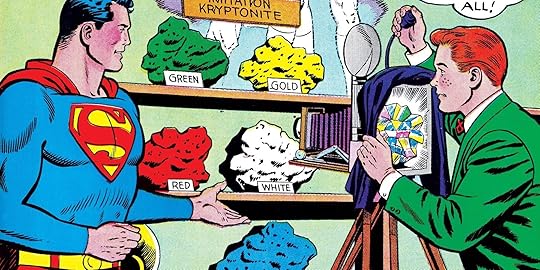
"Green... Gold... Blue... Red-green... Red-gold... Red kryptonite... Each scarlet-tinted piece had a unique impact, it worked on Superman just once, and its fallout lasted at most forty-eight hours." Pink 😏
I've been a Superman fan most of my life. Read the comics, seen the movies, watched the television shows, and even have a few Superman shirts in my collection. That to say, I doubtless know more than the average person about Superman and his legacy. That's why this book appealed to me. I was curious what it would have that I might have missed...
Quite a bit, really. This work is the most definitive telling of the Superman history that I've seen so far. Everything from his early beginnings until the present day is covered. (Yes, even Smallville and the upcoming 2013 movie.) Generally each chapter deals with a different era, though there are a few exceptions. You'll acquire lots of new superhero trivia here. (Who was the first superhero to fly? The answer is not who you think.)
I especially appreciated the chapter titled "A Matter of Faith". This is a subject not often talked about with regards to comic books, and I salute Mr. Tye for doing so. I thought it gave the book an extra feeling of completeness. It was interesting to read how Superman is seen by people of different belief systems (even agnostics) as affirming what they themselves believe. Almost as if he were a comic book Rorschach test--you see what you want to see.
Surprisingly, the one part of Superman's history that doesn't come across as glowing--though the presentation here is both sympathetic and objective--are the superhero's creators. Their story illustrates the danger of discontentment, misplaced priorities, and greed.
"The High-Flying History of America's Most Enduring Hero" is an interesting read for both fan and novice alike. I recommend it!
(One additional note: This book has tons of references. There are over a hundred pages of Notes and Bibliography.)
I had a Superman outfit as a small boy, Superman wallpaper on my bedroom walls and was a fan in the way of many small boys of my generation – in that I never read the comic books, but did have a religious devotion to the Christopher Reeve films. That childlike love followed me into my adult life. I found myself at first day showings of ‘Superman Returns’, ‘Man of Steel’ and ‘Batman v Superman’ – little realising, as I watched the first of those, that I was at the high point of Twenty-First Century Superman films.
As such this breathless tale of the development of the character is right up my Metropolis street. I say breathless in that there’s a swiftness in relating this seventy-five year long tale, but also for the most part a childlike excitement to the telling. What a tale it is! A character created by two poor Jewish teenagers from Cleveland, and sold to publishers with decidedly dodgy pasts on the kind of contract which still inspires law suits to this day. Over time Supes has been reimagined for radio, TV, movies, video games – each time with something new added to make it contemporary to the day. After all, a character doesn’t survive for nearly a century without knowing how to evolve.
Annoyingly, this history finishes before ‘Man of Steel’ is released, which is a shame as I’d like to have read this author’s take on the blowback from that and its sequel. I think though that such is his enthusiasm, he’d have put the best possible spin on the results. I’ve had a look at Mr Tye on line, and even though I can’t find his birthday, he looks to be a bit older than me. That puts us on kind of the same track on fandom – with Christopher Reeve as an entry point – and maybe explains why I briefly thought the book was becoming more perfunctory and less interesting when we hit the late nineties and the turn of the century. A case of the author having other stuff to do and not being engaged in Superman. But then I realised that having read his description, I was actually tempted to watch all ten seasons of ‘Smallville’ – and if the book is able to sell it that well, how perfunctory could it really be? Clearly the enthusiasm once ignited, rarely dims.
Up, up and away!
If you get chance, please visit my blog for book, TV and film reviews - as well as whatever else takes my fancy - at frjameson.com LIke my Facebook page Or follow me on Twitter or Instagram: @frjameson.
Nicely detailed and carefully researched. I loved reliving some precious moments with one of my favorite heroes.
Watching Superman evolve, I did not notice many of the changes. they were too gradual. However, reading about them opened my eyes. For example, I never noticed that Dean Cain played Superman as the alter ego. In all the comic books and early movies, Kent is the alter ego, placing emphasis on Superman.
Nor did I notice the way that Superman evolved with the political climate of the world. And i certainly missed his emergence as a "world" citizen, not just an American hero.
Somehow, I did not expect this book to be engaging. I mean, this is a biography of a fictional character. Yet it was engrossing. I hated having to put it down because I had work to accomplish. I hesistated picking it up because I knew I could not finish it quickly and would have to lay it down again.
This rarley happens with any genre but Sci-Fi fantasy. But I suppose, since Superman is a fictional superhero, then his biography would loosely fall into the fantasy category. so, maybe the engrossing part is not so difficult to understand.
I won this book through Goodreads First Reads Program!
The problem for me with a book like this is that I want to be surprised but know the history so well that I wind up somewhat disappointed. The book is incredibly well researched as noted by the 100+ pages of back matter. It's exhaustively researched with 200 people interviewed, definitely making this the most comprehensive history of the franchise ever. For those less familiar with the overall history it's a terrific read. I do, though, wish Tye spent a little more time on the more recent years as he seemed to rush through the post-Byrne comics giving lip service to the wonderful animated series. He starts with Smallville but never takes us through to its conclusion and is far more laudatory to the execrable Superman Returns than it deserves.
He does a great job bringing Siegel and Shuster to life showing how they squandered their good fortunes time and again, letting bitterness and anger overcome common sense. One thing I did learn was that Joann Siegel was getting a cut of Shuster's DC-provided pension, for which she should have been ashamed.
Still and all, I'm reminded why the character endures and why I still smile very time I see the S-shield.
In his unique history of the iconic character, Larry Tye delivers an insightful biographical account from the perspective of the creators, publishers, and stars behind Superman. Beginning with Superman co-creator Jerry Siegel in Cleveland through the character's re-birth as part of DC's recent 52 remake, Tye analyzes and reveals many fascinating behind-the-scene aspects such as why Superman didn't fight oversees during World War II, the complex origins of kryptonite, and the stories behind the various radio, cartoon, television, and movie incarnations. The comprehensive volume includes numerous interviews and accounts, copious endnotes, and an all-too-short collection of images. The even-handed, thoughtful, and thorough accounting of the muddy and controversial relationship between Siegel and DC delivers one of the best explanations of the whole sordid affair. Though Tye's literary paint-by-numbers styling lacks any zing, he successfully maintains interest throughout the compulsive and highly recommended Superman: The High-Flying History of America's Most Enduring Hero.
Tye's work contains all the information one could possibly want about the Man of Steel in one fun and well written volume. For instance, the reader is treated to bios of Superman's creators and original publishers as well as discussions of his powers, origin story, friends, foes, and physical appearance. Other portions of the book deal with the various actors who have portrayed the Metropolis Marvel as well as the various screen depictions of everyone's favorite Kryptonian. (Did I mention there was a section on The Man of Tomorrow's nicknames?) The author occasionally delves into deeper issues as well--there is a lengthy chapter on Superman's religion and sections on how the character has adjusted to certain major historical events, e.g., WW II. Basically, Tye condensed 75 years of comic books, newspaper strips, radio broadcasts, cartoons, movies, and TV shows into 432 enjoyable and interesting pages.
The story of the quintessential American hero and the history of his development from cheap newsprint comic strip character to multimedia icon.
Tye's well written history of Superman is worth reading by anyone interested in the media, as it shows the history of American media as well as, if not better than, the character himself.
I thought the book was very good. I have watched most of the movies and tv series. I have read many of the comics. It was very interesting learning the background of the comic history and the behind the scenes of each movie and tv series.
A solid, soup-to-nuts history of Superman on the page and on the screen. The tragedy of Jerry Siegel and Joe Shuster losing out on millions is well covered, as is the history of comic books in America. Following the ebb and flow of comic storytelling was pretty engaging, even as I knew that I'd probably bounce off any of the classics if I deigned to read them.
I especially appreciated the segments on the first Superman TV series (and the tragedy of George Reeves) and how the first Superman movie came about. The Hollywood insider stuff definitely caught my attention more than the effusive praise for Superman as America's golden boy. Larry Tye spends probably too much text on why Superman is great - seems like the point of the book is history, not hagiography. (Plus, Superman doesn't really need a hype man)
The Man, the Myth, the Metaphor: A Review of Superman: The High-Flying History of America’s Most Enduring Hero by Larry Tye
Superman is, at once, the simplest and most complicated superhero ever created.
On the surface, his story is almost childishly straightforward—an orphan from a doomed world, raised with Midwestern decency, blessed with powers that make him a god among mortals, and yet unfailingly devoted to truth, justice, and (depending on the era) the American Way.
But beneath that primary-colored clarity lies a character who has evolved, adapted, and been endlessly reinterpreted—a symbol of American optimism and paranoia, immigrant dreams and assimilationist pressures, unshakable moral certitude and the creeping anxieties of modernity.
In Superman: The High-Flying History of America’s Most Enduring Hero, journalist Larry Tye undertakes the Herculean task of chronicling Superman’s cultural, artistic, and commercial evolution. The result is a fascinating, deeply researched, and beautifully written history of not just a fictional character, but the shifting tides of American identity itself.
Because Superman is not merely a comic book character.
He is a lens through which America has seen itself for nearly a century.
And that, as Tye proves, makes him far more than just a superhero. The Origin Story: Mythmaking in Cleveland
Every great myth has a creation story, and Superman’s is as American as they come—a tale of young ambition, creative genius, corporate exploitation, and, ultimately, redemption.
In 1933, Jerry Siegel and Joe Shuster—two sons of Jewish immigrants living in Depression-era Cleveland—dreamed up a character unlike anything seen before. Where pulp heroes like The Shadow and Doc Savage were still bound by human limitations, Superman was a god in a cape, a being who could leap over the Great Depression in a single bound. Yet when Siegel and Shuster sold Superman’s rights to DC Comics (then National Allied Publications) for a paltry $130, they unknowingly created one of the first cautionary tales in entertainment history.
Tye excels in detailing the tragedy of Superman’s creators—their legal battles, their decades of obscurity, and their eventual recognition in the 1970s, when public outcry forced DC to finally acknowledge their contributions.
Superman, the ultimate protector of the weak, had ironically been stolen from the very men who needed him most. Superman as a Literary and Cultural Force
What separates Superman: The High-Flying History from a standard biography is Tye’s deep dive into the literary and cultural significance of the character.
Superman, as Tye argues, is not just a superhero but a metaphor—a Rorschach test for America’s fears, hopes, and contradictions.
The Great Depression and the New Deal Superman (1938–1950s) – The early Superman was a socialist strongman, battling slumlords, corrupt politicians, and corporate greed. He was not yet the messianic figure of later decades, but a New Deal populist in tights, a hero of the downtrodden. The Cold War Superman (1950s–1960s) – As America embraced suburban conservatism, Superman’s radical edges were sanded down. He became a paragon of authority, a father figure, a defender of the status quo rather than a disruptor. The Existential Superman (1970s–1980s) – With the Vietnam War, Watergate, and a more cynical America, Superman became a character in search of relevance. Comics like Whatever Happened to the Man of Tomorrow? (Alan Moore) and Superman: For the Man Who Has Everything (Moore again) wrestled with Superman’s role in a world that no longer believed in absolutes. The Postmodern and Corporate Superman (1990s–Present) – Superman dies and is resurrected. He is reimagined, rebooted, and reinterpreted endlessly. He becomes both a global brand and an increasingly complex, philosophical character, struggling with what it means to be Superman in an age of cynicism, moral ambiguity, and declining cultural dominance.
Tye’s greatest insight?
That Superman is always shifting because America is always shifting. Superman as Art: The Evolution of a Visual Icon
A biography of Superman is also a biography of comic book art itself, and here Tye does an excellent job of tracing the visual evolution of the character.
Joe Shuster’s earliest Superman was raw, powerful, almost crude—a figure of strength rather than refinement. Wayne Boring’s Superman (1940s–1950s) was stoic, broad-shouldered, a man who looked like he could bench-press America itself. Curt Swan’s Superman (1950s–1970s) was so clean-cut and all-American that he looked like he belonged on the side of a Wheaties box. John Byrne’s Superman (1980s–1990s) modernized him for the Reagan era, making him more muscular, more fallible, and—crucially—more human. The cinematic Superman (1978–present), from Christopher Reeve to Henry Cavill, has further shaped the character’s image, reflecting Hollywood’s shifting perceptions of heroism.
What Tye makes clear is that Superman is an artist’s character—a symbol whose meaning is defined by the pen, the brush, and the imagination of each new generation. The Business of Superman: A Brand, A Commodity, A Legacy
One of the more fascinating sections of the book details Superman’s role as one of the first true transmedia properties.
The radio show (1940s)—which popularized “Look! Up in the sky!” and introduced Kryptonite. The Fleischer cartoons (1941–1943)—which gave Superman the ability to fly (originally, he could only “leap tall buildings”). The George Reeves TV series (1950s)—which made Superman a household name for an entire generation. The Richard Donner films (1978–1987)—which defined the superhero movie genre decades before Marvel Studios existed. The decline and rebirth (1990s–present)—with Superman shifting from corporate mascot to philosophical puzzle, struggling for relevance in an era dominated by Batman, Spider-Man, and morally ambiguous antiheroes.
Tye skillfully dissects how Superman’s status as a brand has often conflicted with his identity as a character—a tension that continues to this day. Final Verdict: A Biography of America’s Greatest Fictional Son
If Superman is, in many ways, America’s mythological ideal, then Larry Tye has written the definitive biography of that myth.
This is not merely a book about Superman.
It is a book about the evolution of heroism, about America’s shifting self-image, about how a Depression-era fantasy became a global icon, both timeless and endlessly reinvented.
For those who love Superman, The High-Flying History of America’s Most Enduring Hero is essential reading.
For those who don’t love Superman—read it anyway. Because by the time you’re finished, you’ll understand why the character still matters, still endures, and still inspires.
There are plenty of books about Superman, but few (if any) like this one: a full fledged biography of not only the character but those important (and not-so-important) figures surrounding his creation, subsequent zeniths and nadirs, and everything in between right up to the production of the 2012 Superman film. We learn more than we wanted to know about Jerry Siegel and Joe Shuster, both of whom, frankly, do not come across as sympathetic characters. Sure, in comparison to modern comic creators, they got screwed, but after every handout from DC/Warner, they end up coming back for more. One gets the impression that even if they managed to get the best deal ever in the history of comic books, they'd still would've ended up penniless at the end of their lives. It's just plain sad. On the flip side, we are reminded of how much of a superman Christopher Reeve was both on and off the screen, especially at the end of his way too short life. The prose was a bit verbose at times but always informative and easy to read. There's a ridiculous (in a good way) bibliography and copious notes. I highly suggest this to anyone who is even remotely interested in comics and any student of American pop culture. There's a reason that Superman has such staying power and this book successfully sets out the reasons why.
Coming on the heels of Grant Morrison’s Supergods, Larry Tye gives readers a history of the quintessential supergod--Superman. One of the oldest, and definitely one of the most long running comic heroes, Tye presents the history of Superman in a new way. Coming from an outside perspective (an author who wasn’t even aware that Smallville existed), Tye writes as a biographer telling the story of the men and women that shaped Superman’s history, that gave rise to who he was and is. Tye put a great deal of research into this book, carefully collecting and correlating information from over seventy-five years worth of history and creating an extensive bibliography. Tye covers such topics as Superman’s origins; the radio and TV shows; the various reboots of the comic; and much more interesting to me...the wide number of people who helped Superman survive for over seventy-five years. The only thing that bugged me about the work, is there were times when Tye jumped back and forth between time periods to highlight some point that impacted the current time. While it gave more information, it made it a bit confusing for me as to what year was being discussed. Overall though, this is an amazingly well researched, an engaging read, and great addition to the Superman mythos. Highly recommend this book to all fans of Superman and comics.
Larry Tye’s new book is a comprehensive history of Superman, from his creation by Jerry Siegel and Joe Shuster to the ongoing legal battle by his heirs over the rights of the beloved hero. This is a history of the Superman franchise, but not a history of the Superman comic book character. Tye isn’t interested in explaining/detailing the twists and turns in the comic books (except for the Death of Superman storyline, which affected his public image and DC Comics’ profits).
I really enjoyed this book. It was entertaining and informative. The most interesting part for me was the sordid history of the early history of the character, from how he was created to how DC Comics made him into the big star he would become. This isn’t a whitewashed version of the history. Jerry and Joe don’t come off as saints, DC Comics gets its history laid bare, and by the end I was left with mixed feelings over who I supported in the ongoing litigation surrounding the character.
I wish there was more information on the upcoming movie. There is just about a page on that new film, which unfortunately is going to make this feel dated by the end of the year. Perhaps Tye can re-release an updated version next year.
This was an exhaustive uncredibly detailed account of the lives of Superman and men and women responsible for his creation and success. As a result it was a fairly dense and at times laborious read, but an absolute must for any Superman fan such as myself. The author says in the afterward that he sold the idea for this book was to treat its subject as real as he is to so many in their hearts, as a sort of a bio for a fictional character that has become such an important part of american and by extent universal culture, but the book quite often reads as a business ledger, what sold, what didn't, who got how much, who was screwed out of how much, etc. I suppose that sort of information is inevitable for a complete picture, but it does create for a sort of impassionate read from someone who admitedly grew up on Superman comics. On the other hand it was a very interesting look into the comic book and film/tv industry. This book was obviously meticulously researched and is very informative. Recommended.
This is a well-written and engaging look at the history and development of SUPERMAN over the 75 years since his development. It covers Superman in all of his media embodiments: comics, movies, stage plays, newspaper strips, tv, etc. etc. The longest and, to me, most interesting section is the initial section that covers his initial creation and development. The remainder of the book does a good job of covering his other incarnations, but mostly on a cursory level. (After all, there's over 75 years of development to cover!)
This is a great introduction to Superman and all the changes he's been through. It's written in a very friendly way, and is accessible to people who aren't familiar with Superman and his mythos. Ultimately, there's not a lot of new material here for a long-time fan like me, but there are some interesting tidbit scattered throughout. It's nice to have all of this information together under one cover, and not scattered around in various magazines and websites.
Recommended for anyone interested in Superman and the way he's changed over the years.
This book is a fantastic documentation of Superman from his debut on newstands in June 1939 through his multimedia personae that exists as of the end of the first dozen years on the new millennium. This book is crafted with compassion, respect and honesty towards this fictional icon. Whether you consider him a paragon, reflection or puppet of American and/or Western culture you can find new perspectives on Superman in this book.
Easy to read, this history of the Superman character and franchise covers a lot of familiar ground, but Tye includes fascinating details about the lifelong bitter search for adequate compensation by creators Seigel and Shuster, the financial juggling of the Salkinds for the first Superman film, and much more.
Una muy interesante biografía que trata más de los creadores y la gente detrás de Superman (Jerry Siegel, Joe Shuster, Julie Schwarz, Mort Weisinger y muchos más) que del propio personaje. El nivel de atención por el detalle es muy alto y se nota que el autor ha hecho una investigación tremenda.Tiene un muy buen acercamiento periodístico al tema tratado y además se lee de manera muy amena.
Well-done overview that includes little new material for long-time fans, but is still an interesting read. The business overview of the early years is particularly good. A lot of the focus moves from the comic book to the media versions after the 1930s.
On a spring day in 1954, in room 110 of the United States Courthouse at Foley Square in Lower Manhattan, William Gaines sat behind a table at the Subcommittee on Juvenile Delinquency. Gaines twitched and shifted in his seat, sweating from amphetamine withdrawal. His father, Max Gaines, invented the modern comic book, originally a vehicle for reprints of newspaper strips and then, well before the 50s, as magazines of original comic art. The younger Gaines was one of the first publishers, as head of EC, to produce horror comics, most famously Tales from the Crypt and The Haunt of Fear, as well as other genre, non-superhero books.
Senator Estes Kefauver of Tennessee, a presidential hopeful and Gaines’s polar opposite, calm and collected in an immaculate suit, held up a copy of the May issue of Crime Suspenstories. “This seems to be a man with a bloody ax holding a woman’s head up, which has been severed from her body,” said Kefauver, pointing to the illustration on the cover. “Do you think that is in good taste?”
“I do, for the cover of a horror comic,” Gaines said. “A cover in bad taste, for example, might be defined as holding the head a little higher so that the neck could be seen dripping blood.”
“You have blood coming out of her mouth,” Kefauver said.
“A little,” Gaines admitted.
This exchange, at the height of psychologist Frederic Wertham’s crusade against comic book publishers, has become emblematic for defenders of pre-Comics Code publishers. For the rest of America, at the time, Gaines was “the personification of the creep publisher perfectly willing to poison the brains of America’s children while he plucked dimes from their fingers,” as Jay Maeder wrote for the New York Daily News.
Gaines avoided the self-regulation of the comics industry by closing up his controversial publications and starting Mad which, as a magazine, was not subject to the Comics Code. As much for his latter-day success and subversive comedy publications, Gaines is remembered by many writers and film directors of the late-20th century as a purveyor of boyhood dreams through the fantastic EC books of the early-50s. Stephen Spielberg and George Lucas wrote glowing introductions to deluxe hardcover reprints of EC titles a few years ago. The ethos embodied in those taboo images survives in the pop culture of today.
Less often cited is the exchange that led up to Gaines’s memorable commentary on the cover of Crime Suspenstories.
Chief Counsel of the Subcommittee Herbert Beaser asked Gaines, “You think a child cannot in any way, shape, or manner, be hurt by anything that the child reads or sees?”
“I do not believe so,” replied Gaines.
“There would be no limit, actually, to what you’d put in the magazines?” Beaser continued.
“Only within the bounds of good taste.”
It’s easy to dismiss Kefauver and Wertham and everyone else involved with the Subcommittee on Juvenile Delinquency as quaint yet dangerous figures exploiting a particularly paranoid public during the height of the Cold War. To most, they’re not as sinister as Joseph McCarthy, but to comics historians, they stunted a gloriously free press interim between the Golden Age and Silver Age of Comics.
As Trysh Travis writes, “when authorities, worried about ‘juvenile delinquency,’ started looking for a scapegoat, the sheer mass of comics made them an easy target.” 98% of American children, as surveyed by Wertham’s clinical studies, read comic books regularly. Should those 98% of children be exposed to the violent images in Crime Suspenstories? Put that way, the question seems a little more relevant. But, though Wertham never proposed banning the publication of even the most gruesome material Gaines included in EC’s books, the paranoid language he used to express the idea that some of it might not be appropriate for children cast him as naïve and reactionary.
At a symposium conducted by Wertham in 1948, one of the presenters stated, “At the lowest age level the necessary violence is presented as taking place between little anthropomorphic animals; gouging, twisting, tearing, and mutilating one another-Disney style-to a running accompaniment of all the loud noises and broad swift motions enjoyed by, and forbidden to small children.”
The quantifying of violent images in the symposium’s study seems odd today. “If there is only one violent picture per page-and there are usually more, every city child who was six years old in 1938 has by now absorbed an absolute minimum of eighteen thousand pictorial beatings, shootings, stranglings, blood-puddles, and torturings-to-death, from comic books alone.” This sounds silly, old-fashioned and pedantic. But do we disregard the concerns of a parent who wishes to keep his or her young children from viewing the same (and much worse) deluge of graphic imagery available to them today. Do television and film ratings not help those parents enforce the decisions about appropriate content they wish to expose their children to? Of course, there should be no question as to the content of a comic book with a cover illustration of a decapitated woman and a bloody axe. Any parent purchasing such a book for their kindergartener has only themselves to blame for any ill effects. But the world was different in the 1950s. Children had much more free, independent time away from their parents. A dime could purchase a comic book from the pharmacy and until the industry regulated itself, Superman sat on the same shelf as The Vault of Fear and Little Orphan Annie. Maybe it’s the prudish parent in me talking, but I wouldn’t be comfortable with American Horror Story and Pajanimals appearing on the same cable channel back to back, even though I sit with my daughter every time she views any television program.
There’s no denying, though, that Wertham’s efforts got out of hand. The mere use of the words horror, terror, and even crime, was prohibited in comic book titles. Wertham admitted that he could not prove that comic books affected the behavior of the children who read them, but he argued that “there is nothing in these ‘juvenile delinquencies’ that is not described or told about in comic books. . . . If one were to set out to show children how to steal, rob, lie, cheat, assault, and break into houses, no better method could be devised.” When interviewing “delinquents” Wertham noted that every one of them had read comics regularly. If he had taken a moment to interview everyone else, he would have noted that everyone read comics regularly at the time, delinquent and do-gooder alike.
While Gaines was the most iconic of the publishers affected by Wertham’s prosecution of the Comic Book Scare, superhero books did not escape his judgment. At the same 1948 symposium, another scholar said, “All of Superman’s violence being on the side of right, there is no necessity for any Katzenjammer-Kid punishment on the last page, and this obvious flimflam suffices to blind parents and teachers to the glaring fact that the Superman formula is essentially lynching.
“Instead of being brave and fearless, Superman lives in continuous guilty terror, projecting outward in every direction his readers’ inward aggression. In the ten-year effort to keep supplying sinister victims for Superman and his imitators to lynch, comic books have succeeded only in giving every American child a complete course in paranoid megalomania such as no German child ever had, a total conviction of the morality of force such as no Nazi could even aspire to.”
So Superman’s a Nazi now? No wonder this Wertham fellow is considered a quack.
As I get older, the ethos of Superman, as opposed to Batman, is more attractive, less tyrannical and dystopian, less fascistic and classist. Though he’s an all-powerful alien, Superman’s manifestation as a human is as a poor farm boy who goes to the city to work as a journalist and help the helpless. Though he could easily kill his foes, ridding the world of all its criminals in a matter of minutes, he makes sure never to kill anyone, to reserve judgment and let justice be carried out by more worldly, democratic authorities. His aim is to prevent death not to produce it. Batman, on the other hand, is a vengeful billionaire who takes no quarter and kills petty thugs regardless of the social source of their criminality. I could see Wertham picking on Batman, but Superman?
Unfortunately Larry Tye does not explore the Comic Book Scare or the ins and outs of Superman’s morality in any depth in his new history of the Man of Steel. Superman: The High-Flying History of America’s Most Enduring Hero starts at the beginning, with Superman’s creators, and takes the reader through a rather straightforward telling of the evolution of Superman in comic books and strips, theatrical serials, television series, feature films and a Broadway musical. Jerry Seigel and Joe Shuster, the two diminutive Jewish boys from Cleveland who dreamt up Superman, sold him to the publishers at National Comics for a pittance. The two were nerds and typical of the most legendary of comics writers. Stan Lee, Jack Kirby, Seigel and Shuster and a litany of others, compensated for deficiencies in their lives, inadequacy at school, fatherless homes and second-class immigrant status, by creating larger-than-life characters. The creative losers behind comics, long before comics were cool or respectable, channeled their own meekness through dreams as big as myths and an industry that would make their publishers very rich men. Again and again, Tye reminds us, Seigel and Shuster did not fare so well as their greatest creation.
The early story of the business side of Superman is a typical tale in early comics history. The business interests, the publishers at National, exploit the creative talent, getting ultra-rich on other men’s work, by controlling the licensing and distribution of every character and every story in every one of their books. The untold tale in this well-trod legend is that Seigel and Shuster were actually made rich in the process and squandered their own fortunes living lifestyles neither had dreamed of as poor kids in Cleveland. At the same time, Seigel had to fight a legal crusade just to persuade the publishers of Superman comics to give him and Shuster credit for their work. Will Eisner and Stan Lee wised up to the way publishers exploited creative talent and started their own publishing houses – and proceeded to exploit the talent they hired the same way older publishers had. Seigel and Shuster did not have the professional acumen of Eisner and Lee and, after the early 40s, never contributed another lasting character or story to the cannon of comic books. Tye focuses too often on the business aspects of Superman’s evolutions in different media, and though business has always been important, he neglects the writers behind Superman’s evolution (though he documents the changes well) as much as National, then DC, did until the mid-1970s. This was far too late for Seigel and Shuster, who fought for restitution and acknowledgment until they died.
Tye’s treatment of the religious symbolism in Superman’s story is pedestrian, as sophisticated as an undergraduate thesis, but his explanation of the innovativeness and importance of the radio show Adventures of Superman from the 1940s is enlightening and riveting. Most casual fans of the character, and most comic book purists, would never have imagined that so many of the key elements of the Superman mythology originated in television, radio and film. The influence does not always flow from the comics to other media, but often from other media – radio gave us Jimmy Olsen, for example – back to influence the comics. This very syndication and serialization of Superman makes his world both enduring and expansive, but also, ironically, disposable and contradictory. Tye fails to illuminate any actual plot arc in Superman’s historical trajectory. His constant summarization of television, radio and comic strip scenarios makes Superman’s seventy year history seem like a long series of incessant reiterations of the same staid, formulaic story. By the Silver Age of Comics, the 1960s, Superman, only twenty years into his life on the page, appeared “square” in contrast to the new edgy countercultural material Lee started producing at Marvel. Those complex tales of doubt and adolescent longing in the Spiderman, X-Men and Hulk books, even in the small capsule form Tye presents them in, make Superman look wooden and unapproachable.
In Superman’s more recent history, his story has taken on more human aspects, and shed the alienating alien-ness. Particularly in the mid-70s, when DC gave its editors and writers more recognition and control, Superman stories grew a backbone. As a champion of the dispossessed he exposed the injustices of mid-century urban politics and social engineering, increasingly as Clark Kent, the journalist, and less often as the Caped Crusader. But by the early-90s the character was floundering in artistic inconsequentiality and it took killing him off to remind the comic book reading public what they were missing. In the end, Tye’s Superman is often sad and cheap. The author needs the assurance and quotes of college students and nerds, fanboys acting the part of scholars. Tye himself is the biggest fanboy. He never questions a new, half-baked incarnation of his subject in any medium (with the exception of the Superman III and IV feature films, which were obvious failures). Superman: The High-Flying History of America’s Most Enduring Hero is a squandered opportunity to explore the moral intricacy of its subject and the gritty story that lies out of reach of the author’s cursory research.
Larry Tye's Superman gives a solid account of the myriad incarnations the original comic book hero has had over the years from his inception in Action Comics in 1938 to the short animated films of the early 1940s to the long-lived radio program to the live action shorts and TV shows to the more recent movies and the more cohesive graphic novels of the last few decades (and, of course, the numerous pieces of merchandising throughout the years).
Tye also covers the lives of many of the figures who, one way or another, breathed life into the death-defying man of steel. His main focus is Jerry Seigel and Joe Shuster, the two teenagers who dreamed up Superman and watched their creation become a cultural phenomenon before their lives became a series of major frustrations, personal failures, and legal battles. But he extends his coverage to many of the major players involved in the comic book industry as well as the tragic figures like George Reeves, who committed suicide shortly after playing Superman in the 1950s, and Christopher Reeve, who was paralyzed after a horse riding accident in the 1990s.
The most interesting aspect of the book is how Superman changes over time. Even when it seemed that the public had tired of him, new writers were able to give him a rebirth and reconfigure him for a new generation. Sometimes, the changes reflected the hopes and fears of the American zeitgeist while other times, they were made for crass and exploitative purposes. There was a constant tug of war between the artistry of the character and his current medium at any given time and the commercial interests looking to maximize profits by selling him in whatever way they could.
Even within any one iteration of Superman, there were plenty of ways to understand him. In the most juvenile sense, he was the secret hero residing within all of us, ready to stamp out the bully and win the girl. In more mature ways, he was an underdog caught between two worlds (Krypton and Earth), a Christ figure (even though he was Jewish), and a figure of strength and morality when everything else in the world seemed to be coming apart. In a way more specific to the time of his creation, he was an extension of the social justice largely embodied by FDR and the New Deal.
This book is clearly well researched and provides many little bits of analysis (although, I would have liked a more thorough analysis of the most recent graphic novels). I realize, too, that Superman has a robust and convoluted history, yet I can't help but feel there are times when Tye complicates that history even more with his somewhat erratic storytelling. He has a tendency to stray too far into the weeds on some of the more trivial topics and can be a little too cute in his writing from time to time, dropping a nugget of information that he won't fully explain for another fifty or one hundred pages. Even so, this book provides more than enough encouragement for readers to seek out Superman in one of his many forms.
Quite a thorough history of the man of steel, appreciated the early days especially as well as setting record straight on Max Fleishmans amazing shorts. A great reminder of how jewish people managed to find their way and flourish in a time when they were being discriminated against, creating some of the most enduring folk heroes, (super), music (White Christmas?!), musicals, etc. Why people feel the need to attempt to shut out other races, nationalities or religions is one of the true failings of humanity. While one might say it is some survival instinct bullshit, I feel it is just fear, jealously, greed....deadly sins for those religious phonies who purport to be christians .... they can go to hell (if you believe in that place) for their ignorance and intolerance.
Back to the non practicing jewish man of steel , it was interesting choice not to join war effort in kicking hitlers ass, though tough act to follow, and didn't help Captain America much later on. I love his credo and the fact that they attempted to stay with it through the years, no killing, not trying to be overlord or power hungry, taking bosses to see the error of their ways (in the mines) governors to see prisoners falsely accused, etc. Not so thrilled about earth one , earth two ploys or him dying , especially since the original concept was quite perfect. George Reeves got a lot of play, and yes, I was in love with the show, actually begging for tape recorder so I could sit in front of TV,( holding mic to speaker and yelling at people going by too noisily) and record the show. And yes, I donned a blanket and jumped out the window in Sunday school thinking I could fly away (and escaping whatever less than exciting lesson of the day). Kids today have no idea the struggle! Renewed interest as Christopher Reeve took on the role though how this story could ignore the single most amazing and super act of super heroism by Superman is beyond me. Hello!!!! The man watched Lois Lane get crushed in a car and killed and grief stricken flies around the world at super speed thus turning back time (yes Cher, he did) and saving her life. There is nothing more super than that kids, nothing. Live long Superman, hope people taking care of you will do just that.
This entire review has been hidden because of spoilers.
For over eighty years, the Man of Steel has soared high above our heads, battling the most dastardly foes imaginable and struggling to keep Lois Lane in the dark about his secret identity while posing as mild-mannered reporter Clark Kent. In this biography of Superman and his creators, Larry Tye performs a great service to those who have wondered if the last son of Krypton still has any relevance for our times.
"Superman: The High-Flying History of the Man of Steel" is a pretty good breakdown of the history behind DC Comics' most iconic character (and indeed the most iconic character in comic-book history). At times, the story can get bogged down in details that don't exactly leap off the page, but the overall story especially behind the scenes of Superman's tortured beginnings and how his creators sold their birthright for a measly sum, only to realize they'd been swindled, is very interesting. Tye looks at all the ways that Superman has translated into more media than just comic books, with a radio series, multiple TV and film projects, and even a Broadway musical. With the current pop-culture moment seemingly dominated by the MCU and DCU of film franchises, this is a book that helps explain in part how we got here, thanks to this alien child from a doomed planet.
Full disclosure: I'm more of a Spider-Man fan. I've always related more to the web-slinger than the Man of Steel, and while I enjoyed the Christopher Reeve films when I was little, I find Superman to be kind of dull. But I have to put respect on the Superman's name, because he was the first real comic-book superhero to grab hold of the public imagination, and he's never really let go. As a social and cultural history of an icon, this book soars to great heights, with an occasional stumble here and there. But it's a really good look at a superhero who's never really faded from view, even if his popularity has waxed and waned with the times. We'll always have a need for Superman as a culture, and this book goes a long way towards explaining why.
This year marks the 75th anniversary of the debut of Superman, one of the most recognizable fictional characters in the world, ranking right up there with Mickey Mouse and Sherlock Holmes. In honor of the anniversary I read Larry Tye's "biography" of the character, Superman: The High Flying History of America's Most Enduring Hero.
I've never been a big Superman guy. I was more of a Marvel Comics guy or, if it were a DC hero, I preferred Batman. Superman was too bland and uncomplicated for me. But Tye's book was very engaging, and it is unquestionable that Superman is an essential bit of Americana.
He was created by two Jewish teenagers who lived in Cleveland. Jerry Siegel was the writer, and Joe Shuster the artist. Many of the great American comic book heroes were created by Jews--in addition, Bob Kane, the creator of Batman, was Jewish, as is Stan Lee, who created many of the Marvel heroes. Tye puts it: "The Jewish writers were outsiders by birth. They were conflicted, with one foot in their parents' shtetl and another in their brave new universe of opportunity. They gave life and shape to heroes whose very names, from Batman to Captain America, reflected their creators' reach for the otherworldly and the all-American. Yet the themes and the characters they brought to life grew out of the very past they were trying so hard to escape."
Siegel's father died when Jerry was a kid, and so the origin of Superman, sent by his parents from a dying planet to Earth, resonated when compared to Jerry's story. He was a wunderkind of science-fiction and fantasy, and his first incarnation of the "Super-Man" was as a villain in a pulp magazine he produced himself. Tye points out his resemblance to other characters who came before him, notably Doc Savage, but eventually the Man of Steel took unique shape, and was published by two former smut peddlers, Harry Donenfeld and Jack Liebowitz. It was an almost instant sensation.
Here is where the story gets complicated, not only in Superman's story but Siegel and Shuster's as well: "On March 1, Jack mailed Jerry and Joe a check for $412...and, almost as an afterthought, $130 for Superman. It was double what they were used to and a fair rate--$10 a page--for the era and their experience, so Jerry and Joe cashed it and split it down the middle. It was also a swindle on the order of the Dutch West India Company's 1626 purchase of Manhattan from the natives for $24."
For years, until their deaths and after by their descendants, Siegel and Shuster have battled National Publications, later called DC, now owned by Warner Communications, for a share of the possible billion dollars that Superman is worth. This even while Siegel continued to write for them.
The character was a big hit, with Joe DiMaggio counted among his fans. At first it was a comic book and daily strip, then animated films made by the Fleischers, then a radio show. In fact, it was the radio show that introduced some of the character's features, such as the ability to fly (the comic book Superman could only jump long distances) and his vulnerability to Kryptonite. It also introduced the doggerel that is still familiar today: "Faster than a speeding bullet, more powerful than a locomotive. Able to leap tall buildings in a single bound! Look! Up in the sky! It's a bird! It's a plane! It's Superman! Yes, it's Superman! Strange visitor from another world, who came to Earth with powers and abilities far beyond those of mortal men. Superman, who can change the course of mighty rivers, bend steel in his bare hands! And who, disguised as Clark Kent, mild-mannered reporter for a great metropolitan newspaper, fights a never-bending battle for truth, justice and the American way!"
Eventually there would be film serials and a popular television series starring George Reeves, which Tye covers in detail (including Reeves' mysterious death). Then there is extensive coverage of the big-budget films produced by Alexander Salkind, who had no idea who Superman was until his son suggested they make a movie about him. As the films declined in quality and success, the comic book continued, with the publicity-garnering killing off the character in the '90s (of course, he didn't stay dead for long).
Tye's narrative goes right up to Man of Steel, which at the time was in pre-production, but proved his point that Superman is America's most-enduring hero, for even after 75 years, millions of dollars are spent on being entertained by the man in cape and tights.
Where Tye's book moves beyond simple biography the religious aspect--Superman has penumbras of both Judaism and Christianity, given his origin (on one hand, he is Moses-like, sent off as a baby only to become a leader of the chosen people, on the other he is the only son of a man sent to Earth to save them). "Superman had even stronger cultural ties to the faith of his founders. He started life as the consummate liberal, championing causes from disarmament to the welfare state. He was the ultimate foreigner, escaping to America from his intergalactic shtetl and shedding Jewish name for Clark Kent, a pseudonym as transparently WASPish as the ones Jerry had chosen for himself. Clark and Jerry had something else in common: both were classic nebbishes. Clark and Superman lived the way most newly arrived Jews did, torn between their Old and New World identities and their mild exteriors and rock-solid cores. That split personality was the only way he could survive, yet it gave him perpetual angst. You can't get more Jewish than that."
Tye attempts to explain why Superman has been so popular for so long, but I think the answer is elusive. Still, this comes pretty close to the mark: "He is an archetype of mankind at its pinnacle. Like John Wayne, he sweeps in to solve our problems. No thank-you needed. Like Jesus Christ, he descended from the heavens to help us discover our humanity. He is neither cynical, like Batman, nor fraught, like Spider-Man. For the religious, he can reinforce whatever faith they profess; for nonbelievers, he is a secular messiah. The more jaded the era, the more we have been lured back to his clunky familiarity. The outcome of his adventures may be as predictable as those of Sherlock Holmes--the good guy never loses--but that too is reassuring."
This is a wonderful book for the comic book geek and the student of American cultural history, as it covers print, radio, TV and movies. We follow along as the comic book soars and then declines in popularity (as Tye points out, now they are bought mostly by adults in specialty shops at prices much too high for kids). Those who were at the helm of those entities are a wonderful menagerie of characters, who all were passionate about keeping Superman alive in the imagination. Judging by the robust (if not stratospheric) box office numbers from Man of Steel, Superman isn't going away anytime soon.
I love Superman. I love the Golden Age, the Silver Age, Bronze Age, Dark Age, Modern Age, Digital Age, every era of this character. There are some rough stories or comics that don't reflect my version of the character, but each era had something to offer and I think that's beautiful. Apparently I'm not alone, because Larry Tye wrote an extensive book on the subject. I'd tried listening to this audio book in the past a few years ago, but I didn't like it. Now, being about 4 or 5 years since I tried this, I figured, why not give it a shot again. I'm glad I did. Tye takes us through the history of Superman, from previous concepts by his creators Siegel and Shuster, to the time the book was published, which would've been around 2013. Extensive, interesting, and well written all are ways to describe this book. The character of Superman is truly fleshed out in an interesting way, detailing how all of the different mediums he appeared in shaped the way our modern day version came to be. From Kryptonite being in the radio show and flight being from the Fleischer serials, not a stone goes untouched in terms of the development of the original superhero. Additionally, Tye creates different storyline subjects; the first being our lovable Clark Kent, the Siegel and Shuster family being #2, Jack Liebowitz at #3, and all the other actors and people involved in the creation of Clark Kent involved. Its so interesting to get an idea of what really happened between all of these people and how their lives were effected and changed by the Man of Steel. Certainly, the chapters dedicated to the murder of George Reeves and the tragedy of Christopher Reeve were worth noting. But all to say, this is a really interesting read. If you're a Superman fan, or a person who's even remotely curious, this is a great way to find out what makes the character endearing, popular, or interesting.
About halfway through this I realized the book I wanted to read and the book Larry Tye had written were not the same thing. Not to say this book is bad, I think Tye accomplishes what he sets out to do—provide an overview of Superman’s history. This does that.
I found what I really wanted was a history of DC Comics and/ or a more sociological perspective of Superman’s impact on culture and how culture has impacted him. The most interesting portions of this book are the early chapters that profile Jerry Siegel and Joe Shuster and the early days of DC Comics. The first few chapters feel similar to Sean Howe’s history of Marvel comics. I was much less interested in the chapters regarding the George Reeves show or the Donner movies and in fact the second half of the book became a bit of a slog, focusing less on comics and more on these two adaptations. It comes back around to my interests when discussing the Death of Superman but largely glosses over anything more recent than that as almost footnotes. Part of it is a product of its production, no doubt this was being written either while Smallville was on or just after it ended.
Anyway, it’s worth taking a look at if you’re a fan of Superman, particularly for the insight into Siegel and Shuster. But it is pretty dry and doesn’t find a way to make the pieces you are less curious about engaging. The omission of most of the post-Byrne era comics or the Animated Series feel like particular failures, but I suppose also match the media trends and where the real money is for a character like this. Also kind of surprised how highly he regards Superman Returns.
Greedy, horrible and hungry owner that is called DC represented by Jack Liebowitz practiced the very cunning business manipulation onto two hopeful artist and script writer who just wanted to earn some money. This was the last type of bad practice that could thrive in the modern world. Yet, nearly a century ago, such treatment towards artist and art were treated with the least of respect, and the winner was those with the least conscience people reaching out for greed and fame.
It made me furious of the treatment received by Jerry Soegel and Joe Shuster, two talented young man who had created a symbol recognized in the whole world. Fell from grace throughout half their lifetime all because of the dictatorship of business world pre-war era.
Admittedly, such practice did not age well, yet did not make it any better when I was emotionally engage into the life these artists of the past and it saddened me how cruel the real world was indeed. We were extremely lucky to have lived beyond great depression, where selfish deed, oppressive businessman do not usually get away with evil deed. It still happened, yet fewer instances without bad rep.
It was a history of Superman, of the founder filled with sadness and unfairness. More that I respected the art , and artists who had painstakingly created superheroes that we know today. Tribute to Jerry Siegel, Joe Shuster. Even for iconic Batman creator Bill Finger (Not Bob Kane who had stole the credit longer than he deserved from Bill).