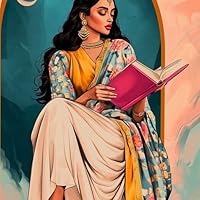
Evil Rakshasa Kalanemi is back on Earth, this time appearing as Kansa, the tyrant king of Mathura. To vanquish him and his horde of evil monsters, Lord Vishnu comes to Earth in his eighth avatar - Krishna, the defender of dharma. Since his birth, Krishna valiantly fights evil monsters, showing courage and valour. But as he grows up and becomes a councillor of the race of Yadavas, he observes that the real struggle in this age is not with magical monsters but with evil kings and warriors. Accompany this wise and courageous hero on his journey on Earth as he conquers evil to put mankind back on the path of righteousness.
Shweta Taneja is a fantasy author, comic writer and journalist based in India. She's written seven books and two hundred articles in a career spanning fourteen years. She's a Charles Wallace India Writing Fellow and was shortlisted for Best Writer Award in ComicCon India for The Skull Rosary.
Her graphic novel Krishna Defender of Dharma is part of CBSE and Kendriya Vidyalaya Recommended Lists. Her novels include Ghost Hunters of Kurseong, the bestselling Cult of Chaos an Anantya Tantrist Mystery, and How to Steal a Ghost @ Manipal. Website: www.shwetawrites.com
The kings of Indian mythology are amar chitra katha(ack). We live in a country where we hear Krishna's story on a daily basis. For kids and anyone who wants to get a quick gist of Krishna's life, this book does the job. The art is wonderful for sure, and better than amar chitra katha. But when it comes to content, this cannot surpass. Ack does a far better job in bringing out short and very beautiful stories in Krishna's period, which are not typically his well known pastimes. I particularly love Ack's stories on conversations between narada and krishna. There is one statement in the narrative that is misplaced. King yudhistira says that krishna does not get swayed by affection or attachment, but uses his wisdom. In fact it's a little opposite. Krishna only sways for affection and favors clearly those who are affectionate. And such people are mostly righteous. He has swayed towards bhishma, drona but in other ways. In essence that's why he has a very special place in his heart for the milkmaids of vrindavan. They know no wisdom, no strategy, just plain affection.
But no sweat. This is a great book with amazing art and clean in it's intention. There are no warped up theories, or own 2 cents from the author. It's close to pure mythology.. Good read...
As you can clearly see, I was't very impressed with the storytelling. Dialogues were filled with large words and very little emotions. And the script wasn't compelling enough. It was no match to the grandeur of the illustrations that accompanied it.
Krishna is a character I've adored all my life. I've heard numerous stories of him as the butter-thief, the prankster and the undeniably wise guide of Arjun. As a Hindu, I grew up amidst stories of Kannaiya. I have sung bhajans in his praise; I have danced to his 'leelas'.
So, when Krishna is such a big part of my life, I had huge expectations for this graphic novel.
And I was disappointed.
That said, I think that the artwork itself is mind-blowing. See, I know all of these stories already. So I would sit late at night, propped against my pillow, open this graphic novel and ogle at the artwork with starry-eyes. It's worth it.
I think that Indian graphic novels can be done in a much bigger scale and scores better quality-wise. We have the stories. We just need the storytellers to do it right.
The first thing that caught my eyes was the art. I absolutely loved it. Most panels were vibrant and absolutely gorgeous, especially the scenes of Lord Vishnu up in Vaikund. I liked how some panels were bright and others were dull to go with the mood of the story. My rating is mostly for the artwork.
I liked the pacing of the story. It was like reading an illustrated CliffsNotes on Lord Krishna's scenes from the Mahabharata. It was a tad too wordy, which is understandable when adapting such a big story into a graphic novel. People who don't like too much text in their graphic novel may not enjoy this, but I would still recommend this book for the artwork.
Krishna is full of colour, sometimes vibrant and sometimes toned down; the colours always compliment the mood. In his godly moments Krishna's blues become brighter with glowing highlights. For those unfamiliar with Indian mythology, an introduction is provided with each chapter. In the first part, a great tyrant rules the land unjustly, and so Krishna is reborn to protect dharma. Even as a child he defeats demons that are sent to assassinate him. He is rash, but brave, and is protected by his divine right. No matter how many strange events happen to him, the villagers always just accept and forget, remaining none-the-wiser to his true self. In a world full of demons and gods, maybe this is more commonplace, but their reaction is still too muted. Krishna's brother Balarama is also quite special, and manages to defeat several demons as well. After the tyrant is defeated, and the real king restored, Krishna rescues Rukmini, who he then takes as his wife. The next few chapters are about the great war that is fought between the Pandavas and Kauravas. Even though of the same family, the war must happen to restore order. Krishna acts in the role of adviser, being a better ally to have than an entire army. Finally, his time on earth comes to an end, through the will of a curse, but in his time there he left behind many teachings to be passed on, of which the basics are mentioned in the preceding chapters. Although Krishna has many virtues, his wisdom is the most prominent, for more often than not his enemies are defeated by his wise actions, rather than his strength. He is a god that cares for the people, and the family he is born into. This adaption does not include all his aspects, but does a fair job showing what it does.
This was an amazing, beautiful, approachable take on Indian mythology. I have always been interested, but have found straight texts too complex with unfamiliar names/places, so this was wonderful to look at and very informative.
This graphic novel about Krishna is really a highlight real of Krishna's life. As such there are just the main scenes after another main scene because there's no time or chance to explore a story and if Shweta had tried that then this book would be 1500 pages long not 152. So the story is the same one we have been seeing throughout being an Indian Hindu and the best part about it are the illustrations, though they also dip in some places mostly they are gorgeous. I liked this book a lot after all it had a familiar story and wonderful graphics.
So do try this graphic novel and try for yourself and then Keep on Reading.
I have always loved comics, and I hope that I will always love them. Even though I grew up reading local Indian comics like Raj Comics or Diamond Comics or even Manoj Comics, now's the time to catch up on the international and classic comics and Graphic novels. I am on my quest to read as many comics as I can. I Love comics to bit, may comics never leave my side. I loved reading this and love reading more, you should also read what you love and then just Keep on Reading.
The artwork is stupendous, but there's something a little bit cheeky about taking a major epic like MAHABHARATA and turning it into a graphic novel. That said, it gets the story of Lord Krishna's life across quite clearly. He's an avatar of Vishnu come to mortal form to repress evil. In the course of his life and teachings, there are some hard truths, none more difficult that ones he imparts to Arjuna on the eve of the cosmically epic battle between the Pandavas and the Kauravas, who cheated the Pandavas out of their inheritance with loaded dice. Someone forgot to tell Duryodhana what goes around comes around. (A universal truism if there ever was one.) Everything is change; nothing, permanent. One must do one's duty without attachment and one must always strive for justice and righteousness.
I read the Bhavagad Gita in college and learned about Krishna through his words, but this is the first I've read the stories he's associated with. It was interesting to note a few similarities between his birth and the birth of Christ. It was also wearying reading all the time about people having to fight for duty or honor all the time when you are a believer in peace. I guess given what I remember about Krishna's words, I thought he was a bigger advocate for peace than he seems to be in these stories. Ultimate peace, yes, but there's all kinds of ends-justifying-means going on here. Still, they're great stories and I relish the opportunity to learn more about another religion's traditions and history through them.
There are certain depictions that were slightly inaccurate but this was still an amazing read. The colors and designs were quite vivid and graphic at times. They added a lot to what was happening.
I grew up hearing stories about Krishna and I still love reading and talking about His stories. This book narrates His stories in summaries but still well portrayed.
The content and the role play of Lord Krishna is very well versed. But the graphics were on the whole average.. except for a few scenes like the supreme form of Krishna and Bhishma's killing. But overall could have been better. Otherwise an amazing piece!!!
Very beautiful illustrations. I think it needs to be a little longer. I found some later passages confusing, and the author summarized parts of the story where I would have preferred exposition.
It was interesting to read these stories, in a different context/format, so many years after hearing/reading them last. Surprised myself at how much I still remembered.
The drawing/writing style, wasn't my favorite. Prefer my graphic novels a bit more gritty and adult. However, probably appropriate for the content. A sort of modern update to the classic's of Amar Chitra Katha.
I'm not familiar with these figures, myths, or legends so I cannot attest to their accuracy or portrayal compared to the original source. What I can say, however, is that this was a lush, beautifully drawn book that told small stories overlapping with the growth of a young god.
Gorgeous illustrations and unputdownable story. This covers many of the stories from Krishna’s life in a graphic novel format. My kids sat in rapt attention as we read through half of the 140 pages this weekend.
If you're curious about the Hindu faith, this is a great introduction to Krishna and his role as Defender of Dharma (the principle of cosmic order, something like the ancient Egyptian concept of ma'at). The author, an award-winning journalist, novelist and comics author in India, has done an excellent job of depicting the contradictions and difficulty inherent in fighting evil when humans are such an admixture of both good and bad. This tale starts with Kansa, the tyrant king of Mathura. His misdeeds lead to Lord Vishnu's return to the world in form of his eighth human avatar – Krishna. From his infancy onward, Krishna must confront monsters, demons, and ogres, but his biggest problem is figuring out what the right thing to do might be. Too many of his opponents are not monsters. Many are simply human kings and princes and warriors doing what they believe is the right thing. Thus Dharma winds up requiring far too many deaths, and only rarely results in peace. The artwork is gorgeous and gives us a breathtaking view of legendary characters, cities and battlefields, but if you have a choice, use a reader with full color capacity - Kindle's black and white version does not do it justice, and makes the text significantly more difficult to read. Unfortunately, the print version isn't available in the United States, so the e-book is your only option.