
What do you think?
Rate this book

304 pages, Hardcover
First published May 8, 2012


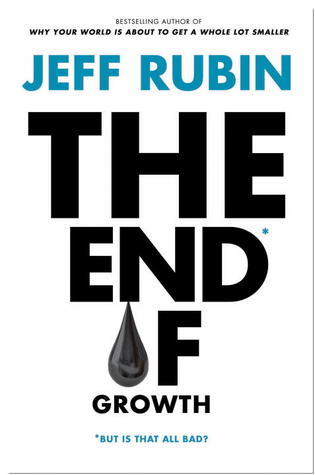
At one time or another, we've all heard—or even said—that things will get better once the economy picks up again. Recessions have happened in the past and the world has always come out of them with increased economic growth, triggered by various events. Author Jeff Rubin doesn't think we've recovered completely from the sub-prime mortgage crisis of 2008 and, what's more, believes that we're on the verge of an even greater recessionary period that will be sparked by the European Union's debt situation. And this time, he states, the global economy is never going back to the way it was.
In his book, The End of Growth, Rubin reasons that the underlying drive for economic growth that's been hardwired into the minds of every modern financial player on earth was supported by a condition that no longer applies: the existence of cheap, accessible oil. The last recession was caused because interest rates were hiked to offset energy inflation, which in turn led thousands and thousands of homeowners to default on mortgage payments. Now, Rubin argues that the same rising energy prices are the real problem that is holding back the recovery of the housing market, as well as threatening to crush the global economy with another, even more serious recession.
Very simply stated, Rubin's point is that the energy we've relied on in the past is no longer cheap or easily accessible. It has become too expensive to sustain our present practices. And that means an end to the traditional idea of economic growth. Growth has been the 'Holy Grail' of modern society, either directly or indirectly motivating the activities of every working individual who contributes to his or her national economy.
The increasing scarcity of energy resources and the difficulties with which they are extracted are the reasons we're now going to the ends of the earth to exploit those reserves or are engaging in expensive refining processes to get at unconventional sources. We have come to a point where the demand is greater than our ability to provide an affordable supply. The emergence of new economic players such as China and India mean that the situation is only going to become more critical. Rubin admits that we may not run out of oil, natural gas or coal completely, but qualifies this acknowledgement by saying that the cost of obtaining them is going to mean that citizens of most nations will no longer be able to afford the fossil-fuel-based lifestyles they have come to enjoy.
Rubin includes a few examples of adaptations that are already being incorporated by several countries in the face of this new economic reality. The Danish have embraced a much less carbon-centric existence because of their government's use of cost deterrents. The Japanese have embarked on a policy of setsuden, or electricity conservation. And the Germans have begun to use job-sharing to cushion the impact of an economic downturn.
Despite the stark message Rubin is sending about the end of the global economy as we know it, he does leave the reader with some hope that a satisfying and sustainable future is possible so long as we are willing to shift our attitudes and change our behaviour to embrace more sustainable economic activity in the future.


