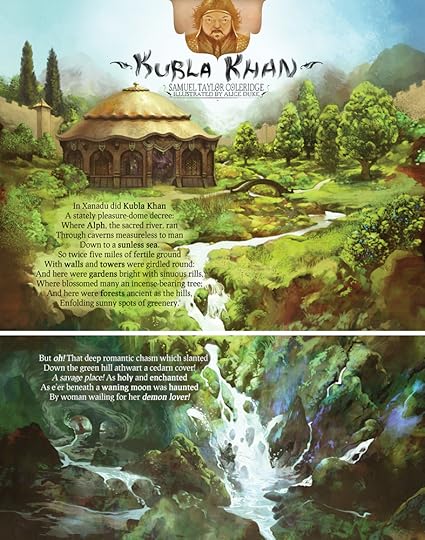
The Graphic Canon, Volume 2 gives us a visual cornucopia based on the wealth of literature from the 1800s. Several artists—including Maxon Crumb and Gris Grimly—present their versions of Edgar Allan Poe’s visions. The great American novel Huckleberry Finn is adapted uncensored for the first time, as Twain wrote it. The bad boys of Romanticism—Shelley, Keats, and Byron—are visualized here, and so are the Brontë sisters. We see both of Coleridge’s most famous “Kubla Khan” and “The Rime of the Ancient Mariner” (the latter by British comics legend Hunt Emerson). Philosophy and science are ably represented by ink versions of Nietzsche’s Thus Spake Zarathustra and Darwin’s On the Origin of Species .
Frankenstein , Moby-Dick , Les Misérables , Great Expectations , Middlemarch , Anna Karenina , Crime and Punishment (a hallucinatory take on the pivotal murder scene), Thoreau’s Walden (in spare line art by John Porcellino of King-Cat Comics fame), “The Drunken Boat” by Rimbaud, Leaves of Grass by Whitman, and two of Emily Dickinson’s greatest poems are all present and accounted for. John Coulthart has created ten magnificent full-page collages that tell the story of The Picture of Dorian Gray by Oscar Wilde. And Pride and Prejudice has never looked this splendiferous!
This volume is a special treat for Lewis Carroll fans. Dame Darcy puts her unmistakable stamp on—what else?—the Alice books in a new 16-page tour-de-force, while a dozen other artists present their versions of the most famous characters and moments from Wonderland. There’s also a gorgeous silhouetted telling of “Jabberwocky,” and Mahendra’s Singh’s surrealistic take on “The Hunting of the Snark.”
Curveballs in this volume include fairy tales illustrated by the untameable S. Clay Wilson, a fiery speech from freed slave Frederick Douglass (rendered in stark black and white by Seth Tobocman), a letter on reincarnation from Flaubert, the Victorian erotic classic Venus in Furs , the drug classic The Hasheesh Eater , and silk-screened illustrations for the ghastly children’s classic Der Struwwelpeter . Among many other canonical works.
Editor of the website The Memory Hole which publishes and archives hidden US government documents, including scientific studies and reports, civil rights-related reports, intelligence and covert action reports.
He was also editor-at-large for The Disinformation Company, where he had published several books including The Book of Lists and 50 Things You're Not Supposed to Know.
Volume 2 was my first introduction to Kick's "The Graphic Canon" collection. I really enjoyed the volume, but I can agree with the drawbacks that other reviewers have listed: lack of diversity, lack of illustration for some pieces, and some illustrations that were "unreadable" or difficult to visually decipher.
That being said, I am glad I picked up the volume. Another reviewer said that she approached the book like she would an art museum, which I thought was a good comparison. I paged through it in one sitting, carefully reading the stories and/or illustrations that caught my attention, and skimming through the ones that I didn't care for. Like an art museum, you are free to pay attention to what interests you. The excerpts are short enough that passing over some is no hassle.
I actually didn't mind at all that the excerpts were kept short. Kick is obviously not trying to adapt canonical works into graphic novels...but creating a visual "museum" for a textual era of work. I liked having these small visuals to attach to the works in my mind. Now when I hear or read Anna Karenina, or Huck Finn, or I Wandered Lonely As A Cloud, I have these reminders to refer to (but they are not so encompassing that they would take the place of my own imagination, if that makes sense.) It made me want to go pick up the novels themselves and read them in their entirety, which i suspect was also the point of the collection. Also, as I said before, the short length makes it easy to sample the volume.
I also liked Kick's introductory writing before each piece. His writing was concise, casual, and presented the necessary nuggets of information along with some interesting things you might not have heard before--much like a good museum tour guide would do. I look forward to exploring the other volumes.
This volume was better than volume 1, but one has to say that with the same tone as one says "having a temperature of 104 is better than having a temperature of 106." Some of the artwork is great - this is a fine showcase of a number of up-and-coming artists who may make it big for all the right reasons. Some of the "artwork," though, is just sloppy mediocre pseudo-art pretentiously demanding we call it "art" just because it says so (even though Mrs. Wilson's 3rd-grade class could draw better than this). In what purports to be a collection of the "World's" best work during the 18th-19th centuries, we are led to believe "the world" is mostly the UK and the USA, with only a dozen or so selections from other countries, including one that is essentially pornography (Venus in Furs), but Kick assumes we are enlightened enough to consider masochism is actually fine literature. Some artists do treat the source material with great respect. Others, like Hunt Emerson, don't. If I said Kick gives too much space to Nietzsche, Darwin, Ludlow, Carroll, and Blake, would that betray my biases? or his? Nat Turner, who killed people solely because of their race, we are told is a hero - killing people on the basis of their race is a quality of a hero? in the 21st century? or ever? I dunno. Kick, as usually, exerts himself to the point of apoplexy trying to get us to believe each selection is astounding and each artist is a genius: if the work doesn't speak for itself, no amount of cheerleading (i.e., grandstanding) is going to make it canonical. At other times, Kick makes us wonder if he even read the work in question: Huck Finn respects Jim as a human being early in the novel? Not really, no. Perhaps Kick's penchant for postmodern criticism has hindered his understanding of the actual works. Some inclusions just make us scratch our heads in bemusement, wondering why entire short tales are in here simply to show off one panel of artwork from Kick's heroes - especially since Kick includes other works about selections without the relevant prose (such as the lengthy litany of Alice adaptations). If the purpose of this is to encourage readers to go out and read the real thing, I fear it fails. If the purpose is to show off the contemporary panoply of artists, it may succeed both to tell us whom to admire and whom to avoid. Reading this is mostly a chore - it has some bright spots, but they are few and far between.
(this review is the same as the one I wrote for volume 1. I really liked both volumes so far. I think perhaps the second one was more consistent in terms of sensibilities and quality, but I think that had mostly to do with the time period it was covering. Lots of great, beautiful stuff in both. Of course when dealing with canonization, what gets included and excluded, there is a lot to be debated. These books aren't super imaginative in that context, but hopefully they open up a space for others to create alternative volumes and alternative literary histories.)
This book has its ups and downs but all in all it's a nice reminder of the depth and breadth of our literary histories, and also a beautiful compendium of styles and approaches to adaptation. It's great to see the passion graphic artists have for their beloved prosy and/or poetical works.
Some perks: there are great prefaces to each adaptation contextualizing the text and its graphic adaptation. Also, a lot of artists are not published in a main-stream widely accessible format aside from these books, and so it's great to have an introduction to their work.
My main complaint is that a lot of the adaptations are short and come from the middle of books and they are confusing and unsatisfying and even if I wanted to read the rest, well, for most of the graphicized excerpts there is no rest. Also, a few of the adaptations are inscrutable.
I got the first two volumes of the Graphic Canon out of the library (most of the books I read are library books) and enjoyed them both. I am right now reading the childrens literature one. I imagine they are all prohibitively expensive to buy, thought I haven't checked to see, and I suppose prohibitively expensive to me might not be prohibitively expensive to others. In any case I highly recommend checking them out of the library at the very least. A lot of fun and a lot to think about.
Just as good as the last one. This covers probably my least favorite era in literature - the 18th and 19th centuries - but it still has a few really beautiful adaptations, notably Moby Dick and Huckleberry Finn.
A thought about the era: I recently read Jane Eyre and Les Miserables, two of the books adapted in this collection, and it's impossible to miss how much attention is given to minutia and detail, with Les Mis especially. My theory is that this was the first era where storytelling was dominated by the literate rather than the oral tradition. This isn't to say that there wasn't an oral tradition still, just that it was mostly overshadowed by actual books and the expansion of literacy. Books lend themselves to longer, more vivid description than we normally would hear in a spoken format, so the authors went somewhat insane with the concept and, like in the case of Hugo, wrote a hundred goddamn pages on sewers. I know that the story adapts itself to the format of the storytelling - look at television and movies - but it seems like there's always a period where people haven't quite gotten the hang of it. Film-makers eventually caught onto how to do it particularly well around the 70's and 80's, and television has just started creating brilliant works of art in the past ten years or so.
Anyway, that's probably an underdeveloped theory, but the basic point is that the literature in the 18th and early 19th century was long and windy and was begging for Twain and Hemingway to come and chop it into something short, direct, and incredible.
Again, a few good adaptations, but overall very lackluster. I'll be skimming Volume 3, but overall the highlight of the series still remains the Children's Lit collection.
Volume 2 in a series of condensed or excerpted literary works, from Kubla Khan (1797) to The Picture of Dorian Gray (1890). All kinds of artistic styles and media are on display, including some exceptionally clever adaptations. There were a handful of samples I found dull or impossible to follow, and a number of others whose original works I hadn't heard of, but it was overall an entertaining trip through the long history of world literature. Volume three completes the chronological journey.
It’s an anthology, and I’m starting to believe that you’re not supposed to like everything in one because it is purposely a buffet and presents a wide range. My only complaint was that some font was hard to read, and in the case of William Blake’s Jerusalem—illustrated by Blake— I couldn’t read much of the lovely, stylized script.
This compilation of graphic adaptations was hit or miss for me. I loved the takes on Moby Dick, Middlemarch, Anna Karenina, A Message from Mount Misery, and the poems of William Blake. I was far less enthused by the inclusions of the fairy tales of Hans Christian Andersen and the brothers Grimm. These entries consisted of the entire text of selected fairly tales reproduced in a very small font and paired with a single illustration. I'm not an expert but I doubt that that would fit the definition of a graphic work. In the same vein the editor included a gallery of single illustrations by various artists of the Alice franchise, but I actually loved those. Inconsistent I know but what can I say. Some of the adaptations were beautiful but essentially unreadable.
I did enjoy the brilliantly pithy "Three Panel Reviews" by Lisa Brown that accompany the introduction. My favorite was Brown's take on Madame Bovary: "My husband bores me." "I bore my lovers." "Hey, is that arsenic?"
Like all anthologies, some of these were better than others. I personally enjoyed the following:
"The Message from Mount Misery"--Excerpt from Frederick Douglas famous speech "An Occurrence at Owl Creek Bridge"--Wordless! Loved it. By far my favorite. "Adventures of Huckleberry Finn"-- His escape with Jim. Does a great job showing slavery and how Huck was torn with helping Jim and turning him in as an escaped slave. The only part I did not like was Jim's thick dialect. "Alice Gallery"--various artists depict the white rabbit and Alice in Wonderland. Very strange and wonderful. "Jabberwocky"--Even though this is the poem, which means it is very difficult to understand, the illustrations paired with the verse was beyond fantastic. Super Creepy and Fun! "Anna Karenina: Ch.22 & 23"--Really nicely done, but you really should have read the original to fully appreciate this adaptation.
İlk ciltte olduğu gibi, çok iyi seçilmiş yapıtlar, çok usta grafikerler-çizerler, çok iyi çeviriler, şahane bir baskı, muhteşem bir cilt, mükemmel bir derleme olmuş... "Kolektif kitap" çok başarılı bir tasarım yapmış... Mutlaka çok seveceğiniz bir bölüm vardır... Edinin, tekrar tekrar okuyun...
I liked this one better than Volume 1 but still scratched my head at some of the work. Kafka's Metamorphosis done in a Charlie Brown style... what? Does the book itself not have enough merit? I get it, it's an interpretation, but still for some reason it didn't sit well for me.
It was good to see some works by women writers. I enjoyed the Tolstoy, and enjoyed that one. (In fact, much better than reading Anna Karenina in its entirety!) But... what? No Pushkin!?
I was not fond of the "art" accompanying Walden. It annoyed me. It looked like a child drew the table with the complete lack of perspective. How poor Henry could have written with that table perched on its side as it appeared to be, I cannot imagine.
Of course with a volume like this it's going to be hard to make everyone happy. Humans have opinions. But I did enjoy reading most of it. Admittedly I skipped a bit or two.
As opposed to the first volume, this one is Euro/American centric with a heavy emphasis on male authors. Some of the entries are bit non-graphic - for instance the Grimms and Andersen ones are predominately text and are the weakest ones in the book. Additionally, I don't understand why the volume needed two different versions of Poe's "Raven". It is a great poem but it seems the room could have been used for another author or work.
Also this book seems to suggest that only the only writers lived in Europe and the US, so that is somewhat problematic as well.
Yet the Huck Finn and Kubla Khan entries are wonderful.
I picked up this book to read the graphic novel version of Frankenstein by Mary Shelley. This heavy tome includes multiple selections of books in graphic format. Unfortunately, each is only a snippet of each book. I read three of the selections: Frankenstein (which focused on the murder by the "monster"), Middlemarch (which focused on the meeting of the cousins in the museum and the unhappiness of marriage), and Kubla Khan (an elaborate visual feast). After those three, I decided to find a full graphic version of Frankenstein to compare with the full text version of the novel.
The most interesting aspect of the Graphic Canon was provided in the introductory material for each selection.
I checked this book out at the library to see if it might be a good resource for illustrated introductions to the classics for my kids. Nope! This book took a lot of work to put together so it gets a couple of stars, but the art and writing are quite unpaired to their classic texts. There is little in the way of truth, beauty, our goodness to be seen here. Vulgar and crass in image and word. This is the kind of modern-day schlock you would expect in an English lit course at a post-liberal arts college overrun by people with no respect for the past and a taste for being “edgy.” I was obviously not impressed.
I appreciate these visual adaptations being done, but for the most part I didn't care for the art, even though there was such a variety. Jane Eyre (I liked the art better than most, and appreciated the artist Elizabeth Watasin's attempt at capturing the feelings of the excerpted chapter) and Frederick Douglass's "The Message from Mount Misery" (the art, by Seth Tobocman, really helped his speech come to life for me) stood out.
I could see this being interesting for young adults or people who wanted a very quick introduction to several topics in literature. It would be good for a classroom, and especially for sparking student interest. However, if you're really interested in the works, reading them would be a better route.
This series is a phenomenal crash course in the literary canon and the world of graphic illustration all in one. The summaries are punchy and informative and the art, in its widely varied approaches, is a pleasure to behold you walk through some of humanity’s greatest stories.
Some really interesting visuals for classic pieces. In many cases, these are excerpts from independent graphic novels, with intriguing information about the piece and the interpretation choices of the graphic artist. I probably enjoyed the poetry most, as it was captured in its entirety.
There were a few highlights in here that I loved but, like the first, I found it overall fairly disappointing. A few a found myself skipping through entirely.
I didn't like this one as much as the others because in many cases the full text of a piece was included with one image. I prefer less text, lots of images.
I was fortunate enough to meet Russ Kick, the editor/curator of this amazing work, while he was in town for Books on the Banks. He mentioned (as he does deftly in the Introduction) that we are living in the "Golden Age" of graphic novels, and this behemoth is true testament to that. The popularity of graphic novels in both popular and academic cultures is not to be underestimated. Kick's appreciation of this is forward-thinking and prophetic, at the very least.
The Graphic Canon, volumes 1 and 2, are literally (and graphically) feasts for the senses, and by feasts, I mean, if these were meals, they'd blow Thanksgiving out of the water. There is so much great literature covered in these first two installments, and to see them come to life on the page is an extraordinary experience. A small example is Kick's addressing of the classic American behemoth novel, Moby Dick. It comes to light that an online blogger/artist named Matt Kish set out to create a drawing (in a number of different media) for each and every page of the novel (all 553 drawings can be viewed on Kish's site: http://everypageofmobydick.blogspot.c...).
There are so many talented artists involved in this project, and Russ Kick provides sharp, witty observations and pays sufficient homage not only to all included literary works, but also to the graphic representations of each piece. It certainly helps that he writes in a relaxed, low-key yet academic voice that can readily and easily be trusted. Whether you love or hate it, graphic representation of literature is here to stay. These books make it obvious that we should hop on board and fasten our seat belts.
One of the greatest things about these two volumes is that you can open the books up and at any point, on any page, find something wonderful and weird (even mind-blowing), and hell, you might even learn something in the process.
Volume 3 is set for release in April, 2013, and spans from Conrad's Heart of Darkness to David Foster Wallace's Infinite Jest. My order has already been placed.
Again, similar with vol. 1, it's packed with gorgeous illustrations, one can simply flip through the pages and enjoy the spectacle even with limited knowledge on the context. Readers need not to worry though, as Russ's introductions before each piece give enough background information on the literary works which inspired them.
There are some drawbacks of course which several reviewers here already pointed out—lack of illustration for some pieces, and some illustrations that are difficult to decipher—which I tend to agree.
There are 3 pieces that notably need more graphical interpretations: Poe’s “Works”, H.C. Andersen’s “Fairy Tales” and Grimm’s “Fairy Tales”. These pieces are presented in their original text form, sometimes 10 pages long, with only 4 or 5 illustrations. In fact, I don’t think these 3 pieces can be classified as “graphic” at all.
Artist Dame Darcy made 2 adaptations in this volume (“Alice in Wonderland” and one Dickinson’s poem). Russ in his introduction to the pieces applauded the much renowned artist but her works are visually too complex for me. Same with Tara Seibel’s adaptation of “Les Miserables” although Russ has warned us that to read the text in this piece is “purposely not always easy or possible”.
Interpreting and adapting poems are also challenging if not impossible. So for poems, it’s already a success if the artists were able to simply express the nuances. This is more difficult when the poems are symbolic in style, for instance Blake’s “Auguries of Innocence” and Rimbaud’s “Drunken Boat”. The approach for these two works seems too literal for me.
My favorites in this volume are all the three pieces by the acclaimed cartoonist Hunt Emerson and Matt Kisch’s “Moby Dick”. Emerson has a knack in creating humorous spin out of the literary works, while Matt Kisch, well, his illustrations are simply breathtaking. You need to see them for yourself.
The second volume of the Graphic Canon is equally as impressive as the first in terms of both the variety of artwork, the depth of the commentary and the breadth of the selection of literature.
In order to refrain from repeating myself, I’ll attempt to elaborate on my review of the first volume.
When thinking of the literary canon, one automatically thinks of novels and poetry, typically non-fiction. However, as Russ Kick points out, there are many important works that are non-fiction, or that are letters or speeches.To some degree, this book made me question what constitutes the literary canon and whether there even can be a concrete definition.
Another thing that I noticed, and that you are called attention to, is the number of works that that at the time of their publication, were met with public disapproval or were ignored. It was only much later that these works were recognized as being valuable. Which, and I guess this ties into what I said above, makes you think about how literature, like everything else, requires the right time and place. There are probably works that have been lost to time that today we would find exceptional and conversely, how many novels that are famous today will remain so in a hundred years time?
The last thing I want to talk about is censorship – how over the course of time novels and stories have been censored to the point where the versions we are familiar with today are not what the author wrote or intended. Perhaps this should be remedied?
Recommended to lovers of literature and graphic novels.
Where these anthologies excel is when they reintepret the classics and bring to light the lesser known works. I may be in a minority but Kubla Khan was unknown to me before this and the rendition (see image below) is stunning - it's a great opening piece. Equally, longer verse-style poetry, which can be hard to stick with and appreciate, is very digestible when interspersed with images. The range of graphic styles and media is impressive as well.
Choices Obviously such a large undertaking is going to limited by the size of the collection and cuts will be made but this volume in particular felt like the Anglo-centric, high school required-reading edition. Maybe that is what the editor wanted to do: provide an introduction to these works so that young people who might struggle with the texts have an entry point? Personally I would have appreciated some diversity but I can understand why this selection was put together and anyway it’s an anthology - it will never be to everyone’s tastes.
Not as great as Volume I (but I think that’s because more of the texts were known to me) but definitely worth the read.
This huge volume of graphic novelizations of various poems, stories and novels is almost too much to get through, some portions actually including large sections of works (Grimm's Fables and others) in very small print with relatively little illustration to accompany them.
Overall I enjoyed the various artists twists on the stories, some of my favorites include the Rime of the Ancient Mariner, I Wandered Lonely as a Cloud by Wordsworth I thought was conveyed very nicely by PMurphy, very colorful, but also adding a twist to the poem. I also really enjoyed the artwork accompanying Carroll's Jabberwocky and would read the entirety of Middlemarch in comic form by Megan Kelso.
I also enjoyed the various Alice montages and even more so those devoted to Moby Dick, many of which I would love to have for myself.
Something I could have seen more of were the 3 or 4 panel review/summary comics that were in the beginning of the book by Lisa Brown, they were quite funny and I thought deserved a lot more space than just a nod by the editor and a few dotted here or there.