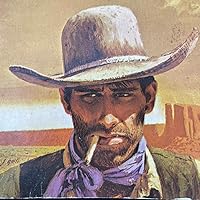
Trent came to Idaho seeking solitude. He built a cabin, broke a few wild horses, and quietly put his past behind him. Then King Bill Hale began laying claim to all the land around Cedar Bluff. When Hale’s son kills one of Trent’s neighbors, Trent quickly steps forward to lead the fight. Their property had been legally filed on, but Bill Hale has the men, money, and political power to steal it from them. What Hale doesn’t realize is that Trent also has connections. With evidence that can ruin Hale’s scheme, Trent must find a way past Hale’s gang of thugs to the men who can help him. However, if Trent succeeds, his violent past will be revealed; if he fails, the others may forfeit their land. But Trent could forfeit his life.
Louis Dearborn L'Amour was an American novelist and short story writer. His books consisted primarily of Western novels, though he called his work "frontier stories". His most widely known Western fiction works include Last of the Breed, Hondo, Shalako, and the Sackett series. L'Amour also wrote historical fiction (The Walking Drum), science fiction (The Haunted Mesa), non-fiction (Frontier), and poetry and short-story collections. Many of his stories were made into films. His books remain popular and most have gone through multiple printings. At the time of his death, almost all of his 105 existing works (89 novels, 14 short-story collections, and two full-length works of nonfiction) were still in print, and he was "one of the world's most popular writers".
A classic western. Lance goes to the mountains and becomes embroiled in King Hale trying to push Lance’s neighbours off their legitimate claims. Hale has an insane son, Nita is there too and we are entertained by some great boxing fights.
The trek over the desert is an endurance test and the Hatfields were great characters. Another easy enjoyable read.
"They were men who had always worked with their hands, and were beholden to no man. Not one of them was a gunfighter, but each had used a rifle or a short gun all his life and would have been lost without one or the other."
"Jack," Trent said, "when I was fourteen I was a man. Had to be. Well, it looks like your father dying has made you a man, too. "I'm giving you this Sharps. She's an old gun but she shoots straight. I'm not giving this gun to a boy, but to a man, and a man doesn't ever use a gun unless he has to. He never wastes lead shooting carelessly. He shoots only when he has to and when he can see what it is he's shootin' at."
This is chronologically the second Kilkenny book taking place a year or so after The Rider of Lost Creek. Kilkenny left Texas to go somewhere people didn’t know him and lands in a struggle between a huge rancher and some small family homesteads. This is a familiar western trope where the lonely gunfighter is a cowboy knight-errant. Kilkenny continues to do everything well. Kilkenny helps the common homesteaders fight back against the professional gunmen employed by the wealthy rancher. There are some familiar characters from the previous book and even a continuation of storylines, which is not typical of L’Amour’s books.
#amancalledtrent aka #themountainvalleywar by #louislamour a greedy bad guy and his cronies trying to pinch good hard working folks land by killing them and driving them off, a man with secret identity hiding a dangerous past helps the innocent defend their land and lives. A classic #western featuring all the usual themes good vs evil, independence vs tyranny. Enjoyable
The Kilkenny seris - Monument Rock [novella] by Louis L'Amour
4.5 Stars
challenging dark hopeful inspiring reflective sad tense
Fast-paced
Plot or Character Driven: A mix Strong character development: Yes Loveable characters: Yes Diverse cast of characters: Yes Flaws of characters are a main focus: Yes
You knew what was going to happen (in a good way). I was glued into this story from a few pages in.
I wanted to know how it was going to happen, for you knew that he'd accomplish the task that he set out for himself...but I wasn't prepared for the depths that he would actually take.
It really doesn't pay to be a bad guy, especially around this villain (actually in any villain story).
I am getting used to the author's style of writing, and can say that this was my favourite story...and NOW I want to pick up the full-length novel...with this same title.
If you've read both, is the full-length novel an expansion on this story...OR is it a totally different story, with the same title?
On to the last story in this part of Louis L'Amour's world...that I own.K
“Trent” - an alias for the man famously known as Kilkenny wants to escape his reputation as a gunfighter. He moves to fertile land where he files a claim and lives in a small cabin. Others filing claims in this beautiful land too files claims on their land. These are known as “nesters”.
But a man named King Bill Hale has other plans for the land. He wants all of it for his own and will stop at nothing to achieve that including threatening others to in town not to sell food stuffs or supplies to the nesters, and sending his riders to kill and murder.
When a serious confrontation happens between Kilkenny and King Bill Hale, it sets off a chain of events that will affect so many lives forever!
My new favourite Louis L’Amour book,and I thought the first Kilkenny book was really good!
Trent came to Idaho seeking solitude.He built a cabin, broke a few wild horses and quietly put his past behind him.Then King Bill Hale began laying claim to all the land around Cedar Bluff.
I loved the characters in this book and I love the way Louis L’Amour wrote it as the details make the story come alive! The first 2 books of this series are classics,written well and I really enjoyed them.
Other than the Sacketts, Lance Kilkenny is my favorite returning character. I first read this book outloud to my baby brother while he did dishes. I'm not sure if we finished it, but that's my first memory of it. I must have been between 12-14. This is a grand adventure of the underdogs and the backwater folks against a wealthy, lawless tyrant. It doesn't get much better than that. I appreciated the historical notes, the fistfights, the scenery, the courage, and as always, the brave women who made homes in the west for cowboys, gunslinger, and mountain men. Good stuff.
If you loved the first one, you will love this one. Nita follows him to Idaho. L'Amour does his best in his description of the area. Hale is trying to run out the homesteaders. Kilkenny has changed his name and is trying to run a farm. He is one of those who is being attacked. Couple of good fist fights and the ending takes an unusual twist. Good solid characters drive an action packed plot.
My first-ever western novel and I enjoyed it more than I thought I would. Louie L'Amour writes a great story about good vs evil, hidden identity, standing up for the little man, and being brave enough to love. Now, this did end up being the 2nd book in the Kilkenney series, which I was unaware of beforehand, but it still read great on its own. I look forward to reading more books written by L'Amour.
L’Amour knows how to tell a simple story with great feeling. In this case, a man with a reputation is trying to start over when he becomes involved in trying to keep a few mountain ranchers from being driven off their homes by King Bill Hale. It’s a story that is the basic idea behind a hundred western movies and probably even more books but L’Amour brings it to life in his own unique way with vivid landscapes which are actually important to the story and solid characters. The crossing of the salt flats and the pivotal boxing scene late in the story are especially well done. In the final analysis, this isn’t on the level of L’Amour’s best books like The Lonesome Gods, but it’s a quick and enjoyable tale.
The Kilkenny series by L'Amour is an action-packed, fast paced series. In this story, reluctant gunfighter Lance Kilkenny sides with a bunch of high country homesteaders against a ruthless cattleman who will stop at nothing to own all of his surrounding territory. Self-declared "King" Bill Hale, who has plenty of valley land, only wants to own the high country because some have settled it, including Kilkenny. Gunfights, bare knuckle fist fights, deadly ambushes and unprovoked murder leap from page-to-page. You can't put this book down until it's finished.
I spent two and a half months working my way through Nicholas Nickleby by Charles Dickens--one of my favorite authors. After that I had to grab some fast reads, so, of course I grabbed a Louis L'Amour book. Make that books, I've got a few others lined up.
This is the second book in L'Amour's Kilkenny books. But the third one written. He first wrote the novel Kilkenny in 1954. Twenty years later, he wrote, the Rider of Lost Creek, the first book in Kilkenny's history and followed it up two years later with the Mountain Valley War. In the internal chronology of the books, Kilkenny is the final book.
In the MVW, Kilkenny is living in Idaho, trying to avoid his reputation as a gun-fighter, going by the name of Mr. Trent. He's settled in a high valley, built himself a house and is farming and running a few cattle. He's filed on his land, as did all of his neighbors, mostly small farmers. But the big man on the block King Hale has decided he wants their land, despite they all own their land and have filed claims on their lands.
But that doesn't stop Hale, or his son Cub. They've declared war on the farmers, killing one man by shooting him in the back. Reluctantly, Kilkenny is pulled into a war.
This moves fast--If finished it in a day. It's got all the hallmarks of a L'Amour novel, fast-paced, small towns, people trying to live in peace, fist-fights, gun battles.
Kilkenny spends time strategizing and looking for ways out of gun battles. This is also a study on wealth and power accumulated too quickly. It's not heavy-handed about it, but neither is it subtle. More along the lines of your basic Sunday School lesson type.
There are a couple interested, unexpected twists. However, the final showdown between Kilkenny and Cub is actually anti-climatic, and a let down.
I did find a copy of Kilkenny so I can finish up the series.
Louis L'Amour wrote dozens of stories with non-reoccurring characters. The hero would appear in one book never to be seen again. On the other side was almost two dozen novels about the Sackett family. The Sackett books spanned several generations. In between these Louis L'Amour had a few characters that popped up in various novels and short stories. Kilkenny was one such. There were three novels and three short stories about Kilkenny.
For some reason Kilkenny is one of my favorite Louis L'Amour characters. He had many of the traditional traits: fast with a gun, a good fist fighter, smart, stood up for justice and for most of the stories he rode off into the sunset, alone.
"The Mountain Valley War" is the last Kilkenny novel. Once again our hero is minding his own business. He is up in the mountains of Idaho building up a small ranch. Then a cattle baron starts pushing his weight around. He wants more land, and he kills for it. Kilkenny gets involved and rallies to the side of the small settlers. In addition to all that, trouble has followed him from the story of "The Rider of Lost Creek." We have lots of gun battles and some fist fights. The action just moves from page to page.
Personally I recommend you start with "Kilkenny" and "The Rider of Lost Creek" before reading "The Mountain Valley War." But if you like Louis L'Amour or westerns in general you can jump straight to "The Mountain Valley War."
I chose this book because it was set in Idaho. It is set in the southwestern corner of the state, but it never made me feel like I was there. There seemed to be a few breaks where it seemed that the story was going to say one thing, and instead, something completely different had been inserted. It seems like I read somewhere that the story was originally a short story that was later expanded into a novel--that would explain the insertions. Overall, a good book. The protagonist is the classic L'Amour hero with a sense of justice and the abilities to sustain it. He works to save the legitimate farmers and small ranchers from the heavy-handed conquest of the "King" of the valley. The female characters seemed to get less time than in some of L'Amour's other works. The main character Kilkenny, and the woman Nita, have both been introduced in a previous book which I do not recall having read, but the back story is provided here. It's good, but not great. Although there are exciting bits of action along the way, ultimately it comes down to a classic showdown between the forces of good and evil. The final act begins with a boxing match. Gunfire eventually follows; mercy has it's place, but justice still prevails--which is what the Western is all about: a classic morality play decked out in the accoutrements of the American West.
Trent is living in Idaho on a small mountain spread, seeking solitude and a life alone to escape a gunfighting past when one of his neighbors is killed by a range baron's son named "Cub" Hale. King Bill Hale is the dad; he, his crazy son and his hired henchmen are trying to push off the local settlers and take over the whole valley, even resorting to buying out local shops and trading posts and refusing to sell to the valley's settlers who resist his offers.
"Mountain Valley War" was written in 1978, right at the height of L'Amour's late preachy anecdotes phase, and suffers somewhat from the same narrative struggles we see in his lesser books like "Walking Drum" and "Tucker." The protagonist Trent and the good guys spend a lot of time talking about right and wrong, and talking to Hale's goons about right and wrong, but there are also some immersive ventures into the mountains of Idaho on treacherous trails and action sequences.
Verdict: "The Mountain Valley War" is a decent, short venture into a full-blown mountain war not usually seen in a L'Amour novel, with a focus on the one protagonist, a love story, some bad guys and good guys, but not among L'Amour's better tales.
Jeff's Rating: 2 / 5 (Okay) movie rating if made into a movie: PG
It has been a few decades since I read one of America's Frontier Storyteller's books. found a four-pack cleaning up my in-law's place and decided to once again wade in. All was as I recall from my initial foray into the Western genre, goaded by my high school buddy Dan, wanting to debate between Zane Gray and Louis L'Amour. There is a mysterious fellow in the area, previously classified as a gunfighter, but he was pushed into a situation where he had to capably and nobly defend himself. Now, he will have to take a reluctant stand to protect his hard-earned peace and quiet, living alone in a cabin crafted by his own hands. Never fear, there will be a love interest from his past, or a sweet widow woman who will complete his life. The bad guys go down, the weak and manipulated get run out of town, and the territory is restored to the utopia it should be.
As to that debate? Sorry Dan, no disrespect to the Sacketts, but I will take Longmire as my preferred western hero.
Another great Western. This one had some good themes covering that transition from the wild west to the west. I found it good and engaging the whole way through (but I always do with westerns) many of the characters felt flat and lacked deapth beyond their trope. A few stood out with more intrest/motivations/story than others, but generally this book had more people and all the people felt watered down. The plot also felt more disjointed and watered down. We spend more time worried about major obstacles, which turn out to be minor speed-bumps, and never get used again.
As I think more, if felt like a season finale where all the extras come back and get their stories wrapped up. It's possible there were lots of returning characters in this book and I could have loved it more if I'd known more of them.
I rated it a three because it had flaws and was a bit bland. I also absolutely loved it and wish everyone I know could read it. I think I'm just a sucker for westerns...
As a Louis L'Amour fan, it feels strange to say this; this book was just alright.
At no point did I feel connected to the characters, so their struggles didn't carry any emotional weight. I also felt that it was much longer than it needed to be and was inconsistent with detail, with some scenes dragging on for too long with blow-by-blow narration and others feeling relatively brief. I found the protagonist, Trent, to be uninteresting. He's an archetypal Western hero: strong, great with a gun, an overdone "a gunfighter's way of life always catches up with him" mentality. Beyond this, he didn't seem to have much of a personality.
However, it does have L'Amour's fantastic writing style, with vivid descriptions of land, historical accuracy, and a grit that feels authentic.
If you love Louis L'Amour's writing and you're just itching for more, try this book out. Just don't expect it to be on the same level as his other stories. Otherwise, I'd pass on this one.
A solid frontier historical novel about a gunfighter trying to avoid his reputation and live a quiet life, who gets caught up in a range war between King Hale and several people who filed on and proved up property near by his range.
The book suffers a bit from some pontificating by L'Amour about various subjects, as if he steps into the narration and talks directly to the reader. I don't mind what he has to say, but its a bit jarring and interrupts the story. A final boxing match in the book takes up an entire chapter, which is too much boxing for my taste, but its well told.
Overall the story is pretty good, particularly sections describing an arduous exploration and passage through a desert area. As L'Amour personally goes into each of these areas he writes about, that place is there complete with the petroglyphs and the caves, and you can almost taste the dust.
Just because Hale is the richest man and largest land owner in the area, he's forgotten that what it means to be a good person. He doesn't need more land, but once some settlers move into the mountain valleys, he decides he wants the land for himself. Those in the mountains have filed legal claims to their land and want to be left alone. One of those folks is a man who calls himself Trent, who has come to this area for peace and quiet. A man who is very quick and good with a gun, whose real name is Kilkenny, has hung up his pistols and raises a few cattle and horses. His neighbors regard as quiet and helpful. King Hale, his son Cub, and those hired gunman decide to move the settlers out, thus the story of how to have the settlers keep their land.
I thought I had read all the Kilkenny stories. I guess I was wrong. This is one I had never read. Kilkenny has found a place to call home. It is in the Bitterroot Mountains of Idaho. He is happy and building a nice place to settle down. He likes his neighbors who are all homesteading like he is. They have all filed their homestead claims and they are all busy making a home for themselves. As always there is a man that thinks his is lord of all he can see. He never thought to file a claim on any land but he claims all he can see.
This set the scene for all the trouble that follows.
This is a book book. I couldn't put it down. There is so much going on even a happy ending for Kilkenny.
I don't know. I guess this two star rating is probably a little generous. 1.5 is more on the mark.
I have now completed the four book arc of this series, even though I read them in the wrong order. This may be the best of the bunch, though it continues to be devoid of any complexities of character, or have any tension regarding how the story will actually be resolved. In the end, the bad guys lose and the good guys win.
Maybe that's part of the appeal for L'Amour fans, though this book suffered from being read as I was at the same time reading a Larry McMurty western full of ambiguity and uncertainty.
I wouldn't recommend these books to anyone out of middle school.
Excellent Louis L'Amour western. All the elements are present for a great read: a larger-than-life protagonist, a rich ruthless land owner killing and taking financial advantage of innocent homesteaders, and a strong female character for the love interest. High adventure in the mountains of Colorado, a boxing match our hero is forced to become a combatant in, and a final showdown. Really good stuff and, after reading, is one of my very favorite L'Amour novels and he is among my favorite authors so heady stuff. Great read.
All Trent A.K.A. Kilkenny wanted was to live in peace with his neighbors but as happens with a fast gun, who does not want trouble, trouble finds him, when a neighbor is killed and a polecat by the name of King Hale is behind it. Slowly but steadily Trent and some of his neighbors set out to make things right by using guns and brains and fists. In between all of the action a love story blossoms as it often does in these types of stories. I can't give much away but will say even when good guys when live can be lost.
A classic L’Amour - and perhaps western - format of the gun-slinging, tough-as-nails brawler cowboy wanting to find peace and yet just can’t avoid coming to the rescue of the overbearing land baron. Trent - aka Kilkenny - counts himself as one of those looking just to forge out a living (and life) on land they’ve properly filed on but the now interests King Bill Hale for that singular reason. There is also the woman - Nita - who Kilkenny has tried to protect from his reputation. Not as developed as some of my favourite L’Amour novels but enjoyable.
I think this story rather clearly illustrates the problem of upholding the law. What agency is gonna take interest in a remote SouthWestern corner of Idaho? Settlers had filed on claims honorably and set up a homestead, only to have the evil Hale's come by and forcibly remove them from the land. The book kept referring to the elder Hale as a statesman, giving to the public, yet he let his renegade son run wild over the settlers, killing people at whim. Also, interesting fight depictions, and how Trent managed to get the better of two fights against extremely tough fighters!
This entire review has been hidden because of spoilers.