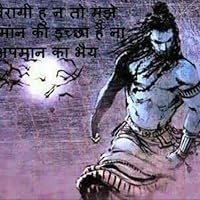
Bhakti Yoga is a real genuine search after the Lord, a search beginning, continuing, and ending in Love. One single moment of the madness of extreme love to God brings us eternal freedom. When a man gets it, he loves all, hates none; he becomes satisfied forever. Swami Vivekananda
"Arise Awake and Stop not til the goal is reached"
Vivekananda left a body of philosophical works (see Vivekananda's complete works). His books (compiled from lectures given around the world) on the four Yogas (Raja Yoga, Karma Yoga, Bhakti Yoga and Jnana Yoga) are very influential and still seen as fundamental texts for anyone interested in the Hindu practice of Yoga. His letters are of great literary and spiritual value. He was also considered a very good singer and a poet.By the time of his death, He had composed many songs including his favorite Kali the Mother. He used humor for his teachings and was also an excellent cook. His language is very free flowing. His own Bengali writings stand testimony to the fact that he believed that words - spoken or written - should be for making things easier to understand rather than show off the speaker or writer's knowledge.
Swami Vivekananda [ স্বামী বিবেকানন্দ ] (1863 – 1902), born Narendranath Datta, was an Indian Hindu monk, philosopher, author, religious teacher, and the chief disciple of the Indian mystic Ramakrishna. He was a key figure in the introduction of Vedanta and Yoga to the Western world and is credited with raising interfaith awareness, and bringing Hinduism to the status of a major world religion.
Born in Calcutta, Bengal Presidency, British India (present-day Kolkata, West Bengal, India)
I could not make sense of Bhakti Yoga as easily as Karma Yoga. "How can one love God so much?", I would wonder reading the initial pages. Then incidents of life gave that answer to me. Quite a year this has been!- 2017
*Re-reading in 2019: Everything makes so much sense now! Whoa! It's like new windows in my brain have opened up in these 2 years.
Swami Vivekananda was one of the most no-nonsense thinkers of his times. His books work for me like anything. This simple 100 pager on the concept of attaining union (Yoga) through love is just what I wanted to read right now. I am going through a painful psychological phase where I am working very hard to understand what my mind truly seeks. This book was a major revelation and I am glad I read it.
I liked this book but found it contained general information...nothing specific about how to practice bhakti yoga. However, there is a really good online article I recommend that gets right to the point.
This is a book that will make you rethink your old ideas on Bhakti, or devotion.
In our modern cynical age, religion, and specially devotion, has come under increasing critical scrutiny. The leap of faith that underlies devotion has come under increasing skepticism, and the view has gained ground that Bhakti or devotion is directly antagonistic to science; you have to choose either one or the other.
This is a book that teaches us that it is not so. Swami Vivekananda brilliantly brings before us the full range of the teachings of the path of devotion of Hinduism. Bhakti has many layers, from the simple minded dualistic beliefs to the highest Advaitic principles. It is in these heights that we find the harmony of Bhakti and science, because 'God' here is not an old bearded man in the Heavens but our conceptualization of the entire Universe. We then realize how we can gain the immense strength of faith in our hearts and combine it with the vigor of science and reason. Through such an interpretation of Bhakti, we can approach the final spiritual goal of Samadhi or immersion in the absolute even in the modern age.
This book is a must for all who are looking for a fresh and strong interpretation of Bhakti which does not require us to give up science and reason.
...P. J. Mazumdar, author of The Circle of Fire: The Metaphysics of Yoga
One of the problems growing up in the west as an Indian is that there is a definite fear of God as the primacy of worship. Maybe it is the Puritan world view of America, The commandment “don’t take God’s name in vain.”
Vivekananda says otherwise. God is to be treated as a friend of equals, get angry, be friendly, love and don’t ask of anything in return. You don’t ask a best friend for anything in particular, you just go on adventures or enjoy each other’s company.
It was a refreshing read to for me that when I say “God damn it” in the Vedantic tradition I am not going to hell…
It's very simple, if your love is for material things, you know that they don't last forever. Instead if you direct your love towards God, it will make your love last forever, leading up to your subsequent rebirths. Bhakti Yoga (in this book) has been shown as the simplest ways to break away from the chain of getting a life on earth.
Busco a Bhakti, buscas a a Bhakti. Bien Bendecido es Buscando a Bhakti bajo buenas visiones. Bien busco a bhakti verás bondad bhakti bien a. bhakti. bua bua.
"Bhakti Yoga: The Yoga of Love and Devotion" is a profound and insightful book written by the renowned spiritual leader, Swami Vivekananda. In this book, the author explores the concept of Bhakti Yoga, which is a path of devotion and love towards God, and explains how this ancient practice can be used to achieve spiritual enlightenment.
The book begins by providing a detailed explanation of the different types of Bhakti Yoga, including the practices of devotion, worship, and selfless service. The author explains how these practices can be used to develop a deep and personal relationship with God, and how this relationship can lead to spiritual growth and enlightenment.
One of the most striking aspects of the book is the way in which the author presents Bhakti Yoga as a universal practice that is accessible to people of all backgrounds and religions. He argues that Bhakti Yoga is not limited to any one particular tradition or culture, and can be practiced by anyone who is willing to open their hearts to the divine. He also emphasizes that Bhakti Yoga is not just a set of practices or rituals, but it’s a way of life that transforms the individual from inside out.
Throughout the book, the author provides many examples and anecdotes that help to illustrate his points, making the book an engaging and easy read. He also draws upon a wide range of sources, including the Bhagavad Gita, the Ramayana, and the writings of other spiritual leaders and thinkers, which lends credibility to his arguments!
One of the most compelling arguments that the author makes is that Bhakti Yoga is a powerful way to achieve spiritual growth and enlightenment. He argues that by developing a deep and personal relationship with God through devotion and love, we can transcend the limitations of our ego and become one with the divine. He also emphasizes the importance of selfless service, which is a fundamental aspect of Bhakti Yoga, as it helps to cultivate humility and detachment, and allows us to experience the divine in all things.
Overall, "Bhakti Yoga: The Yoga of Love and Devotion" is a deeply insightful and thought-provoking book that provides a powerful and compelling argument for the practice of Bhakti Yoga. It is a must-read for anyone interested in spiritual growth and enlightenment, and for anyone who wants to develop a deeper and more personal relationship with God. The book is a great reminder of the power of love and devotion in achieving spiritual growth, and the writing of Swami Vivekananda is simple yet profound making the book easy to read and understand. It is a great addition to any spiritual or philosophical library!
Bhakti Yoga explains the true nature of the divine love that all men and women should have for God. It was a sheer pleasure and bliss for the mind to read through the pages. Before reading this book, I could only understand God in terms of my religion but the book explains that how God is one, we cannot even perceive him truly with the limited senses of a human body. God is beyond our worldly manifestations.
What is air to the body, water to the plant and light to the eyes, God is to a Bhakta. Bhakti Yoga is the most natural of all four Yogas as Bhakti is love, the highest form of love, love for God and love cannot be developed with force or logic. Love sprouts just for the sake of love, for no gains, no fear, no expectations and no hurt. This makes Bhakti Yoga the easiest way yet the most difficult one.
The book explains how a Bhakta does not seek for knowledge, but he/she just seeks for the love of God, one touch, one union and that's all a Bhakta lives for. A Bhakta, unlike a Jnani, would love to reincarnate again and again just to experience the love for the Lord as a second being. Despite having known the Brahma, a Bhakta chooses to love God like a worldly lover. Bhakta does not even seek for freedom (moksha) over love of Lord. Such is the love of a Bhakta.
I read this after reading Karma Yoga and I understood that the two paths are not separate. But unlike Karma Yoga which does not require one to even believe in God or follow any doctrine, Bhakti Yoga demands for manifesting God in our lives, through our wordly senses and love him more and more day by day.
I loved the book so much that I would say it is a must read. However, I also believe that the book will find you when it is meant to be. For me it was magic and I would love to read it again.
Lots of valuable stuff here--I highlighted a ton of passages! But this is not a hands-on guide to deepening your devotion to God. Nor is it meant for newcomers to Hindu thought; in fact, it assumes a familiarity with sages like Shankara and Ramanuja, and their respective ideas of monism and qualified monism.
Since this book isn't a hands-on guide, I have a hard time explaining what, exactly, it is. It covers lots of ground, going into interesting theological territory, and warning about some pitfalls.
And these are important warnings: Don't imagine your view of God is the only one, and that everyone else should worship exactly as you do. Don't become obsessed beyond reason with diet--don't make your religion only about what happens in the kitchen. (Which is not to say the kitchen isn't important!) Don't carry even the principle of not doing harm to ridiculous extremes.
While all this is useful, sometimes Vivekananda seems to realize that he's gone outside the territory that most interests bhaktas. At one point, he says: "To the Bhakta these dry details are necessary only to strengthen his will; beyond that they are of no use to him."
Well, maybe some use. If you come into this book knowing that it's not a hands-on guide, I think you'll find it well worth the read.
The fourth and final in the Yoga series - Bhakthi Yoga - the Yoga of love and devotion. If Jnana yoga was to attain the absolute through sheer logic, bhakthi yoga does the same through devotion which also happens to be the most natural way for human beings. The love shall be expressed through many forms and Vivekananda emphasises on the need to direct the love from lower forms towards higher forms. Again as in Jnana yoga, complete renunciation is a must to reach the ultimate goal. Vivekananda was a bridge between the classical scriptures and the modern world. Having a photographic memory and laser focussed towards Indian scriptures of way past, he has given the meat of them in the most understandable manner. Inspite being more than a century old, his logical approach and lucid explanations will easily pass the test of time. Thoroughly loved this one as well. Don't know when I went off track, his books are so addictive!
Detailed explanation of the Bhakti sect. Many false narrative and assumption have been burst. This book is a door towards a good religious life.
Also concept of 'Religion is an opium' explained. (When and whose idea of a religion become opium). Concept of 🕉️ sound explained. Concept of food choice. Concept of life choice. Concept of Guru -shishya parampara. Concept of purity and devotion.
It will be difficult to understand in one go. Multiple time reading same books gives many new concepts and knowledge.
A crystal clear explanation of Bhakti Yoga chapter from BhagvadGita. What it is all about. It's not about going temples and churches but your unconditional love for God. This reminds me of Gitanjali where you find Tagore's love and compassion for God. It is surely a must read explanation of Bhakti Yoga
A short and a crisp read about probably the easiest form of yoga to adopt in life, happy to read it as the last book of this year. Though the way most people worship God now a days is a lower form of devotion, and often towards religious fanaticism, a major cause of conflicts in our society. True love and devotion cannot be reduced to any earthly benefit.
This a book on Bhakti aka devotion based on the ancient Indian philosophies. The author is a well-known and well-educated Indian monk, and one of my childhood/teenage hero.
It draws parallels with Bhakti/Devotion and Love. In this Yoga=Marga=path of Bhakti, the goal is to fall in love with God instead of people or other ideas or things. It means loving God to the extent of craziness (the author used the term "mad love"). It is only then we would be able to find happiness. I can see why and how! When you are madly in love, you are in a crazy/irrational world. So, yes, defining Bhakti as "mad love" was helpful to understand why certain people speak irrationally.
There are some good parts. Like respect others' love/bhakti etc. How to be a good teacher, a good student, etc.
Before I go on to tell in harsh words about why I don't like this philosophy, I remind you again that the author is my childhood hero, and I respect him. But I am not taking the path described by this philosophy. Here in this book, I found that the author speaking like a car salesman trying to sell an old car of Bhakti, by exaggerating everything and even trashing others who don't agree with these philosophies. The author also sounded like a person describing his lover about how awesome she/he is, how nice, how beautiful/handsome, happy to look at her, blah blah blah, except here it is God and not a lover/partner.
As you advance in this path, you'd madly in love with god, you would be focussing all your energies to love God. You are asked to not expect anything in return - otherwise, there would be a disappointment. I understand that you will be completely occupied with it so you will not be hurting anyone which is nice, but you will also not really doing anything good to the other people in our world(not in your crazy world of mad love). Being stuck in your own crazy world instead of being here to help others in this world - what a waste of life!
In summary, this is not my way of life. I would rather be on Karma Yoga: the Yoga of Action instead. (I am yet to read JanaYoga, that sounds nice too)
My first book.... in the search for philosophical truth in matters of love. Going through intense shifts with people, losing people, learning realities - this book tries to explain that curiosity and questioning ARE love and ARE reality.
Now - Vivekananda did not exactly tell people how to practice Bhakti yoga... but it serves as a gentle rulescape for living in truth, respecting reality and mindfulness should be, and also should not be....separate from dreams.
This book is an exciting journey that will help you discover the fascinating path of bhakti yoga: the yogic path of liberation through Devotion to the Eternal Love that lies within. Written in a masterfully poetic word, it is worth reading again and again, pausing to digest every sentence as deeper meanings can be constantly discovered. A work of art and truth that reflects the eternal teachings that only an Enlightened Mind can offer.
Hearing this was so insightful and definitely informative on the topic of devotion and the divine love that one should have towards God. If many people read and applied this, it would definitely end many feuds in the modern day world.
It's hard to follow this path in all consciousness of the human mind, also I had a hard time understanding most of the knowledge in this part despite me being a religious devotee.