In this classic study of cultural confrontation Professor Momigliano examines the Greeks' attitude toward the contemporary civilizations of the Romans, Celts, Jews, and Persians. Analyzing cultural and intellectual interaction from the fourth through the first centuries B.C., Momigliano argues that in the Hellenistic period the Greeks, Romans, and Jews enjoyed an exclusive special relationship that guaranteed their lasting dominance of Western civilization.
What was the nature of the cultural (as opposed to the military and political) interactions among the leading cultures of the Mediterranean basin during the first five centuries BCE?
Now that is a big topic, and in a slim volume based on a series of lectures given at Cambridge University and Bryn Mawr College, Alien Wisdom: The Limits of Hellenization (1975), the great Italian classicist Arnaldo Momigliano (1908-1987) provides an introduction to such interactions between the Celts, Romans, Greeks, Jews and Persians (the Egyptians, Phoenicians, etc. receive little attention).
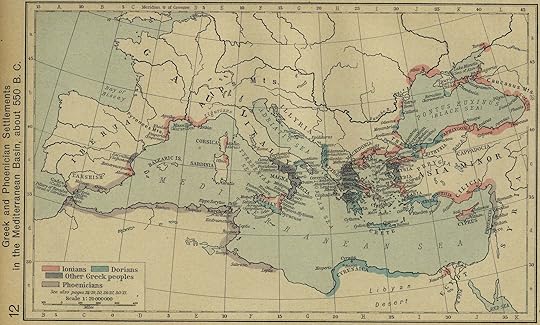
Using primarily literary, but also archaeological and numismatic evidence, Momigliano paints a fascinating picture of cultural exchanges that are strongly colored by the idiosyncratic characteristics of each culture. For example, though the Greeks were the first ethnographers and had some interest in "barbarians" as strangely incomprehensible creatures whose curious habits were to be marvelled at, they had next to no interest in learning their languages. Indeed, though they had a major colony at Massalia (Marseille) since around 600 BCE, they made little effort to learn about the geography, institutions and economy of their neighbors, foes and trading partners, the Celts (whereas the Celts poured into Massalia to learn about Greek culture). On the other hand, the Romans weren't interested in anyone until they were ready to conquer them (or the Other was trying to conquer them), whereupon they began studying them carefully, including learning their languages. But the Romans usually hired foreign scholars to do the studies for them; ironically enough, when they became interested in the Celts of Gaul and Spain, they hired Greeks to do the work. Finally, Greeks penetrated into the interiors away from their familiar coasts! Momigliano directly suggests that a significant contributing factor to the decay of the Hellenistic empires was the Greek monolinguism, whereas the Roman willingness to learn everything about their foes, including their language, correspondingly contributed to the rise of the Roman Empire.
From the beginning of history, the Greeks were interested in the Egyptians, Mesopotamians and Persians as sources of deep and arcane wisdom (for the Greeks, the Old had enormous prestige). But it had to be translated before they would really take notice. Nonetheless, even after the texts in what has become the Old Testament were translated into Greek during this time period, the Greeks never mentioned them in their surviving writings. Momigliano says flatly that the Greeks never read them.
The Jews were in many ways an irreducible problem for the Persians, then the Greeks, and then the Romans; Momigliano makes the case that the primary reason for this was not the Jews' aversion to polytheism (after all, the Zoroastrian Persians were monotheistic), but the identification of their racial and cultural identity and value with their religion. The most violent Jewish revolts occurred when they perceived their occupiers as threatening their religious traditions (such as when their Hellenistic overlord Antiochos IV turned the Temple in Jerusalem into a temple for Zeus). Nonetheless, precisely these religious traditions underwent a significant transformation under Persian and Greek influences, which Momigliano briefly traces.
The Greek-Persian cultural interaction was intense, and the Hellenistic overlords adopted many Persian cultural attributes, some of which are recounted in these lectures. Aside from reminding us that the Persians' cultural inheritors, the Parthians, were so Hellenized that the celebration of their tremendous victory over the Romans at Carrhae included a performance of Euripides' tragedy The Bacchae in the original, Momigliano tells us little about the results in Persian culture of Greek influence.
Ancient Wisdom(*) is an engaging, if necessarily limited introduction to a fascinating topic about which I've been reading recently and for which this is my first report. A suivre...
(*) I first read this in a French translation - Sagesses barbares: les limites de hellénisation - which I mention because for this edition Momigliano updated the nice bibliography of the first English edition. I haven't looked at any later English editions to see if they included a corresponding extension of the bibliography.
Bought it in 1993, and finally read it. An unbelievable erudition in service of an immense topic, on the cultural relationship between ancient Greeks and their Roman, Celtic, Jew, and Persian neighbors. A fascinating little book.
This book is just the right length for the casual reader. It does expect the reader to be a classics major at points but even without that background there is still a lot of understanding to be gained of how the Greeks thought of the world at the boundaries of their own as well as that they were enculturating and trading with.
El contenido del libro fue presentado como conferencias, por lo que el texto tiene más tintes académicos que de divulgación histórica. Aun así, es muy ameno de leer y pinta una imagen muy viva de los intercambios culturales e intelectuales del mediterráneo en la época clásica.
Arnaldo Momigliano, además de exponer la tesis del libro, también le dedica su tiempo a la historiografía. Es una obra muy buena que se disfruta aun más al acompañarlo con revistas divulgación histórica sobre eventos históricos aludidos en el libro.
"If that nose had pleased the gods as it pleased Caesar and Antony, a loose Alexandrian Gnosticism might have prevailed instead of the Christian discipline imposed by the two Romes, the old one on the Tiber, and the new one on the Bosporus." These open words read handsome!
Quit in the first chapter, although I appreciate the author's writing.
This book is not easy to read. The readers are expected to be quite familiar with the classical culture. The stories and figures in the narration are what I never knew. And that is beyond me.