

What do you think?

Gravity: How the Weakest Force in the Universe Shaped Our Lives
A history of gravity, and a study of its importance and relevance to our lives, as well as its influence on other areas of science.
Physicists will tell you that four forces control the universe. Of these, gravity may the most obvious, but it is also the most mysterious. Newton managed to predict the force of gravity but couldn't explain how it worked at a distance. Einstein picked up on the simple premise that gravity and acceleration are interchangeable to devise his mind-bending general relativity, showing how matter warps space and time. Not only did this explain how gravity worked – and how apparently simple gravitation has four separate components – but it predicted everything from black holes to gravity's effect on time. Whether it's the reality of anti-gravity or the unexpected discovery that a ball and a laser beam drop at the same rate, gravity is the force that fascinates.
Physicists will tell you that four forces control the universe. Of these, gravity may the most obvious, but it is also the most mysterious. Newton managed to predict the force of gravity but couldn't explain how it worked at a distance. Einstein picked up on the simple premise that gravity and acceleration are interchangeable to devise his mind-bending general relativity, showing how matter warps space and time. Not only did this explain how gravity worked – and how apparently simple gravitation has four separate components – but it predicted everything from black holes to gravity's effect on time. Whether it's the reality of anti-gravity or the unexpected discovery that a ball and a laser beam drop at the same rate, gravity is the force that fascinates.
336 pages
First published May 22, 2012
About the author
Brian Clegg
171 books3,292 followersBrian's latest books, Ten Billion Tomorrows and How Many Moons does the Earth Have are now available to pre-order. He has written a range of other science titles, including the bestselling Inflight Science, The God Effect, Before the Big Bang, A Brief History of Infinity, Build Your Own Time Machine and Dice World.
Along with appearances at the Royal Institution in London he has spoken at venues from Oxford and Cambridge Universities to Cheltenham Festival of Science, has contributed to radio and TV programmes, and is a popular speaker at schools. Brian is also editor of the successful www.popularscience.co.uk book review site and is a Fellow of the Royal Society of Arts.
Brian has Masters degrees from Cambridge University in Natural Sciences and from Lancaster University in Operational Research, a discipline originally developed during the Second World War to apply the power of mathematics to warfare. It has since been widely applied to problem solving and decision making in business.
Brian has also written regular columns, features and reviews for numerous publications, including Nature, The Guardian, PC Week, Computer Weekly, Personal Computer World, The Observer, Innovative Leader, Professional Manager, BBC History, Good Housekeeping and House Beautiful. His books have been translated into many languages, including German, Spanish, Portuguese, Chinese, Japanese, Polish, Turkish, Norwegian, Thai and even Indonesian.
Along with appearances at the Royal Institution in London he has spoken at venues from Oxford and Cambridge Universities to Cheltenham Festival of Science, has contributed to radio and TV programmes, and is a popular speaker at schools. Brian is also editor of the successful www.popularscience.co.uk book review site and is a Fellow of the Royal Society of Arts.
Brian has Masters degrees from Cambridge University in Natural Sciences and from Lancaster University in Operational Research, a discipline originally developed during the Second World War to apply the power of mathematics to warfare. It has since been widely applied to problem solving and decision making in business.
Brian has also written regular columns, features and reviews for numerous publications, including Nature, The Guardian, PC Week, Computer Weekly, Personal Computer World, The Observer, Innovative Leader, Professional Manager, BBC History, Good Housekeeping and House Beautiful. His books have been translated into many languages, including German, Spanish, Portuguese, Chinese, Japanese, Polish, Turkish, Norwegian, Thai and even Indonesian.
Ratings & Reviews
Friends & Following
Create a free account to discover what your friends think of this book!
Community Reviews
Displaying 1 - 30 of 35 reviews

August 13, 2014
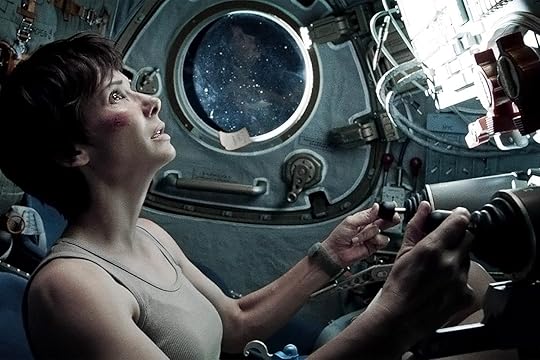
Celebrity Death Match Special: Gravity versus Gravity
[SANDRA BULLOCK sits listlessly in front of the instrument panel in the Soyuz spacecraft. Slowly, she adjusts a setting, leans back in her chair and closes her eyes.]
BULLOCK: It's hopeless. I mean, how am I supposed to write a book about gravity? I can remember a bit of what I did in my undergraduate courses. Plus what I read in Scientific American. Who'd ever take me seriously?
[Tears pour down her perfect cheekbones. Enter THE GHOST OF GEORGE CLOONEY.]
CLOONEY: Hey, hey, hey! That's no way to talk. Trust me, you know plenty. Just write it down and they'll love it.
BULLOCK: I wish. I don't understand relativity properly and I'm supposed to explain quantum gravity. How's that going to look? I mean, I can't even remember how to derive the formula for the Riemann--
CLOONEY: Baby, you're overthinking it. Put in some stuff to make them laugh, some historical anecdotes--
BULLOCK: Like, Einstein's teacher said he'd never amount to anything? Puh-lease.
CLOONEY: Yeah, why not? It's good material. Lots of people don't know that. Newton and the apple. Everyone likes the apple story.
BULLOCK: And what about the math?
CLOONEY: Come on, you're writing a pop science book. Anything mathematical comes up, don't go into details. Just tell 'em it's complicated. No problem.
BULLOCK: But look, I can't--
CLOONEY: Stop thinking tensor calculus. Read my lips: space is like a rubber sheet. I want to hear you say that.
BULLOCK: I--
CLOONEY: Say it.
BULLOCK: [Defeated] Space is like a rubber sheet.
CLOONEY: You got it, baby. Trust me, it's all gonna be fine.
[BULLOCK opens her eyes. CLOONEY has disappeared.]
BULLOCK: Oh thank God, it was just a dream!
[She glances at the incomprehensible Russian labels on the panel, then confidently presses two buttons]
This'll be a piece of cake. I'm going home.
Match point: Gravity

March 8, 2022
A historical account of spacetime warping
This book offers a historical account of gravity, one of the four fundamental forces of nature, and how it eludes our understanding. This is a concise narrative that is engaging without any equations or too much physics. It is explained in a very simple language. But some of the recent and relevant discussions have not been included here.
The Newtonian physics describes the behavior of matter and energy in space and time. According to Isaac Newton, time flows equably without relation to anything external, and absolute space is also its own thing, always similar and immovable. Events of physical reality performed independently on a neutral stage where actors strutted and fretted without influencing the rest of the theater. This pretty much explains physical reality we see and experience in our daily life. But Albert Einstein’s theory of general relativity turned Newton’s absolute space and time into a relativistic mash-up. According to him, spacetime is completely amalgamated into a malleable fabric and the two do not exist independently as Newton predicted. This is a new arena in which the players altered the space of the playing field. It was a physics game changer. Einstein also showed in his general theory of relativity that matter and energy warped the spacetime surrounding it. In fact, that is called gravity, which Newton thought was a force. Newton’s apparent force of attraction became a sort of illusion perpetrated by spacetime geometry. The shape of spacetime dictated the motion of massive bodies, and in turn massive bodies determined spacetime’s shape.
With our understanding of quantum physics where matter at the most fundamental state is known to have wave-particle duality, that is it exists as both particle and a wave simultaneously. If that is the case, then how does matter exert gravity when it is in a wave-state? Quantum physicists suggested that spacetime at the most fundamental state also exists in discrete quanta, that in bits and pieces, qubits. In fact, the treatment of gravity with quantum physics has led to thorny issues that is largely derived from the black hole physics where spacetime is curved to an extreme extent.
To understand the quantum properties of space and time, it is realized that information plays an important role in quantum reality, because it gives the observer a role who becomes an integral part of the physical reality. Recent advances in quantum Information have shown that information naturally describe evolution of quantum geometry. There seems to be a deep connection between information and the nature of space and time, and space and time are losing their role as grounds for an objective physical reality. The observer or the consciousness is an integral part. It may also mean that gravity may be an emergent phenomenon in quantum physics, or gravity and quantum physics are different approximations of a more fundamental theory that is still out there but not yet discovered.
This book offers a historical account of gravity, one of the four fundamental forces of nature, and how it eludes our understanding. This is a concise narrative that is engaging without any equations or too much physics. It is explained in a very simple language. But some of the recent and relevant discussions have not been included here.
The Newtonian physics describes the behavior of matter and energy in space and time. According to Isaac Newton, time flows equably without relation to anything external, and absolute space is also its own thing, always similar and immovable. Events of physical reality performed independently on a neutral stage where actors strutted and fretted without influencing the rest of the theater. This pretty much explains physical reality we see and experience in our daily life. But Albert Einstein’s theory of general relativity turned Newton’s absolute space and time into a relativistic mash-up. According to him, spacetime is completely amalgamated into a malleable fabric and the two do not exist independently as Newton predicted. This is a new arena in which the players altered the space of the playing field. It was a physics game changer. Einstein also showed in his general theory of relativity that matter and energy warped the spacetime surrounding it. In fact, that is called gravity, which Newton thought was a force. Newton’s apparent force of attraction became a sort of illusion perpetrated by spacetime geometry. The shape of spacetime dictated the motion of massive bodies, and in turn massive bodies determined spacetime’s shape.
With our understanding of quantum physics where matter at the most fundamental state is known to have wave-particle duality, that is it exists as both particle and a wave simultaneously. If that is the case, then how does matter exert gravity when it is in a wave-state? Quantum physicists suggested that spacetime at the most fundamental state also exists in discrete quanta, that in bits and pieces, qubits. In fact, the treatment of gravity with quantum physics has led to thorny issues that is largely derived from the black hole physics where spacetime is curved to an extreme extent.
To understand the quantum properties of space and time, it is realized that information plays an important role in quantum reality, because it gives the observer a role who becomes an integral part of the physical reality. Recent advances in quantum Information have shown that information naturally describe evolution of quantum geometry. There seems to be a deep connection between information and the nature of space and time, and space and time are losing their role as grounds for an objective physical reality. The observer or the consciousness is an integral part. It may also mean that gravity may be an emergent phenomenon in quantum physics, or gravity and quantum physics are different approximations of a more fundamental theory that is still out there but not yet discovered.

October 30, 2022
Maybe the advantage of this book is what it prompts, but leaves largely unsaid.
Regarding Einstein’s principle of equivalence, what are the relationships between gravity and acceleration, gravitational and inertial mass, and inertial and gravitational force? Is, for example, inertia a body’s natural state (straight-line motion or a rest state relative to other bodies) that, in turn, as gravitational force, modifies (accelerates) the inertial motion of other bodies?
Clegg is critical of Newton’s word for gravitational force, “attractive,” because of its intentional connotation. That seems to me to be a lesser problem with that word, given Einstein’s general theory of relativity where there is no attraction (or for that matter, “pulling”) of one body by another or of each body vis-à-vis each other. Rather, with Einstein there’s a straight-line inertial movement toward a gravitational center that curves that motion and it is this that is termed “attraction.” Seen this way, is the idea that the Earth attracts the apple and the apple attracts the earth a wrongly conceived legacy of Newtonian physics?
Clegg notes that it’s not the moon that circles around the Earth, but that both revolve around their joint center of gravity, which is a depression point in the fabric of spacetime. Straight-line movement is curved by the presence of both bodies, with the center being located more toward the greater mass – in this case, three-quarters of the way to the Earth’s surface. Extending this thought, could a gravitational center exist not inside a mass but, rather, in some center/balance point in the empty space between two bodies. In that case, the warping factor is not a body, per se, but nothing (except that spacetime is a fabric of something).
Clegg states that spacetime, via the presence of a concentrated mass, is stretched as well as warped. This suggests that spacetime, as a “fabric,” has mass and energy of some sort (dark energy, dark matter; or as Clegg writes, spacetime is “a kind of aether,” or elsewhere it is “an energetic field”) that, itself, is moved by inertial (resting or moving) bodies. Does this mean that bodies move “through” or “on” spacetime, or is it both?
Clegg says that gravity is the source of energy. Writing it this way suggests that gravity itself is an entity that exerts physical force. Is it? Or, is gravity the effect of concentrated mass-energy that warps-stretches spacetime that in turn modifies inertial movement. At the top of the hill, a body has potential energy; in the movement toward the bottom, a body expresses its kinetic energy (potential, rest energy, converts to motion, which is kinetic energy). Or, at the top of the hill, an object is an energetic body that “wants” to move (inertia) and its kinetic energy is the movement itself (the expression of its inertial energy). Gravity is not a thing (as an energetic body) but, rather in this case, a description of potential and kinetic energy that transitions from a rest to a movement state. Seen this way, how useful is “gravity” as a term and isn’t it an outdated legacy of Newton and a failure to fully make a transition to Einstein’s theory of relativity?*
Left unsaid in the prior example, is what happens when the said object hits the ground? Can it be said that movement is toward the gravitational center, which is where it would have gone were it not for the ground that impeded its motion? Had it not been for the ground, the object would have moved, almost teleologically, toward its inertial ground state, which is a point of equilibrium where there are not energetic differences requiring resolution.
With the inward move toward the gravitational center, such as in star formation, matter heats up. In extreme cases, where movement toward the gravitational center overcomes outward pressures, such as a big bang scenario, there is a transition to an explosive state. Why doesn’t the same thing occur with black holes? Clegg notes that they radiate or evaporate, per Hawking, but they don’t explode.
The movement of large concentrations of mass-energy creates ripples through (or in?) spacetime and such movements are called gravitational waves. What are Dirac’s “gravitons?” Are the ripples packets of mass-energy that move through (“in or on”) spacetime at c?
When writing of angular momentum, Clegg states that, “As far as we know, the universe doesn’t spin.” How is that known per Einstein’s theory of relativity if we are within the universe and have no external reference point to detect movement? Also, if there is a big bang explosion, isn’t there a gravitational center of some sort and if there’s an actual or looming contraction, could there not be a super, super galaxy-like, universal spinning of some sort?
Finally, Clegg speculates that anti-gravity might be some dark energy that pulls on dark or non-dark matter (galaxies), expanding it and inducing speed. But with a big bang explosion, and energy and matter dissipating outward, wouldn’t the gravitational effect at some point lessen and, liberate inertial movement to run free at c (in the case of light)? And, if the universe has a cosmic center, doesn’t that free energy move around the cosmic curvature to again begin to feel the gravitational effects of a movement toward the cosmic center?**
* Clegg knows this, but his language throughout his book references gravity as an attractive force. Bertrand Russell says the term “force” doesn’t apply in Einstein’s theory, but it’s a term of convenience and it is too difficult to come up with a different way to describe what’s involved.
** If there’s a cosmic center, where is it? Clearly, it has nothing to do with the earth’s location within the cosmos. With curvature being curvature, and not within our “line of sight,” it is conceivable that it is, for us, nowhere to be found.
Regarding Einstein’s principle of equivalence, what are the relationships between gravity and acceleration, gravitational and inertial mass, and inertial and gravitational force? Is, for example, inertia a body’s natural state (straight-line motion or a rest state relative to other bodies) that, in turn, as gravitational force, modifies (accelerates) the inertial motion of other bodies?
Clegg is critical of Newton’s word for gravitational force, “attractive,” because of its intentional connotation. That seems to me to be a lesser problem with that word, given Einstein’s general theory of relativity where there is no attraction (or for that matter, “pulling”) of one body by another or of each body vis-à-vis each other. Rather, with Einstein there’s a straight-line inertial movement toward a gravitational center that curves that motion and it is this that is termed “attraction.” Seen this way, is the idea that the Earth attracts the apple and the apple attracts the earth a wrongly conceived legacy of Newtonian physics?
Clegg notes that it’s not the moon that circles around the Earth, but that both revolve around their joint center of gravity, which is a depression point in the fabric of spacetime. Straight-line movement is curved by the presence of both bodies, with the center being located more toward the greater mass – in this case, three-quarters of the way to the Earth’s surface. Extending this thought, could a gravitational center exist not inside a mass but, rather, in some center/balance point in the empty space between two bodies. In that case, the warping factor is not a body, per se, but nothing (except that spacetime is a fabric of something).
Clegg states that spacetime, via the presence of a concentrated mass, is stretched as well as warped. This suggests that spacetime, as a “fabric,” has mass and energy of some sort (dark energy, dark matter; or as Clegg writes, spacetime is “a kind of aether,” or elsewhere it is “an energetic field”) that, itself, is moved by inertial (resting or moving) bodies. Does this mean that bodies move “through” or “on” spacetime, or is it both?
Clegg says that gravity is the source of energy. Writing it this way suggests that gravity itself is an entity that exerts physical force. Is it? Or, is gravity the effect of concentrated mass-energy that warps-stretches spacetime that in turn modifies inertial movement. At the top of the hill, a body has potential energy; in the movement toward the bottom, a body expresses its kinetic energy (potential, rest energy, converts to motion, which is kinetic energy). Or, at the top of the hill, an object is an energetic body that “wants” to move (inertia) and its kinetic energy is the movement itself (the expression of its inertial energy). Gravity is not a thing (as an energetic body) but, rather in this case, a description of potential and kinetic energy that transitions from a rest to a movement state. Seen this way, how useful is “gravity” as a term and isn’t it an outdated legacy of Newton and a failure to fully make a transition to Einstein’s theory of relativity?*
Left unsaid in the prior example, is what happens when the said object hits the ground? Can it be said that movement is toward the gravitational center, which is where it would have gone were it not for the ground that impeded its motion? Had it not been for the ground, the object would have moved, almost teleologically, toward its inertial ground state, which is a point of equilibrium where there are not energetic differences requiring resolution.
With the inward move toward the gravitational center, such as in star formation, matter heats up. In extreme cases, where movement toward the gravitational center overcomes outward pressures, such as a big bang scenario, there is a transition to an explosive state. Why doesn’t the same thing occur with black holes? Clegg notes that they radiate or evaporate, per Hawking, but they don’t explode.
The movement of large concentrations of mass-energy creates ripples through (or in?) spacetime and such movements are called gravitational waves. What are Dirac’s “gravitons?” Are the ripples packets of mass-energy that move through (“in or on”) spacetime at c?
When writing of angular momentum, Clegg states that, “As far as we know, the universe doesn’t spin.” How is that known per Einstein’s theory of relativity if we are within the universe and have no external reference point to detect movement? Also, if there is a big bang explosion, isn’t there a gravitational center of some sort and if there’s an actual or looming contraction, could there not be a super, super galaxy-like, universal spinning of some sort?
Finally, Clegg speculates that anti-gravity might be some dark energy that pulls on dark or non-dark matter (galaxies), expanding it and inducing speed. But with a big bang explosion, and energy and matter dissipating outward, wouldn’t the gravitational effect at some point lessen and, liberate inertial movement to run free at c (in the case of light)? And, if the universe has a cosmic center, doesn’t that free energy move around the cosmic curvature to again begin to feel the gravitational effects of a movement toward the cosmic center?**
* Clegg knows this, but his language throughout his book references gravity as an attractive force. Bertrand Russell says the term “force” doesn’t apply in Einstein’s theory, but it’s a term of convenience and it is too difficult to come up with a different way to describe what’s involved.
** If there’s a cosmic center, where is it? Clearly, it has nothing to do with the earth’s location within the cosmos. With curvature being curvature, and not within our “line of sight,” it is conceivable that it is, for us, nowhere to be found.

November 26, 2024
I've read more recent works on gravitational waves and whatnot, but this was a good collection of our history of understanding gravity and what we wish we could know about it going forward. I don't think the examples and depth of explanations here are the best, there tends to be a lot of hand waving when things get complex, but enough is included that you have a good jumping off point for further research and reading. I would have loved some diagrams to better understand his "think of it this way" bits as I could not picture what he was saying by the end of it. The unified theory eludes us and still remains one of the most alluring phantoms.

October 22, 2024
Obviously the first of the four foundational forces of our reality that a human being begins to understand and appreciate is gravity. In all its royal glory, that first fall that a baby experiences when trying to walk, that first time you fall when learning how to ride a bike, or perhaps going easy on the mishaps, just plain simple walking - are all made possible because there's gravity.
Mankind has always been amazed by the inverted celestial bowl of stars staring down on us each night, and have wondered why if objects dropped from a person's hands fall to the ground, why then those far off objects don't come crashing down. From Aristotle to Ptolemy, from Newton to Einstein, and from Hawking to Feynman, the book is chock full of interesting sound bites, and clever ideas, all expressed in a accessible language - for the most part.
There is nothing easy when it comes to the Relativistic equations, but the author makes an impressive attempt to resort to as few equations as possible, when navigating some of the densest subject matter in the book. This is not a science textbook. Far from it. By and large, I found that high school-level knowledge of physics and cosmology is enough to understand a vast majority of the content in this book. Of course, if one is interested in those subjects and has read any other texts, either as coursework or as casual interested reading, then they should feel right at home on almost all pages of the book. That goes to show the effort that must have gone in to make the text and the concepts simplified down to the basics, and even explaining them using (mostly) terrestrial examples.
Where I felt the book veered off course was towards the last third part. There is a chapter devoted to humanity's attempts at anti-gravity, and while it may be an expected inclusion for some, I skimmed over most of it. There is content that I couldn't quite reconcile with the titular subject - for instance, noncommutative mathematics and how it would change our understanding if it were to be applicable to the real world felt too theoretical to me, and a bit out of place in a book on gravity, the most widespread and widely recognized physical manifestation of a physical force, at least on the habitable Earth. There is also rather generous coverage of the Standard Model of quantum mechanics, but here too I felt if the intent was to eventually show that Gravity is not covered by anything in it, it felt rather a diversion. Especially since the reasons of that exclusion are not known, we don't know why that happens or even how. Of course, once the shortcoming of the SM are mentioned, there had to be obligatory coverage to other much less successful models - the strings theory, the M-theory, and others.
That's not to say it would not be interesting to many other readers. Mr. Clegg has a clear affinity for his subject, and he has done a tremendous service of furthering the layperson's understanding of that most ubiquitous of the four forces responsible for life as we know it.
Mankind has always been amazed by the inverted celestial bowl of stars staring down on us each night, and have wondered why if objects dropped from a person's hands fall to the ground, why then those far off objects don't come crashing down. From Aristotle to Ptolemy, from Newton to Einstein, and from Hawking to Feynman, the book is chock full of interesting sound bites, and clever ideas, all expressed in a accessible language - for the most part.
There is nothing easy when it comes to the Relativistic equations, but the author makes an impressive attempt to resort to as few equations as possible, when navigating some of the densest subject matter in the book. This is not a science textbook. Far from it. By and large, I found that high school-level knowledge of physics and cosmology is enough to understand a vast majority of the content in this book. Of course, if one is interested in those subjects and has read any other texts, either as coursework or as casual interested reading, then they should feel right at home on almost all pages of the book. That goes to show the effort that must have gone in to make the text and the concepts simplified down to the basics, and even explaining them using (mostly) terrestrial examples.
Where I felt the book veered off course was towards the last third part. There is a chapter devoted to humanity's attempts at anti-gravity, and while it may be an expected inclusion for some, I skimmed over most of it. There is content that I couldn't quite reconcile with the titular subject - for instance, noncommutative mathematics and how it would change our understanding if it were to be applicable to the real world felt too theoretical to me, and a bit out of place in a book on gravity, the most widespread and widely recognized physical manifestation of a physical force, at least on the habitable Earth. There is also rather generous coverage of the Standard Model of quantum mechanics, but here too I felt if the intent was to eventually show that Gravity is not covered by anything in it, it felt rather a diversion. Especially since the reasons of that exclusion are not known, we don't know why that happens or even how. Of course, once the shortcoming of the SM are mentioned, there had to be obligatory coverage to other much less successful models - the strings theory, the M-theory, and others.
That's not to say it would not be interesting to many other readers. Mr. Clegg has a clear affinity for his subject, and he has done a tremendous service of furthering the layperson's understanding of that most ubiquitous of the four forces responsible for life as we know it.

November 3, 2021
The few stars I give this book are for organization. Mainly, I don't understand the organization of this book. It begins rather comprehensible to the layman in physics, with a heavy emphasis on scientific history, but then about halfway through switches to a rapid-fire discussion of an immense range of subjects related or sometimes tangentially related to gravity, and at a technical level beyond the layman.
That aside, I need at regular intervals to be pushed beyond my common perception of the world, and this is the sort of book to do that. Observing great minds wrestle through the function of gravity on large scales (general relativity) and miniscule scales (quantum mechanics), and not be able to connect their theories together, is a surreal experience. How can space-time warp? I cannot even fathom it, and yet that is, best we can tell, what gravity is.
Here is yet one more example of a mystery fully known to the mind of God--he invented it, after all--but concealed from human minds for thousands of years. We have literally been living in this space-time warp without the slightest notion that we were living in it. If physical concepts are so difficult and mysterious, how much more should we expect and be comfortable with the mysteries of theology, such as the relation of persons to being in the Trinity, and the relationship between God's sovereignty and human responsibility.
That aside, I need at regular intervals to be pushed beyond my common perception of the world, and this is the sort of book to do that. Observing great minds wrestle through the function of gravity on large scales (general relativity) and miniscule scales (quantum mechanics), and not be able to connect their theories together, is a surreal experience. How can space-time warp? I cannot even fathom it, and yet that is, best we can tell, what gravity is.
Here is yet one more example of a mystery fully known to the mind of God--he invented it, after all--but concealed from human minds for thousands of years. We have literally been living in this space-time warp without the slightest notion that we were living in it. If physical concepts are so difficult and mysterious, how much more should we expect and be comfortable with the mysteries of theology, such as the relation of persons to being in the Trinity, and the relationship between God's sovereignty and human responsibility.
May 19, 2017
A nice book for learning about the history of humanity's understanding of gravity, the various theories of it over the ages, how they developed and changed, and the implications of gravity. Peripheral to the topic, it was fascinating to learn some of the less obvious aspects of the scientific method as he discussed current efforts to investigate theories of quantum gravity and to find some unification of quantum theory and general relativity.
Clegg'swriting is very casual—perhaps slightly too much so for my taste—and very accessible.
I am a bit disappointed, however. In recently reading about the string theory, I wondered why there was talk of and search for the "graviton." As I understand it, gravity is a force unlike light, for example, in that it is not transmitted by particles or waves, but simply by the topology of Space-Time. Why, then, would we expect there to be a gravity particle? Is there perhaps a paradigm in which gravity has a dual nature, the way electromagnetism acts both as particle and wave? Unfortunately, while Clegg referred both the curvature of space-time and graviton, he did not discuss a comparable son or relationship between the two. Perhaps it is a silly question arising from
My relative ignorance of physics.
Clegg'swriting is very casual—perhaps slightly too much so for my taste—and very accessible.
I am a bit disappointed, however. In recently reading about the string theory, I wondered why there was talk of and search for the "graviton." As I understand it, gravity is a force unlike light, for example, in that it is not transmitted by particles or waves, but simply by the topology of Space-Time. Why, then, would we expect there to be a gravity particle? Is there perhaps a paradigm in which gravity has a dual nature, the way electromagnetism acts both as particle and wave? Unfortunately, while Clegg referred both the curvature of space-time and graviton, he did not discuss a comparable son or relationship between the two. Perhaps it is a silly question arising from
My relative ignorance of physics.

August 5, 2017
Ever thought of what compels weight as well as the formation of planets? Look no further and be immersed in this profound book which unravels the power of gravity; the weakest of the 4 universal forces, yet capable and influential in shaping the universe. Clegg masterfully introduces and integrates mind-bending theories such as Quantum Tunnelling, Wave-Particle duality and Kepler's laws to enrich our understanding of this mystical force. Discover the birth and growth of gravitational theories over the course of the book as we see the infamous clash between philosophical and scientific concepts. The debate between proponents of Aristotle's geocentricism and Galilei's heliocentrism has never been so heated. Furthermore, take the opportunity to marvel at how intriguing experiments like the Torsion Pendulum exacted the value of the famous Gravitational Constant G.
A book that is certainly free from scientific jargon although a tad bit wordy, Gravity is sure to ignite your interest in the gravitational realm.
A book that is certainly free from scientific jargon although a tad bit wordy, Gravity is sure to ignite your interest in the gravitational realm.

July 15, 2018
The first part of this book is a historical overview of how our understanding of gravity has changed over time, and highlights all the main scientific figures you'd expect (Galileo, Newton, Einstein, etc.). This part was easy to follow, and while not a lot of the information was new to me (or anyone who has had take a basic physics class) it was a good reminder about how far we've come in what is really only a few centuries. However, in the second half of the book Clegg turns to covering all the various attempts to integrate general relativity and quantum mechanics, and that's when things start to fall apart a bit, at least for a generalist reader like me. I realize that these theories are complex in the extreme, but Clegg's explanations often read like gibberish to me, especially since he didn't go in depth on clarifying what quantum mechanics is and how it relates to gravity. Maybe diagrams would have helped? I think Clegg definitely knows what he's talking about, but his ability to translate that knowledge for a non-technical reader came up short.
October 30, 2025
This book provides a nice review of the past and current thoughts on gravity. The history of our ideas—from the ancient Greeks to Einstein and ending with quantum loop gravity. The author provides some great insight into the evolution of our understanding of gravity and how this understanding progresses through time. It explains the concepts well without getting too esoteric or technical. I would recommend it for anyone interested in physics or in a better understanding of gravity. This book is an easy and informative guide.
October 11, 2021
A great summation of this mysterious force of nature. The author approaches this fundamental force of nature in an easy to understand way. He offers background about the theories and early physicists that proved them and gives his own points to consider on some of the ideas that are still being discussed in the scientific community. For someone like me who is just now learning about science at 40 years old I think this book is a good place to start.

February 25, 2017
Good:
* Many interesting scientific information: gravitational wave, how to build a time machine to the future, black hole etc.
Bad:
* A lot of information in this book is already covered by other books.
* Some sections are too technical for the average reader.
* Many interesting scientific information: gravitational wave, how to build a time machine to the future, black hole etc.
Bad:
* A lot of information in this book is already covered by other books.
* Some sections are too technical for the average reader.

July 25, 2026
Explanation at its best.
When I finished this book I realized that I understood gravity, and yet what I didn’t understand, no one else did either. The author has done a great job of showing me what we know and what we don’t know.
When I finished this book I realized that I understood gravity, and yet what I didn’t understand, no one else did either. The author has done a great job of showing me what we know and what we don’t know.

September 8, 2018
Great read and the best book to understand gravity that happens in our daily lives. I really love science and this book really helped me improved my knowledge. Great book.

February 10, 2019
Gravity provides a good overview of the history of theories of gravity, from Aristotle through modern theories of quantum gravity. Clegg does a good job explaining basic principles along the way.
September 4, 2019
very approachable and informative

June 7, 2024
I really enjoy Brian Clegg's books! Thankfully he has written a lot of them.
April 23, 2012
Review Originally published at Bookshelf Love:http://bookshelflove.blogspot.com/201...
Clegg, Brian. Gravity: How the Weakest Force in the Universe Shaped Our Lives. New York: St. Martin's, 2012. Hardcover. +336 pages. $25.99. Release date: 22 May 2012.
Full disclosure: I received a digital advance copy of this book from the publisher for review.
Gravity is one of those books that is trying to do two things and doing neither very well. At once, it's attempting to be a history of gravity as we know it and to explain gravity as well as possible in layman's terms, but reading through it, I found it a huge disappointment on both sides.
This is partly because of the organization. Clegg jumps around from historical ideas to explanation with little to no transition. I'm not sure that there would have been a better way to organize the book--after all, one must understand Newton before one gets to Einstein, but it's not well done.
I think the largest problem is that Clegg is not a historian of science, and I'm inclined to think that he had a bad experience with one somewhere in his career--either that, or he is one of those unfortunate souls who got to college, realized that things did not work the way he'd been told in high school and has continued to resent it the rest of his life. Most of the beginning part of the book is correcting misconceptions from high school science and history, which I truly have no problem with. After all, Clegg does address the fact that the Greeks and the medieval world knew that the world was round, for example. He points out that Christianity and Islam in the Middle Ages did not repress science, but encouraged it, and he points out that the medieval world, while not yet at the point to recognize that the earth was not the center of the universe, did realize that the earth rotated.
Yet at the same time, Clegg's also correcting things that really don't matter. No, according to the Gregorian calendar change, Galileo did not die the same year Newton was born. But does it really matter? And is the brief digression into Latin philology necessary? And Clegg makes assumptions about the feelings of scientists without any evidence for them, sending him into one-sentence flights of fancy that is incredibly distracting from the rest of the text. The same thing goes for a brief discussion about the inside-out nature of anti-space and his completely gratuitous mention of Galaxy Quest, without any real meat to the analogy.
Clegg is best at underscoring some of the newer developments, such as Horava Gravity, which he claims may, if future experiments work out, may someday reconcile Newtonian physics and general relativity. These are relatively new developments, which I'd not heard of. Granted, while I am an English professor, the history of science is one of my specialties, and I'm by no means ignorant of much of what he's saying.
One section which really bothered me was Clegg's digression regarding the rubber sheet analogy. Oftentimes, physicists use the rubber sheet analogy to explain how space-time is warped by gravity. Here's an illustration from Stanford (from an article about Gravity Probe B, which Clegg does discuss in the book) that might help explain. {Illustration cut from text}
If you want a really useful explanation, I'd click through to the article. But the point is that everything with mass distorts space-time around it. This is an example of it simply in one dimension. But Clegg has problems with it, because in this illustration, if we pretend the probe in the picture is a marble rolling around to the center of the well, we forget that there is also a little distortion around the probe.
Clegg's point is not that this is necessarily wrong, but that it's overly simple--we forget that it's distorting space-time, not just space. That's all well and good, but the digression wasn't necessary. Clegg could have made the point without the need to attack the model.
And I suppose that's the real problem with this book. Clegg is constantly on the offense, either against bad history, bad illustrations, bad politicians who are cutting money from projects, and bad scientists who are letting them. His explanations aren't clear, and the book itself would be immensely improved by illustrations for visual learners.
All in all, if you want a good explanation of gravity and the way quantum mechanics may work with relativity, go read Brian Greene's The Elegant Universe or watch the NOVA series. It may not be as up-to-date as Clegg's, but you'll learn more and you'll learn it more easily.
Gravity- D+
Clegg, Brian. Gravity: How the Weakest Force in the Universe Shaped Our Lives. New York: St. Martin's, 2012. Hardcover. +336 pages. $25.99. Release date: 22 May 2012.
Full disclosure: I received a digital advance copy of this book from the publisher for review.
Gravity is one of those books that is trying to do two things and doing neither very well. At once, it's attempting to be a history of gravity as we know it and to explain gravity as well as possible in layman's terms, but reading through it, I found it a huge disappointment on both sides.
This is partly because of the organization. Clegg jumps around from historical ideas to explanation with little to no transition. I'm not sure that there would have been a better way to organize the book--after all, one must understand Newton before one gets to Einstein, but it's not well done.
I think the largest problem is that Clegg is not a historian of science, and I'm inclined to think that he had a bad experience with one somewhere in his career--either that, or he is one of those unfortunate souls who got to college, realized that things did not work the way he'd been told in high school and has continued to resent it the rest of his life. Most of the beginning part of the book is correcting misconceptions from high school science and history, which I truly have no problem with. After all, Clegg does address the fact that the Greeks and the medieval world knew that the world was round, for example. He points out that Christianity and Islam in the Middle Ages did not repress science, but encouraged it, and he points out that the medieval world, while not yet at the point to recognize that the earth was not the center of the universe, did realize that the earth rotated.
Yet at the same time, Clegg's also correcting things that really don't matter. No, according to the Gregorian calendar change, Galileo did not die the same year Newton was born. But does it really matter? And is the brief digression into Latin philology necessary? And Clegg makes assumptions about the feelings of scientists without any evidence for them, sending him into one-sentence flights of fancy that is incredibly distracting from the rest of the text. The same thing goes for a brief discussion about the inside-out nature of anti-space and his completely gratuitous mention of Galaxy Quest, without any real meat to the analogy.
Clegg is best at underscoring some of the newer developments, such as Horava Gravity, which he claims may, if future experiments work out, may someday reconcile Newtonian physics and general relativity. These are relatively new developments, which I'd not heard of. Granted, while I am an English professor, the history of science is one of my specialties, and I'm by no means ignorant of much of what he's saying.
One section which really bothered me was Clegg's digression regarding the rubber sheet analogy. Oftentimes, physicists use the rubber sheet analogy to explain how space-time is warped by gravity. Here's an illustration from Stanford (from an article about Gravity Probe B, which Clegg does discuss in the book) that might help explain. {Illustration cut from text}
If you want a really useful explanation, I'd click through to the article. But the point is that everything with mass distorts space-time around it. This is an example of it simply in one dimension. But Clegg has problems with it, because in this illustration, if we pretend the probe in the picture is a marble rolling around to the center of the well, we forget that there is also a little distortion around the probe.
Clegg's point is not that this is necessarily wrong, but that it's overly simple--we forget that it's distorting space-time, not just space. That's all well and good, but the digression wasn't necessary. Clegg could have made the point without the need to attack the model.
And I suppose that's the real problem with this book. Clegg is constantly on the offense, either against bad history, bad illustrations, bad politicians who are cutting money from projects, and bad scientists who are letting them. His explanations aren't clear, and the book itself would be immensely improved by illustrations for visual learners.
All in all, if you want a good explanation of gravity and the way quantum mechanics may work with relativity, go read Brian Greene's The Elegant Universe or watch the NOVA series. It may not be as up-to-date as Clegg's, but you'll learn more and you'll learn it more easily.
Gravity- D+
March 8, 2017
Essentially a history of the science of gravity throughout time. I enjoyed the early chapters more than the later chapters, both because it was interesting to see how the understanding of (and explanations for) gravity changed over time, and because the later chapters are very, very dense as the author attempts to explain quantum physics to a lay audience. The author really appeared to know his stuff, but it was difficult to keep up with him at the end.

December 22, 2015
I enjoyed Brian Clegg’s 2012 book, Gravity: How the Weakest Force in the Universe Shaped Our Lives . Let’s review a number of factoids about gravity that I gleaned from his book:
1. Gravity is the most obvious force in nature: “What goes up, must come down.”
2. It is “an invisible force with no detectable mechanism for exerting an influence.”
3. There exists a stronger gravitational force between a newborn baby and the midwife than between that baby and another planet.
4. Without gravity, the fusion process couldn’t have begun. Fusion is what powers all the stars and our Sun. The Sun converts about four million tons of matter into energy every second.
5. On August 2, 1971, the true extent of Galileo’s assertion that two bodies, regardless of their weight, accelerate at the same rate when dropped, was demonstrated vividly. During his third moonwalk, Apollo 15 mission commander David R. Scott dropped a geological hammer and a feather together on the surface of the Moon. They both fell at the same rate. Air resistance on Earth prevented Galileo from doing this experiment, but not so for Scott, who had no atmosphere on the Moon to contend with.
6. Newton couldn’t explain why gravity works, just that it acts according to the laws of gravity he developed.
7. The Moon doesn’t rotate around the Earth. Both rotate around their joint center of gravity, which just so happens to be a point about three-quarters of the way to the Earth’s surface from its center.
8. If the Earth lasted long enough, eventually the Moon would slow down the Earth’s spin such that it would complete one rotation each year. In other words, the Earth would always have one of its sides facing the Moon. The other parts of Earth wouldn’t be illuminated by the Moon. This formation between a planet and its moon is called tidal lock.
9. When a satellite is in orbit, it is falling freely under the force of gravity. The only reason it doesn’t crash to the Earth is because it keeps missing. The satellite is also moving “forward” at a tangent to the Earth’s surface. If it only had this forward velocity, the satellite would fly off into space; this forward motion coupled with the force of gravity keeps it in a fixed orbit.
10. Because astronauts are falling freely in the ISS, they don’t feel their weight (neither does a satellite in orbit).
11. Einstein’s General Theory of Relativity states that the force of gravity is just a tendency of bodies to move along the warps in space-time caused by the distortion of the fabric of reality by mass.
12. Gravity defines the curvature of space-time and is ignorant about mass when it comes to the speed of a falling body, for example. Photons, with zero mass, experience the same warping as anything else.
13. Light is bent by gravity; it is red-shifted by the pull of gravity.
14. Clocks slow down under the influence of gravity. A clock experiencing a higher gravitational pull will run slower.
15. A black hole is an inescapable gravity pit.
16. Gravity waves should cause ripples in space-time that should move at the speed of light. They are only an oscillation in the warping of space, not of time.
17. Gravitons are the carriers of gravity, just as photons carry electromagnetism.
I'm sure you can add to this list, so read Brian's book and go for it!
1. Gravity is the most obvious force in nature: “What goes up, must come down.”
2. It is “an invisible force with no detectable mechanism for exerting an influence.”
3. There exists a stronger gravitational force between a newborn baby and the midwife than between that baby and another planet.
4. Without gravity, the fusion process couldn’t have begun. Fusion is what powers all the stars and our Sun. The Sun converts about four million tons of matter into energy every second.
5. On August 2, 1971, the true extent of Galileo’s assertion that two bodies, regardless of their weight, accelerate at the same rate when dropped, was demonstrated vividly. During his third moonwalk, Apollo 15 mission commander David R. Scott dropped a geological hammer and a feather together on the surface of the Moon. They both fell at the same rate. Air resistance on Earth prevented Galileo from doing this experiment, but not so for Scott, who had no atmosphere on the Moon to contend with.
6. Newton couldn’t explain why gravity works, just that it acts according to the laws of gravity he developed.
7. The Moon doesn’t rotate around the Earth. Both rotate around their joint center of gravity, which just so happens to be a point about three-quarters of the way to the Earth’s surface from its center.
8. If the Earth lasted long enough, eventually the Moon would slow down the Earth’s spin such that it would complete one rotation each year. In other words, the Earth would always have one of its sides facing the Moon. The other parts of Earth wouldn’t be illuminated by the Moon. This formation between a planet and its moon is called tidal lock.
9. When a satellite is in orbit, it is falling freely under the force of gravity. The only reason it doesn’t crash to the Earth is because it keeps missing. The satellite is also moving “forward” at a tangent to the Earth’s surface. If it only had this forward velocity, the satellite would fly off into space; this forward motion coupled with the force of gravity keeps it in a fixed orbit.
10. Because astronauts are falling freely in the ISS, they don’t feel their weight (neither does a satellite in orbit).
11. Einstein’s General Theory of Relativity states that the force of gravity is just a tendency of bodies to move along the warps in space-time caused by the distortion of the fabric of reality by mass.
12. Gravity defines the curvature of space-time and is ignorant about mass when it comes to the speed of a falling body, for example. Photons, with zero mass, experience the same warping as anything else.
13. Light is bent by gravity; it is red-shifted by the pull of gravity.
14. Clocks slow down under the influence of gravity. A clock experiencing a higher gravitational pull will run slower.
15. A black hole is an inescapable gravity pit.
16. Gravity waves should cause ripples in space-time that should move at the speed of light. They are only an oscillation in the warping of space, not of time.
17. Gravitons are the carriers of gravity, just as photons carry electromagnetism.
I'm sure you can add to this list, so read Brian's book and go for it!
September 30, 2012
“Astronomy is such a high-minded, theoretical field of inquiry. The objects of its study are not at all down-to-Earth. Observations can be made only via the electro-magnetic spectrum (light).”
Brian Clegg proved my posting on Facebook true with this book. He started (and ended) with the question of what happens when you hold out a book and let go. It falls. Why?
Beginning with the natural philosophy of the ancient Greek Aristotle, passing through Galileo and Newton, and beyond Einstein, the author related various explanations for gravity. The last couple chapters were so theoretical and abstruse, I gave up and skipped to the end.
Aristotle theorized (and refused to experiment) that solid objects by nature fall toward the center of the universe (the Earth) while airy things by nature rise away from the center. This view held for a couple thousand years until Galileo broke with tradition and conducted experiments. He argued for acceptance of Copernicus’s Sun-centered heresy of planet movements.
Astronomers like Tycho Brahe and Johannes Kepler made observations and showed how the planets really orbit the Sun. Isaac Newton didn’t explain how gravity works but he did figure out how to calculate its effects. For hundreds of years, gravity was thought to be a force of attraction.
Then Einstein started thinking…deeply. He decided gravity is really a warping of space and time in the presence of mass. Then he figured out the highly complex math to explain his reasoning. (This is where things started to get beyond me.) His “simple” equation has three tensors –mathematical expressions of ten highly complex equations.
Many of the strange implications of his theory of general relativity (gravity) have been supported by experiments. Other implications have given rise to the abstruse, high-minded theories that lost me: string theory, multi-verses, symmetry, and quantized space-time.
For the most part, I did enjoy the Clegg’s work. I like this sort of explanation of scientific knowledge. And I learned more about general relativity. I would recommend this book to anyone who enjoys reading about scientific inquiry.
Brian Clegg proved my posting on Facebook true with this book. He started (and ended) with the question of what happens when you hold out a book and let go. It falls. Why?
Beginning with the natural philosophy of the ancient Greek Aristotle, passing through Galileo and Newton, and beyond Einstein, the author related various explanations for gravity. The last couple chapters were so theoretical and abstruse, I gave up and skipped to the end.
Aristotle theorized (and refused to experiment) that solid objects by nature fall toward the center of the universe (the Earth) while airy things by nature rise away from the center. This view held for a couple thousand years until Galileo broke with tradition and conducted experiments. He argued for acceptance of Copernicus’s Sun-centered heresy of planet movements.
Astronomers like Tycho Brahe and Johannes Kepler made observations and showed how the planets really orbit the Sun. Isaac Newton didn’t explain how gravity works but he did figure out how to calculate its effects. For hundreds of years, gravity was thought to be a force of attraction.
Then Einstein started thinking…deeply. He decided gravity is really a warping of space and time in the presence of mass. Then he figured out the highly complex math to explain his reasoning. (This is where things started to get beyond me.) His “simple” equation has three tensors –mathematical expressions of ten highly complex equations.
Many of the strange implications of his theory of general relativity (gravity) have been supported by experiments. Other implications have given rise to the abstruse, high-minded theories that lost me: string theory, multi-verses, symmetry, and quantized space-time.
For the most part, I did enjoy the Clegg’s work. I like this sort of explanation of scientific knowledge. And I learned more about general relativity. I would recommend this book to anyone who enjoys reading about scientific inquiry.

April 10, 2013
This is a book with a distinct identity crisis. It masquerades in some parts as a work on the history of gravity, then occasionally digresses into biographies of gravity scientists like Newton and Einstein, and then takes on the deep science of gravity and the connected physics (often in language much too dense to fully comprehend the arguments), while randomly reporting on "pseudoscientific" excursions and arbitrary discoveries that are quite peripheral to the main hypotheses being discussed. Clearly, this work is noble in intent, but could have benefited from a better conceptualization of a uniting vision and definitely a better editor.
That said, the book dances around its purported main theme - trying to unify gravity with our understanding of the quantum, and in reviewing the many attempts to reconcile the singularity problem when the mathematics behind general relativity regresses into meaningless infinities. Clegg's main contribution is a fairly copious review of theories more recent than string theory, such as loop quantum gravity. In particular, his citing and discussion of very novel perspectives/researches into tenets that abandon general relativity assumptions is quite fascinating - for example, the work of Czech physicist Peter Horava and English physicist, Mark Hadley. Horava treats space and time as separate concepts, in essence dismantling general relativity and starting afresh to remove problems that specifically erect barriers for a unified theory.
Overall, readers are better served sticking with the other physicist author named 'Brian' - Brian Greene, who is able to enunciate the complex ideas surrounding the four forces (electromagnetic, strong, weak, and gravity) more cogently, and tie the overall ideas far better than Brian Clegg is able to do in this undertaking, which like the force itself, remains rather weak in its rendering...
That said, the book dances around its purported main theme - trying to unify gravity with our understanding of the quantum, and in reviewing the many attempts to reconcile the singularity problem when the mathematics behind general relativity regresses into meaningless infinities. Clegg's main contribution is a fairly copious review of theories more recent than string theory, such as loop quantum gravity. In particular, his citing and discussion of very novel perspectives/researches into tenets that abandon general relativity assumptions is quite fascinating - for example, the work of Czech physicist Peter Horava and English physicist, Mark Hadley. Horava treats space and time as separate concepts, in essence dismantling general relativity and starting afresh to remove problems that specifically erect barriers for a unified theory.
Overall, readers are better served sticking with the other physicist author named 'Brian' - Brian Greene, who is able to enunciate the complex ideas surrounding the four forces (electromagnetic, strong, weak, and gravity) more cogently, and tie the overall ideas far better than Brian Clegg is able to do in this undertaking, which like the force itself, remains rather weak in its rendering...

July 8, 2016
Gravity has been touted as the start of the scientific enquiry. And this book shows exactly just that. From Greek philosophy to the rise of the scientific method, this book covers it all, even describing the theory's influence on hallmarks of modern physics, such as quantum and particle physics.
The book starts with a history lesson on the progress of Man's attempts to understand the world around him. It started with the Greek's attempt at using logic to explain the phenomenon he sees. Aristotle, as a philosopher had came up with explaination behind the falling apple and that became widely accpeted. Until comtemporary physicists came along, saw that experiments are crucial for uncovering the truth, then hence started the birth of the scientific method.
Along the way, great minds throughout the centry had came up with mathematical predictions behind the movements of the heavenly bodies. Newton came along to unify all those under a force named gravity. Then Einstein came along, did some revolutionary work that helped complete the full picture by considering near-light speed.
Then there is quantum physics. Gravity doesn't seem to fit anywhere yet, nobody can be sure of the cause of such a force, or energy. There have been many attempts are trying to combine the theory of relativity with quantum theory to form a "unified theory of the universe".
There hasn't yet been a model that can be tested. But improving technologies are slowly chipping away at the theorectical frontier of modern physics. We have eliminated some theories, confirmed some observations, eventually, this will give us a full picture of what is actually happening about us.
The book starts with a history lesson on the progress of Man's attempts to understand the world around him. It started with the Greek's attempt at using logic to explain the phenomenon he sees. Aristotle, as a philosopher had came up with explaination behind the falling apple and that became widely accpeted. Until comtemporary physicists came along, saw that experiments are crucial for uncovering the truth, then hence started the birth of the scientific method.
Along the way, great minds throughout the centry had came up with mathematical predictions behind the movements of the heavenly bodies. Newton came along to unify all those under a force named gravity. Then Einstein came along, did some revolutionary work that helped complete the full picture by considering near-light speed.
Then there is quantum physics. Gravity doesn't seem to fit anywhere yet, nobody can be sure of the cause of such a force, or energy. There have been many attempts are trying to combine the theory of relativity with quantum theory to form a "unified theory of the universe".
There hasn't yet been a model that can be tested. But improving technologies are slowly chipping away at the theorectical frontier of modern physics. We have eliminated some theories, confirmed some observations, eventually, this will give us a full picture of what is actually happening about us.
This entire review has been hidden because of spoilers.

November 8, 2016
First read only chapters 9-12 in October 2016. A good read, and insightful, although I didn't really learn anything new. But it still was worth reading and I may go back to read the first 8 chapters, which I skipped largely due to a time restraint (it was a book from the public library). Start date is just an estimate.
Update: Finally finished the first 8 chapters on November 30, 2016. Not that it is that long, just that I read it in bits and pieces here and there. Good read with some insights, although there were a few items I would like to discuss with the author. For example, on page 5 he says that the core temperature of the Sun is about 10 million K or 18 million degrees F. However, every reference I know of says more like 15 million K or 27 million degrees F. Also there was a statement on page 169 that black hole formation is not preceded by a supernova. Clearly, this seems possible and there appears to be some evidence of at least one red supergiant collapsing directly into a blackhole without a super nova (https://arxiv.org/abs/1609.01283), it is not considered the norm.
Update: Finally finished the first 8 chapters on November 30, 2016. Not that it is that long, just that I read it in bits and pieces here and there. Good read with some insights, although there were a few items I would like to discuss with the author. For example, on page 5 he says that the core temperature of the Sun is about 10 million K or 18 million degrees F. However, every reference I know of says more like 15 million K or 27 million degrees F. Also there was a statement on page 169 that black hole formation is not preceded by a supernova. Clearly, this seems possible and there appears to be some evidence of at least one red supergiant collapsing directly into a blackhole without a super nova (https://arxiv.org/abs/1609.01283), it is not considered the norm.

April 14, 2015
The first half of this book covers the historical breakdown of many perspectives on the subject of gravity going from it just does to more definable and measurable events that take place on Earth. It covers Greek ideas, Roger Bacon, Galileo, and Einstein. However, following the basic concepts and the procession of events (specifically everything that follows general and special relativity), the explanation of each idea explaining the connection to relativity and quantum mechanics seems fairly ambiguous. While much of these theories are in some sense left in obscurity themselves, the author doesn't do them justice by only just barely skimming quantum mechanics with little to no explanation as to how or why it even relates to the topic of gravity. That said, I still think very highly of the first half of this book as a popular science read. But what it gained in the first half, it lost in momentum post relativity.
Give the reader a chance! We know its complicated. That doesn't mean don't talk about it! 3/5
Give the reader a chance! We know its complicated. That doesn't mean don't talk about it! 3/5
May 25, 2016
The simple title of the book is deceptive. In its short span of less than 300 pages, the book covers a breath-taking range of topics from Newtonian Gravity and Galilean Relativity to General Theory of Relativity, standard model of particle physics, to anti-gravity and beyond. To the credit of its author, this vast range of topics are treated very adequately. He is accurate without being rigorous. This makes book easy to read, even if one is not able to grasp all the complex details. It is also peppered with interesting anecdotes and stories about science and its practitioners. The only shortcoming of the book in my opinion is its economy with figures and illustrations. I could count less than ten figures in this book dealing with the most intricate of scientific subjects!

February 7, 2012
This book mixes physics explanation of Gravity with the theory that were made about this argument from the beginning of philosophy. It's very articulated and long, maybe too long, and maybe it's just the topic that's not so interesting, for me anyway.
Questo libro mischia spiegazioni di tipo fisico della gravità, con tutte le teorie che nel corso dei secoli si sono evolute per spiegare il concetto. E' un libro lungo e molto articolato, ma forse per quanto mi riguarda forse era l'argomento che, alla fine, non mi interessava più di tanto....
THANKS TO NETGALLEY AND ST.MARTIN'S PRESS FOR THE PREVIEW
Questo libro mischia spiegazioni di tipo fisico della gravità, con tutte le teorie che nel corso dei secoli si sono evolute per spiegare il concetto. E' un libro lungo e molto articolato, ma forse per quanto mi riguarda forse era l'argomento che, alla fine, non mi interessava più di tanto....
THANKS TO NETGALLEY AND ST.MARTIN'S PRESS FOR THE PREVIEW

February 16, 2014
Gravity is a fascinating subject. This book will not tell you everything you ever wanted to know about it because no one yet knows everything one would want to know about gravity, but it does tell you a good deal about the ideas surrounding it and the efforts to learn more. It elucidates, debunks, and attempts to explain and contrast some past and current ideas in a way that can provide the reader with a deeper understanding of the weakest, most obvious, and possibly still the most mysterious of the fundamental forces of nature. I found it a good read. I recommend it.

May 11, 2016
In the final chapter Clegg quotes the American physicist Richard Feynman saying "the most impressive fact is that gravity is simple". In a way that is true but I fear that Clegg makes too much of this. Gravity might be simple, but understanding it is an incredibly difficult task. This is why many of the scientists discussed in the book devoted their entire lives to trying to solve aspects of the science. Cleggs book is a good attempt at making some difficult science easier.
Full review: http://resolutereader.blogspot.co.uk/...
Full review: http://resolutereader.blogspot.co.uk/...

July 6, 2012
I have received this book from Goodreads! It is definitely very educational and interesting but sometimes it can be a bit boring but it can definitely help in the future for school.
Displaying 1 - 30 of 35 reviews