Since Ralph received a mouse-sized motorcycle over the Fourth of July weekend, nothing much exciting has happened. Hoping to find adventure, Ralph hops on his motorcycle and zooms away to the summer camp down the road. There he envisions fun, freedom, and delicious crumbs from peanut butter and jelly sandwiches. Instead he runs headlong into a strict camp watchdog, a mouse-hungry cat, and even more fur-raising escapades. Suddenly home doesn't seem like such a bad place to be!
Librarian's note: the reverse of the title page shows ISBN 0440775198. This is an invalid ISBN.
Beverly Atlee Cleary was an American writer of children's and young adult fiction. One of America's most successful authors, 91 million copies of her books have been sold worldwide since her first book was published in 1950. Some of her best known characters are Ramona Quimby and Beezus Quimby, Henry Huggins and his dog Ribsy, and Ralph S. Mouse. The majority of Cleary's books are set in the Grant Park neighborhood of northeast Portland, Oregon, where she was raised, and she has been credited as one of the first authors of children's literature to figure emotional realism in the narratives of her characters, often children in middle-class families. Her first children's book was Henry Huggins after a question from a kid when Cleary was a librarian. Cleary won the 1981 National Book Award for Ramona and Her Mother and the 1984 Newbery Medal for Dear Mr. Henshaw. For her lifetime contributions to American literature, she received the National Medal of Arts, recognition as a Library of Congress Living Legend, and the Laura Ingalls Wilder Medal from the Association for Library Service to Children. The Beverly Cleary School, a public school in Portland, was named after her, and several statues of her most famous characters were erected in Grant Park in 1995. Cleary died on March 25, 2021, at the age of 104.
I have finally figured out what my youngest child likes to read: action.
Action!
She also likes talking animals, humor and adventure.
So. . . a little mouse, on a motorcycle, zipping along the highway was a big hit at our house this week.
Luckily this particular daughter's interest in both Roald Dahl's and Beverly Cleary's work has made the juvenile portion of my 1970s reading project easy to complete.
This was the 1970 sequel to THE MOUSE AND THE MOTORCYCLE and my 11-year-old says: FIVE STARS.
Because schools so often assign them, over the last few years I've read and reread Cleary's "Dear Mr. Henshaw" and "Strider" countless times, but never went any farther into her catalog. That wasn't due to my opinion of these books (they are both very good) but because I was too old to be aware of Ms. Cleary as a child, so really wasn't familiar with the breadth of her work. It's a little disconcerting to realize that a 90-year-old author wrote her books too late for you to read in childhood, but then Beverly Cleary is hardly your standard 90-year-old. At any rate, two events in the last couple of years--reading "Ellen Tebbits" and "Henry and the Paper Route" with two different kids who were obviously loving these books just as much as I did--has sent me on a quest to work through her works, in spontaneous and random fashion. "Runaway Ralph" is the sequel to "The Mouse and the Motorcycle" and is a marvelous story (this from someone who hates mice). I especially enjoyed Cleary's bemused, and rather dead-pan renderings of the songs kids sing in summer camps and their underlying darkness (Ralph the mouse is terrified by "Little Rabbit Fru-fru...scooping up...field mice and banging them on the head"). Made me think of "London Bridge Is Falling Down" and "Ring A Round the Rosies," not to mention "Three Blind Mice."
I thought I had read this before, but apparently not. It’s an odd little book about a mouse and a toy motorcycle powered by sound effects. You just don’t find books like this anymore.
Ralph decides to run away after being irritated by his little cousins and siblings and runs away to the nearby day camp. A boy, a loner, tries to befriend Ralph, but the boy’s singing of “Little Bunny Foo Foo” makes Ralph wary of him.
[image error]
I never knew where the story was going, and that’s always a good thing.
Language: Clean Sexual Content: None Violence/Gore: Mild Harm to Animals: Harm to Children: Other (Triggers):
I would have to agree with my first review, below. It's really not too bad a book in the end, I suppose, just not my cup of tea. On a side note, Aunt Jill is a #boss and a great, rare example of an actual useful adult in a novel.
First review I probably would have given this three stars had it come to a satisfying conclusion. Instead, it just sort of ends with the promise that everything is going to turn out all right. Aside from that, it's a rather dragging story, with small bursts of action between long sections of basically nothing. The character development, Ralph learning to appreciate his home life, doesn't seem genuine because of this. Still, I think children would enjoy it (and obviously do), so I couldn't give it one star.
Young Keith Gridley has moved on from the Mountain View Inn, but not before giving Ralph S. Mouse his cherished toy motorcycle, which sets him apart from every other mouse in the world. Zooming up and down the hotel hallways at night, Ralph is the envy of his cousins, though his mother and Uncle Lester worry. He has a crash helmet Keith made for him out of a halved pingpong ball, but the speeds Ralph attains on his motorcycle have his mother convinced he's doomed to suffer an accident. Still a young mouse, Ralph is accountable to his family, and he longs to speed away from the Mountain View Inn and explore the world. Could a mouse and his motorcycle hit the road all alone and find fulfillment past the horizon? Ralph sets out into the night on his shiny chrome ride, committed to answering that question. But is he ready for the real world?
Danger is everywhere for a creature Ralph's size. Wild animals hunt at night, big trucks barrel along the roads, and dogs don't want stray mice entering their homes. In his final days at the Mountain View Inn Ralph observed a family with a boy Keith's age named Garf. He wore a Happy Acres Camp T-shirt, and now Ralph finds himself puttering up to that same camp, where a watchdog named Sam firmly insists he leave the premises. Sam is a decent gatekeeper, but giving him the slip isn't hard for Ralph on his bike. Safely within Happy Acres Camp, Ralph figures the time has come to stash his ride and settle in, but living on his own isn't going to be as easy as that.
Cats prowl Happy Acres Camp, the worst being Catso, who knows every trick in the feline playbook. Ralph is no match for him physically, but a human intervenes before Catso can bring Ralph's adventuring days to a dark end. Garf, the boy from the hotel, nabs Ralph in a butterfly net and transfers him to a cage, where he keeps him as a pet in the craft shop. Garf has disliked the camp experience thus far, so "Aunt Jill", one of the leaders, allows him to keep the mouse. Ralph might have believed Garf to be a kind boy like Keith if he hadn't heard the camp songs Garf belts out with his peers. Surely Keith wouldn't sing such appalling lyrics. But perhaps Garf needs Ralph more than either of them sees. He doesn't fit in with his fellow campers, and the rift widens when a girl named Karen loses her watch. No one directly accuses Garf of stealing it, but he spends a lot of time at the craft shop taking care of Ralph, and that's where Karen remembers leaving her watch. Garf has no way of knowing that Ralph saw exactly what happened to the watch. He's tired of living in a cage, and wouldn't mind returning to the Mountain View Inn even if it means submitting to his mother's rules. Can Ralph work with Garf to restore the sullen boy's reputation and get Ralph back home, or has too much changed for Ralph to ever go home again?
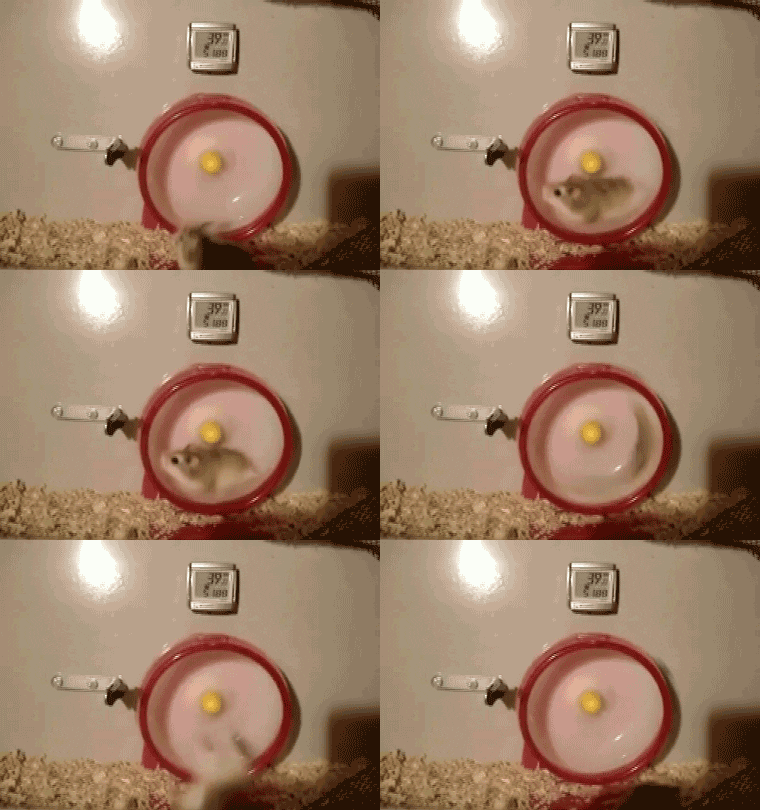
Most boys, like Ralph, reach the stage where living with their parents feels like more of a hassle than it's worth. They want freedom, a feeling Keith understood well in The Mouse and the Motorcycle. Runaway Ralph shows the natural result of leaving home to live by your own rules: getting locked in a different sort of cage, running around and around on a wheel that never seems to take you anywhere. Is it an improvement on what you had, or a step back? Ralph doesn't think hard about this until meeting Chum, a "philosopher" hamster from a neighboring cage in the craft shop. Their brief time together is marked by surprising depth of thought, probably the highlight of this book. Runaway Ralph is more philosophical though less poignant than The Mouse and the Motorcycle, but the two novels are roughly equal, and I rate them both two and a half stars. I enjoy the smooth, sweet readability of Beverly Cleary's books, and will always come back to read about Ralph S. Mouse again. I look forward to it.
This one was a disappointment after the first book. We meant it for a read-aloud but both my children disliked it and I'm the only one who finished it. The first book in the series has such a warm feeling, full of excitement, but a happy excitement, friendships... loved it. This one just feels so different, much more negative, Ralph seems really grumpy and selfish and not at all the same fun-loving and optimistic character he was before... he runs away from home because he doesn't want to share his motorcycle with his younger siblings but is caught by a boy at camp and gets stuck in a cage for most of the book, faces several threats (like the tomcat) and he and Garf (the boy at camp) don't have much of a friendship throughout. The ending feels a bit rushed and unresolved. I expected Ralph to have a big "There's No Place Like Home" moment, but I didn't get the sense he really had a change of heart about his home or family... it's hinted at but what mostly came across is that he didn't like being at camp and wanted his motorcycle back. The best part for me so far is Aunt Jill in charge of the camp. I loved her cheerful wisdom paired with a not-unkind nonchalance ;-) I appreciate that she didn't try to talk Garf (the homesick boy at camp) out of his desire for some solitude and peace and quiet -- as an introvert myself, I get so frustrated when people are often telling kids to just go-go-go and be extroverted and social all the time. Love that she gave Garf a place he could go when he wanted some time by himself to recharge.
We are huge fans of Ralph the Mouse in this household! This wonderful series of books is charming for all ages... and can be read and re-read over and over again, without becoming boring or out-of-date. All readers will love Ralph's adventures and giggle at his overwhelming love and obsession with the motorcycle. This is an excellent read-aloud for young kids, even in first grade. You can continue reading the Ralph books with your child, as he/she gets older -- or they may find the motivation to just read ahead themselves! All the better! They are also a great way to revisit some of the terminology and products of the past. My kids thought some of the things were hilarious when we explained them. A great way to bridge the generations. Marvelous author and marvelous book!
I would just like to point out that this book is outdated in terms of animal care, such as cedar wood being used for hamsters and mice bedding. Cedar and pine are bad for small animals(birds, too) respiratory systems. Use Aspen or a paper bedding. Just had to say that, because it was bothering me! Also, just FYI, they need bigger cages than you might think! Do your research. :)
Not quite as wonderful as the first, imo. I suppose because it's a sequel. But I love the philosopher Chum. And remembering making mosaics with seeds & beans. And one youngster saying to another who is scolding him, "You don't have to sound like a grown-up."
Ralph is back at it again. He's such a character. Some of the original Mouse/Motorcycle magic is obviously gone. And I would say the action moves a bit slower than the first book. But I also think the conflict and the character development are much deeper.
Such a clever book! Ralph gets so many wonderful lessons that are very well portrayed. Some continue from the first book and others are new. Looking forward to the last book of the series.
My kids (9 and 6) didn't love this one as much as the Mouse and the Motorcycle, but they enjoyed some of the new characters (Catso the cat, Sam the dog, and Chum the hamster). It was fun to see Ralph in a new environment and out of the Mountain View Inn.
Awww. Aww. Awww. Awww. I can fill this review with just "Awwws," and I still wouldn't be done awwing. Ralph is my favorite mouse. Ever. When my friend gifted the first in the series as a birthday gift to me last year, I fell in love with him - a cute mouse who tucks his tail, hops on to a motorcycle to go racing in the dark! How can you not love him? I had to wait another year for another birthday to go by before my friend remembered to gift me the second in the series.
In second book, Ralph has a series of adventures - he runs away, finds out what it is to live in a cage and ponder about life- and has to use all his wits to scramble out of the mess he dug himself into. The illustrations in this book are simply marvelous, and the story is just such a romp. I can't wait to read the next in the series - and I don't want to wait another year, my friend. Hint. Hint.
I read this aloud to my 2nd grade son (and anyone else who happened to be listening in). He thought it was hilarious that the boy in this book was named Garf and I thought he was going to die laughing when I read the sign that he tacked above Ralph's cage: "Pryvat! Keep Out! This Mowse is the Personul Property of Garfield R Jernigan. If you Fead Him You Will Drop Ded." His review: "It was a fun, fun, fun book".
I liked the part where Ralph asked Garf if he could have a peanut butter sandwich when he was returning the watch to Lana. It was funny! Garf was already giving him the motorcycle back and he wanted a peanut butter sandwich because he was hungry and he likes peanut butter sandwiches.
This entire review has been hidden because of spoilers.
I love this little mouse and wish I had a pet like him! This book was so much more fun than the first one, I thought. Can't wait to read the third and final (sadly) part.
Bookshelf clean out: Keep vs. McKays A sequel about growing up and learning that there really is no place like home! A keep for me! Extra special because the copy I read was my mom’s and printed in 1970. The old book crinkly pages really added to the reading experience!
I liked this book better than the first one! The main adult in the story is “Aunt” Jill, the camp director, and she is wonderful with the kids.
A boy in the story is having a difficult time, and there’s a beautiful section (half of a chapter) where Aunt Jill helps him process what he’s feeling and find solutions. _
Content:
Ralph runs away from home (and later has regrets).
A camp boy wants to run away from camp - Ralph is excited by this and hopes he does run away (but he doesn’t).
A sign that says if you feed a boy’s mouse you will “Drop Ded”.
Some instances of… Stupid Lame Fed up Drat
A few brief, silly songs about animals that concern Ralph. These are very short and add to the plot + some comedy. Ex: Little Rabbit Fru-Fru; four lines about things like gopher guts and chopped-up baby parakeet; a goat soon to die. _
We read this in 3 sittings as it’s a friend’s book and needed to finish it before leaving their house. I liked this one better than the first for some reason. Little more action.
When asked what she liked about this, Luna surprisingly said: “Catso”! I asked why, and she said “I don’t like mice. They chewed through my Saluva” (local dress of hers) 😆 Anyways, she was quite captivated and kept telling me to continue!
Runaway Ralph, by Beverly Cleary. Published by Harper Collins in 1970. 175 pages. This can be used in 3rd-5th grade. Guided Reading: 0; Lexile: 890L.
Summary: This is the second in a series about Ralph, the mouse, by Beverly Cleary. This story is about Ralph, the mouse, after he has received his motorcycle. It begins with him being teased by his family because all he wants to do is ride his motorcycle and they don’t think it’s safe. Feeling unappreciated, he decides to escape the hotel he lives in and hits the open road. Unfortunately for Ralph, he’s going to find that the outside world isn’t so friendly either! The setting of this story includes the hotel where he lives and the summer camp where he ends up. At summer camp after running into a mother cat and her kittens who play with him; and the guard dogs, he meets Garf whom he quickly befriends. The main problem in the story is that while at summer camp Garf (who isn’t very popular) is accused of stealing a watch from one of his fellow campers and enlists Ralph’s help returning it. Can he? The story ends with Garf promising Ralph that not only will he bring him home, but that he’ll visit him after camp ends. Ralph, who wanted to leave, returns home where he’s happier than ever! A message learned: the grass isn’t always greener!
Teaching ideas: I taught this novel with my third grade and we turned it into a play! We literally took the book and wrote the script… the students were in the computer lab typing away after I had taught them how to write a script and what the main elements are. Then we created puppets and the scenery to use and enacted it on the last day of school. We watched the movie to as a means of comparison to help ‘see’ how the book should look.
Common Core Standards: 3.RL.1 Ask and answer questions to demonstrate understanding of text, referring explicitly to the text as basis for the answers. 3.RL.2 Recount stories 3.RL.3 Describe characters in a story 3.W.5 & 3.W.6 With guidance and support from peers and adults … develop and strengthen writing; use technology to publish writing
First time reading this, after re-reading The Mouse and the Motorcycle with my 6 yo. After the last page he said he can’t wait to start Ralph S. Mouse! I’m rating based on that. These books have gentle adventures and a cute little mouse riding a motorcycle. Pretty much his wheelhouse, and perfect for bedtime reading.