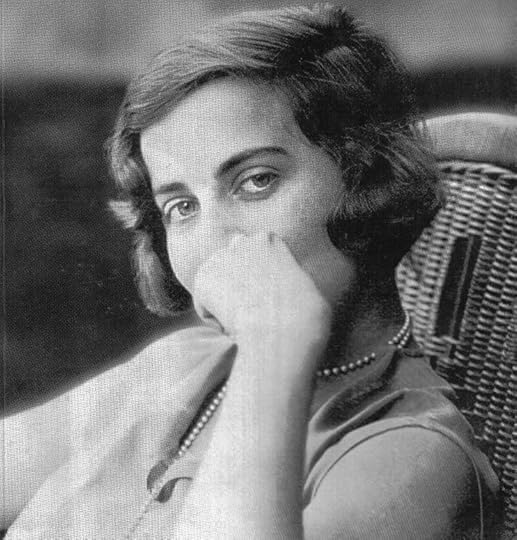
Silvina Ocampo Aguirre was a poet and short-fiction writer.
Ocampo was the youngest of the six children of Manuel Ocampo and Ramona Aguirre. One of her sisters was Victoria Ocampo, the publisher of the literarily important Argentine magazine Sur.
Silvina was educated at home by tutors, and later studied drawing in Paris under Giorgio de Chirico. She was married to Adolfo Bioy Casares, whose lover she became (1933) when Bioy was 19. They were married in 1940. In 1954 she adopted Bioy’s daughter with another woman, Marta Bioy Ocampo (1954-94) who was killed in an automobile accident just three weeks after Silvina Ocampo’s death.
Lovers gorging themselves with sweet cakes before lovemaking, a young girl placing a poisonous spider in her friend’s hair on the morning of her wedding day, lovers consumed by jealousy refuse to leave their bed set on flames, people are sent to hell for reading a certain newspaper article or drinking a glass of milk - the surreal, bizarre, dark and disturbing combined with a delicate poetic voice, Silvina Ocampo (Argentina, 1903-1993) is one of the most original short story writers you will encounter.
From Jorge Luis Borges’ introduction included in this Penguin edition: “In Silvina Ocampo’s stories there is something I have never understood: her strange taste for a certain kind of innocent and oblique cruelty. I attribute this to the interest, the astonished interest, that evil inspires in a noble soul.” To provide a small sample of Silvina Ocampo’s storytelling, here is my write-up of two of my favorites from this collection:
Icera Self-Identity in Miniature: “When Icera saw the set of doll furniture in the window of that enormous toy store at the Colon Bazaar, she coveted it. She didn’t want it for her dolls (she didn’t have any) but for herself.” That’s right, Icera wanted to sleep in the wooden doll bed, look at herself in the doll mirror, sit at the doll table in her doll chair. Actually, this is not such an uncommon wish – to be someone or something other than ourselves, a wish expressing itself in mild form, such as wearing a team jersey with a famous athlete’s name and number, to taking more exotic forms: to fly as a bird, to swim as a dolphin, climb a mountain like a mountain goat or compute figures and data like a computer.
Good Fortune, One: Our desire for self-transformation can either be thwarted or enhanced by those around us. In Icera’s case, she had the good fortune to be liked by the head of the doll department, a man by the name of Dario Cuerda who lets her lie down in the doll bed, comb her hair using the doll mirror and sit in the doll chair at the doll table. However, it is to be well noted Icera didn’t like any of the dolls; rather, she considered them her rivals.
Good Fortune, Two: Icera’s family was too poor to buy her any toys or gifts for Christmas but bighearted Dario Cuerda came through, giving Icera a doll dress, doll hat and doll shoes that couldn’t be sold by the store since they were slightly damaged. And the gifts from Mr. Cuerda continued throughout the year – a miniature guitar and miniature rake along with soaps, little hangers and little combs. And, as anybody reading this review knows, the more other people feed our desires, the more those desires can grow and grow, grow large enough to bloom into all-consuming obsession.
Cold Water: Icera’s mother tells her repeatedly how children do grow up and how one day the little doll dress will no longer fit. Icera has to admit what her mother says is unfortunately true but she decided to repeat the words “I won’t grow up. I won’t grow up” ceaselessly to herself as a way to halt her growth. And, miracle of miracles! Icera did not grow. I personally love the power of positive thinking – when the goal is positive and the positive thinking works, that is. In this case, knowing Silvina Ocampo’s dark literary aesthetic, one can’t be so sure if remaining small will be a good thing.
The Wheel of Fortune Turns: One day Icera falls ill and remains ill for four whole weeks. When healthy again she discovers to her dismay she has grown four inches. An inch for every week in bed! Not only can Icera no longer fit into her doll cloths but her parents forbid her to do any of those little girl things like standing on the table. For a doll-wannabe, this is nothing short of tragic. But Icera made the best of bad news: she wore her doll dress as a blouse, cut her doll gloves and doll shoes in a way to make them into mittens and slippers. Now that’s thinking on your larger feet, Icera! But darn – even a neighbor tells you how tall you have grown. Damn big mouth!
Time Warp: Icera runs to the toy store as her place of refuge. But her hope turns to bitterness when only the dolls are displayed in the store window – one doll dressed as Little Red Riding Hood, one doll for first Communion and one doll dressed as a bride. Frantic, she asks an employee for the whereabouts of Dario Cuerda. The cashier points him out and we read: “Dario Cuerda was so covered with wrinkles that Icera did not recognize him. On the other hand he, with his blurry memory remembered her because of her height. “Your mother used to come and look at the toys. How she liked the bedroom sets and the little sewing machines!” Dario Cuerda said politely, moving forward with a maternal tenderness. He noticed that the little girl had whiskers and false teeth.”
Peculiar Finale: The story continues with additional bizarre twists. Eventually Icera lies down in a doll box in the store window. “Then Dario Cuerda realized that what was happening was not the result of his fatigue. Thirty-five years had passed since Icera’s last visit to the store. He thought, confusedly perhaps (because he was in fact extremely tired) that Icera had not grown more than four inches in all that time because she was destined to sleep future nights in that box, which would prevent her growing in the past.”
Mimoso The Way of the Heart: Mimoso is on the cusp of dying, poor dog! Mercedes loves her doggie and feeds him milk, fruit juice and tea with a little spoon. Wishing to keep Mimoso forever, Mercedes gives the taxidermist a call and asks for details, including prices. She imagines little Mimoso standing by the entrance to her bedroom with glass eyes, symbolically guarding the house. Anybody who has ever owned and loved a pet can feed Mercedes’ pain. Some people unfeelingly scoff at the love some pet owners lavish on their pets, but this is most unwise – opening one’s heart to a fellow creature is one of the greatest gifts life offers us.
Crude Encounter: The next morning Mercedes puts Mimoso in a sack and takes the bus to the taxidermist. When asked, Mercedes tells him she wants her Mimoso sitting with his front paws crossed. When Mercedes takes her Mimoso out of the sack, the taxidermist crudely remarks how her dog is not as plump as his owner. Holding Mimoso in his arms, he begins to laugh loudly and says, “When you see him he’ll be good enough to eat.” At this point, Mercedes puts on her coat and has to grip her gloves tightly as a way of holding back the urge to slap the brute.
Love is Eternal: Mercedes and her husband tell their friends and neighbors they are having Mimoso embalmed; the friends (so called) and neighbors are in disbelief. No matter - Mercedes loves her Mimoso with so much intensity, “she sat like Penelope, knitting, awaiting the arrival of the embalmed dog. But the dog didn’t come. Mercedes was still crying and drying her tears with a flowered handkerchief.” A pet might die but the powerful love a pet owner has for their pet does not.
Mimoso, Redux: The taxidermist finally has Mimoso ready. “He had never looked in better health. He was fat, well-brushed, and shiny, the only thing he couldn’t do was talk. Mercedes caressed him with trembling hands, tears burst from her eyes and fell on the dog’s head.” Her husband asks the taxidermist how he accomplished such a miracle. The taxidermist replies he did the whole job with poison, his own particular system of working. However, not to worry: the only way the poison could do any harm is if someone were to eat the embalmed dog. Ha! No comment.
Joy Turns To Outrage: Mercades was happier with the embalmed dog then with the live one – she didn’t have to feed, walk or clean up after him. But happiness never lasts. Knowing they kept an embalmed dog in their home, neighbors did a lot of evil talking and the greatest evil arrived in the form of an anonymous letter, including a lewd, obscene drawing of Mercades and Mimoso. Infuriated, her husband took Mimoso and, as if a dry branch, broke the embalmed dog over his knee and threw him in the oven.
Revenge is Sweet: A tearful Mercades tells her husband she knows who the terrible person is who sent that letter – the book vendor, a man better called a vendor of pornography. And that evil cur will never set foot in our house again! Well, her husband replies, you can tell him yourself since he is coming to dinner tonight. Let me stop here as I am sure you can guess the inevitable conclusion. Incidentally, I included this Silvina Ocampo story in my review since there is a strong element of humor, dark humor, that is, but humor nonetheless.
Silvina Ocampo studied painting in Paris with Giorgio di Chirico but gave up paint and brush and turned to writing. And here is one of Silvina's memorable quotes: "What matters is what we write: that is what we are, not some puppet made up by those who talk and enclose us in a prison so different from our dreams."
Be aware that this book has been superseded. NYRB appears to have acquired the rights to it. In 2015, they release "Thus were their faces" which contains all the stories in this book plus another 10 from the same translator, Daniel Balderston.
Balderston in his postface notes that the first book contained the best of Ocampo. It is hard to disagree with this. I would not buy the expended version from NYRB unless my goal was to re-read the stories in this set. The additonal pieces allows the reader to understand Ocampo better but I found it to be decidedly inferior to those in the first book.
On the back cover of this collection of 32 weird and perverse tales, it is explained that the author studied painting under the surrealist Giorigio de Chirico and was a sell avowed disciple of Jorge Borges. With the idea thus planted, the reader certainly senses the influences of this two famous artists on every page. If you do not like the surrealist movement, this book will certainly be tough going as it was for me.
The stories are sinister and unpleasant. The protagonists are frequently murderous children. Hope is absent in a world of strange events and evil intentions. To give the devil her due however, Ocampo's style is distinct and commands your respect. She is in control of her narrative and forces the reader to follow the route she maps for each tale. Fans of Borges, Antonin Artaud, Luis Bunuel and Andre Breton should love this book. I did not.
A good writer. Tight, sinister stories that hinge on withheld information, set in some otherworld that’s entirely her own. But for all that – and as with Bioy Casares – the influence of Borges is too omnipresent for me. I can’t help imagining what Ocampo might be like without that influence, and it distracts me. It undermines the vision. I haven’t read all of these; my opinion may change; and sure, she’s less obsessed with her mentor than Bioy is. But I’m betting there’s a truer Silvina Ocampo being obscured here, and it’s frustrating.
This was a strange collection of short stories filled with mysticism and soothsaying as well as more down to earth human things like jealousy and infidelity or violence and murder. Most of them are very short, some barely two pages so there isn’t any deep characterisation. There’s a surreal feel to it all and while many of the stories left me wondering, others were creepy or surprising. My favourite was ‘The House of Sugar’ about a superstitious woman who seems to be becoming the woman who lived in the house before her.
A collection of jagged short stories. At their best (i.e. the stories in La Furia) they are vicious tales of horror that expose the violence and savagery latent within civilized, domestic life. These stories are worth spending time with.
Nonetheless, the book was a bit of a slog to get through. These stories likely work best when you read one every few days, particularly given Ocampo’s decadent, rank style. But no one really reads at such a leisurely pace (i.e., one story a month in a literary journal). And reading the stories back to back cheapens them: what should be surprising, dreadful, horror becomes predictable and everyday.
Great book filled with the shortest stories, but somehow she works an entire story into sometimes less than two pages. I loved the stories 'The Punishment' and 'Report on Heaven and Hell'. As you can imagine from the names, some of the stories are a bit heavy but the magically realism and writing style keep the book light. Recommended!
This entire review has been hidden because of spoilers.
I can certainly respect Ocampo's career and literary influence as a pillar of Argentinian fantasy and the country's literary scene but it would seem my expectations based off of her reputation were a little...overstated. There are a couple of good stories in here that I can't remember by name now unfortunately cuz it's been a few weeks, but by and large that's one of the main problems here: very few of the stories feel truly unique. All of her primary and secondary characters are actually just a three-person acting troupe doing their best with a limited budget and endless imagination of accents to use. And while I admire the tenacity and the style, there's only so much of that show that I can sit through and still be entertained.