

What do you think?

Městečko u vody #3
Harlequin's Millions
"Czechoslovakia's greatest living writer." —Milan Kundera
In this moving, absorbing novel, we meet the eccentric residents of a home for the elderly who reminisce about their lives and their changing country. Written with a keen eye for the absurd and peppered with dialogue that captures the poignancy of the everyday, Harlequin's Millions is a sensual delight.
Bohumil Hrabal (1914–1997) worked as a railway dispatcher during the Nazi occupation of then-Czechoslovakia, a traveling salesman, a steelworker, a recycling mill worker, and a stagehand. His novels were censored under the Communist regime and have since been translated into nearly thirty languages.
In this moving, absorbing novel, we meet the eccentric residents of a home for the elderly who reminisce about their lives and their changing country. Written with a keen eye for the absurd and peppered with dialogue that captures the poignancy of the everyday, Harlequin's Millions is a sensual delight.
Bohumil Hrabal (1914–1997) worked as a railway dispatcher during the Nazi occupation of then-Czechoslovakia, a traveling salesman, a steelworker, a recycling mill worker, and a stagehand. His novels were censored under the Communist regime and have since been translated into nearly thirty languages.
313 pages, Paperback
First published January 1, 1981
About the author
Bohumil Hrabal
199 books1,368 followersBorn in Brno-Židenice, Moravia, he lived briefly in Polná, but was raised in the Nymburk brewery as the manager's stepson.
Hrabal received a Law degree from Prague's Charles University, and lived in the city from the late 1940s on.
He worked as a manual laborer alongside Vladimír Boudník in the Kladno ironworks in the 1950s, an experience which inspired the "hyper-realist" texts he was writing at the time.
His best known novels were Closely Watched Trains (1965) and I Served the King of England. In 1965 he bought a cottage in Kersko, which he used to visit till the end of his life, and where he kept cats ("kočenky").
He was a great storyteller; his popular pub was At the Golden Tiger (U zlatého tygra) on Husova Street in Prague, where he met the Czech President Václav Havel, the American President Bill Clinton and the then-US ambassador to the UN Madeleine Albright on January 11th, 1994.
Several of his works were not published in Czechoslovakia due to the objections of the authorities, including The Little Town Where Time Stood Still (Městečko, kde se zastavil čas) and I Served the King of England (Obsluhoval jsem anglického krále).
He died when he fell from a fifth floor hospital where he was apparently trying to feed pigeons. It was noted that Hrabal lived on the fifth floor of his apartment building and that suicides by leaping from a fifth-floor window were mentioned in several of his books.
He was buried in a family grave in the cemetery in Hradištko. In the same grave his mother "Maryška", step father "Francin", uncle "Pepin", wife "Pipsi" and brother "Slávek" were buried.
He wrote with an expressive, highly visual style, often using long sentences; in fact his work Dancing Lessons for the Advanced in Age (1964) (Taneční hodiny pro starší a pokročilé) is made up of just one sentence. Many of Hrabal's characters are portrayed as "wise fools" - simpletons with occasional or inadvertent profound thoughts - who are also given to coarse humour, lewdness, and a determination to survive and enjoy oneself despite harsh circumstances. Political quandaries and their concomitant moral ambiguities are also a recurrent theme.
Along with Jaroslav Hašek, Karel Čapek, and Milan Kundera - who were also imaginative and amusing satirists - he is considered one of the greatest Czech writers of the 20th century. His works have been translated into 27 languages.
Hrabal received a Law degree from Prague's Charles University, and lived in the city from the late 1940s on.
He worked as a manual laborer alongside Vladimír Boudník in the Kladno ironworks in the 1950s, an experience which inspired the "hyper-realist" texts he was writing at the time.
His best known novels were Closely Watched Trains (1965) and I Served the King of England. In 1965 he bought a cottage in Kersko, which he used to visit till the end of his life, and where he kept cats ("kočenky").
He was a great storyteller; his popular pub was At the Golden Tiger (U zlatého tygra) on Husova Street in Prague, where he met the Czech President Václav Havel, the American President Bill Clinton and the then-US ambassador to the UN Madeleine Albright on January 11th, 1994.
Several of his works were not published in Czechoslovakia due to the objections of the authorities, including The Little Town Where Time Stood Still (Městečko, kde se zastavil čas) and I Served the King of England (Obsluhoval jsem anglického krále).
He died when he fell from a fifth floor hospital where he was apparently trying to feed pigeons. It was noted that Hrabal lived on the fifth floor of his apartment building and that suicides by leaping from a fifth-floor window were mentioned in several of his books.
He was buried in a family grave in the cemetery in Hradištko. In the same grave his mother "Maryška", step father "Francin", uncle "Pepin", wife "Pipsi" and brother "Slávek" were buried.
He wrote with an expressive, highly visual style, often using long sentences; in fact his work Dancing Lessons for the Advanced in Age (1964) (Taneční hodiny pro starší a pokročilé) is made up of just one sentence. Many of Hrabal's characters are portrayed as "wise fools" - simpletons with occasional or inadvertent profound thoughts - who are also given to coarse humour, lewdness, and a determination to survive and enjoy oneself despite harsh circumstances. Political quandaries and their concomitant moral ambiguities are also a recurrent theme.
Along with Jaroslav Hašek, Karel Čapek, and Milan Kundera - who were also imaginative and amusing satirists - he is considered one of the greatest Czech writers of the 20th century. His works have been translated into 27 languages.
Ratings & Reviews
Friends & Following
Create a free account to discover what your friends think of this book!
Community Reviews
Displaying 1 - 30 of 53 reviews

March 29, 2017
A Gulag for the Aged
An old peoples' home is to Hrabal what a cancer ward is to Solzhenitsyn and an Alpine sanatorium to Mann: an allegorical setting for a society in the process of disintegration. Czechoslovakia, however, was a far less malign society than the Soviet Union or even fin de siecle Europe - an amateur one might say, in the techniques of repression and self-delusion. Nonetheless, the old people's home is part of the Czechoslovakian Gulag, less overtly oppressive but no less dismal than that of the Soviets or pre-WWI Big Powers.
There are enough cultural relics in the castle-turned-retirement-home to remind the resident population that at some point in the not distant past things were different. A cultural life had thrived. The evidence is in the mouldy statues, and decaying frescoes that are the only distractions for the pensioners. Formerly elegant spaces have become communal wards; the library, a boiler room; the tied convent, a laundry.
A trio of pensioners are a source of orally transmitted memories and myths about events in the nearby village going back centuries. When alone with each other, they are silent, having heard everything each other has to say. But when approached sympathetically by someone else, they pour forth facts and rumours and tall tales in coordinated first-person detail, a sort of syncopated Greek chorus.
History, in Harlequin's Millions, does not take a wrong turn; it stops entirely. In 1945. The village is one that time by-passes. The enormous clock in the old people's home, a remnant of aristocratic life, has ceased to function long ago. The buildings are slowly crumbling; their sedated inmates barely existing in a state of permanent boredom. While free to roam, they rarely make it to the end of the drive before scuttling home.
The men shuffle aimlessly waiting for the next meal; the women knit unneeded baby clothes endlessly. The principle effect of the creation of the communist state had been to institutionalise the class animosities, national hatreds, and personal resentments of the past; not just in the workplace but also into old age. Correct procedure is valued above all else: even the laundry van is meticulously and tediously inspected on entry and exit for no apparent reason.
The eponymous Harlequin's Millions is a favourite popular tune of the Director. It plays constantly in the intervals between Czech-language news broadcasts on ubiquitous loud-speakers. A sort of institutional theme-song. Alternatively the title could refer to the country's duped population. Or perhaps to the local misperception that nationalisation of the local brewery had created instant millionaire-shareholders of the workers. In any case, Harlequin's Millions is the functional equivalent of Abide With Me played on the deck of the Titanic: a dirge in the face of impending death. At one point, a rotting gutter on the castle falls and crushes a tannoy-speaker mounted in the garden below, which continues to drone on. Only the expectation of lunch holds more interest for the pensioners.
A clutch of mad doctors look after the health of the inmates. One comforts by prescribing whatever quantity of cigarettes and alcohol is currently consumed by his charges. The other constantly plays classical pieces by Czech and German orchestras on the gramophone as balm for his patients. This latter unaccountably begins a sort of violent revolution among the retirees but regrets his imprudence and has them all sedated the following day. I am I insufficiently familiar with Czech history to understand the allusion but can guess that the reference is to political leaders and their vacillating nationalistic courage.
Visitors to the pensioners bring tales of woe from outside: disruption from construction, economic hardship, road accidents. Much better, they say with some irony, to be in the peace and quiet of the haven of the castle. All the inmates want to communicate to the visitors is how frightful old age is. They are agitated by these visits for days afterward. Retirement for them represents a defeat, a loss of not just material possessions but of a place in the world. They have nothing in common with those not similarly placed
"What is life," asks the narrating pensioner. "Everything that once was, everything an old person thinks back on and tells you stories about, everything that no longer matters and is gone for good," she replies to herself. Even the graveyard within the castle grounds is turned into a theme park, the tombstones, coffins and bodies treated as so much refuse. A Gulag even for the dead. "Such a wonderful beginning, and now such an end," she concludes. Written in 1981, there wasn't that long to wait.
I usually find allegorical tales somewhat tedious. Having to decode esoteric allusions, many obviously personal, does become arduous at times. However given the conditions under which Hrabal wrote in 1980, the allegorical form is probably the only one possible; and at least the outlines of his references can be comprehended by someone not similarly inhibited.
An old peoples' home is to Hrabal what a cancer ward is to Solzhenitsyn and an Alpine sanatorium to Mann: an allegorical setting for a society in the process of disintegration. Czechoslovakia, however, was a far less malign society than the Soviet Union or even fin de siecle Europe - an amateur one might say, in the techniques of repression and self-delusion. Nonetheless, the old people's home is part of the Czechoslovakian Gulag, less overtly oppressive but no less dismal than that of the Soviets or pre-WWI Big Powers.
There are enough cultural relics in the castle-turned-retirement-home to remind the resident population that at some point in the not distant past things were different. A cultural life had thrived. The evidence is in the mouldy statues, and decaying frescoes that are the only distractions for the pensioners. Formerly elegant spaces have become communal wards; the library, a boiler room; the tied convent, a laundry.
A trio of pensioners are a source of orally transmitted memories and myths about events in the nearby village going back centuries. When alone with each other, they are silent, having heard everything each other has to say. But when approached sympathetically by someone else, they pour forth facts and rumours and tall tales in coordinated first-person detail, a sort of syncopated Greek chorus.
History, in Harlequin's Millions, does not take a wrong turn; it stops entirely. In 1945. The village is one that time by-passes. The enormous clock in the old people's home, a remnant of aristocratic life, has ceased to function long ago. The buildings are slowly crumbling; their sedated inmates barely existing in a state of permanent boredom. While free to roam, they rarely make it to the end of the drive before scuttling home.
The men shuffle aimlessly waiting for the next meal; the women knit unneeded baby clothes endlessly. The principle effect of the creation of the communist state had been to institutionalise the class animosities, national hatreds, and personal resentments of the past; not just in the workplace but also into old age. Correct procedure is valued above all else: even the laundry van is meticulously and tediously inspected on entry and exit for no apparent reason.
The eponymous Harlequin's Millions is a favourite popular tune of the Director. It plays constantly in the intervals between Czech-language news broadcasts on ubiquitous loud-speakers. A sort of institutional theme-song. Alternatively the title could refer to the country's duped population. Or perhaps to the local misperception that nationalisation of the local brewery had created instant millionaire-shareholders of the workers. In any case, Harlequin's Millions is the functional equivalent of Abide With Me played on the deck of the Titanic: a dirge in the face of impending death. At one point, a rotting gutter on the castle falls and crushes a tannoy-speaker mounted in the garden below, which continues to drone on. Only the expectation of lunch holds more interest for the pensioners.
A clutch of mad doctors look after the health of the inmates. One comforts by prescribing whatever quantity of cigarettes and alcohol is currently consumed by his charges. The other constantly plays classical pieces by Czech and German orchestras on the gramophone as balm for his patients. This latter unaccountably begins a sort of violent revolution among the retirees but regrets his imprudence and has them all sedated the following day. I am I insufficiently familiar with Czech history to understand the allusion but can guess that the reference is to political leaders and their vacillating nationalistic courage.
Visitors to the pensioners bring tales of woe from outside: disruption from construction, economic hardship, road accidents. Much better, they say with some irony, to be in the peace and quiet of the haven of the castle. All the inmates want to communicate to the visitors is how frightful old age is. They are agitated by these visits for days afterward. Retirement for them represents a defeat, a loss of not just material possessions but of a place in the world. They have nothing in common with those not similarly placed
"What is life," asks the narrating pensioner. "Everything that once was, everything an old person thinks back on and tells you stories about, everything that no longer matters and is gone for good," she replies to herself. Even the graveyard within the castle grounds is turned into a theme park, the tombstones, coffins and bodies treated as so much refuse. A Gulag even for the dead. "Such a wonderful beginning, and now such an end," she concludes. Written in 1981, there wasn't that long to wait.
I usually find allegorical tales somewhat tedious. Having to decode esoteric allusions, many obviously personal, does become arduous at times. However given the conditions under which Hrabal wrote in 1980, the allegorical form is probably the only one possible; and at least the outlines of his references can be comprehended by someone not similarly inhibited.

March 16, 2014
Harlequin's Millions is the third portion to Bohumil Hrabal's biographical trilogy which started with Cutting It Short and The Town Where Time Stood Still. The story takes place in an old castle once owned by Count Špork, now converted into a retirement home, where the unnamed narrator and her husband, Francin have joined his aged, disabled brother, Uncle Pepin already residing in the medieval stoned edifice, perched on top a hill overlooking Nymburk,
the town where time stood still.
Within its walls mingle the staff, running their scheduled maneuvers of bedpans, diaper changes, and stupefying medicinal injectables; and the pensioners, motioning slowly through daily routines of card games; or the activity of wandering, outdoor walks along the grounds overlooking the broken tombstones of a dilapidated graveyard; or for the less mobile, sitting and staring dreamily into their pasts: their cyclical revisitations, as if caught in a loop, are synchronized in virtual tandem to the daily mechanical routine of the retirement home.
Hrabal portrays the very real conditions of the end phases of life with the surrealism I most admire in his novels. He blends memories of a period happier in the past, with the present, less pleasant times; statues of mythical gods once symbols of lust, youth and vitality now barely stand, moldy and broken and decaying, now blurred images of the bygone powerful splendor of the castle.
As residents in the rustication of life - where their foundations are crumbling, their joints destabilizing - predominantly feed on their memories, Hrabal serves up allusions of youth, setting the ritual of dining under ceilings frescoed in nymphs and wedding scenes, while the Serenade of Harlequin's Millions plays in the background. The rhythm follows them throughout the day as oxygen, thankfully, still does:
The string orchestra curls gently around the old tree trunks and “Harlequin’s Millions” climbs like old ivy into the crowns and trickles down along the leaves, the corridors of the home are filled with a pleasant phosphorescent gas, with the scent of cheap perfume, so no one is really aware of the music, only when there’s a power failure and “Harlequin’s Millions” is suddenly cut off, stops short, the way everything stops as if by magic in the tale of Sleeping Beauty, all the pensioners glance up, they look up at the speakers and the sudden loss of the music feels to them like when the lights go out and everyone longs to hear it again, because without it the air in the castle and along the paths in the park is unbreathable.
The castle itself, once a grand statement of youth and beauty projects another allusion to the narrator, who happens to be modeled after Hrabal's mother. She peers at her toothless image in the mirror and recalls the vibrance of her young life, the contented marriage to Francin, his comfortable career as a brewery manager before the change of communism. She may grimace at the greyed hair which was once the long, lush red-gold tresses admired by the menfolk of the town before cutting it short , but refuses to be contrite for the jealousy she inspired in the womenfolk.
And so I didn’t even try to wear my dentures, even when I had them, nor did I dye my hair to look like everyone else, but became proud of my ugliness, I accentuated everything that made me old … And so I became the woman I once was, a proud old woman who stood out from the rest,… I walked with my head held high …
Through the narrator's observations of life in the castle for the retired ( that is to say Hrabal's keen human insight and his signature dollop of playfulness and sardonic humor), the reader discovers the myriad of behaviors and the spectrum of emotions that follow lives lived in close proximity: the good and the bad times, the contented and the discontented, the poignant and exciting periods, the joyful and sad moments, the many encountered harlequin faces - Harlequin's Millions .
I've worked and continue to work in retirement facilities, and though castles they are not (more like hotels with some restrictions and nursing skill ) - they are for me, in a positive light, fulfilling in the sense that I have been constantly exposed to a gamut of profound experiences, wonderfully satisfied as well as heart-wrenching life stories, a bottomless well of wisdom and enlightening, endearing Hrabal-esque strings of palavering. Harlequin's Millions will give the next reader this sense too, don't miss it.
Read May, 2014
Within its walls mingle the staff, running their scheduled maneuvers of bedpans, diaper changes, and stupefying medicinal injectables; and the pensioners, motioning slowly through daily routines of card games; or the activity of wandering, outdoor walks along the grounds overlooking the broken tombstones of a dilapidated graveyard; or for the less mobile, sitting and staring dreamily into their pasts: their cyclical revisitations, as if caught in a loop, are synchronized in virtual tandem to the daily mechanical routine of the retirement home.
Hrabal portrays the very real conditions of the end phases of life with the surrealism I most admire in his novels. He blends memories of a period happier in the past, with the present, less pleasant times; statues of mythical gods once symbols of lust, youth and vitality now barely stand, moldy and broken and decaying, now blurred images of the bygone powerful splendor of the castle.
As residents in the rustication of life - where their foundations are crumbling, their joints destabilizing - predominantly feed on their memories, Hrabal serves up allusions of youth, setting the ritual of dining under ceilings frescoed in nymphs and wedding scenes, while the Serenade of Harlequin's Millions plays in the background. The rhythm follows them throughout the day as oxygen, thankfully, still does:
The string orchestra curls gently around the old tree trunks and “Harlequin’s Millions” climbs like old ivy into the crowns and trickles down along the leaves, the corridors of the home are filled with a pleasant phosphorescent gas, with the scent of cheap perfume, so no one is really aware of the music, only when there’s a power failure and “Harlequin’s Millions” is suddenly cut off, stops short, the way everything stops as if by magic in the tale of Sleeping Beauty, all the pensioners glance up, they look up at the speakers and the sudden loss of the music feels to them like when the lights go out and everyone longs to hear it again, because without it the air in the castle and along the paths in the park is unbreathable.
The castle itself, once a grand statement of youth and beauty projects another allusion to the narrator, who happens to be modeled after Hrabal's mother. She peers at her toothless image in the mirror and recalls the vibrance of her young life, the contented marriage to Francin, his comfortable career as a brewery manager before the change of communism. She may grimace at the greyed hair which was once the long, lush red-gold tresses admired by the menfolk of the town before cutting it short , but refuses to be contrite for the jealousy she inspired in the womenfolk.
And so I didn’t even try to wear my dentures, even when I had them, nor did I dye my hair to look like everyone else, but became proud of my ugliness, I accentuated everything that made me old … And so I became the woman I once was, a proud old woman who stood out from the rest,… I walked with my head held high …
Through the narrator's observations of life in the castle for the retired ( that is to say Hrabal's keen human insight and his signature dollop of playfulness and sardonic humor), the reader discovers the myriad of behaviors and the spectrum of emotions that follow lives lived in close proximity: the good and the bad times, the contented and the discontented, the poignant and exciting periods, the joyful and sad moments, the many encountered harlequin faces - Harlequin's Millions .
I've worked and continue to work in retirement facilities, and though castles they are not (more like hotels with some restrictions and nursing skill ) - they are for me, in a positive light, fulfilling in the sense that I have been constantly exposed to a gamut of profound experiences, wonderfully satisfied as well as heart-wrenching life stories, a bottomless well of wisdom and enlightening, endearing Hrabal-esque strings of palavering. Harlequin's Millions will give the next reader this sense too, don't miss it.
Read May, 2014

March 27, 2015
... And there was music coming from the speakers, a string orchestra played "Harlequin's Millions," the melody swirled around the pensioners and everyone who heard it was entranced, but the music didn't sound like a reproach, it was more like a melancholy memory of old times ...
One of Hrabal's last novels, Harlequin's Millions shows his preoccupation with death and the persistence of memory. The opening scene describes a long avenue of shaded trees, leading away from "the small town where time stood still" to the grounds of an opulent, Baroque-style castle, now repurposed as a retirement home. The new communist society has no more use for elderly, and parks them here out of the way, relics of a past they want to forget. The unnammed narrator is a woman who is not ready to give up on life, and she restlessly wanders through the corridors and the grounds of the castle, trying to make sense of her life. As a young girl, she was impetuous and ambitious, grabbing at life with both hands, full of laughter and passion. Now, for the first time, she has the leisure to think and analyze where she comes from and what wisdom can be learned from her fellow retirees.
I've come to realize that there is a time for everything, I've even discovered, here in the retirement home, that this is the first time I've ever been able to take a good look at what is going on around me, and on the faces of all these people I could see and read their fate, I could write a book about it, I saw their fate like those old gypsy women who can read palms or see human destiny in a cup of coffee grounds, I saw in each of them that everything was written not just on their faces, but also in the way they walked, on their whole body.
Everybody has a story to tell, and every street, every house, every small square of her home town is imbued with the memories of the lives of her ancestors. I think of her as a twin of H'anta, the old book shredder from Too Loud A Solitude. H'anta saves old books from destruction, she saves the past lives of her friends from oblivion. Both are considered irrelevant by the new regime, and both feel it is their purpose in life to keep the flame of culture burning bright. The analogy is explicit in the present text in a memorable scene which I hope is fictional/allegorical and not based on fact:
In the graveyard three trucks were loaded down with tombstones, six men were loading the heavy stones with names and dates of people who had lived in the little town, six men loaded those tombstones onto the trucks, whose licence plates were from completely different regions, they were taking them to places where no one knew those names, where the tombstone portraits in little glass ovals would mean nothing [...] Only my friends and I, we, chroniclers and witnesses to old times, shall guard the contents of that empty graveyard!
Three secondary characters in the novel are real instead of fictional. They are the three witnesses to old times, who enchant the narrator with their quirky and humorous tales of the inhabitants of the little town, back in the golden age of the Austro-Hungarian Empire before the world wars and the Communists came to erase the board and start anew. Vaclav Korinek, Karel Vyborny and Otokar Rykr are the three Czech memoir writers who inspired Bohumil Hrabal to write the present novel, with their anecdotes and trivia collected and published in personal diaries, newspapers or self-published books. The focus and the glorification of the past can be interpreted as a form of protest against the Communists and the perceived degradation of the social fabric and of the moral compass of the modern people. The woman and her husband have more than enough reasons to protest, as it appears they have lost both the beer brewery they owned and their pension savings in the aftermath of the war.
We had grown old, yet we were still the same as we'd been when the war ended, I had moved even further back, to the last century, which had risen for me from the dead. The retirement home with its Baroque halls and gardens, this castle in which I lived, suddenly meant more for me than that golden brewery of mine, where I had spent my younger years.
The exercise of memory reaches though beyond the simplistic nostalgia for La Belle Epoque and the condemnation of Communism. It is made personal and universal in the effort of self-awareness and self-analysis that is one of the perks of being old and with leisure time on your hands. The allegory this time is of a set of statues in the garden of Count Spork's castle, the favorite place of retreat for the narrator:
... these statues represented the entire human race, in all its phases, and together they formed what we call nature: spring, summer, fall, winter ... I was standing there in front of the statue of May when suddenly I knew that I needed to arrive at this point, just as I am, so that while there was still time I could penetrate the secret of each statue, perhaps even the secrets of all these statues, which would probably tell me nothing more than the story of life, a cycle I'd nearly reached the end of. I could see that the sandstone statues formed a kind of novel, the tale of someone who had been waiting here for me, to explain to me, in stone handwriting, what Count Spork and his guests must surely have known as they strolled past the statues reading the story of man.
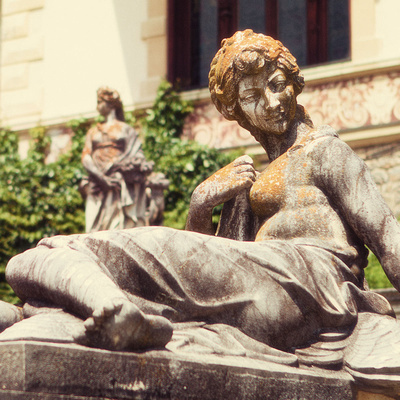
The answer lies in the same anecdotes and silly stories that accumulate and paint in pointillist fashion the panorama of the little town where time stood still, where everybody knew everybody else and no secrets could be kept from the gossip of your neighbors. The answer lies in the memories of one's own youthful enthusiasm and in the good times you spent with your loved ones and your friends, drinking, eating, dancing, even in the mistakes and regrets, in missed opportunities and lovers quarrels.
... What is life? Everything that once was, everything an old person thinks back on and tells you stories about, everything that no longer matters and is gone for good.
The reader might expect a novel about old people waiting to die, struggling with false dentures, inedible food, bedsores and forgetfulness to be depressing and boring, but this is Bohumil Hrabal we're talking about - the writer who it seems to me is able to find beauty and a thirst for life in the dreariest situations. He doesn't shy away from ugliness and pain, but the images he paints are always vivid and touched by humour. His prose is flowing in long, meandering paragraphs, of an elegance to rival the best of Faulkner (the English translation is really good, and it has been nominated for a prize in its category). The people of the little town and of the lives they used to have in the golden past are bubbling from the pages like fine champagne, making me wish I could step through a time portal and join them for weekend picnicks on a river island, or for a drinking song in a smoky tavern.
Speaking of songs, there is certainly a rhythm and a leitmotif to the story: the title piece that endlessly plays in every chamber and on every terrace of the castle Spork:
From each little cage music was pouring, music for strings, the poignant sound of the strings were intertwined, they played in unison, and then suddenly one of the players, with great urgency, would play a solo, the theme ... yes! It was "Harlequin's Millions", those same millions that accompanied silent movies in the old days, an amorous scene, a declaration of love, kisses that made the viewers, who were moved to tears by the string players, reach for their handkerchiefs.
Makwishly sentimental, this tune somehow reminds me of Chaplin's compositions for his silent movies: the same emotional intensity that should be nauseatingly sweet, yet it reaches and tugs at the heartstrings just as strongly as it did almost a century ago when it was first penned. Hrabal takes us to an even higher musical plane, offering an improvised classical concert in the huge dining room of the castle, the one decorated with a ceiling fresco of the Greek and Persian armies going to war around the mythical figure of Alexander the Great. The message is clear - we can only fight war and destruction with art, and art has the best means to guide us to the asnwers we seek. From the the sensual and anarchic chords of Debussy and his Apres-midi d'un Faune, the pensioners are led to the majesty of Beethoven and to the lyrical poem of Liszt:
... and that symphonic poem by Franz Liszt was truly an even more powerful, more terrifying affirmation of the feeling that life on earth could only ever be complete and beautiful if nourished by love, by the relationship between man and woman, a young woman, who loves with all her being, with her body, with everything, completely, like the statues of the young months in our park, the symphony orchestra poured out its sorrow and longing and rose and fell on waves of emotion, one after the other, the music swelled decisively and triumphantly to the declaration, Franz Liszt heartfelt utterance, that without love, without great love, one couldn't survive ... and that one had to fight for such love.
Poetry, music, sculpture and history are all one in the end, and guided by them, our unnamed narrator reaches the end of her path through the castle's garden, where the last statue in the allegorical dance of life is waiting to impart its words of wisdom:
... and then finally the statue of an old man, Winter, which completes the cycle of man and nature and most resembles everything that surrounds me here in the retirement home, once Count Spork's castle, where today I've seen all the sandstone phases that I and the others have lived through, and it makes me regret that when I was young, I forgot about love, which has slipped through my fingers before I knew it ... But then, isn't that what life is?
Autobiography or fiction? Part of a trilogy or a stand-alone story? I don't really care (although I made a note to check out the other two books set in the little town where time stood still). I care about how this magician of the written word has managed again to make me care about the people and the places where he lived and loved and wrote his novels. The last quote is from the afterword, where the author explains the genesis of the novel and what he hoped to achieve with it. For me, his efforts were sucesful:
... a text in which the details are true, but the rest is fiction, from which I hope to be able to extract more truth. May Count Spork's fictitious estate, the present-day retirement home, live on in the hearts of the readers!

March 29, 2017
Bohumil Hrabal, even his name is like an incantation, inviting you into the incredible music of his prose.

December 11, 2013
Burns with a quiet laugh and points up and out from itself -- two qualities another Hrabal narrator claimed were required for lit that's worth its salt. Big snowstorm en route and the salt's all sold out across the area. Perhaps not so coincidentally I started to slip about midway through this -- I admired the playfully gothic retirement castle and the chapters that began cogently before devolving into blessed confabulatory nostalgia for the golden years, with the title being a song that serves as recurring musical motif. I like Hrabal but he's maybe too good-natured for me or maybe I felt this one was too long by half? A worthwhile read and at times the prose achieves real profluence (forward flow) but maybe at this point with a big snow coming on I want to hunker down with more of a story. Think I'll reread The Trial. See how the newish translation goes. This translation, by the way, read very smoothly, fluidly, and Archipelago's unique horizontal format is always a pleasure.

May 4, 2017
The Beautiful Absurdity of the Game
I knew nothing, shame, shame on me!, of Bohumil Hrabal when I received Harlequin’s Millions as a birthday present from my best friend. Until then, for me Czech literature began with Karel Čapek and finished with Milan Kundera (one of my all time favorites, it’s true) with nothing in between. Not anymore. I have made a solemn promise to myself to read at least two other Hrabal’s works - Closely Observed Trains and I Served the King of England as soon as possible, because I already miss his voice.
For it is the voice that mesmerizes the reader from the very beginning of this amazing book, a voice streaming quietly but powerfully, uninterrupted by paragraphs (Jose Saramago does not have the monopoly of this kind of transposition of the oral style, it seems) like an “anecdote without end” to quote James Wood inspired phrase. A voice sometimes nostalgic, sometimes curious, sometimes satirical and sometimes just observant, telling the tale of the epic, endless confrontation between two sworn enemies: Man and Time. And displaying some of the weapons Man throws into the battle in order to neutralize Time’s only but very efficient one: Death.
A first weapon, the stubbornness to exist by repetition, is suggested by the title and will be heard all over the book, for the music accompanies the characters and the reader obsessively, almost ominously. I have to confess I had never heard about “Harlequin’s Millions” before reading the book (the title made me think though of a sort of modern vanity fair, and I was not proved very wrong in the end) e and I had to search information about it. According to Wikipedia, “Harlequin’s Millions” is the name of one of the three ballets that were prepared for the 1900-1901 season at Hermitage Museum, where the Imperial Russian court was expected to attend. The libretto, inspired by characters from Commedia dell’arte, was prepared by Marius Petipa, premier maître de ballet of the St. Petersburg Imperial Theatres, and the music was composed by Riccardo Drigo. I don’t know what part of this music was in the author’s mind for his novel, but I suspect it was the Sérénade, which became pretty famous and was often played in Edwardian salons and even (kind of foreshadowing detail for our book) on the Titanic. Anyway, the narrator identifies it with the music that “accompanied silent movies in the old days, an amorous scene, a declaration of love, kisses that made the viewers, who were moved to tears by the string players, reach for their handkerchiefs…”
And here you have, to remain faithful to my own metaphor, a first scene of the war, in which death is responded both with the power of music, repeated again and again in background until it becomes a part of the pensioners’ life, and with the power of the mask, reminding of the millions who have taken Harlequin’s role, never letting him die. No wonder that, when the music broadcasted by rediffusion boxes in the castle and its park, music that “curls around the old tree trunks” and “climbs like old ivy into the crowns and trickles down along the leaves” towards the corridors, stops sometimes suddenly because of some accident like a power failure,
… all the pensioners glance up they look up at the speakers and the sudden loss of the music feels to them like when the lights go out and everyone longs to hear it again, because without it the air in the castle and along the paths in the park is unbreathable.
A second weapon is offered by the ability of man to understand, to transfigure and be transfigured by art. Architecture, music, painting, sculpture is the way even the ordinary man can attune his soul to the music of the spheres, to step for a moment beyond his limits.
The story opens with a detailed description of a retirement home in which the narrator, her husband Francin and her brother-in-law, Uncle Pepin seem to live, in fact a castle that belonged a long time ago to Count Špork, whose initials are still on the gate together with his coat of arms representing seven plumes in two rows (why? we shall see). The road to the gate is not without danger for “now and again, but always suddenly and unexpectedly, a black branch falls” and the gate itself, which opens only during visiting days, “is forged in the shape of the two black wings of a fallen angel”. The impression that this is the gate to Underworld is strengthened by the mention of a gatekeeper, whose Charon role pensioners play in turn:
We each take turns acting as gatekeeper, many of the pensioners here consider it an honor to perform this service at what was once the Count’s gate. Everyone who spends ten hours on duty here, keeping watch over that beautiful gate, feels like a changed person, it’s such a great honor to inspect each pensioner who enters the gate. There are some pensioner who live in the castle side by side, but here at the gate they act as if they don’t know each other at all, as if they’re seeing each other for the very first time.
Inside, a Sleeping Beauty atmosphere heads back the visitors, starting with the clock in the hall, whose hands “as big as a grown man” have stopped at twenty-five past seven, “like a memento mori, because everyone here and in this area knows that most old people die in the evening, at just about half past seven.” The old people populating the castle move slowly, half asleep, among statues representing gods and goddesses that at first seem to be only painful reminders of the decrepit humans’ lost youth, but at a closer sight they give the bittersweet comfort that beauty does not have to be flawless to exist:
…none of the statues looks very good from the back, they’ve been badly neglected, the sight of them from behind can even be somewhat painful for the pensioners, they have the feeling, and rightly so, that they caught someone sitting on the toilet, or deep in thought with a finger up his nose and then wiping off the snot on a tree or a wall, the unexpected sight of the back of a statue is, for every pensioner, like a glance through a keyhole, a curious glance, which catches an old person taking out or putting in his false teeth.
Apart from statues, the castle is adorned with many paintings, and in one powerful scene, the description of the ceiling fresco in the former banquet hall (showing the scene of a battle of Alexander the Great, with hundreds of soldiers fighting or dying) is followed by the description of the four hundred pensioners waiting for the soup to be served while “four hundred bowls flicker across the ceiling, with their shallow porcelain bottoms they scan the battlefield like searchlights”. When food is finally served only the tinkling of spoons, the slurping, the chomping and the belching can be heard, and the up and down nodding of the skulls can be seen. And who is to say that this war on the floor is not as glorious as the one on the ceiling, for it is a survival war, with spoons, knives and forks as weapons.
And the narrator feels it is her duty not to let these warriors die, not to let their fate be a derisory one, as she immortalize them in words as skilled as the brush of the fresco artist:
…I’ve come to realize that there is a time for everything, I’ve even discovered, here in the retirement home, that this is the first time I’ve ever been able to take a good look at what is going on around me, and on the faces of all these people I could see and read their fate, I could write a book about it, I saw their fate like those old gipsy women who can read palms or see human destiny in a cup of coffee grounds, I saw in each of them that everything was written not just on their faces, but also in the way they walked, on their whole body. That’s why all I did was walk and look around, I tried to assess the relationships between people, and that wasn’t too hard, because all people, even though they may try to pretend, are easy to read, easy to assess.
Thus we arrive at the most powerful weapon of all, suggested by the motto quoting the Austrian philosopher Theodor Gomperz: “The absurdity of the game./ A child sets up his toy figures/ only to knock them down again.” It is the power of word that carries on memories, building and rebuilding the past, reinventing it, changing it, deforming it, maybe, but never let it die, moreover, winning a victory whenever it makes time stop. Indeed, another leitmotiv of the story is of the town “where time stood still”, the town the narrator usually identifies with a golden age when nothing could go wrong, when everything seemed set in stone. To revive this past, she is helped by three old-fashioned figures, three “witnesses of old times”:
….the always elegant Mr Otokar Rykr, his pince-nez in his hand one minute, on the base of his nose the next, workshop foreman Mr Karel Výborný, with the same kind of cap that drivers wore, and Mr. Václav Kořínek, railroad engineer, who was constantly raking back his graying hair with widespread fingers.
The narrative voice becomes thus a coryphaeus inserting her personal memories into the memories of the chorus who playfully or respectfully or mockingly sing about people long gone in always to-be-continued stories, Scheherazade style, dominated by the ubi sunt motive, sometimes chronicle-like memories with a pedantic care to specify the exact year of the event, like the story of the former master of the castle, Count Špork, who, the reader is informed, had married the baroness Františka Apollonia in 1686, had led a very austere life after the death of his sons, imposing a strict discipline to all his subjects and who died in his castle in the year of 1738.
In another significant scene of the novel, the narrator enters the living room on a rainy day, soaked, and the three old men, after inviting her to join them by the fire look through the window at the old cemetery “with its black marble gravestones, golden crosses” and talk about the names engraved on the stones, which would mean nothing without the story of their nicknames (Harlequin’s millions, of course!): for example the many Červinka, among whom Červinka the Parasol because he gave his fiancée a parasol, Červinka the Perch because of his fish eyes, Červinka the Gimp because of his flat feet, Červinka the Periwig, because he was so proud of his curls, Červinka the Grey hound because so lean and bony, Červinka the Cigar because – I expect you know why etc.
But Time fights back and the old cemetery is pulled down in order to be converted into a pleasure park. The pensioners who assist at its demolition are upset because for them the graveyard had already been a park where they could read poems on the old stones and remember the past. The fight between tombstones and bulldozers seems one hopeless battle, with only one victor possible:
…there, within sight of the retirement home, the three trucks disappeared with the black tombstones of citizens, people, who years ago had lived in the little town where time hasn’t stood still for anything, not even for the old graveyard.
Narrator’s desolation encompasses her own destiny which at once seems defeated, her clinging to the past a mistake, an illusory refuge, for the days of her youth, when she was the most beautiful and envied woman in the town are gone forever and all she is now is that toothless old woman who likes to think she is still envied because she stands apart from the other women in the retirement home, whereas she is only obsolete, replaceable and forgettable:
…we were still living as if nothing had happened, but something had happened, and we were the only ones who hadn’t noticed, we had actually stopped living from the moment we left the brewery, we remained exactly the same, we were behind the times, like yesterday fashions, while all the rest….(…)We had grown old, yet we were still the same as we’d been when the war ended, I had moved even further back, to the last century, which had risen for me from the dead.
The turning point of the story is the death of Uncle Pepin. For the first time, the narrator seems to notice something strange in the behavior and the appearance of the three witnesses she finds in the mortuary chamber singing the Death song in Uncle’s ear, song that actually describes their own death, happened many years ago. The reader finds also that the narrator, maybe due to the fact she had been an actress playing many lives (Harlequin’s millions, again!) has lied to him, that she never really lived in the pensioners’ house, only wanted to, because the home she had built for herself and her husband is a cold and draughty one, only a house, never a home. The final image shows the very house being swept away maybe by the same wind that swept away Dorothy from her reality to another, letting the narrator finally free to move in the coveted castle of her imagination:
…and at the sound of that crash, I knew that the lid had banged shut, once and for all, on my past, it was all behind me now, (…) there was no longer any need for me to feel oppressed, everything had been swept away, just as when a child is finished playing with his toy figures and sweeps them off the table, to heighten the absurdity of the game.
Therefore the book ends, symmetrically, with the same mention of the absurdity of the game. Game of life that art gave a sense to, or game Sisyphus has learned to play happily for there is a sense even in repetition, even in punishment (as Camus taught us)? The narrator lets us wonder, even when she follows us outside the narrative, to inform us, in a succinct note put in italics, that the three witnesses were pretty real, she had found and read the books Mr Rykr wrote and published at his own expense, the memories Mr. Václav Kořínek published in a local magazine, and the manuscript written “with pen and pencil” of Mr Karel Výborný and used all these in her tale. She also wants to make it clear that only the details of the story are true, “the rest is fiction”. So, Count Spork’s coats of arms, the mysterious seven plumes make perfect sense together with the wish that closes (this time definitely) the book:
May Count Spork’s fictitious estate, the present-day retirement home, live on in the hearts of the readers!
By assuring us that the story is fictitious and only the details true, she opens the door towards our reality, making the readers who knew about the autobiographical details (for example that Hrabal’s stepfather was the manager of the brewery in Nymburk, the town in which he grew up) wonder whether the narrative voice is not a tribute of the author to his mother.
Maybe, the book challenges us, the most effective way to fight Death is not to fight but to embrace it, dismissing physical death as not important as long as memory (fictitious or not) lives. And maybe this message anticipates the one the author left with us when he went, feeding the pigeons, to his intentional fall, mocking Time again and again.

September 12, 2014
set in a "little town where time stood still," bohumil hrabal's harlequin's millions (harlekýnovy milióny) is an elegantly written work of reminiscence and remembrance. full of exquisite, expressive prose, the late czech writer's novel features an aged female protagonist/narrator reflecting on years past and moments elapsed. hrabal's rhythmic sentences and chapter-length paragraphs reveal the nameless lead's life story (personally, politically, and professionally) - as well as those of her husband, francin, and his older brother, pepin. their dalliances as residents in a local castle-cum-retirement home alternate between the wistful and the jubilant.
while touched by moments of melancholy, hrabal's tale tends more towards the nostalgic than the languid or rueful. as the titular song "harlequin's millions" plays unendingly throughout the castle grounds, melodic memories of the novel's richly drawn characters unfurl as well. harlequin's millions is an evocative tale of aging that effortlessly mingles the bitter and the sweet.
*translated from the czech by stacey knecht
while touched by moments of melancholy, hrabal's tale tends more towards the nostalgic than the languid or rueful. as the titular song "harlequin's millions" plays unendingly throughout the castle grounds, melodic memories of the novel's richly drawn characters unfurl as well. harlequin's millions is an evocative tale of aging that effortlessly mingles the bitter and the sweet.
we had grown old, yet we were still the same as we'd been when the war ended, i had moved even further back, to the last century, which had risen for me from the dead. this retirement home with its baroque halls and garden, this castle in which i lived, suddenly meant more to me than that golden brewery of mine, where i had spent my younger years. here in this castle i lived every day in the mystery, in the strata of human destinies of people who had long since been buried, but i brought them back to life, thanks to the memories of the old witnesses, václav and karel and otokar, my three dear friends, who each day pointed their fingers to show me things in the little town, where what could no longer be seen was still very much alive to us...
*translated from the czech by stacey knecht

May 6, 2013
Part III of Hrabal's autobiography/biography of his mother, that started with Cutting It Short (I've yet to find Part II in translation) is more of the same: at times hilarious in the way it trips, slapstick-like over itself to find the time to tell all the stories it wants to tell, and at times filled with grief for that which has gone and will never come again.
She is old now, and together with Francin and his senile brother Pepin they've checked into a retirement home; it used to be a castle belonging to a nobleman, but of course this is the CSSR and there are no noblemen anymore. (They'd wanted to spend their autumn years travelling the world and even saved up the money for it, but of course they don't get to do that now.) With Hrabal's amazing gift for imagery, the old castle becomes both a mirror of the big world outside (the old people guard the gates themselves, unable to recognize friend from foe as long as they're on duty) and the setting for the stories that the three oldest inhabitants of the home tell to her: everyone that lived in the little town down there, everything they did, stories going back 50, 100, 200, 400 years. And in Hrabal's prose, all of these times and themes mingle and mirror each other. For instance, there's a breathtaking scene in which the narrator describes dinner time at the home, with 400 decrepit and toothless old people reflecting a huge painting of Alexander the Great defeating the Persians, that the old Count had put on the ceiling of the dining room. Knives clash against plates as the new world sweeps away the old, the huge but outdated Persian army being bested by the streamlined and modernised Greeks, while outside the walls of the castle (Masque of the Red Death, anyone?) new thoughts and styles are not only replacing the old ones but even, as is often the case, even the memories of the old ones.
The teeth she was tricked into replacing with false teeth she couldn't wear; the gravestones that the caterpillars like giant dentists rip up at the local cemetary to turn it into a park, carting away all the old stones - the only witnesses remaining that these people ever existed. The stories that the three oldest men tell her of times gone by that often get told twice - always a little fancier the second time around; this is both an exercise in and an indictment of nostalgia. The only way to keep memories alive is to keep telling stories of them, but the stories tend to get idealised over time and turn into fiction. A lot of times, things were better in the old days because we tell ourselves they were.
The shops that used to have first and last names had transformed into Meat and the department store Unity, Restaurant and Bread and pastries, Café and Motors. I smiled and was happy that I'd gotten to see with my own eyes how times had changed, how almost all of the old people had passed away and been replaced by young women and young men, everything was different from before.
And of course, the subtitle to the whole book is "A Fairytale." Because we cannot really trust anything we remember; man (and, I suppose in this case, woman) likes to mythologise, likes to fill in the blanks and make sense of what we remember, improve on it.
In every room in the retirement home, where the old people live bunched together, 8 to a bedroom, there's a loudspeaker playing the Harlequinade (that's the book's title); that sentimental ballet music you hear over a thousand silent movies, as if to keep the old people stuck in their nostalgia and not look at the world around them. The narrator and her three companions find a way out by telling stories of what they've seen: keeping themselves alive by keeping the past alive, by not forgetting the good and the bad, not buying into the mandatory conformity. Not all of the memories are happy, not all of them are even all that fascinating; but hey, that's Life - and in the hands of Hrabal, even the dullest stories take on all five senses, right up until the ending knocks us all flat on our backs.
She is old now, and together with Francin and his senile brother Pepin they've checked into a retirement home; it used to be a castle belonging to a nobleman, but of course this is the CSSR and there are no noblemen anymore. (They'd wanted to spend their autumn years travelling the world and even saved up the money for it, but of course they don't get to do that now.) With Hrabal's amazing gift for imagery, the old castle becomes both a mirror of the big world outside (the old people guard the gates themselves, unable to recognize friend from foe as long as they're on duty) and the setting for the stories that the three oldest inhabitants of the home tell to her: everyone that lived in the little town down there, everything they did, stories going back 50, 100, 200, 400 years. And in Hrabal's prose, all of these times and themes mingle and mirror each other. For instance, there's a breathtaking scene in which the narrator describes dinner time at the home, with 400 decrepit and toothless old people reflecting a huge painting of Alexander the Great defeating the Persians, that the old Count had put on the ceiling of the dining room. Knives clash against plates as the new world sweeps away the old, the huge but outdated Persian army being bested by the streamlined and modernised Greeks, while outside the walls of the castle (Masque of the Red Death, anyone?) new thoughts and styles are not only replacing the old ones but even, as is often the case, even the memories of the old ones.
The teeth she was tricked into replacing with false teeth she couldn't wear; the gravestones that the caterpillars like giant dentists rip up at the local cemetary to turn it into a park, carting away all the old stones - the only witnesses remaining that these people ever existed. The stories that the three oldest men tell her of times gone by that often get told twice - always a little fancier the second time around; this is both an exercise in and an indictment of nostalgia. The only way to keep memories alive is to keep telling stories of them, but the stories tend to get idealised over time and turn into fiction. A lot of times, things were better in the old days because we tell ourselves they were.
The shops that used to have first and last names had transformed into Meat and the department store Unity, Restaurant and Bread and pastries, Café and Motors. I smiled and was happy that I'd gotten to see with my own eyes how times had changed, how almost all of the old people had passed away and been replaced by young women and young men, everything was different from before.
And of course, the subtitle to the whole book is "A Fairytale." Because we cannot really trust anything we remember; man (and, I suppose in this case, woman) likes to mythologise, likes to fill in the blanks and make sense of what we remember, improve on it.
In every room in the retirement home, where the old people live bunched together, 8 to a bedroom, there's a loudspeaker playing the Harlequinade (that's the book's title); that sentimental ballet music you hear over a thousand silent movies, as if to keep the old people stuck in their nostalgia and not look at the world around them. The narrator and her three companions find a way out by telling stories of what they've seen: keeping themselves alive by keeping the past alive, by not forgetting the good and the bad, not buying into the mandatory conformity. Not all of the memories are happy, not all of them are even all that fascinating; but hey, that's Life - and in the hands of Hrabal, even the dullest stories take on all five senses, right up until the ending knocks us all flat on our backs.

December 30, 2014
[4.5] Far from the gritty, serious-faced equivalent of the British kitchen sink novelist / Angry Young Man I'd imagined Hrabal to be, the first book of his I've read is like a musical in novel form. (The previous impression wasn't helped by some review I ran across last year - of another book - about him being sexist; this probably meant I'd just consider him a typical bloke of his time, but I so much could not be bothered with the debate. Glad I did give this one a try because it was rather fun and sweet.)
Narrated by a character based on Hrabal's mother, this is a fantasia set in an old people's home, including stories of bygone days in the nearby town where she lived. It's subtitled 'a fairytale' and opens like one, with her walk through a beautiful avenue of overgrown trees, to the former castle / stately home where the elderly people now live. The writing is gorgeously descriptive, light-hearted and flowing. And for English speakers, the name of the castle's builder, Count Špork, has unintended extra silliness. There's usually an irrepressible jauntiness that leads to continual smiling; potentially grim scenes are often orchestrated crowd set-pieces, things that would be irritating in real life sound endearing, and the book runs the gamut of emotion from slapstick to deeply felt tragedy. (The demolition of the graveyard was heartrending.) It wasn't just your usual West End type musical; at times it can be as crazily OTT as a Ken Russell production.
Harlequin's Millions - named after a film score often played in the home - doesn't have as strong a storyline as comparisons like 'fairytale' or 'musical' might suggest; a few things 'happen' but much of the novel is fantastical slices of life, and the resolution is psychological rather than material.
It was so likeable, and the language and style so enticing that it was easy to forgive shortcomings in the book. Such as the way the narrative didn't quite inhabit the narrator. It's hard to say for sure though, without knowing more about Hrabal's mother though. There were things I could identify with, but which I wasn't so sure would fit an old lady of her time. Sometimes a page or two may as well have been in third-person, she seems so absent/detached from the room - but she's much more present and alive in individual conversation. (She has never been a group person though, and says she didn't get on with the women of the town, the communist period only having intensified their existing dislike of her as a bourgeois fashion-plate. Ever contrarian, she now delights in 'letting herself go' and hanging out with three old dudes who talk about local history, whilst the other ladies strive to keep up appearances and sit together making beautiful crochet and knitting.) Where it did seem that it wasn't a question of personality, but the author being a straight man (or at least someone who didn't share her interests) who hadn't adapted to the character, was the way female bodies - largely statues and paintings around the castle - are described with more sensual detail than men's - as if he only occasionally remembers the narrator is/ had been attracted to men. (She could have been a closet lesbian, of course...) And when she talks about her love of fashion, and opening a perfumery and cosmetic shop in Prague her younger days, it's in general terms that don't convincingly show an expert - she has little to say about particular favourite outfits and products, the feel of them, how they worked, what didn't work and so forth. Nor does she notice and analyse details of others' appearances as a former fashionista surely would. (The understanding of how having all one's teeth out and getting dentures felt like an irreversible crossing of a bridge into old crone-dom was absolutely spot on, though, for someone who'd placed such importance on appearance... It's just a shame she hadn't thought it through to that extent before taking the plunge.)
That's a lot of words about something that barely detracted from a delightful book, which still has great charm and humour, gives the reader a fascinating place to wander around with the narrator, and beautifully written micro-history about life in Czechoslovakia before and after the war.
Narrated by a character based on Hrabal's mother, this is a fantasia set in an old people's home, including stories of bygone days in the nearby town where she lived. It's subtitled 'a fairytale' and opens like one, with her walk through a beautiful avenue of overgrown trees, to the former castle / stately home where the elderly people now live. The writing is gorgeously descriptive, light-hearted and flowing. And for English speakers, the name of the castle's builder, Count Špork, has unintended extra silliness. There's usually an irrepressible jauntiness that leads to continual smiling; potentially grim scenes are often orchestrated crowd set-pieces, things that would be irritating in real life sound endearing, and the book runs the gamut of emotion from slapstick to deeply felt tragedy. (The demolition of the graveyard was heartrending.) It wasn't just your usual West End type musical; at times it can be as crazily OTT as a Ken Russell production.
Harlequin's Millions - named after a film score often played in the home - doesn't have as strong a storyline as comparisons like 'fairytale' or 'musical' might suggest; a few things 'happen' but much of the novel is fantastical slices of life, and the resolution is psychological rather than material.
It was so likeable, and the language and style so enticing that it was easy to forgive shortcomings in the book. Such as the way the narrative didn't quite inhabit the narrator. It's hard to say for sure though, without knowing more about Hrabal's mother though. There were things I could identify with, but which I wasn't so sure would fit an old lady of her time. Sometimes a page or two may as well have been in third-person, she seems so absent/detached from the room - but she's much more present and alive in individual conversation. (She has never been a group person though, and says she didn't get on with the women of the town, the communist period only having intensified their existing dislike of her as a bourgeois fashion-plate. Ever contrarian, she now delights in 'letting herself go' and hanging out with three old dudes who talk about local history, whilst the other ladies strive to keep up appearances and sit together making beautiful crochet and knitting.) Where it did seem that it wasn't a question of personality, but the author being a straight man (or at least someone who didn't share her interests) who hadn't adapted to the character, was the way female bodies - largely statues and paintings around the castle - are described with more sensual detail than men's - as if he only occasionally remembers the narrator is/ had been attracted to men. (She could have been a closet lesbian, of course...) And when she talks about her love of fashion, and opening a perfumery and cosmetic shop in Prague her younger days, it's in general terms that don't convincingly show an expert - she has little to say about particular favourite outfits and products, the feel of them, how they worked, what didn't work and so forth. Nor does she notice and analyse details of others' appearances as a former fashionista surely would. (The understanding of how having all one's teeth out and getting dentures felt like an irreversible crossing of a bridge into old crone-dom was absolutely spot on, though, for someone who'd placed such importance on appearance... It's just a shame she hadn't thought it through to that extent before taking the plunge.)
That's a lot of words about something that barely detracted from a delightful book, which still has great charm and humour, gives the reader a fascinating place to wander around with the narrator, and beautifully written micro-history about life in Czechoslovakia before and after the war.

October 11, 2019
This is an absolutely marvelous sequel to Hrabal's masterpiece "The Little Town where Time Stood Still" which conflicts the painful transition experienced from being notables in a small town in pre-war Czechoslovakia to being humiliated marginals in the new communist Czechoslavakia.
The Harlequin's Millions addresses the final chapter in their lives; i.e. their vigil in a retirement where they await their own deaths. They are able to see their lives as triumphs in the Socratic sense in that they have loved one another and lived good lives. Those jeered at them when they fell are not humiliated but become humble before their own deaths.
The Harlequin's Millions is anything but fine literature. The title of the book refers to a serenade taken from a 19th century ballet that is played constantly over the public address system of the retirement. Hrabal's use of the Harlequin's Millions serenade as a leitmotif is both excessive and heavy-handed. In many massages, however, one finds the normally light-handed Hrabal in top form.
I did enjoy this work but do not count it among Hrabal's best works. Do not read it unless you have first read the "The Little Town where Time Stood Still."
The Harlequin's Millions addresses the final chapter in their lives; i.e. their vigil in a retirement where they await their own deaths. They are able to see their lives as triumphs in the Socratic sense in that they have loved one another and lived good lives. Those jeered at them when they fell are not humiliated but become humble before their own deaths.
The Harlequin's Millions is anything but fine literature. The title of the book refers to a serenade taken from a 19th century ballet that is played constantly over the public address system of the retirement. Hrabal's use of the Harlequin's Millions serenade as a leitmotif is both excessive and heavy-handed. In many massages, however, one finds the normally light-handed Hrabal in top form.
I did enjoy this work but do not count it among Hrabal's best works. Do not read it unless you have first read the "The Little Town where Time Stood Still."

July 29, 2014
"Outside the little town where my time stood still is a small castle, and in that castle is a retirement home".
"Here in this castle I lived every day in the mystery, in the strata of human destinies of people who had long since been buried, but I brought them back to life, thanks to the memories of the old witnesses, Vaclav and Karel and Otokar, my three dear friends, who each day pointed their fingers to show me things in the little town, where what could no longer be seen was still very much alive to us."
In Harlequin's Millions, the Czech author Bohumil Hrabal returns to the scene, and characters, of his previous work "The Little Town Where Time Stood Still".
Specifically, to the town of Nymburk (although the town is only first named on page 195 of this novel) and the character of Marsyka, wife of Francin, the brewery manager. In real-life, Hrabal spent his late childhood in Nymburk, where his own mother was wife of brewery manager.
The Little Town Where Time Stood Still contained two novellas, one telling stories of life in Nymburk between the wars, and the other covering the Second World War and the advent of communism.
In Harlequin's Millions, Marsyka (the - in this novel, unnamed - narrator) and Francin have now retired to the aforementioned retirement home. Uncle Pepin, Francin's brother and a key character in the earlier novel, is a much diminshed figure here, having retired to the home years earlier, and now nearing his death.
Hrabal tells us, in an afterword, that Harlequin's Millions was inspired by his discovery of the written reminiscenes of three real-life local characters "who wrote their memories the way memories should always be written: because the moment moves you, and because you feel the need to capture something others have long forgotten, or can only barely remember. When I first read their words, I was so moved by the sense of detail that I struck up a friendship with the three men, even though they were already dead." One wrote instalments for local magazines, one was a self-published author and one who appears to have written purely for himself.
Hrabal incorporates them, under their real names but as fictitious characters, in his novel, as the three "witnesses", Mr Otokar Rykr, Mr Vaclav Korinek and Mr Karel Vyborny. Hrabal tells us "I was able to take these painstaking descriptions, which still move me deeply, and incorporate them into my tale of the retirement home, a text in which the details are true, but the rest is fiction, from which I hope to be able to extract more truth."
In the novel, Maryska lives in the retirement home, the fictitious former estate of Count Spork, but sees herself as a detached observer. Her narrative alternates between her observations of the retirement home and the pensioners living there, her own memories, and relaying the reminisces of the three ghostly "witnesses to old times" on the, largely pre-WW1, history of Nymburk.
The retirement home itself is rather soporific, and Maryska's observations have an affectionately comic touch. the pensioners are pensioners “are actually in a permanent state of half-sleep ... anything even resembling consciousness is nipped in the bud. The nurses generously replenish this half-sleep with pills and injections."
She realises that "all I do is disturb them in their quiet and gradual dying...I can't help thinking that if war broke out, no one in the retirement home would notice, especially if it was time to prepare for lunch"
Indeed lunch is the highlight of the day, described in detail by Marsyka, the following passage being just a small part:
"The hall is filled with the steam from dozens of soup tureens, the shuffling of shoes, boots and slippers, the tinkling of impatient spoons, I perceive all these sounds together with that fresco billowing over the dining hall like a tarp over a gigantic hayrick, and then there's the impatient tinkling of spoons against porcelain, slurping, chomping, belching, the tapping of saltshakers against the sides of bowls, eyeglasses bent over those bowls and casting long reflections through the hall, which is filled with silver fish and eyeglass frames, faces that nearly touch the bowls with their chins...four hundred skulls nod up and down to the rhythm of the soup dribbling down along the spoons, through the throat and into the stomach, all those stomachs, even the sick ones, consume the vermicelli and vegetable-laced liquid with great relish, their greed in this first phase is unbelievable, not even children eat as greedily as pensioners, especially those who have digestive trouble, no one eats as greedily as a person with a duodenal ulcer or a nervous stomach, they can hardly even wait for the main course, they torture themselves with the thought, will they get the best piece of meat today? Will they manage to ladle up a few extra dumplings? Extra sauce? And while on the ceiling the young men are slaughtering each other with such ferocity, such envy and hatred, while at the edge of the fresco battlefield the lightly armed Greek soldiers, with their short swords and enormous studded shields, prepare for the decisive attack, for the moment when they can finish off the heavily armed Persians, in the hall below, the main course is brought in on plates, dumplings with meat and sauce, four hundred plates descending from above, and upturned eyes, lit with enthusiasm until the moment the plate is on the table, and if the portion meets their expectations, their enthusiasm grows, but if the meat is all gristle, that enthusiasm fades, slowly turning to amazement, then to indignation and rage and looking around at other people's pieces of meat, and then knives tinkle, forks raise bits of noodle and meat in the air, and chewing and swallowing begin..."
The references to the ceiling fresco, here a battle scene involving Alexander the Great are significant. The castle and it's grounds are filled with frescos and statues from the times of Count Spork, featuring warriors, Greek gods, nymphs and satyrs, bursting with love, lust and life, and which Maryska contrasts frequently with the elderly inhabitants. "And because Francin was manager of the brewery and had to go to all the balls organised by all the clubs and political parties, all those fancy dress balls where I was queen, and all the men and women, who were young in those days and loved to dance as much as I did, as much as the fauns and nymphs in the frescoes on the ceiling, their eyes too were drunk with dancing and alcohol, I realised that all those men and women, when they first came here as pensioners, had stood looking in dismay at the statues along the walls and stairs, and at the ceiling, that they had stood for a moment, as I did, in utter consternation, when they realised that those splendid days of their youth were past and that before they knew it they had grown old....And there was music coming from the speakers, a string orchestra played "Harlequin's Millions", the melody swirled around the pensioners and everyone who heard it was entranced, but the music didn't sound like a reproach, it was more a melancholy memory of old times...".
The novel's title "Harlequin's Millions" is from the ballet by Marius Petipa, and specifically the song Notturno d'Amour, taken from Riccardo Drigo's score. This song "accompanied silent movies in the old days, an amorous scene, a declaration of love, kisses that made the viewers, who were moved to tears by the string players, reach for their handkerchiefs.". In the retirement home it is constantly piped throughout the castle and ground through loudspeakers, like "a pleasant phosphorescent gas, with the scent of cheap perfume, so no one is really aware of the music.". It acts to calm the elderly residents, and one humorous interlude tells the fantastical tale of when a visiting doctor stimulates the women pensioners instead with some more lively classical music, leading to a destructive orgy. "The next day, while the carpenter was repairing and gluing the broken legsk of the Count's chairs, Dr Holoubek again advised the nurses to go on playing "Harlequin's Millions" and instead of classical music he order soothing drinks from the pharmacy to help the pensioners sleep".
The novel's title also links neatly to a key scene from the earlier novel where Maryska makes Francin a harlequin's costume.
The observations of the three witnesses to old times, with their array of colourful characters, give the novel it's colour, and deliberately lack any narrative structure, Hrabal capturing beautifully how people recount their memories. Maryska describes how one of them "spoke as he always did, as all three chroniclers did, for that matter, as if he were reading aloud from his memoirs".
Hrabal's afterwords refers to using the fictional elements of the novel to "extract more truth." And one hidden motive in his work is the implicit analogy for Czechoslovakia under Communist rule - although would be wrong to read the novel as parable or look for too detailed a correspondence
This theme is acknowledged explicitly at one point, when Maryska reminiscences come to the day, post WW2, when the brewery was collectivised and she and Francin were expelled: "a whole new era had begun and the old times, my golden times, were over, they had slipped away right before my eyes."
Francin protests against his fate, particularly given how well he treated his workers, only for the Chairman of the Council of Workers to answer benignly "No, Mr Francin, you've never played the boss, you've always been kind and friendly to us, but that only works against you now, because by treating us decently you took the edge off the class struggle."
But it would be wrong to see this as Marsyka's self-righteous lament for a capitalist past. "At that moment it dawned on me that for a quarter of my life and more I’d been a source of great aggravation to all the women in that little town, the wives who lived in a kitchen and one room, and that I, with my three pigs, had in fact provoked the wives of the station staff and the railroad workers, women who were willing to travel all the way to Prague with their trail pass to buy cheaper lard and bacon, while I had pails full of lard and smoked meat from the pigs I fed with waste from the brewery."
Maryska comes to realise that, in the little town, time stood still for some but not for others: "like time itself, which had stood still on the church tower when the hands fell off the clock and stopped moving, because in the little town a time had come for other people, a time full of elan and new endeavours, a time that gladly demolished all that was old, it was the time of a new generation that couldn't give a damn that the time of cattle markets and Christmas markets and farmers' markets had stood still ... everything that was old and connected with the old days had been lost in the flow of the hands on the church clock or fallen into a deep sleep, as if those old times had choked on a piece of poisoned apple like Snow White, but no prince ever came or ever will, because the old society, the society that Francin, Pepin and I belonged to, is so old that it no longer has any strength or courage, and that's why it's no wonder that a time has come of huge posters and huge meetings and huge parades that raise their fist at everything old."
As Maryska herself ages, and the town changes, she harks back all the more to times past. "I had never expected that life would go by so quickly. Before I'd even taken a good look around me, I'd plucked out my first grey hair. But in those days I'd always been under the impression that I still had plenty of time, that I had time for everything, that old age was something that did not concern me."
When even the town's gravestones are cleared away to make room for future burials she realises that Nymburk is actually "the little town where time hasn't stood still for anything, not even the old graveyard".
And at the novel's end, following a small twist to the story, she is finally able to put her own past behind her and move on: "I knew that the lid had banged shut, once and for all on my past, it was all behind me now,..., there was no need for me to feel opressed, everything had been swept away, just as when a child is finished playing with his toy figures and sweeps them off the table, to heighten the absurdity of the game."
The novel has been beautifully translated by Stacey Knecht, previously better known as a translator from the Dutch (notably In Babylon by Marcel Moring), this being literally a labour of love: "Apparently it is possible to fall in love with a writer you've never met. I'm honoured to have had the privilege of falling in love with Bohumil Hrabal, with his words and music and images. If he were still alive I'd tell him so, but instead I've made us both a promise: to continue translating his books and advising others to read them." I very much look forward to further translations by Knecht of Hrabal - and I'd join her in advising others to read them.
"Here in this castle I lived every day in the mystery, in the strata of human destinies of people who had long since been buried, but I brought them back to life, thanks to the memories of the old witnesses, Vaclav and Karel and Otokar, my three dear friends, who each day pointed their fingers to show me things in the little town, where what could no longer be seen was still very much alive to us."
In Harlequin's Millions, the Czech author Bohumil Hrabal returns to the scene, and characters, of his previous work "The Little Town Where Time Stood Still".
Specifically, to the town of Nymburk (although the town is only first named on page 195 of this novel) and the character of Marsyka, wife of Francin, the brewery manager. In real-life, Hrabal spent his late childhood in Nymburk, where his own mother was wife of brewery manager.
The Little Town Where Time Stood Still contained two novellas, one telling stories of life in Nymburk between the wars, and the other covering the Second World War and the advent of communism.
In Harlequin's Millions, Marsyka (the - in this novel, unnamed - narrator) and Francin have now retired to the aforementioned retirement home. Uncle Pepin, Francin's brother and a key character in the earlier novel, is a much diminshed figure here, having retired to the home years earlier, and now nearing his death.
Hrabal tells us, in an afterword, that Harlequin's Millions was inspired by his discovery of the written reminiscenes of three real-life local characters "who wrote their memories the way memories should always be written: because the moment moves you, and because you feel the need to capture something others have long forgotten, or can only barely remember. When I first read their words, I was so moved by the sense of detail that I struck up a friendship with the three men, even though they were already dead." One wrote instalments for local magazines, one was a self-published author and one who appears to have written purely for himself.
Hrabal incorporates them, under their real names but as fictitious characters, in his novel, as the three "witnesses", Mr Otokar Rykr, Mr Vaclav Korinek and Mr Karel Vyborny. Hrabal tells us "I was able to take these painstaking descriptions, which still move me deeply, and incorporate them into my tale of the retirement home, a text in which the details are true, but the rest is fiction, from which I hope to be able to extract more truth."
In the novel, Maryska lives in the retirement home, the fictitious former estate of Count Spork, but sees herself as a detached observer. Her narrative alternates between her observations of the retirement home and the pensioners living there, her own memories, and relaying the reminisces of the three ghostly "witnesses to old times" on the, largely pre-WW1, history of Nymburk.
The retirement home itself is rather soporific, and Maryska's observations have an affectionately comic touch. the pensioners are pensioners “are actually in a permanent state of half-sleep ... anything even resembling consciousness is nipped in the bud. The nurses generously replenish this half-sleep with pills and injections."
She realises that "all I do is disturb them in their quiet and gradual dying...I can't help thinking that if war broke out, no one in the retirement home would notice, especially if it was time to prepare for lunch"
Indeed lunch is the highlight of the day, described in detail by Marsyka, the following passage being just a small part:
"The hall is filled with the steam from dozens of soup tureens, the shuffling of shoes, boots and slippers, the tinkling of impatient spoons, I perceive all these sounds together with that fresco billowing over the dining hall like a tarp over a gigantic hayrick, and then there's the impatient tinkling of spoons against porcelain, slurping, chomping, belching, the tapping of saltshakers against the sides of bowls, eyeglasses bent over those bowls and casting long reflections through the hall, which is filled with silver fish and eyeglass frames, faces that nearly touch the bowls with their chins...four hundred skulls nod up and down to the rhythm of the soup dribbling down along the spoons, through the throat and into the stomach, all those stomachs, even the sick ones, consume the vermicelli and vegetable-laced liquid with great relish, their greed in this first phase is unbelievable, not even children eat as greedily as pensioners, especially those who have digestive trouble, no one eats as greedily as a person with a duodenal ulcer or a nervous stomach, they can hardly even wait for the main course, they torture themselves with the thought, will they get the best piece of meat today? Will they manage to ladle up a few extra dumplings? Extra sauce? And while on the ceiling the young men are slaughtering each other with such ferocity, such envy and hatred, while at the edge of the fresco battlefield the lightly armed Greek soldiers, with their short swords and enormous studded shields, prepare for the decisive attack, for the moment when they can finish off the heavily armed Persians, in the hall below, the main course is brought in on plates, dumplings with meat and sauce, four hundred plates descending from above, and upturned eyes, lit with enthusiasm until the moment the plate is on the table, and if the portion meets their expectations, their enthusiasm grows, but if the meat is all gristle, that enthusiasm fades, slowly turning to amazement, then to indignation and rage and looking around at other people's pieces of meat, and then knives tinkle, forks raise bits of noodle and meat in the air, and chewing and swallowing begin..."
The references to the ceiling fresco, here a battle scene involving Alexander the Great are significant. The castle and it's grounds are filled with frescos and statues from the times of Count Spork, featuring warriors, Greek gods, nymphs and satyrs, bursting with love, lust and life, and which Maryska contrasts frequently with the elderly inhabitants. "And because Francin was manager of the brewery and had to go to all the balls organised by all the clubs and political parties, all those fancy dress balls where I was queen, and all the men and women, who were young in those days and loved to dance as much as I did, as much as the fauns and nymphs in the frescoes on the ceiling, their eyes too were drunk with dancing and alcohol, I realised that all those men and women, when they first came here as pensioners, had stood looking in dismay at the statues along the walls and stairs, and at the ceiling, that they had stood for a moment, as I did, in utter consternation, when they realised that those splendid days of their youth were past and that before they knew it they had grown old....And there was music coming from the speakers, a string orchestra played "Harlequin's Millions", the melody swirled around the pensioners and everyone who heard it was entranced, but the music didn't sound like a reproach, it was more a melancholy memory of old times...".
The novel's title "Harlequin's Millions" is from the ballet by Marius Petipa, and specifically the song Notturno d'Amour, taken from Riccardo Drigo's score. This song "accompanied silent movies in the old days, an amorous scene, a declaration of love, kisses that made the viewers, who were moved to tears by the string players, reach for their handkerchiefs.". In the retirement home it is constantly piped throughout the castle and ground through loudspeakers, like "a pleasant phosphorescent gas, with the scent of cheap perfume, so no one is really aware of the music.". It acts to calm the elderly residents, and one humorous interlude tells the fantastical tale of when a visiting doctor stimulates the women pensioners instead with some more lively classical music, leading to a destructive orgy. "The next day, while the carpenter was repairing and gluing the broken legsk of the Count's chairs, Dr Holoubek again advised the nurses to go on playing "Harlequin's Millions" and instead of classical music he order soothing drinks from the pharmacy to help the pensioners sleep".
The novel's title also links neatly to a key scene from the earlier novel where Maryska makes Francin a harlequin's costume.
The observations of the three witnesses to old times, with their array of colourful characters, give the novel it's colour, and deliberately lack any narrative structure, Hrabal capturing beautifully how people recount their memories. Maryska describes how one of them "spoke as he always did, as all three chroniclers did, for that matter, as if he were reading aloud from his memoirs".
Hrabal's afterwords refers to using the fictional elements of the novel to "extract more truth." And one hidden motive in his work is the implicit analogy for Czechoslovakia under Communist rule - although would be wrong to read the novel as parable or look for too detailed a correspondence
This theme is acknowledged explicitly at one point, when Maryska reminiscences come to the day, post WW2, when the brewery was collectivised and she and Francin were expelled: "a whole new era had begun and the old times, my golden times, were over, they had slipped away right before my eyes."
Francin protests against his fate, particularly given how well he treated his workers, only for the Chairman of the Council of Workers to answer benignly "No, Mr Francin, you've never played the boss, you've always been kind and friendly to us, but that only works against you now, because by treating us decently you took the edge off the class struggle."
But it would be wrong to see this as Marsyka's self-righteous lament for a capitalist past. "At that moment it dawned on me that for a quarter of my life and more I’d been a source of great aggravation to all the women in that little town, the wives who lived in a kitchen and one room, and that I, with my three pigs, had in fact provoked the wives of the station staff and the railroad workers, women who were willing to travel all the way to Prague with their trail pass to buy cheaper lard and bacon, while I had pails full of lard and smoked meat from the pigs I fed with waste from the brewery."
Maryska comes to realise that, in the little town, time stood still for some but not for others: "like time itself, which had stood still on the church tower when the hands fell off the clock and stopped moving, because in the little town a time had come for other people, a time full of elan and new endeavours, a time that gladly demolished all that was old, it was the time of a new generation that couldn't give a damn that the time of cattle markets and Christmas markets and farmers' markets had stood still ... everything that was old and connected with the old days had been lost in the flow of the hands on the church clock or fallen into a deep sleep, as if those old times had choked on a piece of poisoned apple like Snow White, but no prince ever came or ever will, because the old society, the society that Francin, Pepin and I belonged to, is so old that it no longer has any strength or courage, and that's why it's no wonder that a time has come of huge posters and huge meetings and huge parades that raise their fist at everything old."
As Maryska herself ages, and the town changes, she harks back all the more to times past. "I had never expected that life would go by so quickly. Before I'd even taken a good look around me, I'd plucked out my first grey hair. But in those days I'd always been under the impression that I still had plenty of time, that I had time for everything, that old age was something that did not concern me."
When even the town's gravestones are cleared away to make room for future burials she realises that Nymburk is actually "the little town where time hasn't stood still for anything, not even the old graveyard".
And at the novel's end, following a small twist to the story, she is finally able to put her own past behind her and move on: "I knew that the lid had banged shut, once and for all on my past, it was all behind me now,..., there was no need for me to feel opressed, everything had been swept away, just as when a child is finished playing with his toy figures and sweeps them off the table, to heighten the absurdity of the game."
The novel has been beautifully translated by Stacey Knecht, previously better known as a translator from the Dutch (notably In Babylon by Marcel Moring), this being literally a labour of love: "Apparently it is possible to fall in love with a writer you've never met. I'm honoured to have had the privilege of falling in love with Bohumil Hrabal, with his words and music and images. If he were still alive I'd tell him so, but instead I've made us both a promise: to continue translating his books and advising others to read them." I very much look forward to further translations by Knecht of Hrabal - and I'd join her in advising others to read them.
May 28, 2020
Nu m-a găsit pregătită. O să o reiau, cu siguranță, cândva. Cu siguranță? Mmm. Hai, probabil... Peste vreo 10-15 ani.

March 17, 2019
Packaged in a cute little hardboard package, this book purports to be the last book the author wrote before his death. Did he suffer from dementia? copyright 1981, published in English 2014 with subtitle "Fairy tale" Described as Hrabal recreating his hometown.
It is 312 pages of sentences that go on for pages. It describes life in a special retirement home, the former castle of a Count. Here is a sample, random sentence from middle of book. Many are longer.
"And so on Sunday morning, bright and early, small groups of pensioners would be gathered here and there in the courtyard, when it rained they sat in the Count's great vestibule, but some couldn't bear it and kept going out in the rain to see if anyone was driving up the avenue of old chestnuts that starts at the chapel and goes uphill, they'd peer all the way down to the bottom of the road, and sooner or later a car always came driving up the hill toward the gate, and the pensioners would hurry back to the vestibule, settle themselves into an armchair and put on their best smile, they watched the door, but those same pensioners who had run outside so impatiently to await the arrival of their beloved family were the ones whom hardly anyone ever came to see."
It is 312 pages of sentences that go on for pages. It describes life in a special retirement home, the former castle of a Count. Here is a sample, random sentence from middle of book. Many are longer.
"And so on Sunday morning, bright and early, small groups of pensioners would be gathered here and there in the courtyard, when it rained they sat in the Count's great vestibule, but some couldn't bear it and kept going out in the rain to see if anyone was driving up the avenue of old chestnuts that starts at the chapel and goes uphill, they'd peer all the way down to the bottom of the road, and sooner or later a car always came driving up the hill toward the gate, and the pensioners would hurry back to the vestibule, settle themselves into an armchair and put on their best smile, they watched the door, but those same pensioners who had run outside so impatiently to await the arrival of their beloved family were the ones whom hardly anyone ever came to see."

June 16, 2014
Before we start this review let’s go straight to the font of all knowledge, Wikipedia. “Bohumil Hrabal (28 March 1914 – 3 February 1997) was a Czech writer, regarded by many Czechs as one of the best writers of the 20th century.” There is then a reference to James Wood’s article in the “London Review of Books, Vol 23 No.1, 2001). I think that article contains a little more depth to the greatness of Hrabal’s work. You can read it here if you’re interested http://www.lrb.co.uk/v23/n01/james-wo...
“Harlequin’s Millions” is the latest release from USA not-for-profit publisher Archipelago Books and as one of his last novels, it is Hrabal’s tribute to Nymburk, the town where he grew up. We are in the former castle of Count Spork, a magnificent chalet that is adorned with frescoes, statues on the lawns, rusting guttering, a sound system that plays Harlequin’s Millions constantly (a serenade) and a clock that has permanently stopped at 7:25 (apparently the most popular time for people to die). This is no grand castle any longer, it is now a nursing home…
because an old person really has no place to go, and when they do go anywhere, it’s back to the memories, to the heart of the life that was once as much of a reality as…as what?
This novel follows an unnamed female protagonist as she becomes a resident of the retirement home, makes friends with the “three witnesses to old times”, walks the gardens and reflects on her own times in the town, of course always accompanied by the serenade “Harlequin’s Millions”;
And there was music coming from the speakers, a string orchestra played “Harlequin’s Millions,” the melody swirled around the pensioners and everyone who heard it was entranced, but the music didn’t sound like a reproach, it was more like a melancholy memory of old times.
Our story takes place in the “town where time stands still”, however we have the dichotomy of the ageing pensioners, our unnamed protagonist slowly decaying, her husband’s brother passing away, a multitude of reflections of people who no longer exist, a town where time is not standing still at all.
For my full review go to http://messybooker.blogspot.com.au/
“Harlequin’s Millions” is the latest release from USA not-for-profit publisher Archipelago Books and as one of his last novels, it is Hrabal’s tribute to Nymburk, the town where he grew up. We are in the former castle of Count Spork, a magnificent chalet that is adorned with frescoes, statues on the lawns, rusting guttering, a sound system that plays Harlequin’s Millions constantly (a serenade) and a clock that has permanently stopped at 7:25 (apparently the most popular time for people to die). This is no grand castle any longer, it is now a nursing home…
because an old person really has no place to go, and when they do go anywhere, it’s back to the memories, to the heart of the life that was once as much of a reality as…as what?
This novel follows an unnamed female protagonist as she becomes a resident of the retirement home, makes friends with the “three witnesses to old times”, walks the gardens and reflects on her own times in the town, of course always accompanied by the serenade “Harlequin’s Millions”;
And there was music coming from the speakers, a string orchestra played “Harlequin’s Millions,” the melody swirled around the pensioners and everyone who heard it was entranced, but the music didn’t sound like a reproach, it was more like a melancholy memory of old times.
Our story takes place in the “town where time stands still”, however we have the dichotomy of the ageing pensioners, our unnamed protagonist slowly decaying, her husband’s brother passing away, a multitude of reflections of people who no longer exist, a town where time is not standing still at all.
For my full review go to http://messybooker.blogspot.com.au/

July 27, 2015
Written in cooperation with three witnesses to old times, Harlequin's Millions chronicles the goings on in Count Sporck's castle which is now and old people's home, near the town where time stood still. The narrator recounts the best of times, and the worst of times, while wandering round the corridors and gardens of the Count's castle to the sounds of Harlequin's Millions pouring from the PA system, accompanied by the three witnesses to old times.

July 15, 2014
A lively but sad contrast between life in Czechoslovakia under Communism and the years between the wars. What could have been a boring exercise in nostalgia is so fanciful and told with the long, rhythmical sentences of a master (well captured by Ms. Knecht) that it’s a joy. The only thing that weighed it down somewhat, at least for me, were the stories of the three “witnesses to old times.”

December 3, 2016
Schitterend verhaal over ouderdom, eenzaamheid en burgerlijkheid. Hrabals massieve stijl, vol knipogen en kwinkslagen, is eens te meer om van te smullen. De Hrabaliaanse paradox ten top: de euforische schoonheid van het leven verpletterd door het genadeloos blootleggen van de schone schijn. Alweer een prachtige vertaling van Kees Mercks.
April 20, 2014
This review originally appeared in monkeybicycle ,
Like the orchestral music blaring through the speakers during the entirety of Bohumil Hrabal’s Harlequin’s Millions, the story is expertly wound together in a bittersweet melody. Maryska, a character who appears in previous Hrabal works, is now an elderly pensioner living in a retirement home, which used to be the castle of the now dead Count Špork. The halls of the castle once used to entertain noble guests, but are now dedicated to bedridden patients and many toothless pensioners. Maryska is accompanied in the castle home by her husband, Francin, a former brewery manager, and his older brother, Uncle Pepin, as she narrates a story that meanders through ruminations on her current situation and the memories of a life lived in the past. In classic Hrabal style, the story teeters constantly between the sadness of woebegone days and the humor his characters are always able to find even in the most melancholic circumstances. This ability is what makes Hrabal such a lasting literary figure.
With each new pluck of a string, Maryska’s perceptions of the castle and her own memories from the life lived in “the little town where time stood still” become sharper, forming a close narrative of a life worth knowing. She takes the reader on a tour of both the castle with its intricate and ornate frescos as well as her own life, which is flowered with keenly drawn characters, many of whom are also residents of the retirement home. The little town where time stood still appears in previous Hrabal works. It is not a city like Prague, which Maryska once craved to be a part of. No, it is a small, rural town not many miles from the capital city that acts as stand-in for the smattering of provincial towns that are scattered around the countryside. In a way, by being unidentified, Hrabal is able to supplant so many exquisite details and peculiarities onto it. A particular favorite is when Maryska is remembering certain residents of the town, each one possessing an even more absurd nickname than the previous. Briefly reminiscing about them, Maryska lists off Červinka the Gimp, who should not be confused with the numerous other Červinkas, including Červinka From Upstairs and Červinka the Cigar. Then there is my personal favorite, Dlabač the Rib Roast, “which he pronounced Wib Woast,” because of the inability to pronounce the letter R. The list goes on.
Maryska and her fellow residents are witnesses to old times, and it is no surprise that from the view from the castle one “could see the whole town laid before you, shrouded in mist, the deanery church towering in the rain like an old ship.” The elderly pensioners take the form of gatekeepers of a time past, and like the castle’s window, they, too, are able to view a sweeping chunk of the town’s recent memories.
Although their town is referred to as where time stands still, this of course is misleading. Time inevitably moves forward, and Maryska and the others have aged. The idea of remembering what has already come is ever-present in both Maryska’s mind and the mind of Hrabal. He has left Maryska in old age without teeth, even allowing her to smash her ill-fitting dentures, making them unusable. Hrabal has made her character elderly, but Maryska’s mind is concerned with her and Francin’s younger days, resulting in many memories spilling from her thoughts as she wanders around the castle, taking in the images of mythological creatures and smooth statues.
Appearances are also highly important to her, and vanity is certainly a theme. In her youth, Maryska was the proprietor of a short lived perfumery in Prague. Hocking lovely scents and powders to mask a person’s physical self is what Maryska so passionately, albeit briefly, wishes to do. Both the youthful Maryska and the retired Maryska seek to stand out from the rest. To open her perfumery, she is set on going to Prague and commits to six months’ worth of advance rent, but can’t help returning to the little town where time stood still. Even at the retirement home, she laments that many of the other pensioners are missing teeth, too, and Maryska rebels by not coloring her greying hair. Individuality is always out of reach for her.
“I suddenly felt disappointment. This was because I had always thought of myself as somewhat different from the rest, I wanted to be the only one who snuck out to the castle park, had a secret, did something forbidden, went from statue to statue, afraid
someone might see me.”
The castle cannot even be her own, but the memories she narrates are colored by her personality and Hrabal’s adroit storytelling.
Those readers who are familiar with Hrabal, an author touted in and outside of the Czech Republic as one of the great writers of the 20th Century, will relish in revisiting characters from his previous works, but new readers will have a fine introduction to the stylings of one of literature’s most noted writers. The English-language audience is only privy to a portion of Hrabal’s extensive oeuvre, and every new translation is a happy occasion. Translator Stacey Knecht preserves the seemingly endless sentences that sometimes run on for entire paragraphs. She gracefully renders the lilting prose, maintaining a lovely balance between the humor and somber rememberings of a time past. This blend has always been what draws readers to Hrabal’s works. He is able to find the jocosity in a situation even in the most dire of circumstances, and Harlequin’s Millions is no exception.

February 2, 2022
„Milioanele arlechinului” este un soundtrack care dă titlul acestui roman despre sfîrșitul vieții.
În povestea lui Bohumil Hrabal bătrînii trăiesc pe domeniul faimosului castel al contelui Spork, devenit acum Casa Pensionarilor, unde zilnic își reamintesc de ceea ce au fost odinioară.
Autorul dezvăluie la finalul cărții că a scris cartea asta pornind de la însemnările unor trei „martori ai timpurilor trecute” astfel că detaliile amănunțite despre Praga și oamenii de altădată le aparțin în totalitate.
„Dar orice ar fi fericirea, nefericirea o pîndește întotdeauna după colț”.
În povestea lui Bohumil Hrabal bătrînii trăiesc pe domeniul faimosului castel al contelui Spork, devenit acum Casa Pensionarilor, unde zilnic își reamintesc de ceea ce au fost odinioară.
Autorul dezvăluie la finalul cărții că a scris cartea asta pornind de la însemnările unor trei „martori ai timpurilor trecute” astfel că detaliile amănunțite despre Praga și oamenii de altădată le aparțin în totalitate.
„Dar orice ar fi fericirea, nefericirea o pîndește întotdeauna după colț”.

January 5, 2022
nobody does page long sentences like Hrabal. this is a masterclass in all sorts of things, but mostly i was struck by how well Hrabal captures the essence of the refrain (psychoanalytic refrain, existential territory type stuff). also does a great job articulating the feeling of dyschronicity in historical time - time and history emptied of historic value, time whizzing away without any telos, any direction. also the book is often very funny in the way Hrabal usually is

June 30, 2014
Bohumil Hrabal is widely considered one of the greatest Czech writers of the 20th century and Harlequin’s Millions is a fine example of his trademark tales of ordinary people, funny, sad, full of observations and anecdotes and with the cadences of everyday speech. The narrator, her husband and brother have come to live in an old castle which has been converted into a retirement home. People by an eccentric cast of characters, who play out the last drama of their lives within this confined space whilst clinging on to their links with the outside world, it’s a book of memories and reflections on the passing of time. Each chapter is a single paragraph with long sentences, and the prose is lyrical and melancholy. It’s a narrative style that either sweeps you along with it or it doesn’t, and for me it doesn’t work. I can appreciate the merits of this short book but I didn’t really enjoy it. For all its poignant themes and gentle characterisation, it didn’t engage me.

December 19, 2013
A meditation on time and place, set in the former castle of Count Spork, now a retirement home just outside of a little town where time stood still. Typical Hrabal, full of poignancy and humor.
Revisited after reading The Little Town Where Time Stood Still. Still a wonderfully poignant book, just not quite up to the standard of the earlier works. Hrabal's "twist in the tail" left me feeling unaccountably let down.
Revisited after reading The Little Town Where Time Stood Still. Still a wonderfully poignant book, just not quite up to the standard of the earlier works. Hrabal's "twist in the tail" left me feeling unaccountably let down.

December 15, 2014
10 stars really. a beautiful and butter colored look at a disgusting and decrepit 'old folks home' where the reality can be manipulated by the imagination. just think about it, if you were put in a home, your family visits every once in a while, the inmates are mad, but also beautiful and intriguing. the gardens are a crumbing disaster, but really the fun part of the place too. the staff, monsters, but also they feed you.
when you look at something grotesque and rotten, but see fresh flowers and golden light, that is what is in this book.
when you look at something grotesque and rotten, but see fresh flowers and golden light, that is what is in this book.

August 10, 2020
O carte despre pensionari care te face nostalgic după niște timpuri pe care nu le-ai trăit și nostalgic după niște timpuri pe care le vei trăi, bătrânețea.
Las aici câteva citate ce mi-au plăcut în mod deosebit:
"Într-un fel sau altul, trebuie să alegi din viață și din amintiri numai ce este luminos, ce te bucură, insă la urma urmelor și mici neadevăruri, dar în care crezi atât de mult, încât se împlinesc..."
"Mi-am spus, zâmbind, că - după ani - este plăcut să revezi cu alți ochi o întâmplare care, altminteri, te speriase îngrozitor și în urma căreia ai fi putut să-ți pierzi viața, este plăcut să fii martor a ceva teribil, ceva de care se teme oricine, dar cu timpul, când începi să uiți spaima, să te simți – la urma urmelor - bucuros că ai fost martorul unui eveniment pe care l-ai trăit, pentru care ai plătit parte din ființa ta, devenind supus, slab de inimă.."
"Mi-am jurat solemn ca în fiecare zi să mă plimb pe acest drum interzis, printre statuile care aveau atâtea de spus, căci eu nu mă așteptasem ca viața să se ducă de repede. De fapt, abia de aşa apucasem să iau seama la ce se întâmplă în jurul meu, că părul mi-a și albit. Pe atunci însă încă mai aveam senza çia că timp este destul, că am vreme pentru toate, că bătrânețea n-are de ce să mă preocupe. Așa că îmi vopseam părul, îmi masam ridurile și mi le acopeream cu cremă."
Las aici câteva citate ce mi-au plăcut în mod deosebit:
"Într-un fel sau altul, trebuie să alegi din viață și din amintiri numai ce este luminos, ce te bucură, insă la urma urmelor și mici neadevăruri, dar în care crezi atât de mult, încât se împlinesc..."
"Mi-am spus, zâmbind, că - după ani - este plăcut să revezi cu alți ochi o întâmplare care, altminteri, te speriase îngrozitor și în urma căreia ai fi putut să-ți pierzi viața, este plăcut să fii martor a ceva teribil, ceva de care se teme oricine, dar cu timpul, când începi să uiți spaima, să te simți – la urma urmelor - bucuros că ai fost martorul unui eveniment pe care l-ai trăit, pentru care ai plătit parte din ființa ta, devenind supus, slab de inimă.."
"Mi-am jurat solemn ca în fiecare zi să mă plimb pe acest drum interzis, printre statuile care aveau atâtea de spus, căci eu nu mă așteptasem ca viața să se ducă de repede. De fapt, abia de aşa apucasem să iau seama la ce se întâmplă în jurul meu, că părul mi-a și albit. Pe atunci însă încă mai aveam senza çia că timp este destul, că am vreme pentru toate, că bătrânețea n-are de ce să mă preocupe. Așa că îmi vopseam părul, îmi masam ridurile și mi le acopeream cu cremă."
July 25, 2025
"Od tej chwili zawsze jest tu za pięć minut wpół do ósmej, mechanizm zegara zatrzymał się i nikt już nie potrafił go naprawić albo też nie widział powodu. To smutne, że właśnie ten zegar wskazuje wciąż ten sam czas, służąc w pałacu jako swoiste memento mori, bo tu i w okolicy wszyscy wiedzą, że starzy ludzie najczęściej umierają wieczorem, koło wpół do ósmej."
pod koniec kariery chyba mu już weszło za mocno podkreślenie że nic z tego co pisał nie miało być śmiesznie...
pod koniec kariery chyba mu już weszło za mocno podkreślenie że nic z tego co pisał nie miało być śmiesznie...
May 18, 2014
Rare are books that, as one reads them, one has the feeling of inhabiting, like a house where one can stroll back and forth, open and close different doors and cupboards to discover forgotten treasures. This is quintessential Hrabal. Harlequin's Millions, in Stacey Knecht's excellent translation, takes you on a curious sort of journey: you never get very far, you keep returning to the same spot, to the same motif, and you are utterly spellbound and wouldn't trade this for a journey around the world. Written in a sort of stream of consciousness, in the voice of a woman retiree who had recently moved into a retirement home located in a dilapidated castle overlooking "the town where the time stood still", the narrative follows the ebb and flow of memories and minute observations of the world around her, ranging from very moving to very funny, or both at once, interrupted only by the sound of your own laughter. [return][return]". . . Some of the men, a few dozen of them, have the habit of removing their teeth at the last moment, they do this so inconspicuously, they try so hard to be inconspicuous that almost all of them drop the dentures, which hit the parquet floor with a loud crash, the men lean over to one side, feel around guiltily for their teeth and wrap them in a handkerchief, and then the embarrassed and blushing pensioner tucks his false teeth, handkerchief and all, into his pants' pocket, while dozens of others are taking their teeth out of their pants' pockets and putting them back in their mouths, so that lunchtime is filled with the tinkling of spoons, knives, forks and the clattering of bowls and false teeth. . . And once again everyone gobbles down their food, as it it's a contest, or as if the battle between the Greeks and the Persians [depicted on the fresco billowing overhead] has spread to the hall below, only instead of swords and lances and shields the diners use spoons and knives, forks and napkins. . ."[return][return]Micro-events, such as the old men's daily struggle with their dentures, or an evening of music selected by a young doctor, are transformed, through the detailed descriptions and the choice of the vocabulary, and the story-teller's power of fascination, into events of mythical proportions: the dining hall activity mirrors the battle painted on the ceiling, and old women listening to music turn into lovesick nymphs. At the same time, History with capital H, the history of changing political regimes, the destruction of the old by the new, are dwarfed by the grandeur of everyday human gestures.

August 21, 2014
Always glad to read something new(ly translated) by Hrabal. Feels like the end of the line. The vignettes take place at an old people's home and the stories are about the losses of time and age. Sad but not only sad. Full of good humor and attentiveness to the ordinary. I have known a number of old folks pretty well and spent a certain amount of time visiting folks in retirement homes. This rang true (p. 146): "I can't help thinking that if war broke out, no one in the retirement home would notice, especially if it was time to get ready for lunch." And then follows a vivid description of the pensioners lining up for lunch and waiting for the doors to open. Perhaps unusual for a novel, there is a quite realistic telling of the condition of the narrator's older brother-in-law who is bed-ridden and helpless (much like my father last year), but it is combined with reminiscences of his life in ways that make it all ok.
I loved the part on hunting wild mushrooms. Czechs love their mushrooms. P. 217: "...using the book Professor Smotlacha had written, we gathered [mushrooms], made a fire and braised and fried the mushrooms in butter, Francin added a Panther Cap and when the mushrooms were ready we let Uncle Pepin have the first taste, he thought it was delicious, then we waited half an hour and Francin asked, Pepin, are your ears ringing yet? And when he said he didn't hear any ringing, we helped ourselves and savored every bite." "Another time we had fried up a few slices of common earthball and after eating it our legs went numb, for three hours we couldn't walk, but then the feeling came back, from then on we avoided the common earthball, we only ever added it to spice up a batch of fried red-foot bolete and sulfur knight." No risk is too great to get some good mushrooms! A great read for those contemplating old age.
I loved the part on hunting wild mushrooms. Czechs love their mushrooms. P. 217: "...using the book Professor Smotlacha had written, we gathered [mushrooms], made a fire and braised and fried the mushrooms in butter, Francin added a Panther Cap and when the mushrooms were ready we let Uncle Pepin have the first taste, he thought it was delicious, then we waited half an hour and Francin asked, Pepin, are your ears ringing yet? And when he said he didn't hear any ringing, we helped ourselves and savored every bite." "Another time we had fried up a few slices of common earthball and after eating it our legs went numb, for three hours we couldn't walk, but then the feeling came back, from then on we avoided the common earthball, we only ever added it to spice up a batch of fried red-foot bolete and sulfur knight." No risk is too great to get some good mushrooms! A great read for those contemplating old age.

August 27, 2014
Death is a constant in Hrabal's works, sometimes a thing to dread, sometimes something to look forward to, but mostly as a kind of punctuation. Harlequin's Millions is Hrabal's meditation on dying itself, the slow process by which people in our society become irrelevant, then useless, then hidden away, and finally forgotten. His ruminations are delivered in the guise of his mother's thoughts as she and her husband Francin settle in a retirement home established in the chateau of the 17th century Count Spork. She nostalgically traces the things which she has lost in life - a shop she briefly owned in Prague, her husband Francin's job as brewery manager and their place at the brewery, and her own beauty - the things from which she most constructed her identity and self-worth. She also has three local historians she walks with who provide her with anecdotes of the lives of the people in the village, all long gone and forgotten, except by them. Mirroring the social process steadily sweeping away individuals is the gradual and sometimes deliberate erasure of the physical reminders of the past, so that both the old and young become unmoored from their environment, even if the elderly are the only ones to realize it. Harlequin's Millions lacks the ebullience of Hrabal's best works, but still offers arresting images and sad and funny stories of our inevitable humiliations as we shuffle forward to death.
May 28, 2014
This is one of those titles I may have to revisit in the future. The style is in a rambling-in-the-present-and-past stream of consciousness. It reminds me of looking at people and events through the window of a slow-moving train...they are here and then they are gone. The prose is crisp and the language is rich. The characters are quirky and eccentric, which matches the town in which they live. I don't know if I could handle the same piece of music playing in the background during all the daylight hours at the Castle turned old-age home (Harlequin's Millions). There's a lot of Czech social, political and cultural history interspersed with the never-ending anecdotes. Some people will find this a great float-downstream vacation book.

July 29, 2015
Exquisite, haunting, beautiful, and at times almost unbearably heart wrenching, Hrabal's languid prose is the literary equivalent of a film like LAST YEAR AT MARIENBAD or the music of The Caretaker, its repetitions and distortions evoking the haze of memory, the alchemical synthesis of dream and recollection. The kind of book one dreams of floating through ad infinitum, just as its protagonist does the streets of Nymburk.
Displaying 1 - 30 of 53 reviews