Eliza dreams of being a playwright for the king’s theater, where she will be admired for her witty turns of phrase rather than her father’s wealth.
Beth is beautiful as the day but poor as a church mouse, so she must marry well, despite her love for her childhood sweetheart.
Zabby comes to England to further her scientific studies—and ends up saving the life of King Charles II. Soon her friendship with him becomes a dangerous, impossible obsession. Though she knows she should stay away from the young, handsome king, Charles has a new bride, Queen Catherine, and a queen needs ladies in waiting.
And so Zabby, Beth, and Eliza, three Elizabeths from very different walks of life, find themselves at the center of the most scandal-filled court that England has ever seen.
I honestly don't know what to make of this book. On the one hand, it's well-written (in some ways) and well-researched. On the other hand, it's structurally unsound, with an abrupt, "Where the heck did the rest of the book go?" finish.
The story revolves around three young ladies, all named Elizabeth and identified by nicknames--Eliza, Beth, and Zabby--as they make their way to the newly restored court of Britain's King Charles II. Eliza, identified as big-boned (which only seems to mean she's rather tall and sturdy and not obese as the term is used today), raised by a Puritanical father, secretly wants to be a playwright instead of the propitiously married-off wife her father wants and so under the excuse that being at court will increase her chances of finding an ideal suitor becomes a lady-in-waiting to Queen Katherine (or as in this book, Catherine) of Braganza. Beth is horribly poor and thoroughly cowed by her harridan of a mother, but she's a beauty and it's that asset her pox- and pustule-covered mother uses to advance their family with an advantageous marriage. Beth catches the eye of the queen, who sees beyond Beth's shabby clothing and whore-like makeup, and gives her a place at her side. However, Beth's other asset is her virtue, something her insane mother protects fiercely with constant vigilance, threats and, when necessary, beatings which leave Beth bloody...but only in places where the scars won't matter. None of that matters to Beth as she's fallen in love, with a most inappropriate man, and will do anything to escape her insane mother and fulfill her romantic fantasy, even if that includes treason. Zabby has recently returned to England from a very provincial and free life in Barbados. Fascinated by her scientific studies, she happens to be in the right place and have the right knowledge to save the king's life. In return, he brings her to court, where everyone assumes she's the latest of his long line of mistresses, for if they knew the truth, that the king is mortal and barely escaped death, Charles, with the echoes of the mob who howled for his father's head still haunting his dreams, fears a lessening of his power and stature. Because of this and their shared love of science, Zabby and Charles spend many hours closeted together in his elaboratory and as Zabby comes to know the man behind the crown, she also comes to discover her own feelings about him.
First of all, I'm not sure why this is marketed as a YA novel. Just because the protagonists are young girls and the cover art makes the novel look like a 17th century version of Gossip Girl doesn't mean that a YA categorization is appropriate. After all, until the mid-twentieth century, there was no such thing as a teenager or the term young adult; you were a child and then, once you reached a certain age--if you were a boy--or you began menstruating, you were considered an adult, capable of being married, having children, keeping your own house. So these girls in the novel are technically adults. As such, most of the issues dealt with in the novel are more adult-oriented; that's not to say young people don't know about sex, prostitution, and whatnot--this is the age of sexting, after all--but wrapped up in the larger context of a royal court, with its intricate politicking, it just doesn't seem like an ideal YA novel. Never mind that the language used, while historically accurate and wonderfully colorful, would confuse many an adult, let alone younger people. Words like 'troth', 'cozening', 'swive' and 'daggle-tailed slut', among others, are completely unfamiliar to a modern audience; perhaps I'm underestimating today's young people, but I can only see their eyes glazing over when they start running into these words and phrases. Don't get me wrong, I'm not being a prude; in fact, I loved seeing all the flamboyant euphemisms flying about in the midst of scathing remarks and flippant wit. Once again, though, except for those rare few teenagers who love such detailed historical fiction, this just doesn't seem the right kind of book to compete for attention against The Awakening and The Struggle or Twilight (although, personally, I'd rather see more intelligent and adult books such as Ladies in Waiting being directed towards young adults than dreck such as Twilight and its ilk).
In regards to the actual writing, the characters were well-portrayed. Beth, the sappiest of them all, still had enough spirit to her that I never felt unduly annoyed by her behavior. Eliza was wonderfully spunky and outlandish and I loved how she spoke, her dialogue liberally dusted with historical colloquialisms and blazing wit. Charles was appropriately magnetic, giving the reader a plausible idea of how women of all stations could so easily fall in love with him, and yet equally repellent with his callow attitude towards Catherine and his imperious personality. Zabby was the only one with whom I didn't really connect. Her supposedly scientific mind wasn't always on display and oftentimes she behaved more like the typical love-sick teenager, meaning she could be moody, irrational, and petty. The novel's greatest strength was the language I mentioned above. Beyond its vividness and lively tone, there was never a moment when a modern phrase sneaked in and jolted me out of the 17th century (that I can remember). As far as pacing, while the novel had a flow to it, it wasn't always a steady flow. At times the story felt rather wobbly; the action wouldn't exactly stop, it would sort of plateau out and just kind of...sit there while another scene was built.
However, while I enjoyed the novel (even though some of the plot points were rather ridiculous), while it is descriptively written and compelling to read, I have one big problem with it: there was absolutely no ending. Nothing. Nada. Just a bunch of loose threads left dangling without even the slightest attempt to bring them together. The story just stops without giving us any idea of how these three girls ended up. The one achieves an ending, of sorts, as she accomplishes what she set out to do and we're told, in a couple of brief sentences, what happens next, but it's not the full closure her story deserves. The other girl suffers a horrible fate and while, on the one hand, the ending is realistic--after all, there is no happily ever after in life, so why shouldn't a fictional character also have a crappy ending?--and so I applaud the author for avoiding a saccharine cliche, I was equally annoyed by the author's lack of closure. We see the girl being driven away in her new husband's coach and we've got some idea of the horrible life she's going to have, but an actual description of what does happen to her would be nice. And the third character just goes back to doing what she was doing all along--really, that's it? Where's her character's growth? What has changed in her personality? I went through 328 pages of story for what? I just felt greatly unsatisfied when I turned the last page, by the lack of a proper ending, by the lack of character growth. No, unsatisfied isn't the right word, I felt cheated. I quite literally yelled out, when I reached the end and discovered this lack of closure, "What the hell kind of story is this? Where's a proper ending?" I'm all for the kind of "leave it to your imagination," "The Lady and the Tiger" type of tale, but not in this context. Really, I can't properly express the indignation and frustration I felt when I finished the last page; it was like I'd run into a brick wall.
Unless this is the beginning of a new trilogy, which I doubt because, had it been, the book's cover would've been plastered with all sorts of exclamatory remarks advertising that fact, this is a rather disappointing stand-alone novel. Honestly, I can't understand how it's getting published in such an unfinished state.
Ladies in Waiting is set during the reign of Charles II. What the book has taught me about history is this: Charles II was a manwhore. Not all that surprising, I'll admit, since he was an English King. Oddly enough, there was a reference to this same fact in another book I'm reading currently, The Origins of Sex by Faramerz Dabhoiwala. I love coincidences like that in my reading.
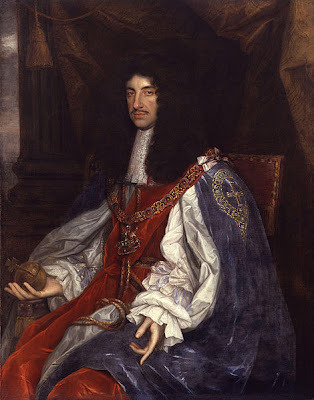
Of course, there is a downside to reading historical fiction that involves real historical figures. At least, I feel there is. Others might feel differently. Since Charles II and Catherine, his wife/her queenliness, were real people, I can look up pictures of them. This means that I can read about what a hottie Charles II was and how all of the ladies wanted to go to there, and then I can Google him and find this:
Source: Wikipedia
Just take a moment to enjoy that hotness. Yeah. I literally laughed for like five minutes when I found out what he actually looks like. Now, I'm sure he could get all the ladies he wants, because it's good to be the king, but I'm not buying him as Mr. Sexypants/robe. Sorry.
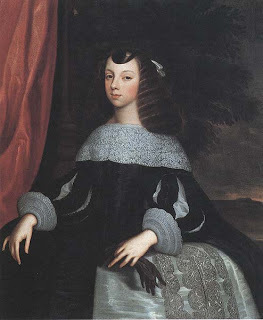
Source: Wikipedia
Sadly, Catherine was not quite so amusing. In fact, viewing her pictures was rather enlightening. The book mentions her change in style from Portuguese gowns to English. Her Portuguese gowns were dark and somber, very much not popular with the English, who liked ladies to put their business on display. Now I know what those gowns look like. I can also see why they would not have been popular. Catherine as a character is rather hard to relate to and unsympathetic. She wants love and she wants power, but she doesn't really do anything.
The story focuses, though, on three of Catherine's ladies in waiting, all named Elizabeth. They become friends and negotiate the scandals of the court together. And, OH MY but there are a LOT of scandals. Women don't come off especially well in this novel; the one comfort is that men come off way worse. None of them are especially likable, but they are pretty entertaining.
Elizabeth #1, Eliza, would have been my favorite; indeed, I liked her immediately upon her introduction in the first page of the book. Unfortunately, she was a bit too into her theater. Her lack of interest in men and marriage I applaud, but she is so cavalier with her friends. Despite the fact that her father is trying to sell her off in marriage to someone she doesn't like, she constantly encourages Beth to accept her awful mother's marriage plans for her. Hypocrisy looks good on no one.
Elizabeth #2, Beth, is the nicest of the three. She truly loves others, and is the only one who wants a family. Unfortunately, she has a completely disgusting mother (she has super serious syphilis, which is way nastier than I knew) who wants to sell her off to someone who is not her love (who is not so great either). The guy her mom (and Eliza) want her to marry is totally creepy as all get out. I sort of feel like there may have been more scenes with him in an earlier version, because at just one point, we get some insight into his thoughts, which is weird. Beth I didn't much care for because she's too gullible and too crazy.
Elizabeth #3, Zabby, also initially seemed like she was going to be a great character. When you first meet her, she doesn't know how to wear a corset, is mistaken for a prostitute, and totally still maintains her attitude. Then she saves the King from the plague. Awesome. Then she falls in love with the King and spends the whole book mooning over him, alternately fantasizing about Catherine's death and trying to help Catherine out of guilt. That whole thing makes me so mad, especially since the King is as I described him above. Not only that, but she totally ruined the happiness of one of her friends out of her desire to make the King like her more. By the end of the book, I was ready to give Zabby the oar to her douchecanoe, so that she can head off to her home at asshole island.
All of that said, Ladies in Waiting is an entertaining read. If you like scandals, crossdressing (even if some of the things that happen in this plot line are not believable) and drama, sit back and enjoy. This is very much like an episode of The Tudors, only the sex happens offstage (mostly), the main characters are actually young, and instead of Henry VIII you have Charles II.
Ladies in Waiting by Laura L. Sullivan is a historical fiction novel set in the vibrant and morally complicated court of King Charles II of England in 1662, following three very different young women, Eliza, Beth, and Zabby who each find themselves in service to Queen Catherine of Braganza and must carve out their own futures amid ambition, love, scandal, and shifting fortunes.
Eliza, a spirited heiress who dreams of being a playwright rather than an obedient wife, chafes at her father’s plans for her future; Beth, beautiful but impoverished, longs to escape her cruel mother’s machinations and pursue true love; and Zabby, an intellectually curious woman from Barbados, finds herself dangerously drawn into the world of science and attir‑ tion to King Charles himself after saving his life. Together, their stories illuminate the passions, perils, and power plays of Restoration London’s most scandal‑filled royal court.
What I found most compelling about this book is how it balances personal dreams with the heavy expectations of 17th‑century aristocratic life: Eliza’s drive to write and be admired for her mind, Beth’s heartfelt longing for love beyond political marriage, and Zabby’s struggle to define her worth beyond beauty or court rumor all made me feel deeply rooted in their individual journeys.
The novel really carries the texture of its era, with decadent parties, rigid social hierarchies, and a vivid sense of how dangerous affections and alliances could be in a world ruled by gossip and power. While some readers appreciate the historical details and the way Sullivan grounds the narrative in real figures like Charles II and Catherine, others have noted that the prose can feel uneven in focus and that the ending leaves emotional threads unresolved, which may frustrate readers who crave a firmer sense of closure.
My rating: 3 out of 5 stars. I’m giving Ladies in Waiting three and a half stars because its rich historical setting, relatable heroine arcs, and courtly intrigue made me care about these young women’s struggles for agency and love, even if the character development and narrative payoff didn’t always land as powerfully as I wished.
It’s a worthwhile pick if you enjoy historical fiction with friendship, ambition, and romance set amid royal pageantry, but it might feel a bit light if you were hoping for a deeply immersive exploration of Restoration England or fully tied‑up resolutions.
Review to be posted on blog closer to release date.
Even though I only gave this book two stars, there are some good things about it. They just didn't make up for what I didn't like. I almost hate to review something I don't like because I feel like I'm being an annoying, bratty kid, but here it is.
What I did love about this book was the main characters, mainly Zabby and Eliza. Eliza is downright hilarious. I loved every second of her conversation. Zabby was definitely the strong heroine type. I found her incredibly likable. Although, I didn't really understand what she saw in Charles. I never warmed up to him and I think that mostly had to do with the fact that the book rarely showed their time together. I guess I should remember that this isn't a romance about Zabby and Charles. It's about the three Elizabeths. Still, in the end Charles does manage to be an honorable person. It kept me from totally disliking him.
I had a hard time remembering that this was a teen book. It never felt like one. There was too much scandal and way too much talk of sex. It felt a lot like some of the historical romances I read. At least there wasn't actual sex, just references to it.
I suppose if you're looking for a book with plenty of intrigue and an emphasis on friendships, this will do it. And the historical setting definitely makes it interesting. I think what it really comes down to for me is that I was expecting one thing and got something completely different. Different stokes, I suppose.
I was surprised that this was listed as a YA book, I would definitely save it for the older end of the group.
The story is set in the court of Charles II. There are three new ladies-in-waiting, all named Elizabeth. They are:
Eliza - daughter of a wealthy noble, she wants to be a playwright
Beth - penniless and beautiful
Zabby - a foreign scholar, she ends up in court accidentally
Now, from the cover, I really thought it was going to be some sort of modern version or something. The girls seem dressed in period, but look modern. Know what I mean? It is a story of friendship, the girls do come across as typical girls really. Their voices are quite different, which is nice. There is actually a lot of talk about the King and his mistresses, their rivalries and general lustiness. While that is stuff that really happened in court, I don't think that the younger end of our YA group probably needs to read about it just yet.
The writing is good, but the story runs a bit slow.
Mostly enjoyable, if lacking in certain areas, Ladies in Waiting is a more than adequate young-adult historical fiction. I will complain a mite about the title as there are technically no ladies involved; the story revolves around three young Elizabeths, each a maid-in-waiting for Queen Catherine of Braganza. Eliza, Beth and Zabby each differ from the other in status, wealth and dreams. Eliza, bright and dramatic, aims to use her father's wealth to achieve freedom, Beth longs for true love to set her free, while Zabby seeks knowledge more than anything else in the world. Each girl represents a different chance at life in restoration England under King Charles II: one has wealth, one has beauty and one has brains for which to make her way in the court. The three split perspectives of severely differing circumstances had a lot of potential to show a more rounded version of life within the kingdom at that time. I had hoped for a more vivid portrayal of the Court and England itself; the novel focuses fairly narrowly upon the three Elizabeths and fails to provide a rich setting or background for the characters to occupy. I was left feeling rather "blah" at the end of the story, as none of the storylines grabbed me as truly original or as doing something truly creative with this era of history.
Eliza Parsloe, she of the extreme wealth and lineage of dirt, is a "provincial heiress" out of the country. Because of the dying wish of her mother, Eliza has what many girls of her time and age do not: the ability to approve of her husband before marriage. With such an unexpected and unlikely power for a woman of the 1660's, Eliza has the rare opportunity to dictate her own life on her own terms - or so she thinks. Sent to court to ostensibly wait on Queen Catherine but in reality dowse out a husband for her commoner father to use and exploit, Eliza finds herself in a situation she thought would never happen. Eliza is strident and willfull; at times the character was so irritating and unthinking I kept waiting for the other shoe to drop upon the poor playwright. Instead of inspiring sympathy for her plight with her deceitful father (he even plots to use her unwanted, previously rejected suitor to "rape her into marriage") I was simply eager for any protagonist besides Eliza to appear.
Elizabeth "Beth" Foljambe is the daughter of the syphilitic Countess of Enfield. With the pedigree that both her friends lack, Beth must catch herself a rick, noble husband in the vipers nest of Charles' court. Born of a Royalist family, Beth is only as important as her chastity; Beth's mother repeatedly tries to use her daughter's virginity to try to accumulate power. The sheer focus on Beth's worth as completely dependent on her purity was a harsh but sadly historically accurate portrayal of a woman's worth during the time. Beth is possibly the most sympathetic character of the story, with only Queen Catherine running her a close second. Beth is sweetand kind, and perhaps a bit too widely-eyed naive to survive for how long she has in the court. Her viper of a mother is a scene-stealer whenever she appears, though the scope of her character could have used some widening.
Zabby Wodewose, the final player in our trifecta of Elizabeths, hails from Barbados. She can be seen as a harbinger of change - a stranger from a strangle land with new ideas and theories. Returning to England with her beloved father (this is the one example shown of a healthy, functional relationship between parents and offspring of the three girls) after a number of years, Zabby's drive in life is to learn. Through a random happenstance, young Zabby saves the life of the King and her life is affected forever. Zabby started out easily as my favorite character, but the development and changes that occurred throughout the novel eroded my affection. She's spunky and truly clever, but becomes way too enamored with the King to focus: I disliked this revelation because knowledge is the love of Zabby's life not the King. Perhaps the point was to illustrate just how alluring the King was or how susceptible Zabby was to his charms, I am not sure. I just prefered the initial version of Ms. Wodewose. The relationship between the three maids shows far more camaraderie and love than any of the other women in the court do. It feels like a viable friendship, one that builds and grows as the girls go through trying experiences with one another.
The novel works, if it does not exactly excel. The writing can veer into too much showing very easily (and frequently), but it manages to engage the reader, thanks to agreeable, if not stellar, characters. The background characters do a fair job as well, and I found myself surprisingly fond of a number of the bit players (the vicious but cunning Lady Castlemaine was probably my favorite character to read/read about). Sullivan's Charles II does a nice job of continually stirring the pot, fearing conspiracy and seeing rebellions everywhere to keep the Court's - and the reader's - tension running high. Catherine is both sympathetic and also aggravating, but provides a nice change from the relative immaturity of POV for the teenage girls. It may be a bit simple and bland, but falls far short of the worst historical fiction I've come across in the last year. I had just hoped for more from this particular novel. The lack of atmosphere and setting did the most to lower my expectations, but I'd recommend this to someone looking for an easy, simple historical fiction set in the 1660.
I feel conflicted about this book. I suppose most of it stems from my expectations of what I was getting myself into. While it's well written, both in story and turn of phrase, I also wasn't in love and it wasn't what I was expecting. 2.5 stars
Going into Ladies in Waiting, I really am not sure what I expected. Perhaps something lighter and less, dare I say it, philosophical. I imagined it would be a typical fluffy book where all of the girls got their happy endings no matter what hoops the real world had to jump to in order to get there. Instead, I got a book that had a grip on reality. One that realized life doesn't just always work out perfectly with a little bow on top, one that knows that the world goes on even after the one true love is gone. While I didn't love it, and may not even recommend it very highly, I was pleasantly surprised by Ladies in Waiting.
We follow the "three Elizabeths", girls who have come to the court of King James II to serve as ladies in waiting to his queen, Catherine. Though they share a given name, that is the only thing similar about them. Eliza is well off, but not noble, and dreams of becoming a famous and revered playwright, in the vein on Shakespeare. Beth is as poor as they come, but breathtakingly beautiful, a gift that her disfigured mother uses to her own advantage. And Zaby was raised a scholar out of the continent and comes to court by saving the king's life. We see the ups and downs of their time in court, see them fall in love, and weasel their way out of trouble.
One of the saving graces of Ladies in Waiting was the characters, especially Zaby and Eliza. While I didn't particularly like what Zaby was doing, I admired her spunk, brains, and her readiness to go after what she wanted. It was the same with Eliza. I found her downright hilarious and loved that she threw caution and convention into the wind to pursue her dream.
I enjoyed the court setting and reading about a king whom I've never seen depicted in fiction. I thought it was researched fairly well and the dialogue and writing flowed well and seemed to fit for the time period. It was well-paced; altogether technically a good read.
Now, back to what I mentioned before, the thing I really admired and enjoyed about the book was that it didn't hold back. There was no just because happy ending. Things worked out for some characters and didn't for others, and it didn't matter if they were the "good guys" or the "bad guys". Honestly, I don't see that very often and I thought it was a breath of fresh air in the young adult market, though I wouldn't really tout this book as very young adult. It's definitely more on the adult side of the genre, just based on content.
Ladies in Waiting tells the tale of three different women named Elizabeth, all with their own hopes, dreams and lives in the bawdy Restoration court of Charles II. Eliza wants nothing more than to be a playwright, but as the daughter of a wealthy noble, there's little she can hope for other than a loveless marriage to the man of her father's choice. Beth may be beautiful, but she has no money, so she must find a wealthy man to marry even though she's in love with another. Zabby, a foreigner, comes to England to further her scholarly studies, but through a chance meeting with Charles II, finds a strange romance that seems impossible.
After reading the blurb on this, I thought I was in store for some kind of super PC, YA-friendly story about how three different women who share the same name become friends, etc. Especially since this is being packaged as a YA novel, I was prepared for some sort of love story, a story of a rebellious teen, and maybe a hint of intrigue and history.
What I ended up with was far from what I thought. Ladies in Waiting drew more on the intrigue and lusty nature of the court, complete with ample, open talk of Charles II's mistresses. In fact, I was very surprised at all the adult-oriented discussion here, especially when it came to Barbara Palmer and Charles' other mistresses. There was also a very open exploration of Charles' relationship with his wife, Catherine, whom he had virtually no relationship with.
Interestingly enough, I found Ladies in Waiting to have closer similarities to Susan Holloway Scott's adult novels of Charles II's mistresses that were historical, but also fairly adult, in content. This is certainly not a bad thing, as I enjoyed the added level to Ladies in Waiting that gave it greater interest, especially when Sullivan began bringing in the court intrigue and discussed the rivalry between the mistresses. However, the beginning and ending of the book tried to pull it further toward the YA side, like it was trying to deliver on the promises the book's packaging offered, but the novel itself, at its core, just wasn't YA-friendly.
Overall, a good book with some enjoyable characters, but despite the nicknames, it got really difficult to tell the characters apart, and there were points where the history just didn't seem right to me. I did enjoy this book though, Sullivan creates some intriguing stories set in Charles II's court, but it would have been nice if the packaging matches its contents.
Historical fiction is a genre I either love or hate. There is no middle ground with this genre. It’s either super fascinating and unputdownable or something that bores me to tears. Ladies In Waiting was sadly the latter of the two.
Eliza, Zabby, and Beth are three friends in the court of King Charles II. They are all very different girls. Eliza is strong-willed, gutsy, and a little bull-headed. Zabby is smart, stubborn, and a bit naive. Beth is caring, kind, and blinded by love. The girls all had very different personalities but there were still times when I was confused as to which girl I was reading about. It probably didn’t help that the point-of-view switched mid-chapter every now and then with no warning.
As for the love interests, I just couldn’t see it working with any of them. Charles was married and on top of that he was a jerk. Flaunting his mistress in front of his wife, flirting with every girl, and basically playing Zabby? Not a nice guy at all. And really, what self-respecting lady would fall for him and think it would work out in her favor? As for Harry, early on you see just what kind of guy he is. Beth was such a sweetheart and Harry was the wrong guy for her. That was very easy to see.
The rest of the characters were a big mystery. None of them were well-developed. I didn’t understand the motives people had for doing what they did. And certain questions were never answered and I really wanted those answers.
The historical setting was the most interesting part. All the court intrigue, gossip, and adultery was fascinating. The rituals of the court were also quite fun to read about. Some things were given in too much detail though and I found myself getting lost in the middle of a sentence. The details got a bit weighty and boring at times.
The ending was rather abrupt and it felt unfinished. Only one character really had a concrete ending and even that one was shaky. There were no conclusions to the other girls’ stories and I was left wondering. Not a good way to end a book, especially when there are no plans for a sequel.
Overall, Ladies In Waiting is one book I can’t say I recommend. If you are looking for a good historical novel, look elsewhere. This one is not worth your time.
Disclaimer: I received a copy of this novel from the publisher in exchange for an honest and unbiased review.
My Summary: Thrown together thanks to circumstances nobody could have predicted, Zabby, Eliza, and Beth are ladies in waiting to King Charles II's wife, Queen Catherine. But life in the King's Court is not all glamour, parties, and petty gossip. And as each girl struggles to fulfill her duties as a lady in waiting, they realize just how much they are going to have to do to ensure they get what they want.
My Thoughts: As a huge fan of historical fiction, I couldn't wait to dive into Ladies in Waiting. The characters were really unique, and I had a few laugh-out-loud moments throughout the course of the novel (Beth's mother... I probably laughed at this way more than is acceptable. I mean I know syphilis is a potentially fatal STD, but I couldn't stop laughing!).
I really liked that the sole focus of the novel wasn't the romance aspect, and that the girls' friendship played a big part in it. There were some hilarious conversations between the girls, and their distinct voices made me hope for the best for all of them. Zabby was probably my favourite character - I loved her wit and the way she went for what she wanted. All in all, a very fun read.
Final Thoughts: I recommend this novel to anyone who enjoys historical fiction, but I would advise that it's kept to more mature teens and adult readers.
Spectacular! Wonderfully written, throughly interesting. I finished this book in two days and it occupied the majority of my thoughts even while I wasn't reading it. Sullivan's world is tangible! Every second I read I felt that I too was part of a greater story, that I was there, part of that sodden silken society. The second I would pull away I was immediately sumonded back to real life, almost reluctantly. I am suprised most people did not find this amazing, because it definitely reflects what a talented intuiative writer Sullivan is. This book surprised me because it wasn't just about love and yet I did not mind. The characters are incredibly realistic and developed and what I loved the most is the expanse of Sullivan's perception. Worth reading, as many have mentioned excellently researched and while this book is an easy read because of its fluidity, it is complex enought to make you think without boring you. Loved it.
Objectively, this is probably a 3-star book tops (especially in terms of story), and I would've given it 3 stars if it weren't for the last few chapters.
I really enjoyed one of the characters (Eliza), and Sullivan's writing style turns a pretty bland story into a vivid picture that kept me engaged. And the ending was not at all what I expected, holy cow. But other than that, the characters are a bit boring or obnoxious, and the story doesn't really roll until about halfway in.
I will say that the cover is VERY misleading. I thought this was some middle school/early YA historical fiction, but nope. Up to the teeth in innuendo and some graphic scenes/themes (nothing explicit) so I'd pin it at late high school at the youngest. Not a bad thing - just a warning for anyone who thought this would be a cute girly romance.
Was fine overall - light easy book that was decently written.
The stories weren't super interesting though and the ending wasn't good. Beth just goes off quietly to marry this random dude who probably had a hand in the deaths of his first few wives? And we don't see the wedding, and neither Eliza or Zabby who are both pretty fierce check in on her?
Also if Beth's mom was so protective of her virginity, why did she dress her so indecently?
Zabby was an okay character, I didn't really like Eliza. The trio's friendship didn't feel very strong either.
This entire review has been hidden because of spoilers.
This book was well-researched and I definitely learned some new things.
I found most of the characters to be annoying. It was confusing at times because it would switch points-of-view in the middle of a chapter with no paragraph break. I found the end for most of the characters to be very disappointing.
I gave this book 2.5/5 stars. I wouldn't recommend it.
During the reign of Charles II of England, three very different girls with the name of Elizabeth find their own paths in court as maids-of-honors of Queen Catherine of Portugal, the king's wife. Each girl has their own goals and fate that will affect their world.
The first Elizabeth, who is referred to as Eliza, is the daughter of an extremely rich man whose chief ambition is to marry Eliza off to a noble husband that will give him the king's ear, so he sends Eliza off as the queen's maid-of-honor in hope of finding a worthy husband. Meanwhile, Eliza plans for a future that will allow her to become a playwright of her time.
Beth, the second Elizabeth, is the daughter of a noble who strayed and landed his family in serious debt. Her mother is insane and dying, she wants to marry her childhood friend, Harry, who is also the son of the man who was the cause of her father's demise and she is betrothed to another who plans to have her as his fourth wife.
Zaby, whose nickname is beyond me, is a science nerd. When the king catches the plague, it is she who saves him from deathbed. In return for saving him, the king appoints her as his wife's maid-of-honor and allows her to work in his laboratory. Unfortunately, Charles refuses to state his reason behind her sudden turn of luck and has everyone believe Zabby is just another one of his many mistresses. It is also worth mentioning that Zabby is starting to fall in love with the king.
Although the novel is called Ladies in Waiting and the summary is focused primarily on the three Elizabeths, this book is Catherine's book as well. As you delve into this major soap opera of history, it is not only the Elizabeths who face hardships; Catherine is as well. How will Catherine face the many mistresses of the king and bear his heir, while his mistress, Castlemain, has given birth to two heirs and clearly has more power over the king than her.
I found Ladies in Waiting a fast-paced and interesting read. The author clearly researched seriously when writing this novel, but also took many liberties. There are countless times when I slapped my head in the stupidity of the novel, but I found each of the protagonists likable and worthy of having a portion of this novel written specifically about them. Each character has his or her heartbreaks and/or dilemmas that he or she is successfully able to escape, but with consequences. Everything that happens is with a purpose, and ultimately forces the bittersweet ending that is satisfying.
I will not say that Ladies in Waiting is a novel worth loving or recommending to everyone. Honestly, it is not. Some of the writing does not seem consistent with the time period. There are a few phrases that are found in Shakespeare's plays. But would those still be used commonly many decades later? A phrase such as 'Lead apes to Hell' will not last for so many years as shown in Ladies in Waiting. I do not believe the author is the blame though. There is not as much writing from Charles II's time compared to the Elizabethan era.
The style of writing, other than a few little annoying buggy things, was extremely well-thought out. Each word flows effortlessly into the next, which helped me finish Ladies in Waiting on a good note. Laura L. Sullivan clearly has a gift with language, albeit sometimes a bit forced during the dialogue. There was nothing too major though.
Although I did enjoy Ladies in Waiting, it is not a novel that one will love passionately like Harry Potter or Lord of the Rings. It is like bittersweet candy. It is worth trying because it is candy, but most people will not enjoy it or even want to try it. Historical fiction is a genre worth expanding and Ladies in Waiting is a great addition to this unfairly treated genre.
I love history, and although I had read about Charles II in relation to Cromwell, I didn't know much about his reign after Cromwell's fall. So when Ladies in Waiting came up on Houghton Mifflins spring titles list I was eager to give it a try.
Filled to the brim with well researched information and fascinating tidbits, Ladies in Waiting did not disappoint in the historical department. A very great deal of the historical details focused on girls and their very cloistered/controlled lives and Sullivan is very no-nonsense about spelling it out for the reader.
Her father had given him permission to try for her hand, leaving them alone with only a maidservant within, for propriety, and a liveried footman without, in case he should try to claim his prize by force. Now, that was a though, he mused. It had certainly been done before, though mostly through abduction. Still, if he managed to spoil the goods here on the chaise, she and her father would probably agree to let him buy what remained...
What her father had proposed was not strictly speaking legal, but it was a common enough occurrence. Young girls with fortunes were cajoled, coerced and yes, even abducted into giving themselves and their fortunes. And most of the time, at least one parent was complicit. Marriages were arranged, and though in theory consent was necessary, in practice a proposal was less a case of will you? than you will. For many readers it will be an eye-opening experience, even for those who thought they understood the limited lives of women. Many people don't realize the strange combination of limits and freedoms for the rich and noble women, especially those living at court where scandal, seduction and politics all lived hand in hand. Ladies in Waiting beautifully illustrated this dynamic in a very realistic way.
However, the actual story of Ladies in Waiting left me both a bit confused and frustrated. For starters, it's told in a very confusing Omnipotent point of view, often shifting mid-paragraph from one persons point of view to another which frequently left me back tracking trying to figure out what just happened. It would have been much more effective for me if it had been a shifting first person POV that changed chapter to chapter, or if it had stuck to just one of the girls POV, at no point did the Omnipotent POV make enough of a difference to the telling of the story to warrant it's use.
My other complaint about this otherwise well researched book, was how each of the three girls focused on, were each a wildly exceptional circumstance. Zabby, from the Barbados, is scientific and brilliant, she has been allowed to run around in pants and explore and she's come to London , not to find a husband, but to further her studies. Eliza is a very rich merchant's daughter, who has been sent to court to make a noble match, she is a playwright and a free spirit. Beth is a stunning beauty whose family has been ruined by her father, she has a title but is penniless and is dogged by a syphilis ravaged, monster of a mother. Each girl is such an extreme of an already unusual situation that I found it very difficult to take them seriously, especially when taken within the confines of a well researched historical novel. By the end each girls story had taken such a ridiculous turn it was bordering on bizarre, and I was left completely put off by the whole thing.
A highly researched historical YA, that fell short for me in both its strange omnipotent POV and even more bizarre fictional adventures, I'm not sure what the intention for Ladies in Waiting was, but it missed the mark in my books.
I really wanted to love Ladies in Waiting will all my heart and I tried so hard! But I'm sad to say I never got there.
The summary sounds epic to me, I mean ENGLISH ROYALTY and young ladies in waiting and intrigue and GAH, just all of it! And one of them trying to break the confinements of her gender in this particular time. There was SO MUCH there for me to possibly love, it's not even funny. Forbidden love and everything. All those things that make me a happy reader if done well.
But it didn't turn out the way I would have thought. It started out incredibly well and after the first two or three chapters it all went downhill for me. First we are introduced to the characters and in a way that had me thinking we would be reading about them from their altnernating point of view. But instead the point of view was never very clear and switched and was just a little all over the place.
I really liked Eliza, and at times I also liked Zabby. I just never really felt anything for Beth accept annoyance. I mean, I don't know if she was meant to be a parody of something, but she came across as if she could be. I was questioning her sanity pretty early on and nothing that she did after made me reconsider said questioning. She was delusional and I was gaping at her stupidity in her 'love' for her childhood 'sweetheart'. And gah, I just wanted to slap her! And Zabby too. I mean, at one point she overhears a plot threathening the queen's life and goes, well, he probably didn't mean that and it's more convenient to believe people just don't do bad things to eachother at court. Or something very close to it. She's supposed to be a scientist and knows all these things and in this she was just a stupid girl and it annoyed me very much.
Also, I never really got her love for Charles. Maybe because we don't see a whole lot of them together, but I didn't get what was so special about him. I mean, he's the king, but that's not a reason to love somebody. I definitely did not like the way he treated his wife, but well, that's probably historically accurate, sadly.
I did however love Eliza. She's free spirited and knows what she wants and isn't afraid to risk everything to get it. And I respect that. She was the one bright point in Ladies in Waiting and I wished she would have gotten a bit more time to shine, because I adored her.
The plot seemed to crawl along at a snail's pace and then the book just ended. I mean, I felt a bit cheated by the end. Things happen, some awful, some I cheered at, but it just ended there. And I felt that everything I'd worked on by reading the whole thing was somehow just swiped off the table and I'm left without any closure. This book and I had a difficult relationship and I would have like to have parted on a good note, but the ending just didn't accomplish this for me.
Also, with all the debauchery and everything going, I'm a bit hesitant about this being marketed as YA, if it can be classified as such, it should in my opinion be more the older teen because there are a lot of sexual references.
All in all, I struggled my way through this book and then I didn't even get my closure at the ending. It had a definite subdued feel to it that was only lifted by the moments in which Eliza was allowed to shine, she was the redeeming factor in Ladies in Waiting!
Before I say anything too much, I am a big history geek. Whether the material is fiction, based around a historical time period or culture that I just happen to enjoy or a stronger route with characters based on real historical figures but in a more fictional story setting. I even have been known on numerous occasions to “study” for fun by reading quite a bit of non-fiction on my favorite subjects.
Ladies in Waiting was something I looked forward to for history, background, and characters. Having already experienced Ms. Sullivan’s writing before, I was excited to read this. It was also different from what I had already read from her writing as well so it was new.
I felt this was a fresh YA historical that was very character-driven and realistic. I had some slight issues though. It wasn’t that I didn’t enjoy the story, because I did. It was something I read easily and was entertaining-- a fresh face into the YA genre where readers are normally bombarded with creatures like vampires and werewolves. I liked the smoothness of the words and imaginative details throughout. Each character had a unique personality, yet they blended well amongst each other.
So my problems were that I just didn’t feel a great connection with most of the characters other than Zabby--who seemed to have the most interesting story for me. Or maybe it was just me, I’m not sure. Yes, I felt the characters were developed well and each had their unique personality trait… but when it came to presenting their “stories”, their POVs, I just didn’t seem to connect with them so well other than Zabby. I just didn’t care about the others too much or whatever happened to them. And that can be a hard thing for a reader. I love connecting with the characters. At least I connected with one of the important ones here though.
At times I felt a little drawn back from the story because I didn’t feel any action. This isn’t really an action piece or any kind of novel I feel that has some kind of heavy agenda. To simply put it, it’s about three unique ladies in waiting to Queen Catherine and their changing lives-- it can be a bit slow in some parts, but I did find it really interesting otherwise with their stories. It was realistic. There are some shifts so that the reader can get to know a bit about each girl and I particularly liked that. It was just unfortunate like I said before that the only one I felt the most connection with was Zabby. I would have liked to know Eliza more, she was the playwright. :)
The ending took me by complete surprise. I don’t want to give anything away because I don’t use spoilers in reviews, but it will take you a bit off guard. It’s not an ending that I really expected-- I can’t honestly say yet if it’s good or bad, I’m still thinking it over. That was another thing I did like about Ladies in Waiting, it made me think a bit at the end of it.
In my honest opinion, I thought “Brightwing”, written under Laura Sullivan’s pseudonym, Sullivan Lee, was more of a favorite compared to Ladies in Waiting. Which did surprise me a bit because I’m more of a YA reader than adult in most cases.
All in all though, I did enjoy this and I’m thankful I had the opportunity to read. Thank you.
Recommended [return][return]Ladies in Waiting is about three girls named Elizabeth, who are in King Charles II Royal Court. They are to be the friends of Queen Catherine. Zabby just got shipped to England by her father, from Barbados. Eliza wants to be a playwright. Her father is one of the richest men in England, but a commoner and a Puritian. Beth is a noble, but her father financially ruined them and they rely on handouts from other nobles. From different circumstances, they end up as the Queen’s Ladies in Waiting. They all have different interests, which are woven into the plot. They are also all waiting for love, but in different ways.[return][return]I’m still not completely sure how I feel about this book. It seems to be historically accurate. It is marketed towards teens, but the language is a mixture of old terminology (a glossary should have been provided) with some modern language. There is pretty mature subject matter in terms of physical and verbal abuse, sex, prostitution, rape, marriage infidelity, a public hanging and language. I would say it is historically accurate and this is what court life was like, along with women being treated like property. Marriage was a business transaction and mistresses were kept for sex/love. It does not get too descriptive, but the reader will clearly know what is going on.[return][return]There has been criticism about the abrupt ending on goodreads.com and mentions of it in professional reviews. But it has keep me thinking about the ending, so maybe that is what the author intended. It was not meant to be a happy ending as life does not always have a happy ending. There are different kinds of love, which can be a pretty powerful realization. I also appreciate the theme of friendship and loyalty. The flippant attitude of royals towards other people in their pursuit of power seems to be historically accurate. Overall, I learned more about Charles and Catherine than I did from history books. It is a period of history that we do not really study in our high school/IB curriculum. I think students would benefit from that. I think it will appeal to girls who regularly read historical fiction. It is a pretty mature book, so I would recommend it for grades 11-12 (maybe 10?). Public libraries can easily add it to the collection. It’s possible there are some curricular connections in an elective history class. In a school, I would have to worry about certain students and parents, so I would not make it a school book club selection. Overall, it’s been kind of a tough review to write. I think I liked it. I would recommend it to mature students. The cover art is very attractive. I’ve been thinking about it for a few days before writing the review…so it was definitely thought provoking.
I got about halfway through this book when I had to return it to the library. That rarely ever happens, even if I hated the book. But it wasn't that great of a book that I needed to finish it anyways. It was set in the late 1600's, I think; I can't remember, but at times the language they were using was something someone would say from modern day slang. There was way too much use of other languages, and most of the time they weren't translated. When they were actually speaking as people did in that time, the Old English got a little overused. The 3 main characters: Zabby - I liked her strong personality. However, where I stopped, she was getting to wrapped up in wanting the King to try and seduce her. It was a little, well, gross. Eliza - I'm so confused over this character. Does she like the old playwriter guy or does she not? That is disgusting if she does, but it wasn't clear if she did. Beth - Her love interest was probably the only one her age. I mean even if marrying someone around your age wasn't very popular around that time, the author could've at least made it that way for my imagination's sake. She did dwell on marriange and all that googoo gaga love crap a little too much for my liking.
The whole friendship pact thing they did was completely stupid and very uneccessary. The whole beginning part where Zabby nursed King Charles from the plague was never clearly and thoroughly explained, yet Zabby kept bringing it up. If you're going to bring it up that much, tell us a little more about it! That and they never said what type of plague it was. If the author wants us to think it was the black plague then both the king and Zabby would probably be dead because the black plague was spread from fleas. One think Zabby did say about her nursing was that her and King Charles cuddled. If it was the black plague, they would certainly be dead, most likely within a couple of days.
The only goood things were: The queen - as far as I had read, her personality was very nice, young, and I don't know how to explain it. I just really liked her personality. The science - I like how Zabby is interested in Science. I hate science, but the parts about science in the book were actually quite interesting. I also like how Zabby is smart in a way. The history - You could tell some of the history in the book was actually researched. For example, they talked about the King who cut off every single one of his wife's heads who didn't bear him a son.
Honestly, just not a great book. The first half was so boring I almost just gave up on it, and by the time it started to get interesting, they shoved all of the important events in 50 pages and it was over. I felt annoyed I had wasted my time on this piece of historical fiction.
There are three different girls by the name of Elizabeth in Ladies in Waiting, all of which come from different backgrounds and yet, they share one thing in common: they're all ladies in waiting for the new queen, Queen Catherine. There's Eliza, who is quite wealthy and would much rather write plays than live a quiet, married life as well as Zabby, who grew up on a plantation and is more interested in scientific pursuits than other young ladies and lastly there's Beth, whose mother is dead set on keeping her completely chaste in the hopes of restoring their family's name.
I'm of two minds when it comes to Ladies in Waiting; on one hand, I did enjoy it and yet, at the same time, there were moments when I felt as if the plot slowed down and to be honest, there were a few times that I felt my interest waning because of it. If you like the time period in which it's set, then please do pick up a copy so that you can form your own opinions on it. Having said that, I definitely liked Eliza the best out of the three Elizabeths mainly because she knows what she wants to do and she knows exactly how she can accomplish it. Beth is definitely an innocent and at times, she was a bit creepy--in the manner in which she handled certain situations. But I think my real problem was with Zabby as she really seems torn for most of the book. There are essentially two things that she wants and yes, she can have both of them, but maybe not in the manner that she wants to have them--that'd make more sense if you've read the book, I promise.
I think I would've enjoyed it a bit more if there had been more intrigue or if Zabby had had less of an internal debate when it came to how she wanted to go about getting the King's attention. And yes, the King definitely plays a large role in Ladies in Waiting, even if he's not in every scene. Overall, I'd say that I enjoyed Ladies in Waiting and that I thought it ended perfectly considering the time period--although I do feel bad for Beth's mother.
This is an interesting account of the 1600’s in England. It’s a work of fiction, but the author clearly did her research and utilized actual, historical characters well. Also, the time period feels authentic, especially for the court that existed during the reign of Charles II. England had just spent years under Cromwell, who imposed radical puritanism on its people. Then the court, post-Cromwell, swung wildly the other way.
There is a lot of innuendo, adultery, and references to sexual practices. For that reason, this isn’t really a book for younger teens. But I think older teens, say 16 and up, will find this interesting. The feel of the time period seems authentic, as well as the situations of many of the characters. For the most part, I enjoyed this story. The parts I didn’t enjoy are just personal taste.
For example, I’m not big into scandal. But Charles II’s court was rife with it, many of which were cause by him. He was notorious for having mistresses and acknowledged nearly a dozen illegitimate children. If that doesn’t set a precedent, I don’t know what does. Hence, there is a lot of drama and scandal between several characters. That said, there are no gratuitous mean girls, and the drama that unfolds still feels authentic to the time period.
Even with the promise of scandal and drama, this is a pretty quiet book. It’s character driven, so there’s not adventure on every page. Yet it was still interesting enough to keep me reading. The romance is on the lighter side, too, which was fine with me. I think some readers might take issue with the ending, but I enjoyed it. It felt like Shakespeare, in a way, and I thought it fit the story well.
If you’re looking for an historical novel that feels authentic to the time period, you might enjoy this book. If you’re looking for a romance that happens to be set in an historical time period, this probably isn’t the book for you.
I really liked this book in the beginning – even the middle! But once I hit a certain point, I wasn’t very fond of it.
The characters were a tossup for me; I’m not sure if I liked most of them or hated them. Let’s start with our three Elizabeths. Eliza, I really liked her. She was funny and crude, threatening her suitors with cutting off their… urm, cods. She was determined to be a playwright no matter what others thought of her. Zabby, I didn’t really care for. She was smart, a bit strange, and fancied herself in love with a married man – the king! What was wrong with her? All she wanted was to sleep with him. Beth was my favourite out of them all. She was sweet, innocent, pretty, and a tad mad, I believe. She lived for love – it was all she ever wanted. On their own these three girls would be fine, but together they made a great big Mary-Sue.
Let’s take a look at the other characters, shall we? King Charles, I’m not going to sugar coat it, he was a man-whore. I don’t agree with infidelity. It’s one of the worst things to do to you spouse. Especially when she is as sweet as Catherine. She loved Charles with all her heart, but he had tons of mistresses and didn’t love her like he should’ve. Harry, Beth’s love, was one of my favourite characters. He loved her after all those years and tried to win her doing whatever could. They said he was brash, but I think he was in love.
Now you’re probably wondering why I hated the ending. It might have been because there wasn’t one. The book just sort of ended. There was only really a closing for Zabby (if you could call it that). I’m still not 100% sure how Beth was in the end of the book as there wasn’t even an epilogue to tell me how they were now faring. It felt although someone had ripped out that last few pages of my book.
3.5 Stars. I think this was a pretty creative endeavor, bringing together three girls named Elizabeth from three very different backgrounds and tossing them together to find their way through the decadence and dangers of Charles II's court. All three girls end up as maids to Catherine, Charles's queen, and form a friendship with the awkward and homesick lady, and with each other. Each of the girls has very distinct personalities and their passions allow Sullivan to delve into some rich historical detail from the time period, including the growing popularity of the theater, the pursuit of scientific knowledge, and the courtly games of romance, sex, and adventure. The treatment is on the lighter side, with the girls giggling over shared secrets, soothing each other's hurt feelings, and drawing strength from one another to defy the conventions that bind them. At its heart it's really a coming-of-age story of friendship.
Sullivan has an easy and often humorous writing style, the characterization is well-rounded, and the story was compelling enough to keep me burning through the pages. But for all that the book was rather light and giggly, the ending was somber and poignant. I think it was pretty realistic, and I give Sullivan props for crafting a story of teenage fun and rebellion that ends with a heavy dose of reality, given that they are young women in a time period where young women have few choices and fewer rights. Some readers may scoff at the frivolity of the tale, but I'm all for anything that gets teens interested in history, and I think this has a lot of appeal for its target audience.
Ladies in Waiting is a character driven novel, and consequently, a bit slow moving. There were several things I really enjoyed about the novel, as well as several things that I did not particularly care for. Despite the slow pace, it is clear from the very beginning that Laura L. Sullivan would weave plenty of scandal and intrigue into the plot to keep the reader engaged.
Ladies in Waiting revolves around three different girls: Eliza, Beth, and Zabby. When we meet each of these girls, there is something unconventional about them, which causes quite a shock for the other characters in the scene. The girls’ adventures and forward thinking definitely brightened up the story.
Despite the interesting plot, there was no real romance in the novel—something it really needed. Of all three girls, only Beth was involved in a romantic relationship, but it wasn’t even satisfying. It was superficial and doomed from the start. Zabby does fall in love, but it is clearly unrequited—this means that there were no swoon worthy moments for her, and as the alleged mistress of the King, I would at least expect some! Eliza spends her whole time refusing to fall in love or marry. While this book did need some more romance, I liked that Eliza was always free—it suited her personality well.
While I did not love Ladies in Waiting, I will pick up the next Laura L. Sullivan’s next novel because I still enjoyed Ladies in Waiting and feel that Sullivan may impress me with her next story. I loved the concept of Ladies in Waiting, and there were scandals galore to keep entertained, but it was missing a real, true romance. Hopefully we will find both elements in Sullivan’s next work.
This is the story of three women living and working in the court of King Charles II. All three are maids of honor to Queen Catherine and all three are named Elizabeth. That's about where their similarities end. Zabby grew up with her father in and around Barbados. She's finally coming back to London with the intention of living with her aunt and continuing her scientific studies. She finds herself in service instead. Eliza's father is wealthier than most nobles, but lacks a title. Eliza has managed to convince her father that she's been putting off marriage out of naive prudishness. In reality, she is determined to become a playwright, but views her appointment to the Queen's side as a convenient way to stave off a miserable marriage. Beth is the only one of the three Elizabeths to have grown up in court. She is the daughter of a noble lady, albeit an aged, syphilitic widow who is far more concerned with keeping Beth a virgin until a profitable marriage can be made than seeing Beth happy. The three quickly became fast friends and trusted maids to the queen. When their hearts begin to yearn for what they cannot have, things become both complicated and dangerous. The writing is impeccable and the characters mulch-dimensional. I was happy to see that the focus of this novel was not the queen, but those who worked with her. The queen is only a minor player, albeit a sympathetic one. The other three women are very, very distinct. The world building is gorgeous and the plot completely absorbing.