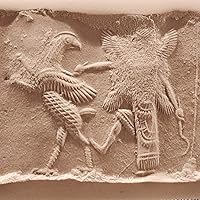
Mesopotamia, the world's earliest literate culture, developed a rich philosophical conception of representation in which the world was saturated with signs. Instead of imitating the natural world, representation—both in writing and in visual images—was thought to participate in the world and to have an effect upon it in natural, magical, and supernatural ways. The Graven Image is the first book to explore this tradition, which developed prior to, and apart from, the Greek understanding of representation.
The classical Greek system, based on the notion of mimesis, or copy, is the one with which we are most familiar today. The Assyro-Babylonian ontology presented here by Zainab Bahrani opens up fresh avenues for thinking about the concept of representation in general, and her reading of the ancient Mesopotamian textual and visual record in its own ontological context develops an entirely new approach to understanding Babylonian and Assyrian arts in particular.
The Graven Image describes, for the first time, rituals and wars involving images; the relationship of divination, the organic body, and representation; and the use of images as a substitute for the human form, integrating this ancient material into contemporary debates in critical theory. Bahrani challenges current methodologies in the study of Near Eastern archaeology and art history, introducing a new way to appreciate the unique contributions of Assyrian and Babylonian culture and their complex relationships to the past and present.
I didn't really want to give this five stars. It's unnecessarily weighed down by jargon and difficult syntax. It constructs a false dichotomy between Platonist and postmodern readings of the image within the realm of Near Eastern art. The interpretations of logo-syllabic cuneiform in terms of Lacanian psychoanalysis and Deleuzian "metaphysics" definitely force some categories as well. But it's so dang thought-provoking, and I can't help but reward that.
The first part covers the various ways colonial discourse has infiltrated art-historical categories and suggests some antidotes. She is very serious about the idea that art historians should think of themselves as ethnographers and learn to accept that they cannot create stance-independent criteria for marginal art. Even when the artistic traditions of colonized peoples were finally admitted to the art historical canon, they were admitted as a sort of addendum. And they were subject to the same old "Western" criteria of evaluation. I think it's important to say this even if I'm only halfway sympathetic.
The second half of the book interrogates the notion of mimesis and the image in the ANE. Bahrani suggests that the West privileges the notion of art as strict mimesis - figure and representation. The more "accurately" a piece of art reflects the figure, the better the art. So she says, this is very Platonic. She suggests that the ANE operated in a very different manner in which the figure and the representation were not independent, but rather, overlapping realities. The ṣalmu (presence/image) was much more than a mimetic attempt at copying the likeness of something. The statue of the king was very much part of the reality of the king and vice versa. Image, text, and person were all constituents of the reality called king. She undergirds this with Derrida's notion of différance, which suggests any concept contains traces of what it is not. Everything is defined in opposition or relation to other things. In the Assyrian-Babylonian world, the king is not present in one localizable essence - every instantiation of his presence always contains traces of what they are not - of the other instantiations of his presence.
This is an incredibly creative application of Derrida's philosophy, and I certainly applaud the novelty. She is most definitely right that our modern distinctions between representation and the referred cannot stand for the Near East. The statue and the king most definitely overlap in a way that is not compatible with modern understandings. Yet, I remain unclear as to why this notion excludes any form of Platonism. Perhaps there is a core, unexpressable reality behind the king that only exists as a constellation of his elements. I don't think the Assyrian-Babylonian model forces us to see the essence of the king as not actually existing, only constantly deferred in the many things that instantiate him. And certainly, when she suggests in accordance with Deleuze that the Assyrians and Babylonians lived in a world that was always becoming, one that was fracturing and repeating, she is not expressing anything about them but about her own philosophical understandings.
If you've suffered through this much of the review, you can tell I found this book stimulating. It's a difficult read, but rewarding, and I certainly understand why it's cited so often.
Zainab Bahrani, The Graven Image: Representation in Babylonia and Assyria, 1st ed., Archaeology, Culture, and Society (Philadelphia: University of Pennsylvania Press, 2003). • Introduction o THE GRAVEN IMAGE is an inquiry into the concept of representation in the ancient Near East o the Assyro-Babylonian practice of combining writing and visual representation for the production of images as a form of essential presence or for what might be described as conjuring presence in an image o ESSENTIAL PRESENCE DEF: the image takes the place of the real or that which is conceived of as a real essence is present in and through the image. This presence is not a matter of simple substitution. o Also concerned with the parallel practice of image making in academic discourse Historical writing and archaeological practice are modes of presencing—that is, they are modes of making present distant and past societies. Representations of culture. o Signification (visual and verbal) o Mesopotamia as a discursive map o Main thesis: in the AssyroBabylonian tradition, representation, far from aspiring to mimesis, is conceived of as being part of the real. In attempting to rethink Near Eastern art from outside the Western tradition of mimesis and to return it to its own cultural context, I have found that for the Assyrians and Babylonians, ontology and semantics were inseparable. To them, things in the world—words and images—had a continuous influence on one another. They could never be separated according to the ontological categories in which we believe. o Above all, however, my study is based on the Assyro-Babylonian record itself. While I discuss the problematic of narrating the past and interpreting the ancient texts and images, for me, the ancient record itself remains the place to which I return for knowledge of the past. 10 o • 1. The Aesthetic and the Epistemic: Race, Culture, and Antiquity o SUMM: considers the ethnohistorical disciplinary structures that formed the background for the study of ane art and architecture, instigated in the mid-nineteenth century. Art history was a discipline enfolded with race, notions of racial evolutions o Traditional cultural exports of Western empires—lit, history, philosophy, fine arts—tend to move in one direction only, from colonizer to colonized. These cultural exports support the authority of the imperial center 13. o I would like to consider art history’s relationship to colonial discourse. o ANE falls outside postcolonial art theory—most scholars see Near Eastern history as an esoteric antiquarian field unrelated to the workings of power through knowledge and only a marginal area in canonical art history In the first section of this book I will attempt to demonstrate that far from bein a peripheral field, it was a necessary component of the development of concept of a recognizable aesthetic in European aesthetic discourse. In Hegel’s words, it is the threshold of art because the East is the realm of the symbol. o Orientalism Her thesis: since the discipline of art history developed during the period of European expansion, it came to rely upon, as well as be utilized by, the imperialist endeavor. Consequently, aesthetic discourse today continues to be a site for the play of alterity. WEST DEF: a Eurocentric identity created by late-eighteenth- and nineteenth-century Western European discourse. Not geographically or racially identifiable entity but rather Euro constructed image of its own culture. Naturalization of a European aesthetic. Orientalism DEF: The field of Eastern expertise 20 • Edward Said’s main point is that cultural knowledge was complicit in the success of European imperialism. Hegemony, he argued, is in fact achieved by masking the relationship between the world of ideas and scholarship on the one hand and the world of politics and power on the other • The business of “knowing” other people was a major tool in “underpinning imperial” power • The concepts of “culture” and of “civilization” were formulated through the humanities and social sciences • Orientalism def Said: a discourse of the other; its main mission is the representation of the other” 21 • Bhabha problematized Said’s monolithic notion of a discourse of imperialism o Sees ambivalence as an inherent part of the dialogic situation of colonialism o The effect of colonial power is not a simple repression or denigration of native tradition but the production of what Bhabha defines as hybridization. For Bhabha, it is this very locus of interaction, the “hybrid displacing space,” that can also be used for resistance against dominant discourse. o “The colonial presence is always ambivalent, split between its appearance as original and authoritative, and its articulation as repetition and difference” (Bhabha 1994:107). Colonial authority is thus not univocal. It is “agonistic rather than antagonistic.” • Spivak’s process of epistemic violence. The intention of subaltern criticism or postcolonial criticism is to interrupt the hegemonic narrative The transcategorical primitive • language, the built environment, and aesthetic production all reflected human development in this ethnological system • 19c racialized polarization of civilized mind/savage mind • 2. The Extraterrestrial Orient: Despotic Time and the Time of the Despots o SUMM: Considers how the name Mesopotamia established this simulacral carographic space as historically factual. The structuring of horizons of space and time allowed a construction of “Mesopotamia” as the infancy of world civilization in order to facilitate a historical narrative with its ideal outcome in the modern West 4. Latent Orientalist epistemology. OP uses Assyro-Babylonian or Babylonian for what is now central and southern Iraq o Importance of production of knowledge for British colonial enterprise in East neither implicit in political rhetoric nor subtly expressed. 50 o The development of the discipline of Mesopotamian archaeology and its discursive practices during this time cannot be isolated from this colonialist enterprise o Ch thesis: I will contend that this narrative of civilization was heavily dependant upon a discourse of otherness that posited a Mesopotamia as the past of mankind, and furthermore, I will maintain that the presencing of Mesopotamia through this imperialist discourse constitutes the ground whence today many Mesopotamian archaeologists continue to unearth what counts as historical fact and to decide upon its accepted mode of comprehension. First, in order to locate Mesopotamia’s position in the Euro-American historical tradition, I will consider the historical dimensions of space and time as structuring horizons for the framework of Mesopotamia. Second, I will argue that this framework, which, in Heidegger’s words, “serves as a criterion for separating the regions of Being” (1962:61) cannot be divorced from the cultural abstraction most commonly used to identify Mesopotamia: despotism o She reads Mesopotamia as a cultural cradle, a product of European efforts to come to terms with a problematic historical domain o This reconstructive historical act has severed Mesopotamia from any geographical terrain in order to weave it into the Western historical narrative. o In the standardized orthodox textbook accounts of Middle Eastern history, Sumerian, Babylonian, and Assyrian cultures can have absolutely no connection to the culture of Iraq after the seventh century A.D. Instead, this past is grafted onto the tree of the progress of civilization, a progress that by definition must exclude the East, as its very intelligibility is established by comparison with an other o On the naming of Mesopotamia underscores its position within the Western historical narrative as the remoter malformed, or partially formed, roots of European culture, o TLDR Space and time are the transcendental horizons within which the identity of Mesopotamia came into being as an extraterrestrial despotic entity. o Bc it is the origin of historical time for the narrative of the progress of human culture, it serves as a limit, in being a beginning for the chronology of civilized mankind. o • 3. o SUMM: Considers two oppositions. First is between subject and object in art history and archaeology. This opposition is a rarely questioned division upon which all that qualifies as valid and objective interpretation hinges. I argue that the subject position of the scholar of antiquity is not separable from the object of study presented in the text. Historical truths are mediated by, among other things, the relationship of the historian to the past. The notion of a problematic context. The second division that I examine here is the fictional binary opposition of perceptual/conceptual representation, or sign/symbol, as equivalent to West/other in aesthetic discourse. It is a framework that requires the East to be, as Hegel describes it, the realm of the symbol. o Anthropology tells us that for societies in which high art does not exist, art arises in two specific domains: o the first is in the realm of rituals, especially political rituals where power is legitimized by association with supernatural forces in representation o the second is in the area of commercial exchange, where artifacts may be technically sophisiticated, but such sophistication consists of the technological transformations of materials for commerce o These entail making rather than matching. They create objects or images that do not imitate a preexisting reality but conjure up an entirely new thing, and in both cases the creation of the artifact is impelled by social forces. o Making comes before matching. Its primitive, coded. o Dependence on mimesis as point of reference in many art historical accounts o my contention is that it is not enough to say that mimetic/symbolic or perceptual/conceptual are categories inadequate for understanding non-Western traditions because they are alien or anachronistic, as many have already argued. No matter how well meaning it is, that approach assumes non-Western art is the undervalued aesthetic of a homogenized other. WOAH 75 o Four points o Art history can roughly be equated with ethnology because these disciplines are methodolically related in their modes of observation and classification o Ethnology cannot be defiend as just the study of culture but of cultural difference o Far from being obvious concepts, both culture and difference are theoretically problematic domains. They are not the transparent areas of knowledge that art historical discourse imagines o The relationship between art historical and ethnographic authority: sameness. o Calling for a serious consideration of Babha’s def of culture as an enunciative site o Study of non-Western art within the discipline of art history is an enunciation of cultural difference. a diascourse of the other. o Bhabha’s argument, explicated by means of his theoretical terms of mimicry and hybridity, is that it is exactly this conception of culture as hybrid that allows a subversive strategy of subaltern agency “that negotiates its own authority through a process of iterative ‘unpicking’ and incommensurable, insurgent relinking” (1994:185). o Sign/symbol o The differences between artifice and reality, physis/tekhne, nature/culture are not universals. They are historically and culturally determined concepts of comprehending the world. 87 THIS HER WHOLE THESIS o What I am referring to here, of course, is the domain of metaphysics that Jacques Derrida describes as “the white mythology which reassembles and reflects the culture of the West: the white man takes his own mythology, Indo-European mythology, his own logos, that is the mythos of his idiom, for the universal form of that he must still wish to call Reason” o Ugh Pierce’s classification of signs o Index: signs that are motivated and have an intrinsic relationship to the thing they mean to signify o Symbol: the opposite, relationship to the signified real is arbitrary and based purely on convention o What I will demonstrate in the next four chapters is that, at least for one ancient society, such a divide between representation and the real cannot be maintained. o Ugh Hegel o Differance • 4. Being in the Word: Of Grammatology and Mantic o SUMM: Representation in cuneiform script, a pluridimensional system of writing. intimate connection to magic and divination o Derrida knows that writing is always ethnocentric o The study of representational practices through an analysis of semiotics and rhetoric, as well as the concept of mimesis, have become standard theoretical inroads for investigation in art history, literary criticism, cultural studies, and anthropology. All concern sign systems and their relation to the real: image, representation, convention, words, and so on; they have also been defined as modes of presencing. o The Script and the Quest for Origins cuneiform refers to a script, not to a language Question of ethnic identity of its inventor (element x or sumer?) three millennia of written history, majority of documents are in this script o The script and the world Pictograms no parts of speech or grammar Problem here bc names are often sentences or statements development of phoneticization Discussion of divination and prophecy and oneiromancy • Ontology is grouned in notions of representation Access to the referent is not privileged amongst metonym, metaphor, resemblance, homophony TLDR the original pictogram designates one object or referent, either by what may have been regarded as a direct iconicity, or in part, metonymically. This pictogram, however, could never be privileged as the most faithful direct access to a signified because the signified could constantly evoke another in turn, through resemblance or contiguity as well as through a homophonic parallel. CHAPTER THESIS • 5. Salmu: Representations in the Real o SUMM: Salmu, Akkadian word for image, defined as a system of visual representation, argued not to be separated from the verbal system of the script nor to be equated with European concept of image visual representation functioned according to a system unrelated to mimesis or preceptualism. Therefore, even the term representation carries certain meanings that might be considered a natural aspect of image making but have the potential of turning into obstacles when applied to a study of Mesopotamian images. Both categories of the binary division of real/representation are at issue when interpretations of Near Eastern antiquity are made because it is not only representation that had a different status from our own. Even the metaphysical category of the real as a separable realm of existence from illusion is difficult to maintain in the context of ancient Babylonian ontology. o Salmu What in our view is representation. Image might be translation I would like to define the function of .almu as part of a pluridimensional system of representation. While .almu was never meant to be a mimetic visual portrayal of the person, it was at the same time certainly a natural representation. Right into Plato and Deleuze Salmu is a sign-representation that takes its place in the realm of the real. That is, rather than being a copy of something in reality, the image itself was seen as a real thing. Therefore, instead of being a means of signifying an original real thing, it was seen as ontologically equivalent to it, existing in the same register of reality. ORGANIC BODY METAPHORIC BODY EXTENSION REPETITION enables presence through reproduction Salmu is a MERE FACET OF PRESENCE. There is no word for the whole because the whole is only accessible as a concept that can be expressed precisely only in a multiplicity. >almu is not an objective representation of reality. It is not a represented truth about the person, nor is it a representational lie about the person, as in propaganda. >almu, as mimetic representation, may relate to the object as an excess in that it can act as a repetition, a replacement. o Louis Marin’s figurability o Explores king substitutes • 6. Decoys and Lures: Substitution and the Uncanny Double of the King o SUMM: assailing images and image theft demonstrate how representation was thought to control, or have an effect on, what is represented. • Substitution magic. Not political ideology or propaganda alone o Here I will investigate the assault and abduction of statues in the context of Near Eastern culture and ontology o In what follows I will discuss works of art from two Near Eastern cities where the deliberate attack on monuments took place. The first group of objects comes from Nineveh, in northern Iraq, and is now in the British Museum, London. The second group is from Susa, in southwestern Iran, and is now in the Louvre Museum, Paris. All the objects discussed have been studied firsthand for evidence of deliberate damage made by sharp tools or weapons, and this damage has been compared to normal erosion of surfaces on the same monuments. This is intended to be a complete catalog of mutilated objects neither from the Near East nor from these particular sites. The Near Eastern monuments that appear to have been deliberately damaged are many, and their enumeration is beyond the scope of this study. The objects discussed here are presented only as a manifestation of the practice of assaulting images, as I am more interested in understanding the thought processes behind such attacks than in listing every extant example. o Animism, magic, and omnipotence of thought are all closely related to the uncanny and form the basis for magic rituals in many cultures (Freud 1912–13:79) • 7 Presence and Repetition: The Altar of Tikulti_ninurta o SUMM: altar of tukulti-ninurta read from word-image dialectic Polysemous nature of Assyro-Babylonian signification • 8 Conclusion: Image, Text, and Difference, or from Difference to Difference o In Platonic Western Tradition, reality and representation have been seen as two logically and ontologically disparate things One belongs in the realm of the essential real; the other is simply an imitation or an illusion and is thus secondary to the real. o Another important Platonic distinction lies in the types of representation: between the categories of images that are copies and classified as having an iconic function, and simulacra or phantasms that do not reflect an originary reality or identity but become independent beings in their own right. Such distinctions have been the focus of philosophical investigations in recent years. It has been argued that an identity, far from being essential or stable, depends on différance: a differing and deferring o
Bahrani-maxxed this semester, read this over spring break. I finished The Infinite Image and moved immediately to The Graven Image. This one was a looooooot denser, but I really liked that. When I felt like I got something, it was immensely rewarding. Made me want to read Lacan, which was a terrifying feeling and not something I ever want to find myself thinking again.
A fascinating book, but one that I kind of hate to have read because it seriously undermined any confidence I have laid claim to having about a certain artistic domain. Regardless, it's some pretty fantastic stuff and opens up all kinds of new ways to interpret the artwork of Mesopotamia outside of a pre-Greek context.