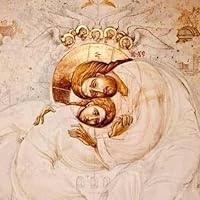
« Plus les choses divines sont en soi claires et manifestes, plus elles sont naturellement obscures et cachées à l’âme. Il en est ici comme de la lumière naturelle : […] plus on veut fixer le soleil en face, et plus on éblouit la puissance visuelle et on la prive de lumière […]. De même, quand cette divine lumière de la contemplation investit l’âme qui n’est pas encore complètement éclairée, elle produit en elle des ténèbres spirituelles, parce que non seulement elle la dépasse, mais parce qu’elle la prive de son intelligence naturelle et en obscurcit l’acte. » Sur le chemin mystique, l’expérience de la nuit n’est ni noire, ni dramatique, ni tragique. Ce magnifique traité poétique montre au contraire qu’elle est réceptrice de leçons divines. Une œuvre majeure de la voie négative.
St. John of the Cross (Spanish: Juan de la Cruz), born June 24 1542, Juan de Yepes Álvarez, was a major Counter-Reformation figure, a Spanish mystic, Catholic saint, Carmelite friar and priest. He was a reformer of the Carmelite Order and is considered, along with St Teresa of Ávila, as a founder of the Discalced Carmelites. He's also known for his writings. Both his poetry & his studies on the growth of the soul are considered the summit of mystical Spanish literature & a peak of all Spanish literature. He was canonized as a saint in 1726 by Pope Benedict XIII. He is one of the 33 Doctors of the Church. (less)
Although I received some insight from reading this treatise on spirituality, I feel I am too much of a beginner to comprehend many of the interior experiences that are touched upon here, particularly in the latter part of the work. I suspect my own darkness and aridity--which is at times considerable--is neither as dark, nor as potentially luminous, as the darkness that lies in the heart of this great saint. I would however recommend it anyway; there is much here for even a beginner to treasure.
But the poem of which this treatise is a commentary is something else again. Inspired by the "Song of Solomon," it is a lyrical, passionate cry, the yearning of a human heart for the Divine that any lover can understand.
This new translation by Mirabai Starr is clear, modern and accessible.
I took this book up on my 10-day Mount Shasta retreat and it became the reverberating background of my whole experience. In the translation by mystic scholar Mirabai Starr, St. John of the Cross's description of the phases of the soul as she ('el alma') nears unity with God far transcends any traditional definitions of Catholicism. The 'Dark Night of the Soul' is not merely a period of intense depression -- it is the annihilation of the ego, the final stage when spiritual rituals, symbols and beliefs no longer suffice and there is no comfort but emptiness: the awareness that 'I Am Nothing.' In every major religion from Buddhism to Judaism, enlightenment or spiritual union or perfect consciousness is described as the ultimate Nothing. Zero. The dissolution of self into Oneness. Like Rumi's devotional poetry to the eternal presence within, St. John of the Cross posits the soul as lover and God as Beloved. "In the darkness of night, the wounded soul rises up in response to the affections of the will. Like a lioness or a she-bear that goes looking for her lost cubs, the wounded soul goes anxiously forth in search of her God. In darkness, she feels only his absence. She feels like she is dying with love for him." Mind, body and soul are purified and illuminated in preparation for total union -- and the process, according to John, is excruciating. The price, as Rumi says, is your life. But to know God means to know yourself, and as Jung said, "The way to light is through the darkness."
For anyone who is "inflamed by love-longing," this book is a beautiful and validating guide.
"Love is like a fire. It rises perpetually upward, yearning to be absorbed at its very center."
I finally managed to make my way through this. It's remarkable reading, but it sure ain't easy reading. This book was so heavy I might only be able to read blogs by the Real Housewives for the rest of my life.
There are two ways of thinking and speaking of God. The first is the apophatic way, or the via negativa, the way of negation. This way of thinking and speaking focuses on the transcendence of God and the inability of human language and experience to encompass all that God is and does. The second is the kataphatic way, or the via affirmativa, the way of affirmation. This way of thinking about God focuses on His immanence and His presence with us in and through His creation. Charles Williams has rightly pointed out that each Christian must approach God through both ways to some degree or risk falling into heretical beliefs. If God were ultimately transcendent, then we would become Gnostics, shunning matter and the material world as evil. If God were ultimately immanent, then we would become pantheists, unable to separate God from His creation. With that in mind, I recently read The Dark Night of the Soul by St. John of the Cross, a practitioner par excellence of the apophatic way. I intend to wrestle with this tough little book and its author and perhaps come to fisticuffs before it’s all over. We’ll see how it turns out.
First of all, some background. St. John of the Cross wrote of the “dark night of the soul,” a time when the first excitement of conversion and service to God wanes, and the believer is left with a sense of emptiness, a sense of God’s absence. He may continue to practice the same spiritual exercises as before, but the joy in them is gone. It seems that he takes no pleasure in the things of God, and this leads to a spiritual depression. Most if not all believers will experience this at some point in their lives. St. Augustine, St. Francis, Martin Luther, G.K. Chesterton and C.S. Lewis all experienced these dark nights. It is the goal of St. John to show that when this occurs it is God’s instrument to empty us of our pride and selfishness and focus us more fully on Him, drawing us closer to Divine Love. So far so good.
St. John open with an excellent discussion of the various manifestations of pride, including prideful things such as the desire to be teachers rather than learners, the desire to experience a spiritual high (a sort of spiritual gluttony), and the desire to be recognized for one’s great learning/humility/holiness. St. John stresses total reliance on Divine Grace and the inability of humans to stir up within themselves these experiences of God. God alone must give a sense of His presence as a gift. St. John is also very concerned with articulating a theology of suffering as an aid to those who suffer in their Christian walk. All of these things are good, and I appreciated them greatly.
That being said, and I feel a bit guilty saying this, I didn’t like this book overall. The whole of the book is permeated with an ascetic sort of dualism. The goal of salvation in the mind of St. John of the Cross is for the soul to become one with God, to enjoy unity with its Creator. In order for this to happen, the person must be emptied, first of every physical desire and pleasure and then of every spiritual desire and pleasure. A perfect emptiness is necessary before the soul may enjoy unity with God. Biblically the ultimate end of salvation is the resurrection of the body and eternal life in the new heavens and new earth. St. John’s method, like the entire ascetic project, finds some sort of sharp division between body and soul and holds the soul up as the better of the two. In the ascetic scheme we come closer to the Giver and embrace Him by scorning His gifts. This whole way of thinking misses the fact that creation is charged with the presence of God. Through sacraments and scripture, we see God everywhere and His truth proclaimed throughout the universe. An author would be puzzled if I claimed to be his biggest fan and then proved it by refusing to read his books. If we love an author, we will generally love his books, and it often works the other way as well; if we love the books we will develop a love for the author. This in essence is the kataphatic way, the way of affirmation. St. Francis revered nature and found God; Dante loved Beatrice and found God; Chesterton embraced the world and found God; Lewis loved Balder and found God.
How do we balance this, though, to avoid having idolatrous thoughts of God? One theme that is abundantly clear throughout The Dark Night of the Soul is that God is far more than we see of Him in Scripture and far more than we see of Him in creation. Because He is transcendent all that we know of Him through His world and Word are still but part of the whole. Our finite minds and language cannot properly conceive the full majesty and glory of God. In St. John’s logic this leads us to the obvious conclusion that we ought to mortify the flesh and spirit in order that our souls may peel back the veil and see God as He truly is. However, not only is this not the only conclusion, I believe it is the wrong conclusion. Martin Luther himself recognized the transcendence of what he termed the Hidden God. He recognized all the same problems as St. John. His solution however was that we will never be creatures that will be able to penetrate that veil for we will always be finite creatures. God would be totally unknowable to us except for the fact that He condescended to meet us where we are. This means that we should look at the things God has revealed about Himself in order to know Him, physical things like the Word and Sacraments. Only through these things can we know God, for we cannot peel back the veil and see the ineffable nature of God. By this the two ways, the apophatic and kataphatic are reconciled in a way that St. John can’t quite reach.
St. John says that many who devote themselves to the contemplation of God that he encourages find it repugnant to speak of the things they have learned in secret for human language cannot tell of what they experience. However, we are told in Scripture that Jesus is the Word of God. God has chosen to reveal Himself in words. Language is God’s divine creation. It is true that we may not know God as He really is, but that is because we cannot comprehend Him as He is. We can only know Him as He reveals Himself, and therefore through special revelation. In other words, words! In fact I may go as far as to say that God does not want us to contemplate His nature or thoughts apart from what He has revealed to us (Deut. 29:29).
Overall I had a hard time with this book. I really wanted to like it. I absolutely loved The Practice of the Presence of God by Brother Lawrence, but this was as different from the world-affirming Lawrence as possible. Often throughout Church history Christians have held that the way of affirmation, of knowing God through His creation and revelation, is the beginning which will eventually lead to the way of negation, knowing God in a contemplative fashion apart from the things revealed. Charles Williams reverses the two saying that we may start with contemplation, but we must move on to affirmation as we mature. I believe that this is more Biblical in light to the great emphasis in the Scriptures on resurrection, material blessings, and the creation in general. As Williams writes, “It [is] necessary first to establish the awful difference between God and the world before we [can] be permitted to see the awful likeness. It is, and will always remain, necessary to remember the difference in the likeness. Neither of these two Ways indeed is, or can be, exclusive.”
One fine day in the fourth grade at Immaculate Conception School, one of my classmates raised her hand and asked how were your sins cleaned out of you in Purgatory. The old nun sneered, "They're burned out of you!" Now I know where she heard that. It's all right here in this book. According to St. John of the Cross while your soul is in Purgatory the love of God ignites it like a log. And, like a log, its composition changes as the fire burns. The entire month or so that it took me to read this difficult book I kept asking myself the same question of St. John of the Cross that I asked (secretly) about Sr. Gertrude Margaret's answer: How do you know? Did you visit Purgatory and come back to tell us?
So why did I read this book? One fine Saturday morning during Advent I went to mass. It wasn't Sunday, but I wanted to appreciate that Advent is different from the rest of the year and clean my spiritual house for the arrival of Jesus. That particular Saturday just happened to be the Feast of St. John of the Cross. In his sermon, the priest told of how St. John of the Cross struggled to found a religious order against heavy opposition from the church hierarchy, and that he wrote this book. I immediately went to the library, anticipating that this would be a story of his personal struggles and would be inspirational. The next day I told the priest I had borrowed this book from the library and he just rolled his eyes.
I should have put it back on the shelf when I saw the word "mysticism". The only mystic I ever knew of was Pete Townsend of the Who and mysticism is a word that I just can't comprehend. It's like "partnership" and "passive activities" in accounting. WHAT THE HELL IS IT?? Apparently, mysticism is the state of transcending human existence to be one with God. That's a beautiful thought, so I read the book.
Ultimately, what I gleaned from it is that in order for the soul to be united with God it must free itself of all earthly chains. This occurs in the Dark Night. According to St. John, the Dark Night could last for years. And to prevent the soul from becoming complacent, God will test it and try it to the point of despair.
Fast forwarding 40 years to a nun I know now: Sr. Jane says that in her opinion - and she adds the disclaimer that her opinion is hers alone and not representative of official church doctrine - you suffer Purgatory right here on earth in your lifetime.
I had a hard enough time reading Fulton J. Sheen last year. I'm done with 16th Century Spanish mystics.
This is not a book for everyone. Well, it's potentially for everyone. Anyone who not only believes in Christ, but desires to be as close to God through Him as possible. The trick is that it comes at a terrible price few are willing to pay. Yet, for those who will, the rewards are infinite.
This is a work of classic mystical theology from the Catholic Reformation period by a Spanish mystic popularly known as "St. John of the Cross." Read this book, and you'll find what an appropriate nickname that really is. It's a truism of mystical piety that the closer one comes to God, the greater one struggles with his or her "demons." For those who desire to step into the light of union with God (defined by John of the Cross as perfect love), the way is through the dark night of the senses and the dark night of the spirit.
If you don't know what I mean, read Mother Teresa's "Come Be My Light," in order to see what the dark night of the soul looks and feels like in an actual human being.
John of the Cross does not hold up union with God or the dark night in a judgmental sense, suggesting that Christians who never go through such experiences are less than true Christians. It is simply a way provided for those desiring to "go deeper" in their faith, as the cliche goes. You have no idea how deep until you take the dive for yourself.
This is a painfully honest, authentic, ultimately hopeful and deeply inspiring book by a challenging soul from the Christian tradition.
I've been wanting to read St. John of the Cross for some time, and awhile ago I happened to have picked up this little hardcover cheaply. I finally began digging into it, and after reading about half, I have decided to read it later in a different translation. It seems Mirabai Starr has taken it upon herself to take a few liberties with the text, two of which are bound to annoy me. The first is that she has "minimized" all "direct Christian references." The second is that she has translated "El Diablo" as the "fragmented self" and has replaced "all references to evil, sin, hell, and the devil, as states and entities" with other such psychobabblish terms. If you want to interpret these Christian terms as metaphorical, fine, but by all means, use the original metaphors; don't attempt some bland substitution that kills the poetry and in all likelihood butchers the sense. Of course the poet can speak to people of other religions, but let's not pretend St. John of the Cross didn't have a specifically Christian understanding of God and humanity and sin. I certainly don't want to read Rumi with all references to Mohammed replaced by some nonspecified prophet-figure either. If readers can't take away truth from a writing without being catered to by having an author's original vocabulary replaced with terms they find more appealing…never mind, rant over.
On a dark night, Inflamed by love-longing - O exquisite risk! - Undetected I slipped away. My house, at last, grown still. Secure in the darkness, I climbed the secret ladder in disguise - O exquisite risk! - Concealed by the darkness. My house, at last, grown still.
That sweet night: a secret. Nobody saw me; I did not see a thing. No other light, no other guide Than the one burning in my heart.
This light led the way More clearly than the risen sun To where he was waiting for me
- The one I knew so intimately - In a place where no one could find us.
O night, that guided me! O night, sweeter than sunrise! O night, that joined lover with Beloved! Lover transformed in Beloved! Upon my blossoming breast, Which I cultivated just for him, He drifted into sleep, And while I caressed him, A cedar breeze touched the air.
Wind blew down from the tower, Parting the locks of his hair. With his gentle hand He wounded my neck And all my senses were suspended.
I lost myself. Forgot myself. I lay my face against the Beloved's face. Everything fell away and I left myself behind, Abandoning my cares Among the lilies, forgotten.
One friend wrote, "Who may review the writings of a saint?" Another answered, "Just us sinners."
I have already listened to this sometime in the past, although I am not sure when. Listening to in again as I drive. It is not a coherent listen, but just in bits and pieces and yet somehow that seems to work.
Sometimes books arrive for you at just the moment for just the right reasons. I am blown away. A challenging work not to be read lightly. The intense effort yields great rewards.
This is a difficult book but certainly a valuable book in discerning your spiritual journey. Once someone explains the concepts, they are not very hard to grasp: there is a denial of sensual consolations and then there is a higher order of denial, the denial of spiritual consolations. Both are steps toward union with God.
So what makes this a hard read? (1) There is a disconnect between the common understanding of “dark night of the soul” and what St. John of the Cross really means. Try not to start with expectations. (2) There are times where St. John is not clear. Perhaps it was me, but I could not understand why a soul would be disguised or hidden. There are concepts like that that baffled me. (3) Half the time it feels like he’s repeating himself with an ever so subtle a nuance that I can’t make a distinction from one chapter to another or even one paragraph to another. St. John gets rather tedious.
I think my favorite part of the book is when St. John brings up examples from the Bible to support his argument. At some point I started tracking references to Biblical personages who St. John identifies as going through this dark night. He mentions King David, Job, St. Paul, Tobias, Jerimiah, and even Mary Magdalene. He quotes from Ezekiel, Psalms, Exodus, the Gospels, Paul’s letters, Isaiah. I’m sure there are more personages and Biblical books quoted. If he had pointed to examples like this more often, I think I would understand the book better and made it a more enjoyable read.
I gave the book four stars. It is an important work, and many find this work resonates with their experience. It didn’t resonate with me. Perhaps my spirituality is much more analytical. But once I understood what St, John of the Cross was articulating, I did see the importance of it. I for one found St. Teresa of Avilla’s The Interior Castle, a work that covers similar ground, to be better articulated and a finer work. But Dark Night of the Soul may be the greater work.
This book worked for me when I looked at it as the story of the author's own spiritual journey. I understand that misery, suffering and mortification can be a powerful spiritual path for some people. Some people do better if they think of God as a stern father who is harsh but fair and ultimately loving. I'm prepared to believe that John of the Cross was a holy man who found a form of enlightenment. And I was also good with the idea that everyone who is a spiritual seeker is likely to experience dark periods in the middle of the journey. It's not an easy road, and being told by someone who has been there that there is light at the end of the tunnel is helpful encouragement.
But I had a problem with the book as an assertion that the path it describes is the only path. It's certainly not my path and never will be. There are things that feel right to me, including the importance of detachment, simplicity, and love, but the complicated step by step method, steeped in Medieval Christian doctrine is not for me, and though I don't expect the way to be easy, I'm not so into mortification and suffering as the only way for everyone.
"He who aspires to being joined with God in perfect union must not walk by the way of understanding, nor lean on either joyful sensations, or inner feelings, or imagination, but he must believe in God's Being, which is hidden as much from the understanding as from desire, imagination, and any sensory apperception, nor can it be known at all in this life in its essential nature. Even the highest concerning God that can be felt and perceived in this life is infinitely remote from Him and from the pure possession of Him. The goal which the soul pursues is thus beyond even the highest things that can be known or perceived. And the soul must therefore pass beyond everything to a state of unknowing."
This book is said to be one of the Top 10 Best Catholic books ever. This is composed of the analysis of two poems by St. John of the Cross (1542-1591). He was a friend to Saint Theresa of Avila and they were both mystics as they were both gifted and saw supernatural visions.
St. John of Cross was known for his poems that talk about the spiritual journey including the journey to the dark (the necessary dark that we need to go through to see the light). His favorite book in the Holy Bible is the Song of Solomon not because of what people now say as that it contains sexual connotations but because he interpreted those as his relationship with Jesus that he is the bride to Jesus and so when he was dying (gravely sick), he requested that the people in the prison to read to him the verses in that book and so he died peacefully.
This is a meditation book but I read this quite hurriedly because of my heavy workload in the office. That's why I am just rating this with 3 stars. I intend to read this again someday when I am less busy.
Nevertheless, I liked the book. Primarily because it is a book about a saint that I did not know anything about prior to this reading. St. Theresa of Avila is also the name of the school where my daughter graduated from elementary and high school so I kept hearing her name and I only knew her through this book and her friendship with St. John of the Cross.
Couldn't get enough of this book! It became my company in my spiritual life. St. John of the Cross is simply a passionate and devoted soul whose knowledge of spiritual life is truly amazing. St. John, pray for us!
St. John of the Cross holds much vocabulary of the language of the soul, putting into words what happens in the soul through the journey of divine union with God.
God aids the weary and weak soul on the journey (visions may be granted to encourage and comfort the soul in the process) while outward spiritual manifestations (contrary to popular belief) are nothing to be proud of as they happen from the rendering of spiritual happenings by the lower sensual parts of the soul.
This is a classic theology piece from the Catholic Reformation period, poetically written by a Spanish friar/priest and mystic. At some points, it was soothing. And at others, it's difficult to focus on. (Particularly when some of the sentences run nearly the length of a page.) x.x
The gist seems to be that those who truly long for and strive to attain some form of union with God here on Earth, suffering is (unfortunately) not optional. And not just suffering, but learning to endure with patient humility. I don't disagree with St. John-of-the-Cross' assessment. Though I think he's a bit overly repetitious in his methodology. But, I suppose one could argue he is simply driving the point home...
"Christ has risen". ---Aleksander Dugin, greeting his interviewer on Easter "That remains to be seen."---Vladimir Posner
Such doubts have no place in the universe of St. John of the Cross, the greatest of all Spanish mystics save St. Teresa of Avila. (The two not only knew each other but lived within walking distance; trust me. I have been to the house of St. Teresa.) If one erased all the Biblical references in this terrifying work (e.g. Hebrews 5:11) the perfect existential novel would pop up. This is a journey through darkness in a world of despair where objects have fooled us into thinking they are our masters, just like in Marx, Camus and Sartre. There would not even be a need to call upon God, since St. John is in agreement with St. Teresa in proclaiming "My Lord I would love thee even if thou did not promise me eternal life." Forget about the next world. Read this explorer's map of a universe driven insane by avarice, entertainment and what passes for news of the world: politics, war, economics. Weirdly and perhaps inevitably, St. John foreshadowed Ludwig Wittgenstein: "A man who needs faith is not so much a sinner as he is sick." If you are not a believer read this dynamite prose keeping in mind the wise observation of the ultimate skeptic, David Hume: "Mystics are atheists without knowing it."
This classic, written by Spanish monk St. John of the Cross, is a feast of spiritual insight by a man whose heart was burning in love with Jesus. It is masterfully written and proved to ignite my own devotional life time and time again. Except for a few places where his exegesis gives way to excessive allegory and a few false Catholic premises, this is a wonderful book and I encourage anyone who is wanting to be led into devotional maturity to engage with this book.
It was a challenge to read St Johns thought that becoming like Christ means going into the fire. Which happens many times. At some point when a log is in the fire the log and the fire start to look the same. Our deep desire as people of God. That we would reflect Christ.
"In the first place, because the light and wisdom of this contemplation is most bright and pure, and the soul which it assails is dark and impure, it follows that the soul suffers great pain when it receives it in itself, just as, when the eyes are dimmed by humours, and become impure and weak, the assault made upon them by a bright light causes them pain. And when the soul suffers the direct assault of this Divine light, its pain, which results from its impurity, is immense; because, when this pure light assails the soul, in order to expel its impurity, the soul feels itself to be so impure and miserable that it believes God to be against it, and thinks that it has set itself up against God.
[...]
To this effect Job says likewise: ‘Have pity upon me, have pity upon me, at least ye my friends, because the hand of the Lord has touched me.’ A thing of great wonder and pity is it that the soul’s weakness and impurity should now be so great that, though the hand of God is of itself so light and gentle, the soul should now feel it to be so heavy and so contrary,115 though it neither weighs it down nor rests upon it, but only touches it, and that mercifully, since He does this in order to grant the soul favours and not to chastise it."
I was curious about Dark Night of the Soul because my 12th grade English teacher mentioned the phrase "dark night of the soul" to me once and also because I am interested in various forms of religious mysticism, especially Christian mysticism.
The only writings by a Christian mystic that I have read were writings by Madame Jeanne Guyon which I enjoyed, and hers' were a more easier read. Opposite to this, St. John of the Cross' writings about purging the spirit of the fleshly to become closer to God is a more difficult read. It really should be taken on when the spirit and mind are quiet. It should be read very slowly and carefully since his sentences are long in most cases. Some of the words are also dated in this edition, and there are some Bible scriptures that are in Latin. The Bible verses that are in Latin are identified by book, chapter, and verse, however, in footnotes. Overall I liked the idea behind this meditative book, and perhaps someday when I am in a more tranquil frame of mind I will reread it.
This was a hard, slooow read. I remember liking it in college, though. Basically, I think the metaphor is to get closer to God we have to die to ourselves, whether consciously or mostly by letting it happen/God do it for us, and that puts us in a very lonely, dark position. See, the author evens looks sad on the cover. The end result of this is very glorious as you are united with divine love. Christian mystics are very emotional. There's not a lot of deductive reasoning, but I think a lot of people can recognize this "night", although they mostly run from it because it's so hard and so not fun, as the author fully attests.
This book is slow reading, & fairly intellectual. This 16th century author is expounding on the dark night of the soul, the dark found before the light. He shows how a seeker's way is weak and tested. How his soul is slowly fed, nourished and strengthened. How he is being made ready for the Lord's inestimable love. These seekers are likened to feeble children, the gold of their spirits not yet purified. He is at work secretly teaching; enlightening, refreshing, humbling and softening. While the soul is in communion, we are gaining secret wisdom. We are ascending a mystical ladder towards the truth, the ladder rests and leans upon the Lord. Beam me up!
Being a very scriptural catholic I like the fact the St John is constantly quoting scripture. The book is easy to read, however, I found I had to really think about what he was saying. But the gist is if we want to know God we have to purge ourselves and this can be painful.