

What do you think?

The Apology and the Last Days: A Novel
Originally published in 1975, The Apology and the Last Days is the final volume in a trilogy of novels--also including The Rise and Fall of Icarus Gubelkian and How to Quiet a Vampire--about the aftermath of World War II, by Borislav Pekić, one of the former Yugoslavia's most important postwar writers. The narrator tells his story from prison, where he is serving time for the murder of a former Nazi official. As the novel unfolds, we learn that the victim was the same person whom the narrator, while a lifeguard during the war, saved from drowning, thus making him vulnerable to charges of collaboration. In this tragicomic tale, Pekić explores eternal questions of fate and individual responsibility.
119 pages, Paperback
First published January 1, 1977
About the author
Borislav Pekić
88 books326 followersBorislav Pekić was a Serbian/Montenegrin political activist and writer. He was born in 1930, to a prominent family in Montenegro, at that time part of the Kingdom of Yugoslavia. From 1945 until his immigration to London in 1971, he lived in Belgrade. A staunch anti-communist throughout his life, he was the founding member of the Democratic Party during the post-Tito era and is considered one of the greats of 20th century literature.
Ratings & Reviews
Friends & Following
Create a free account to discover what your friends think of this book!
Community Reviews
Displaying 1 - 17 of 17 reviews

July 14, 2020
"U životu nekih ljudi uvek biva kako drugi snuju, a oni su kao stajaća voda, bara koja se uzmućka samo ako baciš u nju kamen."
----
"Za dobar sud činjenice su lutke bez duše sve dok proces ne razmrsi konce što te lutke na kriminalnoj sceni pokreću, sve dok sud ne spozna stroj koji ih iza kulisa događaja organizuje u zločinačku predstavu. Sve dotle pravda ima posla sa prividom i njen kantar odmerava pogrešnu težinu."
----
"Familija u kući - kamen o vratu."
----
"Grehota je ubijati se kad je čoveku duša na mestu. To je kao da ti bog da, a ti po tome pljuneš."
----
"Velikom narodu je lako da zaboravlja. Pogotovu zlo. A Srbi su mali, malecni, šaka jada. I zlo nam neka vrednost. Počesto druge i nemamo. Moramo i njega kao oči u glavi čuvati. Nikad ga, do smrti ne zaboravljamo."
----
"Za dobar sud činjenice su lutke bez duše sve dok proces ne razmrsi konce što te lutke na kriminalnoj sceni pokreću, sve dok sud ne spozna stroj koji ih iza kulisa događaja organizuje u zločinačku predstavu. Sve dotle pravda ima posla sa prividom i njen kantar odmerava pogrešnu težinu."
----
"Familija u kući - kamen o vratu."
----
"Grehota je ubijati se kad je čoveku duša na mestu. To je kao da ti bog da, a ti po tome pljuneš."
----
"Velikom narodu je lako da zaboravlja. Pogotovu zlo. A Srbi su mali, malecni, šaka jada. I zlo nam neka vrednost. Počesto druge i nemamo. Moramo i njega kao oči u glavi čuvati. Nikad ga, do smrti ne zaboravljamo."
August 9, 2026
Pekić closes the trilogy (which I've yet to read the first two books) that began with an Armenian trader and a reluctant vampire on a note both smaller and heavier, a hundred pages built around a courtroom and a river, and the pairing suits him.
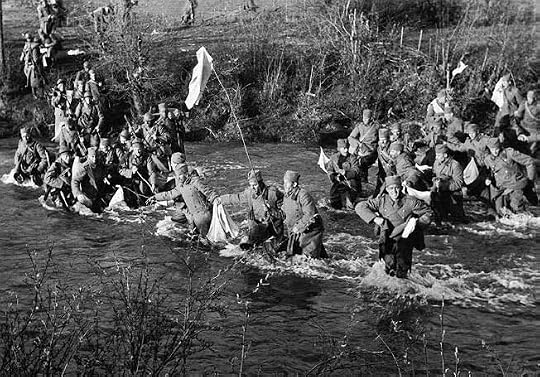
Andrija Gavrilović passes his war years beside a river, watching swimmers manage mostly on their own, and his single true rescue turns out to be the worst catch of his career. He pulls a German officer from the current and hands him, unknowingly, a second breath. Gratitude sinks fast in occupied Serbia. Neighbors read the rescue as a handshake with the enemy, and Andrija learns that pulling one man from water can drag a reputation straight to the bottom.
Decades later, in a West German cell, he stands trial for killing that same officer, and Pekić lets him build a defense from Plato, borrowing Socrates page by page. A lifeguard citing a philosopher makes fine comedy on its own. One job keeps bodies afloat and the other keeps minds awake, and Andrija tries both with equal clumsiness and equal sincerity. His apology, like the original, wins every listener, but will it win the judges holding the verdict?
The title carries its own double current. An apology in the Greek sense means a defense, a courtroom speech long before it came to mean a regret. Pekić lets us watch that distinction worked out in a cell offering only walls and a man's own testimony. Socrates went down swallowing hemlock, calm and philosophical to the last swallow. Andrija went down first, years earlier, hauling a man from a river, a rescue that bought him exile instead of thanks.
Pekić writes with comic patience, letting tragedy seep through small cracks instead of storming the room. Andrija stays too honest for his own good and too literal for his century, a simple man paddling through complicated currents. History here moves like a river indifferent to swimming skill or good intention, sweeping the decent along with the guilty. A conscience that floats even when logic sinks.
Translator Bojan Mišić keeps the sentences brisk and buoyant even as the plot pulls toward despair, and the final chapters, titled with grim accuracy, borrow gravity from Socrates, though composure stays somewhere else entirely. Andrija goes down paddling against a current that keeps handing him hooks instead of ropes.
A slender book making a devastating case that decency drowns people as readily as malice. The line separating a rescue from a crime turns on the moment someone chooses to stand on the bank and watch.
Borislav Pekić (1930–1992) was born in Podgorica, Montenegro, and grew up moving between cities in Serbia, Montenegro, and Croatia before finishing school in Belgrade. In 1948, right out of high school, he was arrested on charges of belonging to the secret "Yugoslav Democratic Youth" association and sentenced to fifteen years in prison, serving five before a pardon. He contracted tuberculosis during his sentence, and used the time to draft extensive outlines for the novels he'd write decades later, including The Apology and the Last Days, which grew out of his broader trilogy about the aftermath of World War II.
He trained in psychology at Belgrade University and spent years as a screenwriter before turning to fiction. His 1970 novel, Houses (The Pilgrimage of Arsenije Njegovan) won the NIN Award, Serbia's top literary prize, which helped him secure a passport to leave the country. He emigrated to London in 1971.
Once he left, Yugoslav authorities treated him as persona non grata and blocked publication of his work at home for several years, which is why The Apology and the Last Days (1975 in the original Serbian) had to make its way to readers under quiet institutional freeze.
He kept writing prolifically in exile: The Rise and Fall of Icarus Gubelkian, How to Quiet a Vampire, and eventually his major work, the multivolume Golden Fleece, published across 1978–1986, which drew comparisons from international critics to James Joyce's Ulysses and cemented him as one of the defining Serbian prose writers of the century.
He also stayed politically active, co-founding Serbia's Democratic Party during the late Communist period, and was elected a corresponding member of the Serbian Academy of Sciences and Arts in 1985. He died in London in 1992.
He's consistently ranked among the most important Serbian writers of the twentieth century, prized for combining rigorous historical and philosophical research with dark comedy and a documentary-style prose method. A habit traceable straight back to the outlines he built in prison. The Apology and the Last Days is a minor entry by page count next to Golden Fleece, but it's part of the loose WWII trilogy that established his reputation for treating ordinary people caught in historical machinery with irony and tenderness. Its debt to Plato's Apology is characteristic of how freely he let classical and philosophical texts structure otherwise plain, almost folkloric stories.
The English translation only arrived in 2012, decades after most of his other major work had already been rendered into English, which is part of why it remains one of his lesser-known titles outside the Balkans despite the esteem he holds within Serbian letters. I highly recommend that you try to get your hands on a copy.
[image error]
❤️ 🇮🇱
Andrija Gavrilović passes his war years beside a river, watching swimmers manage mostly on their own, and his single true rescue turns out to be the worst catch of his career. He pulls a German officer from the current and hands him, unknowingly, a second breath. Gratitude sinks fast in occupied Serbia. Neighbors read the rescue as a handshake with the enemy, and Andrija learns that pulling one man from water can drag a reputation straight to the bottom.
Decades later, in a West German cell, he stands trial for killing that same officer, and Pekić lets him build a defense from Plato, borrowing Socrates page by page. A lifeguard citing a philosopher makes fine comedy on its own. One job keeps bodies afloat and the other keeps minds awake, and Andrija tries both with equal clumsiness and equal sincerity. His apology, like the original, wins every listener, but will it win the judges holding the verdict?
The title carries its own double current. An apology in the Greek sense means a defense, a courtroom speech long before it came to mean a regret. Pekić lets us watch that distinction worked out in a cell offering only walls and a man's own testimony. Socrates went down swallowing hemlock, calm and philosophical to the last swallow. Andrija went down first, years earlier, hauling a man from a river, a rescue that bought him exile instead of thanks.
Pekić writes with comic patience, letting tragedy seep through small cracks instead of storming the room. Andrija stays too honest for his own good and too literal for his century, a simple man paddling through complicated currents. History here moves like a river indifferent to swimming skill or good intention, sweeping the decent along with the guilty. A conscience that floats even when logic sinks.
Translator Bojan Mišić keeps the sentences brisk and buoyant even as the plot pulls toward despair, and the final chapters, titled with grim accuracy, borrow gravity from Socrates, though composure stays somewhere else entirely. Andrija goes down paddling against a current that keeps handing him hooks instead of ropes.
A slender book making a devastating case that decency drowns people as readily as malice. The line separating a rescue from a crime turns on the moment someone chooses to stand on the bank and watch.
Borislav Pekić (1930–1992) was born in Podgorica, Montenegro, and grew up moving between cities in Serbia, Montenegro, and Croatia before finishing school in Belgrade. In 1948, right out of high school, he was arrested on charges of belonging to the secret "Yugoslav Democratic Youth" association and sentenced to fifteen years in prison, serving five before a pardon. He contracted tuberculosis during his sentence, and used the time to draft extensive outlines for the novels he'd write decades later, including The Apology and the Last Days, which grew out of his broader trilogy about the aftermath of World War II.
He trained in psychology at Belgrade University and spent years as a screenwriter before turning to fiction. His 1970 novel, Houses (The Pilgrimage of Arsenije Njegovan) won the NIN Award, Serbia's top literary prize, which helped him secure a passport to leave the country. He emigrated to London in 1971.
Once he left, Yugoslav authorities treated him as persona non grata and blocked publication of his work at home for several years, which is why The Apology and the Last Days (1975 in the original Serbian) had to make its way to readers under quiet institutional freeze.
He kept writing prolifically in exile: The Rise and Fall of Icarus Gubelkian, How to Quiet a Vampire, and eventually his major work, the multivolume Golden Fleece, published across 1978–1986, which drew comparisons from international critics to James Joyce's Ulysses and cemented him as one of the defining Serbian prose writers of the century.
He also stayed politically active, co-founding Serbia's Democratic Party during the late Communist period, and was elected a corresponding member of the Serbian Academy of Sciences and Arts in 1985. He died in London in 1992.
He's consistently ranked among the most important Serbian writers of the twentieth century, prized for combining rigorous historical and philosophical research with dark comedy and a documentary-style prose method. A habit traceable straight back to the outlines he built in prison. The Apology and the Last Days is a minor entry by page count next to Golden Fleece, but it's part of the loose WWII trilogy that established his reputation for treating ordinary people caught in historical machinery with irony and tenderness. Its debt to Plato's Apology is characteristic of how freely he let classical and philosophical texts structure otherwise plain, almost folkloric stories.
The English translation only arrived in 2012, decades after most of his other major work had already been rendered into English, which is part of why it remains one of his lesser-known titles outside the Balkans despite the esteem he holds within Serbian letters. I highly recommend that you try to get your hands on a copy.
[image error]
❤️ 🇮🇱

Read
July 22, 2025Grehota je da Gordan Mihić u pogovoru ili predgovoru svog genijalnog scenarija za "Balkan ekspres" nije napomenuo direktan i jak uticaj ovog spisa. Možda i jeste, ko će ga znati.
Pekić je bio genije, više u misli no na papiru, više u driblingu no u konceptu, večito ironično razigran i pun života.
Gorko se smejem uvek kad ga čitam, slično osećaju koji prati filmove koje je pisao Mihić.
Pekić je bio genije, više u misli no na papiru, više u driblingu no u konceptu, večito ironično razigran i pun života.
Gorko se smejem uvek kad ga čitam, slično osećaju koji prati filmove koje je pisao Mihić.

November 5, 2023
First book I’ve read by Pekić and I loved it. It mixes the story of a naive lifeguard told from the perspective of the same man, now resolute and at peace with his (very ironic, and unfair) fate. It left me with a certain sadness, but I also feel like I gained some insight into the Balkan perspective of the war and occupation, and it made me excited to read more of Platons’ works and of Yugoslavia, and definitely more of Pekić.

January 5, 2025
Немам шта пуно да кажем о овој књизи сем да покушавам да натерам тату да је прочита да бих имала са ким да причам о њој и да ми и даље није јасно како је ово инспирисало истоимени албум Идола. Заправо имам пуно да кажем али не волим да причам у празно па зато терам тату да је прочита. Тата неће видети ово али можда барем манифестујем да је прочита. Молим те тата. Прочитај.

April 14, 2012
It's a fresh and convincing perspective of a simple soul's interpretation of Plato's Apology. Beautifully crafted, it entertains and simultaneously allows introspection without ever being Erziehungs Roman.
July 24, 2026
pekićevski tragikomični anti-Stranac i magistratura o tome kako se lako osedlavaju ljudske sudbine
February 25, 2013
Narodski ispričana priča o životu Andrije Gavrilovića, prožeta izvanrednim humorom, a ujedno i prvi susret sa Pekićem, naslućuje dugo prijateljstvo.

April 30, 2015
Izvanredna.

June 2, 2022
3.5 rounded up

July 15, 2021
"A meni je uveliko šezdeseta, i već mi je dojadilo da u mom životu uvek biva kako drugi snuju, a ja da sam kao stajaća voda, bara koja se uzmućka samo ako baciš u nju kamen."
*
"Sa zamlatama ne koristi da se preganjaš. Bolje ih pusti da se istutnje."
*
"Dokončaće se ovoga puta po mojoj volji, a ne po tuđoj, kako me je do sada zapadalo. Uvek su me nekud vukli drugi, uvek se sa mnom nešto radilo, a ja sam samo stajao i gledao šta se čini. I imaš život, i nemaš ga.
Živ si, doduše, imaš, dakle, život, ali na đubre možeš da ga baciš kad nije tvoj, kad ti njime ne kormaniš. Sad mi je kormilo u ruci. Držim ga čvrsto, sa obe ruke, i dokraja ga ispuštati neću. Pa šta bude da bude."
*
"Za dobar sud činjenice su lutke bez duše sve dok proces ne razmrsi konce što te lutke na kriminalnoj sceni pokreću, sve dok sud, veli, ne spozna stroj koji ih iza kulisa događaja organizuje u zločinačku predstavu. Sve dotle pravda ima posla sa prividom i njen kantar odmerava pogrešnu težinu."
*
"Sa zamlatama ne koristi da se preganjaš. Bolje ih pusti da se istutnje."
*
"Dokončaće se ovoga puta po mojoj volji, a ne po tuđoj, kako me je do sada zapadalo. Uvek su me nekud vukli drugi, uvek se sa mnom nešto radilo, a ja sam samo stajao i gledao šta se čini. I imaš život, i nemaš ga.
Živ si, doduše, imaš, dakle, život, ali na đubre možeš da ga baciš kad nije tvoj, kad ti njime ne kormaniš. Sad mi je kormilo u ruci. Držim ga čvrsto, sa obe ruke, i dokraja ga ispuštati neću. Pa šta bude da bude."
*
"Za dobar sud činjenice su lutke bez duše sve dok proces ne razmrsi konce što te lutke na kriminalnoj sceni pokreću, sve dok sud, veli, ne spozna stroj koji ih iza kulisa događaja organizuje u zločinačku predstavu. Sve dotle pravda ima posla sa prividom i njen kantar odmerava pogrešnu težinu."

August 24, 2022
En livräddares försvarstal, a novel by Borislav Pekić, translated from the Serbian into Swedish by Djordje Zarković. This novel has been published in English as The Apology and the Last Days, but the Swedish title does mean Apology of a Lifeguard. I don't know which one is more faithful to the original Serbian title.
Andrija Gavrilović is a poor, naive, unlucky man who works as a beach lifeguard in Serbia before WW2 and under the German occupation. For 15 years, he gets no chance to rescue anyone from the river, but he finally gets to help one drowning person. Which, in its turn, leads to a sequence of tragicomical misfortunes. Years later, in a Western German prison, Andrija, inspired by his reading of Apology of Socrates, tells the whole truth from his not-too-clever point of view. Some of the novel's scenes are unforgettable, and the closing death is particularly pathetic and chuckle-inducing.
This compelling novel is a little masterpiece of irony and political commentary by the one author I consider the most (although not completely unknown) shining hidden gem of European literature. "Apology of a Lifeguard" is a fantastic novel by a true master writer, and I can't recommend it enough. Do read it in any language available to you.
This book is the third instalment of a loose trilogy that includes another of Pekić's masterpieces: "How to Quiet a Vampire".
Andrija Gavrilović is a poor, naive, unlucky man who works as a beach lifeguard in Serbia before WW2 and under the German occupation. For 15 years, he gets no chance to rescue anyone from the river, but he finally gets to help one drowning person. Which, in its turn, leads to a sequence of tragicomical misfortunes. Years later, in a Western German prison, Andrija, inspired by his reading of Apology of Socrates, tells the whole truth from his not-too-clever point of view. Some of the novel's scenes are unforgettable, and the closing death is particularly pathetic and chuckle-inducing.
This compelling novel is a little masterpiece of irony and political commentary by the one author I consider the most (although not completely unknown) shining hidden gem of European literature. "Apology of a Lifeguard" is a fantastic novel by a true master writer, and I can't recommend it enough. Do read it in any language available to you.
This book is the third instalment of a loose trilogy that includes another of Pekić's masterpieces: "How to Quiet a Vampire".

May 16, 2022
Komična i zanimljiva priča o tragičnoj sudbini jednog karaktera, sa fino utkanom kritikom komunističke vlasti. Andrija Gavrilović je po svojoj paranoidnoj prirodi, samoživosti, krutosti moralnih principa i poricanju društvene stvarnosti upadljivo sličan Arseniju Njegovanu.

January 20, 2019
i am lately really feeling these types of books: war and all around it written from a perspective of a regular person (see knjiga o milutinu). very poignant story of a former "lifeguard" and how seemingly simple situations can lead to a disaster. beautifully written.

August 6, 2020
Odlična. Čisto uživanje kad se čita.

December 4, 2020
Pekic je ozbiljan kandidat za mog omiljenog domaceg pisca.
July 13, 2012
It is really a shame that the Unbound Europe series has been discontinued. I have not read all of their books, but all of them that I have read were at least good; and most of them, like this one, were great. Many of their releases were also books that probably wouldn't have been translated by anyone else, so their departure will leave a hole in the English literary sphere.
At the very least, since this book was brilliant, they went out on a good note that they can be quite proud of.
At the very least, since this book was brilliant, they went out on a good note that they can be quite proud of.
Displaying 1 - 17 of 17 reviews