

What do you think?

The Music between Us: Is Music a Universal Language?
From our first social bonding as infants to the funeral rites that mark our passing, music plays an important role in our lives, bringing us closer to one another. In The Music between Us, philosopher Kathleen Marie Higgins investigates this role, examining the features of human perception that enable music’s uncanny ability to provoke, despite its myriad forms across continents and throughout centuries, the sense of a shared human experience. Drawing on disciplines such as philosophy, psychology, musicology, linguistics, and anthropology, Higgins’s richly researched study showcases the ways music is used in rituals, education, work, healing, and as a source of security and—perhaps most importantly—joy. By participating so integrally in such meaningful facets of society, Higgins argues, music situates itself as one of the most fundamental bridges between people, a truly cross-cultural form of communication that can create solidarity across political divides. Moving beyond the well-worn takes on music’s universality, The Music between Us provides a new understanding of what it means to be musical and, in turn, human.
- GenresMusicPhilosophyScience
277 pages, Hardcover
First published January 1, 2012
About the author
Kathleen Marie Higgins
31 books23 followersKathleen Marie Higgins (born 1954) is Professor of Philosophy at The University of Texas at Austin where she has been teaching for over 20 years. She earned her B.A. in music from the University of Missouri at Kansas City and completed her graduate work in philosophy at Yale University, receiving her M.A., M.Phil, and Ph.D.
Professor Higgins has taught at the University of California, Riverside, and she is a regular visiting professor at the University of Auckland. She has also held appointments as Resident Scholar at the Rockefeller Foundation’s Bellagio Study and Conference Center (1993) and as a Visiting Fellow of the Australian National University Philosophy Department and the Canberra School of Music (1997). She also received an Alumni Achievement Award from the Conservatory of Music at the University of Missouri–Kansas City (1999).
A prolific writer and recognized Nietzsche scholar, her books include The Music of Our Lives (Temple University Press) and Nietzsche’s Zarathustra (Temple University Press), which was named one of the Outstanding Academic Books of 1988-1989 by Choice. She co-edited numerous books with her late husband, Professor Robert C. Solomon, including Reading Nietzsche, A Short History of Philosophy, and the Routledge History of Philosophy, Volume VI: The Age of German Idealism.
Professor Higgins has taught at the University of California, Riverside, and she is a regular visiting professor at the University of Auckland. She has also held appointments as Resident Scholar at the Rockefeller Foundation’s Bellagio Study and Conference Center (1993) and as a Visiting Fellow of the Australian National University Philosophy Department and the Canberra School of Music (1997). She also received an Alumni Achievement Award from the Conservatory of Music at the University of Missouri–Kansas City (1999).
A prolific writer and recognized Nietzsche scholar, her books include The Music of Our Lives (Temple University Press) and Nietzsche’s Zarathustra (Temple University Press), which was named one of the Outstanding Academic Books of 1988-1989 by Choice. She co-edited numerous books with her late husband, Professor Robert C. Solomon, including Reading Nietzsche, A Short History of Philosophy, and the Routledge History of Philosophy, Volume VI: The Age of German Idealism.
Ratings & Reviews
Friends & Following
Create a free account to discover what your friends think of this book!
Community Reviews
Displaying 1 - 4 of 4 reviews

November 21, 2016
This book is about how we humans have a universal language with which we can communicate important information: emotions, intentions, states of mind. Etc. It is not very easy to read and it can get arid at sometimes, but it can surely constitute a source of knowledge for the really interested reader.
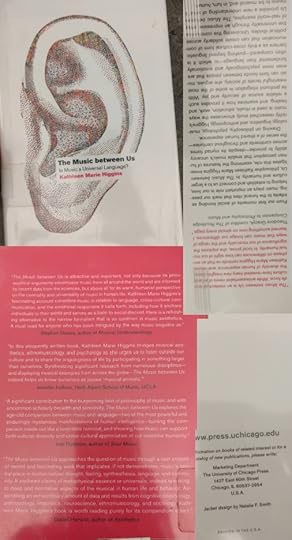
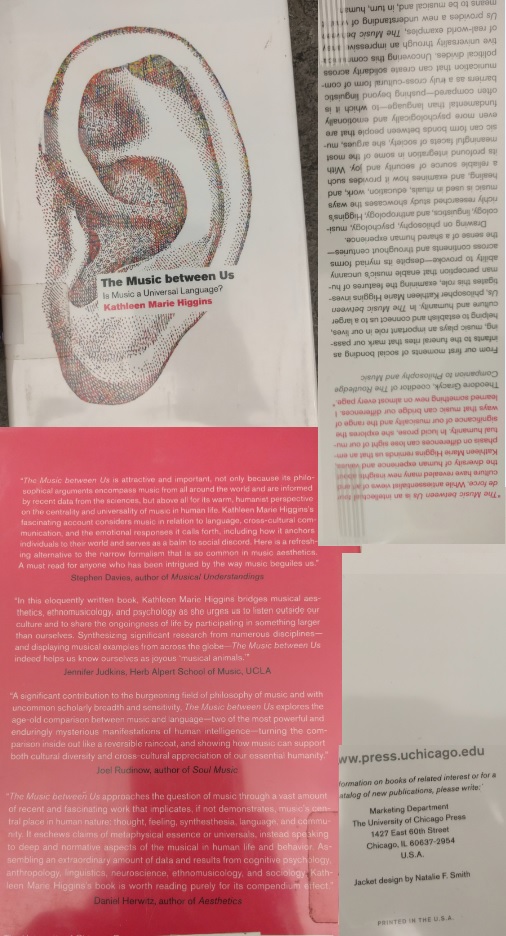
This is the jacket and the cover of the book I read. Sorry, I missed the position of one of the jackets. You will need to turn the image around.
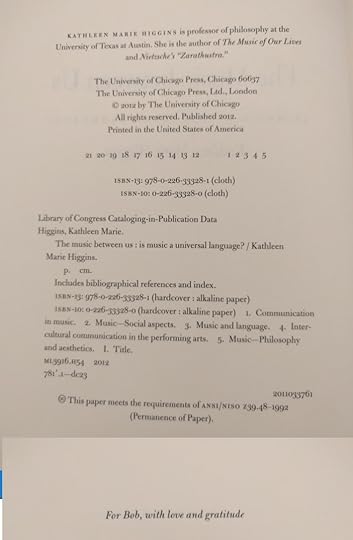
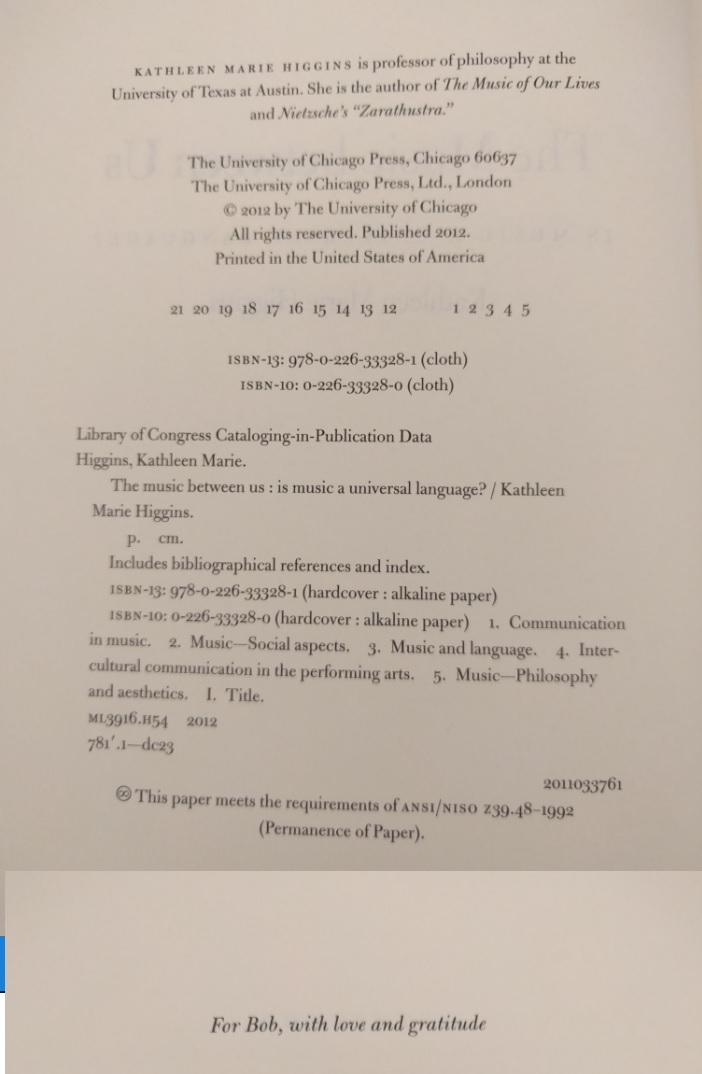
This is the editorial information. This is a 2012 book. It is amazing how current is the writing about such an ancient topic.
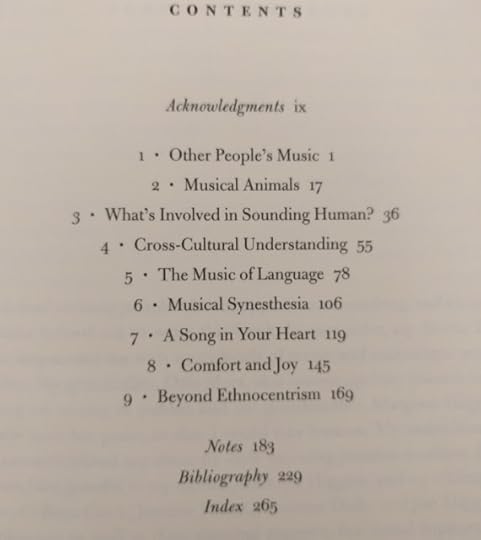
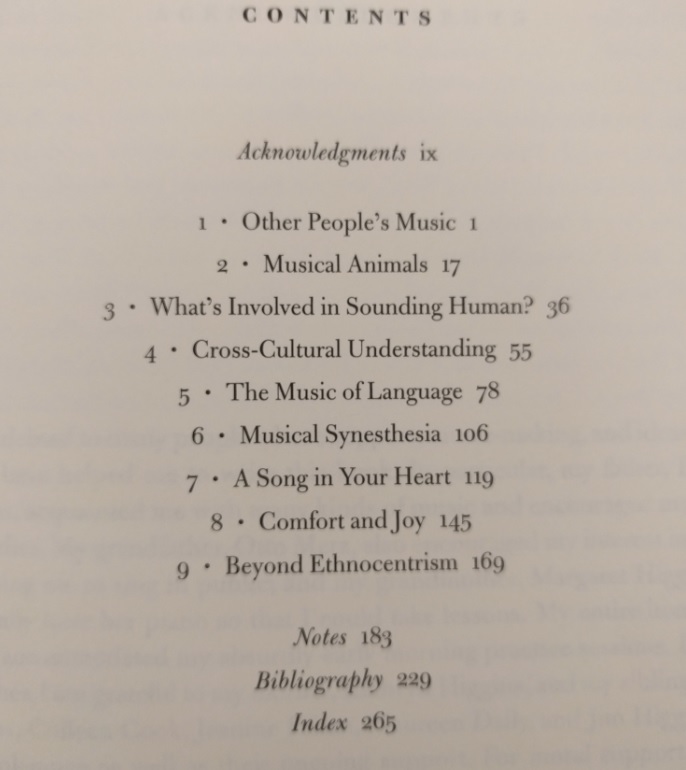
This is the table of contents. Here you see how the book travels from philosopy, to history to cultural studies, to biology and finally to the sense of trascendence. It is a beautiful and complex journal, and all in one single book!
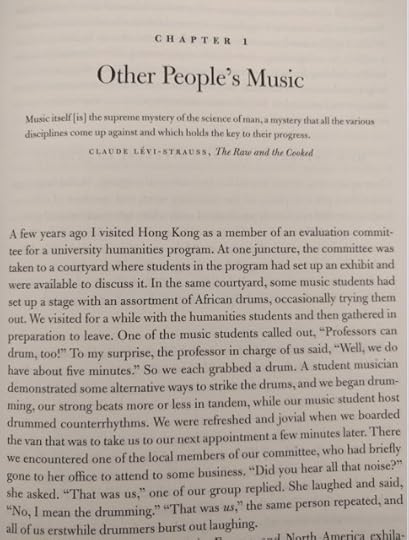
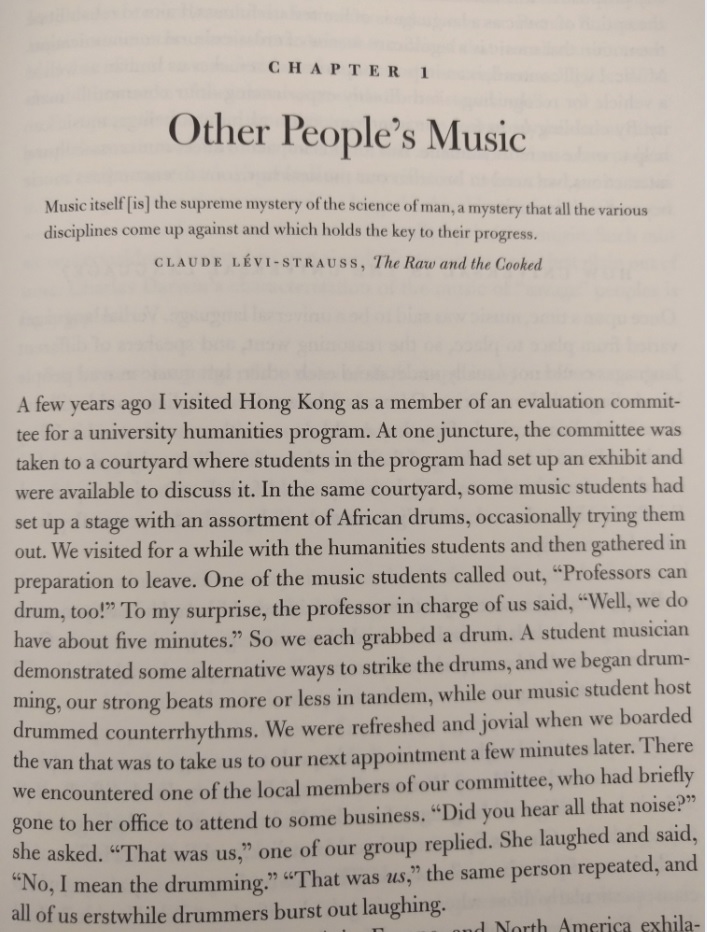
This is the first page of the book, where the author introduces herself as a professor:
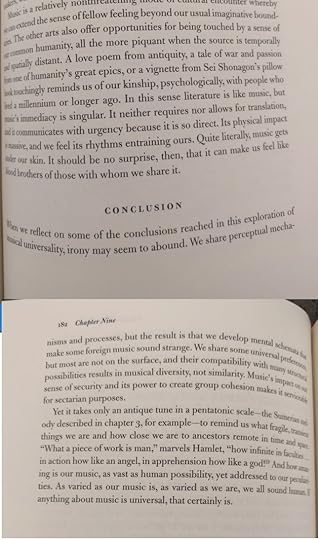
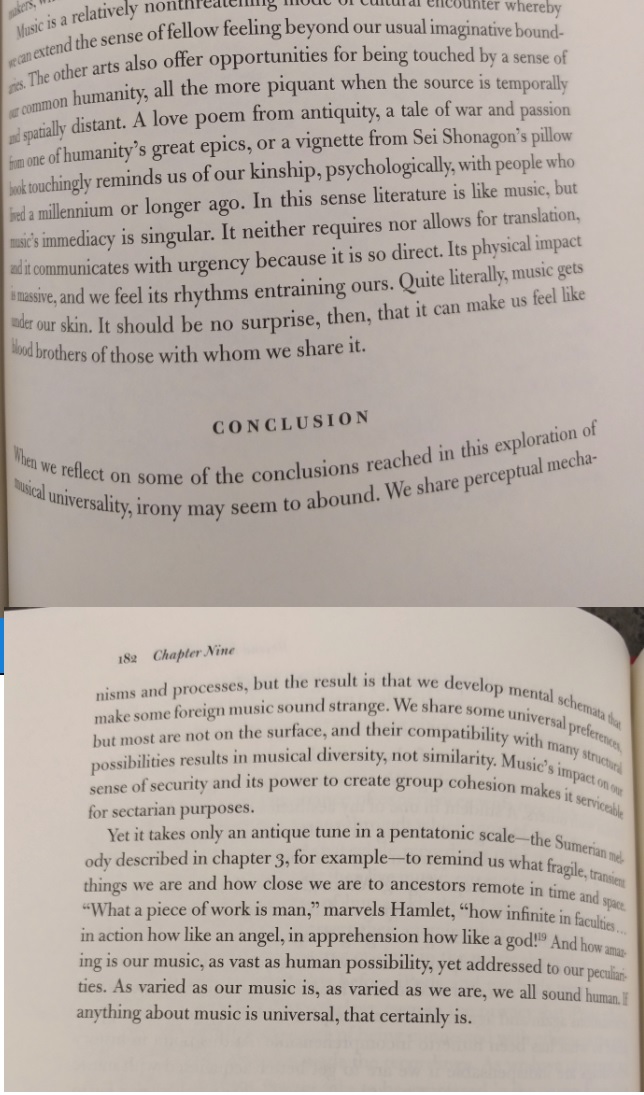
Here is the conclusion of the book. A very important-looking paragraph with lots of big words:
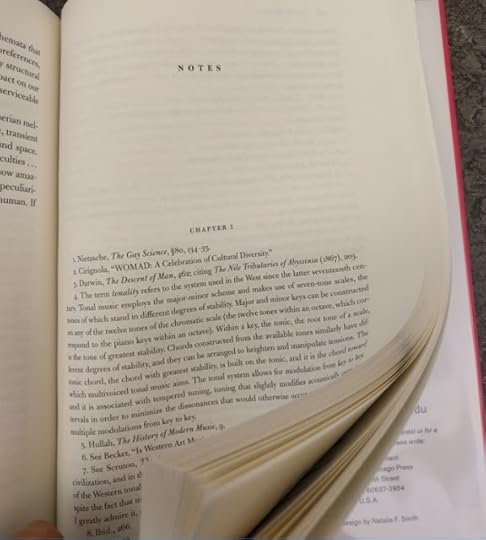
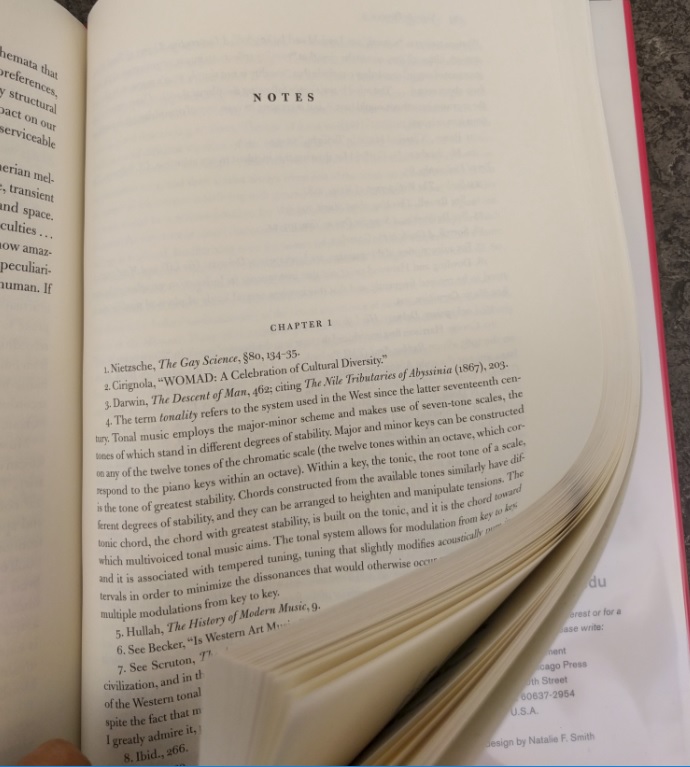
Check out how thick the notes section is. It is almost a quarter of the book. She had to read a lot to write this book!
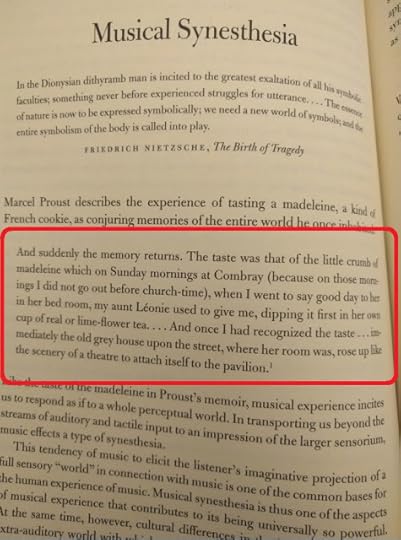
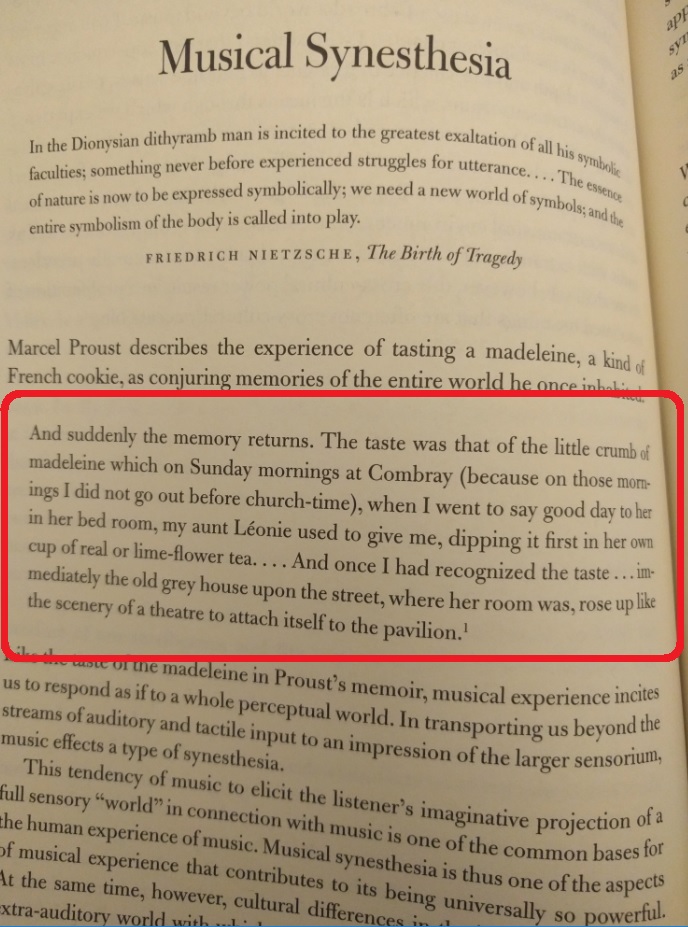
This is a reference to Proust. I couldn't resist copying it here, since I love Proust's famous novel (all the 5000 pages of it!)
This book is difficult to read due to the highly specialized philosophical language, but if you are really passionate for the topic of music, then you should give it a try.
I hope you liked this entry. Did you know that I also have a blog? Here is the link! https://www.lunairereadings.blogspot.com
This is the jacket and the cover of the book I read. Sorry, I missed the position of one of the jackets. You will need to turn the image around.
This is the editorial information. This is a 2012 book. It is amazing how current is the writing about such an ancient topic.
This is the table of contents. Here you see how the book travels from philosopy, to history to cultural studies, to biology and finally to the sense of trascendence. It is a beautiful and complex journal, and all in one single book!
This is the first page of the book, where the author introduces herself as a professor:
Here is the conclusion of the book. A very important-looking paragraph with lots of big words:
Check out how thick the notes section is. It is almost a quarter of the book. She had to read a lot to write this book!
This is a reference to Proust. I couldn't resist copying it here, since I love Proust's famous novel (all the 5000 pages of it!)
This book is difficult to read due to the highly specialized philosophical language, but if you are really passionate for the topic of music, then you should give it a try.
I hope you liked this entry. Did you know that I also have a blog? Here is the link! https://www.lunairereadings.blogspot.com

November 10, 2017
Kathleen Marie Higgins has written an amazing book here. Each chapter could have been much more fully and deeply developed into a book of its own. Of course, this also seems to have been Higgins purpose, to summarize relevant work in the fields relevant to the issue at hand, to help guide (in a sense) her readers through the available data and research and to provide a schema (of sorts) through which to approach music's innate capacity to promote unity and to even communicate across linguistic and cultural boundaries.
That being said, this work is definitely more oriented towards academics and scholars. Each chapter starts with a thesis and then she works systematically to that end, arguing her point and supporting it with research and evidence along the way. One could use her work in any particular area she covers as a starting point for further research in that direction.
I liked the balanced approach she took. In many cases, her point in outlining the different perspectives or views was not to argue a particular one, but rather to argue that most views have something to contribute, something to say. And that behind most of the views there is a common theme or conceptual foundation which promotes a more unified concept of music and its being in the world than any particular individual perspective or argument seems to acknowledge.
As a worship leader I found the underlying themes of the communal nature of music fascinating and convicting. As Begbie would say, 'Music is something that is done,' and what Higgins is arguing is that music is accomplishing a mapping, the entrainment of a schema upon one's mind. That it does this is universal, however the schema is not always the same. I think the differentiation between an entrained musical schema and the actual reality of what music is are hard for many to separate, because music is most often associated with what is done (because that is how it is known).
The book dives into some deep waters in places and so I don't necessarily think it is relevant or necessary for all to read, but if you want to dive a bit beneath the surface of what music is and how it can function across cultural boundaries this is an excellent place to start. Where Begbie has, in his books, limited himself to thinking about and analyzing western music, Higgins jumps the fence, so to speak, and does so in a way which relishes the unknown territory (at least for someone like me who is much less familiar with non-western music).
One of my favorite concepts that she argues, and which I wholeheartedly agree, is that music is not a language, but that language is a music. This she argues most effective in the 5th and 6th chapters, I think. But her discussion and engagement with the concept solidified many thoughts I had been wrestling with in regards to music's communicative capacity. Those two chapters alone are worth the price of the book, in my mind.
In the end I do highly recommend the book. It was excellently written and I liked her approach and perspective on music and its functionality in the world. I found it fascinatingly and intriguingly compatible with other perspectives I enjoy and respect (like Begbie, Zuckerkandl and even Augustine [at least in parts]). I did not get the impression that she was a Christian or that the book was written from a Christian worldview, but much of what she discusses is relevant to what occurs in a church on any given Sunday. It's definitely a book I would recommend to worship leaders or music pastors, and could probably be an excellent jumping point for conversations about music among church leadership.
If you're intrigued about music's capacity to transcend linguistic barriers, or if you want to dive a bit deeper into the philosophy behind music itself, this is a fascinating book I don't' think you will regret taking the time to read and digest.
That being said, this work is definitely more oriented towards academics and scholars. Each chapter starts with a thesis and then she works systematically to that end, arguing her point and supporting it with research and evidence along the way. One could use her work in any particular area she covers as a starting point for further research in that direction.
I liked the balanced approach she took. In many cases, her point in outlining the different perspectives or views was not to argue a particular one, but rather to argue that most views have something to contribute, something to say. And that behind most of the views there is a common theme or conceptual foundation which promotes a more unified concept of music and its being in the world than any particular individual perspective or argument seems to acknowledge.
As a worship leader I found the underlying themes of the communal nature of music fascinating and convicting. As Begbie would say, 'Music is something that is done,' and what Higgins is arguing is that music is accomplishing a mapping, the entrainment of a schema upon one's mind. That it does this is universal, however the schema is not always the same. I think the differentiation between an entrained musical schema and the actual reality of what music is are hard for many to separate, because music is most often associated with what is done (because that is how it is known).
The book dives into some deep waters in places and so I don't necessarily think it is relevant or necessary for all to read, but if you want to dive a bit beneath the surface of what music is and how it can function across cultural boundaries this is an excellent place to start. Where Begbie has, in his books, limited himself to thinking about and analyzing western music, Higgins jumps the fence, so to speak, and does so in a way which relishes the unknown territory (at least for someone like me who is much less familiar with non-western music).
One of my favorite concepts that she argues, and which I wholeheartedly agree, is that music is not a language, but that language is a music. This she argues most effective in the 5th and 6th chapters, I think. But her discussion and engagement with the concept solidified many thoughts I had been wrestling with in regards to music's communicative capacity. Those two chapters alone are worth the price of the book, in my mind.
In the end I do highly recommend the book. It was excellently written and I liked her approach and perspective on music and its functionality in the world. I found it fascinatingly and intriguingly compatible with other perspectives I enjoy and respect (like Begbie, Zuckerkandl and even Augustine [at least in parts]). I did not get the impression that she was a Christian or that the book was written from a Christian worldview, but much of what she discusses is relevant to what occurs in a church on any given Sunday. It's definitely a book I would recommend to worship leaders or music pastors, and could probably be an excellent jumping point for conversations about music among church leadership.
If you're intrigued about music's capacity to transcend linguistic barriers, or if you want to dive a bit deeper into the philosophy behind music itself, this is a fascinating book I don't' think you will regret taking the time to read and digest.

January 6, 2022
It’s hard to know where to start in talking about this book. On one hand, upon looking at the contents of the book and the topics it covers one might get excited to learn the different views of whether music is a universal language. But then when you get to reading it and realise that the book is just not accessibly written.
In chapter 8, for instance, they key takeaways of ‘music brings cultures together,’’people like repetition’ and ‘musical experiences make everyone live in the moment’ are written in 15 (or so) pages of academic jargon. Of course, above examples are a tiny bit tongue in cheek, but the point remains. One could go to a Pop Punk show and all three of these points are announced by the vocalist!
Ultimately, however, I do wholeheartedly agree with the fundamental point Higgins is trying to make. It is so easy to stick purely to music we know and become quite pretentious over it, when there is so much more to be gained from listening and appreciating the music of other cultures. Heck, imagine how boring music would be if each culture sticked purely to its ‘style.’
Overall, I would not recommend this book to someone who may be interested in the title, musician or not. Academic? Perhaps. But general reader, no. I am willing to concede that maybe I just need another take at this book and I don’t want to dismiss the odd nugget of information, but the effort/reward was not worth it for me
In chapter 8, for instance, they key takeaways of ‘music brings cultures together,’’people like repetition’ and ‘musical experiences make everyone live in the moment’ are written in 15 (or so) pages of academic jargon. Of course, above examples are a tiny bit tongue in cheek, but the point remains. One could go to a Pop Punk show and all three of these points are announced by the vocalist!
Ultimately, however, I do wholeheartedly agree with the fundamental point Higgins is trying to make. It is so easy to stick purely to music we know and become quite pretentious over it, when there is so much more to be gained from listening and appreciating the music of other cultures. Heck, imagine how boring music would be if each culture sticked purely to its ‘style.’
Overall, I would not recommend this book to someone who may be interested in the title, musician or not. Academic? Perhaps. But general reader, no. I am willing to concede that maybe I just need another take at this book and I don’t want to dismiss the odd nugget of information, but the effort/reward was not worth it for me

January 4, 2022
The impassioned orator, bard, or musician, when with his varied tones and cadences he excites the strongest emotions in his hearers, little suspects that he uses the same means by which his half-human ancestors long ago aroused each other’s ardent passions, during their courtship and rivalry. – Charles Darwin
Henry Wadsworth Longfellow is said to have christened music "the universal language." But is music a language, or is language a music? In one of the more fascinating parts of The Music between Us, Kathleen Higgins, a professor of philosophy, takes the position that language is a music more than music is a language. Thrilling to read, but not exactly successful: as readers come to find out, the best answer is that music is a language and language is a music.
The scholarly angle taken by this book is such an asset. Delicious little morsels abound, such as Simon Shaheen's naively delightful definition of a melody as "a group of notes that are in love with each other," a completely appreciable linguistic explanation of why English speakers pronounce "I have to" as "I hafta," and – for musicians – a lucid articulation of why sonata-allegro form just works.
In all, there must have been two dozen things that made me think to myself, "I have noticed that!" For me, the most affecting moment was when I learned why I, an irreligious person, so enjoy attending church:
One would not be entirely wrong to go to church for the music if the purpose of going to church is to tune in to what is larger than one’s individual ego. While the qualitative character of the altered sense of self and the doctrinal interpretations of what is involved differ, music’s accomplishment is to attune us with what is beyond ourselves. By building and reinforcing ontological security, music facilitates secure participation in a world with other, fellow beings. What begins in an infant’s sense of being with its mother expands to open-ended spiritual rapport. (157)(Almost a century ago in The Big Money , John Dos Passos has a character say that "unbelief dissolves in music like a lump of sugar in a glass of hot tea.")
Rather than be driven by an overarching thesis, this book seemed more at home as a series of essays, some more convincing than others. The last chapter's admonishment to stop being such a bigot and go and expose myself to foreign music – we will better understand other cultures, you see, if we try to understand their music – did not land. I found myself aching for more of the late Roger Scruton, who never shied from a glass house in declaring certain things just better, and who Higgins uses mostly as a foil for her enlightened, musically relativistic world in which every form of music is celebrated. I was so grateful to Higgins for her references to Scruton's The Aesthetics of Music that I bought a copy.
Displaying 1 - 4 of 4 reviews