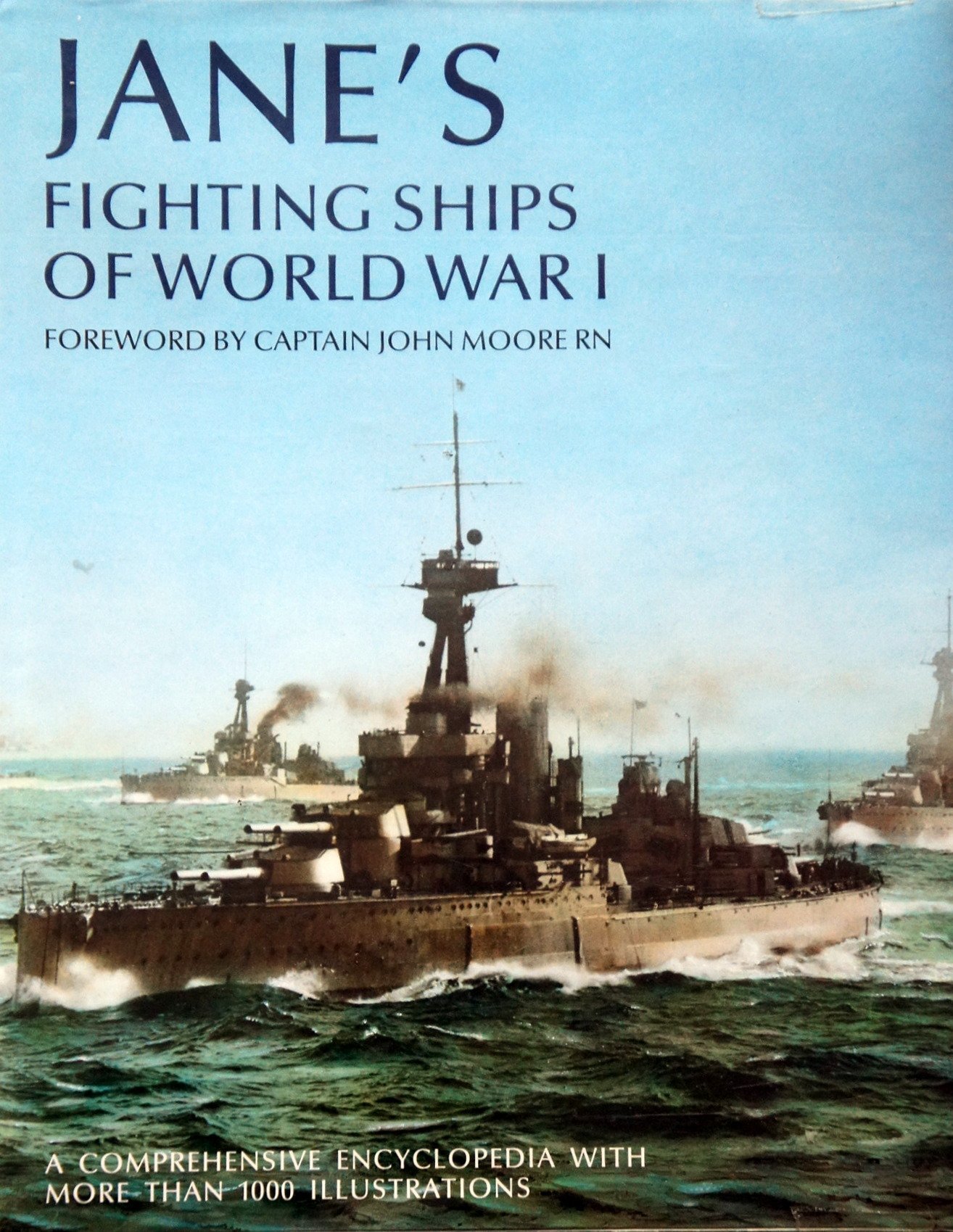
This extraordinary one-volume encyclopedia of WWI warships includes more than 1,000 photographs, line drawings and data tables, providing the reader with instant reference to the great fleets that clashed at sea. It also covers the many warships launched or completed during the last months of hostilities when shipyards were still working at full speed. For this edition, the book has been completely redesigned in a larger and easier-to-handle format. Oversized. 10" x 12 1/2".
Captain John Evelyn Moore was a submariner in the Royal Navy, a Fellow of the Royal Geographical Society and after retirement from the Royal Navy the author for 15 years of the authoritative naval publication Jane's Fighting Ships. (Source: https://en.wikipedia.org/)
JANE'S FIGHTING SHIPS OF WORLD WAR I is a cornucopia of data about the navies during the WWI time frame. I had a good idea of who the Allies and Central Powers were so I was wondering why this book listed the navies of such out of the way places like Haiti and Ecuador. As it turns out, all these countries listed in the book while not actually fighting the Central Powers had at least served diplomatic ties with them. I learned quite a few other things as well.
The British M Class submarine monitor carried a 12 inch gun. While on the surface, the gun was loaded and the barrel raised to a high angle of elevation. The sub dived down to about 12 to 20 feet leaving the barrel and periscope above the surface. Aimed by the periscope, it fired, but then the sub had to resurface to reload. Some early subs carried two or more torpedoes on the outside of the submarine and when dropped free started their run. In the age before radar and sonar, searchlights were important for searching out targets in the dead of night. Battleships sometimes carried submerged torpedo tubes as a nasty surprise for the enemy. When one considers that all 13 of the battleships lost by the British during the war were sunk by either mines or torpedoes I could see the logic in this. Ships of World War II carried massive anti-aircraft armament, so reading that a World War I battleship only carried 4 anti-aircraft guns shows how naive the world's admirals were before Billy Mitchell committed insubordination.
There was a lot of information, and not just about the ships themselves. There is a glossary of technical terms in nine different languages. For the British the dockyards, naval ports and harbors are listed, along with naval charts, at home and abroad. There is a list of engine builders. Uniform sleeve insignia for rank is shown. Naval ordnance lists everything from the .45 inch Webley pistol to the 15 inch guns mounted on the Dreadnoughts. Warship silhouettes are shown. The placement of armor on ships is highlighted along with arcs of fire for the guns. Most ships carried coal though a few of the newer ones also carried oil. All the technical data is provided where possible stating armaments, armor placement, crew size, speed, range, and etc. Even the country's coinage was listed for some.
The reason for the warship silhouettes was it was an important step in ship identification. How many smokestacks did it have? Raiders sometimes carried extra false ones.
The thickest armor was on the main gun turrets and running down into the magazines, the conning tower, and a belt running along the water line for most of the length of the ship. No wonder mines and torpedoes were so deadly!
Placement of the guns were shown. Listed were the arcs of fire, such as to the front to shoot at the ones you are chasing, to the rear to shoot at the ones chasing you, and the boardside where the front, rear, and the guns on one side can all fire to the port or starboard, to the dream of every ship's captain. The position of the guns on some of the older ships were quite peculiar. It makes one wonder just what were they thinking?
Over all, this is a handy book for students of naval warfare and especially those fascinated by the naval aspects of the Great War.
Totally inaccurate as everybody from the RN to the Germans were telling huge whoppers about their ships and Jane’s had no way to verify everything. As a historical document it’s perfect, but for an accurate source you need Conway.