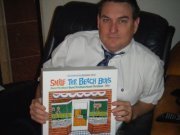
This is a good example, for me, of how the atmosphere around a book (how you learn about it, when you read it, those sorts of things) can significantly affect your reading of it. I wasn't too keen on getting this book when I first saw it, a few other sources I had recommended it somewhat obliquely, I found a used copy cheap, and there it was. I know the subtitle should lead us to think it's basically a history of the Beach Boys as a group, but the emphasis on the 50 songs also leads us to think it's going to be about fifty of their most important/famous/best/whatever songs. I didn't want yet another guy's take on the story of the Beach Boys, but letting their songs tell the story, that notion won me over to getting it (plus the cheap copy on-line). But that's not what this book is, sadly.
The author (and it is truly Mark Dillon telling the story of the Beach Boys, not the songs) tries to give us some half-hearted apology at the beginning about how he was limited in what songs he could include because all the people who responded to his pleas for personal insights and song experiences ended up slanted toward a few albums and some songs, missing some albums entirely (such as the great So Tough) and emphasizing Pet Sounds (and while it's not bad to emphasize Pet Sounds, claiming to tell the Beach Boys story by skipping entire albums because of artificial limitations is nonsense). This leads to another of the misleading aspects of the book: it claims these famous and integral contributors to the BB story are reflecting on the songs. While Mr. Dillon does quote them for that particular song, their insights and reflections are abstemious at best. Mr. Dillon's version of the BB Story does most of the talking. This is not true for all 50 songs, but it is true for more than 40 of them. The insights from the people who were there are too thin, too short, too rare. Yes, Mike Love gives you some notions, and Blondie Chaplin gives you a new line or two, but it's not nearly as much as the book wants you to think it is or how much you want.
Concomitantly, Mr. Dillon gives us insights from a large number (I'd say "disproportionate") of reflections from, well, fans. Fans that had/have their own bands in the 21st century, and some of them have even met Brian Wilson or other Beach Boys, but I don't know them. I don't know their bands. I don't care about their fan responses to these songs. Once I graduated high school, I basically drew the line of my musical experiences: the bands now and before, no more. Surely I am missing out on many wonderful artistry in the 21st century, but having seen enough "grammy-award-related ads" for today's "musical artists," I'm pretty sure the past is where it's at. Feel free to send me a list of the great ones of today I am missing to disabuse me. (Disabuse, I say, not abuse.) Returning to the focus at hand, I did not get this book to read profanity-laced adulations of the Beach Boys in meaningless, superlative terms, which is most of what we get from the "contemporary musicians/producers" upon which Mr. Dillon was dependent to construct this history. I don't want to give you examples, because they are not worth recounting. I'm not saying I can come up with more lucid praise, but that's why I'm not writing books about them (at least, not yet). The fan chapters offer nothing of value.
This book intentionally came out for the 50th anniversary of the Beach Boys, knowing full well they were going to get together and go on tour and put out a new album. So instead of waiting for that rather significant element of "their story," the book came out before that and immediately became out of date and incomplete. That decision made no sense to me, even as a cash grab for the 50th anniversary. Why not wait until it has happened so you can speak about it?
If you haven't read any general histories of the Beach Boys, and if you know about these musician-like people who saltily praise the (real) musicians the Beach Boys, this may be a fine book to read. I came to it too late in my journey through the story of the Beach Boys to appreciate it or find much worthwhile in it. It does have, as I said, three or four good chapters (such as Mike Kowalski, Mark Linnet, Billy Hinsche) with fresh and engaging insights (Mike Kowalski was the longest-termed drummer for the BB) about the history of one of the greatest bands of all times (with possibly the saddest story of all time). Thus, I don't know if I can recommend it: the aspects that entice, the insights from those who were there, are too few to be worth spending very much money. The songs do not tell their story, here, unless "their story" is one of chart positions and sales figures. Many chapters are replete with nauseating Wikipedia-like lists of data, none of which give us valuable insights into what makes the Beach Boys "the Beach Boys." It only tells us English listeners in the 1960s and '70s were more intelligent than American listeners, something we already knew. This history does give us a good sense, though, that the people who initially look like "heroes" to the Beach Boys often end up as "villains." The book gives Mike a fairly decent shake, which is nice as well. Is this the Beach Boys book for you? Not if you are looking for meaningful insight into the actual songs. That contrivance is a misleading scheme for what the book is: Mark Dillon's version of the Beach Boys Story besprinkled with rarely insightful and mostly irrelevant commentary from people of whom you may or not have heard. I honestly do not know if this book is for you, but if you can get a cheap copy on Amazon or somewhere, go for it. If you want a free one, stop on by and I'll give you mine. I'm done with it.