Jump to ratings and reviews
Rate this book

Dialogues Concerning Natural Religion. Edited and with an Introduction by S. Tweyman. [In Focus Series]. Routledge. 1991.

Rate this book
Hume's brilliant and dispassionate essay "Of Miracles" has been added in this expanded edition of his Dialogues Concerning Natural Religion, which also includes "Of the Immortality of the Soul", "Of Suicide", and Richard Popkin's illuminating Introduction.

Paperback

First published January 1, 1779

357 people are currently reading
9333 people want to read

About the author

David Hume

3,108 books1,672 followers
David Hume was a Scottish historian, philosopher, economist, diplomat and essayist known today especially for his radical philosophical empiricism and scepticism.

In light of Hume's central role in the Scottish Enlightenment, and in the history of Western philosophy, Bryan Magee judged him as a philosopher "widely regarded as the greatest who has ever written in the English language." While Hume failed in his attempts to start a university career, he took part in various diplomatic and military missions of the time. He wrote The History of England which became a bestseller, and it became the standard history of England in its day.

His empirical approach places him with John Locke, George Berkeley, and a handful of others at the time as a British Empiricist.

Beginning with his A Treatise of Human Nature (1739), Hume strove to create a total naturalistic "science of man" that examined the psychological basis of human nature. In opposition to the rationalists who preceded him, most notably René Descartes, he concluded that desire rather than reason governed human behaviour. He also argued against the existence of innate ideas, concluding that humans have knowledge only of things they directly experience. He argued that inductive reasoning and therefore causality cannot be justified rationally. Our assumptions in favour of these result from custom and constant conjunction rather than logic. He concluded that humans have no actual conception of the self, only of a bundle of sensations associated with the self.

Hume's compatibilist theory of free will proved extremely influential on subsequent moral philosophy. He was also a sentimentalist who held that ethics are based on feelings rather than abstract moral principles, and expounded the is–ought problem.

Hume has proved extremely influential on subsequent western philosophy, especially on utilitarianism, logical positivism, William James, the philosophy of science, early analytic philosophy, cognitive philosophy, theology and other movements and thinkers. In addition, according to philosopher Jerry Fodor, Hume's Treatise is "the founding document of cognitive science". Hume engaged with contemporary intellectual luminaries such as Jean-Jacques Rousseau, James Boswell, and Adam Smith (who acknowledged Hume's influence on his economics and political philosophy). Immanuel Kant credited Hume with awakening him from "dogmatic slumbers".

Ratings & Reviews

What do you think?
Rate this book

Friends & Following

Create a free account to discover what your friends think of this book!

Community Reviews

5 stars
2,180 (36%)
4 stars
2,071 (34%)
3 stars
1,336 (22%)
2 stars
333 (5%)
1 star
127 (2%)
Displaying 1 - 30 of 240 reviews
Profile Image for Manny.
Author 48 books16.1k followers
August 2, 2015
All the New Atheists I've come across cite the Dialogues Concerning Natural Religion, most recently A.C. Grayling in his horrible The God Argument. But I wonder how carefully they read it; more and more often I feel they are metamorphosing into their creationist enemies, diligently mining out-of-context quotes to support their claim that there is no God and they can prove it. Hume would never have said anything so silly, though I doubt he'd be surprised at the way he is now used: he gives the impression of having seen every side of this debate a hundred times. He is not an atheist but a sceptic, an important distinction. His task here is to look critically at the arguments which purportedly demonstrate that the universe displays evidence of having been created by God. He is remarkably convincing when he demonstrates their essential weaknesses.

The main problems are easy to state: we can only ever reason by analogy with things we know, we only know a small part of the universe, and, worst, we only have one example of a universe to reason about. It is impossible under such circumstances to draw firm conclusions about our universe's origins. It is arguable that the universe in some ways resembles a machine; machines are designed and produced through the agency of human minds, hence it is possible, by analogy, that the universe was produced by some Being whose mind resembles ours. Hume has little difficulty in showing that the argument is weak, and that, even if the universe was produced by a purposeful Being, we have no reason to deduce that this Being necessarily resembles us in any important respects.

The New Atheists like to quote passages from the above. Hume also considers related arguments. Machines are not the only complex, ordered things we are familiar with; there are also living creatures, which are produced by reproductive processes. (It is startling to see how close he is to explicitly hypothesizing a version of evolution). As he says, the universe is arguably as much like a living creature as it is like a machine, so once again it is feasible to reason by analogy: living things arise by reproduction, the universe is like a living thing, hence the universe perhaps arose through a process like reproduction. Yet another possibility is that the universe arose through a process of blind chance. Given enough time, its particles will cycle though all possible combinations, and in the end one configuration may arise which causes the production of the complex world of living creatures that we see.

I think Hume would have been amused to see people like Richard Dawkins and Lawrence Krauss claim, in all seriousness, that they know some version of his second or third scenario to be the true account of our universe's origin. He advances these ideas in a spirit of playfulness, to show that there are equally good alternatives to a Divine Watchmaker, but he makes it clear that he trusts them neither more nor less. He can't see any way to resolve the questions given the evidence at our disposal. We now have a great deal more evidence, but the difficulties in principle remain. With only a single universe, it is not obvious how one can use the scientific method, which relies on accumulating evidence from multiple related cases. This point has been made repeatedly in recent years by Lee Smolin, who accuses speculative cosmologists of concocting radical metaphysical fantasies and marketing them as science.

I'd love to see Hume in a panel discussion with Lawrence Krauss and Francis S. Collins. Since that, alas, seems unlikely to happen, read his book. It's short, amusingly written and remarkably sensible.
Profile Image for Peiman E iran.
1,436 reviews1,088 followers
June 25, 2018
‎دوستانِ گرانقدر، من فلسفۀ انگلیس را نمیپسندم، چون به جایِ اندیشیدن برایِ اندیشیدن و پاسخ به پرسشِ ایجاد شده، بیشتر در موردِ خودِ پرسش تفکر میکنند ... بارها سؤال و پرسش را بالا و پایین میکنند و برایِ آن فلسفه میبافند تا از پاسخ دادن به پرسش شانه خالی کنند... امّا زنده یاد «دیوید هیوم» در میانِ فلاسفهٔ انگلیسی، چیزِ دیگری بود، یک نابغۀ خردمند و یک فیلسوف به معنایِ واقعی بود که عقایدِ روشنگرانه اش تا به امروز بر بینشِ انسان هایِ خردگرا تابش داشته و دارد
‎عزیزانم، تلاش نمودم تا چکیده ای مفید و کافی از این کتاب را برایِ شما خردگرایانِ ایرانی در زیر بنویسم
---------------------------------------------
‎دیوید هیوم مینویسد: برایِ اثباتِ وجودِ هر چیزی، خواه اثباتِ وجودِ خدا و یا هر چیزِ دیگری، به جایِ متوسّل شدن به خرافات و موهوماتی بیخردانه همچون «وحی» و «الهام»، باید به دلیل و منطق و تجربه متوسّل شد
‎دوستانِ گرامی، اگر بخواهیم در موردِ خطِ اندیشهٔ هیوم و یا همان مکتبِ فکریِ «هیوم» برایتان بنویسم، باید بگویم: مکتبِ فکریِ «هیوم» میگوید برایِ درکِ واقعیت، نیازی ندارد که ما در ورایِ مرزهایِ دانش به جستجو و کنکاش بپردازیم و یا برایِ اثباتِ آنچه که در آنسویِ «حواسِ تجربیِ» ما قرار دارد، به منطق و دلایلِ فلسفی متوسل شویم
‎در این کتاب اینگونه آمده: یکی از دلایلی که دینکاران و دیندارانِ بیخرد و معتقدان به وجودِ خدا، بارها از آن استفاده میکنند، «نظم و ترتیبِ جهانِ آفرینش» است... این افرادِ بیخرد میگویند، نظم و ترتیبی که در این جهان وجود دارد، خود دلیلِ اثباتِ وجودِ خداست... «هیوم» این دلیلِ غیرِ منطقیِ آنها را رد میکند و در برابرِ آن میگوید: اصلاً گیریم که ما دلیلِ شما را قبول کردیم و بنا به گفتۀ شما این درست است که این جهان سازنده ای خردمند و توانا دارد، ولی چگونه است که این سازندۀ خردمند و توانایِ شما نتوانسته جهانی را که ساخته است را از وجودِ زشتی ها، بد رفتاری ها و بدکاری ها در امان نگه دارد؟؟! اگر نظمِ دستگاهِ آفرینش میتوانست دلیلِ اثباتِ خدا باشد، چرا این سازندۀ توانا برایِ از بین بردنِ بی نظمی هایِ ویرانگر و خانمان برانداز، مانندِ زلزله، سیل، طوفان و غیره در حساب هایِ مکانیسمِ آفرینش، چاره ای نیندیشیده است؟؟... دوستانِ گرانقدر البته باید توجه داشت که «هیوم» برایِ پاسخ به موجوداتِ بیخردِ مذهبی و عرب پرستان، مجبور شده به مانندِ آنها، شرط را بر منظم بودنِ جهان در نظر بگیرد، در صورتی که منظم دانستنِ دستگاهِ آفرینش و این جهان، بزرگترین مغلطۀ تاریخ است که دینکاران مذهبی و عرب پرستان، مدام از آن برایِ اثباتِ موهومات و خزعبلاتی که میگویند، استفاده میکنند... عزیزانم، بارها در ریویوها و نظراتِ دیگری که نوشتم، این را بیان نمودم که: دستگاهی را میتوانیم منظم در نظر بگیریم که برایِ انجامِ هدفِ مشخصی درست شده باشد، مانندِ ساعت، که هدف از ساختش اعلامِ زمان است و یا ماشین حساب، که هدف از ساختش انجامِ محاسباتِ اعداد و ارقام میباشد... پس ساعت و ماشین حساب را میتوانیم منظم بدانیم... حال به نظرِ شما خردگرایانِ اهلِ دانش، این جهان، هدفِ مشخصی را دنبال میکند؟ آن هدف چیست!!؟ ...عزیزانِ من، معلوم است که هدف مشخص ندارد، پس منظم نیست... فصولِ سال و شب و روز دلیل بر نظمِ جهان نیست، چراکه در سرزمین هایِ مختلف، رخ دادنِ شب و روز و فصولِ سال متفاوت میباشد، در فضا انواع و اقسامِ حرکاتِ مختلفِ سیاره ها و اجرامِ آسمانی است که تازه از خیلی از آنها اطلاعی نداریم و هیچکدام پیروِ نظمِ خاصی نیستند، و مهمتر از همه، این است که موجوداتِ زنده و به خصوص ما انسانها خودمان به زندگی و حیات، هدف می دهیم
‎دوستانِ من، طراحیِ ذهن انسان در طبیعت، به گونه ای بنا شده است که از معانیِ واحدِ واژه ها، برداشت هایِ متفاوتی در خود دارد. اما در طولِ تاریخ، حاکمیتِ ریش سفیدان و پیرانِ قبایلِ قومی و قبیله ای، که ریشه در باورهایِ دینی دارد، اذهانِ عموم را طوری برنامه ریزی کرده اند؛ تا ذهنیتِ اقشارِ نوعِ بشر، در فهمِ یک کلمه تعریفِ مشترکی در خود داشته باشد، و آن اشتراک شعورِ جمعی، معنایی جز «خدا» نیست، که مدعی هستند، همهٔ هستی را بنا نهاده است و متولیانِ دروغگو و کلّاشِ ادیانِ گوناگون، قرنهاست که بیشترین بخشِ انرژیِ شعورِ انسان ها را به حیلهٔ خدایی موهوم و نامرئی، باطل و منجمد کرده اند... که خطرناک ترینِ این خدایان، " اللهِ اکبر" و " یهووه" میباشند
---------------------------------------------
‎امیدوارم این ریویو برایِ فرزندانِ سرزمینم مفید بوده باشه
‎«پیروز باشید و ایرانی»
Profile Image for Roy Lotz.
Author 2 books9,050 followers
June 15, 2016
In almost every aspect of his thinking, David Hume was a man ahead of his time. His views on the nature of causality and induction—the foundation of the scientific method—are still relevant, unsolved problems in philosophy. His views on morals, however simple-minded they may seem, do presage the sociobiological explanation of ethical behavior by pointing to an innate sense. His Dialogues Concerning Natural Religion are perhaps more relevant still, as it seems the debate over evolution vs. intelligent design has not yet been laid to rest.

I am not sure how much needs to be said about this work. To begin with, David Hume is an excellent writer—clear, charming, and concise. What's more, he is profound without being pompous, and serious without being stultifying. The reader of these conversations may doubt that they are, in fact, doing cutting-edge philosophy—as this book is so enjoyable and effortless to read—but they are, indeed.

It is too little remarked that, had not Darwin and Einstein lighted upon the principles that explained the organization of the natural world, the argument from design would still be fundamentally flawed. People act is if the question of God’s existence hinged on the accuracy of Darwin’s theory. It does not, and it never has. This is because the argument by design cannot, almost by definition, be verified, and does not have any predictive power.

This is not to say that the questions that these dialogues explore (e.g. the existence and nature of God) have been answered, but that both sides in the debate should be more careful in their arguments. In point of fact, one of the most endearing quality of this work is that Hume leaves the question open, and probes its answer from multiple directions. No careful thinker can honestly say that they are totally certain of the truths of religion. Hume will show you why.
Profile Image for Darwin8u.
1,833 reviews9,036 followers
February 27, 2017
“All that belongs to human understanding, in this deep ignorance and obscurity, is to be sceptical, or at least cautious, and not to admit of any hypothesis whatever, much less of any which is
supported by no appearance of probability.”

― David Hume, Dialogues Concerning Natural Religion

description

Reading Mill's Utilitarianism the other day reminded me that it has been ages since I've read Hume. Hume's last little book, for me, is nearly perfect. He combines skepticism with a dark and mischievous humor. He is infinitely quotable and his dialogue on natural religion seemed to anticipate PERFECTLY our current Neoatheist debates and squabbles. It is hard for me to read Hume's dialogues without inserting Hitchens, Sullivan and Douthat into the place of Philo, Cleanthes and Demea (not a perfect transposition, but you get what I'm saying).

Anyway, it was a great lazy Sunday afternoon read. I'm glad I read it in my forties, because the humor I found now (based on 20+ more years lived) is considerably more that what I found reading this as an undergraduate at BYU so many, many years ago.

(for a better, fuller review, go read Manny's review).
Profile Image for Yann.
1,411 reviews399 followers
February 28, 2017

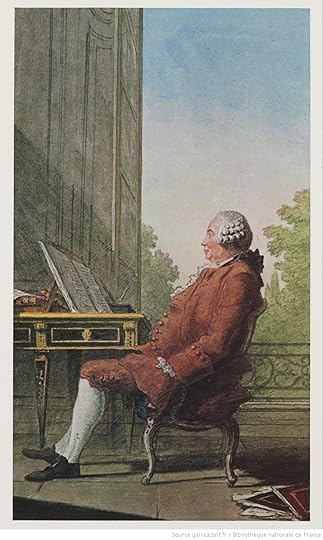
David Hume gravé par Carmontelle

Parmi les œuvres philosophiques du célèbre Marcus Tulius Ciceron, la La Nature Des Dieux est l'un de ceux qui m'ont le plus marqué. Trois amis disputaient sans acrimonie, mais en toute franchise de leurs visions respectives de la religion, en fonction de leurs appartenance à telle ou telle école philosophique, alternant les rôles de thuriféraires et de contempteurs des différentes opinions. Ces anciens se laissaient une grande latitude sur les possibilités de la nature des dieux, mais ils ne perdaient pas pour autant de vue l'importante question de la nature des rapports qui devaient les lier à l'humanité. Dans sa forme, ce dialogue à trois permettaient d'astucieux renversements d'alliance en fonction des sujets abordés. A côté de certains dialogues de Platon, où l'une des parties est réduite à un rôle de faire-valoir, chacun recevait toutes les chances d'exposer ses vues de la manière la plus complète, sans négliger les possibilités de la rhétorique. Tulius se permettait même de garder le flou sur son opinion finale, en partageant son assentiment entre plusieurs. Ce dialogue écrit par Hume, dix-huit siècle plus tard, est un hommage à Cicéron, car il reprend largement la forme de ce dialogue.

Ici, le philosophe anglais met ensemble trois amis: Philon, un sceptique, sorte de Lucien qui en ayant mit un frein à sa causticité, aurait en même temps aiguisé son sens critique. Déméa, un déiste rationaliste, aimant à fonder sa croyance sur des arguments a priori. Et enfin Cléanthe, déiste empirique, qui préfère fonder sa foi sur son expérience, et adepte de cette fameuse religion naturelle, sujet du dialogue. Dans un premier temps, Philon va mener une critique serrée des arguments de Cléanthe, et de son arguments principal, la téléologie: cet horloger de Voltaire, Philon, va en montrer toutes les faiblesses, à la grande satisfaction de Déméa, car elle se fonde sur une analogie gratuite entre l'homme et la divinité. Mais Déméa va bientôt changer de couleur lorsque Philon retournera ses armes critiques contre lui, et lui montrera l'égale vanité de ses prétentions a priori : rien de permet raisonnablement de confondre morale, origine du monde, et tout autre sujet métaphysique dans une substance unique. Déméa, fâché, abandonne la compagnie, et Philon expose alors son scepticisme devant Cléanthe, et fait sentir leur véritable accord commun, en dépit des dissentiments apparents : les trois aiment la morale, ont un sentiment d'émerveillement devant la nature, et souffrent de sentir la faiblesse de l'esprit humain, incapable de trouver des réponses satisfaisantes à son insatiable curiosité. Pastichant la fin du texte de Cicéron, Pamphile (en grec, celui qui aime tout), le narrateur, partage son assentiment entre les diverses opinions exprimées.

Hume n'a pas pris le risque de publier ce texte de son vivant, sans doute pour s'épargner les tracas que lui auraient causé ceux qui ne l'auraient point gouté. Il a pourtant pris les plus grandes précautions pour qu'il puisse être publié après sa mort, chargeant plus de trois personnes de remplir cette commission. Ces précautions ne furent point inutiles, car les deux premiers trouvèrent des prétextes pour se dérober à la demande du défunt. Ce texte est à mon sentiment une vrai réussite, et devient mon préféré de Hume. Je trouve que c'est de loin le plus stimulant et le plus serré de ceux qu'il a composé.
Profile Image for Beauregard Bottomley.
1,234 reviews845 followers
February 16, 2017
I don't like most of the New Atheists (Dennett is the exception). They take their arguments beyond the point they should. They seem to open up a needlessly indefensible special hatred towards Muslims hence allowing for a non-tolerant person to occupy the White House and appointing a white supremacist to the NSC. This book shows in nuanced ways how to argue against dogmatist while not also becoming a dogmatist in the process. Nothing really changes under the sun, and Hume's book is still as relevant today as it would have been if it were published in his life time (which, of course, it was not).

I've got a really special affection for this book and Galileo's "Dialogue Concerning Two Chief World Systems". Hume was obviously influenced by that book and one can tell by the way he gives it special mention within this book. He mentions that within Galileo's book much of the first part of the book is meant to refute the Peripatetic notion of sublunar substance verse the heavenly perfect essence ('quintessence'). Much of this book is also to defend against the pernicious teleology and the special pleading for an immaterial nature of an undefined substance that magically interacts atemporally (often referred to as God) that permeated his time and still lingers today.

A simple book. A brilliant dialogue. I really wish they would make a movie of this book. I can say with certainty that all the apologia that gets presented in the God exists debates I watch online would get shot down by Philo (the skeptical philosopher in the dialogue). The modern debaters use different formulations but the kernel of their arguments always rely on some variation of a Thomas Aquinas/Aristotle final cause with a prime mover argument and something only known to them "objective morality" whatever that may be.

Philo is always reasonable. He'll use reason as his guide. The typical arguments used by apologist fall into at least one of the following categories: 1) ontological, 2) cosmological, 3) objective morality only comes from God, 4) meaning of life must be outsourced to a God to avoid nihilism 5) I feel it in my bones and know it is true 6) or we are in the best of all possible worlds therefore some evil is possible. Hume refutes them all within this short text.

1) is the question of being. It's a variation of Anslem's proof of God. I've been reading St. Aquinas lately and he quickly dismissed those kind of arguments. Hume (through Philo) will say that for any dichotomous statement to be true that the negation thereof must lead to a contradiction. If 'being' is a necessity it follows that 'not being' must lead to a contradiction. It will not. Therefore, the necessity of being (or God) is not provable ontologically. Aquinas rejects them differently but just as effectively.

Hume points our how the dogmatist must often resort to infinity to make their point. That is God must be all knowing, all wise, or another omni. Since likes must come from likes (their language) our mind must come from an infinite mind or similar logic which leap into eternal or infinite spheres which add nothing to the defense except confusion and obfuscation (as pointed out by Hume).

Hume yields on design (a variation of the cosmological argument, and today we might even call it fine tuning). He knew evolution is a fact and calls it such within the text but doesn't have the explanation of natural selection in order to fully grasp its full meaning and implications. According to Hume (through Philo), the world is too complex, humans, animals, the eye, and nature work too well to not have been designed by something. He'll grant a designer or multiple designers but nothing more.

I've never have been enthusiastic about the 'theodicy' argument. Hume thinks it refutes a Christian God and that's why I cited Liebnitz's "best of all possible worlds" above. Because, it can be a response to evil. I liked Liebnitz's "Monadology" and would recommend it. Hume is fair and gives Liebnitz a mention for it. Hume does take the presence of evil and superstition further then I would in his arguments against religion.

Hume is a good presenter for all sides. For me, I favor the position of "hard atheist". It just means that I don't reject all notions of God, but only the ones for which I've heard about so far. There could be a rational and reasonable story to be told for which I am not aware of. Hume, at least within this book, gives credence to a creator God(s). He ultimately would not be swayed by 'a priori' arguments (before the fact, or from first principles, deductive, or without empirical data) and is opened to 'a posterior' arguments (after the fact, derived from data, inductive, or from particular to general). I'm always open for good arguments and Hume is an expert at tearing apart poor reasoning.

Intolerance of others leads to white supremacist in the White House and on the NSC. Hume shows how to defeat the dogmatist while not becoming one.
Profile Image for Erik Graff.
5,166 reviews1,451 followers
July 1, 2015
I read this book for Cornel West's course on Hume & Kant during my last semester at Union Theological Seminary in New York City. This and his Treatise of Human Nature are my favorite books by Hume, one of my favorite philosophers.

It struck me today whilst thinking back upon Hume that his critique of necessity in evidentiary cases of causality, the spark that set off Kant's revolution in philosophy, might be a salutory read for those, like Einstein, who've been troubled by developments in microphysics which have shattered some of the last vestiges of apodictic necessity in the physical sciences. What Hume noted was that there is no such thing as a law as regards our understandings of experience. As regards causal relations, the best we can hope for are more, rather than less, likely patterns, strong tendencies which may be relied on. Some, of course, approach the ideal of lawfulness such as the "laws" of Newtonian mechanics, but, as Kant noted, the ideal of perfect lawfulness in nature is something we impose upon it. Such necessity in the physical sciences is but "a regulative ideal of the Vernunft", something aimed at and aspired to, but never obtainable to finite beings like ourselves restricted, as we are, to our finite inductions from experiment and experience. This being acknowledged, the probability vectors of electrons, indeterminacy and the uncertainty principle, are not so hard to adjust to after all.
Profile Image for Corneel Minne.
53 reviews2 followers
April 19, 2023
Een oninteressant, uiterst achterhaald werk, dat tot hoofdstuk 10 erbarmelijk slecht is geschreven.
Het liefst laat ik Hume als martelaar sterven zodat ik zijn volgelingen kan uitroeien.
Haha
Profile Image for pearl.
371 reviews38 followers
June 5, 2011
I thought, you know, that the idea of an imaginary "dialogue" was cheesy and overdone. But Hume is a riot. He is such a devastatingly skilled debater--so insightful, careful, witty, and unafraid of going waist-deep in his (numerous, varied) convictions--that I've been left in quiet awe of him. And what struck me too was the even-handedness with which Hume dealt all sides, giving equal credence to the voices of his three characters, Philo, Cleanthes, and Demea.

Cleanthes--well, okay so his argument from design holds some water, but it's hard to sympathize with someone so rude! Calling skeptics jesters and railliers? Atheists? Come, come, tsk, tsk. Skeptical Philo was my obvious favorite, but surprisingly (or unsurprisingly?) I found myself empathizing most with Demea, the religious conservative and mystic, especially in his call against the anthropomorphic view of the universe that supposes God must be like ourselves.

My paper on the Dialogues and Cleanthes' argument from design is due Friday. Then all I've got left to read are the two essays on Suicide and Miracles. I can safely say that I'm kinda looking forward to this week...

***Update: I'm done. And my verdict? Smashing.
Profile Image for Warren Fournier.
842 reviews152 followers
August 9, 2024
A short and sweet volume that tackles a big subject--the existence of God.

The "Dialogues" are written in the style of Plato, where three geeky Greeks are arguing about God. Each character represents a different philosophical approach to "proving" the existence of a single divine Being. It's Hume's way of kind of arguing with himself to come up with the best conclusion he can.

Cleanthes is the guy who thinks that just looking at the wonders of nature is enough to prove that there is an intellect behind it all. The world is like a machine. Things decay and are replenished. Ecosystems have a kind of harmony. Plants and animals all have complex inner workings that maintain life. When we marvel at the craftsmanship of clockwork, we don't assume that a bunch of pieces of metal just fell into place to make a watch. Nor do we assume ink just somehow fell into place through some inherent quality of being ink to make an enduring work of literature. So when we observe the world, we get a sense of the Intelligence behind it.

Philo perhaps best represents Hume's actual thinking on the subject. If you know anything about Hume's philosophy on causality, this will not surprise you. Philo says that Cleanthes' argument from "design" is faulty. We can't deduce a Cause based on what we know of the Effect (in this case, the universe). Just because the universe appears to be orderly doesn't mean an Intelligence created that order, and even if an Intellect was behind the design, it is narcissistic to assume that such an intelligence would operate like that of a human being. Our observations say nothing about what such an intelligence is like, least of all that it is a single, all-perfect, infinite "Spirit". For example, why do we assume there must be only one God? When we look at a ship or a building, we don't assume one person built the thing. And Philo points out all the mistakes that are apparent in nature, like diseases and deformities. Why is it not just as feasible to assume God is some fuck-up apprentice who is learning their craft as they go?

By the way, Darwin would give Hume's argument here some real weight with his "Origin of Species"!

Finally, we have Demea, who similarly holds that we can't know God through a posteriori reasoning, but only through faith. Faith is independent of reason, and is superior at revealing Truth.

In summary, Hume never says there is no God, but that there's just no way to know anything about God.

Which seems like a cop-out conclusion. But it probably is about as "empirical" as it gets.

Somehow, this little book took Hume years to write, and in fact, it didn't even get published until after he died. Unfortunately, this doesn't mean that this is a masterpiece from a culmination of a life's work. Anyone hungry for enlightenment or for a glimmer of proof that life isn't meaningless find any meat on these bones. I don't feel the contemporary reader who is at all familiar with philosophy will gain any new insights here--these are arguments we've all seen before, though at the time, this was hot stuff. Don't look for God in Hume, unless you take the character Demea to heart, and if you do, you'll be in good company with Kierkegaard and William James!

But if you are a new student just starting to consider these ideas, then I would recommend this text more highly, because it is a solid example of dialectic method and a quick living example of various historical philosophies of religion.

SCORE: 3 know-it-alls arguing about God

WORD OF THE DAY: Hume had the annoying habit of becoming obsessed with a few words that he would find every excuse to repeat. So today we are featuring several of his favorites... Abstruse, cavil, and contrariety
Profile Image for Maxim Vandaele.
68 reviews
May 17, 2022
Hume schenkt ons een levendige geloofsdiscussie
In deze goed leesbare dialoog verkent David Hume (1711-1776) via drie personages fascinerende topics zoals de vraag of het universum geschapen is, of er God of een god is, of we hier überhaupt iets over kunnen weten, hoe het bestaan van lijden verenigbaar is met het bestaan van een (algoede, almachtige, alwetende) god (het 'problem of evil'), de aard van religieuze discussies en de plaats van religie in de samenleving.

Deze abstracte discussies worden uitermate levendig verteld door Humes luchtige en geestige pen, hier wellicht op z'n scherpst. Het lijkt er op dat Hume met dit werk zowel de absurditeit van rationele theologie (Cleanthes, die geloof rationeel wil bewijzen) als fideïstisch geloof (Demea, die vindt dat geloof niet kan of hoeft rationeel bewezen te worden, geloof is anders of sterker dan de rede) aan wou tonen (via de kritiek van de scepticus Philo). Natuurlijke theologie loopt vast in antropomorfisme (God is ook maar een mens?) en ongeldigheid van de gelovige argumenten, fideïstisch geloof in relativisme (jij voelt je misschien gelovig, maar ik niet, net zoals jij die film prachtig vond en ik niet).

Wie dus in dit werk op zoek gaat naar een sterke geloofsverdediging, zal bedrogen uitkomen, ondanks het feit dat de drie personages schijnbaar de hele dialoog niets anders doen dan het geloof verdedigen - dat de drie personages zeer overtuigde theïsten zijn, lijkt me vooral een strategische keuze van Hume om zich zo in te dekken tegen verwijten van atheïsme, lijkt me. (Eerder kan het werk van Kierkegaard aangeraden worden voor wie zijn geloof wil versterken en verkennen).

Een kleine bloemlezing
Don't you remember, said PHILO, the excellent saying of LORD BACON on this head? That a little philosophy, replied CLEANTHES, makes a man an Atheist: A great deal converts him to religion. That is a very judicious remark too, said PHILO. (Part 1)

Empires may rise and fall, liberty and slavery succeed alternately, ignorance and knowledge give place to each other; but the cherry-tree will still remain in the woods of GREECE, SPAIN, and ITALY, and will never be affected by the revolutions of human society. (Part 6)

Thus the universe goes on for many ages in a continued succession of chaos and disorder. But is it not possible that it may [...] preserve an uniformity of appearance [...]? This we find to be the case with the universe at present. Every individual is perpetually changing, and every part of every individual; and yet the whole remains, in appearance, the same. (Part 8)

In order to cure most of the ills of human life, I require not that man should have the wings of the eagle, the swiftness of the stag, the force of the ox, the arms of the lion, the scales of the crocodile or rhinoceros; much less do I demand the sagacity of an angel or cherubim. I am contented to take an increase in one single power or faculty of his soul. (Part 11)


(Dit boek was verplichte lectuur voor het vak 'Filosofie van de religie' van prof. Walter Van Herck)
Profile Image for Aurélien Thomas.
Author 9 books121 followers
June 7, 2022
Presented as a dialogue between three characters, Demea, Philo, and Cleantes, the philosophe tries, a priori, to understand what is the nature of God -if we can know it at all. The fact that the three orators disagree with each others so badly serves, in fact, as a pretext to shatter the whole idea that God... exists in the first place! Here's the whole genius of David Hume: implying, without ever compromising himself (you had to be suicidal to openly admitting to be an atheist in 18th century Scotland!).

Started in 1750 and ended in 1776, the book will, in fact, be published anonymously and posthumously in 1779. Adam Smith, the economist to whom Hume had entrusted the text, had found the argument so destructive indeed that he had taken all the necessary precautions to reveal it publicly...

The thing is, the traditional arguments to support the existence of God are dismissed quite easily, especially one of the most powerful and (seemingly) convincing that is, the idea that the perfectly ordered nature of the world must reflect the hand of a no less perfect 'creator'. Using examples such as a house or a boat, Hume doesn't need much to demonstrate what a fallacy such an argument is! God? To the philosophe, God is but an error in reasoning; and he visibly took great pleasure into dismantling such error!

Sharp. Incisive. And, still convincing.
Profile Image for Logan Markle.
63 reviews1 follower
February 17, 2021
Few books have impacted my beliefs as much as this. I was first introduced to it my senior year of college in a Metaphysics class when we were discussing God. My professor cited this book multiple times as containing an excellent argument against the teleological design line of reasoning. Additionally, that this book contains an excellent line of reasoning arguing that even if the teleological argument is assumed as true, it tells us nothing about the character of the being(s) which created the universe.

All in all, this is a concise and wonderful discussion (Hume writes as three separate characters all arguing different angles in reference to the points listed above and we tend to assume that Hume adopts the role of the skeptic) on the points I mentioned. And he successfully convinced me that, upon further reasoning, I held views that were faulty. I was convinced that the argument by design was true and that I was able to draw from it the Christian God as I thought of him. I no longer think that the argument by design is convincing and I certainly don’t see how making that argument anymore advantages the Christian, for it is an argument that yields only uncertainty. I recommend anyone interested in these topics read this book! It is short and dense yet manageable and worthwhile.
Profile Image for Tarpley Jones.
Author 1 book5 followers
March 15, 2013
There is something analogous in Hume’s characters of Cleanthes, Philo, Demea, and their pursuit of natural religion to the workings of a dog track. In order to get the dogs to run in a circle, a metal, rabbit-shaped animal—often given a cute name like “Sparky”--appears in front of the pack just when the starting gate is lifted. The dogs, driven by natural instinct, catch sight of Sparky and begin the race. Sparky, driven by an intelligently designed mechanism that surpasses the speed of even the fleetest greyhound, manages to stay ahead of them until he disappears at the finish line. To the gambler, the fastest dog wins the race, but to a more dispassionate observer, the real winner is Sparky. In Hume’s Dialogues, Demea and Philo are the greyhounds, but the winner of the race is the machine, the Sparky-like Cleanthes.
That Cleanthes emerges as the winner of the debate on natural religion isn’t really a surprise. In the first chapter of the Dialogues, Pamphilus introduces Cleanthes as the accurate philosopher, Philo as the careless skeptic, and Demea as the rigidly inflexible orthodox. It is rare in a competition for anyone either careless or rigidly inflexible to prevail. These aren’t the qualities of a winner. While Philo may give the best account of himself with the depth and breadth of his knowledge, I think Cleanthes delivers the ultimate rejoinder at the conclusion of Part VII. Philo’s theories, Cleanthes posits, are “whimsies … that may puzzle but never can convince us.” Cleanthes is forever contemptuous of Philo’s skepticism. That skepticism is “fatal to knowledge but not to religion.” While I tend to identify more with Philo the skeptic or Demea the mystic, their reasoning and eloquence are ultimately futile. If your opponent in a religious debate is convinced that the Deity is “similar to human mind and intelligence” and endowed with anthropomorphic characteristics, any attempts to dislodge him from that belief are likely to end in failure.
Cleanthes thesis is succinct: “the Author of Nature is somewhat similar to the mind of man, though possessed of much greater faculties.” He goes on to say “by this argument, and by this argument alone, do we prove at once the existence of a Deity and his similarities to human mind and intelligence.” The world is “nothing but a machine” of the highest order that is “subdivided into an infinite number of lesser machines.”
Philo immediately attacks this premise. How can order alone be the proof of design? Couldn’t matter itself function as the source, or what he more often calls the “spring,” of the order that we see in the world? Design is merely one of the springs or principles of the universe.
In response, Cleanthes makes one of his best points when he asks Philo to consider the human eye. If you think about the marvelous structure of the eye, isn’t it obvious that some kind of design is responsible for its function? This argument might seem less persuasive in the modern age where people carry around man-made eyes embedded in their cell phones, but even today science is better able to explain the dynamics of the distant universe than the inner workings of the human mind. Can even the smartest man explain how we see, or how we remember things from our past? Where in the plethora of animals is the dividing line between consciousness and mere instinct, and how did humans rather than chimps acquire it? Cleanthes reference to the human eye is very brief, but this portion of the dialogue is especially persuasive to the notion of intelligent design.
Cleanthes takes issue with Demea’s proposition that God is unknowable. Humans, Demea says, are too “infirm” to understand the Divine, and it is dangerous to equate God to man. Mystics like Demea, Cleanthes replies dismissively, are really nothing more than atheists. Demea later asks Cleanthes for data to support his thesis. Philo quickly agrees with Demea and states, “we have no data to establish any system of cosmogony.” Human experience is too limited to make positive assertions about natural religion. The world, Philo says, resembles the working of an animal or a vegetable; nature is spontaneous and follows its own accord without any particular design. It just grows. Cleanthes response is simple. Use your common sense, Philo. Does the world really resemble a vegetable? Philo’s arguments are pretty, but they are unconvincing. Cleanthes isn’t citing any data; he relies on what I would call his “gut feel.” To impute the nature of the world to some kind of regenerative animal or vegetable doesn’t really refute his contention—those theories might even corroborate it.
Demea then proposes two classical proofs of the existence of God. The first is the “voluntary agent or first mover” theory of Aquinas fame. Philo takes issue with this and says that motion is just a principle of matter. Nature doesn’t require a prime mover to be in motion. Cleanthes, who has little use for proofs in the first place, makes an interesting point about camels. What good are they? Would the world have dissolved if camels or any domestic animal had never existed? Cleanthes makes a strong point here, just as he did when he put forth the example of the human eye. In my opinion, the human eye and camels are good arguments for design, or what Cleanthes more accurately calls “benevolent design.” Camels are indeed natural creatures, but it is hard to understand why they exist if not for some kind of divine benevolence, or perhaps some divine sense of humor that exists in a Deity (just as it exists in man) but is totally absent from nature.
A second classical argument about the existence of God is the ontological one. There must have been a first being, Demea says, because nothing can cause itself to exist. Not so, replies Cleanthes. In a conclusion that could have emanated from Philo, Cleanthes says that the material universe itself could be the first Being. There is something contradictory about this explanation. If Cleanthes admits that the universe could be the first Being, it follows that the universe could also be the source of its own design, but he denies this. Cleanthes is not a logician like Philo. As the debate unfolds, Cleanthes relies less on logic and philosophy to support his contention of intelligent design and falls back on that age old device to support a position that cannot be proven by evidence: belief.
In the last two chapters of the Dialogues, the nature and pervasiveness of evil play central roles in the debate. Here Cleanthes is relatively silent, his rebuttals falling short of the mark. When Demea and Philo insist that most men are miserable, Cleanthes can only say that he has observed “something like what you say in others,” but rarely in himself. He is a happy man indeed. Health, he says, is more common than sickness. Pleasure is more common that pain. That might be so, agrees Philo, but isn’t pain “infinitely more violent and durable?” Philo is ready to rest his case at the end of Chapter X. Heretofore, he has resorted to metaphysical arguments to refute Cleanthes’s system of design, but now he is certain the Cleanthes cannot explain how an infinitely powerful and infinitely wise Deity can be conjoined with the violent nature of the world.
Cleanthes doesn’t have much of a counter punch. His lame contention that the world experiences lesser evil in place of a greater one lacks credibility. Seemingly tired of the discussion, he asks Philo to explain the nature of evil. He does so over several pages. Cleanthes is not impressed, and he recovers himself to make what I think is his strongest statement in support of his position
A false, absurd system, human nature, from the force of prejudice, is capable of adhering to with obstinacy and perseverance; but no system at all, in opposition to a theory supported by strong and obvious reason, by natural propensity, and by early education, I think it absolutely impossible to maintain or defend.
It is better to believe in something than in nothing. A few pages later Cleanthes says, “religion, however corrupted, is better than no religion at all.”
Is that the final word? Is a corrupted religion better than no religion at all? Philo very properly argues that few doctrines have led to more misery in the records of history than religion. He is correct, but most people still believe because most people are not philosophers or skeptics. From my own perspective, I like facts and data more than I like stories, so my personal inclination is to side with Philo, or perhaps more closely to Demea. God probably does exist, in one form or another, but he is unknowable, and any attempts to get at him eventually dissolve into nothingness. It is certainly possible that God looks exactly like the strong, grandfatherly figure that Michelangelo drew at the apex of The Sistine Chapel. But mankind’s experience with God is minimal, and our data, as Philo contends, is nonexistent. It is just as likely that God created humans experimentally in an effort to devise something totally unlike himself. God might resent any comparisons between Him and us.
At the end of Part IV in the Dialogues, before the debate has really gained any traction, Cleanthes says, “I have found a Deity; and here I stop my inquiry. Let those go farther who are wiser or more enterprising.” I might not agree with Cleanthes, but his practical arguments about the Author of Nature prevail over the skeptical and the mystical.
Profile Image for Otto Lehto.
475 reviews236 followers
February 7, 2019
Anybody who doesn't appreciate Hume doesn't appreciate philosophy. His dialogues are entertaining and insightful, and they are a good introduction to Hume's style and thought.

The dialogues exhibit the typical Humean combination of technically proficient but also commonsensical arguments. Hume methodically dispels the haughty aura of self-declared experts in the ivory tower by appealing to the intuitions and the common sense of ordinary people. (In this there are strong echoes of Plato's dialogues.) But he simultaneously, and miraculously, avoids the trap of being caught up in the superstitions and logical fallacies of the uneducated mind.

Hume's skeptical agnosticism, while not as radical as the atheistic materialism of Hobbes or Lucretius, carried out the death sentence of theism and abstract theology. The arguments are rhetorically powerful and framed in a fashion that respects the intelligence of the reader. Religious philosophy has never recovered.

The only thing that drags the dialogues down is the passage of time. They seem partially outdated in the Western world, where Humean skepticism has become fashionable. The even more radical Marxist atheism and New Atheism have seemingly overtaken Humeanism. At the same time, advances in cosmology and biology have rendered some of the scientific speculations in the dialogues moot. But I'm sure Hume would appreciate those things, since he was a fan of radical thinking and science.

And in some ways these new developments have strayed from Hume's teachings. The spirit of Humean skepticism is a precious civilizational heirloom whose true value is easily forgotten by the younger generations. The skeptical attitude has too often been lost in the exuberant hubris of Enlightenment, Marxist, New Atheist, or physicalist-scientistic dogmatism.

Only a perpetual recursion back to Hume can save the critical spirit of humanity from succumbing to the dark nemesis of its own creation: the dogmatic certainty of belief.
Profile Image for J.D. Steens.
Author 3 books32 followers
August 18, 2014
In these Platonic-like dialogues, Hume uses three characters to lay out three views on religion. In one, God transcends all human attributes and is incomprehensible. In another, God is modeled after humans, focusing on intelligence in a super-human sort of way. The third view, articulated by Philo, takes Hume’s empiricist approach to argue that we cannot establish the existence or non-existence of God. Philo’s ambivalence on the issue of God is palpable and in the end he lands on a deist approach: God, whatever that might be, set things in motion and then (God’s) natural laws took it from there.

The book closes with two short essays. The first, and consistent with the arguments in the Dialogues, opposes the traditional arguments regarding the immortality of the soul. The second, an essay on suicide, argues that since we take charge of our lives in all other respects, we should be able to take our own life.

This book is written in Hume’s thick prose. Without detraction, Hume’s argument could have been shortened, significantly. Substantively, Hume’s deist approach may have made sense at the time, but it seems now more like a last ditch attempt to seam a religious sensitivity and a scientific worldview together.
Profile Image for Emmanuel Boston.
143 reviews38 followers
December 27, 2012
It's dangerous to rate and review such an influential work, and philosophy nonetheless. So for now, my review will be short...

Hume writes well, and is pretty winsome, however I disagree with the conclusions of most of the works in these essays. I find that Hume does not question his own presuppositions, but asserts them and argues from them. If one accepts those presuppositions as true, then the conclusion does naturally follow, but if you do not grant the presuppositions (which I do not), then the conclusion stands in midair ready to fall.

I give it 5 out of 5 for making me think...
I give it 2 out of 5 for compelling argumentation...
I give it 3 out of 5 for style...
I give it 1 out of 5 for conclusions...
I give it 1 out of 5 for the dangerous implications being played out now if one takes what he's written as true.

3 out of 5 overall.
Profile Image for Ben Williams.
Author 1 book7 followers
May 8, 2022
Perhaps the most over-rated thinker of all time. The only thing Hume ever proved is that men who don't want to believe in God will invent innumerable loopholes to reason their way to that conclusion.
Profile Image for Brandon.
207 reviews8 followers
January 19, 2024
Philosophers are so good at praising and dissing. Schopenhauer said "there is more to be learned from each page of David Hume than from the collected philosophical works of Hegel, Herbart and schleiermacher taken together." Kant credited Hume for his awakening from his dogmatic slumber. Hearing such veneration, I was extremely excited to read my first David Hume book, The Dialogues Concerning Natural Religion.

I loved The Dialogues and would recommend it to anyone, though admittedly I am quite biased as religion is one of my favorite topics in philosophy.

Stylistically, this book is absolutely fantastic. Obviously, the language used in philosophy is a huge detraction. The abstractions, jargon, and poor writing skills have frequently combined to make some books near unreadable. I am happy to report that this book was surprisingly easy to read. Hume writes with meticulous clarity, for sacrificing linguistic rigor for showmanship’s sake, aside from a few ironic comments. The ideas conveyed through the dialogue are extremely well-expressed, leaving little uncertainty at all due to the mode of his expression. Somehow, he manages to combine this clarity of ideas with an extremely entertaining format. This is no Socratic dialogue. There is no didactic tirade. This conversation captures the essence of a spirited debate perfectly. Sometimes they go too far, sometimes no responses can be thought of, sometimes it is acknowledged that the arguments are off the cuff.

Obviously, the arguments contained within are fantastic. The prevalent speaker here is Philo, debating Cleanthes, along with Demea. Philo and Demea generally agree that whatever ultimate force/god may be outlined by empirical findings, there can be nothing more inferred about it’s nature other than its existence. Cleanthes disagrees, holding an anthropomorphic view of god. I tended to agree more with Philo, but Cleanthes is not strawmanned at all. I thought many of his arguments were very strong. This changes at the end, as Philo certainly “wins” the debate, and Cleanthes has less and less to say, though the book ends with Philo somewhat agreeing with Cleanthes, and the narrator even crowns Cleanthes the victor.

That's essentially what this book is, just arguments. There is no overly abstract system of philosophy erected here, no life-altering worldview switches, just arguments and rebuttals. It’s great, it’s like a toolbox. Take what you need, provoke some thought, and go on with your day. Of course, there are many hints of Hume’s overall empiricist outlook, which were very interesting.

The essays included in this edition are entertaining, if only for historical value in the case of the immortality of the soul essay. One funny thing I realized is that the way Hume has been characterized to me previously has been entirely wrong. Hume’s true view on religion and the nature of his argument on miracles are mostly what I am referring to. Read this book, then read some reviews on here to see exactly what I mean. It’s like they don’t even read the book!

Obviously, I don’t agree with everything said here, and I doubt most people will. The included essays are especially more susceptible to rebuttal, but that may be due to the nature of those as essays rather than a dialogue.

Unfortunately, there are some QUITE clear instances of misogyny here, which betray Hume’s extreme stupidity in that regard.

Overall, though, I think this book is a fantastic read, I’d say essential. Especially of interest to those who have any sort of interest in religion.
Profile Image for J. Rutherford.
Author 20 books68 followers
July 13, 2018
Can God be known through reason or our experience? If so, what can be said about him? These questions are at the heart of the endeavour of natural religion (known today as natural theology), and so are the subject David Hume’s posthumously published Dialogues Concerning Natural Religion (1779). Dialogues is a conversation between three thinkers—Cleanthes, Demea, and Philo—cast as the memories of a certain disciple of Cleanthes. Hume appears to have written the dialogue to lead the reader to the conclusion that to believe in the god of natural theology is to make a pointless concession: it is a vacuous affirmation of a remote analogy between the first cause of the universe and man, an affirmation that can have no impact on everyday thinking.


Outline
This end is far from where Dialogues begin: Hume opens Dialogues with the question of natural religion in general—what priority should be given to it in education? The question at first is this: assuming god exists, what can be known about him from natural religion? It quickly becomes more serious when the very possibility of knowing that god exists from natural religion is called into question.

Cleanthes, Hume’s portrayal of a deist or natural theologian, presents in Parts 2-8 the a-posteriori argument for god—that we can know god exists and is something like man by arguing from experience. Philo, Hume’s skeptical empiricist, and Demea, a classical ‘orthodox’ Christian, take issue with Cleanthes for differing reasons. Philo objects that a-posteriori reasoning cannot lead to the conclusion of a god anything like that which Cleanthes desires. Demea objects that the god Cleanthes would prove is nothing like the Christian God he knows—at best he is an anthropomorphism, at worst, a vegetable.

In Part 9, Demea tries to argue for the existence of the God in whom He believes—a necessary being. Both Cleanthes and Philo take issue with this, for a fact (a real existence) cannot be demonstrated (must have the possibility of existence or non-existence) and necessity is a dangerous idea—allowing the world itself to be ineffably necessary.

Part 10-11 then take up the Moral Argument, with Demea arguing that God is necessary as an opiate for the misery of man, Cleanthes that good outweighs evil, and Philo showing that any god whose character is derived from our experience will be evil (as is the simplest explanation).

In the last Part, 12, Cleanthes argues for the moral necessity of the postulation even of a finite anthropomorphic god and Philo concedes that the religious man can make no objection to the affirmation that the first cause of the universe bears some resemblance to man, but such an affirmation can have no effect on practical life.


Evaluation
The arguments Hume raises in these 12 parts address many theological and philosophical problems present in his day, many of which remain today. Much of the debate revolves around the concept of analogy, just how much can we know about God if we start from man. Demea frequently raises issue with Cleanthes’ inductive (a-posteriori) natural religion because it can only prove an anthropomorphic god. That is, if our language for talking about God begins with man, the best we can prove is a manlike god—even if we extrapolate predication to an infinite degree (it is still ever the attributes of man greatly magnified).

For Demea, who believes in a mystical, ineffable God, this proves to be a tremendous issue: natural religion, by describing god in the language of man, reduces him—to some degree—to the level of man. Cleanthes is forced to admit this in the end, when he agrees that the god he proves is finite and manlike. Hume also raises the theological problem of Evil, though in a way quite different from its contemporary forms.

Usually the Problem of Evil is used to prove that God cannot exist, but Hume uses it to show that natural theology cannot prove an infinite good god. He argues that it is possible, if we already knew that God existed, that the evil in this world is compatible with infinity and goodness. But if we are trying to know god or prove his existence through our experience—as natural religion attempts—at best we can demonstrate an impotent god, if not an evil god. Thus natural religion cannot establish the truths of the Christian religion, argues Philo.


These challenges are devastating to natural theology; after Hume, the interest in natural religion, in building a doctrine of god from nature, died quickly. Yet, these arguments are not so devastating to Biblical Christianity. The problems of predication, analogy, remain for mystical forms of Christianity. But for a theology that believes God has revealed Himself, Hume’s arguments are impotent. With such a basis, evil is explained not by imperfection in God but by the fall of the first man and women (of course it gets more complicated than this, but there are answers based on Scripture).

Though I concede that analogy cannot prove God in the way Cleanthes sought, once we know from His own revelation that God exists, the world we see fits remarkably well: a-posteriori reasoning fails as a proof for God but serves well to support His self-attestation in Scripture.

Finally, Revelation offers an alternative to man-centred analogy. God reveals in Scripture that we can know Him and that there are resemblances between the creator and the created because He intentionally created man in His image: God made man in such a way that we are finite reflections of the infinite. This is, then, the opposite of anthropomorphism: the God in Scripture is not accommodated to man, but the finite man is made like the infinite God. Biblically, we reason from God to man, not from man to God.


Hume’s Dialogues Concerning Natural Religion is an incisive and thought-provoking work. It is effective in showing that, as far as philosophical theology goes, the emperor has no clothes. However, it misses the mark as a critique of Biblical Christianity; it is only successful if the possibility of revelation is ruled out a-priori.
Profile Image for Matt.
747 reviews
July 30, 2024
A friend of mine gave me a warning before Dialogues Concerning Natural Religion that David Hume puts all his mental capabilities to bring into the question the existence of a wise and loving creator, that his can be quite compelling and that I needed to be prepared to have my faith severely tested. After reading this essay, my friend could have saved his time warning me because Hume just wrote stuff down like some people just talk to hear themselves talk, in the words of William Shakespeare this was all “sound and fury, signifying nothing”. This book also contained the unpublished essays “Of the Immortality of the Soul” and “Of Suicide” that were impressive, also included was “Of Miracles” that I read in Hume’s Enquires and I decided not to read a second time for the author circular argument. In all honesty, I have found David Hume to be overrated and wish he had taken the hint when his first book had bombed and never written again.
Profile Image for ص مصطفی.
16 reviews2 followers
January 3, 2020
نقطه‌ی قوت این خوانش، در فاصله گرفتن از دیدگاه‌های معمول در مورد هیوم است. نگرشی از منظر روان‌شناختی-فلسفی که این گفت‌وگوها را نه بین چند دیدگاه، که در درون یک انسان می‌داند و سعی می‌کند نشان دهد که فاصله‌ی ناچیزی است که یک انسان، تبدیل شود به انسانی دیگر.
Profile Image for Peter.
10 reviews
April 5, 2024
Never write a dialogue again pal
Profile Image for Andrei.
Author 10 books76 followers
July 18, 2020
I re-read this great book after 15 years. A must-read for anyone interested in philosophy or religion.
Profile Image for Floor Jan.
48 reviews
October 16, 2024
Wat een boek. Het duurde even voordat ik begreep wat ik aan het lezen was. Maar toen ik het door kreeg werd het steeds leuker. Het boek laat je denken maar af en toe ook lachen. Ben verder wel blij dat het uit is, want tijdens het lezen moest ik veel woorden opzoeken wat niet echt ontspannen leest.
Profile Image for Illiterate.
2,773 reviews56 followers
April 6, 2023
Devastating. If we still believed in human reason, it would be hard to grasp how theism survived it.
Profile Image for Jeff.
673 reviews53 followers
April 11, 2018
Sometimes Hume makes me hate him because i cannot follow his ideas and i want to blame it exclusively on his punctuation or if i'm not being reductive on his prose style but most likely i simply don't read carefully still his ideas and arguments are quite intriguing and usually convincing unsurprisingly as i'm not averse to criticizing Proofs of God's Existence but what the hell is up with the Miracles essay's claim that all religious miracles cancel each other out which occurs in a section i hate or misread or read lazily so thank Gore there are things such as Internet Encyclopedia of Philosophy and Stanford Encyclopedia of Philosophy to help a dimwit maybe understand a sentence such as
I may add as a fourth reason, which diminishes the authority of prodigies, that there is no testimony for any, even those which have not been expressly detected, that is not opposed by an infinite number of witnesses; so that not only the miracle destroys the credit of testimony, but the testimony destroys itself.
maybe i need to type the whole book rather than reading it because a glimmer of sense slightly more than a brief hint of meaning appeared to me just then
Profile Image for Steven.
1 review1 follower
January 12, 2012
I have a small addiction to late night talk shows. When I say small, I mean that I am constantly searching for who is on so that I know when to record which program. A long time ago, Cornell West was on the Craig Ferguson show and somehow they started talking about David Hume. As an agnostic, I am always searching for a thought-provoking read. Inevitably, I end up re-reading Voltaire or random op-ed articles/journals. So when Cornell West said that this was the greatest piece of literature ever written about religion in terms of skepticism, I was rather surprised. After all, in the same breathe, Mr. West said that he was a Christian and that he disagreed with Hume's opinion. Needless to say, I was intrigued. (Sorry for the back-story.)

So I picked this up at a book sale and it blew my mind. I have never read something so articulate in terms of arguing against organized religion. I found myself nodding rigorously. For those of you who do not like dry humor attacks on theology, please don't read this. Like many people who have commented before me, I think this is a work of literature that can be read by people of all faiths, or lack thereof. It carries on a conversation that should be had, yet often isn't. Phenomenal work of literature.
Displaying 1 - 30 of 240 reviews

Can't find what you're looking for?

Get help and learn more about the design.