

What do you think?

Iron: Or, the War After
IN A WORLD OF CONSTANT WINTER...
When an intelligence spy from the Resistance--the rabbit, Hardin--steals secret information from a military base of the Regime, his actions set off a chain of events that reverberates through the ranks of both sides, touching everyone from the highest-ranking official to the smallest orphaned child. When the snow finally settles, who will be the true patriot and who the true traitor?
When an intelligence spy from the Resistance--the rabbit, Hardin--steals secret information from a military base of the Regime, his actions set off a chain of events that reverberates through the ranks of both sides, touching everyone from the highest-ranking official to the smallest orphaned child. When the snow finally settles, who will be the true patriot and who the true traitor?
152 pages, Hardcover
First published April 10, 2012
About the author
S.M. Vidaurri
28 books17 followersMy apartment is filled with many animals. I like romance novels, superhero movies, rooms filled with plants and peach iced tea.
My first graphic novel Iron: Or The War After was published in 2012 and was nominated for the Graphic Album category in the Pépites 2013 Salon de Montreuil.
I read a lot, but for the purposes of my reviews on here, I'll only be writing about the books I absolutely loved, in the hope to support the authors I admire.
My first graphic novel Iron: Or The War After was published in 2012 and was nominated for the Graphic Album category in the Pépites 2013 Salon de Montreuil.
I read a lot, but for the purposes of my reviews on here, I'll only be writing about the books I absolutely loved, in the hope to support the authors I admire.
Ratings & Reviews
Friends & Following
Create a free account to discover what your friends think of this book!
Community Reviews
Displaying 1 - 30 of 112 reviews

February 2, 2013
this is another somber tale told with animals. it is not whimsical and lighthearted; it is more like Duncan the Wonder Dog: Show One and Each Day a Small Victory, where the animals are as far from disney as you could imagine.

this story is not as mindblowingly good as duncan, but the artwork is similar, in that is is black and white and pretty badass, and to someone who has been told they have a shitty eye for art, that is enough to meld them together in my mind. but i know a LOT about art - i can tell that duncan is more roundy almost-cartoony, and this one is more blurry-shady.
is how the Great Masters talk about art.


the plot itself is a little murky, i'm not gonna lie. there is espionage and there are rebels and seeecret stolen documents and essplosions, but i'm not really clear on what the resistance is for,or more specifically against or who is the ruling power. it is clear in the book which characters are on which side, but it might help to have a clearer idea of the big picture.
or maybe not. because enough hints are dropped that you get the general sense of the conflict, but the focus is more on the effects of conflict on individuals - the orphaned children who don't understand what is happening (like the reader) but still want to contribute to the cause, or who don't understand the animosity towards the children of soldiers. and the frustration of aging revolutionaries towards a futile resistance that seems to be winding down without any of its goals realized. (whatever those goals may be.)
even without fully understanding the specifics, the story is interesting and tragic enough and the artwork is lovely enough to keep me turning the pages, and i read it two times, which has got to count for something...
this seems to be the first part of a story which will hopefully continue and maybe the next part will be more rich in backstory, but even if this is the only glimpse into this world, it is sad and lovely, and i don't need much more than that.
and also, for greg, a fox-lady!

 come to my blog!

this story is not as mindblowingly good as duncan, but the artwork is similar, in that is is black and white and pretty badass, and to someone who has been told they have a shitty eye for art, that is enough to meld them together in my mind. but i know a LOT about art - i can tell that duncan is more roundy almost-cartoony, and this one is more blurry-shady.
is how the Great Masters talk about art.


the plot itself is a little murky, i'm not gonna lie. there is espionage and there are rebels and seeecret stolen documents and essplosions, but i'm not really clear on what the resistance is for,or more specifically against or who is the ruling power. it is clear in the book which characters are on which side, but it might help to have a clearer idea of the big picture.
or maybe not. because enough hints are dropped that you get the general sense of the conflict, but the focus is more on the effects of conflict on individuals - the orphaned children who don't understand what is happening (like the reader) but still want to contribute to the cause, or who don't understand the animosity towards the children of soldiers. and the frustration of aging revolutionaries towards a futile resistance that seems to be winding down without any of its goals realized. (whatever those goals may be.)
even without fully understanding the specifics, the story is interesting and tragic enough and the artwork is lovely enough to keep me turning the pages, and i read it two times, which has got to count for something...
this seems to be the first part of a story which will hopefully continue and maybe the next part will be more rich in backstory, but even if this is the only glimpse into this world, it is sad and lovely, and i don't need much more than that.
and also, for greg, a fox-lady!
 come to my blog!
June 17, 2015
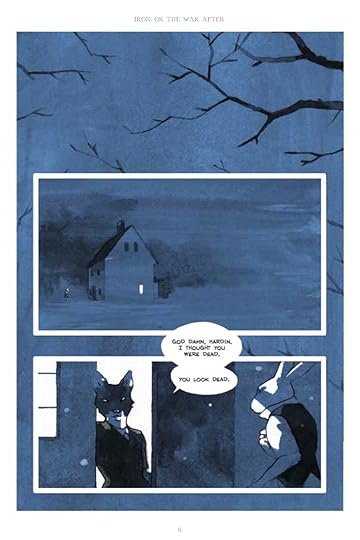
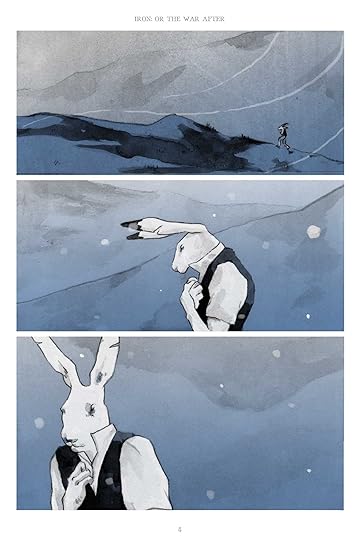
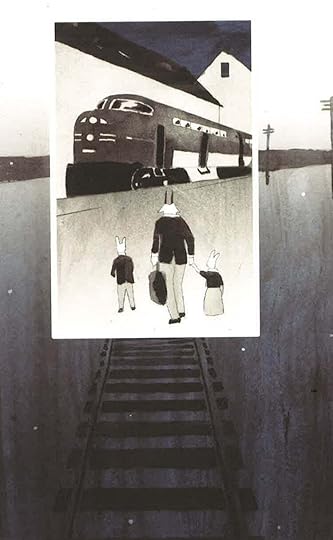
The outside of this book is beautiful: gold and black designs stamped on a red cloth cover. And on the inside the drawings perfectly match not only setting of the story (an unnamed land of constant Winter) but the mood as well. Somber drawings in muted shades of grey, blue and black work better for this unusual war...or after war....tale than vivid colors would have. And the characters drawn with animal heads but human bodies give the book an exotic flavor that makes it more interesting than if they had been shown as regular people or even as regular animals.
But the story? Well, to be honest it felt like walking into a theater halfway through a movie and forever wondering what happened before I got there. There had been a war, but it was supposedly over. However, there were still active and well-organized rebels. The reason for the war is never explained. The reason the war is over is never explained. The reason the rebels are still rebelling and what exactly they are rebelling against is never explained.
I don't usually do this, but before I started to write this review I read some of the others for Iron, thinking I had missed something somewhere. Maybe an earlier book that had all those pesky details I was wondering about? What I discovered was that most readers felt the same way I did...confused about the story, but full of praise for the artwork.
I would like to think Vidaurri knew exactly what he was trying to say here, but for me he says it so subtly that I could not grasp the message with just one reading. Luckily I am intrigued enough by the book to keep trying to work it out.
But the story? Well, to be honest it felt like walking into a theater halfway through a movie and forever wondering what happened before I got there. There had been a war, but it was supposedly over. However, there were still active and well-organized rebels. The reason for the war is never explained. The reason the war is over is never explained. The reason the rebels are still rebelling and what exactly they are rebelling against is never explained.
I don't usually do this, but before I started to write this review I read some of the others for Iron, thinking I had missed something somewhere. Maybe an earlier book that had all those pesky details I was wondering about? What I discovered was that most readers felt the same way I did...confused about the story, but full of praise for the artwork.
I would like to think Vidaurri knew exactly what he was trying to say here, but for me he says it so subtly that I could not grasp the message with just one reading. Luckily I am intrigued enough by the book to keep trying to work it out.

September 6, 2013
SOMEONE EXPLAIN TO ME WHAT I JUST READ?! I think I'm semi-intelligent but this abstract concept idea just blew me out of the water---
Speaking of blowing things up---this book had the recipe for an effective novel: art, mood, characters, themes: (espionage, war, survivors, rebels, terrorist attacks, BOMBS, & CHILDREN. I'm just not sure when it was all mixed together it did not formulate into anything but a sense of "Should I read this again?" or "Did I not pick up on the little details?" "Are clues in the art?"---I was left with a huge question mark. I felt that this was almost an exploration of war musings or an experimental theme of as the title suggests about the aftermath of a war.
I mean the art is a 5! Visually appealing and such striking details it has such a Maus feel. I mean you could FEEL the tension in the art...the palette the murky---blurred lines---the torn letters...and I am immediately scrambling to identify with what human survivors could be identified. I mean the whole book is just amazing, and I kept reading going---I know I'll get it in the end...It will make sense in the end.

Unfortunately, I did not figure it out. I almost feel as if somehow I might be missing out on something. I guess I need to reevaluate or just think about this storyline for a bit.

Maybe it will come to me one day....
Speaking of blowing things up---this book had the recipe for an effective novel: art, mood, characters, themes: (espionage, war, survivors, rebels, terrorist attacks, BOMBS, & CHILDREN. I'm just not sure when it was all mixed together it did not formulate into anything but a sense of "Should I read this again?" or "Did I not pick up on the little details?" "Are clues in the art?"---I was left with a huge question mark. I felt that this was almost an exploration of war musings or an experimental theme of as the title suggests about the aftermath of a war.
I mean the art is a 5! Visually appealing and such striking details it has such a Maus feel. I mean you could FEEL the tension in the art...the palette the murky---blurred lines---the torn letters...and I am immediately scrambling to identify with what human survivors could be identified. I mean the whole book is just amazing, and I kept reading going---I know I'll get it in the end...It will make sense in the end.
Unfortunately, I did not figure it out. I almost feel as if somehow I might be missing out on something. I guess I need to reevaluate or just think about this storyline for a bit.
Maybe it will come to me one day....

June 1, 2016
Gripping graphic novel that examines the costs of war, starting with the theft of secret information by a resistance fighter. The ramifications of that theft spill out and touch many lives, even those who aren't on a "side," if the sides here even mean anything given how destructive their war is - and given that Vidaurri is much more interested in the effects of the war than in the particulars of how it started and supposedly ended, but continues to hurt people even still. It's tense at times, appropriately sorrowful, and the art is a perfect match with its minimalism and muted colors. I think watercolor, with maybe some pencil too?
A must-read, and luckily it's being reprinted soon! There's only so many times I can legitimately check out our library's battered copy...
A must-read, and luckily it's being reprinted soon! There's only so many times I can legitimately check out our library's battered copy...

July 26, 2021
we're using words like "plot" and "narrative" to describe any old random assemblage of events now i see

January 30, 2019
The story was somewhat intriguing, taking place after a civil war parallel in epoch to WWII. A resistance fighter steals secret documents from the opressive Regime, the theft itself acting as a decoy to a planned bombing of a important bridge connecting the regime's military and supplementation bases.
The minimal drawing style uses black and white with heavy shadows to emphasize on the grimness of war and it's aftermath discussing ideals, patriotism, sacrifice, "the end justifies the means" mentality, totalitarianism etc. Art is interesting, simplistic yet powerful enough for the message it represents. Reminds me of Dimitris Pantazis, a greek illustrator with a very similar technique albeit more detailed.
A decent comic, it's a fast read but struggles to keep the reader captivated. And, although i enjoy anthropomorphism a lot, i think it's starting to get overused as a literary device in comics. Especially in the last decade.
The minimal drawing style uses black and white with heavy shadows to emphasize on the grimness of war and it's aftermath discussing ideals, patriotism, sacrifice, "the end justifies the means" mentality, totalitarianism etc. Art is interesting, simplistic yet powerful enough for the message it represents. Reminds me of Dimitris Pantazis, a greek illustrator with a very similar technique albeit more detailed.
A decent comic, it's a fast read but struggles to keep the reader captivated. And, although i enjoy anthropomorphism a lot, i think it's starting to get overused as a literary device in comics. Especially in the last decade.
August 31, 2012
“IN A WORLD OF CONSTANT WINTER… When an intelligence spy from the Resistance-the rabbit, Hardin-steals secret information from a military base of the Regime, his actions set off a chain of events that reverberates through the ranks of both sides, touching everyone from the highest-ranking official to the smallest orphaned child. When the snow finally settles, who will be the true patriot and who the true traitor?”
The heart wrenching blurb caught my eye while the cover of anthropomorphized rabbit running in a landscape does the rest for me. I have recently read about Alice in Wonderland, I did read about symbolism of animal in tales and this brought my interest for the “Iron or The War After”. It was until a few pages that I was immediately tuned to the work of SM Vidaurri.
The graphic novel started with gorgeous painting of a bird on a tree in shaded tones that was similar to eastern asian calligraphy painting. I am reading both in my B&W kindle and coloured in tablet and they were both definitely gorgeous in either medium. I noted the snowy landscapes that were beautifully captured by the artist and the relevance of anthropomorphized characters that were metaphorical crafted with each pages. By each pages, I found the soul within the novel that was painfully stroked into the paper and I was engrossed by the serious storyline.
Although the book is brief but the story is profound. Ink wash painting is a very highly skilled craft that I had tried once but never again. It is a hard work and require excessive patience and control to achieve a good stroke. Of course, it was very rare to find a western graphic novelist doing inkwash fully. However, I find the style is right for this novel. The overwhelming sadness and overtone of darkness that was carried by the characters in great depth was further emboldened by each contrasted frames . The artist effectively portrayed pretense confusions and self-contained destructiveness in great deal and he had given a sense of realism and identity to his work.
While I was not distracted by the artistry, I was utterly captivated by the characters in this book. Hardin’s desperation , his children’s sadness and anguish, Engel’s contempt and Pavel’s conflicts. Each chapters carried unpredictability, sense of morose and utter despair. It is truly an emotional work of art and I’m grateful to have experience it and enjoyed it thoroughly.
The heart wrenching blurb caught my eye while the cover of anthropomorphized rabbit running in a landscape does the rest for me. I have recently read about Alice in Wonderland, I did read about symbolism of animal in tales and this brought my interest for the “Iron or The War After”. It was until a few pages that I was immediately tuned to the work of SM Vidaurri.
The graphic novel started with gorgeous painting of a bird on a tree in shaded tones that was similar to eastern asian calligraphy painting. I am reading both in my B&W kindle and coloured in tablet and they were both definitely gorgeous in either medium. I noted the snowy landscapes that were beautifully captured by the artist and the relevance of anthropomorphized characters that were metaphorical crafted with each pages. By each pages, I found the soul within the novel that was painfully stroked into the paper and I was engrossed by the serious storyline.
Although the book is brief but the story is profound. Ink wash painting is a very highly skilled craft that I had tried once but never again. It is a hard work and require excessive patience and control to achieve a good stroke. Of course, it was very rare to find a western graphic novelist doing inkwash fully. However, I find the style is right for this novel. The overwhelming sadness and overtone of darkness that was carried by the characters in great depth was further emboldened by each contrasted frames . The artist effectively portrayed pretense confusions and self-contained destructiveness in great deal and he had given a sense of realism and identity to his work.
While I was not distracted by the artistry, I was utterly captivated by the characters in this book. Hardin’s desperation , his children’s sadness and anguish, Engel’s contempt and Pavel’s conflicts. Each chapters carried unpredictability, sense of morose and utter despair. It is truly an emotional work of art and I’m grateful to have experience it and enjoyed it thoroughly.

January 2, 2013
At the beginning of this graphic novel, a letter is stolen which sets off a series of terrible events. The novel is both very political and anti-war. It is also, at times, very hard to follow. I'm not sure if this is due to the fact that there is little dialogue or the characters are animals, or perhaps it is the sheer number of characters. Having said this, despite having to go back several times to try to understand what was happening, I found the story intelligent and intriguing.
And much of my enjoyment was due to the stunning graphics - what a feast for the eyes!. They are done mainly in light washes of blue and gray which makes it even more eye-popping when the robin appears done in a beautiful scarlet. I must admit I kept thinking that I would love to have some of these pictures on my walls, I was that impressed.
As I said, this is not an easy story to follow. I suspect it would take two or three readings to start to get a real grasp on this complicated story. But, trust me, it would be worth it if only as an excuse to look at the graphics.
And much of my enjoyment was due to the stunning graphics - what a feast for the eyes!. They are done mainly in light washes of blue and gray which makes it even more eye-popping when the robin appears done in a beautiful scarlet. I must admit I kept thinking that I would love to have some of these pictures on my walls, I was that impressed.
As I said, this is not an easy story to follow. I suspect it would take two or three readings to start to get a real grasp on this complicated story. But, trust me, it would be worth it if only as an excuse to look at the graphics.
September 17, 2020
This was pretty powerful, even if there's a lot of backstory left unexplained. The story is told by anthropomorphic animals. It seems a big war was fought at some point in past, and the losing side has resistance movement trying to undermine the current regime. Our story deals with the resistance being investigated and there's a lot to process.
The art is haunting, and overall the graphic novel does have an oppressive feeling. It felt like an old British war movie in a way.
Overall I enjoyed this and it was something different.
The art is haunting, and overall the graphic novel does have an oppressive feeling. It felt like an old British war movie in a way.
Overall I enjoyed this and it was something different.

February 1, 2014
NOTE - Minor spoilers up ahead.
Before I review the book itself, I want to write a little about the graphic novel as a literary form. Now I don't mean to set to set myself up as a formalist pedagogue, because I'm not, please believe me (pliz), but the creative latitude that a graphic novel can give to it's author +/ illustrator differs greatly from that available through prose, poetry, epistolary etc. forms of writing. The imagery that the written word attempts to form in your mind is where a graphic novel has a power unlike any other form - it can directly present the intended imagery to your eyes.
Exposition can be done more tastefully and easily, due to the readily available imagery, without being a convenient "writing crutch" in the absence of action or occurrences (which often require more skillful writing).
But the illustrations don't render the written portions secondary in importance or impact. This is the final point that I wanted to note, that, to me, the most basic characteristic of a good graphic novel is when the writing complements the illustrations and vice-versa. Neither of them should do the heavy lifting alone. This isn't a rule as much as a general observation, and I'm sure there are numerous graphic novels which tweak the interplay of imagery and writing in other creative ways to come up with something fantastic.
Iron: Or, The War After
First of all I'll quickly get my few criticisms out of the way. I found the character of Ford (nurse/caretaker at an orphanage) and her relation to Engel (Captain, the Regime) of enough importance to warrant more development. I was a bit disappointed that Ford's character was significant in affecting the course of events, and her relationship to Engel was peculiar, but their past was hardly explored. This would probably have been absolutely fine if Ford at least reappeared as a minor character later in the book; but as she didn't I couldn't help but revisit and comment upon the dynamics at work when she did make her appearance.
Second "criticism" - I wish Patricia (James Hardin's daughter, and James Hardin Jr.'s sister) and Konstantin's (the son of the "traitor") interactions were depicted more, especially after their escape from the orphanage.
Now, why I gave this book a 5 star rating.
1.)The artistic setup - The fact that each character is literally a different animal made it very easy to consider each character individually. This made the book all the more fun to read, because there were several characters who I could consider the "protagonist".
Plus, I liked the illustrations and all that jazz.
2.) The writing style - Well measured. I didn't find any dialogue or narrative text to be superfluous, and the text worked wonderfully well with the illustrations.
3.) "In a world of constant winter......... who is the real traitor and who is the real patriot?"
The little description given at the back of the book captures the essence of the story and the themes without giving anything away. The biggest reason why I want to give this book a 5 star rating is because in about 150 pages or so it accomplished in making the reader (here, me) think about the shades of grey involved in judging the "good side" and "bad side" independently as well as in relation to each other - not because of their language, power, expressions etc. but because of their actions. I read the comments of several reviewers here who found the story too abstract or difficult to follow. And I acknowledge that that may be the case if one tries to follow a conventional right vs. wrong, oppressed vs. oppressors narrative.
Engel's letter to his father (not going to give anything away), for example showed him to be dedicated to peace and stability too, though his methods were cruel and unjust. What James Hardin Jr. did was the biggest moral question of the book.
Was his action wrong only because it WENT wrong, or was it inherently wrong even before it was put into action? Is terrorism on innocent civilians by oppressed rebel factions justified? Is the violation of human (or animal) rights by a regime still working for stability justified?
This graphic novel was the bombdiggity. BOOM 5 stars
Before I review the book itself, I want to write a little about the graphic novel as a literary form. Now I don't mean to set to set myself up as a formalist pedagogue, because I'm not, please believe me (pliz), but the creative latitude that a graphic novel can give to it's author +/ illustrator differs greatly from that available through prose, poetry, epistolary etc. forms of writing. The imagery that the written word attempts to form in your mind is where a graphic novel has a power unlike any other form - it can directly present the intended imagery to your eyes.
Exposition can be done more tastefully and easily, due to the readily available imagery, without being a convenient "writing crutch" in the absence of action or occurrences (which often require more skillful writing).
But the illustrations don't render the written portions secondary in importance or impact. This is the final point that I wanted to note, that, to me, the most basic characteristic of a good graphic novel is when the writing complements the illustrations and vice-versa. Neither of them should do the heavy lifting alone. This isn't a rule as much as a general observation, and I'm sure there are numerous graphic novels which tweak the interplay of imagery and writing in other creative ways to come up with something fantastic.
Iron: Or, The War After
First of all I'll quickly get my few criticisms out of the way. I found the character of Ford (nurse/caretaker at an orphanage) and her relation to Engel (Captain, the Regime) of enough importance to warrant more development. I was a bit disappointed that Ford's character was significant in affecting the course of events, and her relationship to Engel was peculiar, but their past was hardly explored. This would probably have been absolutely fine if Ford at least reappeared as a minor character later in the book; but as she didn't I couldn't help but revisit and comment upon the dynamics at work when she did make her appearance.
Second "criticism" - I wish Patricia (James Hardin's daughter, and James Hardin Jr.'s sister) and Konstantin's (the son of the "traitor") interactions were depicted more, especially after their escape from the orphanage.
Now, why I gave this book a 5 star rating.
1.)The artistic setup - The fact that each character is literally a different animal made it very easy to consider each character individually. This made the book all the more fun to read, because there were several characters who I could consider the "protagonist".
Plus, I liked the illustrations and all that jazz.
2.) The writing style - Well measured. I didn't find any dialogue or narrative text to be superfluous, and the text worked wonderfully well with the illustrations.
3.) "In a world of constant winter......... who is the real traitor and who is the real patriot?"
The little description given at the back of the book captures the essence of the story and the themes without giving anything away. The biggest reason why I want to give this book a 5 star rating is because in about 150 pages or so it accomplished in making the reader (here, me) think about the shades of grey involved in judging the "good side" and "bad side" independently as well as in relation to each other - not because of their language, power, expressions etc. but because of their actions. I read the comments of several reviewers here who found the story too abstract or difficult to follow. And I acknowledge that that may be the case if one tries to follow a conventional right vs. wrong, oppressed vs. oppressors narrative.
Engel's letter to his father (not going to give anything away), for example showed him to be dedicated to peace and stability too, though his methods were cruel and unjust. What James Hardin Jr. did was the biggest moral question of the book.
Was his action wrong only because it WENT wrong, or was it inherently wrong even before it was put into action? Is terrorism on innocent civilians by oppressed rebel factions justified? Is the violation of human (or animal) rights by a regime still working for stability justified?
This graphic novel was the bombdiggity. BOOM 5 stars

June 3, 2013
Each page of "Iron" is a sombre reflection of desperate times. The story is grim and dreamy, supported beautifully by the moody artwork. There are few expected elements - no sound effects, a changing narrative, and characters that are far more complex than their dialogue is. I would love to see more of this world.

September 29, 2015
Complex tale of the aftermath of war and the people (actually anthropomorphic animals) caught up in the intricacies of espionage resulting from war. The art is absolutely stunning and the story challenging in its minimalism. This is a story to come back to and savor again and again.
January 21, 2018
It's hard to explain why this is both realistic fiction and fantasy without at least a few spoilers, but to me, one of the questions was whether this was a story taking place in a world with talking animals, or a story in which talking animals replaced people in terms of visual imagery. Weirdly, it's more interesting if it's the latter, but also less convincing.
The never-ending winter is never explained, and neither are certain other oddities, again suggesting fantasy, but one just isn't sure.
Still, the artwork is gorgeous, and the parts of the story that I think I understood were excellent. Unfortunately, there were also parts of the story that I think I didn't understand, including the old war itself.
Still, for people who liked Maus for reasons other than its links to World War II, this might be a good read. It's certainly worth taking a look at the artwork.
The never-ending winter is never explained, and neither are certain other oddities, again suggesting fantasy, but one just isn't sure.
Still, the artwork is gorgeous, and the parts of the story that I think I understood were excellent. Unfortunately, there were also parts of the story that I think I didn't understand, including the old war itself.
Still, for people who liked Maus for reasons other than its links to World War II, this might be a good read. It's certainly worth taking a look at the artwork.

August 14, 2023
3 ⭐, perché il comparto grafico è eccezionale , altrimenti la media si abbassava ulteriormente.
Capiamoci, la storia scorre, è evidente cosa l'autore vuole comunicarci:
Nella guerra non ci sono mai veri vincitori, non si ferma mai alla generazione in cui si svolge la guerra e porta sempre strascichi ecc ....
Ma la storia non ha davvero senso, cioè la parte finale e banalizzata all'inverosimile e alla fine dei conti da una storia con tutte le premesse per lasciare un segno, diventa una storia semplificata, velocizzata e senza neanche una morale.
Gli eventi accadono perché devono accadere e le pagine stanno finendo.
Peccato un occasione persa, iniziata con le migliori premesse ma conclusa in maniera raffazzonata.
Capiamoci, la storia scorre, è evidente cosa l'autore vuole comunicarci:
Nella guerra non ci sono mai veri vincitori, non si ferma mai alla generazione in cui si svolge la guerra e porta sempre strascichi ecc ....
Ma la storia non ha davvero senso, cioè la parte finale e banalizzata all'inverosimile e alla fine dei conti da una storia con tutte le premesse per lasciare un segno, diventa una storia semplificata, velocizzata e senza neanche una morale.
Gli eventi accadono perché devono accadere e le pagine stanno finendo.
Peccato un occasione persa, iniziata con le migliori premesse ma conclusa in maniera raffazzonata.
April 27, 2024
interesting concept, incredible artwork, but a little janky at times

January 10, 2022
In a world of perpetual winter, a war has just ended, so we're told. However, there is still resistance by a group of rebels. One of them, a leader called Hardin, embarks on a planned mission to steal top secret documents. Except that's just a ruse to lower security in order to launch a coordinated and violent attack.
As readers, we are thrust headfirst into this world. We're not told much about the war that just ended - what ended it, what motivated the rebels and so on. The idea, perhaps, is to examine the impact of war on people, including children. The characters in Iron are also anthropomorphic - rabbits, foxes, owls and tigers. Someone noted that the rebels were all prey, and the government predators, which I hadn't noticed. I'm not sure the division was always so neat, in memory, but it was an interesting point. The story focuses on themes of patriotism, what it means to be a traitor (and whether it's always so simply defined) and what it means to stand for a cause. However, the action is somewhat muted to the reader, because of the lack of backstory. The result is this feeling of distance, even when grappling with poignant scenes of death and self-sacrifice (perhaps intentionally so). While I understand the author perhaps didn't want to focus on backstory, to avoid giving readers an easy way to identify who the heroes and villains are, it was still disorienting for me as a reader and appears to have been for others too - so I'm not sure the author entirely succeeded in what he was going for.
However, I will say I understood and related to many elements in the story as a Sri Lankan. In Sri Lanka, our war ended 30 years ago but is constantly invoked, the violence continues (see the suicide bombings in Sri Lanka on Easter Sunday in 2019) and the question of who is patriot and who is traitor is still constantly being reframed in Sri Lanka. While the war is over, conflict continues - so the themes touched on in Iron are very much relevant to our context. For that reason, I could appreciate what the author was trying to do - t0 highlight the hopelessness of war, how difficult it is to end it, and its impacts on people caught up in it. I also loved the artwork, done in moody blacks, blues and grays, which really added to the story. But I still found the story disorienting - there was too much pared back, which meant that there felt like a lot of missing context.
As readers, we are thrust headfirst into this world. We're not told much about the war that just ended - what ended it, what motivated the rebels and so on. The idea, perhaps, is to examine the impact of war on people, including children. The characters in Iron are also anthropomorphic - rabbits, foxes, owls and tigers. Someone noted that the rebels were all prey, and the government predators, which I hadn't noticed. I'm not sure the division was always so neat, in memory, but it was an interesting point. The story focuses on themes of patriotism, what it means to be a traitor (and whether it's always so simply defined) and what it means to stand for a cause. However, the action is somewhat muted to the reader, because of the lack of backstory. The result is this feeling of distance, even when grappling with poignant scenes of death and self-sacrifice (perhaps intentionally so). While I understand the author perhaps didn't want to focus on backstory, to avoid giving readers an easy way to identify who the heroes and villains are, it was still disorienting for me as a reader and appears to have been for others too - so I'm not sure the author entirely succeeded in what he was going for.
However, I will say I understood and related to many elements in the story as a Sri Lankan. In Sri Lanka, our war ended 30 years ago but is constantly invoked, the violence continues (see the suicide bombings in Sri Lanka on Easter Sunday in 2019) and the question of who is patriot and who is traitor is still constantly being reframed in Sri Lanka. While the war is over, conflict continues - so the themes touched on in Iron are very much relevant to our context. For that reason, I could appreciate what the author was trying to do - t0 highlight the hopelessness of war, how difficult it is to end it, and its impacts on people caught up in it. I also loved the artwork, done in moody blacks, blues and grays, which really added to the story. But I still found the story disorienting - there was too much pared back, which meant that there felt like a lot of missing context.

February 18, 2017
Another incredibly sad war novel. The illustrations are charming, which clashes mightily with the subject matter. I do wish that one particular letter's content had actually been demonstrated during the tale.

June 14, 2013
I loved the artwork. I kept petting the pages, they just looked so soft.
I don't usually like stories told through animals (I generally loathe them entirely, outside of Mrs. Frisby and the Rats of Nihm) but I think it really worked well.
I liked it. I liked it a lot.
I don't usually like stories told through animals (I generally loathe them entirely, outside of Mrs. Frisby and the Rats of Nihm) but I think it really worked well.
I liked it. I liked it a lot.
October 25, 2015
i read it on one rainy late afternoon. this story is told in strong pictures that are able to create a dense atmosphere.
April 26, 2020
This is insightful. Although it's a bit dreary, it's child-friendly, and really does talk about how "morals" and nationalism are ambiguous, and really everything always comes down to who's in charge and who's powerful. Often those who have very little to lose have the true power for they aren't afraid to do the right thing, but sometimes, what we think is right is only right to us alone. The book is beautiful and tragic. Taking away stars only because the book is far too poetic for my taste - in the way that it really doesn't give enough background. It's not the most well-rounded story and you do get confused at one point about whether a character is even alive or not. It's a good book though. I like how it's about a war we've actually had in our real past. The hopelessness is caused by the people in the story, not by circumstance. It's choices all over.

September 8, 2020
This book was haunting. The absolutely unique and stunning art perfectly captures the bleak atmosphere of the world in this book. The cover is incredibly gorgeous.... this was such an amazing and unique read my brain is still going several miles an hour thinking about it.
There many gaps in the story not fully explaing what the war was or why the rebels are active but i didn't really end up minding that a whole lot. If in your mind you thinknof the first world War and revolutionary Russia the story starts to make a lot more sense.
The tragedy and deaths, dark struggles that these characters experience.... even if this book was told with human characters it would still be incredibly unique.
Id definitely recommend trying to read this book. Even if only to experience the art alone its beyond worth it.
There many gaps in the story not fully explaing what the war was or why the rebels are active but i didn't really end up minding that a whole lot. If in your mind you thinknof the first world War and revolutionary Russia the story starts to make a lot more sense.
The tragedy and deaths, dark struggles that these characters experience.... even if this book was told with human characters it would still be incredibly unique.
Id definitely recommend trying to read this book. Even if only to experience the art alone its beyond worth it.

April 28, 2023
Da fuq? I am just so confused. Like I just stepped into a world but right in the middle of everything that is unfolding there. I get that there was a war. Apparently the baddies won given all the resistance stuff, the bomb-planning, how far that evil man would go to make sure everything is good. But I just missed so many details. And so I just couldn't really get a grip on the characters, what happened to Hardin was just BS, the kids were mostly annoying (though I did grow to like Patricia), and there was just so much that kept slipping away from me. So yeah, this is another, the third one, miss from my book haul yesterday. The art was beautiful, I really love the style, I love how it captures the wintery feeling and uses grey/blue/black as tones and that is why I give the book 2 stars. Also because there was a lot of potential here. If only there had been more details on everything.

February 20, 2020
I love the themes. How the war reverberates down generations. How it doesn’t end when it ends. As time passes people forget the reasons but remember the brutality and violence. A great choice to not even describe the war that the older characters fought in. No description of the war’s causes or the motivations and ideologies of the two sides. Because in this story, after the war, that stuff doesn’t matter. After no one cares. No one wants to remember.
The artwork was brilliant. I had no idea it was even possible and I have seen nothing like it. It looks like water color but the art captures light reflecting off snow.
What I learned: Older stronger trees are more likely to break under the weight of snow.
The artwork was brilliant. I had no idea it was even possible and I have seen nothing like it. It looks like water color but the art captures light reflecting off snow.
What I learned: Older stronger trees are more likely to break under the weight of snow.

October 18, 2019
The suddenness of the beginning is slightly jarring - the author drops you right into the middle of the action. The novel, however, is stunning - the art is minimalistic and resembles watercolor paintings; the snowy grounds bleed into the gray sky above, and though the character's faces sometimes betray no emotion, the very rendering speaks volumes.
The story revolves around predator vs prey animals, with a rabbit acting as the main source of rebellion; though the civil war is over, there are a few rebels left who wish to fight for the revolution.
Though it was a quick read, it was nice - the art is really clean, and the story is really moving.
9/10 would recommend.
The story revolves around predator vs prey animals, with a rabbit acting as the main source of rebellion; though the civil war is over, there are a few rebels left who wish to fight for the revolution.
Though it was a quick read, it was nice - the art is really clean, and the story is really moving.
9/10 would recommend.
January 5, 2021
Boring story that was illustrated beautifully.
Physically, this book is absolutely gorgeous. It is a clothbound hardback with gold detailing on the front. The illustrations are really pretty, I like the art style a lot. The colour scheme is very muted and really fitting to the tone of the story.
Now I am not an intellectual by any means. Due to this, any deeper meaning in this book flew right over my head. I found it to be quite slow and boring if I'm honest. This book does not give much backstory to the reader, and the lack of information can be quite jarring. It definitely made it difficult for me to get into the story.
I wish I could have enjoyed this more.
Physically, this book is absolutely gorgeous. It is a clothbound hardback with gold detailing on the front. The illustrations are really pretty, I like the art style a lot. The colour scheme is very muted and really fitting to the tone of the story.
Now I am not an intellectual by any means. Due to this, any deeper meaning in this book flew right over my head. I found it to be quite slow and boring if I'm honest. This book does not give much backstory to the reader, and the lack of information can be quite jarring. It definitely made it difficult for me to get into the story.
I wish I could have enjoyed this more.

July 18, 2021
Quality Rating: Three Stars
Enjoyment Rating: Four Stars
This graphic novel is stunningly drawn (painted) and beautifully designed. The illustrations are atmospheric and moody, and play with tone and setting very well. However, the story itself is rather vague and unsatisfying. Its theme changes multiple times over four chapters, and despite its interesting cast of varied characters, there's no protagonist to anchor what's happening. The rebel hero doesn't last long, his son's story peters out and then there's a corrupt detective whose general absence from most of the action makes his final acts fall a little short of effect because we just haven't seen him enough to really care.
Enjoyment Rating: Four Stars
This graphic novel is stunningly drawn (painted) and beautifully designed. The illustrations are atmospheric and moody, and play with tone and setting very well. However, the story itself is rather vague and unsatisfying. Its theme changes multiple times over four chapters, and despite its interesting cast of varied characters, there's no protagonist to anchor what's happening. The rebel hero doesn't last long, his son's story peters out and then there's a corrupt detective whose general absence from most of the action makes his final acts fall a little short of effect because we just haven't seen him enough to really care.
September 19, 2025
excellent artwork - the muted color palette was suitably somber and depressing, and some of the expressions were incredible, especially on the children. great use of lighting as well - there's one panel where the goat-man is lying in bed that's backlit to perfection, almost Hitchcockian.
the story was a confused mess where the reader is only really clear the motivation for one character (James Jr.). the rest are hard to believe, especially the tiger - without a source for the hate it just feels like an excuse to illustrate a downer graphic novel.
pretty brutal with no payoff, but well illustrated.
the story was a confused mess where the reader is only really clear the motivation for one character (James Jr.). the rest are hard to believe, especially the tiger - without a source for the hate it just feels like an excuse to illustrate a downer graphic novel.
pretty brutal with no payoff, but well illustrated.

May 15, 2022
The watercolour art in this is absolutely beautiful. So much is achieved with so few colours.
The plot is both simple and incomprehensible. There is a Regime and there is a Resistance, but why and what they're fighting for, we have no clue.
Where the plot lacks coherence, it makes up in tragedy. And there is plenty of tragedy to be had here, with one heartbreaking event after another, until you get to the end and realised that nothing has been accomplished outside of a growing pile of dead bodies.
The plot is both simple and incomprehensible. There is a Regime and there is a Resistance, but why and what they're fighting for, we have no clue.
Where the plot lacks coherence, it makes up in tragedy. And there is plenty of tragedy to be had here, with one heartbreaking event after another, until you get to the end and realised that nothing has been accomplished outside of a growing pile of dead bodies.

February 23, 2020
It is the aftermath of a long war, in a world of constant winter. An intelligence spy from the Resistance steals secret information from a military base of the Regime. Heavy and atmospheric, the delicate pastel drawings perfectly establish an atmosphere of cold, damp, wintry despair. There is a feeling of desolation - physical and emotional. Everything creates a sense of repression, failed revolution and hopelessness. Lots of fun!
July 3, 2021
I guess, this comic is on the artsy sides of things. Because you can't deny the artwork is marvellous, the whole book itself screams premium/ classy.
But the plot could go more in detail because in some parts i was quite confused what had happened. Plus, beating up, gory or even bloody scene is not shown. Only a flash of hands and a tortured face. Then, the body on a floor.
Good art comic for sure
But the plot could go more in detail because in some parts i was quite confused what had happened. Plus, beating up, gory or even bloody scene is not shown. Only a flash of hands and a tortured face. Then, the body on a floor.
Good art comic for sure
Displaying 1 - 30 of 112 reviews