

What do you think?

Talk to Me First: Everything You Need to Know to Become Your Kids' "Go-To" Person about Sex
We live in a time when kids of all ages are bombarded with age-sensitive material wherever they turn; "sexting" and bullying are on the rise at an increasingly younger age, and teen moms are "celebrified." What is a concerned--and embarrassed--parent to do? With wit, wisdom, and savvy, Deborah Roffman translates her experiences gleaned from decades of teaching kids and parents, and as a mom, into strategies to help parents navigate this tricky terrain. Talk to Me First is for any parent who wants to become and remain the most credible and influential resource about sexuality in their children's lives.
296 pages, Paperback
First published July 10, 2012
Ratings & Reviews
Friends & Following
Create a free account to discover what your friends think of this book!
Community Reviews
Displaying 1 - 27 of 27 reviews

August 4, 2012
One of the most frustrating and scary things about parenting adolescents is how quickly (and often imperceptibly) things change. What worked for your pre-teen or teen last week doesn't work this week. The knowledge you had a couple of months back about who your son or daughter's friends are is, in a moment, found to be inaccurate. What felt before to your son like kind, caring interest now feels like intrusion. "But I thought you liked (fill in blank)..." rapidly becomes an indictment of your own lack of getting it. "Getting it" is a somewhat mysterious thing that happens when your child (of any age) feels that you are engaged and close enough to them to make an accurate guess about who they are or how they might feel, now. But it doesn't happen without your teen, especially, feeling that you can be asked about, (semi-respectfully) argued with, and probed for your own opinions and values. Your teens want to know what you value and will use that information (gleaned more from what you do and how you do it, than from what you actually say) to figure out their own similar and unique values that form their sense of identity.
If your teenager and pre-teen can ask you questions, express their own thoughts and have them listened to without a whole lot of judgment thrown in--while at the same time you provide sound information in a reasonable, calm way--you're on the way to "getting it." When you "get it" your kids will share more with you about what really matters and ask you about the things that really matter. Your kids will be safer, make better choices and manage the risks of adolescent more smoothly.
Lest you think "getting it" is an elusive quality that cannot be taught--like being cool--it isn't. And wise educator and author Deborah Roffman's Talk to Me First: Everything You Need to Know to Become Your Kids' "Go To" Person about Sex is a virtual roadmap in "how to get it." The most important thing that can be said about Roffman's work is that it isn't just about sex or sex education--it's about being a solid parent and giving your kids the support they'll need to navigate their adolescence well into adulthood. She begins in the way I believe all parenting books should begin: with a thoughtful, accurate understanding of the current cultural context of sexuality in the United States. She reminds us that teens need our proximity more than ever during adolescence and that despite the "independence" they represent (and have represented to them by mass media), they are hungry for you to be what Roffman calls an "askable parent." Your teen wants to come to you with questions, concerns and worries and feel that you are interested and curious, right along with them. It doesn't mean you have to not have reactions or express your own values; it just means that you don't lead with them if you want your teen to be open to your positive influence. If your kids don't "talk to you first," who will they be talking (and listening) to in getting the "right" messages about sex, sexuality, boundaries and good decision-making? Well, you already know the answer to that: they'll get their answers from out of the places they spend the most time. In 2012, we know that teens and pre-teens increasingly spend the majority of their time connected to mass digital media. This book is an antidote to that unfortunate situation.
Roffman explains that children are indeed sexual beings but it doesn't meant that they want to have sex. She helps the reader understand the difference between talking about all the aspects of sexuality and giving "permission" for your older children to engage in whatever behaviors they want. The book is eminently practical, helping parents understand the multitude of ways to talk with kids about sex and sexuality depending upon context, age, gender, grade level and the like. I especially applaud--and think readers will find enlightening--her refusal to make "one size fit all." She gets that different kids need different approaches, but that all approaches to dealing with sex and sexuality are ultimately rooted in our beliefs, values and morals. She knows that morals, values and beliefs can be best expressed to our children in changing ways, based on developmental stage and age. As a psychotherapist and adolescent specialist, I can say that one of the best things about the book is that it is ultimately a guide for how to create kids who can guide themselves well, in a challenging, media-soaked digital world.
Roffman's tone is down-to-earth, grounded in a deep knowledge of child development and always respectful to children, parents and educators. There are far too many books on both parenting and sexuality/education out there and it's confusing. But this isn't a confusing choice: Talk to Me First "gets it" and belongs on the bookshelf of every parent and teacher.
If your teenager and pre-teen can ask you questions, express their own thoughts and have them listened to without a whole lot of judgment thrown in--while at the same time you provide sound information in a reasonable, calm way--you're on the way to "getting it." When you "get it" your kids will share more with you about what really matters and ask you about the things that really matter. Your kids will be safer, make better choices and manage the risks of adolescent more smoothly.
Lest you think "getting it" is an elusive quality that cannot be taught--like being cool--it isn't. And wise educator and author Deborah Roffman's Talk to Me First: Everything You Need to Know to Become Your Kids' "Go To" Person about Sex is a virtual roadmap in "how to get it." The most important thing that can be said about Roffman's work is that it isn't just about sex or sex education--it's about being a solid parent and giving your kids the support they'll need to navigate their adolescence well into adulthood. She begins in the way I believe all parenting books should begin: with a thoughtful, accurate understanding of the current cultural context of sexuality in the United States. She reminds us that teens need our proximity more than ever during adolescence and that despite the "independence" they represent (and have represented to them by mass media), they are hungry for you to be what Roffman calls an "askable parent." Your teen wants to come to you with questions, concerns and worries and feel that you are interested and curious, right along with them. It doesn't mean you have to not have reactions or express your own values; it just means that you don't lead with them if you want your teen to be open to your positive influence. If your kids don't "talk to you first," who will they be talking (and listening) to in getting the "right" messages about sex, sexuality, boundaries and good decision-making? Well, you already know the answer to that: they'll get their answers from out of the places they spend the most time. In 2012, we know that teens and pre-teens increasingly spend the majority of their time connected to mass digital media. This book is an antidote to that unfortunate situation.
Roffman explains that children are indeed sexual beings but it doesn't meant that they want to have sex. She helps the reader understand the difference between talking about all the aspects of sexuality and giving "permission" for your older children to engage in whatever behaviors they want. The book is eminently practical, helping parents understand the multitude of ways to talk with kids about sex and sexuality depending upon context, age, gender, grade level and the like. I especially applaud--and think readers will find enlightening--her refusal to make "one size fit all." She gets that different kids need different approaches, but that all approaches to dealing with sex and sexuality are ultimately rooted in our beliefs, values and morals. She knows that morals, values and beliefs can be best expressed to our children in changing ways, based on developmental stage and age. As a psychotherapist and adolescent specialist, I can say that one of the best things about the book is that it is ultimately a guide for how to create kids who can guide themselves well, in a challenging, media-soaked digital world.
Roffman's tone is down-to-earth, grounded in a deep knowledge of child development and always respectful to children, parents and educators. There are far too many books on both parenting and sexuality/education out there and it's confusing. But this isn't a confusing choice: Talk to Me First "gets it" and belongs on the bookshelf of every parent and teacher.

August 10, 2021
I'll be recommending this book to lots of people! Roffman puts things so simply and has a great way of explaining the whys and hows of talking to your kids about sex, relationships, and anything that might make you initially cringe thinking about. I wish I'd read it when my son was a little younger but I'm glad I've read it now! This was a scary topic for me to think about approaching but I'm feeling much better about these conversations now.

March 23, 2021
Read the Appendix before you read the book. More than any of the core content of the book, the appendix distills facts and information readers should really know before diving in.
This is an excellent excerpt and representative of the overall tone of "Talk To Me First."
I picked this up primarily because I did not and do not want my kids to learn about sexuality from the internet, I want them to learn from their parents. This book was recommended by Planned Parenthood and is clearly highly recommended here on Goodreads and Amazon. I wanted some third-party, expert advice around becoming the go-to source not just in my mind, but in my kids'. Consider that most kids do not learn about sex from their parents:
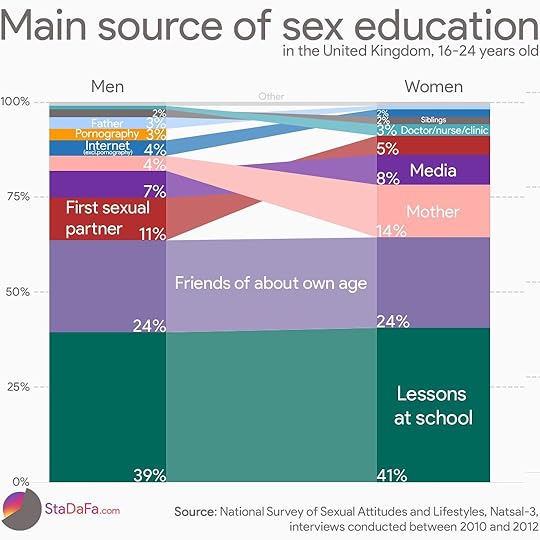
Even the most liberal among us can probably agree that pornography makes for poor sex ed. Friends and public schools are also not necessarily the best places to be learning about sexual values. Roffman advocates for values-based sexual education. She balances a realistic view of fact-based, comprehensive sex education with the need for guidance in values around sexual activity. She has been recognized by both Planned Parenthood and the National Federation of Republican Women, meaning from a "political spectrum," she talks to both sides.
Too much of the book was assumptive that times used to be better, that people did not behave in certain ways in the past that they do today, and that much of our "permissive attitudes" can be put at the feet of increased access to highly sexualized content in the wake of the AIDS crisis. In discussing "tweens" and the perception that kids grow up too fast:
This assumption that things used to be better, that people used to be more moral, that somehow our own parents are free of fault is one that niggled at me throughout the book. Data does not back this up. The extensively researched, "Harmful to Minors" debunks the idea that the current generation is somehow more hedonistic or less moral than prior generations. If anything, the "i-Gen" and younger have more conservative sexual values than Gen-Xers, with a higher average age for participating in sexual activity and lower incidence of sexually-transmitted diseases than prior generations.
This is not a bad book, far from it. Roffman does a great job of talking to both sides of the values spectrum of America; no easy task. If you feel uncomfortable discussing sexuality with your kids, don't know how to approach them or understand why they won't talk to you, this is a solid book.
How did the relatively sane world we used to know and count on turn into a twenty-first-century Alice's Wonderland, where suddenly up is down, down is up, yet life goes on as "normal?" Why has this been allowed to happen and what is the toll on our children? And most important, how do we turn it around?
This is an excellent excerpt and representative of the overall tone of "Talk To Me First."
I picked this up primarily because I did not and do not want my kids to learn about sexuality from the internet, I want them to learn from their parents. This book was recommended by Planned Parenthood and is clearly highly recommended here on Goodreads and Amazon. I wanted some third-party, expert advice around becoming the go-to source not just in my mind, but in my kids'. Consider that most kids do not learn about sex from their parents:
Even the most liberal among us can probably agree that pornography makes for poor sex ed. Friends and public schools are also not necessarily the best places to be learning about sexual values. Roffman advocates for values-based sexual education. She balances a realistic view of fact-based, comprehensive sex education with the need for guidance in values around sexual activity. She has been recognized by both Planned Parenthood and the National Federation of Republican Women, meaning from a "political spectrum," she talks to both sides.
Too much of the book was assumptive that times used to be better, that people did not behave in certain ways in the past that they do today, and that much of our "permissive attitudes" can be put at the feet of increased access to highly sexualized content in the wake of the AIDS crisis. In discussing "tweens" and the perception that kids grow up too fast:
Heck, my mother lived through the Great Depression without (dressing in sexy lingerie or experimenting with oral sex), I'm almost certain.
This assumption that things used to be better, that people used to be more moral, that somehow our own parents are free of fault is one that niggled at me throughout the book. Data does not back this up. The extensively researched, "Harmful to Minors" debunks the idea that the current generation is somehow more hedonistic or less moral than prior generations. If anything, the "i-Gen" and younger have more conservative sexual values than Gen-Xers, with a higher average age for participating in sexual activity and lower incidence of sexually-transmitted diseases than prior generations.
This is not a bad book, far from it. Roffman does a great job of talking to both sides of the values spectrum of America; no easy task. If you feel uncomfortable discussing sexuality with your kids, don't know how to approach them or understand why they won't talk to you, this is a solid book.

February 13, 2013
I keep telling friends about this book, because it goes beyond a book about talking about sex to become a great summary of child development and parenting writ large. Her fundamental point is that sexuality is just one of many aspects of kids' lives that they have to learn to understand and navigate, and that parents must prepare their children to be sexual beings in the same way they prepare them to become kind and thoughtful friends, drivers, drinkers, college students, and ultimately responsible adults-- by repeatedly and age-appropriately teaching them about the values and ethical framework that we reply upon as we make decisions in our own life.

October 4, 2012
I like books that give me theoretical and philosophical support for stuff I already think. This book is all about how sex is a topic like any of the other thousand topics parents teach their children every day over many years. Basic parenting principles apply to this difficult subject just as they do to other less-difficult subjects. Anyhow, I feel empowered to be a better educator for my children after reading this book.

September 1, 2021
Alongside books like the Robie Harris sexuality books (It’s Not The Stork for ages 4 and up, It’s So Amazing for ages 7 and up, and It’s Perfectly Normal for ages 10 and up), and Peggy Orenstein’s Girls & Sex, Roffman’s book is an excellent, excellent resource for parents who want to encourage healthy sexuality in their kids.
Roffman’s book is about much more than sexuality. Really, it’s about how we talk to children, and what children need from the adult nurturers around them so that they know how to make smart, thoughtful decisions. She talks about what children need, and based on those needs, she describes communication as a five piece suit, composed of 1) affirmation, 2) information, 3) clarity about values, 4) setting limits, and 5) anticipatory guidance.
Soon after I started reading it, I had a conversation about something else difficult (I can’t even recall what it was, but I know it didn’t have to do with sexuality) using Roffman’s ideas, and was able to navigate the awkwardness with grace and honesty. In terms of discussing sexuality, I have my own baggage and tricky spots—and Roffman’s book helped me approach some of those things that previously felt too scary or uncomfortable.
I recommend this book to anyone who wants to help guide children toward strong, healthy adulthood.
Roffman’s book is about much more than sexuality. Really, it’s about how we talk to children, and what children need from the adult nurturers around them so that they know how to make smart, thoughtful decisions. She talks about what children need, and based on those needs, she describes communication as a five piece suit, composed of 1) affirmation, 2) information, 3) clarity about values, 4) setting limits, and 5) anticipatory guidance.
Soon after I started reading it, I had a conversation about something else difficult (I can’t even recall what it was, but I know it didn’t have to do with sexuality) using Roffman’s ideas, and was able to navigate the awkwardness with grace and honesty. In terms of discussing sexuality, I have my own baggage and tricky spots—and Roffman’s book helped me approach some of those things that previously felt too scary or uncomfortable.
I recommend this book to anyone who wants to help guide children toward strong, healthy adulthood.

February 23, 2018
Best and most important parenting book I’ve read since How to Talk So Kids Will Listen.... this book both impresses why we need to be engaged with our kids on this hard/embarrassing topic and empowers parents to address what kids need at every developmental level. It covers sexuality as a much broader concept (making it much less intimidating “but isn’t it too soon to be thinking about that!?” topic). Teaching and talking with kids about intimacy and relationships with the expectation that they will need to make these decisions independently someday and when they do that we should be their sources of information and values that they are using to make those decisions (rather than pop culture/media/peers/school health class).
One of those rare parenting books that you don’t just need the cliff notes blog post version!
This is one that I am sure to read again and recommend to all the parents I know.
One of those rare parenting books that you don’t just need the cliff notes blog post version!
This is one that I am sure to read again and recommend to all the parents I know.

May 7, 2025
I think Deborah Roffman creates quite a comprehensive and easily taught and understood model of what children and adolescents need from their parents as they develop, and explains how to meet those needs without attempting to exert an unhelpful level of control or giving them so much space that they feel lost and confused. She also does a good job of reinforcing that talking with your children about sexuality is pretty much the same as talking with them about anything else, and that concepts that we tend to value in regards to sexuality, such as responsibility, communication, and honesty, can be taught to children in just about any situation.
The book is quite dense, though, and it takes quite a while for the author to get to the point in my opinion. I think it could certainly be written in a more approachable way, since its target demographic is parents, and I can't really imagine that most parents would read this entire book, despite all the important information it contains.

August 2, 2021
Really excellant book! If you're from a conservative or liberal mindset, have young or older kids, have lots of biology knowledge or none this is the book for any parent, guardian, or teacher. There's a few helpful metaphors. There's some check lists and scenarios. But mostly it's solid information about how to frame your conversations about sex and sexuality with kids. Great info on consent, values, LGBTQ support, media/internet, intimacy, and expectations. If you have any discomfort or confusion do yourself and your youngsters a favor and read this book!

May 13, 2022
The first couple of chapters are a bit of a “rant” about how we got to this super-sexualized culture we now have. She’s not wrong, but I think that might have been better as an appendix, to help her excellent advice set the tone instead. She does a great job of identifying what kids really need in their “sex talks” and pointing out the ways we differentiate these conversations from all the other talks we have with our kids to our detriment. Her distinction between sex and intercourse is also incredibly helpful, and something I’ve not heard much before.

Read
June 1, 2023reading this to inform a training we're building at work, I found a lot that was useful (like the 5 basic needs framework) and a few parts that made me cringe (her takes on feminism/"girls these days" and The Media). if you take the dated-seeming bits with a grain of salt, I think there's a lot here for parents/caregivers who are ready to improve upon the sex talk they received in their family of origin.

June 6, 2024
Excellent book from a sex educator who’s been teaching for 35 years. Lots of practical information and scenarios to think through for all ages. Written in 2012, it felt pretty modern…although I did chuckle whenever she used the words “the net” for the internet ;) Will definitely want to re-read in the future.
July 11, 2018
Absolutely essential reading for all parents. Lots of it is about older kids, but in order to set the foundation it should be read by age 4. Buy it and read it now if you have kids over the age of 3.

December 15, 2018
It took me a really long time to get through this book since it is sort of heavy stuff. But I will definitely refer back to it as my kids age. A really great book on this topic.

February 3, 2020
A must-read for anyone that has a child, may have a child, was a child. Should be required reading for every parent.

July 5, 2022
I thank Nicholas Kristof for writing the OpEd in the NYTimes in which he recommends this book to parents who are looking for help on navigating this topic with their kids.

January 16, 2013
"Talk To Me First" is certainly what I want my children to do. I think there are some great ideas in this book about how to make that happen. It's a book to refer to every few years - as your child develops, what you say might change, but now is the time to plant the seed for the way you handle it.
I think that the points made in the book boil down to this: "talking to your kids about sexuality is talking to them about life."
The author talks a lot of setting clear, firm limits, and I appreciated some of the examples of how to word them. But sometimes it seemed that there were no limits, and so I'm unclear as to what the balance is. To some extent, I suppose each parent finds their own.
The following are some details that I marked for myself:
p. 12 "Here's the straight-on truth: as parents we don't get to decide that we're too uncomfortable to parent."
p. 37 "...there had been no such thing as a 'tween identity' until marketers made it up. For sure, marketers' interest was demographic, not developmental...Once someone dreamed up the catchy and memorable moniker 'tweens' to capture the message - that eight-year-olds are really just short fourteen-year-olds, with one foot in childhood and the other in full-blown adolescence - the rest was history."
ch. 3 Children have five fundamental needs, so parents have five fundamental jobs: affirmation, information, clarity about values, setting limits, anticipatory guidance.
ch. 5 Any question your child might ask is really one of the following eight questions:
- What's true?
- How do people do that?
- Can you please help me figure this out?
- How can I protect myself?
- Am I normal?
- What should I do? (Be careful not to confuse with a What's true? question)
- What's right?
- Will you pass my test?
p. 139 There has been a shift from rule-based morality to ethics-based morality, but it has broken down because "a model that involves applying abstract principles requires learning to think in a very particular and complex way that simply can't happen in the absence of deliberate adult mentoring."
p. 217 Mantra = "Independence is earned."
I think that the points made in the book boil down to this: "talking to your kids about sexuality is talking to them about life."
The author talks a lot of setting clear, firm limits, and I appreciated some of the examples of how to word them. But sometimes it seemed that there were no limits, and so I'm unclear as to what the balance is. To some extent, I suppose each parent finds their own.
The following are some details that I marked for myself:
p. 12 "Here's the straight-on truth: as parents we don't get to decide that we're too uncomfortable to parent."
p. 37 "...there had been no such thing as a 'tween identity' until marketers made it up. For sure, marketers' interest was demographic, not developmental...Once someone dreamed up the catchy and memorable moniker 'tweens' to capture the message - that eight-year-olds are really just short fourteen-year-olds, with one foot in childhood and the other in full-blown adolescence - the rest was history."
ch. 3 Children have five fundamental needs, so parents have five fundamental jobs: affirmation, information, clarity about values, setting limits, anticipatory guidance.
ch. 5 Any question your child might ask is really one of the following eight questions:
- What's true?
- How do people do that?
- Can you please help me figure this out?
- How can I protect myself?
- Am I normal?
- What should I do? (Be careful not to confuse with a What's true? question)
- What's right?
- Will you pass my test?
p. 139 There has been a shift from rule-based morality to ethics-based morality, but it has broken down because "a model that involves applying abstract principles requires learning to think in a very particular and complex way that simply can't happen in the absence of deliberate adult mentoring."
p. 217 Mantra = "Independence is earned."

June 27, 2015
Nonfiction books take me forever to read but I do think this one had a lot of helpful thoughts for me as I parent. Written by a woman who has been a sex educator for many many years, she has a lot of experience in speaking directly about sex with kids of varying ages. She uses an analogy about driving a car--we assume our kids will drive at some point so we frequently speak openly with tips/information/explanations about driving in daily life. Similarly we can assume that our kids will have sex and we need to openly discuss sex with them throughout their life so that they are thoughtful in what it means to approach sex with the basic human values (like respect, trust, caring, loyalty, fairness, equality) that they would approach all relationships. Roffman also includes some helpful thoughts on internet use, gender stereotypes and anticipatory guidance. She also has a great 5 part working definition of parenting--affirmation, information, clarity about values, setting limits and anticipatory guidance.

July 26, 2015
Practical, unflinching guide for nurturing parents to provide their children with affirmation, information, clarity about values, limits and boundaries, and guidance in all aspects of life. The author has lots of experience doing so, as a mother of two grown children and as a sexuality educator for grades 4 to 12 for many years.
"I've developed a new sense of deep empathy and concern for parents today: no other generations of parents in history have faced the deliberate and ubiquitous intrusion of multibillion-dollar industries into the privacy of family life and parental authority." (page 41)
She covers that and so much more. She doesn't tell readers what values or boundaries they should have; instead she explains how to integrate their values and boundaries into discussions that matter with their children.
"I've developed a new sense of deep empathy and concern for parents today: no other generations of parents in history have faced the deliberate and ubiquitous intrusion of multibillion-dollar industries into the privacy of family life and parental authority." (page 41)
She covers that and so much more. She doesn't tell readers what values or boundaries they should have; instead she explains how to integrate their values and boundaries into discussions that matter with their children.

November 14, 2012
Everyone, everyone needs a copy of this book. Keep it in your briefcase, on the nightstand, or the coffee table. Parents, grandparents, coaches, teachers, anyone who works with kids, mentors kids, needs to read this book. More than talking to kids about sex, it is all about how to be the best caregivers we can be as a country. I could turn this book yellow with highlighter.

Read
September 9, 2014I've been looking at this book on-and-off for a couple months now. I'm going to take a break, but This quote is a great way to understand the motivation of the author: "Unless and until we attend to the humanity of sexual experiences, we'll continue to reinforce in our minds and theirs [youth] that sex is about body parts, not people."
January 27, 2017
A friend recommended this and said it really helped her to think about how to talk to her children about sex and sexuality. I guess I find it useful - but I think the points could be made more succinctly and with less fuss.....

August 24, 2012
Clear, intelligent advice.

May 22, 2013
This book is an excellent guide not only to discussing matters of sexuality, but also to parenting in general. I would recommend this book without hesitation to any other parent.

February 20, 2014
If I could give this book six stars I would. So much good here on teaching children about sexuality as a basic human trait. (Good for teaching adults, too, might I add...)

August 8, 2015
Overall parenting book, so subtitle is kind if deceiving. Probably best for a parent of little kids, to use over a child's life stages. I just didn't love it.

Want to Read
January 27, 2014Recommended by Larry Cohen of Playful Parenting
Displaying 1 - 27 of 27 reviews