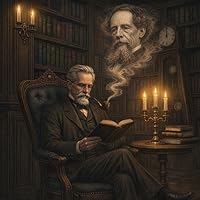
Of course, according to the most obvious principles of art, the narrator of a fiction must be as thoroughly in earnest as if he were the narrator of facts. One could not tell the most extravagant fairy-tale so as to rouse and sustain the attention of the most infantine listener, if the tale were told as if the taleteller did not believe in it. But when the reader lays down this "Strange Story," perhaps he will detect, through all the haze of romance, the outlines of these images suggested to his reason: Firstly, the image of sensuous, soulless Nature, such as the Materialist had conceived it; secondly, the image of Intellect, obstinately separating all its inquiries from the belief in the spiritual essence and destiny of man, and incurring all kinds of perplexity and resorting to all kinds of visionary speculation before it settles at last into the simple faith which unites the philosopher and the infant; and thirdly, the image of the erring but pure-thoughted visionary, seeking overmuch on this earth to separate soul from mind, till innocence itself is led astray by a phantom, and reason is lost in the space between earth and the stars. Whether in these pictures there be any truth worth the implying, every reader must judge for himself; and if he doubt or deny that there be any such truth, still, in the process of thought which the doubt or denial enforces, he may chance on a truth which it pleases himself to discover. -- Edward George Bulwer-Lytton
Edward George Earle Lytton Bulwer-Lytton, 1st Baron Lytton PC, was an English novelist, poet, playwright, and politician. Lord Lytton was a florid, popular writer of his day, who coined such phrases as "the great unwashed", "pursuit of the almighty dollar", "the pen is mightier than the sword", and the infamous incipit "It was a dark and stormy night."
He was the youngest son of General William Earle Bulwer of Heydon Hall and Wood Dalling, Norfolk and Elizabeth Barbara Lytton, daughter of Richard Warburton Lytton of Knebworth, Hertfordshire. He had two brothers, William Earle Lytton Bulwer (1799–1877) and Henry Bulwer, 1st Baron Dalling and Bulwer.
Lord Lytton's original surname was Bulwer, the names 'Earle' and 'Lytton' were middle names. On 20 February 1844 he assumed the name and arms of Lytton by royal licence and his surname then became 'Bulwer-Lytton'. His widowed mother had done the same in 1811. His brothers were always simply surnamed 'Bulwer'.
“The science of to-day is the ignorance of to-morrow! Every year some bold guess lights up a truth to which, but the year before, the schoolmen of science were as blinded as moles.”
Young Dr. Allen Fenwick is a staunch believer in the progress of science, as the introductory quotation shows, and has no time for any balderdash, such as Mesmerism, or the idea that there is more to our lives than the interaction of body and mind. In the town where he has settled down as a GP, he soon comes into conflict with an elder colleague of his, whose more metaphysical ideas he lambasts mercilessly, thus driving the sensitive old man into a premature grave. ”Was I inhumanly barbarous because the antagonist destroyed was morbidly sensitive?” is the question Fenwick asks himself, and he is also a trifle uncomfortable because of the malediction the dying man uttered with his last breath.
However, Fenwick cannot ponder long about the effects of his intolerance in medical and scientific matters, even though he feels sorry for his late antagonist, because all of a sudden, he falls in love with Lillian Ashleigh, the daughter of a widow who newly moves into town. Now Lillian may not be the paragon of level-headedness and sensibility that Fenwick actually sought for in a prospective wife, because she has a tendency to dreaming but well, where love goes … Fenwick’s life, however, is further complicated with the arrival of a young, energetic, popular man called Margrave, who wins the hearts – and souls? – of practically everyone. With some exceptions – one being Lillian herself, who nevertheless becomes estranged from her fiancé, the other being Sir Philip Derval, who claims that Margave is somehow implicated in a murder that took place years ago in Aleppo, and that he may be much older than he seems. Matters become even stranger when Sir Philip Derval finds himself implicated in a murder, namely as its victim – and suspicion falls on Fenwick. How can the doctor prove that Margrave has a hand in all this?
A Strange Story, written by Edward Bulwer-Lytton, is not only a strange story, but also a very long one. This is because of the author’s tendency to have his protagonist and other characters engage in lengthy, even footnote-based discussions on metaphysical problems, in which they often say the same things twice, or thrice in new words. Little does it help that Allen Fenwick keeps asking himself the same questions as to the veracity of his theories about Margrave. Last but not least, Bulwer-Lytton also gets entangled in the various strands of his plot, introducing characters that simply drop out of the story a little later and dwelling on events which will prove quite irrelevant to what is going to follow. One must say that the story as such keeps up the reader’s interest, but that in the case of The Strange Story, Bulwer-Lytton’s indulges too freely in his predilection for purple prose – which is actually what I love him for, but here it comes too thick – and high-falutin claptrap, thus unnecessarily slowing down the pace of his tale and tiring out the reader’s patience.
After reading this I find it hard to believe Edward Bulwer-Lytton has a bad writing contest associated with his name. He was a very skillful writer and a wonderful story-teller.
This story is told from the perspective of Dr. Allan Fenwicke, a rational materialist if there ever was one. He publically debunks the spiritualist beliefs of his fellow physician Dr. Lloyd, and thereby hastens his colleague's demise. Soon after, the Mysterious enters Dr. Fenwicke's logical life in the form of the lovely and dreamy Lillian and the wickedly amoral Mr. Margrave.
Mr. Margrave may or may not be the evil Louis Grayle made young again with black magic. But our hero Dr. Fenwicke will brave all to rescue his Lillian.
The book a real page turner. You don't know until the last page if all will turn out well for Allan.
I recently read this book looking for one of my characters. Well, she's not mine: I borrowed her. But, having read A Strange Story, I strongly suspect that the namesake author I borrowed her from also borrowed her from Bulwer-Lytton.
A Strange Story was originally written as a twenty-something part serial. The result is a rather jumbled overall plot structure, but a definite page-turner anyway, as the author aimed to get readers to come back next week for the next installment. Of course modern readers will have to look past the florid Victorian style and the rich purple angst that was so popular at that time, but beyond that is a pretty straightforward supernatural thriller.
The fascinating thing was to see how many of the tropes I saw in a Strange Story are familiar from other, later works. Modern writers might not read Bulwer-Lytton, but many of the writers who are better known for writing occult, spiritual or mystical books obviously did.
If you read Victorian fiction, you might give this a try. If you are interested in how and where the ideas of Victorian occultism came from, this is definitely an interesting read.
This author's vehemently flowery prose is an entertainment in itself. It's a story of the supernatural, spun on the familiar armature of the man of science, egotistically rational, who confronts the supernatural / spiritual and is humbled. There's a silly religious agenda in this Victorian novel, but it's good fun nonetheless.
Umberto Eco tricked me into reading this, I hold him responsible! The tale revolves around a doctor who meets the devil and tries to rationalise the encounter away. Consequences ensue. The body/soul dichotomy is strong with this one, the story hops between a penny dreadful, a religious debate, a sentimental romance, and... idk, fantasy, maybe? The alchemy is there as promised, but it never actualises into anything real. Magic is dispelled. Metaphorically, however, the alchemical wedding is in full swing. I have enjoyed the 19th century narrative, colourful and slow-paced, although the pitiful place that women took in that society still made me take a deep breath and count my privileges. This strange story may have aged poorly, but the anthropological value is immense. Also, nothing beats good old Victorian story-telling on a cold winter night, period.
This is another book that's been hanging around in the back of the shelves for a long time. It is divided into two books. The first is a pretty straight forward love story combined with ghosts and the supernatural. Much of the second book is given over to serious discussions about the nature of the supernatural and metaphysics. A large part of the first of the second book is kind of a drag, but after that it picks up again. Bulwer Lytton also makes some keen observations along the way. Realizing he was writing in 1893, he sounds very contemporary in his comments about life and women. It was really quite amazing.
A Strange Story was published in Charles Dickens All the Year Round magazine, in 31 episodes and 180 pages, from August 10, 1861, to March 8, 1862. Bulwer ruefully thought of his tale as a "mystic story" with him fancying that this would be the best work of his imagination.
Bulwer's core theme in the novel draws upon the Victorian era's quintessential problem as shown through the skeptical narrator and protagonist Dr. Allen Fenwick's thoughts of the perceived conflict between reason and materialism, and the faith of one having a soul which leads to a sharp division between the material and the ideal, or the body and the spiritual as modes of experiencing the world. Fenwick becomes increasingly frustrated with the sensory information he perceives
Bulwer throughout A Strange Story criticizes materialism as a method of reasoning, finding it insufficient for explaining the distinction between justified belief and opinion. However, in the end Bulwer bequeaths us a darn good Victorian occult themed novel giving us a very amoral evil antagonist (a man without a soul) in the guise of a wizard sorcerer character named Margrave. Margrave's central haunting and spectral appearance of his ghastly double in that of the Luminous Shadow, highlights the most enduring aspect of the novel’s legacy in terms of the spectacle of a truly Victorian era occult themed novel.
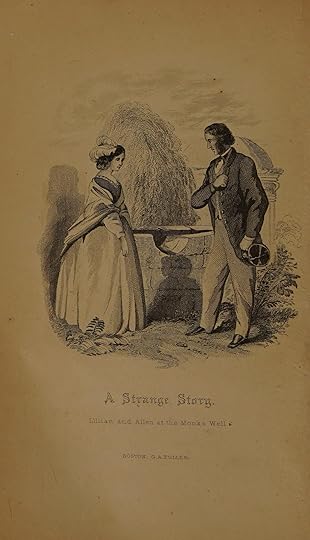
Allen encountering Lillian at the Monk's well.
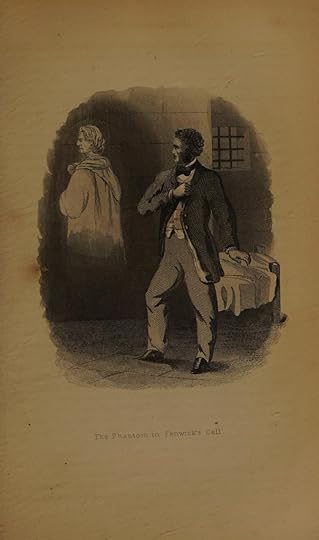
The Luminous Shadow (Margrave's Phantom) appearing in Fenwick's cell.
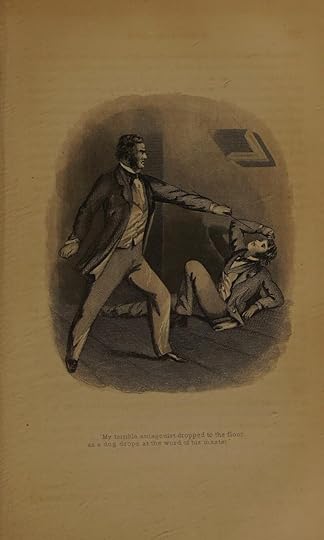
"At that moment I snatched up the wand, directed it towards him, and, advancing with a fearless stride, cried, 'Down to my feet, miserable sorcerer!'” Fenwick waving the wand drops Margrave to the floor "as a dog drops at the word of his master".
The story is fantastic, of course, but must have been very original for its time. What makes it hard to put down is the craftsmanship of his writing. It is structured, strong--and honest. His dialog is especially "alive." Over and over again I could see evidence of Lytton being in the moment, absolutely immersed in the scene he was depicting. For some reason--and I mean this in a good sense--as I read, I would picture Lytton at his desk writing, totally absorbed in his craft, and oblivious to the possible reactions of the reading public.
This is both a positive and a negative aspect of Lytton. This novel needed editing; some scenes--and conversations--were followed to the point of exhaustion; the plot, too, became predictable. But the quality of his writing, which is a joy to read, kept me connected. I had the impression, throughout, that he was a man of independent means who had the freedom to write as he damned well pleased. Fortunately for us, he wrote well!
A Ridiculous and Boring Story, posing as an occult thriller. It doesn't get interesting until about a half way in, but the ending is really disappointing. I'm guessing that the only reason Crowley added it to his (secondary) suggested reading list is because of the long philosophical debates about "soul" and "mind," along with the occasional speculations on alchemy and Rosicrucianism.
A strange story indeed, though quite interesting at times. Difficult to read with a modern mindset, a bit of a background in Victorian literature surely is useful.