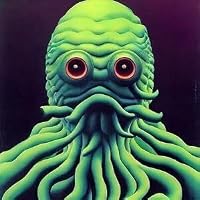
Ballantine Books, 1971. Mass market paperback. This book collects 10 science fiction stories which, in the words of editor Robert Silverberg, “provide entertainment and stimulation for an adult audience.” There was a total of 9 books in this series. Includes an introduction by the editor and these
“Call Me Joe” (1957) by Poul Anderson “Goodbye Amanda Jean” (1970) by Wilma Shore “A Man of the Renaissance” (1964) by Wyman Guin “Wall of Crystal, Eye of Night” (1961) by Algis Budrys “Faith of Our Fathers” (1967) by Philip K. Dick “That Share of Glory” (1952) by C. M. Kornbluth “The Men Return” (1957) by Jack Vance “The Voices of Time” (1960) by J. G. Ballard “The Burning of the Brain” (1958) by Cordwainer Smith “The Shaker Revival” (1970) by Gerald Jonas
Philip Kindred Dick was a prolific American science fiction author whose work has had a lasting impact on literature, cinema, and popular culture. Known for his imaginative narratives and profound philosophical themes, Dick explored the nature of reality, the boundaries of human identity, and the impact of technology and authoritarianism on society. His stories often blurred the line between the real and the artificial, challenging readers to question their perceptions and beliefs.
Raised in California, Dick began writing professionally in the early 1950s, publishing short stories in various science fiction magazines. He quickly developed a distinctive voice within the genre, marked by a fusion of science fiction concepts with deep existential and psychological inquiry. Over his career, he authored 44 novels and more than 100 short stories, many of which have become classics in the field.
Recurring themes in Dick's work include alternate realities, simulations, corporate and government control, mental illness, and the nature of consciousness. His protagonists are frequently everyday individuals—often paranoid, uncertain, or troubled—caught in surreal and often dangerous circumstances that force them to question their environment and themselves. Works such as Ubik, The Three Stigmata of Palmer Eldritch, and A Scanner Darkly reflect his fascination with perception and altered states of consciousness, often drawing from his own experiences with mental health struggles and drug use.
One of Dick's most influential novels is Do Androids Dream of Electric Sheep?, which served as the basis for Ridley Scott's iconic film Blade Runner. The novel deals with the distinction between humans and artificial beings and asks profound questions about empathy, identity, and what it means to be alive. Other adaptations of his work include Total Recall, Minority Report, A Scanner Darkly, and The Man in the High Castle, each reflecting key elements of his storytelling—uncertain realities, oppressive systems, and the search for truth. These adaptations have introduced his complex ideas to audiences well beyond the traditional readership of science fiction.
In the 1970s, Dick underwent a series of visionary and mystical experiences that had a significant influence on his later writings. He described receiving profound knowledge from an external, possibly divine, source and documented these events extensively in what became known as The Exegesis, a massive and often fragmented journal. These experiences inspired his later novels, most notably the VALIS trilogy, which mixes autobiography, theology, and metaphysics in a narrative that defies conventional structure and genre boundaries.
Throughout his life, Dick faced financial instability, health issues, and periods of personal turmoil, yet he remained a dedicated and relentless writer. Despite limited commercial success during his lifetime, his reputation grew steadily, and he came to be regarded as one of the most original voices in speculative fiction. His work has been celebrated for its ability to fuse philosophical depth with gripping storytelling and has influenced not only science fiction writers but also philosophers, filmmakers, and futurists.
Dick's legacy continues to thrive in both literary and cinematic spheres. The themes he explored remain urgently relevant in the modern world, particularly as technology increasingly intersects with human identity and governance. The Philip K. Dick Award, named in his honor, is presented annually to distinguished works of science fiction published in paperback original form in the United States. His writings have also inspired television series, academic studies, and countless homages across media.
Through his vivid imagination and unflinching inquiry into the nature of existence, Philip K. Dick redefined what science fiction could achieve. His wor
In the Alpha series of anthologies Silverberg collected stories of speculative fiction that he felt were of superior literary merit and that were worthy of more recognition in the field than they had so far gathered. In this second volume his selection spanned a fifteen year period and the writers included old pros as well as new writers (remember the book appeared in 1971), as well as authors that were quite well known as well as more obscure names. This one includes my favorite Poul Anderson story, Call Me Joe, as well as memorable works by Philip K. Dick, Jack Vance, C.M. Kornbluth, and Cordwainer Smith. My favorite was The Shaker Revival by Gerald Jonas, which I found very moving.
In the 1970s Robert Silverberg edited a series of short stories and Alpha 2 (1971) is the second in this series which collects a roster of science fiction's best fiction from old masters and then new writers. Alpha 2 includes such well-known names as Poul Anderson, J. G. Ballard, Philip K. Dick, C. M. Kornbluth, Cordwainer Smith, and Jack Vance. Less recognizable--to me, at any rate--are Algis Budrys, Wyman Guin, Gerald Jonas, and Wilma Shore, although I'm quite sure I've read Shore's "Good-bye Amanda Jean" before. It seems to me a story suitable to a collection under the Hitchcock name, but I cannot find evidence that this is where I found it first. An interesting collection with the usual amount of terrific stories mixed with the not-so-great. ★★★
A brief look at the stories: "Call Me Joe" by Poul Anderson. Given the incredibly harsh conditions on Jupiter, if humans are ever to investigate the planet it will have to be by proxy. But robotic equipment just doesn't give the same interpretations that a human visitor might. Anderson comes up with an ingenious way in which humanity could experience Jupiter "first hand" and an interesting twist on what might happen if our proxy developed a mind of his own...
"Goodbye Amanda Jean" by Wilma Shore: This is a very creepy tale. No explanations given--we don't know if other animals have gone extinct and that drives the rather unusual hunting season described in the story. But we can only hope that the story is not in any way prophetic.
"A Man of the Renaissance" by Wyman Guin: A story of a "superman" who is so sure of his knowledge and vision for his world that he is willing to give up everything, even the woman he loves to make certain that vision becomes reality.
"Wall of Crystal, Eye of Night" by Algis Budrys: A man arranges to have sole control of the ultimate entertainment system--no matter who he has to step on to get it. But then his competition does him one better.
"Faith of Our Fathers" by Philip K. Dick: PKD tells us a little bedtime nightmare about the dictatorship that takes over the earth....but isn't quite the dictatorship that it seems. But then nothing in this story is....
"That Share of Glory" by C. M. Kornbluth: A young novice in a monastery-like training ground for interstellar translators finally earns his place on board a trading ship...but soon learns that his testing isn't over. Will he pass?
"The Men Return" by Jack Vance: Vance weaves a tale of the Earth whose universal orbit takes it into space where the physical laws that man and beast have been subject to no longer apply...what might that Earth look like? And who is the master of the Earth then?
"The Voices of Time" by J. G. Ballard: This one, I'm afraid, makes no sense to me. It's like a dream involving time and the main character seems to be running out of time and sleep...but goes into a coma or goes to meet the voices in the stream of time. Or something. And there's a guy following him around who never sleeps. And...yeah. [I told you it makes no sense.]
"The Burning of the Brain" by Cordwainer Smith: What if ship captains controlled their ships with their brains? And what if the proper coordinates for travelling from here to there got lost? What would the captain have to do to get his ship safely back where it belongs? This is that story.
"The Shaker Revival" by Gerald Jonas: The young people (younger than 30, that is) host a revolution by reviving the tenants of the Shakers with modifications suitable to a response to the 70s-ish era of rampant consumerism. The New Shakers adopt a creed of "No war. No money. No hate. No sex" (The 4 Noes) and the story relates the reaction of the feebies (the parents and the establishment) to revolution.
First posted on my blog My Reader's Block. Please request permission before reposting. Thanks.
⭐⭐⭐⭐ Wall Of Crystal, Eye Of Night ALGIS BUDRYS ⭐⭐ That Share Of Glory C. M. KORNBLUTH ⭐⭐ The Burning Of The Brain CORDWAINER SMITH ⭐⭐⭐ The Shaker Revival GERALD JONAS ⭐⭐⭐⭐ The Voices Of Time J. G. BALLARD ⭐⭐⭐ The Men Return JACK VANCE ⭐⭐⭐⭐ Faith Of Our Fathers PHILIP K. DICK ⭐⭐⭐ Call Me Joe POUL ANDERSON ⭐⭐⭐ Goodbye Amanda Jean WILMA SHORE ⭐⭐⭐ A Man Of The Renaissance WYMAN GUIN
Each volume of Robert Silverberg's Alpha series features a selection of stories that Silverberg considers good, literary science fiction. There is no theme: just good stories. I read Alpha 1 not long ago, and I just read Alpha 2.
For me, it was again a mix of stories I'd read before (some multiple times) and one's I hadn't. And again it was a mix of authors whose work I know well -- Cordwainer Smith, Poul Anderson, Jack Vance -- and ones I know little of (Wyman Guin, Wilma Shore). Overall, it's another strong anthology.
Poul Anderson's "Call Me Joe" is the story of a man who becomes disabled and volunteers to have his consciousness transmitted into an artificial being on the surface of Jupiter. As time progresses, he becomes more and more at home in the artificial body, and less and less wants to return to his own. If this sounds familiar, it's because the basics of the movie Avatar are much like it. James Cameron really should have a sent a check to the Anderson estate. And unlike Avatar, which is visually stunning and is entertaining but is hampered by cliches, "Call Me Joe" remains fresh and compelling.
"Faith of Our Fathers" by Philip K. Dick is set in a world where the North Vietnamese and the communist block nations have won the war. The main character is a bureaucrat in the Ministry of Cultural Artifacts, where among other things he must detect writings that aren't politically correct. But he's given an anti-hallucinogen before he sees the glorious Leader, who perhaps isn't what he appears to be. Is he human? Alien? A robot? Something else? Are people perceiving the reality they think they are in only because they are being constantly fed hallucinogen's. Like many Dick works, this story explores the nature of reality. The ending isn't quite satisfying, but overall this is a strong story.
"The Burning of the Brain" is part of Cordwainer Smith's Instrumentality of Mankind series. When an interstellar ship is lost in the void, a Go-Captain must sacrifice his own sanity to get everyone home. It's told in Smith's unique style: nobody wrote quite like him. And like almost all of his fiction, it's engrossing and hard to forget.
I wasn't familiar with Wyman Guin, but his "A Man of the Renaissance" is a memorable story of a multi-talented genius in a world of floating islands. He is trying to bring about a revolution, to install a leader on his home island who will agree to tie together (literally) three islands, for safety and economic development. While Guin's prose is in now way Vancian, his world, his societies, and some of the situations would be at home in one of Jack Vance's novels. It's a good story exploring character, politics, and the morality behind some political actions.
The volume also features good stories by Jack Vance, J.G. Ballard, C.M. Kornbluth, Algis Budrys, and others.
*** Call Me Joe (1957) • Poul Anderson * Goodbye Amanda Jean (1970) • Wilma Shore ***** A Man of the Renaissance (1964) • Wyman Guin **** Wall of Crystal, Eye of Night (1961) • Algis Budrys **** Faith of Our Fathers (1967) • Philip K. Dick **** That Share of Glory (1952) • C. M. Kornbluth **** The Men Return (1957) • Jack Vance *** The Voices of Time (1960) • J. G. Ballard **** The Burning of the Brain (1958) • Cordwainer Smith ** The Shaker Revival (1970) • Gerald Jonas