

What do you think?
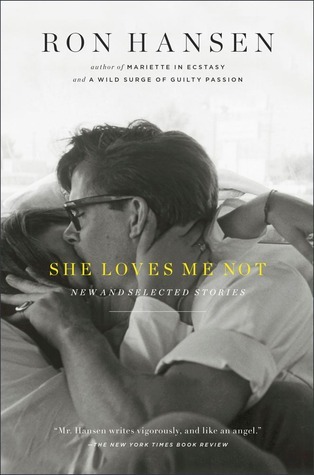
She Loves Me Not: New and Selected Stories
From an author praised by literary giants such as John Irving and the New York Times alike, a stunning story collection—over two decades in the making.
From an author Praised by literary giants and critics alike, a stunning compendium of selected stories over three decades in the making.
Ron Hansen has long been celebrated as a master of both the novel and the short form. His stories have been called “beautifully crafted” ( The New York Times ), “unforgettable” ( San Francisco Chronicle ), and “diverse and expansive” ( The Washington Post ). His 1989 collection, Nebraska, was widely praised, and he has published stories in literary magazines nationwide— The Atlantic, Esquire, Harper’s, Tin House, The Paris Review, and many others.
In this new volume, comprising twelve new stories and seven pieces selected from Nebraska, the subjects of Hansen’s scrutiny range from Oscar Wilde to murder to dementia to romance, and display Hansen at his storytelling the craftsman described as “part Hemingway and part García Márquez . . . an all-American magic realist in other words, a fabulist in the native grain.” Readers will thrill to Hansen’s masterful attention to the smallest and most telling details, even as he plunges straight into the deepest recesses of desire, love, fury, and loss. Magisterial in its scope and surprising in its variety, She Loves Me Not shows an author at the height of his powers and confirms Hansen’s place as a major American writer.
From an author Praised by literary giants and critics alike, a stunning compendium of selected stories over three decades in the making.
Ron Hansen has long been celebrated as a master of both the novel and the short form. His stories have been called “beautifully crafted” ( The New York Times ), “unforgettable” ( San Francisco Chronicle ), and “diverse and expansive” ( The Washington Post ). His 1989 collection, Nebraska, was widely praised, and he has published stories in literary magazines nationwide— The Atlantic, Esquire, Harper’s, Tin House, The Paris Review, and many others.
In this new volume, comprising twelve new stories and seven pieces selected from Nebraska, the subjects of Hansen’s scrutiny range from Oscar Wilde to murder to dementia to romance, and display Hansen at his storytelling the craftsman described as “part Hemingway and part García Márquez . . . an all-American magic realist in other words, a fabulist in the native grain.” Readers will thrill to Hansen’s masterful attention to the smallest and most telling details, even as he plunges straight into the deepest recesses of desire, love, fury, and loss. Magisterial in its scope and surprising in its variety, She Loves Me Not shows an author at the height of his powers and confirms Hansen’s place as a major American writer.
256 pages, Hardcover
First published September 4, 2012
About the author
Ron Hansen
66 books277 followersRon Hansen is the author of two story collections, two volumes of essays, and nine novels, including most recently The Kid, as well as The Assassination of Jesse James by the Coward Robert Ford, which was made into an Oscar-nominated film. His novel Atticus was a finalist for the National Book Award. He teaches at Santa Clara University.
Ratings & Reviews
Friends & Following
Create a free account to discover what your friends think of this book!
Community Reviews
Displaying 1 - 24 of 24 reviews

March 14, 2022
I loved Mariette in Ecstasy so I was disappointed to find this collection mostly underwhelming, with the exception of Wilde in Omaha, Wickedness, The Sparrow, and The Sleepwalker.

January 29, 2013
During the late 1990s, I wanted to buy Ron Hansen’s 1989 short story collection "Nebraska." Hansen and I grew up in the Midwest, albeit several hundred miles apart, but I was curious as to what he had to say about his native state of Nebraska. This was before the Internet and amazon.com, and I couldn’t find the book at new or used bookstores after several months of searching. I recently came across his 2012 collection, "She Loves Me Not: New and Selected Stories," and was pleased to discover that it contained seven stories from that earlier book of stories.
Hansen’s short stories span from the late 19th century to well into the 20th century. Among the stories taking place in the 1800s were “Wilde in Omaha” about the visit of British playwright and wit Oscar Wilde to Nebraska in 1882 and “Wickedness,” a horrific (but I think accurate) account of the blizzard that hit the state and killed many of its inhabitants in 1882. On the other hand, “Playland” is a spooky story about a fictional amusement park, at an undisclosed location in the United States, with a swimming pool one mile long, half a mile wide, and 36 feet deep at its center. The three main characters visiting the park right after World War II are as mysterious and sinister as their surroundings. “The Killers” seems to be an homage to the Hemingway short story of the same name.
I especially liked “The Sparrow” about a 12-year-old Nebraska boy trying to cope with the death of his mother in a flying accident and pondering in the inchoate way of a child the question of why good people suffer. A priest he visits cannot offer an answer to this question. The short final scene in an overheated second-story classroom at a Catholic elementary school with the sparrow of the book’s title is riveting. The enigmatic final paragraph gives the reader something to ponder.
I am impressed by the variety of people from a variety of occupations from a variety of times in these stories. The stories give the reader a good feel for the Midwest and its inhabitants. Not every story is a winner, but several are exceptional.
Hansen’s short stories span from the late 19th century to well into the 20th century. Among the stories taking place in the 1800s were “Wilde in Omaha” about the visit of British playwright and wit Oscar Wilde to Nebraska in 1882 and “Wickedness,” a horrific (but I think accurate) account of the blizzard that hit the state and killed many of its inhabitants in 1882. On the other hand, “Playland” is a spooky story about a fictional amusement park, at an undisclosed location in the United States, with a swimming pool one mile long, half a mile wide, and 36 feet deep at its center. The three main characters visiting the park right after World War II are as mysterious and sinister as their surroundings. “The Killers” seems to be an homage to the Hemingway short story of the same name.
I especially liked “The Sparrow” about a 12-year-old Nebraska boy trying to cope with the death of his mother in a flying accident and pondering in the inchoate way of a child the question of why good people suffer. A priest he visits cannot offer an answer to this question. The short final scene in an overheated second-story classroom at a Catholic elementary school with the sparrow of the book’s title is riveting. The enigmatic final paragraph gives the reader something to ponder.
I am impressed by the variety of people from a variety of occupations from a variety of times in these stories. The stories give the reader a good feel for the Midwest and its inhabitants. Not every story is a winner, but several are exceptional.
May 9, 2016
As a man who has wept over the death of a dog, it is no small challenge to proclaim that Ron Hansen has penned perhaps the most hilarious story ever written about such an occurrence. It may be the only one to take that approach. And yet.
And yet "My Kid's Dog" is probably not the first or most important thing anyone needs to know about this very fine collection. I first encountered many of these stories years ago when "Nebraska" first came to my attention thanks to Daedalus, my favorite remaindered book sellers. The title story, re-published here, remains a masterpiece of understated, yet spot-on description of a rarely probed land.
Other stories probe the same landscape with the same insight, accuracy and sweet impact. But Hansen also has a weird, uncanny and somewhat violent streak. (Think Kafka, with more freedom to be explicit.) That places the bucolic, beautiful stuff in a different, wholly original, perspective.
And yet "My Kid's Dog" is probably not the first or most important thing anyone needs to know about this very fine collection. I first encountered many of these stories years ago when "Nebraska" first came to my attention thanks to Daedalus, my favorite remaindered book sellers. The title story, re-published here, remains a masterpiece of understated, yet spot-on description of a rarely probed land.
Other stories probe the same landscape with the same insight, accuracy and sweet impact. But Hansen also has a weird, uncanny and somewhat violent streak. (Think Kafka, with more freedom to be explicit.) That places the bucolic, beautiful stuff in a different, wholly original, perspective.

November 25, 2012
Hard to rate this one. He's obviously a good writer and his mastery of language is impressive. The stories are interesting and engaging, but they are quite quirky, too much so for my personal taste. He seems to be doing sort of a collage technique in some that is intriguing but, for me, not as satisfying as a solid traditional narrative structure.
January 10, 2013
Am I the only one that thinks a story should have a narrative arc, some sort of plot? The stories in this book don't seem to have much in the way of plots and that makes them tedious.

August 26, 2014
Some great stories, but some misses, too. An erratic read, but "Wickedness" about a sudden blizzard, made the whole book worth it.

April 8, 2018
If I could be a writer I'd want to be Ron Hansen. It's not about the action with him. It's about what events and actions mean in the lives of his characters. It's about significance.
This book is a collection of Hansen's short stories, some republished from an earlier collection, Nebraska, and some newly published. Although I had read Nebraska years ago, I didn't mind at all re-reading those republished stories. Hansen is a writer who bears reading over and over. One in particular, Wickedness, is a story that still haunts me with its depictions of lives lost in a sudden freeze during a Nebraska winter. The depictions have the feel of reality, so much so that I left the story believing, rightly or wrongly, that it wasn't fiction -- if fiction, it's the kind of fiction that merits the over-used "truer than fact" label.
Some of these stories strike what to me is a different tone for Hansen -- a farcical tone I haven't appreciated in him before. The title story, She Loves Me Not, is an example, with characters and events spiraling away at a right angle from anything "normal".
I think what makes these stories, and Hansen's writing in general, so engrossing is his ability to disclose the depth of every human life in them. It's as if every character is experienced in the first person. He is telling the autobiographies of each character, and the story is their intersection.
If you haven't read any of Hansen's novels or short stories, this is not a bad place to start. It contains some samples of his historical fiction, in the tough portrayals of life in Nebraska, drawn out in larger form in novels like Desperadoes and The Assassination of Jesse James. It also contains those character studies of desperate or doomed characters, as in A Wild Surge of Guilty Passion. If you read these stories, you'll want to move on to those longer, fuller novels as well.
This book is a collection of Hansen's short stories, some republished from an earlier collection, Nebraska, and some newly published. Although I had read Nebraska years ago, I didn't mind at all re-reading those republished stories. Hansen is a writer who bears reading over and over. One in particular, Wickedness, is a story that still haunts me with its depictions of lives lost in a sudden freeze during a Nebraska winter. The depictions have the feel of reality, so much so that I left the story believing, rightly or wrongly, that it wasn't fiction -- if fiction, it's the kind of fiction that merits the over-used "truer than fact" label.
Some of these stories strike what to me is a different tone for Hansen -- a farcical tone I haven't appreciated in him before. The title story, She Loves Me Not, is an example, with characters and events spiraling away at a right angle from anything "normal".
I think what makes these stories, and Hansen's writing in general, so engrossing is his ability to disclose the depth of every human life in them. It's as if every character is experienced in the first person. He is telling the autobiographies of each character, and the story is their intersection.
If you haven't read any of Hansen's novels or short stories, this is not a bad place to start. It contains some samples of his historical fiction, in the tough portrayals of life in Nebraska, drawn out in larger form in novels like Desperadoes and The Assassination of Jesse James. It also contains those character studies of desperate or doomed characters, as in A Wild Surge of Guilty Passion. If you read these stories, you'll want to move on to those longer, fuller novels as well.

December 9, 2018
Some truly outstanding stories: Wickedness, Wilde in Omaha, Sparrow. There is a Flannery O’Connor macabre influence. I was otherwise underwhelmed.
January 13, 2019
Very good writing capturing various aspects of American life and past, lost me with switch to unpleasant and unedifying weirdness. Too bad.

May 5, 2016
I’m old school, I admit it. I do tinker with structure when I’m writing, but not enough to take away from the major tenets of the short story or novel: character development, moving story forward in the Aristotlean manner of rising action, climax, denouement. These, while leaving participatory room for the reader.
I know other forms of tinkering occur in writing classes of various sorts, and one may forgive many things, but not robbing the reader of being properly entertained and/or informed.
Lest I be accused of curmudgeonly ways, I have to give Hansen his props: he’s not afraid to experiment. But in experimental mode, a writer can’t expect every test tube to turn lead to gold, an adage that the She Loves Me Not collection proves true. The author experiments here with a journalistic form of fiction in “Wilde in Oklahoma.” He writes “Nebraska” trying to see if narrative alone can carry the story. He toys with flash fiction in “The Sleepwalker.” And in “The Theft,” he tries to resolve character and storyline in a final sentence or two, a piece perhaps too short to carry out his designs. In the title story, an otherwise engaging tale, his narrator’s voice seems counter to his characters and storyline.
The popularity of story collections doesn’t wane; such collections are a repository for the odd scribbles of writers both learning the craft and of those wishing to toy with the tried and true. However, I’ve always found them unsatisfying for these reasons - the best foot is rarely being put forward in such a collection.
Still, Hansen imprints his stories with enough wit and talent to make the read worthwhile. But I would get his one at the local library, not buy it.
My Rating: 14 of 20 stars
I know other forms of tinkering occur in writing classes of various sorts, and one may forgive many things, but not robbing the reader of being properly entertained and/or informed.
Lest I be accused of curmudgeonly ways, I have to give Hansen his props: he’s not afraid to experiment. But in experimental mode, a writer can’t expect every test tube to turn lead to gold, an adage that the She Loves Me Not collection proves true. The author experiments here with a journalistic form of fiction in “Wilde in Oklahoma.” He writes “Nebraska” trying to see if narrative alone can carry the story. He toys with flash fiction in “The Sleepwalker.” And in “The Theft,” he tries to resolve character and storyline in a final sentence or two, a piece perhaps too short to carry out his designs. In the title story, an otherwise engaging tale, his narrator’s voice seems counter to his characters and storyline.
The popularity of story collections doesn’t wane; such collections are a repository for the odd scribbles of writers both learning the craft and of those wishing to toy with the tried and true. However, I’ve always found them unsatisfying for these reasons - the best foot is rarely being put forward in such a collection.
Still, Hansen imprints his stories with enough wit and talent to make the read worthwhile. But I would get his one at the local library, not buy it.
My Rating: 14 of 20 stars

April 4, 2013
I like Ron Hansen's writing as a general rule. He has never been a genre-bound writer, as this collection vividly illustrates. The story topics range from historical fiction to contemporary crime. Most are set in Nebraska, such as 'Wickedness' which recalls the horrors the Children's Blizzard of 1888 that swept unexpectedly through the Plains states. "She Loves Me Not" is the 'personal' confession of a small time loser so infatuated with an exotic dancer that he agrees to help murder her thuggish, Omaha strip club-owner husband. "Wilde in Omaha" is a young reporter's account of the flamboyant young writer's visit to the Midwest in 1882. The retiree in "Red-Letter Days" recounts his days of golf and getting older in his journal. Hansen even takes on Henry James, cleverly re-imagining "The Turn of the Screw" in "The Governess", where the devious pranks of the housekeeper are directed against the newly installed, naive young lady of the title. If you're from Nebraska (or any of the Plains states, or any small town for that matter) you will readily recognize some of the more contemporary characters and settlings.
As is true with most short story collections, not all the stories will appeal to everyone. Some are very short, one or two are only a page long, if that. Some seem to be over-long. On the whole, though, it is a very enjoyable book.
As is true with most short story collections, not all the stories will appeal to everyone. Some are very short, one or two are only a page long, if that. Some seem to be over-long. On the whole, though, it is a very enjoyable book.
Read
August 6, 2013Ron Hansen is an author whose work I follow because he is local in my Bay Area of California. This is a short story collection with several of the short stories rooted in Nebraska and the Midwest. Ron Hansen's prose is vivid, spare, and engaging. My favorite in the collection is the first one: "Wilde in Omaha" wherein Hansen imagines Oscar Wilde on tour from the point of view of a culturally aspiring young man who yearns to get close to the international celebrity. The tone of this story is ironic, contrasting the earnest adulation of the local audience with Oscar's world weariness. How Oscar's life will turn out is still unknown, including the dangers which his wit will unleash. In the meantime, Wilde takes Omaha by storm. I also especially enjoyed "Red-Letter Days," a diary of an retired lawyer whose last days are obsessed with his golf game, and watching his contemporaries decline. To balance what could be grim, the lawyer is mentoring a local young man who is truly gifted in golf, helping him to obtain a scholarship. Again, it is the tone and detail that make the story compelling. Each story is a world of its own. I am now motivated to follow through on other Hansen works that have passed me by.

November 23, 2012
3.5 Have not read many stories set in Nebraska but there are several in this book, including one of my favorites about the Great Blizzard of 1888, which has interested me so much that I have checked out a non fiction book from my library called "The Children's Blizzard." Hansen does a great job with these stories, it is easy for the reader to immerse himself totally in the Midwest, his descriptions are so vivid, his writing smooth and relateable. Two other favorites of mine were "Wilde in Omaha", I find reading about Oscar Wilde very amusing. I also liked "The Sparrow".

March 31, 2013
The story "My Communist" is thoroughly charming, and for that alone I'm glad I read the book. In one story Hansen skillfully describes an 1880s Nebraska blizzard from its contemporaries' point of view, in another the shop talk of auto mechanics of the 1980s. Many of the stories are disturbing or just plain strange, though, and I often wondered what exactly they were supposed to do. I may look for one of his novels next.

March 15, 2013
Terrible. It's as if he wanted to see how many adjectives he could fit into each sentence. Totally unnecessary. Half the stories are constructed of small, random paragraphs with nothing to tie them together. Other stories are so jumbled they are nearly impossible to follow. Waste of time. One of the worst collections I have ever read.

October 29, 2012
I WON THIS BOOK ON GOODREADS. I MUST SAY THAT THIS BOOK OF STORIES IS UTTERLY AMAZING. I LOVE SHORT STORIES AND THIS BOOK BRINGS THEM TO A TOTALLY NEW LEVEL OF EXCILLENCE. I WAS AMAZED AND FILLED BY MANY DIFFRENT EMOTIONS AS I READ EACH AND EVERY WOUNDERFULL PAGE.

February 2, 2014
I considered abandoning this part way through. The stories are just a little too quirky, the narrative arc just not quite straightforward enough for me. He is clearly a good writer and captures feelings, moods, places well, but it felt a little like a chore every time I picked this up.

November 13, 2012
Strange!


November 24, 2013
It's hard to rate a collection of short stories. Some were great, others not so much. On the whole, however, I was a little disappointed

September 14, 2014
An interesting collection of short stories, to be sure. However, I'm fairly certain that I won't be reading this again any time soon.

May 31, 2015
this is a real mixed bag. some of the stories are fantastic, others are just so-so. there were even a couple i didn't like at all.
October 19, 2015
A few hits, some misses. Some stories that really didn't seem to fit in the collection.

June 24, 2013
Didn't read all the stories. Loved "My Communist"
Displaying 1 - 24 of 24 reviews