

What do you think?

Bad Religion: How We Became a Nation of Heretics
The book that has sparked a vigorous national debate about the state of American religion, praised by Timothy Keller as “provocative” and “compelling,” while The New York Times says “Douthat attacks nonsense on both the cultural right and left…responsible and fair,” and the Washington Times raves “a superb documentation of America’s crisis of faith,” now in paperback.
AS THE YOUNGEST-EVER OP-ED COLUMNIST FOR The New York Times , Ross Douthat has emerged as one of the most provocative and influential voices of his generation. In Bad Religion he offers a masterful and forceful account of how American Christianity has lost its way—and why it threatens to take American society with it.
In a world populated by “pray and grow rich” gospels and Christian cults of self-esteem, Ross Douthat argues that America’s problem isn’t too much religion; nor is it intolerant secularism. Rather, it’s bad religion . Conservative and liberal, political and pop cultural, traditionally religious and fashionably “spiritual”—Christianity’s place in American life has increasingly been taken over, not by atheism, but by debased versions of Christian faith that stroke our egos, indulge our follies, and encourage our worst impulses.
In a brilliant and provocative story that moves from the 1950s to the age of Obama, Douthat explores how bad religion has crippled the country’s ability to confront our most pressing challenges and accelerated American decline.
AS THE YOUNGEST-EVER OP-ED COLUMNIST FOR The New York Times , Ross Douthat has emerged as one of the most provocative and influential voices of his generation. In Bad Religion he offers a masterful and forceful account of how American Christianity has lost its way—and why it threatens to take American society with it.
In a world populated by “pray and grow rich” gospels and Christian cults of self-esteem, Ross Douthat argues that America’s problem isn’t too much religion; nor is it intolerant secularism. Rather, it’s bad religion . Conservative and liberal, political and pop cultural, traditionally religious and fashionably “spiritual”—Christianity’s place in American life has increasingly been taken over, not by atheism, but by debased versions of Christian faith that stroke our egos, indulge our follies, and encourage our worst impulses.
In a brilliant and provocative story that moves from the 1950s to the age of Obama, Douthat explores how bad religion has crippled the country’s ability to confront our most pressing challenges and accelerated American decline.
352 pages, Paperback
First published April 17, 2012
About the author
Ross Douthat
21 books366 followersRoss Gregory Douthat is a conservative American author, blogger and New York Times columnist. He was a senior editor at The Atlantic and is author of Privilege: Harvard and the Education of the Ruling Class (Hyperion, 2005) and, with Reihan Salam, Grand New Party (Doubleday, 2008), which David Brooks called the "best single roadmap of where the Republican Party should and is likely to head." He is a film critic for National Review and has also contributed to The New York Times, The Wall Street Journal, The Weekly Standard, the Claremont Review of Books, GQ, Slate, and other publications. In addition, he frequently appears on the video debate site Bloggingheads.tv. In April 2009, he became an online and op-ed columnist for The New York Times, replacing Bill Kristol as a conservative voice on the Times editorial page. Douthat is the youngest regular op-ed writer in the paper's history.
Ratings & Reviews
Friends & Following
Create a free account to discover what your friends think of this book!
Community Reviews
Displaying 1 - 30 of 410 reviews

April 8, 2012
I've been a Christian without a community for some time, and this book started to help me realize why. Douthat suggests, and I am convinced, that most of modern American Christianity is unorthodox, indeed heretical, and that this development is bad for the religion and bad for the country.
The major heresies Douthat describes as having taken over American Christianity are these: first, the Dan Brown school of Gnostic Christianity, an outgrowth of the new historical approaches and new apochryphal materials that came to light in the 20th Century. If you place more value on new texts such as the dubious Gospel of Judas, or if you pick apart the Synoptic Gospels according to your historical or textual theory, you can define Jesus as you like. This is the heresy of making Jesus in your own image, or whatever image is comfortable to you: the hippie Jesus, the feminist Jesus, the "social justice" Jesus, the not-supernatural Jesus.
Second is the "God Within" heresy, the Gospel that is more therapeutic than salvational, and which usually claims to be "spiritual but not religious." These are they who pick and choose, a little Christianity, a little Eastern philosophy, maybe a little Wicca, and thus never sink deep into a community or tradition. This is the religion of Oprah, and has recently been popularized by Elizabeth Gilbert's Eat, Pray, Love.
Next is the Prosperity Gospel, and Joel Osteen is the epitome of this heresy. This brand of Christian heresy ignores the uncomfortable anti-mammon passages of Jesus, and preaches that God wants you to get rich!
Finally, the most pernicious heresy, and in my mind the most widespread (and for me the most personally alluring), is the gospel of American Nationalism. This heresy has a messianic and an apocalyptic face, with George W. Bush and Barack Obama both personifying the messianic and Glenn Beck the face of the apocalyptic. The doomsayers preach that America has fallen, that we need to go back to some earlier, more pure Christian society. These are the ones who deify the Founders. The messianic face preaches that America has a mission as "a city on a hill", either to evangelize Democracy (in the Middle East, for instance) or to create a social utopia. This modern vision of American exceptionalism betrays the humility of LIncoln, whose Second Inaugural acknowledged God's hand in our history, but also acknowledged that Americans cannot pretend to know all of what Deity intends, or pretend that we are always worthy instruments.
Douthat argues, convincingly, that this last heresy is what lends our culture wars their religious intensity. When the other party is in power, the apocalypse is nigh, and Theocracy or Socialism is coming! When our party is in power, heaven on earth is imminent. Of course, these concepts are ridiculous, as both parties are made of fallible and decent humanity. The intensity of our current debates is partly because both Left and Right have claimed the sanction of their version of God's Will. Religious people on both sides of the aisle are co-opted, as a Catholic Democrat can no longer be pro-life, and an Evangelical Republican can no longer criticize the Wealthy. Instead of our religion giving us moral insight, humility, or solidarity with our fellow citizen, political divisions have overwhelmed our religion.
Douthat offers the only real solution to the widespread heresy in American Christianity: a return by each individual and congregation to orthodox Christian belief and practice.
A marvelous book.
The major heresies Douthat describes as having taken over American Christianity are these: first, the Dan Brown school of Gnostic Christianity, an outgrowth of the new historical approaches and new apochryphal materials that came to light in the 20th Century. If you place more value on new texts such as the dubious Gospel of Judas, or if you pick apart the Synoptic Gospels according to your historical or textual theory, you can define Jesus as you like. This is the heresy of making Jesus in your own image, or whatever image is comfortable to you: the hippie Jesus, the feminist Jesus, the "social justice" Jesus, the not-supernatural Jesus.
Second is the "God Within" heresy, the Gospel that is more therapeutic than salvational, and which usually claims to be "spiritual but not religious." These are they who pick and choose, a little Christianity, a little Eastern philosophy, maybe a little Wicca, and thus never sink deep into a community or tradition. This is the religion of Oprah, and has recently been popularized by Elizabeth Gilbert's Eat, Pray, Love.
Next is the Prosperity Gospel, and Joel Osteen is the epitome of this heresy. This brand of Christian heresy ignores the uncomfortable anti-mammon passages of Jesus, and preaches that God wants you to get rich!
Finally, the most pernicious heresy, and in my mind the most widespread (and for me the most personally alluring), is the gospel of American Nationalism. This heresy has a messianic and an apocalyptic face, with George W. Bush and Barack Obama both personifying the messianic and Glenn Beck the face of the apocalyptic. The doomsayers preach that America has fallen, that we need to go back to some earlier, more pure Christian society. These are the ones who deify the Founders. The messianic face preaches that America has a mission as "a city on a hill", either to evangelize Democracy (in the Middle East, for instance) or to create a social utopia. This modern vision of American exceptionalism betrays the humility of LIncoln, whose Second Inaugural acknowledged God's hand in our history, but also acknowledged that Americans cannot pretend to know all of what Deity intends, or pretend that we are always worthy instruments.
Douthat argues, convincingly, that this last heresy is what lends our culture wars their religious intensity. When the other party is in power, the apocalypse is nigh, and Theocracy or Socialism is coming! When our party is in power, heaven on earth is imminent. Of course, these concepts are ridiculous, as both parties are made of fallible and decent humanity. The intensity of our current debates is partly because both Left and Right have claimed the sanction of their version of God's Will. Religious people on both sides of the aisle are co-opted, as a Catholic Democrat can no longer be pro-life, and an Evangelical Republican can no longer criticize the Wealthy. Instead of our religion giving us moral insight, humility, or solidarity with our fellow citizen, political divisions have overwhelmed our religion.
Douthat offers the only real solution to the widespread heresy in American Christianity: a return by each individual and congregation to orthodox Christian belief and practice.
A marvelous book.

August 10, 2012
One of the best books on contemporary Christianity that I have ever encountered. The first half of the book serves as an excellent history of the Christian faith as it has waxed and waned across the shores of the 20th and 21st centuries. The second half of the book offers deeply perceptive analysis of 4 dominant, heretical tendencies (gnosticism and the oversimplification of Jesus, the worship of the self via the god within theology, prosperity gospel teaching, and Christian nationalism) that threaten to subvert orthodox Christianity. Douthat is well researched, and he refreshingly avoids simplistic analysis and crass generalization. I especially appreciated his insight that at the core of heresy is the impulse to oversimplify orthodox Christian belief by emphasizing one thing at the expense of others, and thereby denying the deep and abiding complexity, tension, and mystery that pervades orthodox Christian belief. In that manner, I found Douthat to be deeply in line with past insightful Christian thinkers such as G.K. Chesterton and C.S. Lewis. Fortunately for the diligent reader, Douthat closes the book with his own thoughts about how to recover authentic Christianity against the challenges of false theologies, and I found his suggestions to be both compelling and true, and I look forward to thinking more about such a proposal against the history and framework that Douthat has afforded me through this book.

May 3, 2012
Torture the words of the Bible sufficiently and any endeavor can be justified. Douthat utilizes this scripture-twisting tradition to select history, authors, and statistics to build his thesis, which is: the only hope for Christianity, (or the ultimate fate of Christianity; depending on the chapter), is a return to the more extreme, self-sacrificing, exclusive brands of old time religion. The swath of destruction that most churches have plowed from earliest history to the present doesn't come up.
The "bad" of 'Bad Religion' is the corruption of the main doctrines (he mostly picks on Evangelicals but spares none) from the past 60 years or so. He claims that inclusion of gays, women, divorce, abortion, and even contemporary music, have only ever undermined the foundations of the chapel. I share Douthat's disdain for retrofitting doctrine to bless the vanity and materialism of the times, while still claiming "religious virtues". However, I take issue with the hypocrisy of that practice. Douthat, on the other hand, is piqued because adherents are just not suffering enough for Jesus.
He further discredits his work by trivializing or ignoring the scholarship of those who challenge the validity or even the necessity of religion. (He thinks the textual criticism of Bart D. Ehrman is lacking, Sam Harris is a lightweight, Christopher Hitchens is barely on the radar, Richard Dawkins got a mention but Mother "No Morphine-No Condoms" Theresa is the Real Thing).
His unspoken conclusions are dangerous. The perfect Douthat World would dial the clock back about 60 years or more for women and civil rights. It would clear the barriers between continued progress and the otherworldly goals of those of the new Right, (those very people that messed up his Catholic Ideal). He also appeared to rationalize racism as a price paid for keeping religions separated from each other; distinct and pure.
Two stars: one for his excellent writing and another for exposing me to an interesting variety of fallacious arguments.
The "bad" of 'Bad Religion' is the corruption of the main doctrines (he mostly picks on Evangelicals but spares none) from the past 60 years or so. He claims that inclusion of gays, women, divorce, abortion, and even contemporary music, have only ever undermined the foundations of the chapel. I share Douthat's disdain for retrofitting doctrine to bless the vanity and materialism of the times, while still claiming "religious virtues". However, I take issue with the hypocrisy of that practice. Douthat, on the other hand, is piqued because adherents are just not suffering enough for Jesus.
He further discredits his work by trivializing or ignoring the scholarship of those who challenge the validity or even the necessity of religion. (He thinks the textual criticism of Bart D. Ehrman is lacking, Sam Harris is a lightweight, Christopher Hitchens is barely on the radar, Richard Dawkins got a mention but Mother "No Morphine-No Condoms" Theresa is the Real Thing).
His unspoken conclusions are dangerous. The perfect Douthat World would dial the clock back about 60 years or more for women and civil rights. It would clear the barriers between continued progress and the otherworldly goals of those of the new Right, (those very people that messed up his Catholic Ideal). He also appeared to rationalize racism as a price paid for keeping religions separated from each other; distinct and pure.
Two stars: one for his excellent writing and another for exposing me to an interesting variety of fallacious arguments.

May 23, 2018
Excellent exposé on the status of religion in America especially in the latter part of the last century. Douthat believes we are a nation of heretics, that all branches of Christianity have been corrupted; it is only a question of degree. The best review of this book has already been written by Jeff Miller.
Highly recommended, both the book and the review. Updating would earn an extra star from me; book was published in 2012. Douthat is a columnist for the New York Times.
Highly recommended, both the book and the review. Updating would earn an extra star from me; book was published in 2012. Douthat is a columnist for the New York Times.

April 21, 2012
The premise is all right: essentially we've been dominated by heretical forms of Christianity and other religions which overemphasize a few things at the expense of a more holistic view of faith. But the writing is too abstract and dry to make the book enjoyable, desperately needing more examples and stories and less formal argument. It also suffers from a mild "centrist" Catholic bias in terms of example selection and writing.
For example, he talks more about Glenn Beck than Mormonism itself, which is the quintessential America example of heresy. He calls Wicca a "faux-ancient fraud" and talks about it all of once in the book, but Wicca itself is rooted in theosophical and romantic ideals which impact greatly on how we view the environment politically. He briefly covers prosperity theology, like Kenneth Hagin, but doesn't really talk much about Pentecostalism itself. Also, I think he really needed more space discussing atheism as a consequence of and reaction to his main point.
Plus, I think he could have been a bit more balanced about Catholicism. A lot about the typical failings of liberal Catholicism, but less about the overreaction of conversatives, including the flirtation with fascism. Especially since he also tends to criticize fundamentalism fairly often (though not unkindly.)
Finally, again it's just a dry read. Ross Douthat is an excellent short-form opinion writer, but maybe because it's an argumentative piece rather than a descriptive one, it just dragged on for me. It might also be that he doesn't really break new ground for anyone interested in the subject, and his solutions are so abstract as to be unworkable. "Being non-partisan" for example. A good contrast would be Rod Dreher's Crunchy Cons which was far more personal in tone while having the same "things need to change" focus. Even David Brooks, who I dislike intensely as a pundit, writes relatively freshly in his long-form works.
To sum up, while I think the idea is sound and worthy of explanation, for me it just was an unsatisfying read. If you like more erudite and cited arguments (1/3rd of the ebook is notes and citations) you might enjoy this more than I did, but I couldn't help but wish the book was shorter and more like Bobos in Paradise: The New Upper Class and How They Got There. A little more personal and sociological a book would have interested me more.
For example, he talks more about Glenn Beck than Mormonism itself, which is the quintessential America example of heresy. He calls Wicca a "faux-ancient fraud" and talks about it all of once in the book, but Wicca itself is rooted in theosophical and romantic ideals which impact greatly on how we view the environment politically. He briefly covers prosperity theology, like Kenneth Hagin, but doesn't really talk much about Pentecostalism itself. Also, I think he really needed more space discussing atheism as a consequence of and reaction to his main point.
Plus, I think he could have been a bit more balanced about Catholicism. A lot about the typical failings of liberal Catholicism, but less about the overreaction of conversatives, including the flirtation with fascism. Especially since he also tends to criticize fundamentalism fairly often (though not unkindly.)
Finally, again it's just a dry read. Ross Douthat is an excellent short-form opinion writer, but maybe because it's an argumentative piece rather than a descriptive one, it just dragged on for me. It might also be that he doesn't really break new ground for anyone interested in the subject, and his solutions are so abstract as to be unworkable. "Being non-partisan" for example. A good contrast would be Rod Dreher's Crunchy Cons which was far more personal in tone while having the same "things need to change" focus. Even David Brooks, who I dislike intensely as a pundit, writes relatively freshly in his long-form works.
To sum up, while I think the idea is sound and worthy of explanation, for me it just was an unsatisfying read. If you like more erudite and cited arguments (1/3rd of the ebook is notes and citations) you might enjoy this more than I did, but I couldn't help but wish the book was shorter and more like Bobos in Paradise: The New Upper Class and How They Got There. A little more personal and sociological a book would have interested me more.

January 27, 2014
So sometime between the end of the Civil War and now we became a nation of heretics. However, before that was possible, we would have needed to be Catholics, and since most of us weren’t, it is unclear how this all happened. Douthat never clearly puts his finger on the cause of all this so I will: pragmatism. Americans care more about ends than means; and while it has always been this way, the means (the ethics) have been discarded, forgotten, deemed impractical or dangerous, by our pathetic existential fear or greed so often in the last one hundred years of our history that it is laughable to expect anyone to care much about means any more. But here is the thing: Christianity is all about means, not ends. So when we say we are a Christian nation, we are either delusional, sorely misguided, or dumbly naïve. There are people who try. But that is not the same thing as embracing, teaching, and being collectively guided by, something other than practical utilitarian rationality. Winning (land, economic development, war) is the only thing that matters.

March 14, 2017
One of the most insightful, informative, and inspiring books I've ever read.
This book takes great pains to avoid name calling and to be fiercely objective, and that enables the reader to carefully discern true heresies and religious trends. Having context for the religious state of America was not only fascinating, but also practical in discerning orthodoxy in the church.
Furthermore, while I do not agree with the author on everything, his approach and passion for Christianity helped be to accept his critiques and admonitions in my own walk and understanding.
The end is C. S. Lewis-esque and inspires tremendous anticipation in the future even while battling heresies. I never thought a book like this would impact me so profoundly; I highly recommend it.
This book takes great pains to avoid name calling and to be fiercely objective, and that enables the reader to carefully discern true heresies and religious trends. Having context for the religious state of America was not only fascinating, but also practical in discerning orthodoxy in the church.
Furthermore, while I do not agree with the author on everything, his approach and passion for Christianity helped be to accept his critiques and admonitions in my own walk and understanding.
The end is C. S. Lewis-esque and inspires tremendous anticipation in the future even while battling heresies. I never thought a book like this would impact me so profoundly; I highly recommend it.

April 27, 2019
An interesting examination of how Americans arrived at our present religious and political stalemate. The author charts the course of American Christianity, from its post-WW2 resurgence to its current fragmented, and often unrecognizable state. In keeping with its Nation of Heretics subtitle, it offers a relatively non-partisan explanation for the religious aspect of our national polarization in the form of several opposing, but equally destructive, heresies that have that subverted people from the true faith into dysfunctional and ineffective substitutes.

February 25, 2017
BAD RELIGION is probably the best book I've read in the past three years.
Ross Douthat examines the post World War II religious revival that saw Neo-Orthodoxy reinvigorate the Protestant Mainline, Billy Graham lead a new Evangelicalism out of Protestant Fundamentalism, and American Catholicism go mainstream in the USA and the Vatican itself. However, by the 1960s, the golden outlook for all three streams of American Christianity had turned to decline. How could this be, and what was it replaced with?
Douthat convincingly argues that the advent of modern contraception changed the Everyman "common sense" about sex and unaligned it from traditional Christian social teaching. Abstaining from sex outside of marriage in general was no longer necessary to "live the American Dream" and people who were liberated sexually were less inclined to participate actively in churches that taught traditional teachings on sex. Consequentially, over the next several decades, almost every Christian denominational institution in America went into decline. Catholicism was riven in two by accomodationists and the Vatican II reformers who sought a return to Catholic roots--American Catholicism faced massive institutional decline even before the priestly sex scandal sent attendance into a skydive. The Protestant Mainline went accommodationist as well, embracing social change and political action above all else. In Evangelicalism, the new "start-up" denominations failed to create the institutions that could sustain the type of holistic Christian lifecycle seen from 1940 to 1960. (The two exceptions he notes here are the Southern Baptist Convention--the one denomination of the Protestant Mainline that resisted accommodation and joined the Evangelical movement--and the Assemblies of God--the one "start-up" denomination that actually established nationwide institutional infrastructure and support for its members).
The one success was the African-American church, which under leaders like MLK successfully spurred massive social change in the Civil Rights Movement.
Douthat argues the decline in institutional, orthodox Christianity in America does not represent a turning away from spirituality or even Jesus in general--just appropriations of Jesus and spirituality in the American context that actually form Christian heresies. These are 1) the hollowed out accomodation of the Mainline and many local Catholic churches that no longer preach a personal gospel, 2) the Prosperity Gospel of naming and claiming wealth from God that has entered African-American and Charismatic Evangelical Christian space, 3) the God Within spirituality of Oprah and others, 4) the moralistic therapuetic deism that most millennial Evangelicals errantly think of as Christianity, 5) the messianic nationalism of George W. Bush, and 6) the apocalyptic nationalism of Glenn Beck, Michele Bachmann and others. American Christianity's challenge is how to winsomely articulate core orthodoxy in the face of these heresies and to rebuild the institutions that sustain orthodox Christian life.
Ross Douthat examines the post World War II religious revival that saw Neo-Orthodoxy reinvigorate the Protestant Mainline, Billy Graham lead a new Evangelicalism out of Protestant Fundamentalism, and American Catholicism go mainstream in the USA and the Vatican itself. However, by the 1960s, the golden outlook for all three streams of American Christianity had turned to decline. How could this be, and what was it replaced with?
Douthat convincingly argues that the advent of modern contraception changed the Everyman "common sense" about sex and unaligned it from traditional Christian social teaching. Abstaining from sex outside of marriage in general was no longer necessary to "live the American Dream" and people who were liberated sexually were less inclined to participate actively in churches that taught traditional teachings on sex. Consequentially, over the next several decades, almost every Christian denominational institution in America went into decline. Catholicism was riven in two by accomodationists and the Vatican II reformers who sought a return to Catholic roots--American Catholicism faced massive institutional decline even before the priestly sex scandal sent attendance into a skydive. The Protestant Mainline went accommodationist as well, embracing social change and political action above all else. In Evangelicalism, the new "start-up" denominations failed to create the institutions that could sustain the type of holistic Christian lifecycle seen from 1940 to 1960. (The two exceptions he notes here are the Southern Baptist Convention--the one denomination of the Protestant Mainline that resisted accommodation and joined the Evangelical movement--and the Assemblies of God--the one "start-up" denomination that actually established nationwide institutional infrastructure and support for its members).
The one success was the African-American church, which under leaders like MLK successfully spurred massive social change in the Civil Rights Movement.
Douthat argues the decline in institutional, orthodox Christianity in America does not represent a turning away from spirituality or even Jesus in general--just appropriations of Jesus and spirituality in the American context that actually form Christian heresies. These are 1) the hollowed out accomodation of the Mainline and many local Catholic churches that no longer preach a personal gospel, 2) the Prosperity Gospel of naming and claiming wealth from God that has entered African-American and Charismatic Evangelical Christian space, 3) the God Within spirituality of Oprah and others, 4) the moralistic therapuetic deism that most millennial Evangelicals errantly think of as Christianity, 5) the messianic nationalism of George W. Bush, and 6) the apocalyptic nationalism of Glenn Beck, Michele Bachmann and others. American Christianity's challenge is how to winsomely articulate core orthodoxy in the face of these heresies and to rebuild the institutions that sustain orthodox Christian life.

June 11, 2012
I had noticed that TS of Video, meliora, proboque; Deteriora sequor had been reading through Bad Religion: How We Became a Nation of Heretics by Ross Douthat and quoting passages from it. The title and subtitle intrigued me as does the author and so I added it to my wish list and finally got around to buying and reading it.
This book is sort of a history and critique of Christianity as practiced by Americans especially in the last seventy or so years. His critique is that we are a nation of heretics and that really we have always been a nation of heretics from the foundation of the country. What has changed is the amount of orthodoxy as practiced by the various strains of American Christianity. His use of the word heretics is the more general term of use and not a precise canonical one.
As a critique the history provided is of the major trends and personalities involved along with snapshots of data to help you put it all into context. We see how these religious trends often intersected with societal ones and how more and more they took on political tones. These movements within Christianity as practiced in America paralleled movements of thought from Europe resulting in very American formulations of it along with negative reactions to this. He breaks up these movements into two basic areas of accommodation and resistance and reviews both the Protestant and Catholic sides of it. Accommodation being the various forms predominate in a more liberal Christianity along with resistance like the neo-Orthodox movement. This makes up the first half of the book and provides a very readable summary of this history along with exploring the philosophies and personalities behind it.
The second half of the book looks at the various heresies that are predominant now. The culture and the media’s fascination with some of the so-called lost gospels and other gnostic writings used to beat Christianity shows the old adage about “any stick will do.” From the inept translation of the Gospel of Judas as headed by the National Geographic to so much nonsense that has made it to the History Channel we see how that stick is used. They will call the Catholic Church anti-women while promoting the “Gospel” of Thomas where you have to become a man to go to Heaven.
He also explores those who promote a materialistic prosperity gospel of “Name it and claim it” the Word of Faith movement. I find it no surprise that this movement developed in the U.S. and also not a surprise that it runs parallels to the New Age teaching of the “the law of attraction” as espoused in so many books Oprah promoted. Strains of Dr. Norman Vincent Peale “The Power of Positive Thinking” have taken some strange paths.
New Age emphasis on the “God within” has also made many inroads and entries into not only the popular culture, but also the retreat house. It is almost despairing when books like Elizabeth Gilbert’s “Eat, Pray. Love” which exhibit a toxic selfishness not only becomes a best seller, but a movie also. But when the god is within you than sin is dispelled and whatever you happen to be doing is of course part of the will of the god within for you. Mystical pantheism dressed up in radical selfishness.
I found especially interesting the last chapter “The City on the Hill” which looks in part at the various religious/political intersections and how they have played out in our history. The alternations between messianic and apocalyptic views which more and more are existing in parallel. These intersections were to the good in the Civil Rights movements where we had both sides of the political divide along with the parallel elements in various churches. Ross Douthat analysis of this success of this only highlights the failure of modern religious and political partisanship. This is certainly not a simple “liberal bad, conservatives good” book as I think he gives a fair analysis regarding both sides. I certainly did not agree with all of his analysis, but when I didn’t I was more apt to look at my own ideas and see if perhaps I was mistaken or needed to reevaluate something. The conclusion of the book reflects both his “spirit of pessimism” and a hopeful optimism.
This book has been written in a spirit of pessimism, but for both Americans and Christians, pessimism should always be provisional. Even in an era of disarray, Americans can draw confidence from our nation’s remarkable past, with its stories of expectations confounded, obstacles overcome, declines reversed, and better futures attained. Christians have an even stronger source of confidence: the belief that history has an Author and that the destiny of both their country and their creed is in God’s hands.
Ross Douthat as a Catholic knows that the promise concerning the Church’s protection from the Gates of Hell does not mean a protection of American Christianity as he points out. He does not pretend to predict how this ebbs and flows of Christianity within the context of the United States will play out, but he also knows that there have been many predicted ends for it.
As a writer Ross Douthat is really a joy to read and I especially liked the precision in what he wrote. Some people will use their large vocabulary as a spotlight to show how bright they are. I don’t think that was the case here, but I am glad I read the ebook version where a dictionary definition was only a finger press away. When he did use unfamiliar words I found they were perfected fitted to what he was saying.
This book is sort of a history and critique of Christianity as practiced by Americans especially in the last seventy or so years. His critique is that we are a nation of heretics and that really we have always been a nation of heretics from the foundation of the country. What has changed is the amount of orthodoxy as practiced by the various strains of American Christianity. His use of the word heretics is the more general term of use and not a precise canonical one.
As a critique the history provided is of the major trends and personalities involved along with snapshots of data to help you put it all into context. We see how these religious trends often intersected with societal ones and how more and more they took on political tones. These movements within Christianity as practiced in America paralleled movements of thought from Europe resulting in very American formulations of it along with negative reactions to this. He breaks up these movements into two basic areas of accommodation and resistance and reviews both the Protestant and Catholic sides of it. Accommodation being the various forms predominate in a more liberal Christianity along with resistance like the neo-Orthodox movement. This makes up the first half of the book and provides a very readable summary of this history along with exploring the philosophies and personalities behind it.
The second half of the book looks at the various heresies that are predominant now. The culture and the media’s fascination with some of the so-called lost gospels and other gnostic writings used to beat Christianity shows the old adage about “any stick will do.” From the inept translation of the Gospel of Judas as headed by the National Geographic to so much nonsense that has made it to the History Channel we see how that stick is used. They will call the Catholic Church anti-women while promoting the “Gospel” of Thomas where you have to become a man to go to Heaven.
He also explores those who promote a materialistic prosperity gospel of “Name it and claim it” the Word of Faith movement. I find it no surprise that this movement developed in the U.S. and also not a surprise that it runs parallels to the New Age teaching of the “the law of attraction” as espoused in so many books Oprah promoted. Strains of Dr. Norman Vincent Peale “The Power of Positive Thinking” have taken some strange paths.
New Age emphasis on the “God within” has also made many inroads and entries into not only the popular culture, but also the retreat house. It is almost despairing when books like Elizabeth Gilbert’s “Eat, Pray. Love” which exhibit a toxic selfishness not only becomes a best seller, but a movie also. But when the god is within you than sin is dispelled and whatever you happen to be doing is of course part of the will of the god within for you. Mystical pantheism dressed up in radical selfishness.
I found especially interesting the last chapter “The City on the Hill” which looks in part at the various religious/political intersections and how they have played out in our history. The alternations between messianic and apocalyptic views which more and more are existing in parallel. These intersections were to the good in the Civil Rights movements where we had both sides of the political divide along with the parallel elements in various churches. Ross Douthat analysis of this success of this only highlights the failure of modern religious and political partisanship. This is certainly not a simple “liberal bad, conservatives good” book as I think he gives a fair analysis regarding both sides. I certainly did not agree with all of his analysis, but when I didn’t I was more apt to look at my own ideas and see if perhaps I was mistaken or needed to reevaluate something. The conclusion of the book reflects both his “spirit of pessimism” and a hopeful optimism.
This book has been written in a spirit of pessimism, but for both Americans and Christians, pessimism should always be provisional. Even in an era of disarray, Americans can draw confidence from our nation’s remarkable past, with its stories of expectations confounded, obstacles overcome, declines reversed, and better futures attained. Christians have an even stronger source of confidence: the belief that history has an Author and that the destiny of both their country and their creed is in God’s hands.
Ross Douthat as a Catholic knows that the promise concerning the Church’s protection from the Gates of Hell does not mean a protection of American Christianity as he points out. He does not pretend to predict how this ebbs and flows of Christianity within the context of the United States will play out, but he also knows that there have been many predicted ends for it.
As a writer Ross Douthat is really a joy to read and I especially liked the precision in what he wrote. Some people will use their large vocabulary as a spotlight to show how bright they are. I don’t think that was the case here, but I am glad I read the ebook version where a dictionary definition was only a finger press away. When he did use unfamiliar words I found they were perfected fitted to what he was saying.

March 13, 2021
I picked up this book because I believe that Douthat is the most interesting and likely the most talented writer on the NYT editorial page. However, the subject and argument of a limited interest to me and ultimately the argument presented is too qualitative and trusts in the power of ideas or the structure of ideas too much.
Bad Religion argues that the decline of orthodox Christianity in America has not led to a blossoming of secular rationalism, as some (i.e. New Atheists) predicted, but rather to a proliferation of heresies and more primitive forms of religious practice. These distortions of Christian (or monotheistic) tradition offer comfort to many but are shallow substitutes for the rigorous demands of historic faith. Further, post–WWII America once enjoyed a broad, if sometimes contentious, religious consensus, but from the 1960s onward this consensus fractured, leaving a spiritual vacuum filled by self-serving spiritualities, politicized pseudo-religions, and therapeutic creeds. Without completely rising to a polemical level, Douthat softly presents his case for a retvrn to a more orthodox Christian tradition in today's America.
Douthat opens by describing the religious landscape of the 1940s and 1950s, which he regards as a high point for American Christianity. Major figures like Reinhold Niebuhr, Billy Graham, and Fulton Sheen may have represented different theological traditions but together they created a climate of serious engagement with faith, morality, and public life. Christianity was culturally central and intellectually robust, addressing issues of justice, sin, and redemption in ways that were widely influential. Despite Cold War tensions and the challenge of modernity, religion provided a unifying and morally grounding force. I fear Douthat may be projecting an ethos onto a historical epoch that it may not have had, though there is an empirical record that supports the idea that Christianity is less salient in the private and public lives of Americans today than the mid-century. Nonetheless, such data, are not necessarily evidence for Douthat's specific thesis.
Next came the upheavals of the 1960s, including the sexual revolution, political turmoil, Vietnam, and growing distrust in institutions. Douthat also believes this fractious time undermined the Christian cultural consensus. Mainline Protestantism declined sharply, Catholicism was rocked by internal dissent after Vatican II, and evangelicalism both expanded and fragmented. Instead of preserving a disciplined orthodoxy, churches often compromised to accommodate cultural shifts, hollowing out their authority. For Douthat, this decline in institutional Christianity created the conditions for what he calls a “nation of heretics.”
This point is the crux of Douthat's thesis, but it is also deeply fraught. It is extremely difficult to causally connect the choices made by different Christian institutions and the changes in religious and spiritual culture and belief in America. It is further complicated by America's heretical past. Douthat wisely addresses and acknowledges this past, but dismisses it is as marginal relative to the dominance of heresy today. This seems especially poorly substantiated. America has certainly been a very religious country, but the expression of that religiosity has taken on many iterations. If anything, at the time of writing, Douthat is really just lamenting the hegemony of a certain type of Christian heresy, a quasi-godless, permissive, works-focused, and emotive ethic, progressivism.
Douthat defines “heresy” not as atheism or unbelief but as deviations from orthodox Christian teaching that exaggerate one part of the faith while neglecting others. He identifies four prominent forms:
1. The Prosperity Gospel – A theology of wealth and health, promising material blessings to the faithful. Figures like Joel Osteen embody this distortion, which blends American consumerism with Christian language.
2. The God Within – A self-help spirituality emphasizing personal fulfillment, often detached from church structures and doctrine. Bestsellers like Eat Pray Love and Oprah Winfrey’s spiritual empire popularize this therapeutic faith.
3. American Nationalism and Politics – Both the Religious Right and the progressive “social gospel” are distortions that substitute partisan agendas for authentic Christian witness. Each side cherry-picks elements of scripture to sanctify political projects.
4. Neo-Gnosticism and Mysticism Without Truth – A cultural tendency toward relativistic spiritual searching, where all beliefs are equally valid and doctrinal claims are dismissed as oppressive.
These heresies allegedly thrive because they are simply easier, more self-affirming, and more compatible with a modern society comprised of diverse cosmopolites. Traditional Christianity’s demands for repentance, discipline, and sacrificial love.
Douthat argues that this religious drift has had profound cultural consequences. Without strong faith institutions, religion has become privatized, politicized, and commercialized. The result is a society that is simultaneously highly spiritual and deeply self-centered, one in which faith often reinforces narcissism rather than challenging it. He links this to broader crises like family breakdown, political polarization, economic excesses, and cultural fragmentation, positing that America’s moral and spiritual health is endangered.
The book concludes with a defense of Christian orthodoxy as a necessary corrective. Douthat stresses that orthodoxy, far from being rigid or stifling, is what historically provided balance in the broader public sphere by affirming human dignity while acknowledging sin, supporting both reason and revelation, and fostering both personal piety and social justice. He calls for a renewal of churches rooted in tradition, willing to challenge consumer culture, and committed to truth rather than easy spiritual comfort.
This call of course was not and will not be answered. The problems that organized religion face are well beyond theological debate, church doctrines, and institutional action. Even popular culture and the content of public discourse cannot reverse the exodus. Douthat's approach would have been strengthen by a deeper look at technology and long-run trends in American history (remember much of America's founding was itself the result of heretics - Puritans and Quakers for instance).
Bad Religion argues that the decline of orthodox Christianity in America has not led to a blossoming of secular rationalism, as some (i.e. New Atheists) predicted, but rather to a proliferation of heresies and more primitive forms of religious practice. These distortions of Christian (or monotheistic) tradition offer comfort to many but are shallow substitutes for the rigorous demands of historic faith. Further, post–WWII America once enjoyed a broad, if sometimes contentious, religious consensus, but from the 1960s onward this consensus fractured, leaving a spiritual vacuum filled by self-serving spiritualities, politicized pseudo-religions, and therapeutic creeds. Without completely rising to a polemical level, Douthat softly presents his case for a retvrn to a more orthodox Christian tradition in today's America.
Douthat opens by describing the religious landscape of the 1940s and 1950s, which he regards as a high point for American Christianity. Major figures like Reinhold Niebuhr, Billy Graham, and Fulton Sheen may have represented different theological traditions but together they created a climate of serious engagement with faith, morality, and public life. Christianity was culturally central and intellectually robust, addressing issues of justice, sin, and redemption in ways that were widely influential. Despite Cold War tensions and the challenge of modernity, religion provided a unifying and morally grounding force. I fear Douthat may be projecting an ethos onto a historical epoch that it may not have had, though there is an empirical record that supports the idea that Christianity is less salient in the private and public lives of Americans today than the mid-century. Nonetheless, such data, are not necessarily evidence for Douthat's specific thesis.
Next came the upheavals of the 1960s, including the sexual revolution, political turmoil, Vietnam, and growing distrust in institutions. Douthat also believes this fractious time undermined the Christian cultural consensus. Mainline Protestantism declined sharply, Catholicism was rocked by internal dissent after Vatican II, and evangelicalism both expanded and fragmented. Instead of preserving a disciplined orthodoxy, churches often compromised to accommodate cultural shifts, hollowing out their authority. For Douthat, this decline in institutional Christianity created the conditions for what he calls a “nation of heretics.”
This point is the crux of Douthat's thesis, but it is also deeply fraught. It is extremely difficult to causally connect the choices made by different Christian institutions and the changes in religious and spiritual culture and belief in America. It is further complicated by America's heretical past. Douthat wisely addresses and acknowledges this past, but dismisses it is as marginal relative to the dominance of heresy today. This seems especially poorly substantiated. America has certainly been a very religious country, but the expression of that religiosity has taken on many iterations. If anything, at the time of writing, Douthat is really just lamenting the hegemony of a certain type of Christian heresy, a quasi-godless, permissive, works-focused, and emotive ethic, progressivism.
Douthat defines “heresy” not as atheism or unbelief but as deviations from orthodox Christian teaching that exaggerate one part of the faith while neglecting others. He identifies four prominent forms:
1. The Prosperity Gospel – A theology of wealth and health, promising material blessings to the faithful. Figures like Joel Osteen embody this distortion, which blends American consumerism with Christian language.
2. The God Within – A self-help spirituality emphasizing personal fulfillment, often detached from church structures and doctrine. Bestsellers like Eat Pray Love and Oprah Winfrey’s spiritual empire popularize this therapeutic faith.
3. American Nationalism and Politics – Both the Religious Right and the progressive “social gospel” are distortions that substitute partisan agendas for authentic Christian witness. Each side cherry-picks elements of scripture to sanctify political projects.
4. Neo-Gnosticism and Mysticism Without Truth – A cultural tendency toward relativistic spiritual searching, where all beliefs are equally valid and doctrinal claims are dismissed as oppressive.
These heresies allegedly thrive because they are simply easier, more self-affirming, and more compatible with a modern society comprised of diverse cosmopolites. Traditional Christianity’s demands for repentance, discipline, and sacrificial love.
Douthat argues that this religious drift has had profound cultural consequences. Without strong faith institutions, religion has become privatized, politicized, and commercialized. The result is a society that is simultaneously highly spiritual and deeply self-centered, one in which faith often reinforces narcissism rather than challenging it. He links this to broader crises like family breakdown, political polarization, economic excesses, and cultural fragmentation, positing that America’s moral and spiritual health is endangered.
The book concludes with a defense of Christian orthodoxy as a necessary corrective. Douthat stresses that orthodoxy, far from being rigid or stifling, is what historically provided balance in the broader public sphere by affirming human dignity while acknowledging sin, supporting both reason and revelation, and fostering both personal piety and social justice. He calls for a renewal of churches rooted in tradition, willing to challenge consumer culture, and committed to truth rather than easy spiritual comfort.
This call of course was not and will not be answered. The problems that organized religion face are well beyond theological debate, church doctrines, and institutional action. Even popular culture and the content of public discourse cannot reverse the exodus. Douthat's approach would have been strengthen by a deeper look at technology and long-run trends in American history (remember much of America's founding was itself the result of heretics - Puritans and Quakers for instance).

February 5, 2013
The central premise of Ross Douthat's Bad Religion is that the problem with religion (and, specifically, Christianity) in America is not that there is too much or too little of it, but that too much of what passes for religion is "bad" religion - varieties of faith that serve primarily to stroke the ego and avoid confronting the faithful with any difficult questions about their place in the larger culture. The book's thesis is presented in three parts: four chapters tracing the historical development of the current state of Christianity in America, four chapters on the various "heresies" currently ascendant in American Christianity, and a conclusion that makes a case for returning to a more orthodox and theologically challenging faith.
Douthat's analysis of the current state of Christianity is fairly solid, and essentially conforms to the picture of American faith in general that was presented (and backed up by a considerable amount of sociological evidence) in Alan Wolfe's 2003 The Transformation of American Religion. Douthat's case for how this state developed over time feels a bit less convincing, but is not particularly necessary to the validity of his central thesis.
The book is at its best when Douthat examines what he considers to be the four primary "heresies" in contemporary religion: the "real Jesus" movement, prosperity gospel, the Eat, Pray, Love styled god within, and religious nationalism. The common strand in each of these so-called heresies, as Douthat presents them, is that, in each, faith is subverted into a docile, anodyne form that easily conforms itself to both the believer's ego and the value systems (however antithetical to more traditional belief systems) of the culture at large.
Among Douthat's solutions for the current condition is a faith that is "political without being partisan." And, in this regard, Douthat practices what he preaches. A conservative Catholic, Douthat makes no effort to hide his own political and sectarian leanings. But, he is refreshingly even-handed in dishing out blame to Republicans and Democrats and liberal and conservative religious figures alike. He makes a compelling case that one can be confessional in one's belief, but ecumenically spirited in dialogue with others.
This book is primarily targeted toward a Christian audience (though some of its analysis of the watering-down of faith are applicable to American strains of Judaism as well), but Douthat's intellect is generous enough that his arguments should be appreciated by anyone with an interest in the role of religion in contemporary American life.
Douthat's analysis of the current state of Christianity is fairly solid, and essentially conforms to the picture of American faith in general that was presented (and backed up by a considerable amount of sociological evidence) in Alan Wolfe's 2003 The Transformation of American Religion. Douthat's case for how this state developed over time feels a bit less convincing, but is not particularly necessary to the validity of his central thesis.
The book is at its best when Douthat examines what he considers to be the four primary "heresies" in contemporary religion: the "real Jesus" movement, prosperity gospel, the Eat, Pray, Love styled god within, and religious nationalism. The common strand in each of these so-called heresies, as Douthat presents them, is that, in each, faith is subverted into a docile, anodyne form that easily conforms itself to both the believer's ego and the value systems (however antithetical to more traditional belief systems) of the culture at large.
Among Douthat's solutions for the current condition is a faith that is "political without being partisan." And, in this regard, Douthat practices what he preaches. A conservative Catholic, Douthat makes no effort to hide his own political and sectarian leanings. But, he is refreshingly even-handed in dishing out blame to Republicans and Democrats and liberal and conservative religious figures alike. He makes a compelling case that one can be confessional in one's belief, but ecumenically spirited in dialogue with others.
This book is primarily targeted toward a Christian audience (though some of its analysis of the watering-down of faith are applicable to American strains of Judaism as well), but Douthat's intellect is generous enough that his arguments should be appreciated by anyone with an interest in the role of religion in contemporary American life.

April 17, 2012
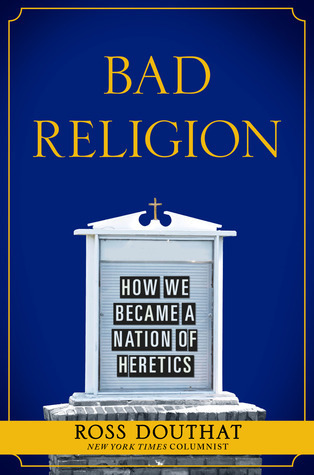
In Bad Religion: How We Became a Nation of Heretics , Ross Douthat proposes that the religious predicament America is facing today is not one of too much religion or too little religion; but rather, he provocatively argues, we are facing the problem of bad religion, of being a nation of heretics:
"America's problem isn't too much religion, or too little of it. It's bad religion: the slow-motion collapse of traditional Christianity and the rise of a variety of destructive pseudo-Christianities in its place. Since the 1960’s, the institutions that sustained orthodox Christian belief – Catholic and Protestant alike – have entered a state of near-terminal decline." (page 3)
In the Beginning, It Was Good. (Or, That's What Douthat Argues.)
Douthat begins by assessing the religious foundation of our nation. His thesis is that in the middle of the twentieth century, American Christianity departed from orthodoxy, and has gradually embraced heresy, not even recognizing the shift.
I believe the book's main weakness is found in this section. Lamentably, Douthat seems to oversimplify and accept a slightly, albeit merely mildly, romanticized view of the religious founders and the spiritual foundation of America. In one instance, he criticized the African American religious culture for remaining separate from denominations, purporting such isolated to be self-imposed. (Of course, there weren't really alternatives since they weren't allowed to in white churches, denominations, or seminaries.) I felt this (and other similar examples) to be a weak aspect of the book, but certainly not enough to hinder the overall message and powerful impact of the book. Douthat's presuppositions of the hearty religious beliefs of our founding fathers often colors his idealizing some our national religious history; at the same time, he does make time to point out that he recognizes orthodoxy was not always in perfect even then.
The book dovetails nicely with Stephen J. Nichol's critique of American Christianity in Jesus Made in America (my review here). However, Nichols pinpoints America's spiritual decline as early as a couple of centuries prior to Douthat's: to Nichols, the glory of America's religious age was the Puritan Era; to Douthat, orthodoxy flowed freely until the middle half of the twentieth century.
The first portion of the book examines the spiritual climate and changes that have taken place over the last century. Such changes, Douthat argues, set the stage for the rise of heresy in American Christianity. The second half of the book looks at the four main heresies that Douthat believes now comprise America's brand of Christianity.
The Four Heresies
Heresy is a flamboyant word, but in reality, it is its subtleness that allows it to develop in the first place.
As Douthat writes, “The great Christian heresies vary wildly in their theological substance, but almost all have in common a desire to resolve Christianity’s contradictions, untie its knotty paradoxes, and produce a cleaner and more coherent faith.”
Theologian John Stott proffered this bit of wisdom on the subject, "Every heresy is due to an overemphasis upon some truth, without allowing other truths to qualify and balance it."
1. Gnosticsm: The Religion of Knowledge
Gnosticism readily seeks to untie Christianity's many paradoxes, doing so under the guise of intellect. In our American Gnostic heresy, we've sought to take the supernatural out of Jesus and make him into our own "Jesus, made in America." Although gnosticism made advances on the fringes through our theological seminaries and scholars since America's beginning, Douthat theorizes that works such as Dan Brown's bestselling The Da Vinci Code and others are what spread this form of heresy to the masses.
2. The God Within
This is America's idol of self-discovery--finding in ourselves what we are meant to be spiritually, mystically, religiously; making God into what we conceive Him to be. This is the religion of Eat, Pray, Love, of The Oprah Winfrey Show, or Deepak Chopra.
3. The Heresy of the Prosperity Gospel
Joel Osteen, is, of course, the whipping boy for the prosperity Gospel. Many of us automatically say the words "prosperity Gospel" as if it is the continuation of Osteen's name, yet without really giving deep thought to what the various outworkings of "prosperity Gospel" may mean practically.
The teachings of men like Osteen and Creflo Dollar are indeed a part of the prosperity Gospel, but as with all heresies, it often comes in more mild forms than the easily detected "love Jesus, make millions." As Wendy Alsup points out, there is also "The Prosperity Gospel of Conservative Evangelicals." In this brief article, Alsup asserts that "our downfall in evangelical circles is that we feel we have to attach an expectation of good earthly outcome to these instructions if we want anyone to obey them."
4. The Heresy of Nationalism
Perhaps the most widespread and most pernicious heresy is the heresy of nationalism.
The heresy of nationalism is surprisingly bipartisan in its existence, although the outworkings are dramatically different for either side. For both hardcore political liberals and conservatives, when nationalism becomes the religion du jour, it has a messianic and apocalyptic slant, depending on who is in office, who is running for office, or whatever other political uprisings may be occurring.
As Branson Parlor wrote in a Think Christian article, "[T]he heresy of nationalism or civil religion is not a fringe position, but a standard creed of American Christians, whether Democrats or Republicans, mainline or evangelical. American civil religion is dangerous precisely because it perpetually invokes Biblical language to give legitimacy to non-Biblical actions or policies. Nationalism in this sense is not simply an individual’s misguided view of the nation, but a structural feature of American political life. Thus, even well-intentioned individuals can end up participating in this problematic worldview."
Douthat frequently remonstrates the conservative flavor of nationalism promoted by talk-show hosts such as Glenn Beck, the right-wing Mormon who infamously urged listeners to leave churches that promoted or used the term "social justice." Douthat points to the example of Beck's misguided understanding of social justice, while also pointing out how misguided Beck's understanding of church history and tradition is, ironically displayed in a discussion Beck gave about "teaching our children divine truth," yet himself conveying inaccurate information about church history and The Dead Sea Scrolls.
While many conservatives would even consider Beck an extreme on the talk-radio circuit, Douthat hits closer to home for many conservative Evangelicals (including Independent Fundamentalists in this umbrella-term) by addressing David Barton's brand of nationalism: "Skousen and Beck can sound a lot like David Barton, the prolific amateur historian whose books and pamphlets have persuaded many Evangelicals that the American Founders had the divine mandate of King David and the politics of a contemporary Tea Partier."
Often, Americans have so deeply wed their politics and religion that they become confused as to which is which. Such unity may be great for a marriage, but not for theology or politics. Far worse, we pull out politics and presume it is our Gospel--herein is the ultimate heresy of nationalism.
This goes well with what Irish theologian Alistair McGrath wrote in Christian Theology : "It may seem to be little more than stating a self-evident fact to say that Christianity often unconsciously absorbs ideas and values from its cultural backdrop. Yet that observation is enormously important. It points to the fact that there is a provisional or conditional element to Christian theology, which is not necessitate by or implied in its foundational resources. In other words, certain ideas which have been regarded as Christian ideas may turn out to be ideas imported from a secular context.”
Conclusion
These heresies are subtle, and most are held by those who identify as believers. As Douthat shares about writing this book, "The heretics I write about aren’t detached completely from Christianity. Some of them identify as Christians and like the idea of identifying with Jesus. But they aren’t interested in sustaining any historic Christian tradition or church apart from their own ministry."
Written from the perspective of a doctrinally conservative Catholic, Douthat's view of "good religion" is the umbrella scope of orthodox Christianity from which both Protestantism and Catholicism flow. Here, he believes we have lost our way from the traditions and creeds of the Church. By traditions, he is not referring to the cultural or small church traditions of American Christianity--those are relatively young--but to the church tradition and creeds that have been proved over millennia.
As a Catholic, he does not dance around the issues and the problems that the American Catholic church has had to deal with, either. He is open and forthright about many of the scandals and even offers thoughts as to why he believes they occurred.
Douthat believes that there is still time for an America re-embrace of orthodoxy--a Christian renaissance of sorts, while at the same time admitting that there has not, and will not be, a perfect "golden age" of the Church.
During my reading, I often found myself surprised that Douthat was not writing as an Evangelical. His grasp of many of the subcultural nuances was not lacking. I did find it interesting to note that in his teens, Douthat converted to Pentecostalism, and only later to Catholicism. Douthat also gives acknowledgement to the work that Tim Keller and Redeemer Presbyterian are doing in New York City, noting them as one of the few contemporary, well-known Evangelical ministries which Douthat believes has managed to avoid entangling their ministry with these four heresies.
Far more than these 1600 words can convey, this book delves deeply into the ways American Christians have allowed their message to be undermined by embracing nationalism as their faith. (And to counter potential pushback, Douthat is not arguing that Christians should entirely remove themselves from any politics.) Even while this book shares a powerful message, it is likely that many will read with a nod to the book's message, but while simultaneously entering into a state of cognitive dissonance.
Table of Contents:


October 11, 2012
I found this book to be surprisingly good. Since the author is a conservative (and I am not) I was prejudiced against it, but I found it to be good and helpful overall.
The four chapters of Part II were the most helpful. Although I thought the first two chapters of Part I were also good, I had trouble with much of what he said in the fourth chapter and especially in the third chapter. For example, I think he was not fair or accurate in his depiction of Harvey Cox.
In particular, I thought his emphasis on paradox was good and important. “Christian heresies," he wrote, "vary wildly in their theological substance, but almost all have in common a desire to resolve Christianity’s contradictions, untie its knotty paradoxes, and produce a cleaner and more coherent faith.” Indeed, heretics often “see themselves, not irrationally, as rescuers rather than enemies of Christianity—saving the faith from self-contradiction and cultural irrelevance” (p. 12). Nevertheless, orthodox Christianity must continue to recognize the paradoxes, he thinks, and I agree completely.
The four chapters of Part II were the most helpful. Although I thought the first two chapters of Part I were also good, I had trouble with much of what he said in the fourth chapter and especially in the third chapter. For example, I think he was not fair or accurate in his depiction of Harvey Cox.
In particular, I thought his emphasis on paradox was good and important. “Christian heresies," he wrote, "vary wildly in their theological substance, but almost all have in common a desire to resolve Christianity’s contradictions, untie its knotty paradoxes, and produce a cleaner and more coherent faith.” Indeed, heretics often “see themselves, not irrationally, as rescuers rather than enemies of Christianity—saving the faith from self-contradiction and cultural irrelevance” (p. 12). Nevertheless, orthodox Christianity must continue to recognize the paradoxes, he thinks, and I agree completely.
November 10, 2019
I've always loved 19-20th century church history, but I have done little reading about the mainline denominations in the mid-20th century and the Catholic church in America. Douthat summarizes well the history of church-life in America from the 1950s to our current era, and he does a terrific job exposing the teachings that have replaced or infected Christianity in the last 30 years so. Only the chapter on "The God Within" tried my patience, and that's just because New Thought makes my eyes glaze over. Also the narrator, Lloyd James, was excellent.

February 28, 2019
If you have ever looked at the news or heard something in a public venue that was touted as Christian and thought what you heard was completely incompatible with what you read in your Bible, this book will help explain the origin of much of the "heresy" that you have heard. The author does an excellent job tracing the origin of many different divergent paths from Scripture. Many people follow these paths, and I hope they will read his criticisms with an open mind.

July 15, 2020
What a book!
Douthat thoroughly educated on why the religious landscape looks like it does.
Some parts of the Heresy section of the book revealed places I didn't even know needed turning.
I recommend (and already did) to anyone who wants to better equipped to spread the gospel.
10/10 would read again.
Douthat thoroughly educated on why the religious landscape looks like it does.
Some parts of the Heresy section of the book revealed places I didn't even know needed turning.
I recommend (and already did) to anyone who wants to better equipped to spread the gospel.
10/10 would read again.
September 4, 2012
I picked this book up from the library not knowing what to expect, and not knowing anything about Ross Douthat other than what is on the back of the book. He assumes a certain level of historical religious knowledge, and some familiarity with religious thinkers (which I certainly don’t have). I selected it mainly because it seemed timely, with the upcoming election and –depending on who you hang with- the belief that the United States is in trouble either because the atheists and liberals have taken over and refuse to let anything remotely resembling a Christian belief be part of public life (i.e.- if we had prayer in school our education problems would be resolved) or because the ultra right-wing religious nuts have taken over and are forcing their views on everything from science curriculum to health care. My understanding is that Ross Douthat is aligned more with conservative thinking- and there is certainly evidence of that here- but he makes many good points that at least deserve consideration and discussion. He skewers conservative and liberal public figures alike.
Ross Douthat’s premise, however, is not that there is too much religion, or that there is too little religion in America. Rather, the premise is that there is too much heresy- the “Bad Religion” of the title. The second part of the book, when he discusses the various modern heresies of American thought, is when it started getting really interesting for me. The first part deals with a historical view on mainline Protestantism and Catholicism during the last part of the twentieth century, and how most churches attempted to revive flagging membership by accommodation, or attempting to “sustain Christianity’s midcentury reconciliation with Western liberalism by adapting itself to the changing cultural circumstances”. Other churches reacted by resistance, or the decision to “break decisively with the revolutionary mood in American society and identify Christianity with cultural conservatism”. This historical review was interesting, although frustrating for the reader if you are not familiar with religious figures such as Reinhold Niebuhr, Teilhard de Chardin, Harvey Cox, John Shelby Spong, Richard John Neuhaus, and numerous others.
The real story is the second part of the book, or the heresies that are so influential in American society in the first decades of the twenty-first century. Here, Douthat goes after Dan Brown, of The DaVinci Code fame; “Prosperity Gospel” preachers like Joel Osteen, Creflo Dollar, Joyce Meyer, and others of their ilk; “The God Within” philosophy of Elizabeth Gilbert; and the heresy of American nationalism, as illustrated by Glenn Beck. He clearly has little regard for the Prosperity Gospel preachers, many of whom have made millions by preaching a “name it and claim it’ theology, in which believers can exercise the same world-changing power as God, so long as they think God’s thoughts after him and speak his words after him”. He describes the wealth of the Osteens, Kenneth and Gloria Copeland (his n hers private jets); Creflo Dollar, Jr. of Atlanta (private jet!), and Joyce Meyer (yes! a private jet!). This heresy is attractive, Douthat says, because it suggests that to be successful in this world, all you need to do is pray more.
When Douthat discusses Elizabeth Gilbert and her “Eat Pray Love” philosophy, I can imagine him doing the grown man version of a teenage girl rolling her eyes at obvious parental ridiculousness. I have read “Eat Pray Love” and found it barely tolerable because Gilbert comes across as an incredibly self-centered woman- and that does not change, despite her world travels. Douthat has a different take on her and the “God Within” heresy- but he comes to the same conclusion: “through all these earth-shaking, all enveloping encounters, though, Gilbert’s theological views don’t seem to change a whit….her initial premises remain unchallenged to the end”.
The conclusion of the book is the weakest part; if these heresies are creating Grand Canyon sized divides in American society, then what does one do about it? He leaves it up to personal action- head back to the confessional; respond to the alter call. Rediscover a more authentic (orthodox) Christianity; accept the suffering along with the resurrection; take on the gargantuan task of working through the inherent conflicts of Christianity and the teachings of Christ. But that answer depends on a heretic recognizing his or her heresy- and resolving to reform. He lists- and expands on- five steps that “orthodox” Christianity must take to increase its relevance and strength in American society: become political without being partisan, allegiance to principle over party, become ecumenical and confessional, be moralistic and holistic, and become re-oriented towards sanctity and beauty.
However, it is also here where he makes the point that, for me, made reading the entire book worthwhile. “There are seven deadly sins, not just one, and Christianity’s understanding of marriage and chastity is intimately bound to its views on gluttony, avarice and pride”. He has no answer for the divisive issue of homosexuality within Christianity, but makes another point: “in a culture that has made heterosexual desire the measure of all things, asking gays alone to conform their lives to a hard teaching will inevitably seem like a form of bigotry”. Living by the tenets of true Christianity is hard, but it should be hard for everyone.
I don’t think this is a book written for either a conservative audience or a liberal one. Both groups will find things to like, and things to dislike about what he has to say. Other reviews I have read have mentioned that he inaccurately describes some of the events of the past half century- and that may be true; I don’t have the knowledge to say yes or no. But I found this book to be well thought out and full of things to ponder.
Ross Douthat’s premise, however, is not that there is too much religion, or that there is too little religion in America. Rather, the premise is that there is too much heresy- the “Bad Religion” of the title. The second part of the book, when he discusses the various modern heresies of American thought, is when it started getting really interesting for me. The first part deals with a historical view on mainline Protestantism and Catholicism during the last part of the twentieth century, and how most churches attempted to revive flagging membership by accommodation, or attempting to “sustain Christianity’s midcentury reconciliation with Western liberalism by adapting itself to the changing cultural circumstances”. Other churches reacted by resistance, or the decision to “break decisively with the revolutionary mood in American society and identify Christianity with cultural conservatism”. This historical review was interesting, although frustrating for the reader if you are not familiar with religious figures such as Reinhold Niebuhr, Teilhard de Chardin, Harvey Cox, John Shelby Spong, Richard John Neuhaus, and numerous others.
The real story is the second part of the book, or the heresies that are so influential in American society in the first decades of the twenty-first century. Here, Douthat goes after Dan Brown, of The DaVinci Code fame; “Prosperity Gospel” preachers like Joel Osteen, Creflo Dollar, Joyce Meyer, and others of their ilk; “The God Within” philosophy of Elizabeth Gilbert; and the heresy of American nationalism, as illustrated by Glenn Beck. He clearly has little regard for the Prosperity Gospel preachers, many of whom have made millions by preaching a “name it and claim it’ theology, in which believers can exercise the same world-changing power as God, so long as they think God’s thoughts after him and speak his words after him”. He describes the wealth of the Osteens, Kenneth and Gloria Copeland (his n hers private jets); Creflo Dollar, Jr. of Atlanta (private jet!), and Joyce Meyer (yes! a private jet!). This heresy is attractive, Douthat says, because it suggests that to be successful in this world, all you need to do is pray more.
When Douthat discusses Elizabeth Gilbert and her “Eat Pray Love” philosophy, I can imagine him doing the grown man version of a teenage girl rolling her eyes at obvious parental ridiculousness. I have read “Eat Pray Love” and found it barely tolerable because Gilbert comes across as an incredibly self-centered woman- and that does not change, despite her world travels. Douthat has a different take on her and the “God Within” heresy- but he comes to the same conclusion: “through all these earth-shaking, all enveloping encounters, though, Gilbert’s theological views don’t seem to change a whit….her initial premises remain unchallenged to the end”.
The conclusion of the book is the weakest part; if these heresies are creating Grand Canyon sized divides in American society, then what does one do about it? He leaves it up to personal action- head back to the confessional; respond to the alter call. Rediscover a more authentic (orthodox) Christianity; accept the suffering along with the resurrection; take on the gargantuan task of working through the inherent conflicts of Christianity and the teachings of Christ. But that answer depends on a heretic recognizing his or her heresy- and resolving to reform. He lists- and expands on- five steps that “orthodox” Christianity must take to increase its relevance and strength in American society: become political without being partisan, allegiance to principle over party, become ecumenical and confessional, be moralistic and holistic, and become re-oriented towards sanctity and beauty.
However, it is also here where he makes the point that, for me, made reading the entire book worthwhile. “There are seven deadly sins, not just one, and Christianity’s understanding of marriage and chastity is intimately bound to its views on gluttony, avarice and pride”. He has no answer for the divisive issue of homosexuality within Christianity, but makes another point: “in a culture that has made heterosexual desire the measure of all things, asking gays alone to conform their lives to a hard teaching will inevitably seem like a form of bigotry”. Living by the tenets of true Christianity is hard, but it should be hard for everyone.
I don’t think this is a book written for either a conservative audience or a liberal one. Both groups will find things to like, and things to dislike about what he has to say. Other reviews I have read have mentioned that he inaccurately describes some of the events of the past half century- and that may be true; I don’t have the knowledge to say yes or no. But I found this book to be well thought out and full of things to ponder.

November 7, 2025
Ross is one of the most interesting writers on the right right now, and I happened to find this in a thrift store and thought I’d take it up.
This is an excellent book, particularly the first half. It is both well written (the transitions and flow across ideas, decades, chapters, and sections is really quite good) and well conceived (his thesis is compelling). Perhaps much of this is well known to someone already well steeped in the church history of the kid 20th century, but I found it enlightening. That said, it’s a little dated (President Obama hadn’t been re-elected yet when it was published) and some of the seeds of his later ideas are half baked here. Nevertheless, an excellent book I’ve referenced in a half a dozen conversations already.
This is an excellent book, particularly the first half. It is both well written (the transitions and flow across ideas, decades, chapters, and sections is really quite good) and well conceived (his thesis is compelling). Perhaps much of this is well known to someone already well steeped in the church history of the kid 20th century, but I found it enlightening. That said, it’s a little dated (President Obama hadn’t been re-elected yet when it was published) and some of the seeds of his later ideas are half baked here. Nevertheless, an excellent book I’ve referenced in a half a dozen conversations already.

August 23, 2018
Heresy has always been with us, and, as New York Times columnist Ross Douthat tells us in Bad Religion, that has not necessarily been a bad thing. Heresy can stimulate orthodoxy to clarify itself and perhaps help correct an imbalance in the church. What is different now is that heresy is no longer at the margins of an orthodox center. Today the situation is reversed.
Douthat chronicles the decline of orthodox Christianity in the United States from a high point in the 1950s to the present. To begin he illustrates by focusing on four religious leaders who were widely admired in mainstream America--a protestant academic, an evangelical revivalist, a Catholic TV personality, and a Black American preacher. These four (Reinhold Niebuhr, Billy Graham, Bishop Fulton J. Sheen, and Dr. Martin Luther King, Jr.) had moral authority and influence that spread across the religious, political, and media landscapes for Christians and non-Christians alike. Today, no Christian (Catholic or Protestant) has the stature of any of them.
From this crest (while recognizing there is no pure, golden age), he walks readers through the accommodationist ideals of liberal Christian leaders and gnostic-admiring academics from the 1960s to the present. Often they walked from orthodoxy to the edges of Christianity before abandoning the faith altogether. He then notes some reactions to these developments as former liberals (such as Ratzinger, Nowak, and Neuhaus) changed course. Also in the 1980s a formerly unthinkable coalition emerged of conservative Catholics and evangelicals.
In part two he focuses on three prominent heresies which have captured the center of American culture: the health and wealth gospel of Joel Osteen and others, the "God-within" spirituality of Oprah and Eat, Pray, Love, and the nationalism of both the left and the right, Republican and Democrat. His ability to critique both ends of the political spectrum is particularly impressive and insightful.
While the book tends to be one of doom and gloom, in the last chapter Douthat suggests several signs that could point to a renewing of orthodoxy such as radical orthodoxy, the emergent church, the "Benedict option," the community of Latin Mass Catholics, the Christian home-school movement, less-partisan leadership at Focus on the Family, the ecumenical and confessional impulses of one like Timothy Keller, and others.
Yet more is needed, he says, such as a holistic moralism that vigorously critiques greed, gluttony, and pride, while putting issues like homosexuality in perspective. After all, the vast majority of sexual sin is heterosexual, and as Ron Sider notes, the vast majority of harm to children comes via heterosexual sin and divorce.
Not surprisingly Douthat leans right--after all he is calling for a return to orthodoxy from leftward excesses. But sometimes he drifts farther from center than needed to reach his goal. Also, he is inclined to sweepingly condemn the combination of politics and religion though he clearly admires the way Niebuhr and King combined the two.
Overall Bad Religion is full of important insights and often shows brilliant balance. The church could do a lot worse than to pay close attention to this book.
Douthat chronicles the decline of orthodox Christianity in the United States from a high point in the 1950s to the present. To begin he illustrates by focusing on four religious leaders who were widely admired in mainstream America--a protestant academic, an evangelical revivalist, a Catholic TV personality, and a Black American preacher. These four (Reinhold Niebuhr, Billy Graham, Bishop Fulton J. Sheen, and Dr. Martin Luther King, Jr.) had moral authority and influence that spread across the religious, political, and media landscapes for Christians and non-Christians alike. Today, no Christian (Catholic or Protestant) has the stature of any of them.
From this crest (while recognizing there is no pure, golden age), he walks readers through the accommodationist ideals of liberal Christian leaders and gnostic-admiring academics from the 1960s to the present. Often they walked from orthodoxy to the edges of Christianity before abandoning the faith altogether. He then notes some reactions to these developments as former liberals (such as Ratzinger, Nowak, and Neuhaus) changed course. Also in the 1980s a formerly unthinkable coalition emerged of conservative Catholics and evangelicals.
In part two he focuses on three prominent heresies which have captured the center of American culture: the health and wealth gospel of Joel Osteen and others, the "God-within" spirituality of Oprah and Eat, Pray, Love, and the nationalism of both the left and the right, Republican and Democrat. His ability to critique both ends of the political spectrum is particularly impressive and insightful.
While the book tends to be one of doom and gloom, in the last chapter Douthat suggests several signs that could point to a renewing of orthodoxy such as radical orthodoxy, the emergent church, the "Benedict option," the community of Latin Mass Catholics, the Christian home-school movement, less-partisan leadership at Focus on the Family, the ecumenical and confessional impulses of one like Timothy Keller, and others.
Yet more is needed, he says, such as a holistic moralism that vigorously critiques greed, gluttony, and pride, while putting issues like homosexuality in perspective. After all, the vast majority of sexual sin is heterosexual, and as Ron Sider notes, the vast majority of harm to children comes via heterosexual sin and divorce.
Not surprisingly Douthat leans right--after all he is calling for a return to orthodoxy from leftward excesses. But sometimes he drifts farther from center than needed to reach his goal. Also, he is inclined to sweepingly condemn the combination of politics and religion though he clearly admires the way Niebuhr and King combined the two.
Overall Bad Religion is full of important insights and often shows brilliant balance. The church could do a lot worse than to pay close attention to this book.

April 26, 2012
Ross Doathat, a New York Times columnist, among other things, hits the proverbial keyboard at full throttle and doesn't slow down until the end of his book Bad Religion. From the beginning he sets the tone "The US needs to recognize...it is not a Christian country, but a nation of heretics." And from this jumping off spot he launches into a reportorial review of American religion from the native American through Puritans to present day. It is not the existence of heretics that concerns the author but the intolerance of heretics for orthodox Christians and the "weakness of the orthodox response." Heretics is not necessarily a bad thing according to the author as long as orthodoxy prevails.
He tells us, "Today's heretics are all eminently American, the heirs of Jefferson and Joseph Smith, Emerson and Eddy,...." And he names names in a true reportorial style as well as religions and cults that have sprung up here and none escape his blazing pen. Much is covered on Catholicism from the runaway affects on America from the Vatican II council and the charm of Pope John Paul to the horrors of priestly sex abuse in the 2003 period. He also uses the example of that little nun in India, Mother Teresa in practicing true Christianity, over American Christianity.
What is the basis of this heretical American attitude? The author says it is from a choose your on "Jesus mentality by ...encouraging spiritual seekers to screen out discomfiting parts of the New Testament and focus only on whichever Christ they find most congenial." And defines American heresy as setting out "to be simple and more appealing and more rational, but it often ends up being more extreme."
He goes into the affects of American religion of foreign persons and entities such as the 14th Dalai Lama's writings and Eastern faiths especially on meditation and spiritual awakening. The American Christianity has embraced much from Zen and Buddhism even to the point of how to make more sales.
He leaves the reader with the hope of recovery of true Christianity but not without a lot of struggle. He sights a report that in 2005 97% of the teenagers studied professed some sort of a divine; but the other side of the coin was that there was no evidence of a recognizable orthodox Christian Faith among them.
This book is full of gems and quotable sayings regarding American religion whether orthodox or heretical. One needs to be prepared to take one's time and mine these gems in order to be part of the recovery of American Christianity and not part of its demise. It is truly an eye opener and the reader will find him/herself nodding acknowledgement of these discoveries.
He tells us, "Today's heretics are all eminently American, the heirs of Jefferson and Joseph Smith, Emerson and Eddy,...." And he names names in a true reportorial style as well as religions and cults that have sprung up here and none escape his blazing pen. Much is covered on Catholicism from the runaway affects on America from the Vatican II council and the charm of Pope John Paul to the horrors of priestly sex abuse in the 2003 period. He also uses the example of that little nun in India, Mother Teresa in practicing true Christianity, over American Christianity.
What is the basis of this heretical American attitude? The author says it is from a choose your on "Jesus mentality by ...encouraging spiritual seekers to screen out discomfiting parts of the New Testament and focus only on whichever Christ they find most congenial." And defines American heresy as setting out "to be simple and more appealing and more rational, but it often ends up being more extreme."
He goes into the affects of American religion of foreign persons and entities such as the 14th Dalai Lama's writings and Eastern faiths especially on meditation and spiritual awakening. The American Christianity has embraced much from Zen and Buddhism even to the point of how to make more sales.
He leaves the reader with the hope of recovery of true Christianity but not without a lot of struggle. He sights a report that in 2005 97% of the teenagers studied professed some sort of a divine; but the other side of the coin was that there was no evidence of a recognizable orthodox Christian Faith among them.
This book is full of gems and quotable sayings regarding American religion whether orthodox or heretical. One needs to be prepared to take one's time and mine these gems in order to be part of the recovery of American Christianity and not part of its demise. It is truly an eye opener and the reader will find him/herself nodding acknowledgement of these discoveries.

July 26, 2021
What a mess. It's hard to untangle all the problems with Mr. Douthat's premise and arguments, but my overall impression is that he's too blinded by his own privileged position within American Christianity to notice the thing that he almost, ALMOST seems to address: the relationship between Christianity and power in the United States.
He sees it as a problem of humility and submission--of people who can't or won't accept what Christianity demands, rather than people who love Christianity but see the harm that Christian-flavored sexism and homophobia can cause to real people. He sees historical/archeological Bible scholarship as an enemy, not a potential ally in Christianity's constant refinement and renewal. He sees fewer butts in pews as a sign of institutional decay, not of people's hard-won freedom to explore different confessions and put their spiritual fruit to the test. He thinks that Christianity's success is in numerical and/or cultural dominance. He equates the most wishy-washy of liberal theologies (cherry-picked to prove a point, naturally) to the destructive, rancid, incredibly popular large-scale sin that is "prosperity theology."
This book is from 2012, and after witnessing the pseudo-Christian grotesqueries of the last couple of years (from Evangelical support for Trump, to the Christofascist Jan 6 attack on the Capitol, to all the sexual and financial scandals no longer covered up by religious hierarchies), I see the true bad fruit of Christian heresy. I'm not amused by a book that considers Christian affirmation of gay people to belong to the same category as "Christian nationalism." This is religion without spirituality. This is religion that takes its power for granted and doesn't think about the consequences of privileging power over love.
I'm also not especially interested in hearing about orthodoxy and heresy from someone who does not once grapple with his own church's role in enabling antisemitism, sex abuse, colonialism, and genocide. All I see in Mr. Douthat is someone who would have supported the extermination of my Waldensian ancestors in the Middle Ages, my Huguenot ancestors in the 1600s, or my Mormon ancestors in the 1840s. He might have wrung his hands and called for more Christian charity, but he would have seen the violence as an inevitable consequence of "heresy." Maybe he would have written a sad little book about it.
He sees it as a problem of humility and submission--of people who can't or won't accept what Christianity demands, rather than people who love Christianity but see the harm that Christian-flavored sexism and homophobia can cause to real people. He sees historical/archeological Bible scholarship as an enemy, not a potential ally in Christianity's constant refinement and renewal. He sees fewer butts in pews as a sign of institutional decay, not of people's hard-won freedom to explore different confessions and put their spiritual fruit to the test. He thinks that Christianity's success is in numerical and/or cultural dominance. He equates the most wishy-washy of liberal theologies (cherry-picked to prove a point, naturally) to the destructive, rancid, incredibly popular large-scale sin that is "prosperity theology."
This book is from 2012, and after witnessing the pseudo-Christian grotesqueries of the last couple of years (from Evangelical support for Trump, to the Christofascist Jan 6 attack on the Capitol, to all the sexual and financial scandals no longer covered up by religious hierarchies), I see the true bad fruit of Christian heresy. I'm not amused by a book that considers Christian affirmation of gay people to belong to the same category as "Christian nationalism." This is religion without spirituality. This is religion that takes its power for granted and doesn't think about the consequences of privileging power over love.
I'm also not especially interested in hearing about orthodoxy and heresy from someone who does not once grapple with his own church's role in enabling antisemitism, sex abuse, colonialism, and genocide. All I see in Mr. Douthat is someone who would have supported the extermination of my Waldensian ancestors in the Middle Ages, my Huguenot ancestors in the 1600s, or my Mormon ancestors in the 1840s. He might have wrung his hands and called for more Christian charity, but he would have seen the violence as an inevitable consequence of "heresy." Maybe he would have written a sad little book about it.
April 19, 2012
Even though I enjoy non-fiction, it rarely keeps me reading past my bedtime. This book did.
Douthat's analysis of the decline and fall of Christian orthodoxy in the United States is detailed, accessible and even funny sometimes. He concentrates on several of the more common heresies within Christendom: the prosperity gospel, the God-within Gospel, and the nationalist Gospel.
In many ways, his treatment of the last heresy - nationalism - is the best. Douthat splits this heresy into two parts: a messianic nationalism, in which the United States is perceived to be a world saviour, and an apocalyptic nationalism, in which the United States is perceived to be inviting God's judgment as Israel did several thousand years ago. Found in both conservative and liberal circles, this heresy, according to Douthat, endangers both political and religious stability.
Another aspect of Douthat's book that I appreciated were the more incidental insights, by-the-way comments that stick with me long after I finished the book. For instance, towards the end of the book Douthat remarks that Christians are not taken seriously when they stand against gay marriage because they have no place for heterosexual celibacy in the church. It is hypocritcal, Douthat suggests, to require those who identify with a homosexual orientation to remain celibate while brushing off heterosexual indiscretions outside of marriage.
Finally, I appreciated Douthat's detailed description of the development of religion in the United States over the last fifty years. Especially in context of some of the other religious history books that I have read (for instance, _An Island in the Lake of Fire_), his division of religious trends into those that accomodated cultural trends and those that resisted them was insightful.
At times, Douthat waxes long-winded in his historical treatment, and I feel like there are other heresies that he could have addressed - for instance, the tendency of some believers to retain the name "Christian" without going to church and often without retaining most of the basic doctrines; this is not, I feel, always identical with the God-within Gospel.
Yet overall, I found Douthat's book a fascinating, compelling treatment of religion in America.
Douthat's analysis of the decline and fall of Christian orthodoxy in the United States is detailed, accessible and even funny sometimes. He concentrates on several of the more common heresies within Christendom: the prosperity gospel, the God-within Gospel, and the nationalist Gospel.
In many ways, his treatment of the last heresy - nationalism - is the best. Douthat splits this heresy into two parts: a messianic nationalism, in which the United States is perceived to be a world saviour, and an apocalyptic nationalism, in which the United States is perceived to be inviting God's judgment as Israel did several thousand years ago. Found in both conservative and liberal circles, this heresy, according to Douthat, endangers both political and religious stability.
Another aspect of Douthat's book that I appreciated were the more incidental insights, by-the-way comments that stick with me long after I finished the book. For instance, towards the end of the book Douthat remarks that Christians are not taken seriously when they stand against gay marriage because they have no place for heterosexual celibacy in the church. It is hypocritcal, Douthat suggests, to require those who identify with a homosexual orientation to remain celibate while brushing off heterosexual indiscretions outside of marriage.
Finally, I appreciated Douthat's detailed description of the development of religion in the United States over the last fifty years. Especially in context of some of the other religious history books that I have read (for instance, _An Island in the Lake of Fire_), his division of religious trends into those that accomodated cultural trends and those that resisted them was insightful.
At times, Douthat waxes long-winded in his historical treatment, and I feel like there are other heresies that he could have addressed - for instance, the tendency of some believers to retain the name "Christian" without going to church and often without retaining most of the basic doctrines; this is not, I feel, always identical with the God-within Gospel.
Yet overall, I found Douthat's book a fascinating, compelling treatment of religion in America.
August 21, 2012
This book will appeal to those who are interested in the interplay between religion and politics in America as well as those who are interested in what the religious landscape of America looks like today. The author is making a case for a return to Christian orthodoxy as opposed to what he calls the pseudo-religions prevalent in America today: Among others, Accommodationism -- both in the Catholic and Protestant churches; the Prosperity Gospel of Joel Osteen and others; the therapeutic and mystic religions of The God Within as celebrated by Oprah Winfrey, Deepak Chopra, and Elizabeth Gilbert; American Nationalism, both on the left and the right {Messianism, Millenialism, Apocalypticism}whose voice rises and falls as the various crises in government wax and wane and moves back and forth between and within political parties. None of these, the author claims, has served to move Americans to more unity and community and are distortions of traditional Christianity. These versions of Christianity, the author claims, are versions of Christianity that breed arrogance, greed, and self-absorption. A blurb from the book jacket: [The author] "charts institutional Christianity's decline from a vigorous, mainstream, and bipartisan faith -- which acted as a "vital center" and the moral force behind the civil right movement -- through the culture wars of the 1960s and 1970s to the polarizing debates of the present day." These heresies,the author claims "have crippled the country's ability to confront our most pressing challenges and accelerated American decline."
The author focused mainly on the religion of Christianity and did not address in-depth other religions that are also included in America's religious landscape such as Islam, Buddhism, and Judaism and how they have or have not contributed to our political discourse. I would have liked to see these religions discussed as well, but that might have been beyond the scope of what he intended to address, the so-called modern heresies of Christianity.
The author focused mainly on the religion of Christianity and did not address in-depth other religions that are also included in America's religious landscape such as Islam, Buddhism, and Judaism and how they have or have not contributed to our political discourse. I would have liked to see these religions discussed as well, but that might have been beyond the scope of what he intended to address, the so-called modern heresies of Christianity.

July 31, 2020
A heady but accessible appraisal of American Christianity’s broad decent in values, virtues, and influence, this book aptly and intelligently frames the myriad issues at stake in the West’s limping faith structure. Douthat is a New York Times columnist I’ve enjoyed reading for a few years now, and I have been wanting to read his books. I’m glad I did. He takes the issues most seminarians would have studied to a deeper level with sweeping research and more penetrating insight. Take for instance the devastating findings of Notre Dame sociologist Christian Smith, that religious youth in America actually have a faith that is merely moralistic, therapeutic, and deistic, and only distinctively Christian in vague and shallow ways if at all. And this despite their parents great but failed efforts to the contrary. Douthat, and Smith in his more recent work for that matter, have pointed to a similar phenomenon as a root cause. That nationalistic religion from the conservatives (a heresy deifying the founding fathers) and secular humanism from the liberals (a heresy deifying the individual), have created a context where orthodox faith or anything resembling it have no quarter in an ignorant yet zealous culture war. He ends showing a great affinity for the ministry of Tim Keller, the writing of C. S. Lewis, and the Neo Orthodoxy of Reinhold Niebuhr. He also makes a heartfelt appeal to the post Christian and the unaffiliated to reconsider their faith, one that had this protestant thanking God for this catholic. I don’t think I’ve encountered a better summary of the intellectual, moral, and political history of American Christianity from the WWII era to present day. 352 pages or 13 hours of social analysis, religious studies, modern American history, and gospel.

February 23, 2021
Ross Douthat is quickly becoming one of my favorite authors. His words are poetic and equally prophetic. Not only does he address the troubled nature of Christianity, but he also spoke to a Christianity I have been wanting for my entire life. Viewing the mystery of God as a positive, and the paradox of his Son as something to be celebrated is a refreshing breath of life. Christianity has chained itself to the twin heresies of accommodationism and fundamentalism for too long. Ross Douthat beautifully calls for a Christianity which balances itself between these opposing forces.
This book has touched a personal nerve in an era of polarization, division, and the search for endless wealth and happiness. I have felt beaten down, and politically homeless, as a Christian for many years. I know now that this is normal. Many Christians (including myself) will have to face a path which rejects aspects of liberalism and conservatism. It will be a path filled with tough decisions, hard conversations, and painful memories. But it will also be a path which re-engages us with the beauty of the cross and the glory of Christ's resurrection.
Embrace the mystery and paradox.
Embrace the beauty and majesty a revitalized Christianity can bring
Embrace a peace which only comes with knowing that utopianism is not around the corner (and neither is the apocalypse!)
And Embrace the understanding that Christianity has more for this present moment than many people may assume.
This was an excellent book.
This book has touched a personal nerve in an era of polarization, division, and the search for endless wealth and happiness. I have felt beaten down, and politically homeless, as a Christian for many years. I know now that this is normal. Many Christians (including myself) will have to face a path which rejects aspects of liberalism and conservatism. It will be a path filled with tough decisions, hard conversations, and painful memories. But it will also be a path which re-engages us with the beauty of the cross and the glory of Christ's resurrection.
Embrace the mystery and paradox.
Embrace the beauty and majesty a revitalized Christianity can bring
Embrace a peace which only comes with knowing that utopianism is not around the corner (and neither is the apocalypse!)
And Embrace the understanding that Christianity has more for this present moment than many people may assume.
This was an excellent book.

July 7, 2020
4.5 stars. Very helpful survey of the many different directions in which American christendom has gone over the past 50-ish years. Douthat argues that America needs strong, uncompromising representations of different forms of Christianity--and that is what is lacking in America. Douthat presents the different representations of Christianity mostly objectively, and it is difficult to determine if he supports any of them (which demonstrates his objectivity). Douthat is (rightly) critical of the health & wealth gospel. He is perhaps least negative about conservative evangelicalism (he cites Tim Keller as a positive example of a Christian leader today), though he is critical of the evangelical attachment to the Republican party.
Douthat argues that conservative Christianity has committed itself too much to the political agenda of the Republican party. By devoting itself (largely) to one political party, the conservative church has limited its potential influence. The church can perhaps fill its kingdom role best by emphasizing what is good in both ends of the political spectrum and speaking out against what is bad in both ends. Wholly giving oneself to a party led by candidates whose lives are characterized by moral failure is hardly a place in which the church should be. Note: This was written several years before the Trump presidency.
Douthat argues that conservative Christianity has committed itself too much to the political agenda of the Republican party. By devoting itself (largely) to one political party, the conservative church has limited its potential influence. The church can perhaps fill its kingdom role best by emphasizing what is good in both ends of the political spectrum and speaking out against what is bad in both ends. Wholly giving oneself to a party led by candidates whose lives are characterized by moral failure is hardly a place in which the church should be. Note: This was written several years before the Trump presidency.
April 25, 2012
Dude is pro-Catholic, which he says right off the bat, no surprises there. I enjoyed the first half of the book, which dealt with the evolution, if you will, of Christianity over the years, with emphasis on the 20th century, very much. The quasi-Christian second half was a long slog but I still found enough nuggets to keep plodding through.
Then it all falls apart with the last chapter. After such a good roll out of Christian ideals/ideas and a pretty good deconstruct of several of the "gimme mine" cults out there (I even thought he scored points against Marcus Borg, whose books I enjoy, and he's harsher on Elaine Pagels than me), then comes the How To Turn America Around, and its all the same old, even unto spruce up your "tacky" church.
I give part I four stars, then it descends pretty quickly to a spectacular flame out.
Then it all falls apart with the last chapter. After such a good roll out of Christian ideals/ideas and a pretty good deconstruct of several of the "gimme mine" cults out there (I even thought he scored points against Marcus Borg, whose books I enjoy, and he's harsher on Elaine Pagels than me), then comes the How To Turn America Around, and its all the same old, even unto spruce up your "tacky" church.
I give part I four stars, then it descends pretty quickly to a spectacular flame out.
June 4, 2021
Douthat convincingly outlines the history of Christianity in America since 1900, then offers persuasive analysis and prescriptions. This book is far better and more interesting than The Decadent Society, and also might have convinced me to apply to grad school.

September 10, 2014
A slog. Book shows promise early. I got into it at first. The history and rise and fall of "traditional religion" in America. Then we're on the scent of the evangelicals who will take over. But wait there are tangents here, thickets of research to explore, names to be dropped. I feel as though I'm now being dragged through brambles. Why is it so hard to connect the dots? Oh the winding trail. I'm told the second half is better. I may sample.
Displaying 1 - 30 of 410 reviews