What must a person believe to be a Christian? In this collection of 16 essays, famed author Dorothy L. Sayers discusses why the church desperately needs to refocus on doctrine, as doctrine impacts all of life.
In her dynamic and sharp writings, Dorothy L. Sayers turned the popular perception of Christianity on its head. She argues that the essence of Christianity is in the character of Christ—energetic, dramatic, and utterly alive. This collection of sixteen brilliant essays reveals Sayers, at her best—a powerful view of Christianity as startling and relevant as it was 50 years ago.
An outspoken defender of Christian orthodoxy, Dorothy L. Sayers discusses Christian theology with brilliance and wit. A British scholar, author, and staunch Christian, Sayers brings theology vividly to life by showing how the Bible, history, literature, and modern science fit together to make religion not only possible but necessary in our time. Each essay is a concise, perceptive examination of the topic at hand. The
Includes sixteen essays on a variety of topics addressing core beliefs, the image of God, the problem of sin and evil, and morePresents age-old doctrines without prettying them up or watering them downProvides insights into the social and spiritual forces that affect the modern-day cultural shift away from ChristWhether you are reading the great works of Western literature, thinking about your place in God's universe, or simply dealing with the thousand-and-one problems of daily living, this powerful book has words of both challenge and comfort for you.
"The devil should stand alert, for Sayers is one of his foremost adversaries."
The detective stories of well-known British writer Dorothy Leigh Sayers mostly feature the amateur investigator Lord Peter Wimsey; she also translated the Divine Comedy of Dante Alighieri.
This renowned author and Christian humanist studied classical and modern languages.
Her best known mysteries, a series of short novels, set between World War I and World War II, feature an English aristocrat and amateur sleuth. She is also known for her plays and essays.
Would you enjoy sitting down with Dorothy Sayers for a rousing discussion of theology and life? Then this is the book for you! Some overlap with The Mind of the Maker towards the end but a helpful overlap.
My favorite take away from this book is the discussion on our modern fixation on “problems” and “solutions.”
Simply brilliant. I’ve known of Dorothy Sayers for a long time simply because she ran in the same circles as C.S. Lewis and J.R.R. Tolkien and was influenced greatly by G.K. Chesterton, all of whom I adore. However, I did not know her on her own writing merits. And meritorious she is. In reading Letters to a Diminished Church I have been properly gobsmacked by Sayers’ incisive, sharp, eloquent prose and the depth and clarity of her thinking. Even when I am not sure I agree with her I am forced to reckon with the depth and thoughtfulness of her arguments (and to be clear, I largely agree with her as she is both orthodox and doxological). She communicates deep theology and a transcendent view of the church with rhetorical simplicity and power. What has stood out to me the most, of all her brilliant authorship, is the timelessness and timeliness of her words. She was critiquing and constructing the church of the 1940s, and yet her observations and diagnoses are painfully accurate to our current day. I feel equal parts abashed for having not read Sayers before now and thrilled to have discovered an author whose work I can devour alongside that of her peers.
I love C.S. Lewis and appreciate the increased emphasis on his writings displayed by many Christian writers and academics. But if I may be so bold, Christians really need to start paying more attention to Dorothy L. Sayers. She often gets swept under the rug as "that woman who wrote detective novels" and it is such a shame. Her writings about creativity and Christianity compliment and expand the writings of Lewis and enlarge on many of the themes that draw creative souls to him. I suppose, in a sense, she touches on fewer "subjects" than Lewis, which might explain the lack of enthusiasm. Sayers, you see, has one, great passion that shines through all her work: the Christian's call to creativity. The subheading of Letters to a Diminished Church reads, "Passionate Arguments for the Relevance of Christian Doctrine." True, at least initially. But the essays in this volume center on a more specific theme even than that. Namely, "Passionate Arguments for the Relevance of Christian Doctrine As It Pertains to the Description of God As Creator." What does it mean that God created the universe? And how does the description connect to man's purpose and calling? Or, to take a very different but no less accurate angle, take the quote: “Fairy tales are more than true: not because they tell us that dragons exist, but because they tell us that dragons can be beaten.” Letters to a Diminished Church explains the Christian theology for why that quote rings so true. Sayers writes with biting wit and clear truths that reveal profound ideas. She touches on ancient history, Medieval allegory, and modern psychology. She unhesitatingly jumps from author to author in fleshing out her ideas, including references to C.S. Lewis's Space Trilogy. And she is just so, so good! This collection is far easier to read and understand than The Mind of the Maker. At the same time, it does come with several difficulties. For example, some quotes are left untranslated, making me wish I didn't give up on my 8th grade German. And the essays themselves - why topically related - do not always fit together nicely. Some seem more on point to the subject than others. Exactly when, or to what purpose, she wrote the essays remains unclear. Most seem to come from the WW2 era, but at least one referenced the 1970s. (Unless I read it wrong.) Further, I could not tell if she wrote all the essays for this one volume, or later compiled and edited essays that touched on a subject she felt passionate about. Despite these weaknesses, I think the book firmly places Sayers in her rightful position as a theological equal of C.S. Lewis whose writings seriously need to be further explored.
Dorothy Sayers writes like a bolt of lightning. She is swift and lights up her subject with energy.
I have found very few writers who have the same rigor and pinache as C.S. Lewis. But here it is. Sayers takes on a broad field of topics in this essay collection, from politics and economy to theology and creativity, yet she synthesizes them so cleanly that it's startling. As with the best of G.K. Chesterton, Sayers reveals the spirit of her age with witty and startling comparisons. For example, in one essay, she shows how Freud's psychological framework is a form of allegory.
Why Work? is also top tier. My personal favorite, however, is The Triumph of Easter. I love the drama of the gospel, and Sayers is very good at telling it.
ENGLISH: Excellent collection of 16 essays, many of which were first published just before or during the Second World War (1938-43).
A very apposite quote about sacrifice appears in the essay titled "What do we believe": Sacrifice is what it looks like to other people, but to that-which-loves... it does not appear so. When one really cares, the self is forgotten, and the sacrifice becomes only a part of the activity... When you say, “I must sacrifice this...” you are doing your duty, and that is admirable, but it is not love. But as soon as your duty becomes your love the self-sacrifice is taken for granted.
In "The other six deadly sins" Sayers gives a very good definition and description of those six sins. Thus she equates "envy" with "equality" (All men have equal rights, and if these people were born with any sort of privilege, I will see to it that that privilege shall be made worthless, if I can, and by any means I can devise. Let justice be done to me, though the heavens fall and the earth be shot to pieces... All inequalities can, theoretically, be reduced to financial and utilitarian terms, and the very notion of intrinsic superiority can be denied and derided. In other words, all pretension to superiority can be debunked.)
She also says this about sloth: The sixth deadly sin is named by the Church acedia or sloth. In the world it calls itself tolerance; but in hell it is called despair... It is the sin that believes in nothing, cares for nothing, seeks to know nothing, interferes with nothing, enjoys nothing, loves nothing, hates nothing, finds purpose in nothing, lives for nothing, and remains alive only because there is nothing it would die for. Here I would make a small correction: "It hates nothing, except Christianity."
I liked "Why work" a lot. She says a lot of deep up-to-date things. I think the way of the world is now even worse than it was when Sayers wrote this, although it was the time of Hitler and the Second World War.
An interesting quote in this paper: The worker’s first duty is to serve the work. The popular catchphrase of today is that it is everybody’s duty to serve the community... The catch in [this phrase]... is that the second commandment depends upon the first, and that without the first, it is a delusion and a snare. Much of our present trouble and disillusionment have come from putting the second commandment before the first. If we put our neighbor first, we are putting man above God.
In "The Faust Legend and the Idea of the Devil" Sayers fights well against the typical atheistic argument about the problem of pain. Then she proceeds to make a good tour around the Faustian legend and the depiction of the Devil in literature.
In "Problem Picture" I liked the following quote: "The spiritual and mental energy that we expend upon resenting the inevitability of death is as much wasted as that which we from time to time have expended on attempts to solve the problem of perpetual motion."
I found unsatisfactory some of the discussion questions added to the book by the publishers. In some essay, they seem to have missed Sayers's intention or misunderstood her. In general, it's better to read Sayers's herself than reading these questions.
ESPAÑOL: Excelente colección de 16 ensayos, muchos de los cuales fueron publicados justo antes o durante la Segunda Guerra Mundial (1938-43).
Una cita muy apropiada sobre el sacrificio aparece en el ensayo titulado "En qué creemos": Lo que a otras personas les parece sacrificio, para quien ama... no lo parece. Cuando a uno realmente le importa [algo o alguien], uno se olvida del yo, y el sacrificio pasa a ser una parte de la propia actividad... Cuando se dice: "Debo sacrificar esto...", uno está cumpliendo con su deber, y eso es admirable, pero no es amor. En cuanto como el deber se convierte en amor, el autosacrificio se da por sentado.
En "Los otros seis pecados capitales", Sayers da una definición y descripción muy buenas de esos seis pecados. Así, equipara la "envidia" con la "igualdad" (Todos los hombres tienen los mismos derechos, y si estas personas nacieron con algún tipo de privilegio, me aseguraré de que dicho privilegio se considere algo sin valor, si puedo, y por cualquier medio que se me ocurra. Que se me haga justicia, aunque los cielos caigan y la tierra se haga pedazos... Todas las desigualdades pueden reducirse en teoría a términos financieros y utilitarios, y el mismo concepto de superioridad intrínseca puede negarse y ridiculizarse. En otras palabras, toda pretensión de superioridad puede ser desacreditada.)
También dice esto sobre la pereza: La Iglesia llama al sexto pecado mortal acedia o pereza. En el mundo se llama tolerancia; pero en el infierno se llama desesperación... Es el pecado que no cree en nada, no se preocupa por nada, no quiere saber nada, no interfiere con nada, no disfruta de nada, no ama nada, no odia nada, no encuentra sentido en nada, no vive para nada, y sólo sigue vivo porque no moriría por nada. Aquí yo haría una pequeña corrección: "no odia nada, salvo al Cristianismo".
Me gustó mucho "Por qué trabajar". Dice muchas cosas profundas y al día. Creo que el mundo está ahora peor aun de lo que estaba cuando Sayers escribió esto, aunque era la época de Hitler y de la Segunda Guerra Mundial.
Veamos una cita interesante de este artículo: El primer deber del trabajador es servir a su trabajo. El eslogan popular de hoy es que es deber de todos servir a la comunidad... El truco en [esta frase]... es que el segundo mandamiento depende del primero, y sin el primero, no es más que una ilusión y una trampa. Gran parte de nuestros problemas y desilusiones actuales vienen de anteponer el segundo mandamiento al primero. Si ponemos a nuestro prójimo primero, ponemos al hombre por encima de Dios.
En "La leyenda de Fausto y la idea del diablo", Sayers lucha bien contra el típico argumento ateo sobre el problema del dolor. Luego procede a ofrecer un buen recorrido por la leyenda fáustica y la representación del Diablo en la literatura.
En "La Imagen del problema" me gustó esta cita: "La energía espiritual y mental que gastamos en tomar a mal la inevitabilidad de la muerte se desperdicia tanto como la que de vez en cuando hemos gastado tratando de resolver el problema del movimiento perpetuo".
Las preguntas de discusión que los editores agregaron al libro no siempre me parecieron adecuadas. En algún ensayo, no parecen haber entendido la intención o las palabras de Sayers. En general, es mejor leer los artículos de Sayers que leer estas cuestiones.
I've been reading Dorothy Sayers for well over a decade, but I'm still slowly making my way through her large body of works. I have trouble committing to a favorite author, but she is a strong candidate for me. Sayers was one of the first women to be awarded a degree at Oxford (years after her graduation as women were not given degrees when she completed her studies), she wrote a lengthy detective series featuring Lord Peter Wimsey, numerous essays explaining Christian theology, as well as plays, and translating Dante's Inferno.
Letters to a Diminished Church is my 18th read by Dorothy Sayers. She is a strong contender for my favorite author. This book is a collection of 16 essays written primarily during WWII, but with shocking relevancy to life today. I find her incredibly witty and observant, with a strong emphasis on knowing Scripture, not to bend it to what we want it to mean, but to understand how it changes our lives. This book is dense, but readable at the same time (far more so than The Mind of the Maker), and I love how she incorporates her knowledge of detective novels and her Lord Peter Wimsey books into an understanding of doctrine. This is one I'm glad to own as I underlined and annotated throughout, and one I expect I will revisit in the future.
An intelligent and incisive set of essays from one of the great minds of the 20th century. As the subtitle for this edition says, this volume is a passionate argument for the continuing relevance of Christian doctrine and, as such, is just as important now as it was 50 years ago. I particularly appreciated Sayers' thoughts on vocation and her critique of late capitalism, and find C.S. Lewis's praise of his own late wife to be the best way to describe Sayers: "[she] was a splendid thing; a soul straight, bright, and tempered like a sword." It is both a pleasure and a challenge to read thoughts from a mind so keen.
eta: The final essay, "Problem Picture," contains an especially fine examination of the limitations of the detective genre (taking Gaudy Night as its test case). It really made clear to me why the later Wimsey mysteries had such a powerful and profound effect on me; Sayers was interested not primarily in "whodunnit" but rather "whydunnit" -- the souls of the detective and the murderer were far more interesting to her than the crimes or the solutions themselves.
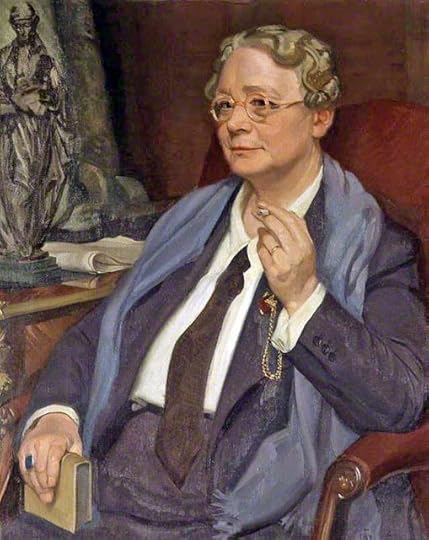
This book is hands-down one of my top three reads for the year. Sayers discusses doctrine, dogma, and ethics-- from humanitarian compassion to the ethos of work to art. Like a surgeon with a razor-sharp knife and a steady hand, she dissects exactly what is wrong with the Church and the world and what we need to do to better- both as individual members of it, as well as the Church as an institution. Nobody is safe from her discerning eye. I found myself smarting a few times-- not because of her words, which are spicy without being sarcastic or offensive-- but because of how plainly she puts things. Right and wrong, it turns out, are actually pretty simple concepts in the kingdom of God. And Dorothy shows us not only what it means to be a Christian, but what it means to be human. C.S. Lewis said of this Dorothy that he liked her "because she liked me" and "later for the extraordinary zest and edge of her conversation." Zesty indeed. Here is a portrait of our girl in the British National Portrait Gallery: Look at that glint in her eye with a cheekly little cigarette and tell me that you wouldn't die for this woman's approval.
As Sayers wrote this during the end of World War II, I found myself resonating with her as I applied some of her thoughts to COVID. (She says in discouragement, "I am frightened by the phrase 'after the war'-- it is so often pronounced in a tone that suggests, 'after the war, we want to relax, and go back, and live as we did before.'") Engaging with this book, at times, felt like a cosmic discussion with a woman across time and space who was also living in a global crisis; feeling like the Church had largely lost their collective minds, and asking for changes to be made for the better since everything was already disrupted. Although, I'll easily admit to being entirely less eloquent than Dorothy Sayers, I was definitely on her wavelength for this book. It is incredible, eye-opening, and plain thoughtful. What a refreshing book that is less concerned with whether it is appealing to the political right or the political left (an admirable feat for a British woman writing in 1941) and wholly absorbed in recapturing the simple truths of how we should live as people under God.
Dorothy wasn't exactly part of 'the Inklings', but she was absolutely their intellectual equal. One can't help but wonder wether her works would be counted as a Christian classic, numbered with Mere Christianity, if she had been born a man. I certainly consider this book as such. Five stars, Dorothy. I am in equal turns intimidated by and enamored of you.
This book is life-changing. Sayers is as relevant today as she was when this was written and is in many ways prophetic. She has changed how I view Christianity and how I aim to progress in the spiritual life. She has a unique and fresh voice which ought to be heard well.
Some of this is certainly over my head at the moment, but I gleaned what I could on this read and would like to reread it in a few years. Maaaaaany echoes of conversations on The Literary Life Podcast.
Sayers is always a delight to read, very educated, informative, yet easy to follow and with a wry humor that helps the pages go by. I definitely don't agree with everything she says here, and I'm not sure where some of it fits into what the Church needs to hear (I'm still rather trying to piece together the purpose of the allegory chapter), but there's some good things to ponder over here.
One of the best books, simply put, that I've read in awhile that isn't hundreds of years old. Also the first title by Dorothy Sayers I've read, and I very much look forward to reading a great deal more. What does the doctrine of the Trinity or the Incarnation have to do with real life? What does real life have to do with the creative life? What utilitarian value does creativity have with the necessary business of living? The questions are reflected on and the terms are re-set entirely in a powerful way that should not be missed by any thoughtful, reflective, creatively minded Christian.
C. S. Lewis, when describing what he liked about Dorothy Sayers, said it was "...for the extraordinary zest and edge of her conversation." While I am not privy to her conversations, I can say that her zest and edge certainly made it into her writing. I have not enjoyed reading a book this much in some time. If you do not read the rest of this review, then know that this is a masterful series of essays, written with the right combination of intelligence, insight and wit to make you eager to turn the pages.
Sayers argument in "Letters" is essentially this: the Dogmas of Christianity are not stale and tired ideas, floating somewhere above the clouds beyond the reach of humanity, but are very much fresh and alive. They both reflect the actual nature of the universe, and ought to be "brought into" that universe. Suffice to say, I think her point holds, and is excellently argued.
She begins by outlining what Christian dogma actually states, concentrating on the doctrines of creation, the trinity, and the incarnation. From there she addresses a variety of issues, looking at all of them from this lens of Christian dogma and how they ought to be re imagined, how they actually are re-imagined, by the facts of Christian theology. These issues include economics, the concept of work, aesthetics of art, and other.
The normal tack for these sorts of essays would be to begin with a political or philosophical outlook, then begin to cite scripture to support said outlook. Thus we get results like ecological devastation justified by "fill the earth and subdue it" (Gen 1:28) and communism by "and they had all things in common." (Acts 2:44) But Sayers begins from the dogma and builds upwards, deftly avoiding preconceived notions of how Christian dogma interacts with the world. The results are surprising, but perfectly resonant with a Christian outlook.
All of the essays are worth reading, but I'll point out a few highlights. "Why Work," is theoretically an economic essay, but it goes well beyond economics and deals with the question of "work" in and of itself. Sayers notions about work, if put into effect, would be really revolutionary, far more so than any Capitalist or Marxist thinker has ever dared.
"Toward a Christian Esthetic," is a must read for creative Christians. Here she argues what Christian Art should actually consist of in light of theology, and it is inspiring. Beside it, "The Writing and Reading of Allegory," is both an enlightening history of the literary form of allegory, but also a convincing defense of it.
Lastly, the final essay "Problem Picture," caps off the discussion by showing what all of this means to the common man. Her ideas are not just for creatives or intellectuals, but for the bricklayer, carpenter, and all 'common' walks of life.
The expand on this last essay a bit, I am going to risk saying it feels "relevant." "Relevant' is a word so often lavished upon popular works as a form of praise that I hesitate to use it, because it has almost lost all meaning. Any meaning it contains now seems to be "It aligns with my political position, therefore it is good." But I think that this last essay is truly relevant, in the sense that it is "relevant to the discussion, that is provides a new angle, shines a new light on the proceedings. "
So much discussion today, if we can use the term "discussion" anymore than we can use the term "relevant", is based around a problem/solution viewpoint. The problem of racism, the problem of poverty, the problem of capitalism, etc. Sayers takes this idea and, in a masterful few paragraphs, dismantles it. Her approach is one that I will have to take time to digest and examine, but I think it is something profound, and something desperately missing from the Church's approach to the current cultural debates.
I have been intentionally vague on Sayers solutions and arguments, but that is because I can not do them justice, and they really ought to be read in their totality. Sayers has taken a place among my favorite Christians authors of her era, shoulder to shoulder with Lewis and Tolkien. Read this book, you will not be disappointed.
You may be familiar with Dorothy Sayers as the author of some unexcellent detective novels. You may have heard of her as an orbital figure in CS Lewis's circles. You may be aware that she wrote "The Lost Tools of Learning," an essay which, by its cleverness, got a bunch of Classical Christian schools stuck in what she herself calls the 'poll parrot stage' of development. You probably have not read her essays. But they are worth reading. She is a snappy strong writer and she makes unexpected connections that can make you go Ah! like Lewis himself at his best. I particularly recommend the essays "The Other Six Deadly Sins" and "The Triumph of Easter." The book itself, as distinct from the writing, is less than ideal: there are no publication dates, let alone introductory material or the like.
In recent years, I have seen a number of quotations from Dorothy Sayers, so I wanted to go to the source. In this collection of a number of her essays, I found her to be a thoughtful commentator, although I don't think I would use the adjective "passionate", as the publisher did. Nevertheless, she was relentless and firm in her writing.
She starts on the very first page: "The Christian faith is the most exciting drama that ever staggered the imagination of man--and the dogma is the drama." She is saying that doctrine (dogma), far from being dull is what gives Christianity its excitement. As she says in another essay, the dogma is the drama.
Sayers occasionally shows a sardonic wit. She imagines the way unbelievers would attack the Christian religion, and in answer to the question "what is the doctrine of the Trinity?", she says "The Father incomprehensible, the Son incomprehensible, and the whole thing incomprehensible."
In three different essays, she emphasizes that a central characteristic common to God and man is the creative instinct, and supports her thesis well. Her essay "Creed or Chaos?" is an excellent defense of the faith, and contains this central thesis statement: "And however unpopular I may make myself, I shall and will affirm that the reason why the churches are discredited today is not that they are too bigoted about theology, but that they have run away from theology." The many decades since she wrote this have proved her point.
In her essay "The Other Six Deadly Sins", she deals particularly with envy, and shows how it goes a long way toward explaining the economic mess in which we find ourselves. In her essay "The Triumph of Easter", she writes "God did not abolish the fact of evil: He transformed it. He did not stop the Crucifixion: He rose from the dead." In answer to the question "Why Work?", she says "I asked that it should be looked upon--not as a necessary drudgery to be undergone for the purpose of making money, but as a way of life in which the nature of man should find its proper exercise and delight and so fulfill itself to the glory of God."
The book also includes essays on Christian aesthetics and the writing and reading of allegory. Sayers was skilled and conversant in literary works as well as religious ones. Some of the essays get a little arcane and difficult to follow, but most are readily comprehendible. Reading this caused me to think once again of The Inklings, and to imagine the discussions and interactions they must have enjoyed.
I found so much to love about this book (see quotes).....and also so much that bored me to tears. Sayers has a wonderful way with words and I look forward to reading more of her works, but this was just okay for other than the parts I loved.
A few favorite quotes: He (Jesus) was not merely a man so good as to be "like God" --He was/is God.
We have very efficiently pared the claws of the Lion of Judah, certified him "meek and mild," and recommended him as a fitting household set for pale curates and pious old ladies. To those who knew him, however, he in no way suggests a milk-and-water person; they objected to him as a dangerous firebrand. True, he was tender to the unfortunate, patient with honest inquirers, and humble before heaven; but he insulted respectable clergymen by calling them hypocrites. He referred to King Herod as "that fox"...."
He was emphatically not a dull man (Jesus) in his human lifetime, and if he was/is God, there is nothing dull about God either.
I found Sayers' collection of essays to be a bit uneven, but she gets five stars for "The Dogma is the Drama" alone.
"Christ, in his divine innocence, said to the woman of Samaria, 'Ye worship ye know not what'--being apparently under the impression that it might be desirable, on the whole, to know what one was worshipping. He thus showed himself sadly out of touch with the twentieth-century mind, for the cry today is: 'Away with the tedious complexities of dogma--let us have the simple spirit of worship; just worship, no matter what!' The only drawback to this demand for a generalized and undirected worship is the practical difficulty of arousing any sort of enthusiasm for the worship of nothing in particular."
Over the sixteen essays, she argues for the relevance and the joy of doctrine in various facets of life. An excellent read.
Reading "Letters To A Diminished Church" was an intense exercise for my brain cells! I had a startling realization of my feeble grasp on classic literature, sadly forgotten since my college humanities classes. But the purpose of this book is not just an intellectual one. The author explains basic Christian doctrines in a way that are both simple and profound. I was amazed that she was writing over 70 years ago in the middle of a war. Her insights seem so contemporary to me. It was an effort to get through this book but I'm so glad I did! I'd recommend this only to those who are willing to put the work into it....it's not an easy read.
Also, Dorothy Sayers was a friend and colleague of C. S. Lewis, and you can tell. Phrases and styles of writing were quite similar.
Sayers ends her book much stronger than she starts it. I was dismayed at the beginning as she dismissed a literal interpretation of Genesis, however the subsequent chapters built to an excellent final chapter that focused on the Christian aesthetic, of which she presents very compelling and helpful insights.
Great book! I admit that some of what she discusses goes over my head, but what I did get was very thought-provoking. She also has a great view of art and Christianity.
4.5 rounded up. This gave my brain a work out! I gleaned what I could & will re-visit in the future. (I'm a little bit in awe of Dorothy Sayers brain & creative ability ;)
I wish I had read Sayers before. Haven't enjoyed a book as much as this in recent times. She reminds me so much of CS Lewis - honest, faithful, and beautiful.
Great collection of essays. There is a lot of discussion on God as Creator and how we are creators which is a fundamental part of how we bear God’s image.
Dorothy Sayers is one of my heroes and role models, and this book is tremendous. I docked a star because it felt more like a collection of essays at the end, rather random and disconnected, instead of each chapter proceeding from the other and supporting what I thought was going to be the main thesis (to quote the subtitle, the relevance of Christian doctrine). Even so, I'll be coming back to this book. Some of her thoughts I've never considered before, and I'll be mulling them over for a while.
I love her perspective on Christians and art, of course (some chapters felt like a preview for Mind of the Maker which I still have to read), as well as her thoughts on the purpose of work (and secular vocations!), the value and correct use of allegory, and how Christians should engage with a secular society (hint: don't adopt its way of thinking but don't run away either). Her description of the deadly sins is especially insightful, and her parody of how most people would recite the catechism made me laugh out loud. I wanted to cheer her when she talked about the danger of the church relying on an alliance with Caesar to accomplish various social causes (in her example, sexual morals). Oh, and her analysis of why looking at problems in the world through the lens of a detective novel is dangerous is worth the price of the book.
She is witty, brilliant, passionate, and creative. Just the best. I'll prove it with some quotes. ;)
Somehow or other, and with the best intentions, we have shown the world the typical Christian in the likeness of a crashing and rather ill-natured bore—and this in the name one who assuredly never bored a soul in those thirty-three years during which we passed through the world like a flame.
Let us, in heaven's name, drag out the divine drama from under the dreadful accumulation of slipshod thinking and trashy sentiment heaped upon it, and set it on an open stage to startle the world into some sort of vigorous reaction. If the pious are the first to be shocked, so much worse for the pious—others will pass into the kingdom of heaven before them. If all men are offended because of Christ, let them be offended; but where is the sense of their being offended at something that is not Christ and is nothing like him? We do him singularly little honor by watering down his personality till it could not offend a fly. Surely it is not the business of the Church to adapt Christ to men, but to adapt men to Christ.
~
No piety in the worker will compensate for work that is not true to itself; for any work that is untrue to its own technique is a living lie.
She (the church) has forgotten that the secular vocation is sacred. Forgotten that a building must be good architecture before it can be a good church; that a painting must be well painted before it can be a good sacred picture; that work must be good work before it can call itself God’s work.
~
[The Trinity] In the last resort, in the depths of their mysterious beauty, the unimaginable and the image are one and the same.
~
We should ask of an enterprise, not "will it pay?” but “is it good?”; of a man, “what does he make?” but “what is his work worth?”; of goods, “not how can we induce people to buy them?” but “are they useful things well-made?”; of employment, “not how much a week?” but “will it exercise my faculties to the upmost?”
~
The great thing, I am sure, is not to be nervous about God—not to try and shut out the Lord Emmanuel from any sphere of truth. Art is not he—we must not substitute art for God; yet this is also he for this one of his images and therefore reveals his nature. Here we see in a mirror darkly—we behold only the images; elsewhere we shall see face-to-face, in the place where image and reality are one.
First, understand that when Sayers says “Church", she is referring to the Anglican communion, with an occasional nod towards Rome. Here is her basic tenet: that Christian dogma matters. It not only matters, but it is a thundering good story. This may seem obvious, but her point is that the modern (mid-twentieth century) church has, as she puts it, "run away from theology", and that, as a result, many, if not most, nominal Christians have very little idea about what it is that the Church really teaches.
This book is a collection of essays and talks written over a period of time (one very annoying thing about this edition is that it nowhere gives the dates of the essays). Sayers' writes about The Other Six Deadly Sins ("Perhaps the bitterest commentary on the way in which Christian doctrine has been taught in the last few centuries is the fact that to the majority of people the word immorality has come to mean one thing and one thing only."), The Faust Legend and the Idea of the Devil ("It is notorious that one of the great difficulties about writing a book or play about the Devil is to prevent that character from stealing the show"), and the relationship between work and religion.
Readers of Sayers' Lord Peter Wimsey will recognize in these essays many of the concerns that are raised in those mysteries, and will be reminded particularly of the philosophical discussions in Gaudy Night.
One word of warning: this book was very poorly edited, to the point where it at times affects readability. It's too bad.
There were certainly sections of this book that I disagreed with (and a few places where I'm sure it was just my own intellectual feebleness, but I had no idea what she was talking about), but wow -- what a thought-provoking book. This one is definitely going to get a re-read. My favorite sections were the chapters called "The Dogma is the Drama", "Creed or Chaos?", and "Why Work?" (that last one especially clearing up a great deal of confusion that I've been trying to sort out lately). I loved Dorothy Sayers already for her fantastic Lord Peter Wimsey stories, but I love her more now after reading this vibrant, spirited, and very witty application of [mostly] solid doctrine to real life.
Sometime when I have time, I'll need to sort out my thoughts and write a real review.
"The only Christian work is good work well done. Let the Church see to it that the workers are Christian people and do their work well, as to God: then all the work will be Christian work, whether it is church embroidery, or sewage farming."
"What we in fact believe is not necessarily the theory we most desire or admire. It is the thing that, consciously or unconsciously, we take for granted and act on."
This book is Sayers' effort to enliven her readers' appreciation for the truth and drama of historic Christianity, about which she thought deeply and was very passionate, and her formulations of Christian doctrine are imaginative and vivid. Her thoughts on creativity, the relevance of dogma, and the "other six deadly sins" are extremely rich and provocative, and the book is worth reading for those chapters alone.
The book's main weakness is that Sayers often makes emphatic statements whose specific content is hard to discern if you stop and think about them, which produces the impression that she was attempting a Chestertonian style without quite attaining to Chesterton's brilliance.
One would think Dorothy Sayers was writing to the American church of 2011. Excellent material written in an engaging and thought provoking manner. More Christians should be reading and thinking about the things she presents.
Really just so fantastic. Sayers lays all would-be equivocation bare with the sheer clarity and force of her explanations, leaving readers no place to hide from Truth. Very highly recommended, especially for Christians who are both analytical and creative.