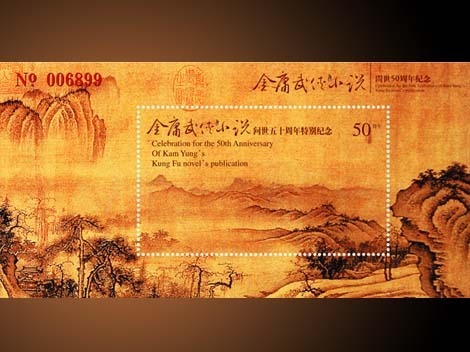
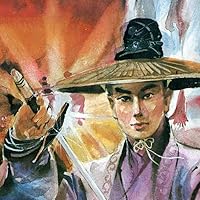
The martial arts novel is one of the most distinctive and widely read forms of modern Chinese fiction. It is popular not only within Chinese-language communities but in translation throughout East Asia and in cinematic and other adaptations throughout the world. In Paper Swordsmen, John Christopher Hamm offers the first in-depth English-language study of this fascinating and influential genre, focusing on the work of its undisputed twentieth-century master, Jin Yong.
For an excellent, in-depth review Goodreads reviewer Grace Tjan does a much better job than I would, hampered as I am by how few of Yong/Cha's works have been translated into English.
An American without reading-level Mandarin trying to delve into the long history of wuxia and xianxia is very much like trying to view a panorama through a keyhole. This book was fascinating on so many levels, though it was slow going. It has the structure of a dissertation, with long, jargon-laden sentences, and some very peculiar neologisms (like "narratorial" instead of "narrative") but I found it worth working my way through it slowly over a period of weeks.
Impressions I came away with: Jin Yong had steeped himself in the wuxia tradition. From the one novel I've read translated, and several media interpretations of his work, I can see the bones of wuxia tradition in the highly picaresque nature of his stories. But also, it seems, he was quite conscious of using jianghu tales in order to comment on current events--something that could be quite dangerous during the volatile sixties and seventies in mainland China. But this, too, seems to be a characteristic of wuxia: the tales that lasted the longest contain oblique commentary on their times.
This book was also interesting in how it traced Yong's use of his publishing medium (basically a tabloid, one of many published in Hong Kong) to foster his work through commentary on it, and letters from fans (whether actual fans or sock puppetry). Hamm traces the beginnings of the literary and academic world, which has also undergone dramatic sea changes in China, as they begin to grapple with Yong's legacy. The only phenomenon I can think of to compare him with in American literary landscape is Stephen King.
Jin Yong's novels are fascinating on several different levels. John Hamm, the author of this book, the only in-depth study of the “Jin Yong Phenomenon” in English, enumerates some of the qualities that make Jin Yong’s fiction appealing to its audience and particularly interesting as a subject:
"Jin Yong’s work is lauded for its panoramic and emotionally charged engagement with Chinese history; its seemingly inexhaustible inventiveness and the dazzling complexity of its plotting; its range of vivid, multifaceted characters and psychologically adventurous exploration of human relationships; its integration of modern sensibility and Western literary techniques with the inherited material of the martial arts genre; its reinvention, through the rejection of Europeanized elements, of Chinese vernacular prose; its ability to wed a breadth of learning and profound insights on life with the most crowd-pleasing action and melodrama; and its effectiveness in accessibly introducing Chinese culture and values to a socially, geographically, and generationally diverse readership, including such a “disadvantaged” elements as the younger generation of Chinese overseas."
Hamm uses media studies approach to investigate how Jin Yong's intertwined roles as both author and publisher, as well as owner and chief editor of the Ming Pao Daily, where the stories were initially serialized, impacted the dissemination of the novels and the propagation of the ideas therein. Apparently, Jin Yong was also a canny newspaperman/businessman who was able to use the enormous popularity of his serialized fiction as a financial leverage to establish a publishing empire, which in turn he used to promote not just the novels, but also the films, TV serials, comic books and other products based on them. But this was not Jin Yong's sole agenda. Hamm argues that from the earliest days of Ming Pao in the late 1950s, Jin Yong had "used his unique role as both author and publisher to shape the conceptual contexts for the acceptance of the martial arts fiction and to open the possibility of his own work's serving as a bearer of literary and cultural capital." This is remarkable as Ming Pao Daily began its life as a tabloid in which "extracts from the international wire services jostle for attention with photographs of bathing beauties and sensationalistic reports of car wrecks, abductions and crimes of passion." Hardly a promising platform for the promotion of works projected to bear literary and cultural capital. Not to mention that the Chinese literary establishment and the communist government had both declared martial arts fiction to be "poisonous weeds" steeped in the feudal past. Indeed, Hamm later points out that many of the decisions taken by Ming Pao's founders in its early days were made in response to changing social circumstances and market opportunities rather than according to any preexisting vision. However, Ming Pao subsequently evolved into a prestigious paper, largely thanks to Jin Yong's influential editorials on mainland politics and its staunch opposition to the Maoist regime. Jin Yong began to position his publications, including his martial arts fiction, as a repository of traditional Chinese values and culture --- "a Chinese cultural nationalism that defined itself in large measure against the excesses of the mainland's Great Proletarian Cultural Revolution." Perhaps it is more plausible to regard this era as the starting point for Jin Yong's didactic project, when the urgency of preserving traditional Chinese culture and values became more pressing under the pressure of attacks against them in the mainland.
The continuous revisions of the novels through the following decades (there were three major revisions, the last finished in the 90s) were aimed at consolidating their position as literary classics, with further polishing of the prose, more refined characterizations and the inclusion of additional cultural and historical allusions. This "canonization" process, actively encouraged by Jin Yong and his publishers, reached new heights in the 80s and 90s with the publication of the Collected Works of Jin Yong both in Taiwan and the mainland, whose governments had previously banned the novels for various ideological reasons. In the mainland, this process was not entirely free of controversy, as evidenced by the "Wang Shuo incident" in the late 90s, in which China's literary enfant terrible, famous for his profanity-laced "hoodlum literature", declared that Jin Yong's fiction is one of the "four great vulgarities of our time" (the other three "vulgarities" are the "Four Heavenly Kings" of Canto-pop music, Jacky Chan's action films and Qiong Yao soap operas). Hamm thinks that Wang Shuo's criticism stemmed from the North/South geocultural division that runs through China --- "It is their identity both as southerners and as products of the foreign-tainted periphery that condemns Jin Yong and his peers to the category of the "four great vulgarities." Despite the very public run-in with Wang Shuo, the general trajectory of the "canonization" process in the mainland seems to have been largely positive, with the acceptance of the works and the author himself into prestigious academic and literary cycles, albeit with some qualifications. Hamm suggests that this might have something to do with Jin Yong's rapprochement with the post Deng Xiaoping (“I have read your novels.”) mainland regime, but he admits that the Jin Yong phenomenon was "no longer nourished principally by the Ming Pao and Yuanliu conglomerates and other institutions with direct commercial interest, but riding free and evidently self-sustaining on the seas of media attention."
Besides looking at the Jin Yong phenomenon through the media studies angle, Hamm also analyzes six major novels, including the patriotic epics The Eagle-Shooting Heroes (Shediao yingxiong zhuan) and its sequel, The Giant Eagle and its Companion (Shendiao xialu) --- these are official, but what awkwardly translated titles! --- and two fascinating late novels, The Smiling, Proud Wanderer (Xiaoao jianghu) and The Duke of Mount Deer (Luding ji).
Hamm interprets these novels as literature of exile and displacement, largely set in pivotal moments in Chinese history, usually during a dynastic crisis, which eventually ended in foreign subjugation. In a sense, these stories are attempts to make sense of China's long and complex history, in which a proud nation is more often than not had to endure humiliating colonization by non-Han "barbarians". Hamm traces the evolution of Jin Yong's ideological stance through these novels, from his initial position on "Han self-determination" through political/military struggle, as reflected in the earlier novels, including Heroes and Companions, to skepticism toward politics as a means to achieve this aim, as reflected in Wanderer, and finally to a pragmatic accommodation of colonization and pan-ethnic solidarity in Mount Deer. This reading is quite obvious, considering Jin Yong's personal history as a mainlander who fled to Hong Kong soon after the Communist takeover, which came on the heel of the Japanese occupation and civil war that wracked the mainland during his formative years. It is illustrative to compare the various exit strategies that his heroes used to deal with the political crisis in the mainland: Guo Jing, the epitome of Confucian patriotism, sacrificed his life in the eventually futile defense of the city of Xiangyang against the Mongol invasion; Yuan Chengzhi, escaping the imminent Manchu victory, left China for the peaceful Nanyang island of Borneo --- like so many overseas Chinese over the centuries; Linghu Chong, disgusted with the "dystopia of political life", retreated into reclusion "of individual liberty given solace and substance by romantic fulfillment on the one hand and transmitted cultural practices on the other"; Wei Xiaobao, who in contrast to any of these other protagonists, was pragmatic to a fault and probably had no single patriotic bone in his body, took himself and his seven wives to the remote province of Yunnan, fleeing from "the knot of conflicting loyalties in which he had become enmeshed" --- instead of from foreign occupation or immoral politicking like his predecessors.
His last two books, in which Jin Yong gradually subverted the paradigms of the genre that he had done so much to advance, are the most interesting. In Wanderer, the martial arts that in the earlier novels empowered their heroes to uphold justice and fight foreign invaders is represented as "not merely a tool for the ambitions of the ruthless and hypocritical, and not merely as inhumanely savage in the most significant instances of its deployment, but also structured around an intrinsic perversity that comes to symbolize the violence and unnaturalness of the quest for power." Likewise, where Heroes "envisions China's martial (wu) and cultural (wen) arts as complementary and mutually fulfilling, Wanderer suggests that for all their structural and stylistic affinities, their fundamental aims are incompatible."
The last book, Mount Deer, is even more radical: Wei Xiaobao, the protagonist of the novel is the antithesis of Jin Yong's previous heroes: not only that he didn't know any martial arts, he was also largely amoral. After spending his entire literary career writing about heroes who represent cherished traditional Chinese values, Jin Yong created a character that reflects the other side of the national characteristics. According to the author, Wei Xiaobao's two most distinct traits, namely his capacity to adapt to his environment and his loyalty to friends, are among the major reasons for the Chinese people's survival and historically unique resilience. However, "the lying and scheming to which Wei Xiaobao's 'adaptability' led him should be understood as revealing the weaknesses of the Qing society in which he lived, and would properly disappear under more enlightened social condition; indeed the prevalence of the 'Wei Xiaobao style' of cronyism, self-interest and disregard for the law has a great deal to do with the Chinese government's continued failure to get on the right track." The Han nationalism that was so prevalent in the earlier novels has been replaced by a sort of a compromise: a non-Chinese emperor like Kangxi could be a legitimate ruler, as long as he fulfills the essential requirement for enlightened rulership according to the Chinese classics, which is to display benevolence toward his subjects. Surely, living under the “benevolent” British colonial government in Hong Kong is much preferable to living under the tyranny of the Han Chinese Maoist regime on the mainland, even if the price is the "bastardization" of one's cultural identity, as reflected by Wei Xiaobao's ethnically uncertain patrimony:
"Wei Xiaobao, with no further ado, drew her aside into her chamber and asked her a question he'd been saving for a very long time, a question that had been brought again to the forefront of his mind as he had stood watching the burning boat near Siyang. The old Triad's words were still ringing in his ears, “A man can only be who he is." And who was Wei Xiaobao? "Mum, tell me, who really was my dad?" Spring Fragrance Wei looked him straight in the eye. "How the hell should I know?" Wei Xiaobao frowned. "No seriously, I mean, when I was in your belly --- who had you been doing it with?" "I was a beautiful woman in those days, my boy. I had lots of different customers everyday --- I couldn't possible worked out who it was!" "Were they all of them Chinese?" "Well, let me see now, I had Chinese, I had Manchus, Mongols ---." "No, I mean, did you ever have any foreign devils?" "What kind of shameless slut do you take me for!" came the angry retort. "Do it with one of them! With a big nose. Not on your life! Hot piece popping tamardy! If a single one of those great hairy Russians, or red-haired Dutch devils, had ever tried sneaking in here, I'd have booted them straight out the door!"
Wei Xiaobao heaved a sigh of relief. At least that possibility had been ruled out. His mother looked up. There was a twinkle in her eye. She seemed to have remembered something. "Wait a minute, though. I do recall, around that time, having a regular who was a Muslim. Very good-looking fellow he was, too. I sometimes used to say to myself, now my Xiaobao's got a fine nose, just like his." "So you had Chinese, Manchus, Mongols, Muslims --- what about Tibetans. Did you ever have a Tibetan?" asked Wei Xiaobao. A glow of pleasurable recollection lit up his mother's face. "Why, now that you mention it, yes, of course I did! There was this Tibetan Lama. Every time he came to bed he'd start chanting his sutra. And all the time he chanted he'd stare at me with this really dirty look. His eyes'd be just about popping out of his head. Saucy pair of eyes they were too --- just like yours!""*
For all its worth, the continuing popularity of Jin Yong, "the single most widely read of all twentieth century writers in the Chinese language", suggests that somehow his stories have struck a deep chord within the Chinese mind. It is surely worth reading, and translating, as literature and also a means to understand contemporary Chinese culture. It surely adds another perspective to the ones suggested by the 'big bad China' cottage industry, the foot binding fetishist fiction, and the Gao Xingjian Nobel-prize winning novels. And they're immensely more enjoyable, too.
Another doctoral thesis as a book, but in this case, I found it mostly engrossing. I was hoping that it would take things a little further beyond Jin Yong, but if you want a close analysis of his career, this book does a good job of it. I didn't find some of the literary analysis nearly as convincing or interesting as the historical sections.
Honestly, I pretty much felt like I'd died and gone to heaven reading this, as martial arts fiction, wuxia, is one of my favorite categories of fiction and one in which I have dabbled myself with my such titles as The Crocodile and the Crane, The Cutting Season, and Quiet Teacher. If you are interested in this subject, you will greatly enjoy this book.