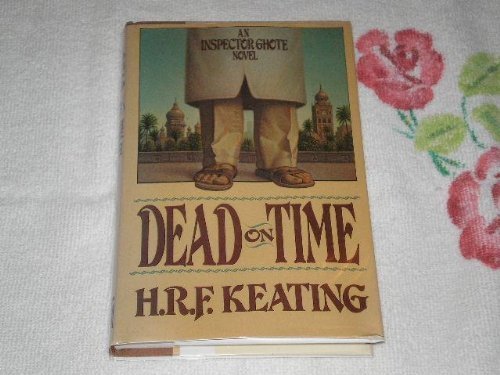
Ramrao Pendke, heir to a massive country fortune, is in Bombay recovering from a kidney transplant operation. Out taking exercise, Pendke visits the Ticktock watchworks and is bludgeoned to death. The head of the Bombay police backs the prompt arrest made by a pet officer of his, Assistant Inspector Lobo, who has forced a confession out of Rustom Fardoomji, owner of the watch store. Ghote has doubts about the confession. He also agrees with the relatives of the Fardoomji would have no reason to do away with a wealthy customer. In order to placate these influential relatives, Ghote is sent to the dead man's home village - a slow-paced backwater the inspector finds maddening. In the course of his energetically pursued investigation he interviews an astrologer, the village barber, a boy Brahmin, and the dead man's grieving grandfather. In the face of a 24 hour ultimatum, Ghote at last finds the essential clue that solves the most difficult case of his career.
Henry Reymond Fitzwalter Keating was an English writer of crime fiction most notable for his series of novels featuring Inspector Ghote of the Bombay CID.
H. R. F. KEATING was well versed in the worlds of crime, fiction and nonfiction. He was the crime books reviewer for The Times for fifteen years, as well as serving as the chairman of the Crime Writers Association and the Society of Authors. He won the CWA Gold Dagger Award twice, and in 1996 was awarded the CWA Cartier Diamond Dagger for outstanding service to crime fiction.
The author has set the scene of the murder in a watch maker's shop so the case is known as the Tick Tock Murder ;-) Truly enjoy reading these books as I can hear the dialogue, with full accenting and emphasis so for a time I'm not in snowy Nova Scotia but in lively, hot, Bombay. So many options/potentials for a whodunnit...Keating is good, real good.
I like reading books across different genres that bring the reader into other cultures and times The way a writer recreates the atmosphere of a society through events that occur, or have occurred in the past to shape the present, and the thoughts and beliefs that the characters hold are, for me, critical to the making of a good story. A good example of this would be the Number One Ladies Detective Agency series by Alexander McCall Smith or the Aurelio Zen series by Michael Dibden.
By all rights I should have abandoned this book after the first 50 pages. The syntax was frequently annoying (I am not one to shy away from narrative that has to be worked at - I will read Kipling or Conrad and navigate the often archaic nautical descriptive), and at first I wondered if this was just poor translation or gratuitous nuance. But more of a problem for me was that the rich Indian culture was barely touched upon, and the characters seemed flat and uninteresting.
This was the first Ghote I have read. Perhaps I would have benefitted from having had prior exposure to the character and the authors writing.