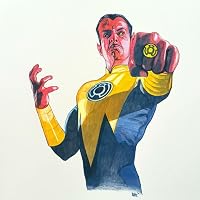
First of all, Ivan Reis.
Holy shit, this man’s artwork is incredible.
I genuinely think he might be on par with Ethan Van Sciver. His style feels like an almost perfect blend of Van Sciver and Jim Lee, combining incredibly detailed characters with dynamic action and some absolutely gorgeous compositions. The covers alone are fantastic.
And his Green Lanterns? Beautiful.
I particularly appreciate how much individuality he gives them. Different uniforms, different emblems, different body types, different ways of wearing essentially the same symbol. It makes the Corps feel like an enormous intergalactic organization rather than an army of identical people wearing green spandex.
As for the story itself, I have some mixed feelings about its structure.
We begin with Hal’s time as a prisoner of war, something that had been teased for quite a while. And honestly, I’m still not particularly convinced by his return to military aviation.
I understand why Hal wants to fly without relying on his ring, and I appreciate that he’s trying to maintain some connection to his old life. But here, that decision nearly gets his friends killed, costs another pilot his career, and puts Cowgirl in serious danger.
And for what?
The main lesson seems to be that Hal probably should have kept his damn ring on.
The mystery surrounding his captivity also feels unnecessarily prolonged. We receive brief flashbacks and hints about what happened, but so much more interesting stuff is happening elsewhere that I found it difficult to care.
The Global Guardians storyline is considerably more interesting conceptually.
I like the idea of different countries and continents having their own superhero teams. It makes the DC Universe feel larger, and it’s refreshing to see stories that don’t revolve exclusively around America.
At the same time, the international treaty and the involvement of government-controlled superheroes raise some uncomfortable questions.
Hal Jordan isn’t simply an American superhero. He’s a Green Lantern, responsible for protecting an entire sector of space. Restricting his activities according to national borders seems fundamentally at odds with that responsibility.
And turning superheroes into government agents can be a dangerous road to travel. At what point do they stop being independent protectors and become an extraordinarily powerful policing force?
It’s an interesting idea, although I don’t think the storyline explores it nearly enough.
But thankfully, we eventually return to Oa.
And that’s where things really start getting good.
The early glimpses of the Sinestro Corps, particularly Arkillo, are fantastic. Knowing what these characters eventually become makes their introductions even more exciting.
I also enjoyed seeing Soranik Natu again. Her connection to Sinestro makes her one of the more fascinating Lanterns to me, and I love the conflict that comes with her family history.
The atmosphere on Oa is another highlight.
Seeing the other Lanterns react to Hal’s presence reminds us that Parallax’s crimes haven’t simply been forgotten. These are people who lost friends and comrades because of him. Some of them have every reason to hate the sight of him.
And yet, Guy Gardner stands up for him.
I absolutely love that.
Their friendship has developed into something genuinely wonderful. They can insult each other, argue, and compete constantly, but when someone threatens one of them, the other is ready to throw hands.
Then Kilowog arrives and puts everyone in their place.
There’s something great about seeing a character who commands the respect of the entire Corps, including Hal himself, his authority comes from something equally important: the respect he’s earned from training and protecting generations of them.
And Salaak continues to be Salaak.
His dedication to duty remains absolute, yet his concern for Hal and the other Lanterns is unmistakable. I particularly enjoyed his interactions with Kilowog when Hal disobeys the Guardians. Salaak knows he has to report him, but he doesn’t seem particularly eager to do it.
It’s these little relationships that make the Corps feel alive.
The mission to Biot, beyond the Guardians’ jurisdiction, is another fascinating piece of worldbuilding.
Interesting that Guardians don’t actually control the entire universe. There are unexplored regions, abandoned sectors, and places even the Green Lantern Corps rarely visits.
Biot itself looks cool, almost like a combination of a Transformers world and the lower levels of Coruscant.
The Manhunters make for an intimidating threat, especially with their ability to drain the Lanterns’ power. The fact that these machines can actually bleed is genuinely disturbing.
But the discovery of the missing Green Lanterns is where the story really grabbed me.
Seeing them imprisoned and connected to an artificial power source was horrifying, but their designs were absolutely incredible.
Kreon, with his golden armor and military background, immediately caught my attention. So did the other prisoners, each looking like they belonged to an entirely different corner of the DC Universe.
I particularly appreciated that Johns gave us glimpses of their histories. As someone who hasn’t read all their original appearances, it makes them feel like actual characters rather than forgotten names brought back for nostalgia.
Then there’s Cyborg Superman.
I’ve always liked Hank Henshaw, and his appearance here might be my favorite design of his. The black and red suit works considerably better for him than simply wearing Superman’s costume.
His connection to Coast City’s destruction also makes him a particularly appropriate villain for Hal to confront.
I do have to admit that the story occasionally feels overcrowded.
Between the Manhunters, the missing Lanterns, Hal’s captivity, the Global Guardians, the mysterious bounty hunters, and the buildup toward the Sinestro Corps, there are moments when Johns seems to be telling three different stories simultaneously.
And while I appreciate how beautifully some of these threads eventually connect, that doesn’t necessarily make them equally engaging while you’re reading them.
It’s something I can appreciate more in retrospect than in the moment.
But the emotional payoff makes up for a lot.
Hal destroying the nanites in his own brain through sheer willpower is a wonderful reminder of why he’s considered one of the greatest Green Lanterns to ever live.
Yet the moment that impressed me more came afterward.
When the rescued Lanterns realize who freed them, they immediately turn against Hal. And honestly, can you blame them?
To them, he’s still the man who destroyed the Corps and murdered their friends.
But Hal refuses to fight back.
I love that decision.
These aren’t stupid people. They’re Green Lanterns. They’re capable of recognizing what’s happening, even if their anger initially overwhelms their judgment.
And Hal understands that regaining their trust isn’t going to happen simply because he’s wearing a green ring again. He has to earn it.
It’s a much more satisfying approach to the Parallax aftermath than simply having everyone forgive him overnight.
And then there’s Arisia.
God, I was happy to see her again.
Her history with Hal makes their reunion particularly meaningful. She’s someone who knew him long before his fall, someone who experienced the consequences of what happened, and yet she doesn’t seem to carry the same hatred toward him as some of the others.
I love the chemistry between them.
There’s a tenderness to their interactions that feels different from Hal’s relationships with the other Lanterns. They come across like two former lovers who have genuinely remained close friends, but who still share something special that never entirely disappeared.
That little moment they share during the confrontation with the Manhunters might honestly be my favorite scene in the entire storyline.
It’s not particularly spectacular. It doesn’t involve some enormous display of power or a dramatic revelation.
It’s simply two people with a complicated history finding a moment of affection in the middle of absolute chaos.
And I absolutely love it.
I’m also intrigued by the reintroduction of Arisia alongside Cowgirl. They’re two very different women connected to different parts of Hal’s life, and while I know where his romantic history eventually goes, I can’t help wishing we got more of Hal and Arisia together.
The appearance of Superboy-Prime adds yet another reminder of how much larger the DC Universe is becoming, and how dangerous some of the threats waiting beyond the immediate storyline truly are.
Overall, Revenge of the Green Lanterns is an ambitious, occasionally uneven, but ultimately very satisfying arc.
I wasn’t always convinced by its pacing or the number of parallel storylines, but the artwork, the exploration of the Corps, the lingering consequences of Parallax, and especially Hal’s reunion with Arisia made it an excellent read.
For all the cosmic spectacle, it’s the friendships, loyalties, and complicated relationships that make the Green Lantern Corps feel like something worth fighting for.