

What do you think?

The Borrowers #3
The Borrowers Afloat
Uprooted once again, the little people journey down a drain, live briefly in a teakettle, and are swept away in a flood. “As irresistible as its predecessors.”--Booklist
196 pages, Kindle Edition
First published February 18, 1959
About the author
Mary Norton
68 books941 followersMary Norton (née Pearson) was an English children's author. She was the daughter of a physician, and was raised in a Georgian house at the end of the High Street in Leighton Buzzard. The house now consists of part of Leighton Middle School, known within the school as The Old House, and was reportedly the setting of her novel The Borrowers. She married Robert C. Norton in 1927 and had four children, 2 boys and 2 girls. Her second husband was Lionel Boncey, who she married in 1970. She began working for the War Office in 1940 before the family moved temporarily to the United States.
She began writing while working for the British Purchasing Commission in New York during the Second World War. Her first book was The Magic Bed Knob; or, How to Become a Witch in Ten Easy Lessons published in 1943, which, together with the sequel Bonfires and Broomsticks, became the basis for the Disney film Bedknobs and Broomsticks.
Mary Norton died of a stroke in Devon, England in 1992.
She began writing while working for the British Purchasing Commission in New York during the Second World War. Her first book was The Magic Bed Knob; or, How to Become a Witch in Ten Easy Lessons published in 1943, which, together with the sequel Bonfires and Broomsticks, became the basis for the Disney film Bedknobs and Broomsticks.
Mary Norton died of a stroke in Devon, England in 1992.
Ratings & Reviews
Friends & Following
Create a free account to discover what your friends think of this book!
Community Reviews
Displaying 1 - 30 of 211 reviews

June 19, 2019
Arrietty and her family, after being forced to leave their comfortable home inside a country house, had found their long-lost relatives and decided to leave for a while with them. Unfortunately, they soon find out that the human owners are leaving, and soon there will be nothing else to borrow; so they decide to leave again, in hopes of finding the ideal village of Little Fordham. Unfortunately, the village lays in a dangerous river,, and they'll have to find a way to cross it to get into it.

Another light, easy read in this series. I liked the first book more than the following, but I guess this one is the one I liked less; even though it was still enjoyable. The plot seemed more stretched and the events less interesting than the previous ones; I also simply can't stand Arrietty's mom!!😂
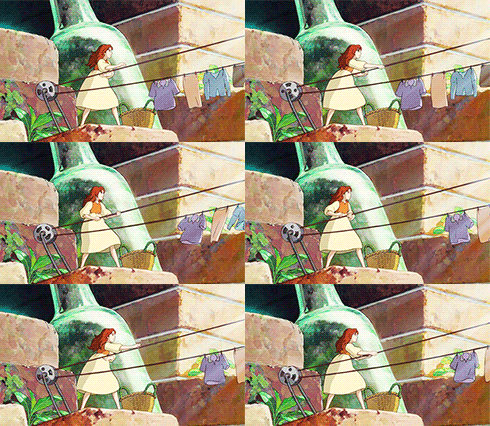
Another light, easy read in this series. I liked the first book more than the following, but I guess this one is the one I liked less; even though it was still enjoyable. The plot seemed more stretched and the events less interesting than the previous ones; I also simply can't stand Arrietty's mom!!😂

April 11, 2018
Probably my second favorite of the series. I love Dreadful Spiller <3

May 6, 2023
Ta część okazała się bardziej wyważona jeśli chodzi o akcję. Szkoda tylko, że same "przygody" Pożyczalskich okazały się mało ciekawe. Mamy tu trochę powtórkę z rozrywki z poprzedniej części. Wykorzystywanie tego samego motywu tom za tomem jest średnim pomysłem nawet w najlepszej serii, a ta niestety taką nie jest.
Bohaterowie ponownie mnie nie zachwycili - jakoś się rozmywają miedzy sobą, a ich rozmowy w większości były nieznaczące. Zabrakło mi napięcia i zaskoczenia przez co ta część rozmyje mi się w pamięci szybciej niż drugi tom.
Sytuacja z ilustracjami nie uległa poprawie, nadal jest ich niewiele w porównaniu z pierwszym tomem, który okazuje się narazie jedynym udanym.
Bohaterowie ponownie mnie nie zachwycili - jakoś się rozmywają miedzy sobą, a ich rozmowy w większości były nieznaczące. Zabrakło mi napięcia i zaskoczenia przez co ta część rozmyje mi się w pamięci szybciej niż drugi tom.
Sytuacja z ilustracjami nie uległa poprawie, nadal jest ich niewiele w porównaniu z pierwszym tomem, który okazuje się narazie jedynym udanym.

March 20, 2023
Felt like nothing happened. Book 3 was essentially a more boring copy of Book 2 but set in a floating kettle instead of a boot and with more racial stereotyping. (Yes, I'm aware it was written in the 50s).
Norton's descriptions of nature are gorgeous but her characters could be a lot better. Wasn't this series about Arrietty? Suddenly Pod and Homily are the main characters. Homily has become insufferable and Pod super bland and meek. Arrietty is no longer the fiery and headstrong teenager but quiet and shy. Also she seems much younger than fourteen, crush on Spiller aside.
The story focuses too much on the adults and their boring lives, very unlike the childish wonder that filled the previous two books. Homily and Lupy's 'rivalry' was so incredibly shallow and stupid I lost respect for both. Eggletina and the cousins serve as background dressings and her story of survival is never even explained properly. What could have happened which left her so mute and timid?
I was also disappointed by Spiller's role in the story. His presence is entirely plot-convenient. The Clocks are in danger? Hurrah, Spiller appears out of nowhere to save them! It was funny in the previous book but this was too much. So far his ominous background has resulted to nothing.
The seeds of a romance between Arrietty and Spiller are planted here, but we never actually have a scene between them narrated from her PoV (only Homily's for reasons beyond my understanding). Quite the missed opportunity.
If you want to compare this to the Ghibli adaptation, then know that it took inspiration from not just the first book but the entire series. There are a handful of scenes from Book 3 that were included - like the closing scene with Arrietty on the edge of the floating kettle watching enormous trout swim past, and her finding the hat-pin as a weapon.
2 Stars.
20/03/2023
Norton's descriptions of nature are gorgeous but her characters could be a lot better. Wasn't this series about Arrietty? Suddenly Pod and Homily are the main characters. Homily has become insufferable and Pod super bland and meek. Arrietty is no longer the fiery and headstrong teenager but quiet and shy. Also she seems much younger than fourteen, crush on Spiller aside.
The story focuses too much on the adults and their boring lives, very unlike the childish wonder that filled the previous two books. Homily and Lupy's 'rivalry' was so incredibly shallow and stupid I lost respect for both. Eggletina and the cousins serve as background dressings and her story of survival is never even explained properly. What could have happened which left her so mute and timid?
I was also disappointed by Spiller's role in the story. His presence is entirely plot-convenient. The Clocks are in danger? Hurrah, Spiller appears out of nowhere to save them! It was funny in the previous book but this was too much. So far his ominous background has resulted to nothing.
The seeds of a romance between Arrietty and Spiller are planted here, but we never actually have a scene between them narrated from her PoV (only Homily's for reasons beyond my understanding). Quite the missed opportunity.
If you want to compare this to the Ghibli adaptation, then know that it took inspiration from not just the first book but the entire series. There are a handful of scenes from Book 3 that were included - like the closing scene with Arrietty on the edge of the floating kettle watching enormous trout swim past, and her finding the hat-pin as a weapon.
2 Stars.
20/03/2023
August 13, 2026
This one wasn't as good as the first two and I found it a little boring. Only a short book which meant I finished it quickly.

June 29, 2019
Floating down the stream in a teapot is not nearly as romantic as it sounds. These installments of the Borrowers books have less of the cozy elements and more of the adventuresome elements, which will appeal more to some readers and less to others (like me). It just a wee bit too stressful to read about tiny people in the wild outdoor world, where they are constantly too close to danger for my readerly comfort. However, I can imagine reading this series aloud with a kid like my brother was as a child (we had...different book tastes) and he would enjoy this one far more than the first book. So, take your chances.
In future re-reads of the series, I think I'll skim this one. It doesn't contribute much plot-wise, and has a few nice moments but not the miniature hygge I look for with this series. Lupy is a memorably infuriating character and her dynamic with Homily continues to spark interest if not joy. I love how Norton created a Borrower world of politics and niceties that doesn't exactly mirror her British world, but strongly bears its imprint.
In future re-reads of the series, I think I'll skim this one. It doesn't contribute much plot-wise, and has a few nice moments but not the miniature hygge I look for with this series. Lupy is a memorably infuriating character and her dynamic with Homily continues to spark interest if not joy. I love how Norton created a Borrower world of politics and niceties that doesn't exactly mirror her British world, but strongly bears its imprint.

August 11, 2009
Installment #3 of the Borrowers saga was, for my money, the strongest. Spiller comes into his own here, and he's quite the taciturn but romantic hero. Arrietty may possibly learn a thing or two in this novel,though it's arguable, as she continues with the talking to humans at every opportunity. Pod's a resourceful if staid old gentleman. Homily drives me mad with her panics and her flighty girly taking on.

June 16, 2020
I really like these books, they get better as i get older. Such harrowing adventures in a nonmagical world and only traveling barely 50 yards. I guess the world is a dangerous place when you’re only as tall as a coffee cup. Reading this series I’ve become more aware of little bits of junk around the house and how they could be used if you were barely a few inches tall.
Rereading the first book with my wife. 🙂
Rereading the first book with my wife. 🙂

October 30, 2025
The Borrowers end up out in the wild again in this volume. More of the same adventures in miniature and most entertaining, too!

January 28, 2022
Dead cute i loved visualising the world in miniature
March 18, 2026
Das war schön 😊

August 31, 2026
Die Borger sind immer ein Vergnügen! Definitiv eine Reihe, die ich immer wieder lesen könnte <3

February 9, 2021
This book seemed to be differently written then the first 2. I found it sometimes hard to follow because of the language and word use. Still, it was fun to read.

September 9, 2011
And now -- my annual relaxing dip into The Borrowers series. Rereading the books now, as an adult living with an infant to whom I may someday read them, I do understand why they're no longer popular with youthful folk. For one, compared to your best-selling teenage fantasy series about wizards, vampire lovers, and the zombie apocalypse, they're rather boring. I mean, the book is essentially a comedy of the manners of the pint-sized bourgeoisie. For another, the characters are so fussy. Fortunately, in this volume Norton allows the mother character, Homily, to loosen up a bit and even tramp around for awhile in her petticoat. This is probably the least notable installment so far -- which explains why I hardly remember it -- but I do confess the climactic stand-off between the Borrowers and Mild Eye, the Gypsy, really had me turning the pages. Why the antagonist needs to be so strongly racialized, well, I'm in a charitable mood tonight, so I'll leave that issue be.
Update (2022): About a decade later, and sure enough - I just finished reading this book to my 9-year-old. We liked it. He says the climactic scene where the borrowers are stranded in the middle of the river is too long/too detailed. 🤷🏼♂️
Update (2022): About a decade later, and sure enough - I just finished reading this book to my 9-year-old. We liked it. He says the climactic scene where the borrowers are stranded in the middle of the river is too long/too detailed. 🤷🏼♂️

November 29, 2020
“'You go on, the both of you, like a couple of human beings.'
'Now, Pod,' protested Homily, 'no need to get insulting.'”

I really seem to struggle with this series. For books with just hundred-something pages, they take me ages to read. My opinion remains unchanged that this is a fun and unique concept, but goodness was I bored with The Borrowers Afloat. Nothing much happens, and what little does happen seems awfully drawn out.
As much as I like the inventiveness of what Borrowers do with human items, the author often seems to get lost in details and I just find myself not really absorbing what I've just read.
On the bright side, Homily - who I've found rather annoying - has shown some character growth and I've actually started to appreciate her character. At the end of the day, I most definitely prefer the Ghibli movie adaptation.

May 11, 2014
Mary Norton does peril very well. In this installment, we also get to see the family acting as a strong, calm unit, despite that peril.
I'm deeply impressed by these books as I reread them. Few children's books surpass them in writing quality, plot, and characterization.
I'm deeply impressed by these books as I reread them. Few children's books surpass them in writing quality, plot, and characterization.

August 22, 2012
What the Five-Year-Old thought: "I liked that they were floating in a kettle for a little bit, and that the gypsy got caught."

December 30, 2022
It all began when Mrs. May told Kate the story of the Borrowers: Pod, Homily, and Arrietty Clock. The story of how these little people lived happily under the kitchen floorboards at Firbank until being smoked out; how they survived hunger, weather, and a sinister gypsy with the help of a human being and a loner Borrower; and how all of this ended with an unexpected reunion with Uncle Hendreary and Aunt Lupy. But, as we’ve learned, things with the Borrowers are never easy and with bad news from the human boy Tom, our three friends are off on yet another adventure, except this time they’re aided by a most resourceful and trustworthy ally, Spiller.
The Borrowers Afloat is the third installment in The Borrowers series and it’s just as thrilling and enchanting as its predecessors. Norton continues to use each book to give readers a greater insight into the world of these resourceful and brave beings. In this book, we see how Uncle Hendreary and Aunt Lupy live and understand the partnership they’ve formed with Spiller. Also, Spiller has been promoted from a supporting role to a main character as he plays an instrumental part in saving the Clocks (quite a few times by now), as well as assisting them in securing permanent housing.
Of all the characters so far, Spiller is perhaps the most underrtated and gracious as he gives up his home, time, and resources to assist the Clocks on more than one occasion. Although he works through barter, the kindnesses extended Pod and Homily seem to go largely unreciprocated and unappreciated except for Arrietty who holds a genuine like and concern for this ragamuffin drifter. Lastly, Norton continues to develop our soft, pampered, and opinionated matriarch, Homily, and allows her to slowly let go of her prejudices to begin appreciating and valuing Spiller and his contributions to her family.
So far, the series continues to delight with an exciting and fun ride while this book leaves readers with the most suspenseful cliffhanger yet as Mild Eye the gypsy is hot on their heels and the return of the nasty Mrs. Driver and Crampfurl reminds us that our friends’ journey is far from over. But, as Pod was reassuring Homily after another near escape by saying, “As I see it, in life as we live it—come this thing or that thing—there’s always some way to manage. Always has been and, like as not, always will be”, and I have no doubt that Pod, Homily, and Arrietty will continue to find some way to manage as long as they’re together.
We’re now posting videos of some of our book reviews! Follow us on Facebook at www.facebook.com/thedustyjacket or on Instagram @tdjreviews and join in on the fun!
The Borrowers Afloat is the third installment in The Borrowers series and it’s just as thrilling and enchanting as its predecessors. Norton continues to use each book to give readers a greater insight into the world of these resourceful and brave beings. In this book, we see how Uncle Hendreary and Aunt Lupy live and understand the partnership they’ve formed with Spiller. Also, Spiller has been promoted from a supporting role to a main character as he plays an instrumental part in saving the Clocks (quite a few times by now), as well as assisting them in securing permanent housing.
Of all the characters so far, Spiller is perhaps the most underrtated and gracious as he gives up his home, time, and resources to assist the Clocks on more than one occasion. Although he works through barter, the kindnesses extended Pod and Homily seem to go largely unreciprocated and unappreciated except for Arrietty who holds a genuine like and concern for this ragamuffin drifter. Lastly, Norton continues to develop our soft, pampered, and opinionated matriarch, Homily, and allows her to slowly let go of her prejudices to begin appreciating and valuing Spiller and his contributions to her family.
So far, the series continues to delight with an exciting and fun ride while this book leaves readers with the most suspenseful cliffhanger yet as Mild Eye the gypsy is hot on their heels and the return of the nasty Mrs. Driver and Crampfurl reminds us that our friends’ journey is far from over. But, as Pod was reassuring Homily after another near escape by saying, “As I see it, in life as we live it—come this thing or that thing—there’s always some way to manage. Always has been and, like as not, always will be”, and I have no doubt that Pod, Homily, and Arrietty will continue to find some way to manage as long as they’re together.
We’re now posting videos of some of our book reviews! Follow us on Facebook at www.facebook.com/thedustyjacket or on Instagram @tdjreviews and join in on the fun!

January 12, 2026
If I’m being completely honest, The Borrowers Afloat is probably my least favorite of the series so far. I still really liked it and continue to be charmed by the story, but something was slightly off in the pacing.
The story begins right where the last left off, with Pod, Homily and Arrietty Clock finding refuge and shelter with long-lost Uncle Hendreary, Aunt Lupy, and their brood of children. But despite their warm welcome, it is immediately apparent that the Clocks are a burden on the Hendrearies, and Lupy especially does not make much effort to hide her unhappiness at having to take in her poor relatives. There’s only so much unwelcome feeling and self-righteous charity a person can take, be they human or Borrower. So when Tom Goodenough warns Arrietty that the humans are about to vacate the cottage, meaning at least one of the families will have to set out in search of a new home, it only moves up the timeline on what was likely an inevitable split.
This was probably my favorite way that Mary Norton expanded her story: the truth that as much as Borrowers fear and hide from humans, they also need them to survive. It’s nearly impossible for a Borrower to survive completely on their own, oddities like Spiller excepted; even when living in the field, the Clocks relied on human castoffs like the boot they used as shelter. Without humans in the house, the Borrowers face the equivalent of a famine.
So, unable to stay living on the Hendrearies’ charity even if they wanted to, the Clocks set out again. This begins the “afloat” part of the story, as they make their escape from the shuttered house via a drain and a waterpipe. This is where my issue with the book’s pacing comes in. The Borrowers don’t actually get on the water until the last third of the book, and the remainder of their time afloat is spent on the journey toward their new home. I was hoping for a closer look at what life in the Borrower equivalent of a houseboat or canalboat would be like, but instead this portion of the story is more of a harrowing (for a middle-grade book) adventure. For my money it wasn’t nearly as engaging as simple living would be, especially with the reintroduction of Roma character Mild Eye as a returning enemy. I did, however, really love the growth the characters show, particularly Homily, who has become much stronger and more resilient than even she would have believed possible.
Even with it being the weakest of the series so far, The Borrowers Afloat remains a solid and charming children’s fantasy. But I will weather my expectations for the next book, The Borrowers Aloft, and won’t be expecting Arrietty and her family to discover the joys of hot air ballooning.
The story begins right where the last left off, with Pod, Homily and Arrietty Clock finding refuge and shelter with long-lost Uncle Hendreary, Aunt Lupy, and their brood of children. But despite their warm welcome, it is immediately apparent that the Clocks are a burden on the Hendrearies, and Lupy especially does not make much effort to hide her unhappiness at having to take in her poor relatives. There’s only so much unwelcome feeling and self-righteous charity a person can take, be they human or Borrower. So when Tom Goodenough warns Arrietty that the humans are about to vacate the cottage, meaning at least one of the families will have to set out in search of a new home, it only moves up the timeline on what was likely an inevitable split.
This was probably my favorite way that Mary Norton expanded her story: the truth that as much as Borrowers fear and hide from humans, they also need them to survive. It’s nearly impossible for a Borrower to survive completely on their own, oddities like Spiller excepted; even when living in the field, the Clocks relied on human castoffs like the boot they used as shelter. Without humans in the house, the Borrowers face the equivalent of a famine.
So, unable to stay living on the Hendrearies’ charity even if they wanted to, the Clocks set out again. This begins the “afloat” part of the story, as they make their escape from the shuttered house via a drain and a waterpipe. This is where my issue with the book’s pacing comes in. The Borrowers don’t actually get on the water until the last third of the book, and the remainder of their time afloat is spent on the journey toward their new home. I was hoping for a closer look at what life in the Borrower equivalent of a houseboat or canalboat would be like, but instead this portion of the story is more of a harrowing (for a middle-grade book) adventure. For my money it wasn’t nearly as engaging as simple living would be, especially with the reintroduction of Roma character Mild Eye as a returning enemy. I did, however, really love the growth the characters show, particularly Homily, who has become much stronger and more resilient than even she would have believed possible.
Even with it being the weakest of the series so far, The Borrowers Afloat remains a solid and charming children’s fantasy. But I will weather my expectations for the next book, The Borrowers Aloft, and won’t be expecting Arrietty and her family to discover the joys of hot air ballooning.

October 7, 2022
Everyone's favourite little junk foragers are back again. This installment begins once more with Mrs May and Kate trying to follow leads several decades down the track.
Our parents and daughter trio start this tale as the destitute house guests of Uncle Hendreary, Aunt Lupy and their four children. (Eggletina has been restored to them. She wasn't killed by the cat after all, although she's retained post traumatic stress disorder.) Anyway, being recipients of strained charity is a bitter pill to swallow. The Hendrearies consider themselves the magnanimous relatives who get to call all the shots. Then when the human residents prepare to shut up house, the prospect of famine rears its ugly head for all. It appears Pod, Homily and Arrietty will have to keep swallowing humble pie, but the intrepid Spiller arrives once again to save the day and be their guide. He suggests an escape route that had never occurred to Pod; the drains.
It's a wonderful exodus fraught with exultation and danger, including the need to escape a deluge of scented water from some distant bathtub. We get a more intimate tour of what lurks down our plug holes than we may have ever wanted, but enjoy every moment, since it's happening to them and not to us. Hanging out with the Clock family helps us view our own familiar world from a super-sized perspective, which is always quite fascinating.
Pod is his usual common-sense self, Homily continues to verge on fastidious hysteria, and Arrietty gets super-excited by each fresh revelation, although she tries to bottle it up. And laconic Spiller is still the scruffiest saviour to be found. The story switches back and forth between reflective nature chapters and action-packed survivalist ones. And all through, they retain their plucky attitude of considering themselves equal if not superior to those oblivious humans they're so fearful of yet so reliant on.
And we're lured by rumours of Little Fordham, the model village built to their scale which every borrower dreams of settling in. Perhaps that will be their next port of call. Throughout the book are many amusing moments and comments. (Homily: What's a poacher? Pod: It's a type of human borrower.)
I get the feeling Little Fordham will be their next stop.
Our parents and daughter trio start this tale as the destitute house guests of Uncle Hendreary, Aunt Lupy and their four children. (Eggletina has been restored to them. She wasn't killed by the cat after all, although she's retained post traumatic stress disorder.) Anyway, being recipients of strained charity is a bitter pill to swallow. The Hendrearies consider themselves the magnanimous relatives who get to call all the shots. Then when the human residents prepare to shut up house, the prospect of famine rears its ugly head for all. It appears Pod, Homily and Arrietty will have to keep swallowing humble pie, but the intrepid Spiller arrives once again to save the day and be their guide. He suggests an escape route that had never occurred to Pod; the drains.
It's a wonderful exodus fraught with exultation and danger, including the need to escape a deluge of scented water from some distant bathtub. We get a more intimate tour of what lurks down our plug holes than we may have ever wanted, but enjoy every moment, since it's happening to them and not to us. Hanging out with the Clock family helps us view our own familiar world from a super-sized perspective, which is always quite fascinating.
Pod is his usual common-sense self, Homily continues to verge on fastidious hysteria, and Arrietty gets super-excited by each fresh revelation, although she tries to bottle it up. And laconic Spiller is still the scruffiest saviour to be found. The story switches back and forth between reflective nature chapters and action-packed survivalist ones. And all through, they retain their plucky attitude of considering themselves equal if not superior to those oblivious humans they're so fearful of yet so reliant on.
And we're lured by rumours of Little Fordham, the model village built to their scale which every borrower dreams of settling in. Perhaps that will be their next port of call. Throughout the book are many amusing moments and comments. (Homily: What's a poacher? Pod: It's a type of human borrower.)
I get the feeling Little Fordham will be their next stop.
September 7, 2020
The Borrowers must leave their previous home and end up living in a kettle lodged on the side of a stream.
This was another sweet, kind read. It still has a surprising amount of danger and upset to it - ferrets, and a man who is after them, and losing their home. I continue to like Arrietty the most with her wide-eyed wonder of the things around her, but Pod the sturdy cobbler is a close second.
My 88-year-old mom and I read this together. She said that she would not like to live in a tea kettle, particularly one with a rust spot.
This was another sweet, kind read. It still has a surprising amount of danger and upset to it - ferrets, and a man who is after them, and losing their home. I continue to like Arrietty the most with her wide-eyed wonder of the things around her, but Pod the sturdy cobbler is a close second.
My 88-year-old mom and I read this together. She said that she would not like to live in a tea kettle, particularly one with a rust spot.

April 8, 2020
I'm a grown man, so these books are not really aimed at me, but I'd always intended to read them as a kid and never got around to it. :)
This one is not as good as the earlier books. The Borrowers family leave stuck up Aunt Lupy's home and go off with Spiller to find the model village at Fordham. Not much of an adventure, a trip down the drain and over the river, and that's about it, and the characters are not as well drawn.
Just started the fourth, Borrowers Aloft... :)
This one is not as good as the earlier books. The Borrowers family leave stuck up Aunt Lupy's home and go off with Spiller to find the model village at Fordham. Not much of an adventure, a trip down the drain and over the river, and that's about it, and the characters are not as well drawn.
Just started the fourth, Borrowers Aloft... :)

November 24, 2017
Мушу визнати: у нас таки завелися роздобудьки. Принаймні, на книжковій полиці та у моєму блозі. Це вже третя книга із серії про пригоди маленьких чоловічків, і знаю точно, що далі буде, бо Под, Хомілі, Аріетті та Спіллер уже стали майже членами нашої родини. Ну, ми з сином із ними точно практично зріднилися)))
Що ж, мандри родини роздобудьків у пошуках житла продовжуються. Коли фінал попередньої частини пообіцяв їм стабільність, безпеку та прихисток, і ми полегшено зітхнули, то потім виявилося, що жити під одним дахом із родичами не дуже зручно (й не тільки книжковим роздобудькам))) Тож наші друзі знову вирушають у дорогу — цього разу річкою. Чи доберуться вони до омріяного легендарного цілого міста для маленьких людців і як їм там вестиметься, очевидно, розповість чергова книга, зустрічі з якою вже чекаємо, бо ж історія — цікава, ілюстрації — прекрасні, переклад — чудовий.
Що ж, мандри родини роздобудьків у пошуках житла продовжуються. Коли фінал попередньої частини пообіцяв їм стабільність, безпеку та прихисток, і ми полегшено зітхнули, то потім виявилося, що жити під одним дахом із родичами не дуже зручно (й не тільки книжковим роздобудькам))) Тож наші друзі знову вирушають у дорогу — цього разу річкою. Чи доберуться вони до омріяного легендарного цілого міста для маленьких людців і як їм там вестиметься, очевидно, розповість чергова книга, зустрічі з якою вже чекаємо, бо ж історія — цікава, ілюстрації — прекрасні, переклад — чудовий.

December 7, 2017
Liked it.

January 24, 2019
I’m here thanks to Studio Ghibli’s Arrietty! Reading this out of order, but it’s still delightful. So much adventure.

December 28, 2021
The adventure continues!! If you loved the first two you'll enjoy this one as well and know exactly what to expect ☺️


October 14, 2023
حتى الرسمات المرافقة للنسخة الأولى بديعة.

October 29, 2021
This series Isa fun read . This one was probably my least favorite one. The plot was kind of boring at times.
![Profile Image for [ J o ].](https://i.gr-assets.com/images/S/compressed.photo.goodreads.com/users/1673171874i/4639825._UY200_CR4,0,200,200_.jpg)
April 12, 2014
The third in The Borrowers series of books, The Borrowers Afloat sees Pod, Homily and Arrietty living in blighted conditions with their relatives in a run-down cottage that is soon to be left empty because Tom, Arrietty's Human friend, is going to live with his uncle. The Borrower family then make the decision to set out for the much-spoken of Little Fordham, a model village that lies at the end of a dangerous river. With the help of Spiller and his broken kettle, the Borrowers flee their weasel-haunted home and take the journey downstream, where nothing but mad gypsies and the unknown await them.
I don't think I've ever read a Borrower book, even though I am well-versed in the story, which, as an English person, isn't quite as inappropriate and weird as it sounds. Borrowers are similar to Lilliputians in size but that is where the similarity ends. As you can gather from their name, they "borrow" items from the Humans whose homes they inhabit, always keeping out of the way as much as possible. Although technically the Borrowers are stealing, it's always harmless and they're very endearing towards those they "borrow" from. This particular story was interesting because it drove the imagery I had of the Borrowers out of my mind (homely, frightened, comfortable under the floorboards) and basically dumped myself and the Borrowers in the outside world, where birds and rivers threaten their lives at every turn. It's a lovely children's story that is easily accessible to an adult, though it has a more British-vibe to it because of our history with it. There have been numerous television and film adaptations and the thought of tiny people living under our floorboards as if there were mice is so ingrained in to us it's almost part of our culture.
Blog | Instagram | Twitter | Pinterest | Shop | Etsy
I don't think I've ever read a Borrower book, even though I am well-versed in the story, which, as an English person, isn't quite as inappropriate and weird as it sounds. Borrowers are similar to Lilliputians in size but that is where the similarity ends. As you can gather from their name, they "borrow" items from the Humans whose homes they inhabit, always keeping out of the way as much as possible. Although technically the Borrowers are stealing, it's always harmless and they're very endearing towards those they "borrow" from. This particular story was interesting because it drove the imagery I had of the Borrowers out of my mind (homely, frightened, comfortable under the floorboards) and basically dumped myself and the Borrowers in the outside world, where birds and rivers threaten their lives at every turn. It's a lovely children's story that is easily accessible to an adult, though it has a more British-vibe to it because of our history with it. There have been numerous television and film adaptations and the thought of tiny people living under our floorboards as if there were mice is so ingrained in to us it's almost part of our culture.
Blog | Instagram | Twitter | Pinterest | Shop | Etsy
Displaying 1 - 30 of 211 reviews