Adding to the Latina tradition, Carmen Giménez Smith, politically aware and feminist-oriented, focuses on general cultural references rather than a sentimental personal narrative. She speaks of sexual politics and family in a fierce, determined tone voracious in its opinions about freedom and responsibility. The author engages in mythology and art history, musically wooing the reader with texture and voice. As she references such disparate cultural figures as filmmaker Lars Von Trier, Annie from the film Annie Get Your Gun, Nabokov’s Lolita, facebook entries and Greek gods, they appear as part of the poet’s cultural critique. Phrases such as “the caustic domain of urchins” and “the gelatin shiver of tea’s surface” take the poems from lyrical images to comic humor to angry, intense commentary. On writing about “downgrading into human,” she says, “Then what? Amorality, osteoporosis and not even a marble estuary for the ages.” Giménez Smith’s poetic arsenal includes rapier-sharp wordplay mixed with humor, at times self-deprecating, at others an ironic comment on the postmodern world, all interwoven with imaginative language of unexpected force and surreal beauty. Revealing a long view of gender issues and civil rights, the author presents a clever, comic perspective. Her poems take the reader to unusual places as she uses rhythm, images, and emotion to reveal the narrator’s personality. Deftly blending a variety of tones and styles, Giménez Smith’s poems offer a daring and evocative look at deep cultural issues.
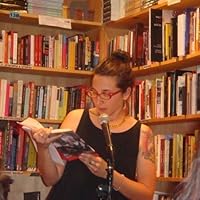
Formerly a Teaching-Writing Fellow at the University of Iowa, Carmen Gimenez Smith is now an assistant professor of creative writing at New Mexico State University, the publisher of Noemi Press, and the editor-in-chief of PUERTO DEL SOL. Her work has most recently appeared in MANDORLA, COLORADO REVIEW and PLOUGHSHARES and is forthcoming in jubilat and DENVER QUARTERLY. She is the author of ODALISQUE IN PIECES (University of Arizona Press, 2009) and BRING DOWN THE LITTLE BIRDS (University of Arizona, 2010). She lives in Las Cruces, New Mexico with her husband and their two children.
I read this book in one breathless sitting, and I felt like a changed person after reading it. The lines and perspectives, and the honesty, worm their way into one's mind, and I felt the way I used to feel as an undergraduate, reading works that I wanted to keep near me and slip into my backpack. I'm not a poet, and I don't know what forms she's working in, but it didn't matter; the language was vivid and challenging, but never felt as though she was writing to impress with wordplay. I have so many favorites here, including the extended numbered list, "Parts of an Autobiography." She takes on our deepest fears: "I'm a Shitty Parent" and "I'm the Shitty Friend writing valentines. I modify everything." This is gripping, creating the kind of reading experience that danced just beyond my grasp but still spoke to me with honesty and searing intellect.
As an undergraduate with a major in Women’s Studies, second wave feminism was at the core of my education. I read theory by white American feminists from Betty Friedan, all the way up to Susan Faludi. In classes, I watched the original 1979 film, Killing Us Softly and several of the updated versions throughout my years of coursework. Writers such as Adrienne Rich and Eve Kosofsky Sedgwick had a lasting impact on my writing and fostered in me a desire to critique binary representations, hegemony, and patriarchy – of course. And yet while I found the occasional text by Audre Lourde tucked into my course readers, I began to feel critical of the overwhelming American middle class whiteness of the work I was studying and participating in.
I was given words like first wave, second wave, and third wave to help me verbalize my anger and frustration with what I felt was a lack of inclusion or intersectionality in my Women’s Studies program. However, even with a B.A. in Women’s Studies, I was not introduced to seminal “second wave” feminist writers of color such as Gloria Anzaldúa or bell hooks until graduate school. These women were a revelation to me, as were third wave feminists like Rebecca Walker. Here were women doing work to address the lived experience of poor women, women of color, non-hetero, non-gender conforming people. And yet, I was and still am often discontent with theorizing that defines feminism in terms of waves. To me, this paradigm implies burst of action on the part of women, followed by long, drawn out lulls of inaction. It implies an ebb and flow, or even an ultimate progressive neo-liberal forward movement. I resist such blunt theories as simplistic even as I tend to align myself more fully with third wave feminists who have done much to address intersectionality, race, class, and gender.
I admit to feeling a bit of strange guilty resentment when I read in the second section of her book Milk and Filth, “An agitator hold her sign up asking do you feel equal,/ so you and your sisters deride her/ because she’s so public about injustice, so/ second wave” (31). In an interview, Giménez-Smith explained, “I fancy myself more of a throwback feminist; I’d like to bring back the look-at-your-cervix parties and neighborhood consciousness-raising groups because I think we’ve lost sight of the most basic goal of feminism, equal rights for women” (Blue Milk). She can be simultaneously scathing and funny in her critique of third wave feminists and their “…earings, Ugg boots,/ removable tramp stamps” (31). In “Juicy Couture,” the speaker asks, “Make me an outfit with mutable bloom,/ an envy magnet” (52). But she is not simply deriding young women or pointing out how easy we might have things, how consumer culture has convinced us that equality exists, that there is nothing to fight for. She is, instead, underscoring the importance of vigilance and of recognizing that prevalent systemic violence against women can be cloaked in “a fabric that changes/ the subject” (52).
Giménez-Smith does acknowledge the historical problems of feminism. She details, “I also feel like, historically, the interests of feminism haven’t completely embraced the kinds of class and race issues that emerged for women of color and so I’m interested in a more inclusive feminism. That means that when I perform or speak as a feminist, it is as a feminist of color” (Superstition Review). This stance is ingrained in each of her “Gender Fables,” which seek to retell the stories of women from a variety of mythic spaces – the bible, literature, celebrity, folklore, and ancient Greece.
These fables include much maligned figures such as Malinché and La Llorona. Giménez-Smith transforms them from one dimensional villains into women with desires, fears, ambition, and failures. Malinché is not shunned as a traitor to her people, but gathers women to her. “She tells them she plans to inter our dialect/ into theirs, our divinity. She wants mongrel dictions/ to ad to her arsenal. She wants to be lord” (7). In retelling Malinché’s story, Giménez-Smith creates a collective voice, one of resistance under the oppressive structures of colonialism and patriarchy. Familiar fabled women are likewise re-imagined and re-contextualized – La Virgen de Guadalupe, Phaedra, Lolita, and Suzanna.
While these women and their new stories are powerful, I did wonder how they worked in juxtaposition with the second and the third sections of the book. In an interview with Superstition [review] she describes the goal in the first section as “rehabilitation work,” her goal in the second section as paying homage, “to what I think were important Second-Wave Feminist strategies,” and the third section as, “my suggestion of a new mythology of new icons” (Superstition [review]). However, I can’t help but feel there is a piece missing. The funny/scathing work she does in her critique of third wave feminists is a bit less fleshes out in her poetry addressing or exploring the second wave.
Ultimately, I found myself reading pieces of Milk & Filth on the bus and then again in between meetings and writing and small quiet moments only to find the power of her words loud in my head, shutting everything else out. Simultaneously, her work begins to build “Schools of Listening” (65) were we might begin to “hear each other’s thoughts” (65). This process of creation and collaboration with readers is complicated, ongoing, and doesn’t always… fit. In “Parts of an Autobiography she writes, “Feminism tried to accommodate me inside of its confines when I was a polygon” (33). However, upon reflection I did find myself wondering about the shape of that polygon. How the confines of feminism were addressed but also what was left out and the ways second wave strategies fell short. Is that interrogation also an important part of creating “a new mythology of new icons”?
These poems could be subtitled "How to be a woman," because they are full of the kind of beautiful, hard, luminous truths that women experience. And you don't have to love poetry to love this collection of poems. This will become a feminist classic, I hope. The standout poems for me were the 8-page "Parts of an Autobiography," "Feminine Agency," and "Something New," which I wrote about on my poetry blog, Structure and Style.
I really liked the expressive mythopoetic creative story telling here. I wanted a little more poetry, though-- I felt like "Parts of an Autobiography" especially didn't quite do enough with language. But that's definitely my own response. There is a ton here to like, even if it is sometimes more document-testimony than lyric.
I hugged this book the first time when Smith wanted to garrote Lars von Trier. I hugged it again when my second copy came in the mail--a kind gift from a stranger after a school secretary threw out (threw out!) my first copy. I hugged it again when I finished it. Yes to the body imagery, yes to the happy jiggly tummy, yes to the mythic characters, yes to Joan Rivers. Go forth and read, peeps.
There is a lot of beautiful language and surprising phrasing in these poems, but ultimately, I just didn't get anything from most of these. It felt like clever phrase after clever phrase, saying the same thing, and never really meaning enough. The endings didn't feel true - I often turned the page expecting the poem to continue, only to find the next poem.
some poems so dirty - bloody and messy - and some so glittering. it's what I wish I could write. mystical while staying grounded in history. there are quite a few references that I think went over my head (a series of stanzas based on Joan Rivers jokes?) but even those were enjoyable and fun.
Raw, humanistically flawed, intelligent, passionate, and clever. All the things you’d want from a poet. Plus, I enjoyed the poems specifically dealing with the complexities of feminism.
Favorite poems were:
For Lars Von Trier, Radicalization and Parts of an Autobiography
Not much in here that really appealed to me though there were a few.
“When I first began writing poetry, first began thinking of poetry, I was certain that I could rely on the I/eye, which turned out to be the most elusive quality.” – p. 34 (from Parts of an Autobiography)
“I like a poem that reminds me of the time I fell in love with poetry and the kind of poetry I was fed, which was unseasoned-quinoa-Sharon-Olds-esque.” – p. 38 (from Parts of an Autobiography)
“When God was a woman, / empire was meh.” – p. 65 (from When God was a Woman)
A challenging one. Dense, theoretically informed but still visceral, explicitly feminist, challenging. But it was the language and ferocity of the best of these poems that had me returning to the beginning of every third or fourth one. Not entirely successful but the risks that pay off justify the occasional rhetorical overreach.
First written review because this collection might just be it. “I liked my poetry to smell like I had forgotten my deodorant, you could smell me from across the table. I liked my work to smell of work and fuck”. Reading someone who is yielding language in visceral and intellectual and profound ways like this is rare and I am dazzled.
(And the Mouth Lies Open) (The Red Lady) Epigrams for a Lady Queenly Parts of an Autobiography The Daughter Rosy Complexion Our Tiny Dimensions Juicy Couture
Will come back to this and quote the loudest lines. So many golden spaces and raging currents and soft beats.