The perfect book for everyone who loves nature! On Meadowview Street celebrates the environment, ecosystems—and individual empowerment. Caroline moves to a new suburban house. The yard, like all the surrounding yards, is plain, boring grass. But then she discovers a wildflower. Soon she’s got her own little wildflower preserve, carefully protected from Dad’s lawn mower. She adds a tree . . . a pond . . . birdhouses . . .she’s brought a meadow to Meadowview Street! Time brings more little meadows, as the neighbors see how beautiful and alive a yard can be. An ideal choice for classroom reading and sharing and for inspiring the creation of green corridors—safe havens for migrating birds and butterflies—at home. For fans of Peter Brown's The Curious Garden , Joanna Gaines's We Are the Gardeners , and Christie Matheson's Tap the Magic Tree . “This lovely picture book offers children a quiet approach to embracing the natural world.”— School Library Journal , starred review “Gentle persuasion for the naturalist in everyone.”— Kirkus Reviews
Henry Cole was a celebrated science teacher for many years before turning his talents to children's books. He has worked on nearly one hundred and fifty books for children, including Nesting, Unspoken, Big Bug, A Nest for Celeste, Jack's Garden, and On Meadowview Street. Henry loves being outside where he can sketch and write.
So yes and very much appreciatively, I do adore (and actually and in fact totally and absolutely love love love) not only the inherently positive, optimistic (and also generally both reasonable and entirely feasible) environmental renewal and conservation message that author and illustrator Henry Cole presents to his readers (or to his listeners) with On Meadowview Street, but it is equally really and truly cheering and wonderful that the impetus for changing a rather standard but also utterly environmentally sterile suburban neighbourhood into houses with un-mowed meadow-like backyards (containing native grasses, flowers, birdhouses etc.) comes from a child, comes from a little girl (who first of course only convinces her parents but then also begins to slowly but surely influence her neighbours as more and more families stop mowing their lawns, start planting trees and so on and so on).
Combined with delightfully colourful illustrations that both imaginatively and realistically mirror the presented narrative and visually provide a wonderful time-line portrait of how slowly but surely Caroline's originally only one single flower nature enclosure in her backyard finally ends up morphing into a natural and totally organic meadow, into an oasis of nature, I have indeed really and truly very much enjoyed if not loved the combination of Henry Cole's words and his accompanying artwork and do certainly consider On Meadowview Street an almost perfect celebration of going more wild and more natural in suburbia, with my only mild but still (I believe) important and necessary caveat being the following warning. For sadly, many cities, many towns, do still and unfortunately rather often have annoyingly strict by-laws regarding home owners being mandated to keep their lawns mowed and free of so-called weeds, and that therefore, while On Meadowview Street is indeed and truly a wonderful story, it is also a scenario that might in actual reality potentially be a bit too good to be true (because if Caroline's suburban neighbourhood did have strict by-laws regarding needing to keep lawns mowed and free of weeds, all it would take would be for a nasty neighbour, for actually anyone to contact the by-law authorities to complain and Caroline's family would likely be handed a stiff fine and also be forced to turn their suburban nature preserve back into the erstwhile environmental sterility).
Finally! An "environmental message" book that is actually positive and shows something that kids (and their parents) can do in their own yard to help make the world a greener, more natural place!
Dismayed that there's no view of a meadow at her new home on Meadowview Street, young Caroline sets about creating her own meadow/wildlife preserve in her yard. I love the idea of this! And, though many suburban neighborhoods have strictly enforced regulations about keeping your grass mowed, most pose no restrictions on planting trees, bushes, and flowers.
Cole's illustrations are always a dellight!
We have the only house on our street that has multiple flower beds instead of an expanse of green lawn in the front yard. We always get compliments on our yard, but none of the neighbors have so far attempted to follow our lead. Maybe if our last name was Jones others would try to keep up with us . . .
This is a lovely book with beautiful illustrations. I loved the message about making a home for animals and plants right in your own backyard. I love how Caroline starts by saving one flower then building on that and creating a paradise out of what started as a manicured lawn. And when Meadowview Street is transformed it is a very appealing place. This is a great book for nature lovers and for letting children know that they can make a difference if they speak up about and then do some work on something that is meaningful for them.
When Caroline and her family move into their new house on Meadowview Street - a typical suburban subdivision, where all the properties look alike - and set about putting everything in order, the young girl asks her father to mow around the pretty flower growing in the middle of their lawn. Setting up a mini "wildflower preserve," she watches as the less groomed part of the yard begins to grow, with flowers of all kind springing up, and birds and butterflies beginning to gather. Soon her parents get in on the act, helping her plant a tree for shade, and make a birdhouse for the wren that has taken up residence. Eventually, there is indeed a meadow on Meadowview Street...
An engaging story that is sure to appeal to young gardeners and nature lovers everywhere, On Meadowview Street encourages readers to consider more creative solutions, when it comes to how to use the land around their houses. To consider making them more biologically diverse, more interesting, and more welcoming to wildlife, than the typical lawn could ever be. Henry Cole, whose artwork can be found in everything from And Tango Makes Three to Mouse Was Mad, creates an engaging visual and textual narrative here - so much so, that the reader will be wanting a meadow of their own, by the end!
Ordinary suburban family making a difference. I wonder, if I'd ever been a homeowner, if I would have had the courage. We renters have to do what the landlords say, though.
*A new year and another year winding down with a unit on positive change. My class this year loved this story! The illustrations tell a wonderful story, and the text plays a supporting role. When a family moves to Meadowview Street, a young girl named Caroline becomes curious if there's actually meadow on the street. When there isn't, she takes action, and sets forth a change for the entire street.
This is a great part of our unit on positive changes and impacts on our environment. It focuses on a young girl and family who move into a new house on Meadowview Street. It gets her thinking why the street is named such without a meadow. As her father is mowing the lawn, she's hit with inspiration, and protects a small flower growing in the back yard from the lawnmower. She ties it off and before long, her patch spreads and spreads. Her family supports her cause, and soon, the lawnmower is sold and the entire yard back yard becomes a meadow.
The story is simple. The message is easy for children to pick up. The illustrations are beautifully presented and are an integral part to the story. In terms of our reading focus, we use this heavily for using context and illustrations to further our understanding of a story. This is a good part of our curriculum.
This is a sweet story book for a small group to be read to in the age of 3-7 years-old. Carolina has explore a mayflower in her yard. The illustration is well done with colorful pictures and family friendly. Carolina enjoy taking care of her garden as she was experiencing different kind colors everywhere and species. Carolina perserve her yard by adding a trees, two ponds, and several wrens for the birds. Caroline and her family worked on the yard, there were more changes and different creatures. The neighborhoods enjoyed Carolina's yard they started to plants their own garden, too.
Learning Experience: Math and Science: The children can count all the species and named them. The child can build a bird house or a nest.
I was glad to find this book in my local library because I think it carries a great message. It is about a young girl named Caroline who, after finding a pretty wildflower in her new backyard, convinces her dad to mow around it. She then uses sticks and string to create a space where wildflowers are allowed to bloom. Soon, her backyard nature preserve expands and begins to attract butterflies. Her dad decides to sell the mower and plant a maple tree to give the garden some shade, which brings in a wren in need of a birdhouse. Dad and Caroline work together to build it one. As time goes on, there are birds, insects, and flowers in need of a water source. Dad complies by helping Caroline build a pond. Their backyard had become ahome to many living things when the neighbors on their street decided to make their homes more welcoming to nature as well. The end of the book has a two-page spread of plants and creatures one might find in a backyard meadow. I like that the book encourages creating wild spaces for nature to survive and thrive in areas where people also live.
I loved this book about a little girl bringing nature back to her suburb, making Meadowview Street reflect its name. I live out in the country and I let nature take over much of my property. I like the wild look and all the wildlife it attracts, so this story spoke to me. Being in nature lifts my spirit, and I believe the world needs more green spaces like this.
I really liked the spread near the very end showing all the different kinds of wildlife that Caroline's meadow attracted - many familiar sights for me. I probably would have given this five stars if the illustrations were more to my taste, but they're still pretty cute as they are. Highly recommend!
Best environmental kid's book I've seen so far. I've heard it said that suburban developments and streets are named after what was destroyed to build them. This girl's house is on such a street, but, little by little, she adds native flowers, trees and shrubs, (while her Dad sells the lawn mower!), and turns her yard back into meadow! She and her dad add a pond and a bird house as well, and many native animals return. Soon other neighbors are doing the same.
We live this book because we went through this process before our daughter was born. It's wonderful to show her what we did and why (and how it attracts many of her favorite animals). This is a fantastic book about adding nature to our home landscapes. It explains this environmental concept so that children (and parents) can understand and be motivated to make changes! And it's beautifully drawn too. I recommend this highly for preschool and elementary school students.
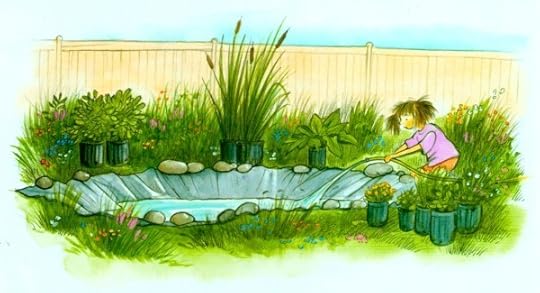
Caroline and her family moved into their new house on Meadowview Street. Noticing a small blossom in the yard, Caroline made a wildflower preserve. Following by planting a maple tree, building birdhouses, and building a pond, Caroline and her family made their yard a home to many things. Their neighbors also started to transform their yards. It's a great story showing children that they are never too small to do anything, and they are able to make a difference. The illustrations show that Caroline was building the wildflower preserve, watering the flowers, cutting the wood, nailing pieces together, and painting birdhouses with the help and support from her parents. The illustrations on the title page and the copyright page show the before and after scene of the transformation of the yards on Meadowview Street.
When Caroline moves to Meadowview street, she realizes something strange: there's no meadow anywhere to be found! So she promptly sets out to create her own, bit by bit, starting with a single flower, until gradually, her lawn is transformed into a gorgeous, sprawling meadow. Eventually her neighbors follow suit, and before she knows it, she's brought the meadow back to Meadowview street.
This eco-friendly picture book demonstrates how even a small step in the right direction can make a difference.
Wish I could get away with doing this in my yard! Nice little story about cause-and-effect in the environment; it reminds me of the National Wildlife Federation's "Certified Wildlife Habitat" program. http://www.nwf.org/Get-Outside/Outdoo...
Outstanding! Words and pictures work well together to tell the story of a family who plant a meadow on Meadowview Street. Excellent environmental theme. Kid-powered. Homey illustrations. A new favorite.
The idea for this book is tremendous and hopeful and positive. But the changes happen too fast. I would have appreciated the story being more true to the pace of nature. Maybe the illustrations could have enhanced that aspect of the story’s unfolding.
A little girl moves into a new home, and wonders (like a lot of us probably do) about the namesake of her new street. And little changes lead to larger ones, and ultimately to an accurate view on Meadowview.
For starters, I love Cole's illustrations. And I love the subtle changes that Caroline makes with her family, bringing greenery and life and color to their yard. It's not all Big Dramatic Change to fix the world, but little steps, one at a time that grow to big impacts. Like Amara and the Bats, a little girl in the suburbs is making positive ecological changes. Unlike with Amara, there isn't a science lesson here too, but there's still a really good underlying idea of tiny changes that we all can do.
Could be a fun STEM or STEM Storytime read, especially paired with a birdhouse or birdfeeder craft project.
A friend sent me this as a gift and it brought a huge smile to my face. Beautiful and inspiring story. It made me tear up as Caroline reminded me so much of myself. Not so long ago I had moved to an urban environment from an extreme rural one, and to say I had trouble adapting was an understatement, BUT, over the years I've learned to make it my own and transformed my yard into a paradise - and is even a certified wildlife habitat now! Nothing but praise for this beautiful book and its beautiful message.
I'm five and I just started kindergarten. I brought this book home from the school library because I thought my mom would like the pictures. In the book, a family moves into a home on Meadowview Street, but a girl notices there's no sign of a meadow. All the houses and manicured lawns look the same. She spots a flower in her yard and puts a rope around it so her dad doesn't mow over it. Soon, she ropes in a bigger and bigger area, until she creates a meadow right in their front yard!
This is a really cute story. I think it is too long for my students to read but I would let them at least try it out if they wanted to. This will be added to my read aloud stack for my students as well. This story is very enjoyable. There are beautiful illustrations and it is a fun read! I would read this again!
This was great! I love how the story progresses. At the beginning, when they move in to the new house, I looked at all the lawn and the fences and thought "ew."
I smiled when Caroline protects the first flower and my smile grew as her preserve did. I loved how her enjoyment of nature spread to her neighbors.
It was fun combining a move with a series of efforts that turned a yard in to a small meadow and inspired neighbors to do the same. The young girl's excitement eliminated the worry from the life change and brought happiness to quite a few people and animals.
This is a simple plot that helps to change the norm of what you might want for a yard. Meadowview street truly becomes a meadow. My biggest gripe would be the seeming break of time between the protagonist and the plants. Many of the ideas in this book would take seasons.
My son really liked how the girl thought and worked to make her yard a place for nature. I thought, 'I personally like having my yard mowed and not forest creatures living in it', but hey, he loved it.