

What do you think?
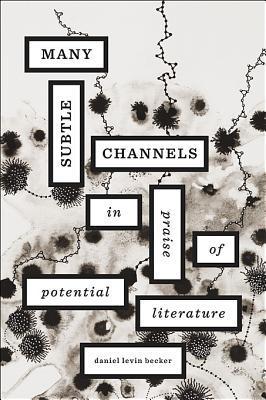
Many Subtle Channels: In Praise of Potential Literature
What sort of society could bind together Jacques Roubaud, Italo Calvino, Marcel Duchamp, Raymond Queneau and Daniel Levin Becker, a young American obsessed with language play? Only the Oulipo, the Paris-based experimental collective founded in 1960 and fated to become one of literature s quirkiest movements.
An international organization of writers, artists, and scientists who embrace formal and procedural constraints to achieve literature s possibilities, the Oulipo (the French acronym stands for workshop for potential literature ) is perhaps best known as the cradle of Georges Perec's novel "A Void, " which does not contain the letter e. Drawn to the Oulipo's mystique, Levin Becker secured a Fulbright grant to study the organization and traveled to Paris. He was eventually offered membership, becoming only the second American to be admitted to the group. From the perspective of a young initiate, the Oulipians and their projects are at once bizarre and utterly compelling. Levin Becker s love for games, puzzles, and language play is infectious, calling to mind Elif Batuman's delight in Russian literature in "The Possessed."
In recent years, the Oulipo has inspired the creation of numerous other collectives: the OuMuPo (a collective of DJs), the OuMaPo (marionette players), the OuBaPo (comic strip artists), the OuFlarfPo (poets who generate poetry with the aid of search engines), and a menagerie of other Ou-X-Pos (workshops for potential "something"). Levin Becker discusses these and other intriguing developments in this history and personal appreciation of an iconic and iconoclastic group.
An international organization of writers, artists, and scientists who embrace formal and procedural constraints to achieve literature s possibilities, the Oulipo (the French acronym stands for workshop for potential literature ) is perhaps best known as the cradle of Georges Perec's novel "A Void, " which does not contain the letter e. Drawn to the Oulipo's mystique, Levin Becker secured a Fulbright grant to study the organization and traveled to Paris. He was eventually offered membership, becoming only the second American to be admitted to the group. From the perspective of a young initiate, the Oulipians and their projects are at once bizarre and utterly compelling. Levin Becker s love for games, puzzles, and language play is infectious, calling to mind Elif Batuman's delight in Russian literature in "The Possessed."
In recent years, the Oulipo has inspired the creation of numerous other collectives: the OuMuPo (a collective of DJs), the OuMaPo (marionette players), the OuBaPo (comic strip artists), the OuFlarfPo (poets who generate poetry with the aid of search engines), and a menagerie of other Ou-X-Pos (workshops for potential "something"). Levin Becker discusses these and other intriguing developments in this history and personal appreciation of an iconic and iconoclastic group.
352 pages, Hardcover
First published April 24, 2012
Ratings & Reviews
Friends & Following
Create a free account to discover what your friends think of this book!
Community Reviews
Displaying 1 - 20 of 20 reviews

April 12, 2012
In reading this charming book, I tried to recall how I first fell in love with the Oulipo. It must've been through Dalkey Archive, and probably had to do with one of the wild-eyed booksellers at Schuler Books & Music, but I just couldn't remember . . . At first I assumed it was through Harry Mathews, whose books were being reissued by Dalkey at the time; it jus as easily could've been through Perec's "A Void," since that's the most patently Oulipian work available in English and I remember pushing it on customers all the time. (And now do the same with my students.)
Then it suddenly came to me: When I was living in Grand Rapids, I went to a used bookstore just to look around, and found a mass market, old-school version of Raymond Queneau's "Zazie in the Metro." For those who don't know, this part of Michigan is loaded with Calvinists and their moral baggage, so it isn't all *that* surprising that someone had scrawled across the title page of this book, condemning it as "erotic trash." SOLD!
But even then, I didn't really know what the Oulipo was. I mean, I got the concept--use constraints to write "potential" literature--and read almost everything I could get my hands on, but without the Wikipedia of today or knowledge of the French language, figuring out what this group of strange writers was all about was like solving a puzzle without any sort of picture to work off of.
Eventually, the "Oulipo Compendium" came out as did "Oulipo: A Primer," and all the pieces/techniques--lipograms, S+7, complicated algorithms, x mistakes y for z--started to come together. That said, until reading "Many Subtle Channels," I don't think I had a sense of how the Oulipo *as a group* has functioned for the past 50-plus years.
As a member of the Oulipo, and the "slave" who organized its archives, Daniel Levin Becker is in the unique position that he can create a context for this group of writers who, as diverse as their are personality-wise, are connected by their love of puzzles, of new ways to generate texts, of learning, of seeking out puzzles, of creating the linguistic labyrinth from which they try to escape.
For anyone who isn't already steeped in Oulipian lore, I highly suggest you read this book, then pick up Queneau's "Exercises in Style," Perec's "Life A User's Manual," Calvino's "If on a winter's night a traveler," and Mathews's "Cigarettes." After you read all of those--and possibly some of the info you can find online--you're likely to be hooked on this way of writing and reading for life.
What's interesting about this book to readers already familiar with the Oulipo and its crazy fun literary stylings is the way in which Levin Becker builds a context around the development of the Workshop while bringing up some really interesting questions about the nature of Oulipian writing: Is it better to reveal the constraints or make the reader figure them out? If the reader knows the constraint, is that the end of their interpretation/enjoyment of the book? How has the group's dynamics and goals shifted from the post-WWII years to 2012? What's the point of all this madness?
There's a lot of great stuff in here worth quoting, both in terms of examples and explanations, but I'll just end this here with one short paragraph that reminded me of why "Lost" was so damn good, and why only *some* people were cool with the eventual ending (I think this proves that I can pull "Lost" into just about every book discussion):
"A good solid search, especially for something you'll probably never find, drives the plot forward both on and off the page. The less you know, the more you want to know. Hitchcock knew it as well as Homer did: get the audience invested in the pursuit of a puzzle piece, be it the key or the antidote or the identity of the dead man, and they'll follow you for as long as it remains missing. That's why it's so hard to write a satisfying ending: 'solutions,' Mathews says, 'are nearly always disappointing.'"
(BTW, Daniel agreed to come on the Three Percent Podcast to talk about this book. I'll update this review once this podcast is available.)
Then it suddenly came to me: When I was living in Grand Rapids, I went to a used bookstore just to look around, and found a mass market, old-school version of Raymond Queneau's "Zazie in the Metro." For those who don't know, this part of Michigan is loaded with Calvinists and their moral baggage, so it isn't all *that* surprising that someone had scrawled across the title page of this book, condemning it as "erotic trash." SOLD!
But even then, I didn't really know what the Oulipo was. I mean, I got the concept--use constraints to write "potential" literature--and read almost everything I could get my hands on, but without the Wikipedia of today or knowledge of the French language, figuring out what this group of strange writers was all about was like solving a puzzle without any sort of picture to work off of.
Eventually, the "Oulipo Compendium" came out as did "Oulipo: A Primer," and all the pieces/techniques--lipograms, S+7, complicated algorithms, x mistakes y for z--started to come together. That said, until reading "Many Subtle Channels," I don't think I had a sense of how the Oulipo *as a group* has functioned for the past 50-plus years.
As a member of the Oulipo, and the "slave" who organized its archives, Daniel Levin Becker is in the unique position that he can create a context for this group of writers who, as diverse as their are personality-wise, are connected by their love of puzzles, of new ways to generate texts, of learning, of seeking out puzzles, of creating the linguistic labyrinth from which they try to escape.
For anyone who isn't already steeped in Oulipian lore, I highly suggest you read this book, then pick up Queneau's "Exercises in Style," Perec's "Life A User's Manual," Calvino's "If on a winter's night a traveler," and Mathews's "Cigarettes." After you read all of those--and possibly some of the info you can find online--you're likely to be hooked on this way of writing and reading for life.
What's interesting about this book to readers already familiar with the Oulipo and its crazy fun literary stylings is the way in which Levin Becker builds a context around the development of the Workshop while bringing up some really interesting questions about the nature of Oulipian writing: Is it better to reveal the constraints or make the reader figure them out? If the reader knows the constraint, is that the end of their interpretation/enjoyment of the book? How has the group's dynamics and goals shifted from the post-WWII years to 2012? What's the point of all this madness?
There's a lot of great stuff in here worth quoting, both in terms of examples and explanations, but I'll just end this here with one short paragraph that reminded me of why "Lost" was so damn good, and why only *some* people were cool with the eventual ending (I think this proves that I can pull "Lost" into just about every book discussion):
"A good solid search, especially for something you'll probably never find, drives the plot forward both on and off the page. The less you know, the more you want to know. Hitchcock knew it as well as Homer did: get the audience invested in the pursuit of a puzzle piece, be it the key or the antidote or the identity of the dead man, and they'll follow you for as long as it remains missing. That's why it's so hard to write a satisfying ending: 'solutions,' Mathews says, 'are nearly always disappointing.'"
(BTW, Daniel agreed to come on the Three Percent Podcast to talk about this book. I'll update this review once this podcast is available.)

May 14, 2013
ebullient to those already under the oulipan spell and likely befuddling to those ingenuity intolerant, daniel levin becker's many subtle channels is a fascinating, engaging, and well-researched account of ouvroir de littérature potentielle (translating loosely as the "workshop for potential literature"), a collective of mostly-french writers and mathematicians that employ(ed) a range of constraints in their work to aid in the exploration of the seemingly limitless possibilities and forms inherent in literary creation.
univocalism, the prisoner's constraint, n+7, anagrams, palindromes, alexandrines, sestinas, chronopoems, acrostics, word golf, metro poems, homophones, lipograms, snowballs, pangrams, and tautograms (to name but a handful) are all deliciously captivating and levin becker does an excellent job describing and providing examples of each (although, sadly, some specimens remain untranslated [untranslatable?!] as yet). surely many subtle channels has a limited audience, but levin becker makes it accessible both to the ardent admirer as well as to those with but a cursory interest. delving into the philosophical ramifications and technical applications of constrained writing (to reveal or not to reveal, that is the question) brings up any number of interesting asides and makes clear that potential(!) volumes of criticism could never begin to exhaust the subject. many subtle channels is an invaluable read for fans of oulipo or for anyone intrigued by boundless creativity, structured formation, or the irresistible coalescence of literature and mathematics.
et vive l'oulipo!
oulipan inquiry has yielded novels without certain vowels, love stories without gender, poems without words, books that never end, books that do nothing but end, books that would technically take longer to read than most geological eras have lasted, books that share the exercise of mourning, books that aim to keep the reader from reading them, books that exist for no particular reason other than to amuse and perplex, books that may not actually exist at all. these works, all of them governed in some way by strict technical constraints or elaborate architectural designs, are attempts to prove the hypothesis that the most arbitrary structural mandates can be the most creatively liberating.levin becker traces oulipo's origins and follows them through a half-century to their myriad present-day spin-offs and associated incarnations. offering brief biographical sketches of many of its most noteworthy members (including co-founders raymond queneau and françois le lionnais), as well as explanations of some of the group's most favored techniques, many subtle channels is an indispensable addition to the oulipan library in english. levin becker, now himself a member (having been co-opted in 2009 at the age of 24, making him the only other american after harry mathews), writes admiringly of the group; recounting meetings attended, performances witnessed, and inquests conducted.
univocalism, the prisoner's constraint, n+7, anagrams, palindromes, alexandrines, sestinas, chronopoems, acrostics, word golf, metro poems, homophones, lipograms, snowballs, pangrams, and tautograms (to name but a handful) are all deliciously captivating and levin becker does an excellent job describing and providing examples of each (although, sadly, some specimens remain untranslated [untranslatable?!] as yet). surely many subtle channels has a limited audience, but levin becker makes it accessible both to the ardent admirer as well as to those with but a cursory interest. delving into the philosophical ramifications and technical applications of constrained writing (to reveal or not to reveal, that is the question) brings up any number of interesting asides and makes clear that potential(!) volumes of criticism could never begin to exhaust the subject. many subtle channels is an invaluable read for fans of oulipo or for anyone intrigued by boundless creativity, structured formation, or the irresistible coalescence of literature and mathematics.
...and so in the oulipo, as in these stories, it is the act of seeking that defines the characters. they become who they are in searching for a solution, through the optimism and momentum of working toward it on their own terms, with the creative tools and interpretive resources at their disposal. the bigger the haystack, the better it is not to have a particular needle in mind. think of the oulipo, if you like, as a search party for those of us who don't know what we're looking for.
et vive l'oulipo!

September 12, 2015
"The greatest trick the Oulipo ever played was convincing the world that its typos and misprints were intentional and devious." :)

August 11, 2012
Superb book that is both the history and the explanation of the great literary group OULIPO. Daniel Levn Becker, the author, actually became an official member of the OULIPO, and it's with great humor and appreciation of these rather 'eccentric' characters that make up this group that are obsessed with word games and how those games turn into literature.
When I first picked up the book I thought it maybe a very dry look or approach to OULIPO, but alas, it is anything but. "Many Subtle Channels" is a personal look into the works of Georges Perec, Raymond Queneau, Harry Mathews, Jacques Roubaud and others. What sounds like party games is actually a deeply involvement with literature and how it works. But done with great humor and wit. An important book on its subject matter, but also a great read.
When I first picked up the book I thought it maybe a very dry look or approach to OULIPO, but alas, it is anything but. "Many Subtle Channels" is a personal look into the works of Georges Perec, Raymond Queneau, Harry Mathews, Jacques Roubaud and others. What sounds like party games is actually a deeply involvement with literature and how it works. But done with great humor and wit. An important book on its subject matter, but also a great read.

December 17, 2014
Cùng với hồi ký của Marcel Reich-Ranicki, cuốn sách phi hư cấu này đã trở thành đầu sách thứ hai mình được đọc và rồi vô cùng yêu thích trong năm 2014. Rất có khả năng nó sẽ giữ nguyên vị trí trong danh sách những đầu sách mình thích nhất từ trước đến nay, đặc biệt là sau khi mình đọc đi đọc lại nó thêm nhiều lần nữa.
Mình bắt đầu chọn cuốn sách này vì Oulipo và mình kết thúc nó cùng với sự yêu thích bổ sung dành riêng cho cá nhân Daniel Levin Becker - một ngòi bút duyên dáng, thông minh, hóm hỉnh, uyên bác và vô cùng chân thành. Đối với mình đó là một bất ngờ thú vị khi đã chuẩn bị tinh thần để tiếp nhận một thứ tài liệu nghiên cứu xa cách hơn.
Và trên hết, mình yêu cuốn sách này còn vì sự đồng cảm trong một vài khoảnh khắc nhất định trước sự giãi bày của tác giả - người cũng đã từng ngưỡng mộ, yêu thích và bị hút vào trò chơi của Oulipo từ khi còn rất trẻ. Ví dụ như khi ông viết về ấn tượng đầu tiên của bản thân trước La Disparition của Perec, "That is, I thought to myself without hyperbole, one of the five coolest things I have ever heard." Đúng vậy, mình cũng đã cảm thấy y hệt thế khi biết về cuốn đó, "one of the coolest thing I have ever heard". Chưa cần biết vị trí trong văn chương hàn lâm, văn chương thế giới như nào, chỉ cần nghe giới thiệu là thấy ngầu rồi. Ừm, có những khoảnh khắc đồng cảm giản dị và thậm chí vớ vẩn thế thôi cũng đủ làm cho người ta yêu thích một cuốn sách, trong trường hợp này là tình cảm của mình dành cho cả tác phẩm của Perec và Becker.
Mình bắt đầu chọn cuốn sách này vì Oulipo và mình kết thúc nó cùng với sự yêu thích bổ sung dành riêng cho cá nhân Daniel Levin Becker - một ngòi bút duyên dáng, thông minh, hóm hỉnh, uyên bác và vô cùng chân thành. Đối với mình đó là một bất ngờ thú vị khi đã chuẩn bị tinh thần để tiếp nhận một thứ tài liệu nghiên cứu xa cách hơn.
Và trên hết, mình yêu cuốn sách này còn vì sự đồng cảm trong một vài khoảnh khắc nhất định trước sự giãi bày của tác giả - người cũng đã từng ngưỡng mộ, yêu thích và bị hút vào trò chơi của Oulipo từ khi còn rất trẻ. Ví dụ như khi ông viết về ấn tượng đầu tiên của bản thân trước La Disparition của Perec, "That is, I thought to myself without hyperbole, one of the five coolest things I have ever heard." Đúng vậy, mình cũng đã cảm thấy y hệt thế khi biết về cuốn đó, "one of the coolest thing I have ever heard". Chưa cần biết vị trí trong văn chương hàn lâm, văn chương thế giới như nào, chỉ cần nghe giới thiệu là thấy ngầu rồi. Ừm, có những khoảnh khắc đồng cảm giản dị và thậm chí vớ vẩn thế thôi cũng đủ làm cho người ta yêu thích một cuốn sách, trong trường hợp này là tình cảm của mình dành cho cả tác phẩm của Perec và Becker.

April 2, 2019
This book is a dream come true; its existence is nothing less than the complete satisfaction of all my unconscious literary desires. Initially an object of ridicule for me, the experimental writing group known as OuLiPo has become over the years something quite the opposite, a mysterious collection of mischevious geniuses (including some of my favorite authors: Calvino, Queneau, Roubaud) creating subversive, playful & delectable works of literature shrouded in semi-obscurity & the impenetrable mantle of decades gone by. Lo & behold, here in the 21st century, Daniel Levin Becker has not only removed all mystery surrounding the group & all its members throughout the years, but detailed its mission enthusiastically & comprehensively, leaving no doubt that, far from being a dusty relic of some long-dead literary cul-de-sac, the OuLiPo is a living, expanding organization, recruiting new mavens, mathematicians & misfits, & full of as much playful possibility as ever. A revelation for me was the notion that the self-imposed restrictions or mathematical formulae I once scoffed at are actually engines to spark creativity rather than hinder it; a concrete structure or set of instructions to follow is more apt to result in a finished work than waiting around for the muse to strike. The point, after all, is to find the potential literature in the everyday rather than create some elite, advanced, insurmountable form. Levin Becker, a kindred spirit of the group who began hanging around asking questions & was eventually asked to join, writes with clarity, humor, & obvious adoration for his subject(s). Mind-blowing, world-altering, inspirational, incredible!

June 3, 2013
A book well-deserving of its five stars not so much for the depth of its research (which is exhaustive), its structure (lol), its language (engaged sans pedantry), its subject (a bunch of literary pranksters within reason), its role as a gateway to an exciting group of writers who otherwise can remain distanced from those of us who don't read French, but because this book inspired the hell out of me--it made me want to write, to read, and to talk about everything written or read! And it made me so so excited to be publishing Anne Garréta's first novel, and it will likewise be her debut novel in English. It's about time, and it won't be her last book I publish in English (dibs on her whole oeuvre, jackals!). Here's hoping some more of these upstart indie presses publish more OuLiPo writers, especially the desperately few women in the group, so we can move discussions of the group in English past Perec's missing 'e' into a larger discussion of oulipian works in the context of world literature!

May 31, 2012
It sounds like they're having more fun and are more "geeky" than before. At the same time, I get the impression that there are no Queneaus or Perecs among their number. What I find interesting about the OuLiPo project is the use of constraint to permit creativity. What I find here is a delight in eccentricity and individuals. If the book veers into "you don't have to be crazy to work here but it helps" territory at times, it is still infused with the oulipoean spirit, and I now know that Poe's "The Raven" is a lipogram in Z.

September 13, 2016
Its sympathetic audience is undoubtedly very small, but for those interested, Levin Becker's book is delightful, informative and motivational.
March 9, 2024
An excellent, readable overview of the Oulipo’s past, present, and future (although not in that order). Particularly worthwhile for capturing the character and contribution of individual members (including the lesser known ones), rather than focussing entirely on the collective. However, as a biographer Levin Becker does insert himself into the narrative a little too often for my liking, usually with an outsider’s sycophancy that borders on the cringeworthy. (Don’t neglect the index which, as you’d expect, contains a number of hidden jokes!)

April 16, 2014
A clear, well-written, and fascinating history and discussion of the Oulipo movement. Refreshingly free of pretension. Anyone with interest in literary constraints or formal conceits should definitely give Many Subtle Channels a read.

April 29, 2012
more books should be this loving.
January 9, 2023
Not a review but a query: what (if any) OuLiPian constraints are at play here?

January 18, 2014
Oulipo (or OuLiPo, as it's properly spelled...it's a condensing of three French words that translate as "Institute for Potential Literature") can be reductio'd ad absurdam the way that John Cage can. Cage = "That guy who did the piece that was completely silent." Oulipo = that guy who wrote that novel without any words with the letter "e" in them. So, that gets you caught up, but of course, it misses tons of details.
Oulipo is an ongoing collective, formed in 1960, dedicated to the pursuit of creative restraints in writing. To use their phrase, "we are the rats who design the mazes that we will escape from." Using ancient, complex poetic forms like the sestina and the alexandrine, as well as creating hundreds of their own, the Oulipo, who's membership included mathematicians, physicists, poets, and jokesters among the writers ranks, pass the test of durable art movements; they aren't doctrinaire, don't actively recruit (if you ask to be in the Oulipo, you are automatically disqualified from ever becoming a member), and don't agree at all on what it's all about. Despite several moments when the group very nearly died out (due to large numbers of founders dying all at once), the Oulipo exists more or less in the same form today (though old-guard cranks note that the performative and humorous elements of the modern Oulipo, which sometimes resembles something more like high-art Mad Libs).
Which brings us to our author. Mr. Becker, a writer for "The Believer" (uh oh) joined the Oulipo in 2009, and writes with an insider/outsider perspective, the new guy who infiltrates the established order, like Hunter Thompson did with the Hell's Angels but with more multi-course dinners and wordplay.
I was on the fence throughout the book about whether or not Becker's decision to insert himself into the text works or not. Ultimately, it did, as did his occasional comparisons to pop-culture touchstones ranging from "Booty Call" to the Kardashians. It may date the book a bit, but it's not completely blasphemous. Didn't the Oulipo live in the world as well? Didn't they create cutups and poems based on pop culture detritus? Becker isn't half as funny as he thinks he is (footnote-based humor: a rickety rope-bridge across a deep gorge on the best of days), but he's funny enough, and his personal reminiscences don't stink up the joint.
Becker stuffs a lot of info into your head -- a dozen major Oulipo players (plus their major works), their hundreds of technical restraints, the spin-off and schisms, their influences (or "pre-emptive plagiarists," as they call them), and the process of archiving the group's massive, unorganized materials are all crammed into 320 pages. I still couldn't pick out the major algorithmic processes or creative restraints in a police lineup, and keeping track of them all would require committing to a true study of the group, which I'm not willing to do right now. I got as much as I needed.
What really comes out, though, is a very interesting and noteworthy insight. The Oulipo, masters of constraints, people who write constantly (some of them...others are content to simply suggest the forms without creating anything within them), who churn and scribble and scratch out and re-write obsessively, stand as prime exemplars of doing the work. By their approach, "pure inspiration" takes a backseat to giving yourself things that you can't do in order to climb to a higher level of insight. Once your first, second, third, and fourth ways of trying to say something are not permitted, you have to work much harder to clarify what you really mean. You might even find you mean something else entirely. What Becker implies in all of this is that people who appear to be "geniuses," who create in a pure vacuum of insight and brilliance, are merely brilliant at self-constraint without making a big fuss about it.
Although I really enjoyed this book, and maybe even put it in the same category as Hans Richter's "Dada: Art and Anti-Art," I was still ready for it to be done by the time I finished. Two causes of fatigue: the labyrinthine collection of poem forms, transpositions, and word games piled so high, it was like trying to finish an extra-large banana split. After a while, you just push it away and ask for a glass of water. Also, there's not a lot of conflict within Oulipo, which helps with the longevity of the group, but doesn't make as compelling a story as Tzara and Hulsenbeck coming to blows about absurdist minutiae. After 250 pages or so, you get a bit tired of hearing about all these people that like and agree with each other.
Minor nitpicks. If you're not already hip-deep in this fun, fascinating group of literary thinkers, this is a more-than-worthy intro to the form. But you'll probably need to keep a copy on hand for deeper research, or better yet, grab a few Oulipo anthologies.
Oulipo is an ongoing collective, formed in 1960, dedicated to the pursuit of creative restraints in writing. To use their phrase, "we are the rats who design the mazes that we will escape from." Using ancient, complex poetic forms like the sestina and the alexandrine, as well as creating hundreds of their own, the Oulipo, who's membership included mathematicians, physicists, poets, and jokesters among the writers ranks, pass the test of durable art movements; they aren't doctrinaire, don't actively recruit (if you ask to be in the Oulipo, you are automatically disqualified from ever becoming a member), and don't agree at all on what it's all about. Despite several moments when the group very nearly died out (due to large numbers of founders dying all at once), the Oulipo exists more or less in the same form today (though old-guard cranks note that the performative and humorous elements of the modern Oulipo, which sometimes resembles something more like high-art Mad Libs).
Which brings us to our author. Mr. Becker, a writer for "The Believer" (uh oh) joined the Oulipo in 2009, and writes with an insider/outsider perspective, the new guy who infiltrates the established order, like Hunter Thompson did with the Hell's Angels but with more multi-course dinners and wordplay.
I was on the fence throughout the book about whether or not Becker's decision to insert himself into the text works or not. Ultimately, it did, as did his occasional comparisons to pop-culture touchstones ranging from "Booty Call" to the Kardashians. It may date the book a bit, but it's not completely blasphemous. Didn't the Oulipo live in the world as well? Didn't they create cutups and poems based on pop culture detritus? Becker isn't half as funny as he thinks he is (footnote-based humor: a rickety rope-bridge across a deep gorge on the best of days), but he's funny enough, and his personal reminiscences don't stink up the joint.
Becker stuffs a lot of info into your head -- a dozen major Oulipo players (plus their major works), their hundreds of technical restraints, the spin-off and schisms, their influences (or "pre-emptive plagiarists," as they call them), and the process of archiving the group's massive, unorganized materials are all crammed into 320 pages. I still couldn't pick out the major algorithmic processes or creative restraints in a police lineup, and keeping track of them all would require committing to a true study of the group, which I'm not willing to do right now. I got as much as I needed.
What really comes out, though, is a very interesting and noteworthy insight. The Oulipo, masters of constraints, people who write constantly (some of them...others are content to simply suggest the forms without creating anything within them), who churn and scribble and scratch out and re-write obsessively, stand as prime exemplars of doing the work. By their approach, "pure inspiration" takes a backseat to giving yourself things that you can't do in order to climb to a higher level of insight. Once your first, second, third, and fourth ways of trying to say something are not permitted, you have to work much harder to clarify what you really mean. You might even find you mean something else entirely. What Becker implies in all of this is that people who appear to be "geniuses," who create in a pure vacuum of insight and brilliance, are merely brilliant at self-constraint without making a big fuss about it.
Although I really enjoyed this book, and maybe even put it in the same category as Hans Richter's "Dada: Art and Anti-Art," I was still ready for it to be done by the time I finished. Two causes of fatigue: the labyrinthine collection of poem forms, transpositions, and word games piled so high, it was like trying to finish an extra-large banana split. After a while, you just push it away and ask for a glass of water. Also, there's not a lot of conflict within Oulipo, which helps with the longevity of the group, but doesn't make as compelling a story as Tzara and Hulsenbeck coming to blows about absurdist minutiae. After 250 pages or so, you get a bit tired of hearing about all these people that like and agree with each other.
Minor nitpicks. If you're not already hip-deep in this fun, fascinating group of literary thinkers, this is a more-than-worthy intro to the form. But you'll probably need to keep a copy on hand for deeper research, or better yet, grab a few Oulipo anthologies.

April 12, 2013
Maybe you have to be fascinated by the Oulipo already to enjoy this book. I don’t know: maybe it’s even more interesting if you know nothing about them. In either case, I don’t think I’m giving anything away by giving you the last last line of the book: “To live your life craftily, whether you read it as labyrinth or a puzzle or simply a long combinatorial succession of evenings and mornings, is to move through it with purpose and the security that come from knowing you hold the tools to give it shape and meaning.”

February 4, 2017
Early in the book, Daniel Levin Becker recalls learning about La Disparition (The Disappearance, a 300-plus page mystery novel by Georges Perec that is entirely devoid of the letter e) for the first time: "That is, I thought to myself without hyperbole, one of the five coolest things I have ever heard." Reading this book was like having that experience three hundred times over.

June 5, 2014
A fabulous introduction to the Oulipo, the French experimental movement. Daniel Levin-Becker has created a combo of a great survey of the wonderful language games they play, a character-driven history of the movement, and his own personal experience researching the Oulipo, which led to his induction into the noble order of literary maniacs. A pleasant and revelatory read.

December 25, 2011
A wonderful history of the Oulipo from its beginnings to the present day. The second half of the book is better than the first, less reportage and more in-depth discussion.

April 13, 2012
Finally (the delay was mine) my review is posted at Three Percent.
Displaying 1 - 20 of 20 reviews