

What do you think?

Apollo 13
Astronaut Jim Lovell and coauthor Jeffrey Kluger's harrowing account of the Apollo 13 disaster. Serving as the basis for Ron Howard's blockbuster Apollo 13, the book reveals true details not shown in the movie. Thrilling and evocative, you feel as though you're alongside Lovell in the lunar module.
Paperback
First published September 6, 1994
About the author
Jim Lovell
7 books72 followersJames Arthur Lovell Jr. was an American astronaut, naval aviator, test pilot and mechanical engineer. In 1968, as command module pilot of Apollo 8, he along with Frank Borman and William Anders, became one of the first three astronauts to fly to and orbit the Moon. He then commanded the Apollo 13 lunar mission in 1970 which, after a critical failure en route, looped around the Moon and returned safely to Earth.
A 1952 graduate of the United States Naval Academy in Annapolis, Maryland, Lovell flew F2H Banshee night fighters. He was deployed in the Western Pacific aboard the aircraft carrier USS Shangri-La. In January 1958, he entered a six-month test pilot training course at the Naval Air Test Center at Naval Air Station Patuxent River, Maryland, with Class 20 and graduated at the top of the class. He was then assigned to Electronics Test, working with radar, and in 1960 he became the Navy's McDonnell Douglas F-4 Phantom II program manager. In 1961, he became a flight instructor and safety engineering officer at Naval Air Station Oceana in Virginia Beach, Virginia, and completed Aviation Safety School at the University of Southern California.
Lovell was not selected by NASA as one of the Mercury Seven astronauts due to a temporarily high bilirubin count. He was accepted in September 1962 as one of the second group of astronauts needed for the Gemini and Apollo programs. Prior to Apollo, Lovell flew in space on two Gemini missions, Gemini 7 (with Borman) in 1965 and Gemini 12 in 1966. He was the first person to fly into space four times. Among the 24 astronauts who have orbited the Moon, Lovell was the earliest to make a second visit but remains the only returnee who has not walked on the surface. He was a recipient of the Congressional Space Medal of Honor and the Presidential Medal of Freedom. He co-authored the 1994 book Lost Moon, on which the 1995 film Apollo 13 was based. Lovell was featured in a cameo appearance in the film.
A 1952 graduate of the United States Naval Academy in Annapolis, Maryland, Lovell flew F2H Banshee night fighters. He was deployed in the Western Pacific aboard the aircraft carrier USS Shangri-La. In January 1958, he entered a six-month test pilot training course at the Naval Air Test Center at Naval Air Station Patuxent River, Maryland, with Class 20 and graduated at the top of the class. He was then assigned to Electronics Test, working with radar, and in 1960 he became the Navy's McDonnell Douglas F-4 Phantom II program manager. In 1961, he became a flight instructor and safety engineering officer at Naval Air Station Oceana in Virginia Beach, Virginia, and completed Aviation Safety School at the University of Southern California.
Lovell was not selected by NASA as one of the Mercury Seven astronauts due to a temporarily high bilirubin count. He was accepted in September 1962 as one of the second group of astronauts needed for the Gemini and Apollo programs. Prior to Apollo, Lovell flew in space on two Gemini missions, Gemini 7 (with Borman) in 1965 and Gemini 12 in 1966. He was the first person to fly into space four times. Among the 24 astronauts who have orbited the Moon, Lovell was the earliest to make a second visit but remains the only returnee who has not walked on the surface. He was a recipient of the Congressional Space Medal of Honor and the Presidential Medal of Freedom. He co-authored the 1994 book Lost Moon, on which the 1995 film Apollo 13 was based. Lovell was featured in a cameo appearance in the film.
Ratings & Reviews
Friends & Following
Create a free account to discover what your friends think of this book!
Community Reviews
Displaying 1 - 30 of 803 reviews

August 20, 2022
‘Houston, we’ve had a problem here.’
— Jim Lovell, Apollo 13
A spaceship flying through space is decidedly NOT a place where you’d want to hear a sound of an explosion.
Yeah. Right. Not quite how it turned out to be when Jim Lovell swapped Apollo 14 mission he was supposed to command for Apollo 13.
—————
By the time of Apollo 13 things have changed. The famous Apollo 11 mission brought first two people to the Moon. Apollo 13 was supposed to bring the fifth and sixth person to leave their footprints there - Jim Lovell and Fred Haise - while Jack Swigert was to orbit the Moon waiting for them to return. By this planned third Moon landing the novelty has worn off and everyone had other pressing matters to attend to.
Until suddenly and abruptly this supposedly now routine mission went very wrong, to say the least.
Apollo 13 was, on one hand, a terrifying example of how terribly wrong things can go in space. An explosion in an oxygen tank almost doomed the astronauts, and the mission to reach the Moon became a desperate McGyvering for survival as one disaster seemed to follow another.
(Seriously. A spaceship pretty much exploded. In space. In the times when computers were room-sized and had less processing power than a Rumba.)
On the other hand, it was a staggering success — a success in beating the odds stacked against three people stranded thousands and thousands of miles away from the rest of humanity, in space from which only thin walls of now useless spaceship separated them, with rapidly diminishing life support and only a small Lunar Module as an improvised space lifeboat.
It took quick thinking, collaboration, communication, competence, ingenuity and insane amounts of level-headedness and calm in the face of immense pressure to turn what seemed like a doomed situation into bringing those three men back Earthside. There was quite a lot of technical stuff happening, things that should have gone right over my head, but that were explained well enough to make sense. It’s told in a measured calm voice, with occasional humor sprinkled throughout — but the kind of humor that never distracts from the gravity of the situation at hand. And since Jim Lovell is a co-author, there is a fair bit of his own biography here, and a look at what his wife Marilyn experienced in those days when her husband’s chances of survival seemed scarily tiny.
Interesting book of intense and yet surprisingly calm real-life space disaster drama.
4 stars.
—————
A great 7-minute video by NASA showing what happened and with real people from the mission - astronauts and Mission Control - involved.
— Jim Lovell, Apollo 13
A spaceship flying through space is decidedly NOT a place where you’d want to hear a sound of an explosion.
“One landing was essentially as good as another, and what could possibly be the difference between Apollo 13 and Apollo 14 except, perhaps, the numeral?”
Yeah. Right. Not quite how it turned out to be when Jim Lovell swapped Apollo 14 mission he was supposed to command for Apollo 13.
—————
By the time of Apollo 13 things have changed. The famous Apollo 11 mission brought first two people to the Moon. Apollo 13 was supposed to bring the fifth and sixth person to leave their footprints there - Jim Lovell and Fred Haise - while Jack Swigert was to orbit the Moon waiting for them to return. By this planned third Moon landing the novelty has worn off and everyone had other pressing matters to attend to.
Until suddenly and abruptly this supposedly now routine mission went very wrong, to say the least.
“If a tank of gas is suddenly reading empty and a cloud of gas is surrounding the spacecraft, it’s a good bet the two are connected, especially if the whole mess had been preceded by a suspicious, ship-shaking bang.”
Apollo 13 was, on one hand, a terrifying example of how terribly wrong things can go in space. An explosion in an oxygen tank almost doomed the astronauts, and the mission to reach the Moon became a desperate McGyvering for survival as one disaster seemed to follow another.
(Seriously. A spaceship pretty much exploded. In space. In the times when computers were room-sized and had less processing power than a Rumba.)
On the other hand, it was a staggering success — a success in beating the odds stacked against three people stranded thousands and thousands of miles away from the rest of humanity, in space from which only thin walls of now useless spaceship separated them, with rapidly diminishing life support and only a small Lunar Module as an improvised space lifeboat.
“This discovery, horrifying as it was, explained a lot. Whatever it was that had happened to tank two, that event was over. The tank had gone off line or blown its top or cracked a seam or something, but beyond the very fact of its absence, it had ceased to be a factor in the functioning of the ship. Tank one, however, was still in a slow leak. Its contents were obviously streaming into space, and the force of the leak was no doubt what was responsible for the out-of-control motion of the ship. It was nice to know that when the needle finally reached zero, Odyssey’s oscillations would at last disappear. The downside, of course, was that so would its ability to sustain the life of the crew.”

It took quick thinking, collaboration, communication, competence, ingenuity and insane amounts of level-headedness and calm in the face of immense pressure to turn what seemed like a doomed situation into bringing those three men back Earthside. There was quite a lot of technical stuff happening, things that should have gone right over my head, but that were explained well enough to make sense. It’s told in a measured calm voice, with occasional humor sprinkled throughout — but the kind of humor that never distracts from the gravity of the situation at hand. And since Jim Lovell is a co-author, there is a fair bit of his own biography here, and a look at what his wife Marilyn experienced in those days when her husband’s chances of survival seemed scarily tiny.
“Combining this with what was left in the hissing oxygen tank, Odyssey alone could keep the crew alive until sometime between midnight and 3 A.M. Houston time.
It was now a little after 10 P.M.”
Interesting book of intense and yet surprisingly calm real-life space disaster drama.
4 stars.
—————
A great 7-minute video by NASA showing what happened and with real people from the mission - astronauts and Mission Control - involved.

February 8, 2014
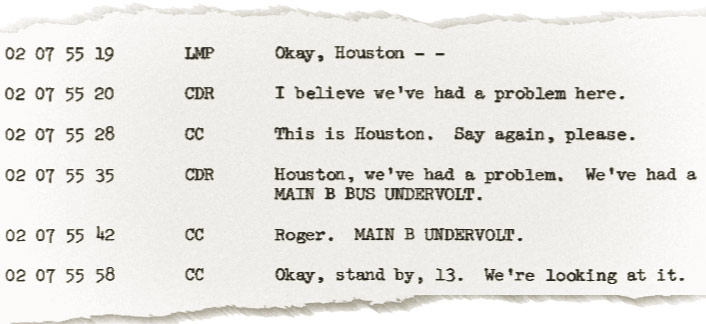
This dialog (taken from the official Apollo 13 technical Air-to-Ground Voice Transcription and reproduced here without permission) between the Mission Control Center and the men aboard Apollo 13 is basically the reason, why this book has been written.
The story of NASA's "successful failure" is a very engaging read, even if you already know the Hollywood movie. There's a lot more information given in this book, the "techno babble" is explained and intelligible to all, and the movie's inaccuracies are ironed out. Some flashbacks to Lowell's life prior to Apollo 13 ease things up.
What impressed me most about the Apollo 13 mission is how calmly and seemingly unexcited the astronauts and people in mission control dealt with the situation, which is considered the most dramatic episode in manned space-travel. If you have some time on your hand, you can listen to 50 hours worth of audio recordings. I used this as a soundtrack while reading (although it didn't take me 50 hours).
I recommend this book to anyone even slightly interested in the exploration of space.
As I hurtled through space, one thought kept crossing my mind - every part of this rocket was supplied by the lowest bidder. — John Glenn

This work is licensed under a Creative Commons Attribution-NonCommercial-ShareAlike 3.0 Unported License.

November 5, 2024
The Moon.
The ultimate prize. At least once Russia started the fabled Space Race.
Werner von Brain and others worked hard to enable humans to lift off of the ground, punch through our atmosphere, escape gravity and float in space - with the ultimate goal being us managing a voyage to the Moon and beyond for exploration (or maybe even conquering some new territory, who knows).
We all know about Neil Armstrong, Buzz Aldrin and Michael Collins. We know the fabled (if a bit haughty) words that were definitely NOT improvised if you ask me. *lol*
However, there were so many other missions. Some failed, some did so catastrophically. Because make no mistake: while the public might have lost interest, being an astronaut was never boring or "routine". It means strapping your ass to a huge can of highly flammable fuel which propells you off of our planet and into space where you're "protected" from immediate death by nothing else than tinfoil held together with duct tape.
Not to mention that the computing power used back then was the same we nowadays still use in musical greeting cards!
Let that sink in for a moment.
So many things could go wrong (and often did). And yet ... we had the drive, the desire, the urge to keep going. I don't know when we lost that. But we lost a lot more than the Moon on that day, for we lost our pride, our ingenuity, our intrepid spirit. Yes, collectively. Space became "boring" and how that could have happened, I'll never understand. Not only is it extremely lethal, it's endlessly fascinating!
Anyway, back in 1970, astronauts Jim Lovell, Fred Haise, and Jack Swigert were on their way to the Moon for what was scheduled to be the 3rd lunar landing (7th manned space flight) when there was an on-board explosion.
The lunar landing module was called the Aquarius while the service module was called the Odysseus of all things.
The Odysseus is where the explosion happened. And they were leaking "some sort of gas". Yeah ... it was oxygen. In case you don't know: oxygen is used for generating electricity on board a spacecraft (I hadn't known). So the three astronauts were basically fucked on two counts.
Since this is 2024 and you can simply google it, here is a spoiler: they made it home alive. All three of them. How, that is the important bit though. Because it took guts and quick thinking and nerves of steel. Which is where this book comes in.
I was elated when I realized this wasn't "just" an account of the disaster, but it gave important context to everything by recounting how these three ended up on this mission, what their lives and careers had been like, what kind of people they and everyone else involved were. Because make no mistake: not just any crew (ground or flight) could have pulled this off! Not to mention what their families went through!
An absolutely wonderful book that was never once boring.
P.S.: It makes me sad that we've lost what we already had once. I'm hoping against hope that we'll go back (and further) one day. All it takes is to get our heads out of our asses long enough. *sighs*
The ultimate prize. At least once Russia started the fabled Space Race.
Werner von Brain and others worked hard to enable humans to lift off of the ground, punch through our atmosphere, escape gravity and float in space - with the ultimate goal being us managing a voyage to the Moon and beyond for exploration (or maybe even conquering some new territory, who knows).
We all know about Neil Armstrong, Buzz Aldrin and Michael Collins. We know the fabled (if a bit haughty) words that were definitely NOT improvised if you ask me. *lol*
However, there were so many other missions. Some failed, some did so catastrophically. Because make no mistake: while the public might have lost interest, being an astronaut was never boring or "routine". It means strapping your ass to a huge can of highly flammable fuel which propells you off of our planet and into space where you're "protected" from immediate death by nothing else than tinfoil held together with duct tape.
Not to mention that the computing power used back then was the same we nowadays still use in musical greeting cards!
Let that sink in for a moment.
So many things could go wrong (and often did). And yet ... we had the drive, the desire, the urge to keep going. I don't know when we lost that. But we lost a lot more than the Moon on that day, for we lost our pride, our ingenuity, our intrepid spirit. Yes, collectively. Space became "boring" and how that could have happened, I'll never understand. Not only is it extremely lethal, it's endlessly fascinating!
Anyway, back in 1970, astronauts Jim Lovell, Fred Haise, and Jack Swigert were on their way to the Moon for what was scheduled to be the 3rd lunar landing (7th manned space flight) when there was an on-board explosion.
The lunar landing module was called the Aquarius while the service module was called the Odysseus of all things.
The Odysseus is where the explosion happened. And they were leaking "some sort of gas". Yeah ... it was oxygen. In case you don't know: oxygen is used for generating electricity on board a spacecraft (I hadn't known). So the three astronauts were basically fucked on two counts.
Since this is 2024 and you can simply google it, here is a spoiler: they made it home alive. All three of them. How, that is the important bit though. Because it took guts and quick thinking and nerves of steel. Which is where this book comes in.
I was elated when I realized this wasn't "just" an account of the disaster, but it gave important context to everything by recounting how these three ended up on this mission, what their lives and careers had been like, what kind of people they and everyone else involved were. Because make no mistake: not just any crew (ground or flight) could have pulled this off! Not to mention what their families went through!
An absolutely wonderful book that was never once boring.
P.S.: It makes me sad that we've lost what we already had once. I'm hoping against hope that we'll go back (and further) one day. All it takes is to get our heads out of our asses long enough. *sighs*

October 15, 2015
GUIDO, EECOM, Flight, CAPCOM, FIDO, TELMU, LEM, CONTROL, Simsups, RETRO, Roger, Copy
that, Go!
I love NASA speak, don't you? It all takes me back to the days when I was glued to the television set, watching as much as I could of the space flights in the 60's and 70's.
This book tells the story of one of the scariest of all journeys, Apollo 13. And Houston, they sure had problems! The unraveling of the mission is a fascinating story, as are the details of the way it was patched back together in order to get the crew back to Earth.
We get to travel not only to the moon with the crew (they got there in an orbit, they just were not able to get to the surface) but back in time to become familiar with Lovell as a person and pilot. We spend hours now and then with his family as they wait along with the rest of the world for events to unfold. And we spend days with the team at Mission Control, which was at one time in my life one of the places I most wanted to see in real life, not just on the small screen.
There was something poignant about reading how bored the nation had become with the space program by the time Apollo 13 was ready for liftoff. According to the book, the entire process had become routine. Until the accident reminded everyone just how risky it was. I thought of the
Challenger disaster in January 1986. The identical mindset had infected everyone by then too. The command to 'Go at throttle up' never sounded the same to me after that day.
But back to Apollo. This book is quite readable even with the NASA terms, which are all explained the first time they appear. The pages go flying by, because the story flows from the beginning, and is suspenseful even though we know that the crew arrives home safely. After all, how else could the Mission Commander be author of the book? He did have help in the form of Jeffrey Kluger, and the book is not told in first person style, but I would say that the team worked smoothly together, whoever did the actual writing.
that, Go!
I love NASA speak, don't you? It all takes me back to the days when I was glued to the television set, watching as much as I could of the space flights in the 60's and 70's.
This book tells the story of one of the scariest of all journeys, Apollo 13. And Houston, they sure had problems! The unraveling of the mission is a fascinating story, as are the details of the way it was patched back together in order to get the crew back to Earth.
We get to travel not only to the moon with the crew (they got there in an orbit, they just were not able to get to the surface) but back in time to become familiar with Lovell as a person and pilot. We spend hours now and then with his family as they wait along with the rest of the world for events to unfold. And we spend days with the team at Mission Control, which was at one time in my life one of the places I most wanted to see in real life, not just on the small screen.
There was something poignant about reading how bored the nation had become with the space program by the time Apollo 13 was ready for liftoff. According to the book, the entire process had become routine. Until the accident reminded everyone just how risky it was. I thought of the
Challenger disaster in January 1986. The identical mindset had infected everyone by then too. The command to 'Go at throttle up' never sounded the same to me after that day.
But back to Apollo. This book is quite readable even with the NASA terms, which are all explained the first time they appear. The pages go flying by, because the story flows from the beginning, and is suspenseful even though we know that the crew arrives home safely. After all, how else could the Mission Commander be author of the book? He did have help in the form of Jeffrey Kluger, and the book is not told in first person style, but I would say that the team worked smoothly together, whoever did the actual writing.

December 20, 2023
This book provides the gripping true story of Apollo 13, the space mission intended to land on the moon in April 1970, which experienced an in-flight explosion 180,000 miles from earth. It is clear how close the US space program came to losing the three astronauts: Jim Lovell, Jack Swigert, and Fred Haise. The narrative takes readers through the advance planning, initial moments of the mission, sudden turn of events, and the response to the life-threatening crisis.
The narrative delves into both the technical aspects of the mission and personal reactions. It intersperses related historic episodes from past missions, including the selection of Lovell into the second group of nine astronauts, previous training simulations that had experienced similar problems, and other NASA accidents. It provides the necessary context to understand the technical jargon of the communications between the flight control center and the Apollo 13 crew.
This is a riveting and detailed account. I felt invested in the outcome even though I know how it all ended. It emphasizes coolness under pressure, resilience, creative problem-solving, and teamwork required by everyone involved. It is a remarkable story of converting a potential tragedy into an amazing accomplishment. Highly recommended to anyone interested in science, technology, or the history of the space program.
The narrative delves into both the technical aspects of the mission and personal reactions. It intersperses related historic episodes from past missions, including the selection of Lovell into the second group of nine astronauts, previous training simulations that had experienced similar problems, and other NASA accidents. It provides the necessary context to understand the technical jargon of the communications between the flight control center and the Apollo 13 crew.
This is a riveting and detailed account. I felt invested in the outcome even though I know how it all ended. It emphasizes coolness under pressure, resilience, creative problem-solving, and teamwork required by everyone involved. It is a remarkable story of converting a potential tragedy into an amazing accomplishment. Highly recommended to anyone interested in science, technology, or the history of the space program.

December 3, 2008
I read this book some time ago, but it was such a good read I thought I'd review it just in time for the holidays....I think it would make a good gift for nonfiction buffs. I don't know if its age makes it hard to find, but it almost guarantees that it may not be familiar to a lot of readers.
This book is a telling of the Apollo 13 saga, as seen by the commander of the mission, Jim Lovell. If you saw the movie "Apollo 13," you will recognize a lot of details, right down to exact quotes. It also helps explain things that may not have made sense to viewers (i.e. why it was such a compliment to tell an engineer he's a "steely-eyed missile man."). Even though we know the happy ending, the book is a fascinating read and an inside view of a critical event in America's space program. You don't have to be a science, space, or history nut to be drawn into the story.
This book is a telling of the Apollo 13 saga, as seen by the commander of the mission, Jim Lovell. If you saw the movie "Apollo 13," you will recognize a lot of details, right down to exact quotes. It also helps explain things that may not have made sense to viewers (i.e. why it was such a compliment to tell an engineer he's a "steely-eyed missile man."). Even though we know the happy ending, the book is a fascinating read and an inside view of a critical event in America's space program. You don't have to be a science, space, or history nut to be drawn into the story.

May 19, 2020
On April 11, 1970, Apollo 13 launched from Kennedy Space Center en route to the moon, temporary home to commander Jim Lovell, command module pilot, Jack Swigert and lunar module pilot, Fred Haise. On April 13, minutes after finishing a broadcast touring the Lunar Module (LM), oxygen tank #2 (of 2) exploded, throwing the mission—and mission control, and the world—into chaos.
1. Written as a joint effort between Lovell (commander of Apollo 13) and Jeffrey Kluger, Apollo 13 is a technically dense narrative of the mission. It contains a high level of detail, but also does its best to balance Lovell's account of the mission with those of ground control and Marilyn Lovell. it also loops back to touch on the Apollo 1 tragedy, as well as Lovell's first lap of the moon on Apollo 8.
I personally liked the tone and the amount of information about the systems and people involved in triaging the situation when shit started to get real: I felt like I understood enough to track the severity of the situation without being overwhelmed and without feeling like I was being spoon-fed the science.
2. That said: holy goddamned shit. The sheer number of issues and problems and hurdles Lovell, Swigert and Haise had to deal with 200,000 goddamned miles away in the vacuum of space is just—phenomenal. Not only did oxygen tank #2 explode, it took oxygen tank #1 with it, as well as 2 of 3 fuel cells that generated power for the Command Module; once ground control figured out what was happening, the astronauts had to completely shut down their command module and take up residency in the lunar module—a ship meant to hold 2 dudes for 2 days to go to the moon. Not, y'know, support 3 dudes for a return trip to Earth. But needs must! Then they had to figure out how to adjust their trajectory to slingshot themselves back to Earth, on a ship not calibrated to fly with the lunar module as the primary engine with the inert command module still attached. And then there's carbon dioxide to deal with. And lack of heat. And lack of power. And lack of water. And exploding batteries. And general drift. And attempting to calibrate their position against stars they can't see because of the MULTITUDE OF DEBRIS FROM THE EXPLOSION.
I mean: god damn. That's SO MANY THINGS. And NASA and the Apollo 13 crew just...dealt with them. One at a time. Need to scrub Carbon dioxide? Okay, take this part and a plastic bag and the hose for your suit's oxygen and some duct tape and the lunar landing instructions you aren't going to use and MACGYVER YOURSELF A SCRUBBER SO YOU CAN CONTINUE TO BREATHE. Can't align your navigation? Okay, we'll just have you calibrate the damn thing against the FUCKING SUN EVEN THOUGH IT'S PROBABLY A LITTLE CLOSE FOR COMFORT, PRECISION-WISE. Need to power on your command module with minimal power? Okay, we'll just write a new procedure for what's usually a 24 hour process ON THE FLY AND THEN READ IT TO YOU HOURS BEFORE SPLASHDOWN.
It's the epitome of divide and conquer and working towards something bigger than the individual pieces. There's a bit about John Aaron straight up negotiating with all these various system owners about turning them on (or not turning them on) in preparation for Apollo 13's return to Earth that puts the entire thing in perspective: there was no room for ego because ego would kill those men in space. And it's just very harrowing and inspiring and strange.
3. I'm sure there are biases I'm not even aware of due to Lovell's personal feelings for NASA and the space program and his colleagues, but it doesn't feel as vitally important as the fact that this program, however flawed or problematic, banded together to bring these men home in the face of ridiculous, impossible odds.
4. I MEAN THEIR GODDAMNED SHIP EXPLODED. IN SPACE. AND THEY SURVIVED! THEY SURVIVED.
1. Written as a joint effort between Lovell (commander of Apollo 13) and Jeffrey Kluger, Apollo 13 is a technically dense narrative of the mission. It contains a high level of detail, but also does its best to balance Lovell's account of the mission with those of ground control and Marilyn Lovell. it also loops back to touch on the Apollo 1 tragedy, as well as Lovell's first lap of the moon on Apollo 8.
I personally liked the tone and the amount of information about the systems and people involved in triaging the situation when shit started to get real: I felt like I understood enough to track the severity of the situation without being overwhelmed and without feeling like I was being spoon-fed the science.
2. That said: holy goddamned shit. The sheer number of issues and problems and hurdles Lovell, Swigert and Haise had to deal with 200,000 goddamned miles away in the vacuum of space is just—phenomenal. Not only did oxygen tank #2 explode, it took oxygen tank #1 with it, as well as 2 of 3 fuel cells that generated power for the Command Module; once ground control figured out what was happening, the astronauts had to completely shut down their command module and take up residency in the lunar module—a ship meant to hold 2 dudes for 2 days to go to the moon. Not, y'know, support 3 dudes for a return trip to Earth. But needs must! Then they had to figure out how to adjust their trajectory to slingshot themselves back to Earth, on a ship not calibrated to fly with the lunar module as the primary engine with the inert command module still attached. And then there's carbon dioxide to deal with. And lack of heat. And lack of power. And lack of water. And exploding batteries. And general drift. And attempting to calibrate their position against stars they can't see because of the MULTITUDE OF DEBRIS FROM THE EXPLOSION.
I mean: god damn. That's SO MANY THINGS. And NASA and the Apollo 13 crew just...dealt with them. One at a time. Need to scrub Carbon dioxide? Okay, take this part and a plastic bag and the hose for your suit's oxygen and some duct tape and the lunar landing instructions you aren't going to use and MACGYVER YOURSELF A SCRUBBER SO YOU CAN CONTINUE TO BREATHE. Can't align your navigation? Okay, we'll just have you calibrate the damn thing against the FUCKING SUN EVEN THOUGH IT'S PROBABLY A LITTLE CLOSE FOR COMFORT, PRECISION-WISE. Need to power on your command module with minimal power? Okay, we'll just write a new procedure for what's usually a 24 hour process ON THE FLY AND THEN READ IT TO YOU HOURS BEFORE SPLASHDOWN.
It's the epitome of divide and conquer and working towards something bigger than the individual pieces. There's a bit about John Aaron straight up negotiating with all these various system owners about turning them on (or not turning them on) in preparation for Apollo 13's return to Earth that puts the entire thing in perspective: there was no room for ego because ego would kill those men in space. And it's just very harrowing and inspiring and strange.
3. I'm sure there are biases I'm not even aware of due to Lovell's personal feelings for NASA and the space program and his colleagues, but it doesn't feel as vitally important as the fact that this program, however flawed or problematic, banded together to bring these men home in the face of ridiculous, impossible odds.
4. I MEAN THEIR GODDAMNED SHIP EXPLODED. IN SPACE. AND THEY SURVIVED! THEY SURVIVED.

May 9, 2012
This book (upon which the film Apollo 13 is based) provides a lot more details and background information about the accident. I’m guessing that science journalist Jeffrey Kluger had a major role in shaping the narrative (which was expertly told and whose chapters alternated between flashbacks and current dramas). The book highlights things missed in the movie: the vast amount of flight experience Lovell already had (having flown twice around the moon), the personal connection Lovell had with ill-fated Apollo 1 tragedy, the social protocol NASA astronauts had (including that of Lovell’s wife, who had to keep one wife “busy” while NASA prepared to deliver the news of her husband’s death), the nitty-gritty detail of the necessary burn operations they had to take, how the “venting” of oxygen surrounded the ship during most of the return home (and interfered with visibility). The book certainly captures the exciting and heroic efforts of the astronauts and crew; strangely, the whole story is told in first person, which papers over the fact that (inside the spaceship at least), the perspective is entirely Lovell’s. Recommended

May 1, 2019
Well, if you liked this book, you should read "Rocket Men" and probably "The Right Stuff" and "Hidden Figures."
The story of Apollo 13 is the story of how smart people face failure with their best work. It's right up for my preference for "good government" and "history of science and technology" books. The American mission to the moon is full of those kinds of stories.
Kudos to Jim Lovell who made the story not just about himself. Surely he and his wife are central characters. But most of the book is about the folks on the ground at NASA in Houston and at Grumman on Long Island who faced a series of "ticking time bomb" challenges to salvage enough water, propellant, oxygen, and heat from a broken rocket to keep three men alive all the way to the moon and back.
Hell, even Richard Nixon gets to act heroically.
The story of Apollo 13 is the story of how smart people face failure with their best work. It's right up for my preference for "good government" and "history of science and technology" books. The American mission to the moon is full of those kinds of stories.
Kudos to Jim Lovell who made the story not just about himself. Surely he and his wife are central characters. But most of the book is about the folks on the ground at NASA in Houston and at Grumman on Long Island who faced a series of "ticking time bomb" challenges to salvage enough water, propellant, oxygen, and heat from a broken rocket to keep three men alive all the way to the moon and back.
Hell, even Richard Nixon gets to act heroically.

July 28, 2019
Book2Movie Review
Buch 4,5 Sterne
Das Buch liest sich wie ein spannender Roman, obwohl es sich ja um ein Sachbuch handelt. Ein Sachbuch mit jeder Menge technischen Informationen, die lesergerecht erklärt wurden. Und da ich das meiste verstanden habe, ist das offensichtlich auch gelungen. Verknüpft mit einer menschlichen Ebene, mit Emotionen und Gefühlen der unmittelbar Beteiligten und sogar einer Prise Humor, ergibt sich ein ganz wunderbares Buch über eine außergewöhnliche Reise zum Mond.
Den Großteil der Zeit begleiten wir die drei Astronauten von Apollo 13 oder die unzähligen NASA-Mitarbeiter im Kontrollzentrum von Houston vom 13.04. bis zum 17.04.1970.
Hier dienten sicher die Protokolle des Funkverkehrs als Gedächtnisstütze und Grundgerüst für die Autoren, denn der wurde im Grunde komplett übernommen (neu war für mich, dass dieser öffentliches Allgemeingut war und sogar live allen Medien zur Verfügung stand). Doch wurde dieser Wortwechsel, der selbst in der Krisensituation erstaunlich nüchtern blieb, angereichert mit persönlichen Zusatzinfos und Erklärungen, womit sich eine runde Erzählung ergibt, die informativ und spannend ist, auch wenn man das Ende schon kennt (Jim Lovell ist schließlich der Autor dieses Buches!). Explodiert sind ja die Sauerstofftanks, aber tatsächlich war gar nicht der Mangel an Sauerstoff für die Astronauten ein Problem (davon gab es in der Mondlandefähre reichlich), sondern zum einen wurde für alles elektrische ebenfalls Sauerstoff benötigt und zum anderen ergaben sich in Folge immer weitere Probleme weil noch andere Dinge ausfielen und die Ressourcen in der Mondlandefähre auf eine viel kürzere Zeit ausgelegt waren.
Als Kind dachte ich, dass Astronauten wirklich richtig schlau sein müssen wenn sie so ein Raumschiff fliegen können. Als Erwachsene dachte ich, dass die da nur drin sitzen und eh alles vom Computer oder vom Boden aus gesteuert wird. Jetzt weiß ich: beides ist richtig! Die Astronauten müssen sich mit ihrem Fluggerät sehr gut auskennen, müssen Probleme erkennen und sofort richtig einschätzen können. Müssen auf Veränderungen im Ablauf schnell und richtig reagieren können, wissen wo welcher Schalter ist und was er bewirkt, wie man dort oben händisch navigiert und steuert. Aber auch vor 50 Jahren wurde natürlich schon unglaublich viel automatisch von Computern erledigt, und vorher alles bis auf's letzte Komma ausgerechnet. Die Bodenstation hat fast alle Daten, die die Männer in der Kommandokapsel auf ihren Bildschirmen sahen, auch übertragen bekommen. Selbst eine Live-Übertragung aus dem Weltall war ja bei den vorangegangenen Apollo-Missionen schon möglich. Faszinierend, welche technischen Möglichkeiten es bereits vor einem halben Jahrhundert gab!
Es war beeindruckend zu lesen, wie sowohl die Männer im All als auch die am Boden die ganze Zeit über einen wirklich kühlen Kopf bewahrt haben und nie in Panik ausbrachen, obwohl die Ausgangslage nach der Explosion des Sauerstofftanks ja wirklich ausweglos schien. Aber wie ich es schon bei der fiktiven Geschichte vom "Marsianer" als auch in einer Neil-Armstrong-Biografie gelesen habe, sind NASA-Männer wohl besonders gut darin, Dinge voll analytisch anzugehen und ein Problem nach dem anderen abzuarbeiten ohne auszuflippen. Geholfen hat beim "kühlen Kopf bewahren" wahrscheinlich auch, dass alle Astronauten der damaligen Zeit ehemalige Testpiloten waren. Diese Kerle waren es gewohnt, Unbekanntes auszuprobieren, schnell Lösungen für unvorhergesehene Probleme zu finden und vor allem waren sie darauf eingestellt, dass jeder Flug auch der letzte sein könnte.
Wenn man es ganz genau nimmt war das dann ja auch der Fall, denn keiner der drei Männer flog jemals wieder ins All. Vielleicht hätte der eine oder andere gern noch mal zum Mond gewollt, aber es gab auch eine ganze Reihe von anderen Astronauten, die für die kommenden Missionen bereits einplant waren und zudem wurde das Apollo-Programm schon bald drastisch gekürzt und fand 1972 mit Apollo 17 seinen Abschluss. Schon bei Apollo 13, der dritten geplanten Mondlandung nur ein dreiviertel Jahr nach Armstrong & Co., war das Interesse der Öffentlichkeit rapide gesunken. Weder der Start noch die TV-Übertragung der 3 Astronauten, die sie kurz vor der Explosion machten, wurden live im Fernsehen übertragen sondern nur kurz in den Nachrichten erwähnt. Der Reiz des Neuen war dahin. Mich hat dieses Desinteresse sehr überrascht!
Über all das kann man in diesem Buch lesen. Hinzu kommen immer mal wieder kurze Abstecher zur Frau von Kommandant Jim Lovell während der Zeit des Hoffens & Bangens. Ebenfalls beschrieben wird aber auch der Werdegang von Lovell, von seiner kindlichen Begeisterung für Raketen über seine Ausbildung zum Testpiloten bis hin zum Einstieg bei der NASA. Auch seinem ersten Flug zum Mond an Weihnachten 1968 werden ein paar Seiten gewidmet, genauso wie dem ersten großen NASA-Unglück 1967 mit Apollo 1.
All diese Einzelheiten ergeben ein sehr ausgewogenes Ganzes, das mit einem Epilog wunderbar abgerundet wird. Hier wird aufgearbeitet, welche einzelnen Fehler und Schäden an der Apollo 13 bei den vielen vielen Tests zuvor entweder nicht aufgefallen sind oder, für sich genommen, als unwichtig erachtet worden sind. In ihrer Gesamtheit dann aber doch zu einer Katastrophe führten.
Das einzige, was mir gefehlt hat, waren ein paar Bilder. So musste ich ständig googeln: über Apollo 1 und Apollo 8, wie die drei Astronauten aussahen, welche Bilder vom Mond sie geschossen haben, wie das Leck am Versorgungstank aussah, wie groß so eine Rakete ist und wie klein dem gegenüber die Aquarius und Odyssey denn etwa waren (leider findet man nur Bilder von außen und ich kann mir immer noch schlecht vorstellen, wie beengt es dort war). Aber zur Visualisierung habe ich mir heute dann eine Spiegel TV Doku angeschaut, und den Kinofilm mit Tom Hanks werde ich in den nächsten Tagen ebenfalls noch einmal genießen.
Film (noch einmal gesehen Dez 2019) 4,5 Sterne
Später als geplant habe ich endlich auch noch einmal den Film mit Tom Hanks als Kommandant Jim Lovell angesehen. Das erste Mal habe ich ihn gleich 1995 gesehen als er rauskam, das war damals im Sommer-Freiluftkino unterm Sternenhimmel. Hat gerade bei diesem Thema wunderbar gepasst.
Während der Film den Fokus auf die Ausweglosigkeit der Situation der Apollo 13 Crew setzte, konnte das Buch besser rüberbringen konnte, wie viele Leute bei der NASA unermüdlich an Lösungen für die verschiedensten (teilweise ja nacheinander auftretenden) Problemen gearbeitet haben, und wie viel auch die Astronauten oben zu tun hatten mit der Eingabe von seitenweise Daten in den Bordcomputer. Im Film wurde symbolisch dafür der ursprüngliche Pilot der Kommandokapsel, Ken Mattingly, hergenommen, der Stunden im Flugsimulator verbrachte um herauszufinden, wie seine Kollegen wieder sicher zur Erde zurückkehren können mit den vorhandenen Ressourcen.
Dafür hatte der Film klare Vorteile wenn es darum ging, Gefühle zu transportieren. Das ging bereits los als Ken Mattingly mitgeteilt wurde, er könne nicht mitfliegen. Verständlich, dass er da sauer war. (By the way - wieso man so einen Start nicht um 2 Wochen verschieben kann ist mir nicht ganz klar. Wenige Tage vor dem Start eine neue Crew zusammen zu stellen ist ja auch nicht ohne Risiko. Es wird dafür schon Gründe geben, sonst hätte man es ja verschoben, aber thematisiert wurde das nie bei all dem Material das ich dazu gelesen oder gesehen habe). Insgesamt wurden die Hauptakteure besser portraitiert und ihnen im wahrsten Sinne des Wortes Gesichter verliehen, die ich beim Lesen des Buches nur hatte, wenn ich parallel gegoogelt habe. Ganz besonders trifft das auf Jim Lovell zu, dessen Familien hier eine nicht unerhebliche Rolle spielt.
Auch die Musik, die hier - typisch Hollywood-Blockbuster - oft sehr theatralisch wirkt, unterstützt die Gefühlsebene enorm.
Ich wusste ja, dass es gut ausgehen wird. Ansonsten wäre es für mich sicher schwieriger gewesen, so einen Film anzuschauen. Und dennoch hatte ich einen Gänsehautmoment, als die Odysseu wieder in die Erdatmosphäre eintritt und habe mitgebangt, als minutenlang keine Verbindung zu den Astronauten aufgenommen werden kann.
Insgesamt hat Ron Howard also fast alles richtig gemacht mit diesem Film. Wie schon gesagt ging die Komplexität der Probleme und deren Lösung ein bisschen unter, aber man hat doch versucht, alles so zuschauergerecht wie möglich rüberzubringen. Die "Bastelstunde", wo die Ingenieure am Boden herausfinden sollten, wie die Astronauten die CO2-Filter mit den vorhandenen Materialien umbauen können, hat wahrscheinlich genau so wie dargestellt stattgefunden.
Fazit:
Sowohl Buch als auch Film sind eine tolle Aufarbeitung der 'most successful failure' der NASA. Während das Buch mit Präzision und Technikwissen punktet, fügt der Film die nicht minder wichtige Gefühlsebene hinzu. Nicht nur für Raumfahrt-Fans empfehlenswert!
Buch
4,5 SterneDas Buch liest sich wie ein spannender Roman, obwohl es sich ja um ein Sachbuch handelt. Ein Sachbuch mit jeder Menge technischen Informationen, die lesergerecht erklärt wurden. Und da ich das meiste verstanden habe, ist das offensichtlich auch gelungen. Verknüpft mit einer menschlichen Ebene, mit Emotionen und Gefühlen der unmittelbar Beteiligten und sogar einer Prise Humor, ergibt sich ein ganz wunderbares Buch über eine außergewöhnliche Reise zum Mond.
Den Großteil der Zeit begleiten wir die drei Astronauten von Apollo 13 oder die unzähligen NASA-Mitarbeiter im Kontrollzentrum von Houston vom 13.04. bis zum 17.04.1970.
Hier dienten sicher die Protokolle des Funkverkehrs als Gedächtnisstütze und Grundgerüst für die Autoren, denn der wurde im Grunde komplett übernommen (neu war für mich, dass dieser öffentliches Allgemeingut war und sogar live allen Medien zur Verfügung stand). Doch wurde dieser Wortwechsel, der selbst in der Krisensituation erstaunlich nüchtern blieb, angereichert mit persönlichen Zusatzinfos und Erklärungen, womit sich eine runde Erzählung ergibt, die informativ und spannend ist, auch wenn man das Ende schon kennt (Jim Lovell ist schließlich der Autor dieses Buches!). Explodiert sind ja die Sauerstofftanks, aber tatsächlich war gar nicht der Mangel an Sauerstoff für die Astronauten ein Problem (davon gab es in der Mondlandefähre reichlich), sondern zum einen wurde für alles elektrische ebenfalls Sauerstoff benötigt und zum anderen ergaben sich in Folge immer weitere Probleme weil noch andere Dinge ausfielen und die Ressourcen in der Mondlandefähre auf eine viel kürzere Zeit ausgelegt waren.
Als Kind dachte ich, dass Astronauten wirklich richtig schlau sein müssen wenn sie so ein Raumschiff fliegen können. Als Erwachsene dachte ich, dass die da nur drin sitzen und eh alles vom Computer oder vom Boden aus gesteuert wird. Jetzt weiß ich: beides ist richtig! Die Astronauten müssen sich mit ihrem Fluggerät sehr gut auskennen, müssen Probleme erkennen und sofort richtig einschätzen können. Müssen auf Veränderungen im Ablauf schnell und richtig reagieren können, wissen wo welcher Schalter ist und was er bewirkt, wie man dort oben händisch navigiert und steuert. Aber auch vor 50 Jahren wurde natürlich schon unglaublich viel automatisch von Computern erledigt, und vorher alles bis auf's letzte Komma ausgerechnet. Die Bodenstation hat fast alle Daten, die die Männer in der Kommandokapsel auf ihren Bildschirmen sahen, auch übertragen bekommen. Selbst eine Live-Übertragung aus dem Weltall war ja bei den vorangegangenen Apollo-Missionen schon möglich. Faszinierend, welche technischen Möglichkeiten es bereits vor einem halben Jahrhundert gab!
Es war beeindruckend zu lesen, wie sowohl die Männer im All als auch die am Boden die ganze Zeit über einen wirklich kühlen Kopf bewahrt haben und nie in Panik ausbrachen, obwohl die Ausgangslage nach der Explosion des Sauerstofftanks ja wirklich ausweglos schien. Aber wie ich es schon bei der fiktiven Geschichte vom "Marsianer" als auch in einer Neil-Armstrong-Biografie gelesen habe, sind NASA-Männer wohl besonders gut darin, Dinge voll analytisch anzugehen und ein Problem nach dem anderen abzuarbeiten ohne auszuflippen. Geholfen hat beim "kühlen Kopf bewahren" wahrscheinlich auch, dass alle Astronauten der damaligen Zeit ehemalige Testpiloten waren. Diese Kerle waren es gewohnt, Unbekanntes auszuprobieren, schnell Lösungen für unvorhergesehene Probleme zu finden und vor allem waren sie darauf eingestellt, dass jeder Flug auch der letzte sein könnte.
Wenn man es ganz genau nimmt war das dann ja auch der Fall, denn keiner der drei Männer flog jemals wieder ins All. Vielleicht hätte der eine oder andere gern noch mal zum Mond gewollt, aber es gab auch eine ganze Reihe von anderen Astronauten, die für die kommenden Missionen bereits einplant waren und zudem wurde das Apollo-Programm schon bald drastisch gekürzt und fand 1972 mit Apollo 17 seinen Abschluss. Schon bei Apollo 13, der dritten geplanten Mondlandung nur ein dreiviertel Jahr nach Armstrong & Co., war das Interesse der Öffentlichkeit rapide gesunken. Weder der Start noch die TV-Übertragung der 3 Astronauten, die sie kurz vor der Explosion machten, wurden live im Fernsehen übertragen sondern nur kurz in den Nachrichten erwähnt. Der Reiz des Neuen war dahin. Mich hat dieses Desinteresse sehr überrascht!
Über all das kann man in diesem Buch lesen. Hinzu kommen immer mal wieder kurze Abstecher zur Frau von Kommandant Jim Lovell während der Zeit des Hoffens & Bangens. Ebenfalls beschrieben wird aber auch der Werdegang von Lovell, von seiner kindlichen Begeisterung für Raketen über seine Ausbildung zum Testpiloten bis hin zum Einstieg bei der NASA. Auch seinem ersten Flug zum Mond an Weihnachten 1968 werden ein paar Seiten gewidmet, genauso wie dem ersten großen NASA-Unglück 1967 mit Apollo 1.
All diese Einzelheiten ergeben ein sehr ausgewogenes Ganzes, das mit einem Epilog wunderbar abgerundet wird. Hier wird aufgearbeitet, welche einzelnen Fehler und Schäden an der Apollo 13 bei den vielen vielen Tests zuvor entweder nicht aufgefallen sind oder, für sich genommen, als unwichtig erachtet worden sind. In ihrer Gesamtheit dann aber doch zu einer Katastrophe führten.
Das einzige, was mir gefehlt hat, waren ein paar Bilder. So musste ich ständig googeln: über Apollo 1 und Apollo 8, wie die drei Astronauten aussahen, welche Bilder vom Mond sie geschossen haben, wie das Leck am Versorgungstank aussah, wie groß so eine Rakete ist und wie klein dem gegenüber die Aquarius und Odyssey denn etwa waren (leider findet man nur Bilder von außen und ich kann mir immer noch schlecht vorstellen, wie beengt es dort war). Aber zur Visualisierung habe ich mir heute dann eine Spiegel TV Doku angeschaut, und den Kinofilm mit Tom Hanks werde ich in den nächsten Tagen ebenfalls noch einmal genießen.
Film (noch einmal gesehen Dez 2019)
4,5 SterneSpäter als geplant habe ich endlich auch noch einmal den Film mit Tom Hanks als Kommandant Jim Lovell angesehen. Das erste Mal habe ich ihn gleich 1995 gesehen als er rauskam, das war damals im Sommer-Freiluftkino unterm Sternenhimmel. Hat gerade bei diesem Thema wunderbar gepasst.
Während der Film den Fokus auf die Ausweglosigkeit der Situation der Apollo 13 Crew setzte, konnte das Buch besser rüberbringen konnte, wie viele Leute bei der NASA unermüdlich an Lösungen für die verschiedensten (teilweise ja nacheinander auftretenden) Problemen gearbeitet haben, und wie viel auch die Astronauten oben zu tun hatten mit der Eingabe von seitenweise Daten in den Bordcomputer. Im Film wurde symbolisch dafür der ursprüngliche Pilot der Kommandokapsel, Ken Mattingly, hergenommen, der Stunden im Flugsimulator verbrachte um herauszufinden, wie seine Kollegen wieder sicher zur Erde zurückkehren können mit den vorhandenen Ressourcen.
Dafür hatte der Film klare Vorteile wenn es darum ging, Gefühle zu transportieren. Das ging bereits los als Ken Mattingly mitgeteilt wurde, er könne nicht mitfliegen. Verständlich, dass er da sauer war. (By the way - wieso man so einen Start nicht um 2 Wochen verschieben kann ist mir nicht ganz klar. Wenige Tage vor dem Start eine neue Crew zusammen zu stellen ist ja auch nicht ohne Risiko. Es wird dafür schon Gründe geben, sonst hätte man es ja verschoben, aber thematisiert wurde das nie bei all dem Material das ich dazu gelesen oder gesehen habe). Insgesamt wurden die Hauptakteure besser portraitiert und ihnen im wahrsten Sinne des Wortes Gesichter verliehen, die ich beim Lesen des Buches nur hatte, wenn ich parallel gegoogelt habe. Ganz besonders trifft das auf Jim Lovell zu, dessen Familien hier eine nicht unerhebliche Rolle spielt.
Auch die Musik, die hier - typisch Hollywood-Blockbuster - oft sehr theatralisch wirkt, unterstützt die Gefühlsebene enorm.
Ich wusste ja, dass es gut ausgehen wird. Ansonsten wäre es für mich sicher schwieriger gewesen, so einen Film anzuschauen. Und dennoch hatte ich einen Gänsehautmoment, als die Odysseu wieder in die Erdatmosphäre eintritt und habe mitgebangt, als minutenlang keine Verbindung zu den Astronauten aufgenommen werden kann.
Insgesamt hat Ron Howard also fast alles richtig gemacht mit diesem Film. Wie schon gesagt ging die Komplexität der Probleme und deren Lösung ein bisschen unter, aber man hat doch versucht, alles so zuschauergerecht wie möglich rüberzubringen. Die "Bastelstunde", wo die Ingenieure am Boden herausfinden sollten, wie die Astronauten die CO2-Filter mit den vorhandenen Materialien umbauen können, hat wahrscheinlich genau so wie dargestellt stattgefunden.
Fazit:
Sowohl Buch als auch Film sind eine tolle Aufarbeitung der 'most successful failure' der NASA. Während das Buch mit Präzision und Technikwissen punktet, fügt der Film die nicht minder wichtige Gefühlsebene hinzu. Nicht nur für Raumfahrt-Fans empfehlenswert!

July 22, 2022
I must have read this before Goodreads. Very good; ideal for space nerds.

September 21, 2015
This book is very stressful. But in a good way. Even though we all know the story of Apollo 13, and we all know how it ends, the pacing in the book is so good that the harrowing moments are, well, harrowing. There's a fair amount of technical jargon, but it's defined in a way that if you care enough to understand it, you'll understand it. The use of third person POV is effective, giving the reader a needed glimpse into the thoughts and actions of people other than the main character.
I recently read Michael Collins's Carrying the Fire, so I automatically compared the two books, even though that's probably unfair. I'd consider Collins a more poetic and thoughtful writer, and I probably like his book better. But Lovell definitely has the more exciting story on his side. Both are great books that should be read in order to re-ignite the wonder of space that we've grown too used to. Just don't be thrown by the NASA-speak!
I recently read Michael Collins's Carrying the Fire, so I automatically compared the two books, even though that's probably unfair. I'd consider Collins a more poetic and thoughtful writer, and I probably like his book better. But Lovell definitely has the more exciting story on his side. Both are great books that should be read in order to re-ignite the wonder of space that we've grown too used to. Just don't be thrown by the NASA-speak!

April 11, 2024
I watched Neil Armstrong walk on the moon. The adults were excited, calling us children to watch on television because they wanted us to watch history being made. I was just old enough to feel the adults' excitement, to know to remember Apollo 11, to hear and remember Neil Armstrong saying, "One small step for man; one giant leap for mankind." Being reminded of it by family and by historical references, made it all easy to remember.
Also living in Texas, we made the road trip to the Johnson Space Center in Houston. Among many other things long forgotten, I remember the moon rock, the moon vehicle, a capsule replica that I think we children were able to get into.
So when I watched Apollo 13, I knew I would find the movie interesting--especially as Tom Hanks was starring. I was curious to learn what made the flight so special. After watching, I knew I would have to read the book. I did about 30 years later.
In his memior, Lovell keeps his narrative streamlined and his language taut. The high stress and the determination to achieve safety strummed on the page. The situation in the control room, in the press room, in the spacecraft, and at the Lovell home, and other NASA community members' homes were respectfully distant yet emotionally charged on the page.
Lovell like a good historian remembered to make homage to the things past that came before Apollo 13 --such as the Apollo 1 fire--and the things future that came after Apollo 13--the Space Shuttle program.
Yet. Yet one part of NASA Lovell failed to even make a nod to. Surely the women of Mercury and the women of the Space Shuttle programs required a mention. These women would have been present at the workplace, on the phones to wives of the Apollo 13 crewmembers, or leaving messages and sending cards of concern and then gratitude. These women were part of the professional world of NASA as the men, more particularly it seems the Space Shuttle program women.
A good read not to be missed. My reading about the Mercury women in The Mercury 13: The Untold Story of Thirteen American Women and the Dream of Space Flight by Martha Ackmann and The Six: The Untold Story of America's First Women Astronauts by Loren Grush also informs my understanding of NASA during the race to the moon and the space shuttle years. Even more fulfilling when considering all the astronauts of NASA., more fulfilling as a work culture filled with challenge, danger, and politocs, including gendered politics.
Also living in Texas, we made the road trip to the Johnson Space Center in Houston. Among many other things long forgotten, I remember the moon rock, the moon vehicle, a capsule replica that I think we children were able to get into.
So when I watched Apollo 13, I knew I would find the movie interesting--especially as Tom Hanks was starring. I was curious to learn what made the flight so special. After watching, I knew I would have to read the book. I did about 30 years later.
In his memior, Lovell keeps his narrative streamlined and his language taut. The high stress and the determination to achieve safety strummed on the page. The situation in the control room, in the press room, in the spacecraft, and at the Lovell home, and other NASA community members' homes were respectfully distant yet emotionally charged on the page.
Lovell like a good historian remembered to make homage to the things past that came before Apollo 13 --such as the Apollo 1 fire--and the things future that came after Apollo 13--the Space Shuttle program.
Yet. Yet one part of NASA Lovell failed to even make a nod to. Surely the women of Mercury and the women of the Space Shuttle programs required a mention. These women would have been present at the workplace, on the phones to wives of the Apollo 13 crewmembers, or leaving messages and sending cards of concern and then gratitude. These women were part of the professional world of NASA as the men, more particularly it seems the Space Shuttle program women.
A good read not to be missed. My reading about the Mercury women in The Mercury 13: The Untold Story of Thirteen American Women and the Dream of Space Flight by Martha Ackmann and The Six: The Untold Story of America's First Women Astronauts by Loren Grush also informs my understanding of NASA during the race to the moon and the space shuttle years. Even more fulfilling when considering all the astronauts of NASA., more fulfilling as a work culture filled with challenge, danger, and politocs, including gendered politics.

January 23, 2018
Apollo 13 chronicles the disastrous mission to the moon and the subsequent fight to save the three men aboard the crippled Apollo 13 spacecraft. I had previously seen the movie and was fascinated by everything that contributed to the eventual safe return of the astronauts. This book helps fill in the gap between a lot of what I didn't understand from the movie, and includes tons of new information. At times, the problems that beleaguer the ship are quite technical, but this book does a great job of presenting them such that they are interesting and easy to understand.
I confess I didn't find this book as gripping as I expected, probably because I mostly knew what was going to happen from having watched the movie many times. Also I finished reading Apollo 8 not too long ago by one of the same authors, and there was some overlap of content between the two books.
One note: I read the anniversary edition, which contains a new preface to the book. Unlike the rest of the book, I found the preface to be not really relevant and quite boring, and wish they hadn't added that unnecessarily to the book.
I confess I didn't find this book as gripping as I expected, probably because I mostly knew what was going to happen from having watched the movie many times. Also I finished reading Apollo 8 not too long ago by one of the same authors, and there was some overlap of content between the two books.
One note: I read the anniversary edition, which contains a new preface to the book. Unlike the rest of the book, I found the preface to be not really relevant and quite boring, and wish they hadn't added that unnecessarily to the book.

September 12, 2021
This is a great book, and an excellent audiobook.

March 3, 2023
Listened to 2019 audiobook, can not find edition on goodreads, excellent..
February 5, 2014
Some might think that this story is over told or over dramatized. If you are one of these people then you need to read this retelling of the story. Co-authored by Jim Lovell, commander of Apollo 13, the book gives authenticity, weight, and just a down right "first hand" feel to the tale. After the prime of the moon-landing days which NASA was emerging from, Apollo 13 seemed to be a "routine" mission into outer space (as if there could be such a thing.) However, a mechanical failure and explosion caused this routine mission to become National headlines and a test of what the people of NASA were made of-- astronauts, engineers, and commanders alike. Just the sheer man-power, bravery, determination, and leadership that it look to bring Jim Lovell, Jack Swigert, and Fred Haise home from a mission that more and more looked like it was going to end badly, is cause for amazement. We can learn from this story and these men's lives and how they handled themselves when faced with disaster.
July 3, 2013
This is one of those books where the story is more interesting than the writing. In my opinion, the book was more technical than the lay man could understand in some parts, particularly in discussing what went wrong (or what they think went wrong). At the same time, I didn't really feel the emotion of the individuals during the plight from this book. I KNEW they must have been crapping their pants, because that's what I would have been doing, but the book somehow is very detached to the emotions of the people, something that I don't know whether to applaud or not, to be honest.
The combination o the two, being overly technical and unemotional, made me feel like I was reading something more akin to a logbook than a novel. Not really sure if it's because this is non-fiction or because the author, one of the astronauts, didn't want to be biased one way or the other.
The combination o the two, being overly technical and unemotional, made me feel like I was reading something more akin to a logbook than a novel. Not really sure if it's because this is non-fiction or because the author, one of the astronauts, didn't want to be biased one way or the other.

April 12, 2020
More compelling and Hardy pounding than any fictional thriller, this account of the Apollo 13 space mission and it's tense moments (of which there were many!) are told in this account of the program by one of the astronauts on the mission, Jim Lovell. Not only does the authenticity of the story make this a superior listen on this message, but the narration by Fred Sanders is also excellent. If the movie is not enough for you to commemorate the 50th anniversary of this memorable act of bravery by these astronauts and the outstanding work in Mission Control to get them home safely, then pick up this audiobook.

Read
December 13, 2020. . .
August 26, 2019
It was fascinating to read about all that went into getting the Apollo 13 crew back to earth after the explosion of oxygen tank no. 2, told in third person from multiple points of view.
April 11, 2024
Had seen the movie many years ago but first time reading the book. Has to be the greatest non-fiction escape / near-miss story of all time?
Some notes:
- Astronauts and Mission Control barely slept for 4-5 days straight. Astronauts because it was cold AF (to save power), Mission Control because they had so much to figure out and so no one left when their shift ended
- The fact that the explosion happened on the way to the moon, rather than after, saved their lives, since they were able to survive in the Lunar Module for several days since it had not yet been used
- Public attention on NASA and moon landings was already fading prior to this mission, and ironically they received much more attention than they would have if they had successfully completed their mission
- NASA had procedures written up for every scenario they could imagine, including ones similar to what happened here. That saved their lives, but even still a ton of improvisation was required (most famous, and one of the best parts of the movie, being the plastic bag setup to connect the round and square ends of the two different CO2 scrubbers)
My only criticisms:
- Lots of lots of characters, hard to keep everybody straight. Not sure there was any way around this, because so many people in Mission Control played critical roles that saved these guys’ lives
- It was written by Jim Lovell (astronaut who was on the mission) and Jeffrey Kluger (writer) but it ends up feeling like it was just a really well researched book written by a professional writer, as opposed to being able to hear Lovell’s voice come through
My running ranking of the books in my NASA syllabus:
1. Carrying the Fire (first person, put you in his shoes, authentic writing style, there for the first moon landing)
2. Apollo 13 (epic story, but you could tell it’s ghost written compared to Carrying the Fire)
3. The Six (great stories worth telling, but we stay in earth’s orbit)
4. Endurance (no knock on Scott at all, great book, but least interesting content to work with)
Some notes:
- Astronauts and Mission Control barely slept for 4-5 days straight. Astronauts because it was cold AF (to save power), Mission Control because they had so much to figure out and so no one left when their shift ended
- The fact that the explosion happened on the way to the moon, rather than after, saved their lives, since they were able to survive in the Lunar Module for several days since it had not yet been used
- Public attention on NASA and moon landings was already fading prior to this mission, and ironically they received much more attention than they would have if they had successfully completed their mission
- NASA had procedures written up for every scenario they could imagine, including ones similar to what happened here. That saved their lives, but even still a ton of improvisation was required (most famous, and one of the best parts of the movie, being the plastic bag setup to connect the round and square ends of the two different CO2 scrubbers)
My only criticisms:
- Lots of lots of characters, hard to keep everybody straight. Not sure there was any way around this, because so many people in Mission Control played critical roles that saved these guys’ lives
- It was written by Jim Lovell (astronaut who was on the mission) and Jeffrey Kluger (writer) but it ends up feeling like it was just a really well researched book written by a professional writer, as opposed to being able to hear Lovell’s voice come through
My running ranking of the books in my NASA syllabus:
1. Carrying the Fire (first person, put you in his shoes, authentic writing style, there for the first moon landing)
2. Apollo 13 (epic story, but you could tell it’s ghost written compared to Carrying the Fire)
3. The Six (great stories worth telling, but we stay in earth’s orbit)
4. Endurance (no knock on Scott at all, great book, but least interesting content to work with)

March 15, 2012
"Houston we've had a problem."
On April 11, 1970, Jim Lovell, Fred Haise and Jack Swigart blasted off from Earth on a journey to the moon. Three days later there was an explosion that ended the mission and almost ended their lives. For four days they barely slept and did their best to limp home on limited power and oxygen. This story describes in detail the actions of the crew and Mission Control to save Apollo 13 from an uncertain fate.
I liked the various perspectives presented from the Apollo 13 crew to Mission Control to the Lovell household. It was interesting to see how everyone involved reacted to the situation and especially how the team in Houston handled the various problems with the compromised mission. Reading the story from a 2012 perspective I felt somewhat removed from the issues. The idea that that one problem could cause an almost complete meltdown of the spacecraft seems foreign. Today it seems as if there are redundancies for any complex piece of machinery and any issues have long been worked out. But you have to remember that space program was still fairly young in 1970. Man had only landed on the moon one year prior this mission.
As well, the authors did a good job of creating empathy towards the characters. Despite knowing the ultimate outcome of this mission due to its historical nature, I worried about the Apollo 13 crew. I wanted them to be safe. I especially appreciated the attention to detail within Mission control and the spacecraft. The reader experiences the flight just as the crew did and I found the tecnobabble tired me out. Far from being annoyed at this, it let me identify with crew and the tireless Mission Control employees who even slept at work during the crises.
It was jarring to have Lovell as a co-author and yet the book wasn't in first person from his perspective. I do understand that it wouldn’t have made sense to write the story that way due to the various perspectives presented. It did make the book seem colder and less personable, creating distance between the reader and the story.
One thing I didn’t like was the chronological jumping around in Lovell's and NASA's timeline. I got used to it though, jumping from before Lovell was in the space program to his other space missions to Apollo 13. The problem was everytime we cut away from what was happening on Apollo 13 to a different time, it undercut the tension. If the reader is in the midst of worrying about this three man crew and then they're given a chance to relax by switching to an earlier point in history, it diminishes the excitement the story creates. While I believe that a book told chronologically can be somewhat old hat these days, in this case it would have kept my attention for the entirety of the story. As well, the book was filled with dates and technical details and procedures so it was difficult to separate out and remember all that was going on with Apollo 13 when I came back to chapters regarding their missions.
Overall I had a blast reading this book. If you are interested in the history of space travel and don't mind a few technical details read this book!
On April 11, 1970, Jim Lovell, Fred Haise and Jack Swigart blasted off from Earth on a journey to the moon. Three days later there was an explosion that ended the mission and almost ended their lives. For four days they barely slept and did their best to limp home on limited power and oxygen. This story describes in detail the actions of the crew and Mission Control to save Apollo 13 from an uncertain fate.
I liked the various perspectives presented from the Apollo 13 crew to Mission Control to the Lovell household. It was interesting to see how everyone involved reacted to the situation and especially how the team in Houston handled the various problems with the compromised mission. Reading the story from a 2012 perspective I felt somewhat removed from the issues. The idea that that one problem could cause an almost complete meltdown of the spacecraft seems foreign. Today it seems as if there are redundancies for any complex piece of machinery and any issues have long been worked out. But you have to remember that space program was still fairly young in 1970. Man had only landed on the moon one year prior this mission.
As well, the authors did a good job of creating empathy towards the characters. Despite knowing the ultimate outcome of this mission due to its historical nature, I worried about the Apollo 13 crew. I wanted them to be safe. I especially appreciated the attention to detail within Mission control and the spacecraft. The reader experiences the flight just as the crew did and I found the tecnobabble tired me out. Far from being annoyed at this, it let me identify with crew and the tireless Mission Control employees who even slept at work during the crises.
It was jarring to have Lovell as a co-author and yet the book wasn't in first person from his perspective. I do understand that it wouldn’t have made sense to write the story that way due to the various perspectives presented. It did make the book seem colder and less personable, creating distance between the reader and the story.
One thing I didn’t like was the chronological jumping around in Lovell's and NASA's timeline. I got used to it though, jumping from before Lovell was in the space program to his other space missions to Apollo 13. The problem was everytime we cut away from what was happening on Apollo 13 to a different time, it undercut the tension. If the reader is in the midst of worrying about this three man crew and then they're given a chance to relax by switching to an earlier point in history, it diminishes the excitement the story creates. While I believe that a book told chronologically can be somewhat old hat these days, in this case it would have kept my attention for the entirety of the story. As well, the book was filled with dates and technical details and procedures so it was difficult to separate out and remember all that was going on with Apollo 13 when I came back to chapters regarding their missions.
Overall I had a blast reading this book. If you are interested in the history of space travel and don't mind a few technical details read this book!

July 18, 2017
Oh my goodness!! This book was way more in depth than I was prepared for. More information than I really cared for. I did like learning about what happen with Apollo 1 and his Apollo 8 flight where they orbited the moon for the first time. And I was very impressed at how much the movie Apollo 13 stuck with the actual events. Some of the dialog in the movie came straight from mission logs. I really appreciated how close the movie stayed true. I know they can't fit in everything and need to change things around but they did a good job of it.
But all the other backstory stuff was just too long and detailed for me. It didn't help that I felt like the author was trying really hard to show off his writing skills. It just seemed like he would take an entire paragraph to say what could fit into a sentence or 2. I'm sure there are major space enthusiasts that eat this all up but it just wasn't for me. I mainly skipped chapters with back stories read the ones that had to do with actual missions.
But all the other backstory stuff was just too long and detailed for me. It didn't help that I felt like the author was trying really hard to show off his writing skills. It just seemed like he would take an entire paragraph to say what could fit into a sentence or 2. I'm sure there are major space enthusiasts that eat this all up but it just wasn't for me. I mainly skipped chapters with back stories read the ones that had to do with actual missions.

April 3, 2019
I made the very elementary mistake of substituting a movie, Apollo 13, for this book all these years. Having read numerous books regarding the space program I really assumed that well conceived and directed movie told the obvious story to my satisfaction. How wrong I was not to read this exceptionally written and gripping account of the Apollo 13 mission. I hope for those who haven’t read the book for this reason or any other you take the opportunity to do so and find yourselves stranded 250,000 miles from home in the adventure of a lifetime.

November 13, 2016
Very technical, slow reading. For once, I think the movie was better than the book!!

August 25, 2019
This book was a slow read for me. I think it may have been too detailed at some points. It would probably be a real good candidate for a audible book.

October 23, 2023
I’ve always been fascinated by the story of Apollo 13. Parts of this book were just as fascinating as I’d hoped, but they got a little lost in less enjoyable factors for me. One of these was the language; I’m accustomed to dealing with that in direct quotes in narrative nonfiction, but I find it irritating when an author decides to use profanity as a means of intensifying the narrative itself. It distracts me rather than increasing the tension, and in my opinion, the direct dialogue in this book had more than enough profanity to last the whole book without any additional cussing in the narrative text. The jumping-around of the chronology was hard for me to follow, but I understood it was somewhat necessary because of the sheer amount of information needed to support the story, and it probably would not be as much of an issue for someone who reads at a more normal pace than I do. Same for the technical descriptions—they probably would have been much more interesting if I had read them slowly enough to grasp all the scientific details. My final quibble is the emotionally manipulative style the writing employed to grab attention—starting chapters with bold statements, then admitting that technically it wasn’t quite that bad. (“James Lovell was eating dinner at the White House when his friend burned to death. Technically, it wasn’t dinner. Technically, it was the fumes. Technically, they weren’t that close…” Slight exaggeration, but barely.) This happened often enough that I got tired of being jerked around for the sake of drama.
That’s partly because this story has enough drama of its own! I can’t imagine the pressure these men were under, both in the ship and on the ground in Mission Control. If you want a gripping novel-style retelling of the Apollo 13 tale, this isn’t it, but it’s great for the nitty-gritty details of what can go wrong with a lunar mission and what it’s like to try to save it. I’m also fascinated by the details of outer space and what Earth is like to an “outside observer” viewing earthrise, for instance, or reentering the atmosphere. The sections that dealt directly with events aboard the ship and in Mission Control were especially interesting, and I’m glad I got the first-hand view of the grit it took to get three men home under extreme circumstances.
Content warnings: profanity, descriptions of death and physical trauma
Join my newsletter list for monthly reading roundups and author updates, plus a free short story.
That’s partly because this story has enough drama of its own! I can’t imagine the pressure these men were under, both in the ship and on the ground in Mission Control. If you want a gripping novel-style retelling of the Apollo 13 tale, this isn’t it, but it’s great for the nitty-gritty details of what can go wrong with a lunar mission and what it’s like to try to save it. I’m also fascinated by the details of outer space and what Earth is like to an “outside observer” viewing earthrise, for instance, or reentering the atmosphere. The sections that dealt directly with events aboard the ship and in Mission Control were especially interesting, and I’m glad I got the first-hand view of the grit it took to get three men home under extreme circumstances.
Content warnings: profanity, descriptions of death and physical trauma
Join my newsletter list for monthly reading roundups and author updates, plus a free short story.

September 8, 2025
What a survival story! Can't wait to rewatch the movie now. Having read Rocket Men: The Daring Odyssey of Apollo 8 and the Astronauts Who Made Man's First Journey to the Moon relatively recently, this had a pretty slow start since the first ~25% of the book covers the Apollo 1 and Apollo 8 missions, the latter of which Lovell also participated in. But after the actual Apollo 13 content started, this got a lot more interesting! Definitely a lot of names to keep track of, and there's a ton of technical engineering details in here, but the narrative is layered nicely from different perspectives. Definitely an engaging read!

November 12, 2025
A great story of those people doing all in their might to bring that crippled spacecraft back to Earth,🌎 I would consider this NASA'S finest hour!
Displaying 1 - 30 of 803 reviews