A recently discovered book manuscript by the celebrated artist Mark Rothko offering a landmark discussion of his views on topics ranging from the Renaissance to contemporary art, criticism, and the role of art and artists in society
One of the most important artists of the twentieth century, Mark Rothko (1903–1970) created a new and impassioned form of abstract painting over the course of his career. Rothko also wrote a number of essays and critical reviews during his lifetime, adding his thoughtful, intelligent, and opinionated voice to the debates of the contemporary art world. Although the artist never published a book of his varied and complex views, his heirs indicate that he occasionally spoke of the existence of such a manuscript to friends and colleagues. Stored in a New York City warehouse since the artist’s death more than thirty years ago, this extraordinary manuscript, titled The Artist’s Reality, is now being published for the first time.
Probably written around 1940–41, this revelatory book discusses Rothko’s ideas on the modern art world, art history, myth, beauty, the challenges of being an artist in society, the true nature of “American art,” and much more. The Artist’s Reality also includes an introduction by Christopher Rothko, the artist’s son, who describes the discovery of the manuscript and the complicated and fascinating process of bringing the manuscript to publication. The introduction is illustrated with a small selection of relevant examples of the artist’s own work as well as with reproductions of pages from the actual manuscript.
The Artist’s Reality will be a classic text for years to come, offering insight into both the work and the artistic philosophies of this great painter.
American painter of Latvian Jewish descent. He immigrated with his family from Dvinsk (now part of Latvia, then part of the Russian Empire) to the United States in 1913 when he was 10 years old.
“The function of great art is to produce generalizations, no matter whether they are derived from the particular aspects of our environment or from a purely imaginary source” (129).
I have always found Mark Rothko’s color field paintings arresting. There is something about the size, the color choices and their saturation that elicits an immediate affective response in me. Whether these paintings are reflections of mental or emotional states, I’m not sure, but after reading this collection of essays that Rothko wrote about his philosophical approach to art, I’m inclined to think that the color field paintings were studies in the ideal.
It is clear from early on in these essays that Rothko is a Platonist. For him, painting is a technique of inquiry, perceiving, and expressing truth. Each instantiation, each visual expression on a canvas is an attempt at capturing the ideal, which is moving, enlarging with each expression to encompass the attempt while still remaining something beyond any individual attempt to capture it. Sometimes that ideal being chased could be something like a color field or something as simple as the way a garment folds or the way two lines meet at a juncture. Art pursues that ideal across forms of expression.
There are a couple of ideas that are central to Rothko’s philosophy and they are interesting.
Movement
Good art moves. “Art must always be in a state of flux, the tempo being slow or fast. But it must move” (14). He encourages artists not to stop and dwell on a particular form of expression but to continue developing, and pushing, and inquiring and trying to uncover more about the ideal one is trying to capture. The artist chases what is true and what is beautiful. When we perceive something as beautiful we are reacting to its “rightness” or truth (62). “[T]o feel beauty is to participate in the abstraction through a particular agency” (64). Artists participate in the abstraction through the iteration of truths and through the modification of techniques that both show artistic movement toward truth but that also invite the viewer to participate, to move as well. Twists of texture in a painting, or sweeping lines, or turns of a brush stroke move the eye through the painting toward the abstraction that the artist wants the viewer to participate in.
I like this notion of finding movement in art. For one, I am imagining each piece of art that is truly art as being at the end of a gossamer, branching tree with each branch chasing an ideal along a different edge of uncharted ground. Those who stop to dwell at any moment are reproducing and duplicating and not moving forward. I also like the idea that viewing / participating in art involves seeing the movement and following it.
“The function of art is to express and to move. The function of decoration is to embellish” (129)
Plasticity
Plasticity to Rothko is the technique and achievement of movement in art (55). It may be a function of malleable media or just the impression of outward and inward or other kinds of movement (46). The movement may be tactile or pictorial or achieved through words, but the important point is that the depiction is a movement toward an ideal. Media that are plastic move the viewer through it to an end or application. Strangely, the image that came to mind was ergonomic design that, for example, allows one to approach a vacuum cleaner and to see from the plasticity of its design how it can be used. Or that plasticity might be in the adaptability of material or object toward some end or truth that it participates in, like a newspaper that can be folded to be read, to cover one’s head, to hold a fish, or to swat a fly.
Myth
Myth is a kind spirit or orientation one has to their place and time. It is what motivates inquiry and truth seeking, whether from fear, desire, love, repulsion, or something else (90). It is sense of being in the world that is of a time and it is what motivates movement and compels one to see plasticity in the media available to us for pursuing truth. “We know that all art is inescapably entwined with all the intellectual processes of the age in which it is functioning, and modern art is no less an expression of that state of mind than were Christian or Renaissance art of the intellectual aspirations of their own times” (112). Art of a time reflects the methods of truth seeking.
The theory gets a little sketchy when it comes to myth, but Rothko sees expression of it in schools of painting that are expressions of myth of a desire to seek an ideal or an understanding of a condition. Where some older forms of art might express a a myth born of poverty and insecurity, another might derive from rebellion, and others from something else. It makes me wonder what kind of myth we currently inhabit and what kind of art and movement it produces? Maybe a myth reflecting networked isolation? Directionlessness?
Let me start off by saying this book is perhaps one of the most fascinating works I've ever encountered. It's an incredible book, but that said, I don't feel it's comparable to other (regular) books at all. With respect to the entire process of writing, this was never fully developed. Nonetheless, it's lack of polish doesn't hinder it in any way. Written by Mark Rothko back in the 40s, it laid hidden for decades in a manila folder until Christopher Rothko (the late artists son) took the time and care to have it published. That, you see, is what makes it such a wonderful read. It isn't just some prose, carefully laid out by writer, editor and publisher. No, it's much more than that. It's a rare view into the mind of a great artist, if not arguably one of America's best abstract painters.
The book in many ways unfolds Rothko's thinking. One rich in both meaning and insight. Or in other terms, let me equate it to my view of Rothko's abstract paintings: somewhat obscure at first, but with time and patience, one eventually finds incredible meaning, substance and emotion.
What I find especially of interest is Rothko's commentary on the role of art and science. Often people split these two, with presumptions about their different manifestations. Rothko has actually made an interesting case for their unity, and how in fact they have much more in common than we are taught to believe.
I won't go into great detail. However, if you are a struggling artist in any medium, I think you'll find this book a great revelation.
Of course, it's not a page turning thriller. You need to stop every now and then and think -- God forbid people should actually be forced to think while reading-- and yes, it may be somewhat slow as you stop and go, trying to tease meaning from some of Rothko's more elaborate sentences. But be assured, there is profound meaning imbedded here. The more time you invest, the greater your reward.
Things that interrupted the last quarter of this book today:
- Jon animatedly singing "Mr. Roboto" in my face - Kid #1 wanting food - Jon making weird noises to bug me - Kid #2 playing games on computer next to me with noise level at maximum. "You got it right! You're a math STAR!" - Jon wanting food - Kid #3 showing me his "sssoooooper coooool firefire truck" - Jon showing me pictures of Eh! and Tambo and Meredith - Dog farts - Kids #1, 2 & 3 wanting food
Why is it when you get to the end of something brilliant everything in its power tries to keep you from it?
The book. The introduction is beautifully written and carries a sense of melancholy from a son who lost his dad at a young age. It felt a little like this manuscript was a way to get to know his father better or at least connect to him in a way he was unable to as a child. But like many things, I may be reading too much into it.
The manuscript itself tended to flit and fly from one thought to the next without a smooth flow. Although, contained within the random train of thought was brilliance. He's an artist not a writer but was still able to philosophize the whys and hows of art as he see it. You are able to see his polemic views of what he struggled with as an artist. He questions beauty. What is beauty? Is it the emotional reminder of our own humanity that moves us to finding something beautiful? Is it simply something that brings us pleasure? Is it happiness? Is it familiarity? For these questions I may have to go to Eco. For now ... this book was great, even if I did get interrupted multiple times at the best parts.
This book is a series of Rothko reflections on different subjects such as: beauty, reality, myth, sensuality, the artist’s dilemma, the role of unconscious processes in creative work among others.
The introduction was written by his son Christopher Rothko.
Quotations:
What is the popular conception of the artist? Gather a thousand descriptions, and the resulting composite is the portrait of a moron: he is held to be childish, irresponsible, and ignorant or stupid in everyday affairs.
The picture does not necessarily involve censure or unkindness. These deficiencies are attributed to the intensity of the artist’s preoccupation with his particular kind of fantasy and to the unworldly nature of the fantastic itself. The bantering tolerance granted to the absentminded professor is extended to the artist.
[…]
This myth, like all myths, has many reasonable foundations. First, it attests to the common belief in the laws of compensation: that one sense will gain in sensitivity by the deficiency in another. Homer was blind, and Beethoven deaf. Too bad for them, but fortunate for us in the increased vividness of their art. But more importantly it attests to the persistent belief in the irrational quality of inspiration, finding between the innocence of childhood and the derangements of madness that true insight which is not accorded to normal man.
What abetted the artist in his little game was the dogmatic unity of his civilization. For all dogmatic societies have this in common: they know what they want. Whatever the contentions behind the scenes, society is allowed only one Official Truth. The demands made upon the artist, therefore, issued from a single source, and the specifications for art were definite and unmistakable. That, at least, was something … one master is better than ten, and it is better to know the size and shape of the hand that holds the whip. In a master, definiteness and stability are preferable to caprice.
Es un libro raro, muy raro. Escrito por un pintor joven (no escritor) interesado profundamente en las ideas y el proceso del pensamiento en torno y desde la pintura.
The Artist’s Reality es un conjunto de ensayos abandonados a su suerte escritos en los años en que sucedía un proceso de cambio a la nueva forma de pintar (en cuanto a temas y soluciones) que llevaría a Rothko a la fama internacional que ahora nos resulta tan familiar.
Publicado póstumamente por sus hijos después de muchos años de haber encontrado el manuscrito y tratar de darle orden. Un texto que tal vez ni siquiera fue concebido para salir del cajón.
Editado y prologado por su hijo Christopher (no editor ni escritor) quien para nuestra fortuna hizo su mejor esfuerzo para organizar y compartir uno de los ejercicios más interesantes sobre pensamiento pictórico.
No es un texto perfecto, no es un texto fácil. Vamos, ni siquiera es un libro disfrutable. Es un sutil martillo a la cabeza que te caga pero necesitabas recibir.
Me confrontó como artista pero también como padre cuando en el prólogo su propio hijo dice (palabras más palabras menos) que si Mark llegó a la obra que hizo fue porque tal vez había que reconocer que no tenía habilidad para la figuración.
(Uy no, yo le doy un zape al Julián desde el inframundo).
Me enojó y entristeció que alguien tan cercano a Mark pudiera ser tan ignorante e insensible. Hasta que reconocí que lo único que hizo fue ponerme en frente el espejo de lo solitario que es el camino del arte. No importa cuánto intentes transmitir tus ideas nadie, NADIE, ni tú propia sangre frente a la evidencia no verbal reconocerá los pasos que intentaste transitar porque siempre estará la sombra de los lugares que no recorriste y la posibilidad de que fuera porque fuiste un gallina McFly!
Y eso está bien.
Como dato curioso Rothko dio clases de arte a niños en un centro comunitario por más de 30 años :O Wow ¿no? Eso me hizo quererlo un poquito más.
Como recomendación no lo lean si se aburren con facilidad. Está de hueva a menos que seas pintor, filosofo o historiador.
(page xi) "It had a weightness and grandeur that probably exceeded its contents..."
I have abandoned the book. Maybe I am not yet ready to understand what is written here, I don't know. I love Rothko but I can't seem to get this. At times I think he's rambling more than he is reflecting. There was so much promise from the introduction written by his son, Christopher, but the subsequent sections just feel flat and uninspiring.
I was expecting to read more in-depth observations about Rothko's works but he never talks about them. I did some research and found out that Rothko wrote this before he had developed his signature style, so maybe that's why.
Nevertheless, for all my gripes, it hasn't escaped me, too, that I might just be too young or too naive to get everything. That maybe my "cup is too full."
i will read anything about rothko, he is interesting. i wish that i cared more, that would help. this didn't cover the rothko chapel as extensively as i would have liked. i love that place, most beautiful thing i have ever seen and i have seen puppies.
This is amazing. Although it is impossible to date this manuscript exactly, most of the writing must have been done circa 1939-1942, surrounding a period of personal depression and decreased artistic productivity in the artist’s life. In the biographical introduction, Rothko’s son Christopher speculates that much of the thinking that went into these essays would have preceded this period.
And that is impressive. Rothko struggles with the cultural-historical roots of a mechanistic, teleological thinking that he sees around him in American society. These thoughts reminded me a lot of Horkheimer and Adorno in 1945. They wouldn’t get much of a hearing until the mid-Sixties. He identifies some of the major fundamental problems with abstraction that Wittgenstein was also dealing with at the time. His papers of that period weren’t published until after 1953. Rothko looks toward art to portray a more basic human experience that treats myth and symbology as experiential givenness, instead of as objects of study. In those reflections, he’s contemporaneous with Georges Bataille. Most of all, Rothko extends these thoughts into a notion of unground in pre-Christian art such as Deleuze wouldn’t develop until 1968.
Not that I think Rothko should be counted among the philosophers. His thought is badly developed throughout the text, his writing style is often inexact. He appears unencumbered by historical context for the terms he uses, perhaps even actively trying to conceal the sources of his inspiration. Whenever Rothko speaks of the philosophy of his day, it’s with thinly veiled contempt at best. And with good reason: academic thought was at a similar low point as it is in many places today. But reading this, I can’t help wishing he could have known about his contemporaries who were on similar trains of thought at the time.
“For skill in itself is but a sleight of hand. In a work of art one does not measure its extent but counts himself happiest when he is unaware of its existence in contemplation of its result. Among those who decorate our banks and hotels you will find many who can imitate the manner of any master, living or dead, far better than the master could imitate himself. But they have no more knowledge of his soul than they have knowledge of their own.”
If I posted all the quotes that I loved I would be posting like 3/4 of the book basically. So yeah. This was great.
Put five stars but it’s really more like 4.5-4.75… only because I didn’t love the rigid definition of what makes art, art.
I picked this up because I wanted to learn about Rothko's abstract art. This is supposedly not a good book for that, because it was written a few years before he started making his most famous abstract stuff. And he doesn't talk directly about his own art at all. It is however an interesting work of philosophy in its own right, and it does put things in an interesting light.
Rothko opens strong with a theory about the imperative to make art:
"This is the notion of biological immortality, which involves the process of procreation, the extension of oneself into the world of the perceptible environment, very much as Shakespeare expresses in his sonnets. This relates the artistic process to every other essential process; one that is biological and inevitable."
It's just like having kids- making a little copy of your will to persist in the world. "Men insist upon producing art as a fulfillment of the biological necessity for self-expression." I'm not sure that this captures everyone's motivation to make art. But I think the real point of Rothko establishing this is to get to this more specific characterization of the artist's motivation:
"It is the poet and philosopher who provide the community of objectives in which the artist participates. Their chief preoccupation, like the artist, is the expression in concrete form of their notions of reality."
So more specifically, it's your subjectivity, your Ways of Seeing, that you want to turn into an object and put out into the world as your offspring. One thing that's interesting about this is how it relates to intersubjectivity. Would you still feel the compulsion to turn your notions of reality into objects if nobody would look at them? I could see this going either way. Sometimes people just need to get something out of their head. Other times it's a communication or a way of reaching out to be understood. Rothko here wants to characterize it as something more elemental: a primal self-expression as a biological imperative.
The fact that art is a physical object seems to be key for Rothko. He makes a big deal out of the ineffability of one's Reality and therefore of experiencing art:
"If we compare one art to another, it is not with the intention of contrasting their actuality, but to speak rather of the motivations and properties such as are admissible to the world of verbal ideas."
Art has to "speak" for itself. The the "world of verbal ideas" is oblique and at worst distracting from the key project of expressing one's Reality. Here is Berger getting at something similar:
"Seeing comes before words. The child looks and recognizes before it can speak. But there is also another sense in which seeing comes before words. It is seeing which establishes our place in the surrounding world; we explain that world with words, but words can never undo the fact that we are surrounded by it. The relation between what we see and what we know is never settled."
Further than seeing, Rothko has a cool way of arguing for the primacy of the sensual:
"Sensuality stands outside of both the objective and subjective. It is the ultimate instrument to which we must first refer all our notions, whether they be abstract, the result of direct experience or of some circuitous reference to such experience. Sensuality is our index to reality. The proponents of both points of view—the objective and the subjective—must ultimately appeal to our sensuality, our notions of the validly existing. They must make contact with our sense of the tactile that is the textural quality of ideas or substances."
This does more than just argue why paintings can do things that prose can't. Bridging the subject-object divide, the gap between phenomena and noumena, is kind of what it means to express one's Reality. This is especially true in our modern era. It's common knowledge these days that it's difficult or maybe impossible to give a satisfactory account of qualia. That's a really weird existential situation to be in! How do you express what Reality is to you without addressing that?
Rothko seems to hold out hope that art can proceed in a kind of experimental and piecemeal fashion, following the science of the day. Think: as science broke apart from the unified study of the Aristotelian universe into specialized disciplines, art (as experimental attempts to express Reality) changed as our way of looking at the world changed.
"In an age that is preoccupied with the dissection of matter to arrive at the basis of its structural life, where all perceptible phenomena are being dissolved into their abstract components, art can do nothing else but follow the same course in relation to the laws of art."
"When all investigation probed deeper and disintegrated matter even further, art followed suit and tore apart the art of all centuries to find the evolution of matter and spirit which brought about these plastic wonders. In this sense, modern art is a recapitulation of man’s known art experience. This process also shows modern art directly addressing the concerns of the intellectual environment"
Rothko seems to think that this process can work, basically. I love this optimism:
"It has often been charged that modern art has torn apart but has failed to put the body of art together again. These critics claim that modern art in its investigation has lost contact with the human spirit and hence is no longer able to make valid interpretation of human feeling and contact, which, they say, is the end of all man’s expressive functions. This may be so. We shall not stop here to argue either the premise or the conclusions. But even if these critics are correct, let us remember that the task that modern art admittedly has accomplished is gigantic. And even if these pioneers have not reached the promised land, they have led us to the mountains from which it could be viewed. So let us remember that man venerates his martyrs as well as his heroes, and sometimes the valor of the conquered is of longer memory than the prowess of the victor."
This is why I used the word "experimental"- art can proceed by trying to express pieces of reality and seeing what the result is. The "subject" of an abstract work of art, for example, may be:
"the more abstract experience to which the picture refers, such as the establishment of mood without recognizable objects or anecdotes"
A painting could be "about" the experience- the experience of having a mood established in yourself without the influence of symbols, narrative, or thoughts of how the painting relates to anything else.
"There has been a mad scramble to relate everything to everything else."
This brings me back to thinking about Rothko's abstract work. This book gave me a lot to think about, which may not have been entirely the desired reaction to his art, but I like to think about things. But it's probably more accurate to say you can still "get" it no matter what you're bringing to the table. Or, further: it's not about having something to "get".
"When we perceive a painting properly we become aware of the life of the picture as a whole, and that the sum total effect of our recognitions and emotions—that is, our associations and what they have made us feel—is the result of the plastic journey we have enjoyed."
'In pittura, la plasticità è ottenuta per mezzo di una sensazione di movimento sia all'interno della tela sia al di fuori, dallo spazio anteriore verso la sua superficie. L'artista invita così lo spettatore a intraprendere un'escursione nel mondo della tela. [...] Questa esplorazione costituisce l'abbozzo, l'intelaiatura dell'idea. [...] Se non intraprende l'escursione, lo spettatore ha mancato davvero l'esperienza essenziale del quadro.'
'La forma è per noi la convalida di una conformazione attraverso il riconoscimento del suo peso.'
'Lo spazio è la base filosofica di un dipinto, e la sua natura determina generalmente il modo in cui gli elementi plastici devono funzionare al suo interno.'
Not quite a book, since it was compiled from Rothko's papers after his death. As a result it touches on a number of different topics, sometimes jumping to different tracks entirely between chapters. A recurring theme is that Rothko defends his work as figurative rather than abstract, a word which he seemed to have disliked, especially when it came from critics.
On a side note, Mark Rothko battled with despair his entire life, and ended up taking his own life. It's very difficult not to read that into his paintings, which if you have ever seen one in person, are ponderous, heavy-weighted and on a whole, quite somber.
Well....I'm glad I like Rothko's paintings because his writings reeks of mediacrity. I'm suffering through this one. He's philisophising about art, its meaning and place in soceity and railing against the decroative arts. It's no coincidence that this was written the year after he left his wife, a successful jewelry designer, while his career was in the toilet.
Christopher Rothko did an excellent job of making a book out of notes, but that is what it is--a draft that got turned into a book. He stayed true to his father's vision, but the vision wasn't done. Worth the read if you're a Rothko enthusiast as it does give you insight into his philosophy of art; however, it is a product of its time.
This book was not originally on my to-read shelf and my encounter with it was purely coincidental - it was a spontaneous impulse that made me decide that I should pick up this book. To my surprise and pleasure, I cannot express how delighted I'm having this treasure as my first reading for the year.
Despite being an unfinished script that was contrived into the complete book by the author's son long after his death, the power that the book holds is not lessened by its incomplete states. I found myself dwelling on Rothko's outlook on art through the lenses of history, philosophy, science, and of course from his own contemplation - with a confident stride across realms of perception. The writing style is just what I like with smooth clarity and harmonizing streams of thoughts and telling. Many ideas are put onto the table for us to examine and discuss, but at no point we are forced to be directed into a particular point of view. Instead, the readers are invited to explore them with Rothko and freely roam around the sphere of art and artists that are opened up for us. Christopher as the editor also did a great job stringing all the pieces of essays together, in which I can sense the dedication and tribute he wishes to put forward to his father.
I love this book and that might be just enough for this review, to begin with.
-A study of the history of art, then, is really the demonstration of the continuity of this plastic process— a demonstration of the inevitable logic of each step as art progresses on its way from point to point. The practice of art in the large, that is, the aggregate production of all artists, is identical to the evolution of these laws. And the work of each artist is a different facet of each stage and functions as an accretion that serves as a corollary to the preceding stage. It is in the terms of these plastic laws alone that art preserves a continuous, logical, and explicable picture. We thus see the artist performing a dual func-tion: first, furthering the integrity of the process of self-expression in the language of at, and secondly, protecting the organic continuity of art in relation to its own laws. For like any organic substance, art must always be in a state of flux, the tempo being slow or fast. But it must move.
Such an interesting read - for me. I love his (later) work - though, as an utter neophyte when it comes to visual art, I have no idea why - just as I adore Klee but Kandinsky leaves me quite cold ...
If you didn’t know the author, you would not know it was written by an artist - let alone by Rothko: he does not refer to painting from the first person perspective and certainly doesn’t mention his own work.
It was fascinating to read someone speaking confidently about art - and sweeping effortlessly across history. I have often “tuned in” to someone speaking about art - to be very disappointed by what is marshalled - I am thinking back, especially, to Nicholas Serota - who spoke quite a lot without - I felt - saying anything - despite heading up the Tate.
The essays are weird, and in places quite disturbing - especially when talking outside what is usually called the ‘western’ tradition. Those essays came nearer the end of the book. The earlier essays - on plasticity and distinguishing between tactility and illusory space - were partially incomprehensible to me - but I still feel I got a lot out of them.
I recognise, partly from the introduction by his son, that Rothko took singular and highly contestable positions - I cannot just myself - but simply listening to an important artist - however partial his knowledge and eccentric his ideas - was an experience I am glad I have had.
This book is based on Rothko’s unpublished notes from the 1940s. His son, Christopher Rothko, managed to publish them. It is a rare view into the mind of a favourite artist of mine. In this book, Rothko's thinking unfolded, amazing and fearless. Many statements interested me. Rothko's suggestion that art and philosophy were similar, while science, not a quest for generalisation, differs. At times, it took a good deal of effort to follow his reasoning. Rothko's sentences can be quite elaborate. I am left with Rothko’s reminder that art is a serious contributor to the human attempt to find meaning or purpose on this planet. It is too easy, these days, to forget that.
This book reveals via the written word, why Rothko may be the most complete artist of the 20th Century, as well as a keen cultural observer & historical observant. His insights recall the tone of the American founding fathers, the contributions of our accidental founding ancients, and with few exceptions, make ‘sense’ today. Though the latter point matters less, as his is a spiritual journey unbound by time. That his sometimes Hegelian philosophy of art resonates retroactively and singularly with my own life’s vision, is powerfully affirming. An idea man in all its nuance, and a most thorough purist, I’m grateful for his painting and equally, why he made art at all.
Mark Rothko is my favorite modern artist and I have read numerous books about him and his life. It was interesting to read something he wrote and get a small peek at him as a person. I was originally disappointed that the book was so thin when I received it but it’s taken me a long time to get through it. It truly is a philosophy book. Like most philosophy, there are parts that one will agree with and others that make ones eyes roll. I’m glad I had this opportunity to read Mr. Rothko’s own words.
Ca ne m'intéresse pas. C'est de l'écrit de l'artiste orienté théorie de l'art, assez masculin et classique. L'introduction de Christopher Rothko est déjà assez étrange : il précise que tout les textes qui suivent ne seront pas tous intéressants et certains sont à remettre dans leur contexte historique car ils ne correspondent plus à la morale de notre temps... J'y retournerai si vraiment je suis tenté de creuser le travail de Rothko, mais après ma visite de sa rétrospective à la Fondation Louis Vuitton, je n'ai pas grand espoir.
I enjoyed gaining personal insights into Mark Rothko's thinking since I adore his paintings. Glad the book included a few color examples of Rothko's work.
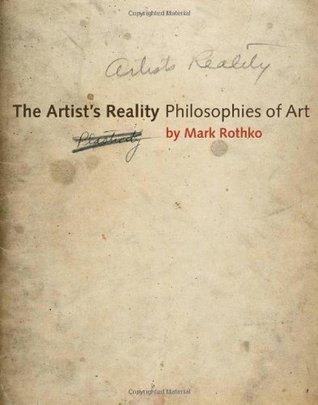
I understand the cover page was trying to be authentic to Rothko's found personal notebook complete with dirt spots and pencil scratchings.
I would think if Rothko knew his notes were to be published posthumously, he would require that one of his colorful paintings be wrapped around the book.
“If one understands, or if one has the sensibility to live in, the particular kind of space to which a painting is committed, then he has obtained the most comprehensive statement of the artist’s attitude toward reality.”
One of countless pearls of artistic insight from Rothko’s unfinished (!) manuscript, and further confirmation that the man was a genius.
Highly recommend if you want to dive into Rothko’s philosophy and understand the mindset behind his work.
The Virgin Mark Rothko: "the art of primitive races"
The Chad Jackson Pollock: "I have always been very impressed with the plastic qualities of American Indian art. The Indians have the true painter’s approach in their capacity to get hold of appropriate images...and in their understanding...their color.... "
most notably, the plate of jelly into which different objects are impressed at various depths, the pressure of air exerting 15 lbs per square inch, the plastic Truth, the impossibility of escapism, the known practice of the child...overly dualistic at times