First published in 1965, A Sense of Where You Are is the literary equivalent of a harmonic convergence, a remarkable confluence of two talents--John McPhee and Bill Bradley--at the beginning of what would prove to be long and distinguished careers. While McPhee would blossom into one of the best nonfiction writers of the last 35 years, Bradley segued from an all-American basketball player at Princeton, to Rhodes Scholar, to NBA star, to three terms in the U.S. Senate. McPhee noticed greatness in Bradley from the start; the book is an extension of a lengthy magazine profile McPhee wrote early in Bradley's senior year; the title comes from Bradley always knowing his position in relation to the basket. What's so noteworthy about the book is the greatness it promised--both for writer and for subject, a greatness both have delivered through the years again and again.
John Angus McPhee is an American writer. He is considered one of the pioneers of creative nonfiction. He is a four-time finalist for the Pulitzer Prize in the category General Nonfiction, and he won that award on the fourth occasion in 1999 for Annals of the Former World (a collection of five books, including two of his previous Pulitzer finalists). In 2008, he received the George Polk Career Award for his "indelible mark on American journalism during his nearly half-century career". Since 1974, McPhee has been the Ferris Professor of Journalism at Princeton University.
If the world hadn't been turned upside down by the pandemic, the NCAA men's basketball championship game would have been played the evening I wrote this. Sports seem suddenly insignificant in the world we now live in, but I miss them all the same. John McPhee's slim but classic basketball book helped fill a small part of that void for me, and it gave me hope for the future.
McPhee's prose is clean and approachable, as always. And the many photos are absolutely terrific. This is his first book, written in 1965, and like many of those that followed, it began as an essay in the pages of THE NEW YORKER. This is where it all began, for both John McPhee and Bill Bradley.
Bearing in mind what was going on in the United States and the world in 1965, it struck me that McPhee makes no mention of race, the war in Vietnam, geopolitics and the Cold War, domestic politics, poverty and injustice, popular culture, the sexual revolution (or sex at all). His setting is a genteel Princeton campus, and his focus is on Princeton's likeable and unassuming All-American campus hero, Bill Bradley. There is a distinct sense of innocence and quaintness here. It all seems a world away.
What McPhee has given us is quite simply a book about one year in the life of one college basketball star, written just months after his senior season was finished. There are no distractions here, and I don't mind.
Bradley was a player who came along once in a generation (if that): special both on and off the court. He was outrageously gifted to be sure, but he was even more outrageously focused, hard-working, and disciplined. And this is what makes McPhee's book really work for me. He gets inside Bradley's head and shows us his thought processes and work habits.
"He not only worked hard on defense, for example, he worked hard on defense when the other team was hopelessly beaten. He did all kinds of things he didn't have to do simply because those were the dimensions of the game."
In a way that very few sports books are able to do, McPhee allowed me to understand what made Bradley tick as an athlete: his vision on the court and his legendary "sense of where you are" (Bradley's phrase that inspired the book's title). McPhee also shows how Bradley approached the game, the practical lessons he learned from both his successes and his failures, his mental agility and flexibility, his selflessness, and his insane drills and practice routines. It's almost impossible to believe the subject of this book was a 21-year-old college student. To say that Bradley was a mature and driven young man doesn't begin to do it justice.
It's good stuff. And it's also surprisingly dramatic. Most of the book is a recounting of Bradley's final season at Princeton, especially the team's Cinderella run in the 1965 NCAA tournament. I knew how that run ended for Bradley and his teammates, but McPhee still had me on the edge of my seat, and it was great fun to follow their improbable quest for a national title. I have a good friend who was at the Final Four in Portland that year as a child. He witnessed Bradley's record-setting heroics, and he still talks about it with awe.
McPhee was a fan himself, not just a reporter: "To me, Bradley's appeal was grounded in the fact that he was a pleasure to watch no matter what was happening on the scoreboard." I know just what he means. That's how I think of my own favorite athletes. Sometimes McPhee seems like he's getting a little too close to his subject, but he always pulls away in time. I never felt like he lost his objectivity or reportorial distance, and his portrait did not strike me as fawning or over-the-top.
I met Bradley briefly at a campaign appearance years ago. I have always liked and respected him as both a player and a public figure. I enjoyed his own basketball memoir, LIFE ON THE RUN. Not sure why it took me so long to get to this, but it was a treat to finally read McPhee's portrait of Bradley as a young student-athlete on the cusp of everything that was to follow for him: his Rhodes scholarship, marriage and fatherhood, Hall of Fame professional basketball career, the U.S. Senate, and all the rest.
Disappointingly fawning, I half-expected to see Bill Bradley’s mother and father as co-writers.
Bill Bradley’s Princeton years were undoubtedly filled with supreme basketball and academic success so I wasn’t expecting any type of exposé but the superlatives were heaped on too heavily for my liking.
McPhee writes brilliantly, and this one is right up there for me with Pat Conroy’s “My Losing Season.” Especially fun after having seen Bradley in person last week. Go Tigers!
I can't exactly say how I came to hear the two of them recommend this book, but when Robert Greene and Paul Graham both say something is good, I don't need to be told a third time. The title comes from a Bill Bradley quote about his hook shot, about how after enough of them his feel for the game was so good that he didn't need to look to see where he was on the court. He just knew. I guess it's probably a bit of the selection bias, but it's fascinating to me to read a biography of someone before they became who they ultimately became. In a way, it gives you a much more honest picture of what made them successful and a lot less opportunities to create that heroic narrative or sense of destiny. Having read most of the research behind Gladwell's Outliers I'm surprised I haven't seen more use of Bradley as an example since he is undoubtedly proof of the concept of deliberative, expert practice.
I just found my old paperback copy of this book. While in high school, I admired Bill Bradley's basketball playing at Princeton a great deal. As a result, I bought this book soon after it came about. This is a good luck at the career of Bradley at Princeton University. Literately written and a fascinating character study. . . .
This is a book that still holds up. More than 30 years ago, my dad told me the anecdote about how, unusually for him, Bill Bradley missed shot after shot in a practice session before declaring—correctly, it turned out—that the hoop was about an inch-and-a-half below regulation. He was that accurate. Then there's the time before a Princeton game at Madison Square Garden when Bradley, not letting his team get psyched out, says the baskets there are 10 feet high there just as they are at home—a line that seems likely to have influenced a nearly identical scene in "Hoosiers." Great stuff. And it's all here, in McPhee's lucid style and delicious phrasing like "subtle felonies" (for physical play) and "Damoclean game" (for Princeton's style of play in foul trouble). 4.5
This is the first of probably many of John McPhee’s books I’ve had the pleasure of reading, and I now see where he gets his reputation for writing creative nonfiction. I am learning to engage with sports more these days, and reading McPhee has done much to help me in my schooling. McPhee makes his subject a living, breathing, sweating person for the reader when they would normally be described using numbers and titles.
Bill Bradley is a fascinating example of what a single person can achieve their lifetime through hard work and dedication. This book describes his collegiate basketball career and life in Princeton university, focusing towards the end of the career especially. As other reviewers have pointed out, unfortunately despite being written by skilled author in McPhee, the book comes across as a hagiography, a completely non-critical description of all the positive aspects of the team, Bradley and the university - which I agree are many, but the book reads as written by an admiring parent, rather than an independent journalist.
There are still some illuminating examples, such as the author describing a game where Bradley looked on as his team went on to a scoring streak against a good opponent, calling it the happiest moment he'd ever had in his life until then: A bona fide athletic start, finding the most happiness in being part of a well-performing team. However, such passages are few and far between, with the most of the short book being used to describe Bradley's playing style and various basketball rivalries this team took part in the 1960s.
The quote I took away from this book was attributed to Bradley himself: "The main thing I have to prevent myself from becoming is disillusioned with transitory success."
He certainly lived up to that, when one reads up on his subsequent life.
Great book! Wilson will kill me for not giving it five stars. (I’m still new to the app so not sure how picky I need to be with five stars)
I thought it was really cool to read about a Princeton legend. Bill Bradley is a fascinating person to read about, and McPhee’s writing is just too good. The combination makes somehow me wish for the days of the set shot
You can tell this is early McPhew. It has the same calm, conversational teaching voice, but it's missing some of the smoothness and gravitas of his other work. There's also a few uncomfortable passages about how "athletic" (e.g., black?) players are changing basketball for the worse, but on the whole a good read.
Bill Bradley was born in a small Missouri town, the son of the town's banker, who taught him discipline, hard work, and a love of learning, and his wife, a fiercely competitive but loving former athlete. Their son was one of the most celebrated schoolboy athletes in Missouri history, and was offered scholarships to over 70 colleges to play basketball. However, he chose to attend Princeton University, which did not provide athletic scholarships and was not known for its basketball team, as he had higher aspirations beyond sports.
He began to play with the varsity team as a sophomore, as freshmen were not allowed to participate in varsity athletics at that time, and immediately became the star player of the team. Princeton quickly became an Eastern basketball powerhouse, culminated by the 1964-65 team in Bradley's senior year, which reached the NCAA Final Four before losing in the national semifinal to Michigan. Bradley's last collegiate game was against Wichita State in the third place game, and Bradley, normally a pass first, shoot second player despite his immense talent, was given free rein by his coach to shoot and score at will. He finished the game with 58 points, which is still the record for the most points scored by an individual player in a Final Four game.
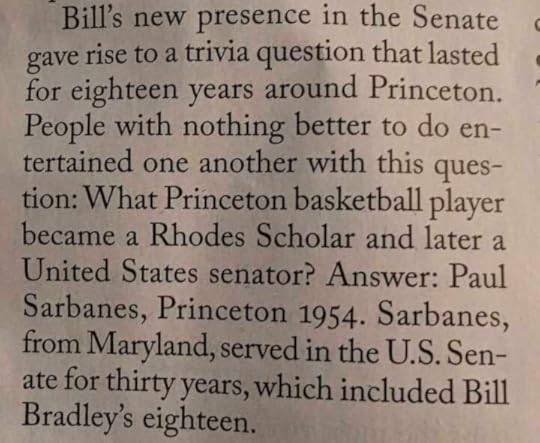
After his collegiate career he attended Oxford on a Rhodes scholarship, and then became an NBA star with the New York Knicks, helping them win two championships, in 1970 and 1973. After his retirement he entered politics, and served as the junior U.S. Senator from New Jersey for three terms. He retired from the Senate in 1997, and ran an unsuccessful campaign for the U.S. presidency in 2000, losing to Al Gore. After that defeat he left politics, but he maintains an active public life, as he has written six nonfiction books and hosts a weekly radio program.
John McPhee grew up in Princeton, as his father served as the physician for the university's athletic department. He attended Princeton, and while working as a writer in New York his father called him to come see a kid on the freshman basketball team, who his father described as possibly the best basketball player, bar none. McPhee attended a game with his father, followed Bradley over his career at Princeton, and wrote his first book about him, in 1965.
A Sense of Where You Are describes Bradley's upbringing in Missouri, and his basketball career at Princeton, including his work ethic and approach to the game, which was far beyond even the best players at his level and allowed him to surpass his modest physical abilities. McPhee also portrays Bradley as a well rounded student athlete who participated fully in campus life and maintained a sense of modesty and humbleness that seems archaic, yet refreshing. The latest edition of the book contains numerous photos of Bradley in action, along with addenda written in 1978 and 1999.
I would highly recommend A Sense of Where You Are for any sports fan, but this would be of interest for anyone who appreciates good journalism or wants to learn about an inspiring and influential man, who has been one of my heroes since I was a child.
This just reminded me of how much I love McPhee's style and also reminded me what it was like in the 1960's to be living in a home where Cazzie Russell was such a house-hold name that it reverberates today with great clangor still today.
This is essentially biographical sketch of a young Bill Bradley just after he left Princeton. Totally basketball, but a glimpse into the workings of the mind nevertheless. In a sense, it is a companion to a piece McPhee wrote within the last year for "The New Yorker" comparing today's senator with the young man who was "the child as father to the man."
I finished A Sense of Where You Are last night. It was a fantastic book and an outstanding story. Bill Bradley lived out a story that every athlete hopes upon, especially to go out on such a positive note. I finished the book and immediately watched Youtube videos of Bradley.
I enjoyed McPhee’s writing style. He’s straightforward, light, metered. There’s an easy rhythm to his words.
I recommend it for sports fans, but also fans of creative non-fiction for the beautiful writing.
A blast of a basketball book, and you'll blast right through it. McPhee is a master- I've read his books on geology, tennis, and now hoops. He has a way of digging into the simplest moments, teasing out the work or factors that went into them, and turning them into fascinating studies in movement. Bill Bradley made a super interesting subject, too. High recommend.
Great portrait of a player through his own eyes. Bill Bradley was a unique player and man and John McPhee capturing some of those moments in action made this book relevant. I think I learned more about the game of basketball from this book than any other source.
This is where I began my strong interest in and respect for John McPhee's writing. He paints a lyrical portrait of young Bill Bradley that piqued my interest in more of his writing.
I have no interest in basketball whatsoever, but this book kept me hooked. I'm trying to read all of John McPhee's books this year, and this was a wonderful start.
Read this book because the author is well-known to be a writing ninja. I was duly impressed. The writing is very clean. The story always kept moving and was interesting.
O livre descreve um mero ano - o ano de finalista na Faculdade de Princeton - de Bill Bradley, à data, o melhor jogador de basket amador dos anos 60.
Com 20 anos, já era medalha de ouro olímpica e a vida ainda o iria levar à nba e, mais tarde, a senador, mas nada disso importa nesta obra.
Importa sim aquela época, inocente e pura, junto dos amigos de faculdade, capitão, estrela daquela e de outras faculdades tal eram as suas exibições.
Importa também sentir a definição de grandeza, como poucas obras conseguiram.
Há pessoas maiores que a vida. Tinha sentido isso no documentário Last Dance, sobre Michael Jordan e voltei a senti-lo quando pousei o livro.
De vez em quando, em algum desporto, em algum lugar, surge um jogador incomparavelmente mais talentoso do que os outros. Quando, como foi o caso, ainda é o mais exigente consigo, o mais disciplinado, o que mais horas treina e o que mais puxa por todos os membros da equipa, tornando todos melhores, testemunhamos grandeza.
A este propósito não é possível esquecer, como disse Rogério Casanova, na crítica a este livro: "No meu parágrafo preferido do melhor livro de sempre sobre desporto (A Sense of Where You Are), John McPhee descreve uma sessão de treino de Bill Bradley, futuro senador americano, mas na altura ainda um jovem prodígio da equipa de basquetebol da Universidade de Princeton. O recinto da Universidade fechara para obras, e a sessão realiza-se num liceu vizinho. Bradley começa o treino da maneira habitual: uma série de lançamentos em suspensão, a quatro metros do cesto. Nas seis primeiras tentativas, a bola bate na parte de trás do aro e não entra. Após uma pausa e um "ajustamento mental", converte os cinco lançamentos seguintes e desabafa com McPhee que o cesto parece uns três centímetros e meio mais baixo do que em Princeton. Depois do treino, McPhee pega num escadote e numa fita métrica e vai confirmar a suspeita: o cesto estava três centímetros abaixo da altura regulamentar."
Grandeza, digo eu.
Realço, por fim, que este homem que bateu recordes na nba e foi eleito três vezes para o senado, recorda o pior momento da sua vida quando, aos 20 anos, no intervalo, não soube motivar suficientemente os colegas para darem a volta ao resultado de um jogo das meias finais.
Um homem que sempre soube o que era importante.
This entire review has been hidden because of spoilers.
I bought this book mainly out of a completionist impulse-- John McPhee is one of my favorite authors ever, and this was his very first book. So I knew it would on some level feel like juvenalia, and this met with my expectations. McPhee's portrait of Bill Bradley is so praiseful that at times it gets cloying, and I don't really think the structure of this book is as airtight as his later, seemingly more finely worked, books. This book was adapted out of a profile written for the New Yorker, and it still very much feels like the profile (which is included as the central chapter of the text, without any revision) with some extra appendices tacked on before and after.
I think if the profile material had been worked over and incorporated into his later reporting I would have enjoyed the book more, but as is, it felt just like a WASP panegyric. Although Bill Bradley is admirable in his exceptional, humble, non-showboating team playing, I can't help but feel when it comes to biography that I'm more drawn to the showboats, the egoists, those who desperately want to be heard and understood and dramatically rise above the rest of the crop. Maybe those guys aren't better people, but they're more compelling. It just makes for better writing than Bradley's weirdly ascetic need to just be the best that he can be without making too much of a spectacle of himself.
That all being said I liked McPhee's sportscasting style near the end (perfected in Levels of the Game) and was pageturning to see how the tournaments panned out. And of course, small genius biographical details shine through from time to time. It's a quick and basically harmless read worth looking at if you're a fan of the author, but not before you look at at least like 5 other books by him.
I read this book in high school, when every basketball fan in America knew about Bill Bradley. It was not long after he had won an Olympic gold medal, been named an all-American, finished his storied career at Princeton as the best Ivy League basketball star ever, and then passed on an immediate career with the Knicks to spend almost two years at Oxford as a Rhodes scholar (before entering the Air Force Reserves during the Vietnam War).
Even before McPhee's glorifying portrait of the young man, it was hard not to be impressed, even awed, by Bradley. His rather average decade as a Knick was a surprise; his later career as a New Jersey senator for two decades was not. It seems likely that this hagiographic account of the athlete's unusual combination of talent and discipline contributed in no small degree to his subsequent fame.
John McPhee grew up at Princeton and attended the university, where his father was the trainer for the college athletes. It was a phone call tip from father to son that started the relationship between writer and athlete that led first to a New Yorker article and then to the book (McPhee's first), simply expanding and extending that earlier profile.
Unlike most of his subsequent writing, for this one McPhee chose a subject already famous. In some ways that made his job easier. His writing did not need to create interest in his topic, manufacture highlights for the story, or puzzle out a starting or ending point. Yet it was obvious to me even as a teen journalist that in this pairing the talent of Bradley was matched by the skill of his publicist. McPhee would soon show that he could make any subject captivating. In this early work he showed he could do justice to the greatest as well.
I did not enjoy this as much as other John McPhee books and I think it's 1) Translating the subject matter to writing and 2) The relevance of the current subject matter. I love watching basketball so I expected to love this book, but reading about basketball is just a whole different deal for me (maybe I'm too visual to get a lot out of reading activity vs. watching it). I also feel the sport has changed so much since the novel. There is no way McPhee, writing in the past, could have framed the revolutionary nature of LeBron's, Jordan's, Magic's, or Curry's stardom but nonetheless a modern reading like mine will have those narratives and stories in mind. McPhee also drifts a little bit into the classic trap of writing about white athletes - assuming that they're the smartest ones in the game and win on intelligence and hard work over natural athleticism.
I wasn't very keen on the subject of Bradley, either. He is obviously very driven, talented and intelligent. But I find stories about Ivy League gunners really off-putting. I appreciate his skills and passion on the court, which a game purely played for the sake of itself, without repercussions and controls on others. I do not appreciate this mindset that you're allowed to control the universe just because you're driven to do so.
Impressive Subject. I really enjoyed reading about Bill Bradley. He seems like a super talented individual worthy of the book. My only wish is that the author would have told it with better reflection and more insight as it reads more like a newspaper article/magazine story than a narrative. There aren’t many examples of Bill leading other men except that he was very good at basketball. Maybe it’s an unfair criticism but McPhee tells us again and again how great Bill is without letting examples make our own decision.
Basketball for dummies. I also enjoyed the definitions that were included on the set shots and hook shots. I could really tell the story was dated but appreciated the level of interest that Bill’s talent invoked, seemingly across the country. I was a bit disappointed in the game logs as they read more like a box score than a dramatic event.
Hindsight. I’m also led to wonder why Bill Bradley was the subject in the first place. Had to be because of his basketball prowess but him becoming a US Senator and a serious Presidential candidate leads my cynical mind to believe maybe this was his plan all along. Hire an author to write about his life to help enable success beyond his basketball career. I don’t think that happened but a bit more context of his talent outside of the court would have been refreshing.
This entire review has been hidden because of spoilers.
Classic sports book is actually built around a long mid-60s profile McPhee did of college hoops star Bradley (and which I've read before). Very short book, but McPhee is a prose master and Bradley a fascinating subject: brainy, driven, and amazingly talented. (He later played on Knicks championship squads and is in the NBA hall of fame -- not to mention his years as a Democratic U.S. Senator from New Jersey.) McPhee details the physical attributes, obsessive training, and court awareness (hence the title) that make Bradley the player he was. (Favorite fact: Bradley's almost superhuman peripheral vision, which McPhee quantifies with help from an optometrist.) Points deducted for authorial old-fartiness: McPhee's taste in hoopsters is very much old-school, and he explicitly condemns the new game that's being played in the 1960s, especially the reliance on big men in the middle to the detriment of strategy. (Bizarrely, though he name-checks NBA stars like Oscar Robertson, he doesn't even mention Wilt Chamberlain, who was by this time the game's biggest name!) Bradley, needless to say, is on McPhee's good side in this matter; the detailed accounts of key games is thrilling.
I had previously read about a third of McPhee's 30-plus books but had somehow missed this one, the very first, published in 1965. When a new acquaintance who had worked with the author at Princeton offered to lend me his copy, I was delighted to fill in this gap in my reading. "A Sense of Where You Are" proved to be an enjoyable bookend to McPhee's "Draft No. 4" (2017), at the time his most recent book, in which he had collected a career's worth of writing advice drawn from his work for the New Yorker and his time in the classroom. "A Sense of Where You Are" shows many of the hallmarks of McPhee's future output, including an obsessive curiosity about how things work (in this case Bradley's perfecting of various shots from all over the court) and experimenting with a nonlinear timeline. Bradley, then in his senior year, was a fine match for McPhee in demonstrating the abundant promise that would lead to his being a Rhodes scholar, an NBA Hall of Famer, a three-term U.S. senator from New Jersey, and a worthy but, alas for us, failed presidential candidate.
I was expecting more. John McPhee has been hyped up, so my expectations were high. I did enjoy his prose, which reminded me of Hemingway.
As a basketball fan, I didn't learn much from this book. I did leave wondering how Bill Bradley made the hall of fame. His stats don't jump out. After reading the book, I'm guessing his impact wasn't captured in the stats, and he was a critical driver in the Knicks' two championships.
Basketball in the 60s was quite different from the game we know today, but also similar. It's interesting to see how things change over time and sit through lines you can follow throughout history.
For all of Bill's gifts and achievements, it would have been nice to see him realize the limiting nature of his principles and value of discipline. These values helped him achieve, but this narrow view limited the expansiveness of his talents. That is what I gleaned from the book, but concede this may not have actually been the case.
and thought, what the hell, let's start off 2024 on a McPhee kick.
four stars as a character study of Bill Bradley, two stars as a work of sports journalism. it's a McPhee joint, so there's a lot of fun errata and moments along the way - not unenjoyable to read. but! this is a McPhee joint! we worship at his altar for all things Structure and Form. and this is a mess! arguably it coheres toward the latter third, as Princeton makes a run at the national championship game, but i double dog dare you to map out the superstructure of the first chunk of this one. it's a rambling mess! two stars, graded on a curve, but if you were making a Vulture ranking of the collected McPhee works, this one definitely clocks in down toward the bottom.
A Sense of Where You Are is a short book that consists of a profile that author John McPhee wrote for the New Yorker magazine in 1964 about Bill Bradley's rise to basketball stardom at Princeton University, and 2 subsequently written chapters that detail Bradley's triumphant senior season.
It's fine.
The New Yorker article was clearly written at a time in which basketball was not nearly as popular or ubiquitous as it is today, and thus McPhee spends a lot of time and space explaining the game itself, and trying to describe how Bradley excels at it. It's not great.
The subsequent chapters are more interesting, as they reveal more about Bradley's life before attending Princeton and how he became the star he became. But overall, the book doesn't have a great deal to commend... it's just fine.
This is a re-read on my part, actually (not a lot to do in this quarantine), it's a fantastic book that looks at Bill Bradley's career at Princeton. He was one of the most touted basketball players to come out of college in the mid-Sixties, a "great white hope" in the eyes of many (misguided) souls, and he went on to have a great career in the NBA with the Knicks. Long before ESPN, the idea of profiling a college player and centering an entire book around him might have seemed ridiculous or in poor taste. But John McPhee, a true fan of the sport, was intrigued by what he heard about Bradley's ability, and he wanted to know what made the young man from Crystal City, Missouri, tick. This is a fantastic read for sports fans, and I was glad to revisit it.