

What do you think?

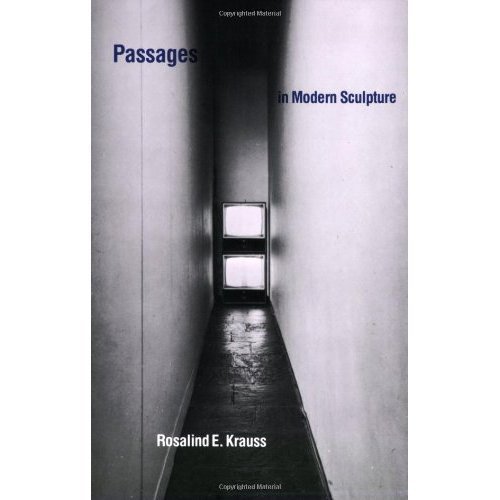
Passages in Modern Sculpture
Studies major works by important sculptors since Rodin in the light of different approaches to general sculptural issues to reveal the logical progressions from nineteenth-century figurative works to the conceptual work of the present.
308 pages, Paperback
First published September 30, 1977
About the author
Rosalind E. Krauss
74 books134 followersAmerican art critic, professor, and theorist who is based at Columbia University, teaching Modern Art and Theory.
Ratings & Reviews
Friends & Following
Create a free account to discover what your friends think of this book!
Community Reviews
Displaying 1 - 19 of 19 reviews

January 7, 2023
The fine arts in Western cultures had, for thousands of years, been conservative in form and content. Most art, especially in western Europe, was limited to themes of Christianity and judgments of quality were based largely on the mastery of technique. Things loosened up during the Renaissance and Enlightenment, and occasionally some oddball like Hieronymus Bosch made something so different that no one could comprehend it. Then Modernism came along and everything went haywire. Rosalind E. Krauss, armed with a solid background in philosophy and art criticism, takes a stab at making sense out of the course that modern sculpture took in her early work called Passages in Modern Sculpture. Through the construction of her own theory, she hones the chaos of modernism into semi-coherent steps along a continuum progressing towards an unknown destination.
The foundation of Krauss’s theory is the phenomenology of Edmund Husserl. On the principle of the transcendent I, meaning that an individual’s true nature is not only located subjectively inside their own consciousness but rather is a meeting ground between their own self-perception and the perceptions of others, she builds a critical theory around the idea that modern art has no inherent meaning. In other words, the meaning of art is created by the viewer as they perceive and interact with that art. Pre-modern concepts of symbolism or allegory no longer apply with the avant-garde art movement of the Modernism period.
She also approaches art through the mediums of time and space. Pre-modernist sculpture was about the perfection of physical form whether the work be a three-dimensional statue or a two-dimensional work set against a background relief while suggesting a third dimension. Also, pre-modern sculpture mostly appeared in media res, representing a point in time along a narrative structure, implying the existence of moments before and after that point, suggested to the viewer and not directly experienced. Modernist sculpture broke with these constructs of time and space to create sculpture requiring different frames of reference for interpretation.
The fun really begins when Krauss applies her theory to art objects. She begins with Rodin, then moves on to the Futurists who expose the core of their objects by penetrating their surfaces and the Constructivists who reveal the interior of their sculptures by displacing outer parts, making surfaces that only cover fragments of the interior, or even using transparent materials. The ubiquitous readymades of Marcel Duchamp are analyzed to show a disconnect between the artists’ subjectivity and the art object itself which no longer represents their subjective life. Brancusi eradicates the inner core of sculpture by mi minimalizing the constituent parts of the surface. The Surrealists transform everyday objects into nonsense to reveal hidden unconscious contents and so on.
Her analysis is engaging and logical up to this point. When she introduces her concept of theatricality into the critique, it begins to wear a little thin. She brings theater into the discussion to show how sculpture was used by modernists to break down the barrier between performers and audience, what Antonin Artaud called the destruction of the fourth wall. But this idea barely seems to fit with what she is saying considering that it is a stretch to redefine performers on stage as art objects moving among other art objects. What she is trying to do is introduce the concept of movement into the study and analysis of sculpture. While previously sculpture had been static and unmoving, modern artists introduced the element of movable parts on one hand, as in the case of the mobiles of George Segal, or art that alters in appearance as the viewer moves around it as in the work of Anthony Caro. But the connection she makes is weak and confusing. This is partly due to her attempt at describing non-representational shapes that have no signifiers to properly correspond to the form they hold in physical space. Her argument also suffers because she introduces a large number of works that she never analyzes past the initial mention in the text.
The writing picks up again after that as she moves into postmodernist movements like pop art, minimalism, abstract expressionism, and earthworks. What this all builds up to is the concept of decentralization in art, an idea that originated in Freud’s theory of the decentralization of the ego in modern psychology, and reached its full expression in postmodern concepts of the interplay of surfaces or the lack of inner meaning, a state where symbols no longer symbolize anything unless the receiver of the symbol assigns a meaning to it. Does this critique of artistic progression run parallel to the experience of humanity in the twentieth century or does art now inhabit a space of its own that is disconnected from reality and impossible to interpret? That discussion would take a whole other book to explore, but I am sure Krauss would continue to insist that any art can be interpreted if we choose to put the creative effort into making it mean something, no matter how bewildering it may become.
The verity of Passages in Modern Sculpture is open to debate. Whether the order that Rosalind Krauss explicates is there or whether it is a construction of her own devise that she imposes on the chaos is an open question. There is something quite arbitrary in how she forms her argument and chooses art objects to support it. But if we follow the theory correctly, that is the whole point. It is up to us to create meaning. It isn’t handed out or spoonfed to us the way ultimate religious truths are. It is more a matter of asking the right questions in the first place and on that note, this book is worthwhile for consideration.
The foundation of Krauss’s theory is the phenomenology of Edmund Husserl. On the principle of the transcendent I, meaning that an individual’s true nature is not only located subjectively inside their own consciousness but rather is a meeting ground between their own self-perception and the perceptions of others, she builds a critical theory around the idea that modern art has no inherent meaning. In other words, the meaning of art is created by the viewer as they perceive and interact with that art. Pre-modern concepts of symbolism or allegory no longer apply with the avant-garde art movement of the Modernism period.
She also approaches art through the mediums of time and space. Pre-modernist sculpture was about the perfection of physical form whether the work be a three-dimensional statue or a two-dimensional work set against a background relief while suggesting a third dimension. Also, pre-modern sculpture mostly appeared in media res, representing a point in time along a narrative structure, implying the existence of moments before and after that point, suggested to the viewer and not directly experienced. Modernist sculpture broke with these constructs of time and space to create sculpture requiring different frames of reference for interpretation.
The fun really begins when Krauss applies her theory to art objects. She begins with Rodin, then moves on to the Futurists who expose the core of their objects by penetrating their surfaces and the Constructivists who reveal the interior of their sculptures by displacing outer parts, making surfaces that only cover fragments of the interior, or even using transparent materials. The ubiquitous readymades of Marcel Duchamp are analyzed to show a disconnect between the artists’ subjectivity and the art object itself which no longer represents their subjective life. Brancusi eradicates the inner core of sculpture by mi minimalizing the constituent parts of the surface. The Surrealists transform everyday objects into nonsense to reveal hidden unconscious contents and so on.
Her analysis is engaging and logical up to this point. When she introduces her concept of theatricality into the critique, it begins to wear a little thin. She brings theater into the discussion to show how sculpture was used by modernists to break down the barrier between performers and audience, what Antonin Artaud called the destruction of the fourth wall. But this idea barely seems to fit with what she is saying considering that it is a stretch to redefine performers on stage as art objects moving among other art objects. What she is trying to do is introduce the concept of movement into the study and analysis of sculpture. While previously sculpture had been static and unmoving, modern artists introduced the element of movable parts on one hand, as in the case of the mobiles of George Segal, or art that alters in appearance as the viewer moves around it as in the work of Anthony Caro. But the connection she makes is weak and confusing. This is partly due to her attempt at describing non-representational shapes that have no signifiers to properly correspond to the form they hold in physical space. Her argument also suffers because she introduces a large number of works that she never analyzes past the initial mention in the text.
The writing picks up again after that as she moves into postmodernist movements like pop art, minimalism, abstract expressionism, and earthworks. What this all builds up to is the concept of decentralization in art, an idea that originated in Freud’s theory of the decentralization of the ego in modern psychology, and reached its full expression in postmodern concepts of the interplay of surfaces or the lack of inner meaning, a state where symbols no longer symbolize anything unless the receiver of the symbol assigns a meaning to it. Does this critique of artistic progression run parallel to the experience of humanity in the twentieth century or does art now inhabit a space of its own that is disconnected from reality and impossible to interpret? That discussion would take a whole other book to explore, but I am sure Krauss would continue to insist that any art can be interpreted if we choose to put the creative effort into making it mean something, no matter how bewildering it may become.
The verity of Passages in Modern Sculpture is open to debate. Whether the order that Rosalind Krauss explicates is there or whether it is a construction of her own devise that she imposes on the chaos is an open question. There is something quite arbitrary in how she forms her argument and chooses art objects to support it. But if we follow the theory correctly, that is the whole point. It is up to us to create meaning. It isn’t handed out or spoonfed to us the way ultimate religious truths are. It is more a matter of asking the right questions in the first place and on that note, this book is worthwhile for consideration.
August 8, 2007
Krauss's first major art theory book - kind of a generalized survey of the evolution of contemporary sculptures. Much more readable than most of her later work. Some of the essays are excellent - really great comparison between Brancusi and Duchamp, and the essay at the end about earthworks is great too.
April 10, 2021
Connecting Smithson’s Spiral Jetty and Laocoon from the outset, Krauss threads her argument almost perfectly throughout (some minor gaps - mostly with her part about happenings, but that’s ok). Very formalist, but hey we are reading Krauss here.

August 21, 2025
Reading Rosalind Krauss’ writing was like finding the piece of theory that was missing from my secondary art education in sculpture 10 years ago. It felt like the professors expected us to critique and to create using this basis of modern sculpture theory without ever giving us the text. There were a lot of male texts given out as reading though… the writers and artists that she references in this book are mostly male. This is absolutely going to be one of my go-to references when I’m making and situating my work in the context of modern art.

November 17, 2021
Passages in Modern Sculpture
By Rosalind E. Krauss
Distinguished art historian and critic Rosalind Krauss analyzes with exceptional clarity and insight the major works that have led 20th century sculpture from the traditional and figurative to the revolutionary conceptual art of the 1970s—an art which has developed a new 'syntax' that discards 'narrative' for instantaneous impact and boldly breaks new ground. Beginning with a penetrating study of Rodin's modernity in rejecting 'narrative' in his 'The Gates of Hell,' she moves successively through detailed examinations of futurism, constructivism, Duchamps' 'readymades,' Brancusi, David Smith's 'Tanktotem,' sculptural realism, and the introduction of light, motion, and theatrical elements into sculpture by Picabia, Calder, Oldenburg, and others right up to younger sculptors like Carl Andre, Blochner, and others [including Robert Morris, Don Judd, Richard Serra, Sol Le Witt, Robert Smithson, and Michael Heizer]. As critic and theorist, Krauss makes demands that will challenge even the most sophisticated.
By Rosalind E. Krauss
Distinguished art historian and critic Rosalind Krauss analyzes with exceptional clarity and insight the major works that have led 20th century sculpture from the traditional and figurative to the revolutionary conceptual art of the 1970s—an art which has developed a new 'syntax' that discards 'narrative' for instantaneous impact and boldly breaks new ground. Beginning with a penetrating study of Rodin's modernity in rejecting 'narrative' in his 'The Gates of Hell,' she moves successively through detailed examinations of futurism, constructivism, Duchamps' 'readymades,' Brancusi, David Smith's 'Tanktotem,' sculptural realism, and the introduction of light, motion, and theatrical elements into sculpture by Picabia, Calder, Oldenburg, and others right up to younger sculptors like Carl Andre, Blochner, and others [including Robert Morris, Don Judd, Richard Serra, Sol Le Witt, Robert Smithson, and Michael Heizer]. As critic and theorist, Krauss makes demands that will challenge even the most sophisticated.

December 14, 2021
Het hoeft geen geheim te zijn dat ik erg twijfel tussen de drie en de vier sterren. Dit is een bij vlagen heel prikkelend boek voor wie zich interesseert in moderne en hedendaagse beeldhouwkunst - en laat ik net in een ontzettende sculptuurfase zitten - dat je op nieuwe manieren naar beelden laat kijken. Haar opmerkingen over reliëfs en Rodin spookten in elk geval door mijn hoofd terwijl ik afgelopen zondag Filip Vervaets indringende expositie in de Brakke Grond zag. Maar een ander groot deel van het boek staat vol met de moeilijkdoenerij die ook Krauss' boek over Cindy Sherman bijna onleesbaar maakt. Ik moest me bij vlagen toch wel door het boek worstelen, al wachtte er vaak toch wel een mooie beloning. Maar al met al was dit boek toch iets te onbevredigend om toch voor de vier sterren te gaan.
Maar hé, zeg eens eerlijk, dit is het internet en wie boeit het verder of ik nu drie of vier sterren geef?
Maar hé, zeg eens eerlijk, dit is het internet en wie boeit het verder of ik nu drie of vier sterren geef?

February 26, 2025
Read the translated version in Italian. A good introduction to the art world and philosophies of the 20th century in general, and not just sculpture. Like most academic texts describing artworks (especially contemporary ones towards the end), it reaches a point where the description in question is overly complicated and philosophical that it can actually be applied to almost any other work than the one it's talking about and still somehow fit, which detracts from its relevance in the first place.
The last chapters from surrealism onwards are better read - in my opinion - accompanied by a simpler introduction. For my class we were reading it alongside "Art since 1900" by Hal Foster and other authors, which helped fill in many of the gaps I encountered in "Passages".
The last chapters from surrealism onwards are better read - in my opinion - accompanied by a simpler introduction. For my class we were reading it alongside "Art since 1900" by Hal Foster and other authors, which helped fill in many of the gaps I encountered in "Passages".
January 31, 2023
Okuması kısmen zor olan bu kitabın Türkçe çevirisi oldukça kötü, orijinali İngilizce olan kitaptaki eser isimlerini Fransızca olarak yazmak, alanlara dair bazı terimleri ve alıntılardaki kelimeleri yanlış çevirmek gibi hataları var. Çeviride cümleler devrik ve anlam bozuklukları var, sıklıkla erken google translate çevirisi okur gibi hissettiriyor.
May 26, 2024
Amazing. Beautifully written and truly insightful. Displays a really-well-formed knowledge of history of art and abstract, academic philosophical argumentation along with a sort of "lived" intuition to connect the field of perception of the works with intangible notions — no need to think of them as separate moments, neither logically nor chronologically.

May 3, 2020
This is very nice outlook on sculpture from the early 1900's to the 60's. It's nicely illustrated and the content is somewhat elucidative.

Want to Read
June 21, 2023It is a good book

December 18, 2024
Essential

July 31, 2020
more didactic and textbook-y than her usual stuff, and slightly more accessible, actually. not everything in here is as blindingly brilliant as my (current) favorite essay of hers, "sculpture in the expanded field," and certain analogies (e.g. eisenstein) stretch a little too thin to convince (very little about oldenburg stuck its landing, either. theater to oldenburg, then oldenburg to happenings?? i'd understand if she touched on his involvement with the form and figures like Kaprow, but she only surveyed his sculptures, so i'm not sure why he wasn't lumped in with pop art in the final chapter), but overall this is a solid capsule of art criticism in the 70s. essential reading for modern art aficionados and art history students.
July 3, 2023
This was a required book to read for one of my college classes, but surprisingly Krauss has become one of my favorite writers. Unlike a lot of other in depth books on art, Krauss is able to break down her arguments into actual digestible chapters. While reading her book I actually felt like I knew what was being said and didn’t have to take constant double takes to try and grasp where her arguments were going.
I understand now why my professor picked her book for required reading, and have now added more of Krauss’ writings to my shelf.
I understand now why my professor picked her book for required reading, and have now added more of Krauss’ writings to my shelf.
Read
August 28, 2012Amazing book on the development of modern sculpture, beginning with Rodin and Brancusi and ending with Serra, Heizer and Smithson. Krauss has a great way of illuminating the pertinent ideas, as well the formal characteristics of the sculpture. Superior to any current art criticism I've read lately.

July 23, 2007
This is one of the most full of shit books I've ever read.
February 22, 2010
i don't know how many times i've read chapter 7 (a new syntax for sculpture)

Read
May 17, 2018great book that looks at modern sculpture and its suspicion toward narrative, as well as the new modes of temporality and spatiality it initiates
i also really appreciated how the book tried to include images of almost all the works mentioned by Krauss
i also really appreciated how the book tried to include images of almost all the works mentioned by Krauss
Displaying 1 - 19 of 19 reviews