Jump to ratings and reviews
Rate this book

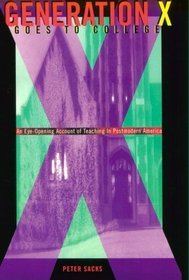
Generation X Goes to College ,An Eye-Opening Account of Teaching in Postmodern America 1996 publication

Rate this book
This is an incredible, amusing, horrifying, yet true story, in which all names have been changed to protect the guilty. It tells how the author, a journalist turned college professor, came face to face with Generation jaded, unachieving, highly demanding yet lacking any respect for standards or intelligence. These insouciant scholars wore bored looks, ample attitudes, and reversed baseball caps. They expected to earn top grades by just showing up in class, which they interrupted with their portable TVs, cellular phones, or personal pagers. For his own survival as a teacher, Sacks decided to play a bizarre, cynical The Sandbox Experiment, in which he catered to the whims of his students as though they were kindergartners. It Sacks became a great success as a 'teacher', got tenure, and now continues to 'teach' at the strange, appalling institution he calls 'The College'.

Paperback

First published May 12, 1996

2 people are currently reading
48 people want to read

About the author

Peter Sacks

8 books19 followers
Peter Sacks is an award-winning author and social critic. He’s the author of LIBERTYLAND, a philosophical thriller, just published in February. His book is TEARING DOWN THE GATES: Confronting The Class Divide In American Education (University of California Press) which won the Frederic W. Ness Book Award from the Association of American Colleges and Universities. He is also the author of STANDARDIZED MINDS: The High Price Of America’s Testing Culture And What We Can Do To Change It (DaCapo Press).

His articles and essays on education have appeared in a variety of publications including: The Huffington Post, The Nation, The Boston Review, and The New York Times. Several have won awards including a Pulitzer Prize nomination. His lectures include appearances at the Harvard Club, University of Notre Dame, and Columbia University.


Ratings & Reviews

What do you think?
Rate this book

Friends & Following

Create a free account to discover what your friends think of this book!

Community Reviews

5 stars
11 (22%)
4 stars
11 (22%)
3 stars
16 (32%)
2 stars
11 (22%)
1 star
1 (2%)
Displaying 1 - 10 of 10 reviews
Profile Image for Katie.
1,551 reviews28 followers
December 3, 2014
I was really hoping to read about someone in a similar situation to me, who did an interesting experiment, and then bucked the system. I got part of that, but not the most important - the system bucking. Dr. Sacks was a tenure track professor getting poor student evaluations who decided to try an experiment. He become an educator entertainer (my words, not his) and the results were....not surprising. His evaluations improved and students loved him. But they weren't learning, as he freely admitted and they were not getting the grades they had earned. They were getting much much higher grades, in fact.

He got tenure.

He didn't really go back to his high (or really just realistic) standards but he did stop pandering completely to them. And guess what? His evaluations suffered.

While I loved this book,really loved it in fact, I was hoping there would be a happier ending. More suggestions for tangible ways that individuals can curtail this dumbing down, the consumerist mentality of college kids, and the drive toward mediocrity (his words, not mine.). But instead, the end was far more gloomy, yet very realistic. The problem is bigger than the individual professor level, bigger than the college level, bigger even than the high school level. It's at the point where we need major reform at ALL levels. Including the students, who are taught to expect the grades they "pay for" and not those they earn.

I found myself shaking my head and nodding in agreement throughout the book. I was basically commiserating. Sadly, this was written 18 years ago and it's still the same story today. I'm trying to remain optimistic in spite of that.
Profile Image for Gregg.
507 reviews24 followers
February 20, 2023
Right now, this country is awash in yet another debate about “What’s to be done with these darn kids?” After two-plus years of remote learning, we’re told the kids are not all right, that their attention spans are shot, they’re years behind in math and reading, they’re addicted to phones and not going to church, they’re depressed, asocial, adrift, unseen and generally doomed. When have we ever seen a crisis like this before?

Well, as it happens, those of us with long memories will recall the authors of the 1975 Trilateral Commission report The Crisis of Democracy wringing their hands over how to engage and control a generation of seemingly disaffected youth currently attending the nation’s public schools. Then there was Allan Bloom’s 1988 bestseller The Closing of the American Mind, in which he argued that the nation’s youth were slouching towards hedonism and eschewing the Great Texts and Great Ideas of Western Civilization.

Or you could go to Mark Bauerlein’s 2008 book The Dumbest Generation and wallow in his thesis concerning the digital age’s stupefying effect on millennials. You can even read his new, postpandemic thoughts on EdWeek.org about how they’re “in a bubble of adolescence, alone in the bedroom” but without “a humanities formation that would make them feel they live in a wondrous stream of civilization.”

And let’s not forget corporate consultant Simon Sinek’s viral TED Talk about “the millennial question,” where he delivers, in a tone equal parts smarmy and officious, his ultimate judgment: Millennials grew up on phones and instant Amazon deliveries, and as a result they’re miserable in the workplace.

None of these critiques should be completely dismissed, of course. Our nation’s youth are in a state of crisis, and the education establishment is predictably stymied. I’m a teacher, and I’ve had maybe the most trying years of my career lately. I’ve heard of no better approach than to figure out where the nation's students are, meet them there, and help them progress. This is a prescription that defies standardization and raises the hackles of the crowd that was booing professional educators before the pandemic, cheering them on during the initial outbreak, and has gone back to script ever since with jeremiad after jeremiad ever since. Still, as Mark Levin noted in a critique of Sinek’s talk, dissecting the youth of the world and bemoaning their state of affairs is nothing new. “Baby boomers were dubbed the "Me Generation" because they were considered lazy and narcissistic,” he rants. “The goddamn ancient Greeks complained about their uppity kids. If every generation was as lazy as the previous generation claimed, we'd have already devolved into moss-covered sloth people.”

So when some joker left an ISU student booklet from 2004 on my desk at school, open to an essay titled “Culture Shock: Generation X Goes to College,” my first instinct was to toss it in the trash. More of the same? No thank you.

But then I flipped through it. Peter Sacks (a pseudonym), a teacher at an unnamed community college out west, published the book in 1996, in which he chronicles his three or four years teaching, or trying to teach, Gen X college students. That’s me. That’s my cohort. I graduated in 1998; I could easily have been one of his, if I’d been in California, credit-starved and appropriately flanneled and whatevered for the Clinton era.

Could it be, I wondered, scouring the Internet for a used copy and giving up my shipping address, that these generational complaints have a pattern? Could this guy have something to teach us today about the state of affairs we’re in? Could it be that the blind (Gen X) are leading the blind (Gen Alpha) and we’re frustrated and failing because we ourselves failed? That would be the red pill of all red pills would it not?

Alas, not quite. Sacks’ book reads much like an academic kids-bashing tome: replace “X-er” with “millennial” and we see that much of this ground has been trodden before. Some observations of him are particularly resonant and painful today, but most of it is balm for the boomers. “It wasn’t me who was the problem,” he says (literally) a third through the text. It was “a culture of young people who were born and bred to sit back and enjoy the spectacle that engulfed them.”

Seymour Skinner, you have found your match.

The book is in two parts. In the first, Sacks tells the story of how he jettisoned his newspaper reporting career to take a job out west in a community college while his partner pursued her medical residency. Sacks was tasked with teaching a journalism survey course and a writing course, three sections, five days a week. Since he can’t produce enough material to lecture nonstop, he concocts research projects and oral reports to, as he puts it, “survive.” Before long, he runs into trouble: students are unprepared, unmotivated, apathetic, downright hostile to what he’s teaching and how he’s teaching. He gets The Look. As in “Convince me I should pay attention to you.”

He gets attitude, cajoling, excuses. “Maybe we can work something out?”

And he has to eventually lower his standards enough that the students are pleased with their grades and the entertainment value of the course that they give him decent evaluations, which determine whether or not he gets tenure. Which he does.

Some of Sacks’ proclamations are utterly head-scratching. He doesn’t know what the modes of rhetoric are; he thinks that “critical thinking” is an academic buzzword even as he continually bemoans his students’ inability to practice it; he assigns a book a week, including texts like Manufacturing Consent, and is bewildered that the students who struggle with reading and seeing the value of media analysis can’t absorb the 482-page study with ease.

He defends “elite” colleges as above-mediocre, claiming that

“If the elites weren’t taught how to think and how to distinguish truth from lies, then the result is somewhat less effective government bureaucracies and Fortune 500 corporations…If ordinary people at ordinary colleges aren’t expected to think critically and take responsibility for themselves, then they will come dupes of the likes of Rush Limbaugh, Louis Farrakhan, and other popular demagogues who prosper from widespread ignorance and their ability to manipulate public opinion. I’m afraid that the state of higher education for the working classes is a much better indicator of where the country is headed than George Bush’s alma mater.”


I know I’ve got the hindsight of history to my advantage, but come on. Who wants to tell him about George W. Bush’s plaudits for that fat piece of shit upon his death? Who wants to tell him about the esteemed Senator Cruz’s stance on climate change (re: it’s fake)?

But I can’t completely throw out Sacks’ observations about the culture of entitlement and expectation of entertainment with the Class of 1996. It’s all too familiar to anyone who’s stuck their head into a classroom over the past thirty years. Yep, commercialism and Saturday morning cartoons sure did a job on us, didn’t they, professor? Sorry.

The second part of the book is an argument that postmodernism, with its truth-is-a-point-of-view approach to thinking and reasoning, is how Gen X got so addled. This is an argument I’ve seen before, and I simply cannot buy it the way it’s usually packaged. Subjectivity and relativism have doubtless done their harm to a variety of disciplines; I would not quibble with this assertion, mostly because I haven’t a clue how to evaluate it in the first place. But:

1) relativism in the social sciences and humanities is a far cry from relativism in biology and physics—if there are any science teachers out there preaching “what do 2+2 do to your feelings?” then I haven’t heard of them;

2) Sacks acknowledges the havoc unbridled capitalism has done on the country and all of us, yet seems to compartmentalize it as just another thing, which is not nearly as dangerous as network programming and grunge music have upon the nation’s youth’s psyche. (He has a particular hardon against The X-Files, for some reason, arguing that its “Trust No One” tagline, and other like sentiments across the cultural-entertainment landscape, teaches its viewers to eschew rational and reliable institutions of science, as well as the media and government, in favor of individualism and skepticism. One wonders whether Sacks has actually read Manufacturing Consent after uttering such a point.)

His research is selective, his reasoning sketchy; he’s not entirely wrong, I don’t think, but he, Bauerlein, Bloom and the Trilateral Commission would make a great bowling team. But it’s a book worth skimming at the very least, especially in light of what we’ve all been through concerning remote instruction, which he tips his hat towards as an alternative for 21st century education, and technology addiction, which every single smartphone user in the country is dealing with to some degree or another. Oh, the kids want something to watch? During class time? Oh boy, professor, You. Ain’t. Seen. Nothing yet.

I’ll go ahead and say it: It's worse now, and Sacks didn't know how lucky he had it. None of us did. X-ers in community college forced to study journalism without caring about it? That must suck. Now step into today’s classrooms, where they’re in courses they actually need for the majors they say they want to study; take a look at today’s accelerated classrooms in high schools all over the country where students languish because they’re convinced that if they don’t, they’re dumb or destined for failure; talk to students today and find out how terrified they are of being wrong, of being seen, of the ravaged, antidemocratic world they’re about to inherit and which we totally fucked up for them. Yes, there’s entitlement; yes, there’s apathy and ignorance. There is also fear, a sense that the game is rigged and they’re suckers for playing. And they’re right. The game is rigged; even our comics have known that for decades.

Sacks even says so himself. “Indeed, they (his students) weren’t sure they wanted to play the game (of higher education) at all,” he notes, “but they saw it as the only game in town.”

Apt, old boy. Terribly, terribly apt.
1 review7 followers
Want to read
August 5, 2016
As a Generation X, born 1965, there were no cell phones or portable tvs in college. We did not wear our baseball hats backwards.

The review of this book makes my skin crawl! Clearly the author has written about Gneration Y and mistakenly titled the book as X? I enjoy reading the tales of both Gen X& Y, when they are historically accurate.
Profile Image for Anh-Tuan.
24 reviews21 followers
June 30, 2008
People. Are. Freaking. Whiney. Brats. Generation X devalues the university degree and is 'entitled' to a disgusting array of things.
548 reviews
May 11, 2011
Pretty entertaining (ha) and insightful read, but the last section of the book bored me.
Profile Image for K.S..
Author 4 books11 followers
September 9, 2017
It was so bizarre reading a book written pre-9/11, pre-social media, and almost-pre-reality tv. The author's predictions about the future of online education (the internet was still called The World Wide Web!) were a little eerie to say the least. I wonder if he's been interviewed lately about any of these topics. Written in the style of Fast Food Nation, although this book came first, it's an intelligent read and basically it's just his opinion. Haha you'll get that joke if you read the book.
Profile Image for Hannah Sanders.
125 reviews16 followers
August 5, 2010
Summer reading for my graduate teaching seminar. The first half was a lot of bitching that, while it may feel good to commiserate with colleagues, seemed to go on to long for the book's sake. Also, the tone made it seem directed to those outside the profession. His descriptions of teaching colleagues accents and person in general seemed a bit trite.

I got a lot more interested when he started talking about the postmodern condition later in the book. Overall, however, I felt he spent more time on the problem than any potential solution.
173 reviews
February 5, 2015
I agreed with a lot of what he had to say about student expectations and entitlement in grading and it helped me to feel not so alone in this crazy teaching job. However, he had a superior attitude toward his students that I couldn't agree with - as if they didn't deserve basic kindness sometimes. He mocked one student for asking their prof for a kleenex. Well I carry kleenex, if my students needed one I wouldn't think they were helpless and lazy, just desperate to blow their nose.
Profile Image for Dee.
Author 15 books28 followers
March 4, 2008
Although I am an "old" Gen Xer (or a terribly young baby boomer), I liked this book. I felt it was an honest appraisal of how many young college students act and respond. Good reading--I'd love to see the author tackle the NeXt Generation.
Displaying 1 - 10 of 10 reviews

Can't find what you're looking for?

Get help and learn more about the design.